Weekly Cantata

Weekly Cantata

Category Archives: Trinity

Season 1, episode 2

04 Saturday Jun 2016

Posted by cantatasonmymind in 1723 Trinity season special series, Bach's life, Cantatas, Leipzig, Trinity

≈ Comments Off on Season 1, episode 2

Tags

according to Lutheran Church year, Bach, cantatas, Harnoncourt, James Gilchrist, John Eliot Gardiner
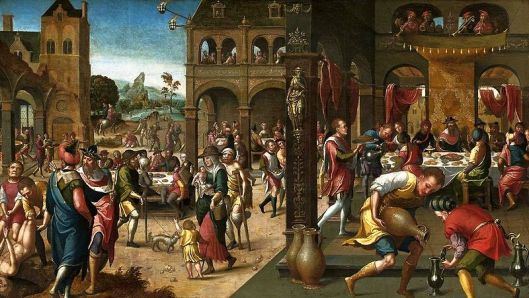
Brunswick_Monogrammist_Great_Banquet

The Parable of the Great Supper / the Great Banquet, by anonymous Dutch painter “the Braunschweig (Brunswick) Monogrammist,” ca. 1525

Trinity season in the Lutheran Church year means no feast days until Christmas, no stories about Jesus’ life in the Gospel texts, and no Vox Christi bass recitatives. To still keep this blog exciting for myself and you loyal readers, I decided to make it into a true weekly series, and will be following all of Bach’s 1723 Leipzig cantatas until Advent, without taking any detours to his Weimar cantatas or later Leipzig cantatas.

A few things that make it irresistible for me to try this: Bach started working  in Leipzig  on the first Sunday after Trinity in 1723 (see last week’s blog post); the dates of the Lutheran Church year in 2016 are practically the same as in 1723 – off by only one day; and I believe that by following this 1723 sequence, we can better imagine how it must have been for the Leipzig audiences (congregation) to hear one cantata after the other, and perhaps get a little insight in how it must have been for Bach himself to write one after the other.

So, here we go with season 1, episode 2:

Previously on Weekly Cantata: Bach arrived in Leipzig on Saturday May 22, 1723,, and made his debut with cantata 75 Die Elenden sollen essen in the Nicolaikirche (St. Nicholas Church) on Sunday May 30, the first Sunday after Trinity.

The second Sunday after Trinity in 1723 marked Bach’s debut in the Thomaskirche (St. Thomas Church). On Sunday June 6, he performed cantata 76 Die Himmel erzählen die Ehre Gottes there, and this one is even more impressive than 75, and includes a festive opening chorus which makes me think of Bach’s later Ascension Oratorio.

There are many similarities between cantata 75 and 76, the most obvious one being that they share the ambitious length of 14 movements in total, divided over two parts. From a superficial point of view, both cantatas start with a psalm text in the opening chorus, have challenging soprano arias, feature bass arias with trumpet, and -never seen again in later cantatas- an instrumental sinfonia at the start of the second part (after the sermon). However there are more (hidden) similarities and cross-references between the two, so that one could almost think about these two first cantatas of the 1723/1724 cycle as a diptych.

I appreciate Gardiner’s interpretation of cantata 76 the most of all recordings I listened to. And the universe will have it that this one was recorded in the Basilique de Saint-Denis (directly north of Paris), which was my subway stop for four fabulous music-filled months in 1994. In his journal from 2000, Gardiner writes that they were very concerned about the enormous size of this Gothic cathedral, and feared that a large audience (needed to balance out the acoustics) wouldn’t show up because it was the night of the France-Italy final in the Euro soccer competition. But everything turned out fine: there were more than 1200 people in the audience, and France won.

Listen to Gardiner’s recording of cantata 76 Die Himmel erzählen die Ehre Gottes on Spotify  or on YouTube, or buy this recording on Amazon.

Cantata 76 starts with a text about heaven: the first and third verse of Psalm 19, Die Himmel erzählen die Ehre Gottes. To illustrate this, the heavenly trumpet (in cantata 75 not introduced until the start of the second half) is heard right away. The fugue on the text “Es ist keine Sprache noch Rede, da man nicht ihre Stimme höre” is fantastic, Bach at his best in my opinion.

After this, the text of the cantata refers to the Gospel reading of the day: the parable of the Great Supper from Luke 14: 16-24 about a man who has invited many guests to a Dinner/Supper/Banquet, receives one cancellation after the other, after which he decides to invite all the beggars and cripples his servant can find, and serves them the dinner instead, not leaving one place open for any of the previously invited guests. All this combined with the “Brotherly love” theme from the Epistle reading of the day: 1 John 3: 13-18.

Another example, though through a completely opposite story as the one from cantata 75, of why it is good to share food and love with others.

Besides the incredible opening chorus, the highlights of this cantata for me are: the soprano aria with violin/cello accompaniment (no. 3), the bass aria with trumpet (no. 5), the incredible sinfonia for oboe d’amore and viola da gamba at the start of the second half (no. 8),  the dramatic, operatic tenor aria (no. 10, fabulously performed by James Gilchrist, including the “shake” Bach wrote on the word “Hasse”), and the alto recitative with viola da gamba (no. 11).

For those who have extra time: listen to the violin/cello duet in the soprano aria accompaniment in an unrivaled (as far as I am concerned) interpretation by Alice and Nikolaus Harnoncourt on their recording from 1976 (scroll to 06:11)

e1712a1a564449d6c9c7a2aad5045250

Nikolaus & Alice Harnoncourt, 1951, before they were married, on tour with the Vienna Chamber Orchestra

Read the German text with English translations of this cantata here, and find the score here.

If you don’t want to miss an episode of this 1723 Trinity season series, please consider signing up  to receive an email every time I’ve posted a new story.

Please feel free to share this on Facebook, or forward to anyone you think might enjoy coming along for this ride. Thank you!

Wieneke Gorter, June 4, 2016, links updated June 12, 2021.
The Leipzig Debut

29 Sunday May 2016

Posted by cantatasonmymind in 1723 Trinity season special series, Bach's life, Cantatas, Leipzig, Trinity

≈ Comments Off on The Leipzig Debut

Tags

Bach, cantatas, Carolyn Sampson, Daniel Taylor, John Eliot Gardiner, Mark Padmore, Peter Kooy, Phlippe Herreweghe

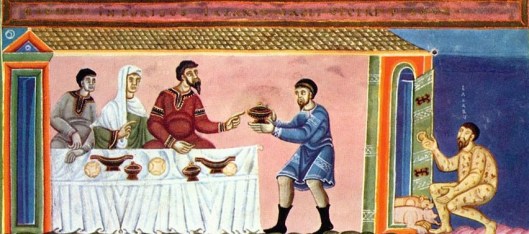
Echternach_Lazarus_Dives

Lazarus and the Rich Man / Lazarus and Dives, Codex Aureus of Echternach, 11th century

On this First Sunday after Trinity (for short:Trinity 1), Sunday May 30, 1723, Bach started his first cycle of weekly cantatas in Leipzig. It was two days before his official installation, and one week after he and his family had arrived in the city.

Trinity is also the start of the part of the church year that deals exclusively with issues of faith and doctrine, instead of celebrating events from Jesus’ life, as was done in the period between Advent and Pentecost. This change must have been important to Bach too, because all three surviving cantatas for Trinity 1 are large-scale, musically ambitious works.

The composition with which Bach made his debut in the St. Nicholas Church (he would not perform in the St. Thomas Church until one week later) was cantata 75 Die Elenden sollen essen, a piece of considerable length, containing no less than 14 movements, seven before the sermon, seven after.

I prefer the recording by Herreweghe, which appears on the same CD as cantata 12 Weinen, Klagen, Sorgen, Zagen.

Listen to Herreweghe’s recording of cantata 75 Die Elenden sollen essen (with soloists Carolyn Sampson, Daniel Taylor, Mark Padmore, and Peter Kooy) on YouTube

Purchase Herreweghe’s recording of cantata 75 Die Elenden sollen essen and two other cantatas on Amazon

Find the complete German text with English translation of this cantata here.

The text of the opening chorus is from Psalm 22, but it is strongly related to the Gospel of the day: the story of Lazarus (a poor leper, who lies in front of the door of a rich man’s house, asking the rich man for food every day) and Dives (the rich man, who ends up in hell when he dies because he didn’t share his blessings/wealth with those in need).

When I listen to the opening chorus, I keep wondering if Bach wrote a Kyrie in Köthen which he never finished or which got lost for another reason. This is not backed up by any of the commentary about this cantata, but in these first measures I can’t stop myself from hearing “Ky-ri-e-e-le–”  in my head when the choir sings “Die-ie E-e-le–.” The music accents the second syllable of the word Elenden, while in the spoken language the stress would be on the first syllable. I find it strange that Bach would have ignored word stress in such an important composition, which he spent extra time on, and probably already wrote before he arrived in Leipzig (Gardiner notes that the paper of the manuscript was not from Leipzig, and that the handwriting was extremely neat). So I’m hoping something will turn up in my lifetime to substantiate this hunch I have ….

Wherever the opening chorus originated from, it is beautifully written,  as are all the arias. The soprano aria has a tender, plaintive oboe d’amore accompaniment, the alto aria floats on a rich blanket of strings, and the bass aria is a show-off piece with virtuosic music for the singer as well as the trumpeter.

There is a symmetry to the order in which the recitatives and arias appear in the cantata which is rarely seen in other Bach cantatas.

In the first half:

Bass recitative – Tenor aria – Tenor Recitative – Soprano Aria – Soprano Recitative

in the second half this pattern is mirrored for the remaining voices:

Alto recitative – Alto Aria – Bass recitative – Bass Aria – Tenor Recitative

But of course it is typical for Bach to use mathematical design when wanting to make a lasting  impression with a composition (such as with the St. Matthew Passion and the Mass in B minor). Also the fact that there are 14 movements to this cantata is not a coincidence: it is the sum of the numbers B, A, C, and H in the alphabet.

There is more symmetry in the cantata: The text of the first half refers to the Gospel story from Luke about Lazarus and Dives, and talks about earthly life and material possessions. In contrast to this, the second half of the cantata moves up to a spiritual level, and up to heaven. This change is illustrated by the introduction of the instrument that was associated with heaven: the trumpet. In the opening movement of the second half of this cantata the trumpet plays the chorale tune with which the first half had ended, Was Gott tut, das ist wohlgetan, and then later accompanies the bass in a stand-out virtuosic aria.

There is also more “showing off” in this cantata. As Gardiner points out, Bach seems to have wanted to make it clear that he was a skilled court composer (which he had been at Köthen before he took the position in Leipzig): after the French Ouverture of the opening chorus, all the arias together from a French Suite: The tenor aria is a Polonaise, the soprano aria a Minuet, the alto aria a Passepied, and the Bass aria a Gigue.


Wieneke Gorter, May 29, 2016


Newer posts →

Recent Posts

  • Family stories and more “Vision Bach” – BWV 179 and 199 for Trinity 11
  • Almost Unbearable, It’s that Good: Hannes Rux-Brachtendorf and Matthias Winckhler in BWV 46 on Rademann’s Vision Bach, Volume 3.
  • “Missa Miniatura” by CONTINUUM/Elina Albach Even More Moving in 2025
  • Bachfest Leipzig 2025
  • Bach Cantatas for Christmas – 1724 and 1734 editions

Archives

  • August 2026
  • August 2025
  • July 2025
  • December 2024
  • November 2024
  • June 2024
  • January 2024
  • December 2023
  • October 2023
  • September 2023
  • August 2023
  • April 2022
  • February 2022
  • January 2022
  • December 2021
  • November 2021
  • June 2021
  • May 2021
  • April 2021
  • February 2021
  • January 2021
  • December 2020
  • November 2020
  • October 2020
  • September 2020
  • August 2020
  • July 2020
  • May 2020
  • April 2020
  • March 2020
  • February 2020
  • January 2020
  • December 2019
  • November 2019
  • May 2018
  • April 2018
  • March 2018
  • February 2018
  • January 2018
  • December 2017
  • November 2017
  • October 2017
  • September 2017
  • August 2017
  • July 2017
  • June 2017
  • May 2017
  • April 2017
  • March 2017
  • February 2017
  • January 2017
  • December 2016
  • November 2016
  • October 2016
  • September 2016
  • August 2016
  • July 2016
  • June 2016
  • May 2016
  • April 2016
  • March 2016
  • February 2016
  • January 2016

Enter your email address to follow this blog and receive notifications of new posts by email.

Join 338 other subscribers

Categories

  • 1723 Trinity season special series
  • Advent
  • After Easter
  • Ascension
  • Bach's life
  • Cantatas
  • Chorale cantatas 1724/1725
  • Christmas
  • Easter
  • Epiphany
  • Following Bach in 1725
  • Köthen
  • Leipzig
  • Septuagesima
  • Travel
  • Trinity
  • Weimar

Meta

  • Create account
  • Log in
  • Entries feed
  • Comments feed
  • WordPress.com

Website Built with WordPress.com.

  • Subscribe Subscribed
    • Weekly Cantata
    • Join 158 other subscribers
    • Already have a WordPress.com account? Log in now.
    • Weekly Cantata
    • Subscribe Subscribed
    • Sign up
    • Log in
    • Report this content
    • View site in Reader
    • Manage subscriptions
    • Collapse this bar
Loading Comments...