Weekly Cantata

Weekly Cantata

Tag Archives: Olivier Picon

Leipzig for Bach = finally getting to work with the legendary Reiche and his crazy instruments

06 Sunday Aug 2023

Posted by cantatasonmymind in 1723 Trinity season special series, Bach's life, Cantatas, Leipzig, Trinity

≈ 2 Comments

Tags

Anneke Scott, Bachstiftung, BWV 105, BWV 24, California Bach Society, Caspar Wilcke, corno da tirarsi, Egger, Gottfried Reiche, J.S. Bach Foundation, Olivier Picon, Rudolf Lutz, Stadtpfeiffer, Todd Williams, Trinity 4, Trinity 8, Trinity 9

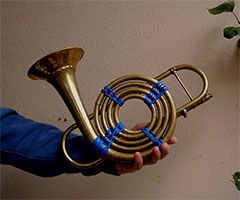
Olivier Picon with a natural horn on the left, and corno da tirarsi on the right

I’m in movie script mode again and jumping back 300 years, to the summer of 1723 in Leipzig. I believe that when moving to Leipzig, Bach couldn’t wait to meet the town’s famous brass player, Gottfried Reiche (1667-1734). I imagine that throughout the summer of 1723, these two creative geniuses would have frequently been “geeking out” about Reiche’s exciting innovation in brass instruments: the corno da tirarsi (or slide horn, on the right in the picture above), for which Bach most probably started writing around Trinity 4 in 1723 (about a month before today’s cantata).

As far as we know Reiche owned the one and only specimen and was the only one who knew how to play it. Scholars consider it very likely that he had the instrument specially made for him, in order to play more complicated music on a horn than one could at the time on a natural horn. 

I have written about the corno da tirarsi before. However, I never fully realized how incredibly special that instrument must have been at the time, what the exact difference was with regular horns at the time, and how it works. Ironically, as a result of musicians being stuck at home during the pandemic, there are now some excellent educational videos on youtube, which explain all of this much better than I could ever do in writing.

So here goes with the lesson:

For an excellent demonstration of the limitations of natural horns before 1750, please watch the first three and a half minutes of this video by Todd Wiliams from the USA.

Then watch this video by Anneke Scott from the UK, about the corno da tirarsi as reconstructed by Egger.

Thank you Todd Williams and Anneke Scott! If you would like to show your appreciation for Anneke’s efforts, you can buy her a coffee on this website. 

Gottfried Reiche

There is no doubt in my mind that Bach had already heard about Leipzig’s highly skilled senior Stadtpfeiffer (town piper) Gottfried Reiche before moving to Leipzig in May of 1723. Bach came from a family of town pipers, and in 1721 he married into a family where every single male was a trumpet player (just sit with that for a few seconds). Reiche was of the same generation as Bach’s father-in-law Johann Caspar Wilcke (c. 1660–1733), and both had been trained in Weissenfels, which Olivier Picon qualifies as “probably the most important city in trumpet playing tradition in Germany at that time” in his 2010 thesis about the corno da tirarsi. I can imagine the animated discussions at both the Bach and the Wilcke family gatherings. Reiche’s virtuosity as well as his unusual instruments* must have been a frequent subject!

Now we come to today’s Cantata 105 Herr, gehe nicht ins Gericht mit deinem Knecht. (Enter not into judgement with Thy servant, O Lord.) It is one of my favorite cantatas, and Bach’s first** Leipzig cantata with a significant solo part for the corno da tirarsi, in the tenor aria. For the educational purpose of this blog as well as for the excellent rendition of the tenor aria I would like to feature the live video by the J.S. Bach Foundation, with Olivier Picon (pictured at the top of this post) playing the corno da tirarsi in the opening chorus, the tenor aria, and the closing chorale. Other soloists are Sibylla Rubens, soprano; Jan Börner, alto; Bernhard Berchtold, tenor; and Tobias Wicky, bass.

Picon initiated the reconstruction of the corno da tirarsi by the Swiss brass instrument firm Egger, which Anneke Scott also refers to in her video. Picon’s thesis from 2010, documenting the reconstruction as well as meticulously analyzing all cantatas that might have possibly been written for this instrument, is still the main source for scholars when discussing the corno da tirarsi. In this work, Picon also shares that Cantata 105 is his favorite cantata to play on the instrument.

Read the German text with English translations of Cantata 105 here, and find the score here.

Of course there’s much more to this cantata than just the unusual instrumentation. In 2021, also as part of a pandemic project, I wrote a post for California Bach Society highlighting all the ways in which this cantata foreshadows the St. Matthew Passion. Please find that post here.  

I welcome your questions, comments, or words of encouragement below in the comment-section. 

Wieneke Gorter, August 6, 2023.

*Reiche apparently was also the owner and player of another unique instrument, the tromba da tirarsi, or slide trumpet.
**Cantata 24 for the 4th Sunday after Trinity 1723 also features a solo part that might have been meant for the instrument, but opinions about this vary, and even Picon suggests the opening chorus might be played on a tromba da tirarsi (slide trumpet) and the closing chorale on a natural horn.

Weekly Cantata is back!

15 Friday Nov 2019

Posted by cantatasonmymind in Cantatas, Chorale cantatas 1724/1725, Leipzig, Trinity

≈ 10 Comments

Tags

22nd Sunday after Trinity, Bachipedia.org, Bachstiftung, Balázs Máté, BWV 115, corno da tirarsi, Marc Hantaï, Olivier Picon, Rudolf Lutz

The Servant Sending his Fellow Servant to Prison, from The Parable of the Unmerciful Servant, bound in Thesaurus Sacrarum historiarum Veteris et Novi Testamenti, 1585.
Anonymous, Netherlandish. Metropolitan Museum of Art, New York (not on view).

I’m back! I’m starting with a small step, but stay tuned … a more considerable post is coming next week.

For this coming Sunday, the 22nd Sunday after Trinity, Bach wrote Cantata 89 in 1723, Cantata 115 in 1724, and Cantata 55 in 1726. Two years ago I wrote about the soprano aria from Cantata 115, not really being able to choose between Susanne Rydén with Bach Collegium Japan or Dorothee Mields with Herreweghe. I also included a link to the soprano aria from Cantata 89. Read that post here.

I still recommend the Herreweghe recording from 2017 for an overall recording of this cantata. However, sometimes it is nice to *see* a performance, and I would like to celebrate an important event in the world of Bach Cantata recordings that happened in the past year: The J.S. Bach Foundation in Switzerland (Bachstiftung) decided to make all their live video recordings of their Bach cantata performances available on YouTube, in full length. Previously, they had only made one movement of each cantata available on YouTube, and one would have to purchase the DVD or buy a live stream subscription in order to see the rest of the cantata.

So in this post I would like to share the Bachstiftung recording of Cantata 115. It was recorded on October 21, 2016, and published to YouTube on October 26, 2018.

Find the German texts with English translations here and the score here.

What is so special about this video recording is that you can see wonderful flutist Marc Hantaï at work in the opening chorus and in the soprano aria. He doesn’t appear on video that often, and they made a good choice to put him in front, so you can see his playing, and of course this way also the microphones pick up his sound better. (to hear more of what I believe is his playing, go to this post).

corno da tirarsi


Other instrumentalists to watch in this video: Olivier Picon on corno da tirarsi, and Balázs Máté on violoncello piccolo. Only three cantatas (46, 162, and 67) show the full name corno da tirarsi written in the manuscript, but there are 27 cantatas from Leipzig requiring a corno in which that part is not playable on a natural horn, so must have been written for this corno da tirarsi as well. Cantata 115 is included in that group. Bach is the only composer who ever mentioned this instrument in writing, and most probably his principal brass player Gottfried Reiche was the only one who ever played it. After Reiche’s death in 1734 Bach did not write for this instrument anymore, and for repeat performances of any cantatas containing a corno da tirarsi part, Bach rewrote it for other instruments. Read more about this in Olivier Picon’s article on the “corno da tirarsi” from 2010. The 27 cantatas are mentioned on page 22 of the article.

To find more of the Bachstiftung videos, search their Archive on their Bachipedia.org website. Most of the videos are “unlisted” on YouTube, so you won’t find them by doing a search within YouTube. Or, for the Dutch readers of this blog, you can use Eduard van Hengel’s new website (another terrific event of this past year!) and click on the links for all YouTube recordings he conveniently provides at the top of each page under the header “Beluister” (for an example, see the one for Cantata 115 here).

Wieneke Gorter, November 15, 2019.

Recent Posts

  • “Missa Miniatura” by CONTINUUM/Elina Albach Even More Moving in 2025
  • Bachfest Leipzig 2025
  • Bach Cantatas for Christmas – 1724 and 1734 editions
  • Fourth Sunday of Advent – more insight into Cantata 62 helped me better understand Bach’s Christmas Oratorio
  • Saint Ambrose and Luther in Milan – Second Sunday of Advent

Archives

  • August 2025
  • July 2025
  • December 2024
  • November 2024
  • June 2024
  • January 2024
  • December 2023
  • October 2023
  • September 2023
  • August 2023
  • April 2022
  • February 2022
  • January 2022
  • December 2021
  • November 2021
  • June 2021
  • May 2021
  • April 2021
  • February 2021
  • January 2021
  • December 2020
  • November 2020
  • October 2020
  • September 2020
  • August 2020
  • July 2020
  • May 2020
  • April 2020
  • March 2020
  • February 2020
  • January 2020
  • December 2019
  • November 2019
  • May 2018
  • April 2018
  • March 2018
  • February 2018
  • January 2018
  • December 2017
  • November 2017
  • October 2017
  • September 2017
  • August 2017
  • July 2017
  • June 2017
  • May 2017
  • April 2017
  • March 2017
  • February 2017
  • January 2017
  • December 2016
  • November 2016
  • October 2016
  • September 2016
  • August 2016
  • July 2016
  • June 2016
  • May 2016
  • April 2016
  • March 2016
  • February 2016
  • January 2016

Enter your email address to follow this blog and receive notifications of new posts by email.

Join 338 other subscribers

Categories

  • 1723 Trinity season special series
  • Advent
  • After Easter
  • Ascension
  • Bach's life
  • Cantatas
  • Chorale cantatas 1724/1725
  • Christmas
  • Easter
  • Epiphany
  • Following Bach in 1725
  • Köthen
  • Leipzig
  • Septuagesima
  • Travel
  • Trinity
  • Weimar

Meta

  • Create account
  • Log in
  • Entries feed
  • Comments feed
  • WordPress.com

Website Built with WordPress.com.

  • Subscribe Subscribed
    • Weekly Cantata
    • Join 158 other subscribers
    • Already have a WordPress.com account? Log in now.
    • Weekly Cantata
    • Subscribe Subscribed
    • Sign up
    • Log in
    • Report this content
    • View site in Reader
    • Manage subscriptions
    • Collapse this bar
 

Loading Comments...