
Tags
Advent, Ambrose of Milan, Christmas, Hilliard Ensemble, Josquin des Prez, martin-luther, Saint Ambrose, Sant'Ambrogio, Sant'Ambrogio Basilica, Veni redemptor gentium

In the absence of a chorale cantata for this second Sunday of Advent*, I wanted to read more about Ambrose of Milan, whose “Veni redemptor gentium” inspired Luther to write his “Nun komm, der Heiden Heiland.” What would Luther have heard about the 4th-century legend when he visited Milan in 1510 on his way to Rome? Always the travel planner, I also wondered if there are there any traces of Ambrose to see in the Milan of today.
Milan’s patron saint

I learned that Ambrose has been Milan’s patron saint for centuries and is still celebrated today. What’s more, the Christmas season in Milan doesn’t officially start until his Saint’s Day, which happens to be … today, December 7. It is on December 7 that the Scala opens its season, with broadcasts of the opera performance throughout the city. And it is on December 7 that the largest Christmas Market opens, and that the bishop preaches in the Sant’Ambrogio Basilica. If you are from Northern Italy or have visited Milan around this time of year you will laugh at me, but I truly didn’t know this when I decided to write a post about Ambrose and his hymn earlier this week, I only found out today.

Ambrose was a theologian and statesman who served as Bishop of Milan from 374 to 397, and is considered one of the most influential ecclesiastical figures of the 4th century. He is the founder of the Sant’Ambrogio Basilica in Milan, which still stands today. His literary works have been acclaimed as masterpieces of Latin eloquence, and as Bishop he did fundamental work for later church-state relations. Ambrose is also remembered as the teacher who converted and baptized the Christian theologian St. Augustine of Hippo.
What Luther would have learned more than a thousand years later
While we know Luther as the most important reformer and founder of Protestantism, he started out as an Augustine monk, and studied Theology in Erfurt. We can assume that Luther already knew Ambrose’s hymns, as they were in use in the churches. However, Luther would likely also have studied Ambrose’s and Augustine’s sermons. For example, Ambrose’s sermon “Exposition of the Gospel According to Luke” was widely circulated. In “Luther’s Theology of Music,” Miikka E. Anttila writes: “Ambrose believed that a psalm softens anger, offers a release from anxiety, and alleviates sorrow. He also pointed out that a child who refuses to learn other things takes pleasure in contemplating a psalm.” These ideas we also find in Luther’s writings.
In 1510, Luther was sent to Rome along with another monk to settle a dispute. There are many legends about Luther’s time in Rome, but I’m more intrigued by his stop in Milan on the way to Rome. In that city, Leonardo da Vinci had finished his Last Supper in 1498. Architect Donato Bramante had constructed the Cloisters of Sant’Ambrogio also in 1498 and a year later finished work on the Santa Maria della Grazie. Also it had been as recently as 1489 that Josquin des Prez, Luther’s favorite composer** had worked in Milan.
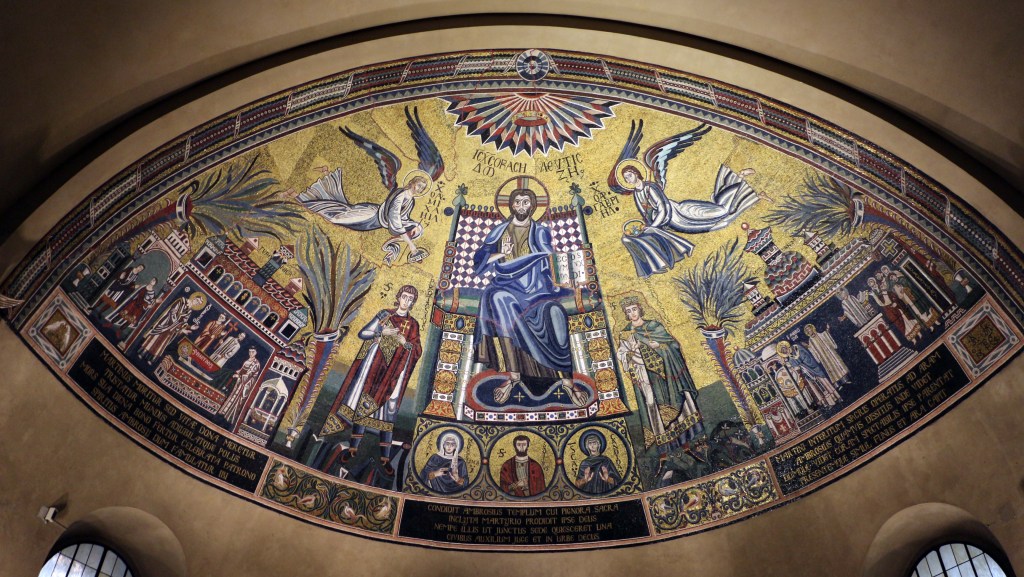
Did Luther visit Sant’Ambrogio Basilica? Did he see this mosaic, which was restored in the 13th century? Did he hear the many legends about Ambrose that made him even more of a hero to him? And: did he happen to hear this incredible polyphony of Josquin des Prez (The Hilliard Ensemble, recorded 1983) somewhere in Milan, and was it thus that he fell in love with Josquin’s music? This is Josquin des Prez’ Ave Maria Virgo Serena, one of the few works by Josquin of which scholars nowadays are certain it was written by him, composed around 1485, during Josquin’s service at the court of Milan, and wildly popular in the 16th century.
As I often say, we will probably never know, but it is nice to contemplate these scenarios, and Milan is now definitely on my “want to go” list.
Wieneke Gorter, December 7, 2024.
*Bach didn’t write a cantata for the second, third, or fourth Sunday of Advent in Leipzig, because the time between the first Sunday of Advent and Christmas was a time of introspection, similar to Lent. Regarding music performed during church services, this meant only strict liturgical singing (= the congregation singing chorales and responses), nothing else.
**Luther wrote: “God has preached the gospel through music, too, as may be seen in Josquin’s, all of whose compositions flow freely, gently, and cheerfully, are not forced or cramped by rules, and are like the song of the finch.”
Further Reading
Find Encyclopedia Brittanica’s entry on Saint Ambrose here.
Find more stories on Saint Ambrose here, and architectural and historical information on the Basilica here.
Find tourist information on Saint Ambrose and the festivities in Milan everywhere on the internet. I started here.
Find the full Latin text of Saint Ambrose’s hymn and Luther’s German adaptation on this website (in Dutch).
Find Yakub E. Kartawidjaja’s PhD thesis “Music in Martin Luther’s Theology” here.

 Weekly Cantata