Weekly Cantata

Weekly Cantata

Tag Archives: Alex Potter

Blogging from Bruges

27 Saturday Jan 2018

Posted by cantatasonmymind in Cantatas, Chorale cantatas 1724/1725, Leipzig, Septuagesima

≈ 1 Comment

Tags

Alex Potter, alto, cantatas, Dorothee Mields, Ignace Bossuyt, Paul Agnew, Peter Kooy, Phlippe Herreweghe, Septuagesima, soprano, Thomas Hobbs
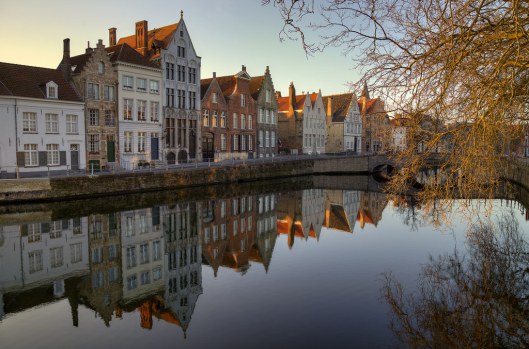
Brugge

I had the privilege of shaking hands with Philippe Herreweghe around midnight on Friday. It was pure coincidence, or serendipity, if you will* and he has no idea who I am, but it was a magical end to an already exciting day at the Bach Academy in Bruges, Belgium.

On that Friday I attended an informative and inspiring lecture by Bach expert Ignace Bossuyt during the day (more about that in a different post), heard a fabulous Bach cantata concert by Collegium Vocale/Herreweghe in the evening, and got to witness a very entertaining interview with Herreweghe late at night. The concert featured Cantatas 186 and 146. It was a feast to see Herreweghe at work, focusing on phrasing and text expression. It was also very enjoyable to experience the rich, well-blended string sound in the orchestra, the terrific oboe playing, the signature sound of the sopranos and altos of Collegium Vocale, and the wonderful work by all four soloists. Bass Peter Kooij stood out for his excellent diction and exquisite tone, tenor Thomas Hobbs for his stage presence and clear voice, and countertenor Alex Potter for his marvelous job in the “Ich und Du” aria from Cantata 146. As always I consider it a blessing to see and hear Dorothee Mields sing. The combination of the sound of her voice and her pronunciation and understanding of the text is something very special and beautiful to behold. I feel lucky that I will get to hear this group of musicians two more times this week: today (Sunday) again in Bruges, and Tuesday in Paris.


Time to talk about the cantata for today now: Cantata 92 Ich hab in Gottes Herz und Sinn for Septuagesima Sunday (the third Sunday before Lent), first performed on Sunday January 28 in 1725. For this cantata, Bach had received an extremely long text from his librettist. We don’t know for sure who Bach’s librettist was at this time. Scholars believe it might have been Andreas Stübel, poet, theologian, and emeritus assistant principal of the St. Thomas School. If it was indeed Stübel, he would pass away on January 31, and might already have been ill around the time Bach was working on this Cantata 92. So while there normally might have been a discussion about the libretto between Bach and Stübel, this time Bach might have had to work with what he had.

The result is a creative but extremely long bass recitative (movement 2), and a rather long cantata in total: nine movements in all. Bach had created such lengthy cantatas at the start of his career in Leipzig, during the summer of 1723, but never before during this chorale cantata cycle of 1724/1725.

This Cantata 92 Ich hab in Gottes Herz und Sinn contains arguably the most operatic tenor aria Bach ever wrote, even crazier than the aria from Cantata 81, an equally dramatic bass aria, and an absolutely lovely soprano aria. But what moves me the most in this cantata is the alto chorale with oboe accompaniment (movement 4). It gives me the good kind of stomach ache every time I hear it. On most recordings this chorale gets sung by all choir altos, not just the alto soloist.

Because I appreciate the bass soloist expressing the drama in his recitative and aria as much as the tenor does in his, my favorite “overall” recording of this cantata is the one by Bach Collegium Japan. Find my playlist here on Spotify. With Yukari Nonoshita, soprano; Jan Kobow, tenor; and Dominik Wörner, bass.

A good alternative on YouTube is Koopman’s recording of this cantata. With Deborah York, soprano; Paul Agnew, tenor; and Klaus Mertens, bass. I always love to hear Paul Agnew in operatic arias like this one.

Please find the text of Cantata 92 here, and the score here. And please consider supporting the artists by purchasing the recording you like best:

Bach Collegium Japan recording of Cantata 92 on Amazon

Koopman recording of Cantata 92 on Amazon


Wieneke Gorter, January 28, 2018.

* A friend and I were sitting in the back of a tiny cafe when Herreweghe and his wife walked in. He went over to greet some fans in the front of the restaurant, then sat down to eat. While I was contemplating what I would say to them later, once I would be on my way out of the restaurant, Herreweghe got up to use the restroom and walked right by our table. My friend asked him if he would welcome even more compliments, and then we shook hands with him and told him how much we had enjoyed the concert. It didn’t feel like the right time to tell him about my blog, and I was too star struck to think of mentioning that I would be attending two of his other concerts this week.


The Herreweghe altos (Trinity 2 in 1724)

25 Sunday Jun 2017

Posted by cantatasonmymind in Cantatas, Chorale cantatas 1724/1725, Leipzig, Trinity

≈ Leave a comment

Tags

Alex Potter, alto, Bach Collegium Japan, Collegium Vocale Gent, Eduard van Hengel, Phlippe Herreweghe

BWV2_title
The title page of cantata 2 Ach Gott tom Himmel sieh darein, written by Bach’s lead copyist, J.A. Kuhnau. Staatsbibliothek zu Berlin Preußischer Kulturbesitz

Regular readers of this blog know that I have a soft spot for the Herreweghe choir sopranos*. But the alto section of Collegium Vocale Gent is often equally impressive, and they deserve a special mention for their fabulous sound in the cantus firmus of this cantata’s opening chorus. Listen to Herreweghe’s recording of cantata 2 Ach Gott, vom Himmel sieh darein on YouTube.

Find the text of this cantata here (read along so you can see the brilliant text-illustration in the music), and the score (where you can see which instruments double which vocal parts) here.

Bach wrote this cantata for the 2nd Sunday after Trinity, which fell on June 18 in 1724.  As I explained last week, this is the second in a series of four cantatas at the start of Bach’s 1724/1725 Leipzig cycle, and according to the master’s orderly design for these first four chorale cantatas, the cantus firmus of the hymn tune (always the same as the cantata title) is now in the alto part.

This Herreweghe recording is from before the time that soloists joined the choir sections of Collegium Vocale, which means that alto soloist Ingeborg Danz does not sing in this excellent group of one mezzo (Mieke Wouters), two contraltos (Yvonne Fuchs and Cécile Pilorger), and one countertenor (Alex Potter). Also the blend with the instruments doubling this alto part (two oboes and one trombone) is so marvelous it gives me goose bumps. Then again, there aren’t many things in music that move me more than a Bach opening chorus with trombones.

Whenever Bach uses the archaic form of chorale motet as opening chorus, especially when he combines it with the use of the Renaissance/Early Baroque trombone quartet (1 cornetto and 3 trombones), he wants to stress the timeless importance, the authoritative character of a message. In this case the at that point already two centuries old message is the chorale, one of Luther’s own.  For readers who understand German: Eduard van Hengel’s website (in Dutch) has a very insightful overview of the original German text of Psalm 12, the text of Luther’s chorale, and how Bach’s librettist changed that into the text for the cantata.  You can find it here.

Bach alto and tenor arias are at their prettiest, I find, when they are written as a trio sonata, and there is a wonderful example of that in the alto aria Tilg, o Gott in this cantata. It is a plea for help in fighting the “Rottengeister,” or the sectarians amidst the Lutherans. Alto soloist Ingeborg Danz does a terrific job interpreting the text. When the alto starts singing the word Rottengeistern, we see that it was that word we had already heard many times in the triplets of the violin part. As Eduard van Hengel says, it is the “popular easy talk of the sectarians, and that is also the reason why the other two parts don’t have this motive” [to further illustrate the schism].

In his effort to educate his fellow Lutherans (the Leipzig congregations) with his music, Bach wants to make it clear that he’s still preaching by means of the well-known chorale, and uses longer notes for the direct quotation (in music and text) of the chorale in this aria: der uns will meistern.

The best interpretation of the tenor aria Durchs Feuer wird das Silber rein actually appears on another recording, that of Bach Collegium Japan with tenor Gerd Türk. You can listen to that aria here. Here we have arrived at the solution/salvation part of the cantata, and so this music is more pleasant, easier to listen to. But Bach is still preaching: there are some crossing (!) lines in the music, and in the middle section, which tells the listeners to be patient (sei geduldig) and Bach stresses the words Kreuz und Not.

So one wonders: was Bach’s decision to focus on chorales for this 1724/1725 cantata cycle inspired by his need to make things easier for the boy sopranos, or by a wish to explain the theology to the congregations in a way that was more obvious to them than the more complicated, sometimes perhaps too hidden, messages he had so far delivered by way of his music? Or had the City Council or the church elders told him to to this?

*Read more about that in this post.

Wieneke Gorter, June 25, 2017

First Sunday after Easter 1724

23 Sunday Apr 2017

Posted by cantatasonmymind in After Easter, Bach's life, Cantatas, Leipzig

≈ Leave a comment

Tags

Alex Potter, Bach, cantatas, corno da tirarsi, Jos van Veldhoven, Peter Kooy, Thomas Hobbs, tromba da tirarsi

caravaggio_-_the_incredulity_of_saint_thomas

The Incredulity of Saint Thomas by Caravaggio, 1601-1602, Sanssouci Palace, Potsdam, Germany

In the past two weeks I ran out of time to work on this blog because of being sick, performing concerts with California Bach Society, and being on a trial jury for the first time since becoming a United States citizen in 2011. So this post for the First Sunday after Easter in 1724 is post-dated, and short, but contains lots of information to learn more about this beautiful cantata.

Previously in 1724: Bach “premiered” his Passion according to St. John on Good Friday, April 7, 1724. Then he ran out of time and energy and, without too much care for detail and text illustration, created cantatas out of existing music for Easter Monday and Easter Tuesday of that year.

This means that the first new composition he wrote after the St. John Passion was this cantata 67 Halt im Gedächtnis Jesum Christ (keep thinking of Jesus Christ), based on the Gospel text of Jesus appearing to his disciples. A famous cantata, already known and admired in the early 19th century, especially because of the dramatic fourth movement for choir and bass, which Bach would later transform into the Gloria of his Missa Brevis in A (BWV 234).

For the background of this cantata I will refer you to the experts, in this 15-minute video by the Netherlands Bach Society, published within their AllofBach series. The video is in Dutch, with English subtitles. It talks about Bach including a flute (not a recorder!) for the first time in a cantata, the meaning behind the text, and the use of the slide-trumpet “corno da tirarsi.”

Listen to and watch their performance here, find the text here, and find the score here. The Netherlands Bach Society, conducted by Jos van Veldhoven, with countertenor Alex Potter, tenor Thomas Hobbs, and bass Peter Kooij.

Wieneke Gorter, April 30, 2017.

Newer posts →

Recent Posts

  • “Missa Miniatura” by CONTINUUM/Elina Albach Even More Moving in 2025
  • Bachfest Leipzig 2025
  • Bach Cantatas for Christmas – 1724 and 1734 editions
  • Fourth Sunday of Advent – more insight into Cantata 62 helped me better understand Bach’s Christmas Oratorio
  • Saint Ambrose and Luther in Milan – Second Sunday of Advent

Archives

  • August 2025
  • July 2025
  • December 2024
  • November 2024
  • June 2024
  • January 2024
  • December 2023
  • October 2023
  • September 2023
  • August 2023
  • April 2022
  • February 2022
  • January 2022
  • December 2021
  • November 2021
  • June 2021
  • May 2021
  • April 2021
  • February 2021
  • January 2021
  • December 2020
  • November 2020
  • October 2020
  • September 2020
  • August 2020
  • July 2020
  • May 2020
  • April 2020
  • March 2020
  • February 2020
  • January 2020
  • December 2019
  • November 2019
  • May 2018
  • April 2018
  • March 2018
  • February 2018
  • January 2018
  • December 2017
  • November 2017
  • October 2017
  • September 2017
  • August 2017
  • July 2017
  • June 2017
  • May 2017
  • April 2017
  • March 2017
  • February 2017
  • January 2017
  • December 2016
  • November 2016
  • October 2016
  • September 2016
  • August 2016
  • July 2016
  • June 2016
  • May 2016
  • April 2016
  • March 2016
  • February 2016
  • January 2016

Enter your email address to follow this blog and receive notifications of new posts by email.

Join 338 other subscribers

Categories

  • 1723 Trinity season special series
  • Advent
  • After Easter
  • Ascension
  • Bach's life
  • Cantatas
  • Chorale cantatas 1724/1725
  • Christmas
  • Easter
  • Epiphany
  • Following Bach in 1725
  • Köthen
  • Leipzig
  • Septuagesima
  • Travel
  • Trinity
  • Weimar

Meta

  • Create account
  • Log in
  • Entries feed
  • Comments feed
  • WordPress.com

Website Built with WordPress.com.

  • Subscribe Subscribed
    • Weekly Cantata
    • Join 158 other subscribers
    • Already have a WordPress.com account? Log in now.
    • Weekly Cantata
    • Subscribe Subscribed
    • Sign up
    • Log in
    • Report this content
    • View site in Reader
    • Manage subscriptions
    • Collapse this bar
 

Loading Comments...