
Tags
Alex Potter, Anna Schall, Arnstadt, Bach, Bachfest 2025, Bachfest Leipzig, Bachkirche, Benedikt Kristjánsson, Bertram Burkert, BWV 232, Continuum Berlin, Daniel Rosin, Elina Albach, Jürg Halter, Johanna Bartz, Joosten Ellée, Joseph Crouch, Lambert Colson, Liam Byrne, Lola Mlácnik, Marie-Luise Werneburg, Mass in B Minor, Nikolaikirche, Philipp Lamprecht, Raphael Höhn, St. John Passion, Thüringer Bachwochen, Thomas Halle, Tobias Berndt, Tobias Knaus, Viola Blache

I want to tell a story and I want to touch everyone in the audience. People can hate it, and that’s okay, we can talk about it! But I don’t want it ever to happen that someone is leaving a concert of my group saying it didn’t move them in any way.
This is what CONTINUUM’s leader Elina Albach told me when I interviewed her in April 2022, and it still rings true today. For me, CONTINUUM’s Missa Miniatura was the most compelling concert at Bachfest Leipzig 2025, and an even stronger manifesto for peace than when I first heard it at the Bachkirche in Arnstadt in 2022.
Unless otherwise noted, all quotes in this article are from the interview I had with Elina Albach in April 2022 and have been edited for clarity.
What is Missa Miniatura?
CONTINUUM’s Missa Miniatura is a chamber-music version of Bach’s Mass in B Minor, arranged by Elina Albach for six singers and seven to eight instrumentalists. It is called “Miniatura” not just because it is performed by fewer people, but also because several movements have been cut from the original score. The Christe Eleison, the second Kyrie, the Gratias, the first three Credo movements, and the second Osanna are replaced by spoken texts, written specifically for this production by Swiss author Jürg Halter. In the music that remains, the vocal parts are almost the same as in the original composition.1 Of the instrumental parts, all original notes are played, but sometimes on completely different instruments than the original score asks for, and also divided differently over the various instrumentalists.
This new approach makes for an exciting, captivating, and thought-provoking concert experience. The spoken texts create a story arc in the piece, which, as an audience member, I often miss in performances of Bach’s Mass in B Minor.
Who is Elina Albach and what moved her to create an adaptation of Bach’s Mass in B Minor?
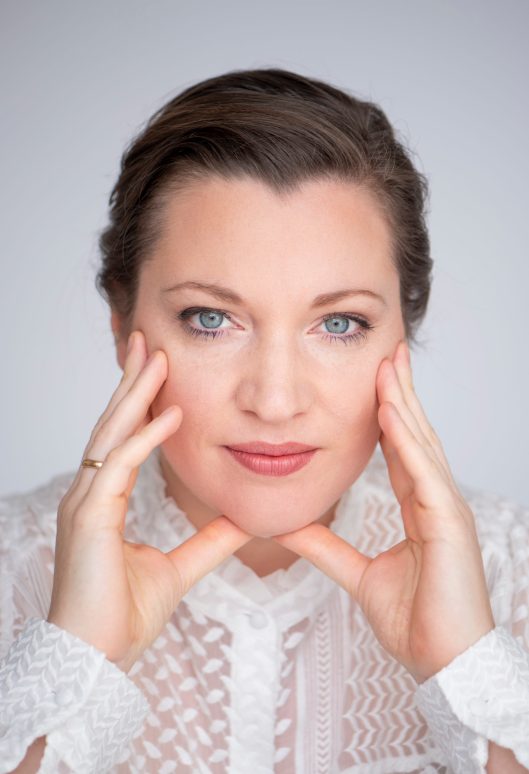
Elina Albach is an award-winning harpsichordist, and the leader and founder of ensemble CONTINUUM, which has become known for its fresh and innovative approaches to Early Music performance. To the wider Bach audience, Elina Albach is probably best known as one of the creators of the Three-person St. John Passion, which received an OPUS Klassik award for the most innovative concert in 2019 and was broadcast live on Good Friday 2020 from an empty Thomaskirche in Leipzig.2
Regarding Bach’s Mass in B Minor, Elina foremost wanted to give the audience a chance to reflect on what “believing” means nowadays. This is the main reason she wanted contemporary spoken texts to replace the first three movements of the Credo, which contain the words “I believe in one God, the Father almighty, maker of heaven and earth, of all things, seen and unseen. And in one Lord, Jesus Christ, the only begotten Son of God.”

She also strongly felt she wanted to reduce the length of the piece, for the practical reason that singing two hours in a row would be too demanding for such a small group of singers, and having an intermission is not an option for her:
“I prefer not having breaks in a concert. When one tries to build a story, a break just destroys everything. When I try to create a particular atmosphere, I really want to grab the audience’s hands and pull them into the concert.”
Selecting instrumentalists: “It is all about the people.”
What distinguishes Elina even more in the world of classical musicians is that she tends to form an ensemble based on the people she loves to share a stage with. Which exact instruments these people play is secondary. She explains this well in a preview video for Missa Miniatura on her YouTube channel:
“I look at which personalities would be a perfect fit for this project, even if they play an instrument that wasn’t planned. It is all about the actual person, with their individual background and abilities, their intellect, and their positive attitude —all the elements I require to realize this project.”
This year in Leipzig, this approach created such a compelling energy on stage, that I personally felt more than pulled into it: I wanted to curl up in the middle of it.
Orchestration
Of course, if you put together an ensemble this way, and still want all the notes from the original score to sound, it becomes quite a puzzle to figure out which instrument will play which notes. Elina admitted this process was much more complicated for the Mass in B Minor than for the St. John Passion. But thanks to a six day retreat with all instrumentalists where they tried out several different options, she solved the puzzle beautifully.

© Bachfest Leipzig/Gert Mothes
Hearing different instruments in the arias and choruses than the ones I’m used to kept me alert as a listener and made the music more transparent. The most striking change was the extreme percussiveness of the “Crucifixus,” which was played on electric guitar, violin, viola da gamba, cello, and harpsichord, with some of the string players playing col legno (with the wooden part of the bow hitting the strings). I felt it illustrated the crucifixion much better than Bach’s original orchestration.
Electric guitar? Yes! Keep reading to find out more about Bertram Burkert.
A strong connection to Bach’s manuscript
seeing it laying there was just very, very emotional
Through a special collaboration with the Staatsbibliothek (state library) in Berlin, all members of CONTINUUM had the rare opportunity to view several pages from Bach’s manuscript of the Mass in B Minor during their rehearsal week in that same building in February 2022. Elina says:
“We saw five or six pages. Of course I had checked the whole manuscript on the internet, but seeing it laying there was just very, very emotional. It was wonderful to be able to give all my instrumentalists and singers the opportunity to see it as well. Because I think it’s one thing to be free with the music, to be free with the concept, and to use different instrumentalists. But I am, of course, still very interested in historical performance practice and I get furious if someone is playing the wrong ornaments or the wrong Generalbassaussetzung [basso continuo realization]. So I think that it was just so good to perform this very free version of the B Minor Mass, but sticking to the original autograph we saw in the library.”

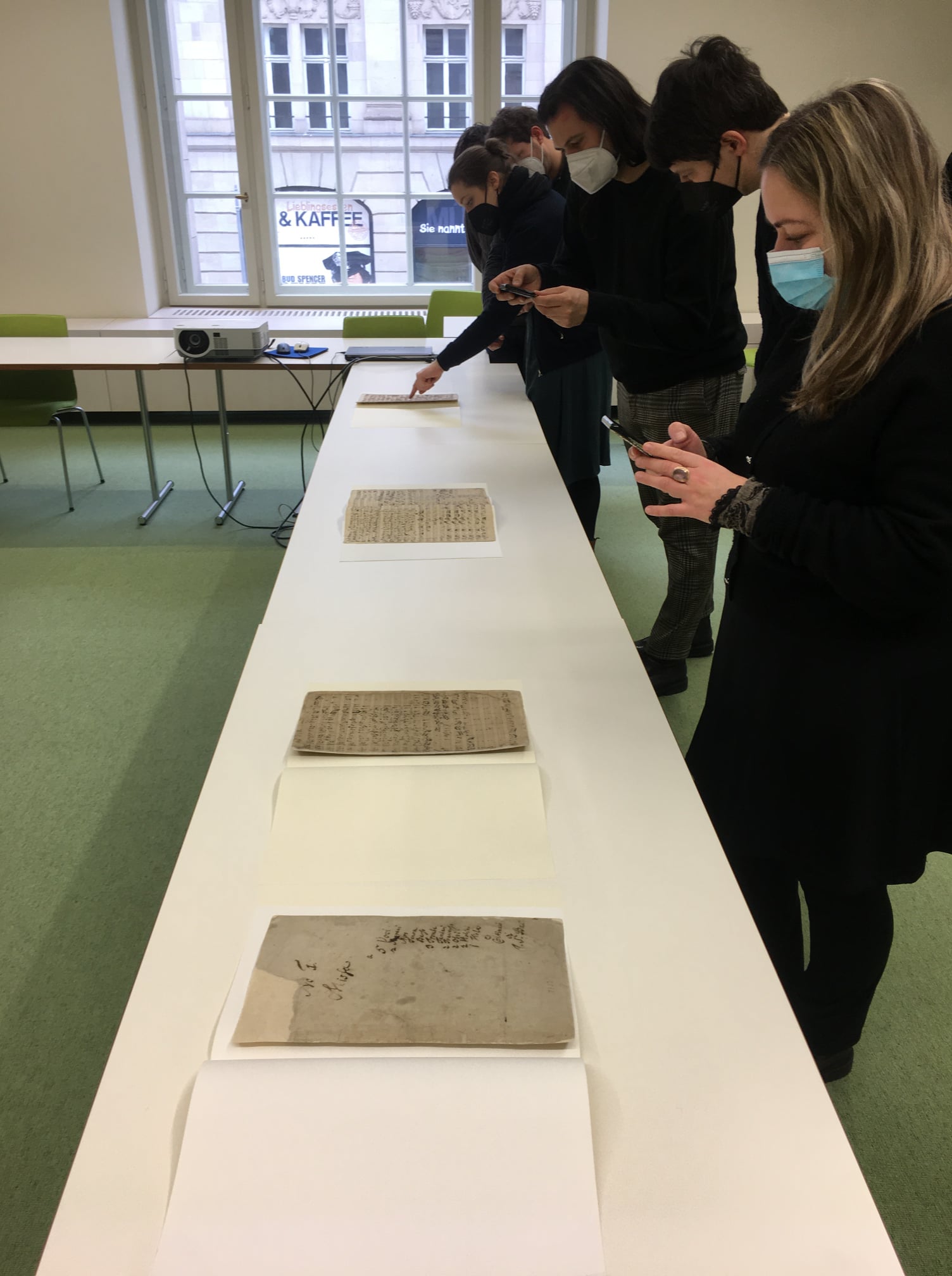
Members of CONTINUUM viewing Bach’s manuscript of his Mass in B Minor at the Staatsbibliothek in Berlin. Photos by Alex Potter.
Sensitive and well-balanced ensemble singing
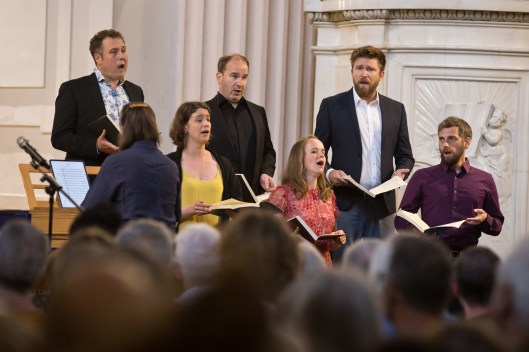
Exciting orchestration aside, this production wouldn’t be as successful as it is without the sensitive and well-balanced ensemble singing by the six fabulous vocalists: sopranos Marie Luise Werneburg and Viola Blache; countertenors Alex Potter and Tobias Knaus; tenor Raphael Höhn; and bass Tobias Berndt. Especially the “Qui Tollis” was fantastic at the concert in Leipzig this year, sung by only four singers, with an incredibly gorgeous entrance by Alex Potter (I already wrote about his “Agnus Dei” aria in my previous post).
How the text became a manifesto for peace
The premiere of Missa Miniatura was set for March 3, 2022, in Berlin. Author Jürg Halter had already finished the texts, to be spoken by actor Thomas Halle during the performance, when, on February 24, Russia invaded Ukraine. It made Halter delete all his words and write new, more personal ones. He finished the texts during the night of March 2. Elina adds:
It’s such a huge privilege standing there, performing and making music, while only 700 or 800 kilometers from Berlin, people are dying.
“For me at least, and I think for all of us in the first performances, it was very, very moving because we felt it’s such a huge privilege standing there, performing and making music, while only 700 or 800 kilometers from Berlin, people are dying. The text finishes with the words ‘I want to see you all laughing in peace,’ after which the ‘Agnus Dei’ and ‘Dona Nobis Pacem’ [Grant us Peace] come. Thus, the whole concert is now a manifesto for peace and against war and cruelty. It has gained that additional layer, which is good.”

Here’s an excerpt of the First Reading, which in the performance comes right after the first Kyrie:
“Ich zweifle an uns Menschen. Ich will nicht glauben, dass ich nicht mehr glauben kann. Ich kann nicht mehr glauben, weil ich weiß. Ich weiß, dass nachdem ich als Kind vom Holocaust erfuhr, mein Zweifeln begann. Meine Gebete wurden mehr und mehr zu Anklagen. Je mehr ich über die dunkle Geschichte unserer Spezies erfuhr, desto weniger konnte ich glauben, dass wenn es tatsächlich einen Gott gäbe, er es zulassen würde, dass Menschen durch Menschen vernichtet werden – denn weshalb um alles in der Welt würde er als Allmächtiger so etwas geschehen lassen? Friede auf Erde den Menschen guten Willens? Nein – was ist schon nur mit all den Verbrechen, die im Namen des vermeintlich Guten, im Namen Gottes begannen werden? Ist Gott ein Zyniker? Ich bin verzweifelt. Ich weiß nur, was ich zu wissen glaube. Ich sehe nur: Die große Herrlichkeit gebärt auch die große Schrecklichkeit. Zweifle nicht – aber ich zweifle!”
German text by Jürg Halter, © 2022; English translation by me, with help from DeepL Translator
I doubt us humans. I don’t want to believe that I can no longer believe. I can no longer believe, because I know. I know that my doubts began when I learned about the Holocaust as a child. My prayers started to sound more and more like accusations. The more I learned about the dark history of our species, the less I could believe that if God actually existed, he would let humans destroy other humans – because why on earth would he, as the Almighty, let something like that happen? Peace on earth to people of goodwill? No – what about all crimes committed in the name of the so-called Good, in the name of God? Is God a cynic? I am desperately confused. I only know what I have come to believe. All I can see is that great glory also gives birth to great horror. Doubt not—but I doubt!
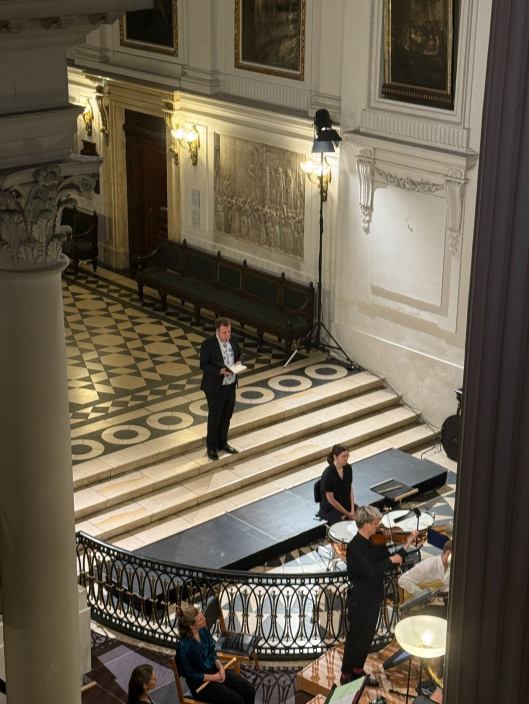
At the time of our interview, Elina suggested they might change the texts in a year. But of course, over the past three years, there have been only more reasons to wish for peace, not less. On June 17, 2025, this horrific reality hit me hard as the concert in the Nikolaikirche was starting. So this First Reading affected me more this time, perhaps also because Thomas Halle read it, in my humble opinion, with more confidence and conviction than he did in 2022.
Electric guitar? Yes! And another moving story about a plea for peace
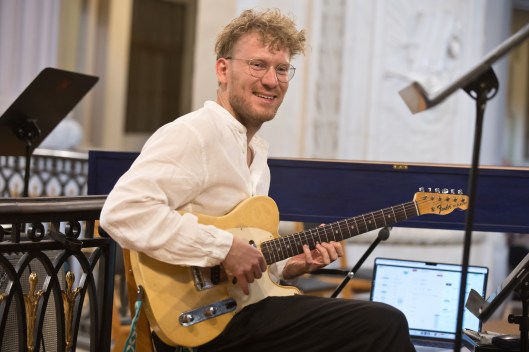
Electric guitarist Bertram Burkert provided a new aspect to the production this year in Leipzig. He did an amazing job playing the notes percussionist Philipp Lamprecht used to play on marimba in previous performances of this piece. His interpretation was completely convincing and very musical. He also played a stellar improvisation to help the spoken text that replaces the first three Credo movements flow into the “Et incarnatus est.” It made the “Et incarnatus est” as poignant as three years ago, albeit in a completely different way. After the concert Elina told me enthusiastically how wonderful it was for her to find a person coming from the jazz world who also loves Baroque music and has such an open mind about combining different styles and traditions of music.

In the “friends and family” row on the second balcony of the Nikolaikirche in Leipzig, my seat was next to a lovely German couple. When I talked to them after the concert, they turned out to be Bertram’s parents. They had traveled there from Weimar and the concert had moved them too. As people who have their roots in church music, they were deeply touched to see and hear their jazz musician son perform Bach, but also moved that they found themselves in the Nikolaikirche. They reminded me this is where the peaceful protests against the GDR had started in the 1980s.3 Nowadays, there are still posters in the Nikolaikirche advertising the Monday evening “Friedensgebet” (prayer for peace), which has been held there every Monday evening since 1982.
When Bertram’s parents told me that during the first 10 years after the fall of the Iron Curtain, they thought this peace was going to last forever, I had to think of Halter’s text in Missa Miniatura‘s Second Reading:
“Never has peace been anything but a long or short phase between wars. You have to be insane to believe in world peace – I would like to be insane. Is that already a profession of faith?”
Let’s talk about it
CONTINUUM’s Missa Miniatura was a great success, not miniature at all in its impact on the audience. Please let me know in the comments if you heard this production at any time over the past three years, how it moved you, and if it made Bach’s Mass in B Minor more transparent for you. Remember, even if you hated it, “we can talk about it!” 🙂

My heartfelt thanks to Marie-Luise Werneburg, Viola Blache, Alex Potter, Tobias Knaus, Raphael Höhn, Zachary Wilder, Tobias Berndt, Thomas Halle, Johanna Bartz, Anna Schall, Lambert Colson, Joosten Ellée, Liam Byrne, Bertram Burkert, Daniel Rosin, Joseph Crouch, Lola Mlácnik, and Philipp Lamprecht for the two concerts I attended in 2022 and 2025. And to Elina Albach for making time for the interview in 2022, for answering my additional questions this week, for her playing and directing, but most of all for her powerful and inspiring energy!
Wieneke Gorter, August 2, 2025.

- Only in the Osanna, instruments are taking over some of the notes from the vocal lines, and the tenor and bass singers are „jumping“ between both choirs. In the end, all notes are played or sung. ↩︎
- The Three Person St. John Passion (or “Johannes Passion zu Dritt” in German) is Bach’s St. John Passion, arranged by Elina Albach, tenor Benedikt Kristjánsson, and percussionist Philipp Lamprecht for tenor solo, percussion, and organ/harpsichord. The only parts that are eliminated are the tenor arias (yes, that is correct: the tenor sings all the arias except his own) and most notes of the choir are played by harpsichord and percussion. In concert performances of this adaptation, the chorales are sung by the audience. This production became widely known on and after Good Friday 2020, during the Corona pandemic, when it was livestreamed from the St. Thomas Church in Leipzig. Several chorales had been pre-recorded by Bach choir members from all over the world, and these were edited into the live performance. ↩︎
- A good explanation of Leipzig’s role in the peaceful revolution of 1989 can be found here. ↩︎



 Weekly Cantata