Weekly Cantata

Weekly Cantata

Tag Archives: Hanneke van Proosdij

Palm Sunday 1714

05 Sunday Apr 2020

Posted by cantatasonmymind in Bach's life, Cantatas, Leipzig, Weimar

≈ Leave a comment

Tags

BWV 18, BWV 182, BWV 21, BWV 61, Charles Daniels, Eric Milnes, Hanneke van Proosdij, Harry van der Kamp, Matthew White, Monika Mauch, Montreal Baroque, Rachel Podger, Voices of Music, Weimar
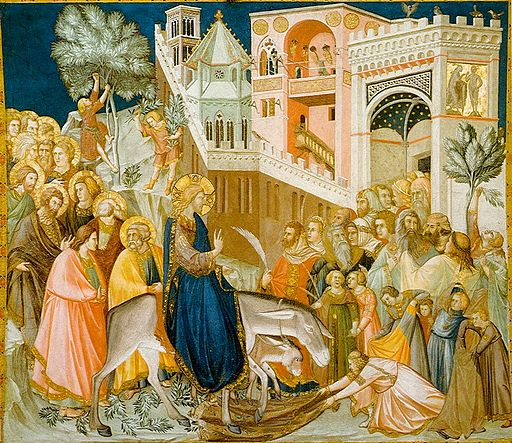
Jesus Entrance into Jerusalem. First picture is Lorenzetti’s version, in the Basilica of Assisi, 1320. Second picture is Giotto’s version from 1305, in the Capella Scrovengni in Padua, third is Duccio’s, created between 1308 and 1311, as part of an altar piece, currently in the Museo dell’Opera Metropolitana del Duomo in Siena. The first two are frescoes, the last one is tempera on wood. 

We’re on Day 20 of “shelter in place” here in the San Francisco Bay Area. We’re counting our blessings, trying to figure out how we can be most helpful to others while also taking good care of ourselves, and trying to wean ourselves off spending too much time on social media. I definitely need my “church” of regular check-ins with family and friends, daily mindfulness exercises, and lots of yoga classes to stay sane through all of this.

Back to Bach’s church. Today is Palm Sunday! Bach never officially wrote a cantata for this Sunday, since no music was to be performed in the churches during Lent. However, in 1714, Palm Sunday fell on the same day as the feast of the Annunciation of Mary, March 25. This way, while specifying “for the feast of the Annunciation of Mary” on the title page of the cantata manuscript, Bach could still write music for Palm Sunday with cantata 182 Himmelskönig, sei wilkommen! (Welcome, King of Heaven!)

If you’re not in the mood for a long story and would just like to listen to a short piece of calming music, I recommend the live performance of the opening sinfonia of this cantata on the YouTube channel of Voices of Music, with two fabulous soloists: Hanneke van Proosdij on recorder and Rachel Podger on violin. You can find that video here.

Many of Bach’s Weimar cantatas start with an elaborate instrumental ouverture or sinfonia.* There are two possible reasons for this. First of all, it was in Weimar that Bach studied lots of French and Italian compositions, and he might have wanted to “show off” that he could also write such a fashionable ouverture. But there might have also been a more practical reason: such an opening movement was the perfect piece of music during which the Duke and his entourage would slowly walk into the chapel and take their seats, and not miss anything of the cantata itself.

For the entire cantata, my all-time favorite still is the recording by Montreal Baroque. Listen here on Spotify, or here on YouTube. Their one-on-a-part performance is similar to how this would have sounded from the small organ loft in Weimar, and features fabulous singing all around (soprano Monika Mauch, countertenor Matthew White, tenor Charles Daniels, bass Harry van der Kamp).

Find the text of cantata 182 here, and the score here.

If you would like to learn more about Bach’s time in Weimar, please visit my post about Bach in Weimar I wrote in 2016. I’ve just updated it with some new photos, including a picture of the organ loft, and it has all the same links for the recording, text, and score as mentioned here.

In Leipzig in 1724, Bach performed this cantata again, on the feast of the Annunciation of Mary, which that year fell eight days before Palm Sunday.

Wieneke Gorter, April 5, 2020.

*(for example cantata 21 Ich hatte viel Bekummernis, 18 Gleichwie der Regen und Schnee vom Himmel fällt, and 61 Nun Komm der Heiden Heiland)

The Annunciation of Mary, March 25

25 Saturday Mar 2017

Posted by cantatasonmymind in Cantatas, Leipzig, Weimar

≈ Leave a comment

Tags

Annunciation, Bach, cantatas, Hanneke van Proosdij, Leipzig, Lent, Luther, Montreal Baroque, Palm Sunday, Rachel Podger, Voices of Music, Weimar

botticelli2c_annunciazione_di_cestello_02

The Annunciation, aka The Cestello Annunciation, 1489, by Botticelli. Uffizi Gallery, Florence, Italy.

In 1714, Palm Sunday fell on the same day as the Annunciation of Mary, March 25. The Annunciation was one of the three Marian feast days Luther kept on the calendar (the other two being the Purification of Mary, February 2, and the Visitation of Mary, July 2).

Thus it happened that in that year, in Weimar, Bach wrote a cantata that is mostly a Palm Sunday cantata, but can also work for the feast of the Annunciation, since that also celebrates the coming of Christ. I squeezed this cantata 182 Himmelskönig, sei willkommen into my post about Bach in Weimar I wrote last year. As I mentioned there, the cantata was repeated a few times in Leipzig, but never on Palm Sunday, as the Leipzig rules dictated that no music was performed during the period of Lent (the 40 days before Easter).

However, the Leipzig council made an exception for the Annunciation, so in 1724 Bach could perform this cantata during Lent, eight days before Palm Sunday, on Saturday March 25. As so often on holidays, there were two cantatas this day, one before the sermon, and one after. The other, newly written, piece for Saturday March 25, 1724, was more literally about the Annunciation: Siehe, eine Jungfrau ist schwanger (Behold, a Virgin is pregnant). The text of this cantata survived, and can be found here, but unfortunately the music is lost.

I still recommend the recording of cantata 182 by Montreal Baroque, but since I wrote my post last year, a terrific live video of the Sonata (instrumental opening) of this cantata has come out on the YouTube channel of Voices of Music, with two fabulous soloists: Hanneke van Proosdij on recorder and Rachel Podger on violin, so I would love to share that here as well. You can find that video here.

Find the text of cantata 182 here, and the score here.

Wieneke Gorter, March 24, 2017.

Recent Posts

  • “Missa Miniatura” by CONTINUUM/Elina Albach Even More Moving in 2025
  • Bachfest Leipzig 2025
  • Bach Cantatas for Christmas – 1724 and 1734 editions
  • Fourth Sunday of Advent – more insight into Cantata 62 helped me better understand Bach’s Christmas Oratorio
  • Saint Ambrose and Luther in Milan – Second Sunday of Advent

Archives

  • August 2025
  • July 2025
  • December 2024
  • November 2024
  • June 2024
  • January 2024
  • December 2023
  • October 2023
  • September 2023
  • August 2023
  • April 2022
  • February 2022
  • January 2022
  • December 2021
  • November 2021
  • June 2021
  • May 2021
  • April 2021
  • February 2021
  • January 2021
  • December 2020
  • November 2020
  • October 2020
  • September 2020
  • August 2020
  • July 2020
  • May 2020
  • April 2020
  • March 2020
  • February 2020
  • January 2020
  • December 2019
  • November 2019
  • May 2018
  • April 2018
  • March 2018
  • February 2018
  • January 2018
  • December 2017
  • November 2017
  • October 2017
  • September 2017
  • August 2017
  • July 2017
  • June 2017
  • May 2017
  • April 2017
  • March 2017
  • February 2017
  • January 2017
  • December 2016
  • November 2016
  • October 2016
  • September 2016
  • August 2016
  • July 2016
  • June 2016
  • May 2016
  • April 2016
  • March 2016
  • February 2016
  • January 2016

Enter your email address to follow this blog and receive notifications of new posts by email.

Join 336 other subscribers

Categories

  • 1723 Trinity season special series
  • Advent
  • After Easter
  • Ascension
  • Bach's life
  • Cantatas
  • Chorale cantatas 1724/1725
  • Christmas
  • Easter
  • Epiphany
  • Following Bach in 1725
  • Köthen
  • Leipzig
  • Septuagesima
  • Travel
  • Trinity
  • Weimar

Meta

  • Create account
  • Log in
  • Entries feed
  • Comments feed
  • WordPress.com

Website Built with WordPress.com.

  • Subscribe Subscribed
    • Weekly Cantata
    • Join 156 other subscribers
    • Already have a WordPress.com account? Log in now.
    • Weekly Cantata
    • Subscribe Subscribed
    • Sign up
    • Log in
    • Report this content
    • View site in Reader
    • Manage subscriptions
    • Collapse this bar
 

Loading Comments...