
Tags
Bach, Charles Daniels, City Council, cornetto, Dorothee Mields, Gesualdo Consort Amsterdam, Harry van der Kamp, Leipzig, Lent, Sigiswald Kuijken
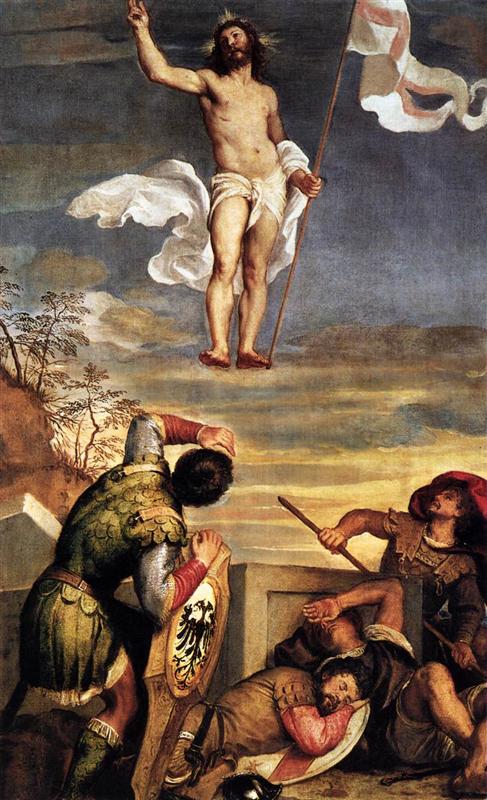
The Resurrection by Titian, 1542-1544
This post is really three posts in one, because I’ve realized over the past weeks that for this Easter season, I would like to follow Bach’s cantata performances of 1724 the same way I did that for the Trinity Season of 1723. Thanks for reading to the end!
In the year 1724 in Leipzig, the last Sunday service with music in the churches had been on February 20, when Bach performed the same cantatas (22 and 23) as on that Sunday in 1723, when they were part of his audition in Leipzig.
Bach’s reason for repeating two existing cantatas for that last Sunday before Lent might have been that he was busy writing his Passion according to St. John. However, he might have had extra reasons: cantata 22 features the Vox Christi (voice of Christ). By reminding the Leipzig audiences of the role of Christ in the scripture and his music, they would–in Bach’s mind– hopefully be well prepared for the St. John, in which the figure of Christ is powerfully prominent, much more than in passion compositions of Bach’s predecessors, and even much more than in Bach’s later St. Matthew Passion, even though the singer portraying Christ has more notes to sing in that piece.
The long monologue by Christ occurs almost right away in the opening of cantata 22. Listen to it here on the AllofBach website, performed by the Netherlands Bach Society, with bass Christian Immler. (If you are wondering what that string instrument is on the shoulder of the medieval-looking guy, it is Sigiswald Kuijken playing the violoncello da spalla, and you can read more about it in this post).
Then, a month later, on Saturday March 25, outside of the regular church year, there was the performance for the Annunciation, as I discussed here. In that cantata, 182, written much earlier in Weimar but not known to the Leipzig audiences until March 25, 1724, there’s also a Vox Christi, singing the words “Siehe, ich komme, im Buch ist von mir geschrieben …” (Lo, I come: in the book it is written of me…). So here we have another “convenient” performance for Bach: no new music to write for the first part of the service*, and a good reminder of the Vox Christi for the listeners.
Despite Bach’s efforts to put his audience in the right frame of mind for the St. John Passion, they were surprised (according to some accounts even shocked) when they heard it on Good Friday, April 7, 1724. I’m pretty sure that Bach himself had not expected this. The passion must have been on his mind already such a long time, and I have no problem picturing this brilliant but nerdy musician who was somewhat incapable of putting himself in the shoes of those with shallower minds. Why I believe the Passion according to St. John must have been on his mind for months already: the tenor aria “Ach mein Sinn” already presents itself in October 1723 in cantata 109 (read more about that here), in November 1723 in cantata 60 (read more about that here), and in January 1724 in cantata 154 (which also has a Vox Christi, read more about it here). Also, the “Herr, Herr” exclamations from the opening chorus first appear as early as July 1723 in cantata 105 (which also has previews of the St. Matthew Passion, read about it here).
Already the opening chorus is of such a dramatic intensity – nobody had every heard anything like it. In the liner notes with his recording, Gardiner says it well: “Even when approaching it from the vantage point of the preceding church cantatas, with their astonishing array of distinctive opening movements, this grand tableau is unprecedented both in scale and Affekt.” What is more, while the instrumental opening suggests lament, the text of the vocal parts turns out to be a praise of Christ as a majestic figure: not a victim, but a victor. Perhaps this vision is what stung the elders and city council members the most, because a year later, in his drastic 1725 revision of the Passion, Bach completely replaced this victorious opening chorus with a lamenting one, later also used as the final movement of the first half of the St. Matthew Passion.
For Easter 1724, on Sunday April 9, Bach performed a cantata from his Weimar years and one from his Mühlhausen years: cantata 31 Der Himmel Lacht, die Erde Jubilieret (discussed here on this blog) and the nowadays well known cantata 4 Christ lag in Todesbanden. Why no new composition for this Easter Sunday? Perhaps he was proud of these cantatas and wanted to show off to the Leipzig congregation and to his colleagues. But most probably he had been extremely busy working on the Passion, and since he was planning no less than four new cantatas for the period between April 10 and 23 of that year, he simply didn’t have time to write anything new.
Watch this live performance by Gesualdo Consort Amsterdam of cantata 4 Christ lag in Todesbanden. It is by no means an impeccable performance, but it is nice to see a live performance of this, and as so often I am moved by Dorothee Mields’ interpretation. I adore how she blends with the cornetto in the alto/soprano duet (starts at 5:27), and her duet with tenor Charles Daniels (a fabulously sensitive and knowledgeable singer, but sometimes overpowered by the orchestra in this performance) is exquisite (starts at 6:10).
* Bach performed two cantatas on that Saturday March 25, 1724, and he did write new music for the second one.

 Weekly Cantata