For today, Exaudi Sunday, or the sixth Sunday after Easter, or the Sunday after Ascension, in 1725 Bach wrote Cantata 183 Sie werden euch in den Bann tun. When I started listening to this cantata I realized I had already written about this one, recommending a golden recording by Bach Collegium Japan, and highlighting the beautiful, unusual instrumentation of this cantata. You can read that post here.
It was a pleasant discovery on a day where I thought I still needed to write two posts (including the belated one for Ascension Day). I can actually spend some time outdoors with my family now. But at the same time it is a bit shocking to me that I’ve apparently now written so many blog posts that I don’t necessarily remember all of them! Up until now I knew if I had written about a cantata or not. It probably means that it is time for me to slow down some more, and then create a good index on this website …
The title page of cantata 183 in Bach’s handwriting: Dominica Exaudi // Sie werden eüch in den Bann tun // à 4 Voci, 2 Hautb d’Amore, 2 Hautb da Caccia, 2 Violini, Viola, Violoncello piccolo e Continuo // di Joh. Sebas. Bach. Staatsbibiothek zu Berlin – Preußischer Kulturbesitz
There are two cantatas for this Sunday Exaudi, aka the Sunday after Ascension, or in the practical reality of the man who had to write the music and rehearse the choir: the Sunday in between Ascension and the three-day-long feast of Pentecost. Because they refer to the same Gospel text, the cantatas share the title Sie werden euch in den Bann tun, but except for the fact that they each contain a glorious soprano aria, they have nothing in common.
I discuss both cantatas in this blog post. Keep reading for Cantata 183, but let’s first look at the one Bach wrote in 1724: Cantata 44 Sie werden euch in den Bann tun.
The soprano aria from this cantata, Es ist und bleibt der Christen Trost, sung by the amazing Peter Jelosits on the Harnoncourt recording from 1975 is among the most happiest music memories of my childhood. I suspect my mom loved it so much that she played it more often than just on this Sunday. I didn’t realize how well this aria is engraved in my brain until I surprised myself during a choir carpool, singing the entire thing from memory, illustrating a story about how some of these boy sopranos could sing very complicated arias.
Es ist und bleibt der Christen Trost, The consolation of Christians is and remains Dass Gott vor seine Kirche wacht. God’s watchful care over his church. Denn wenn sich gleich die Wetter türmen, For even though at times the clouds gather, So hat doch nach den Trübsalstürmen yet after the storms of affliction Die Freudensonne bald gelacht. the sun of joy has soon smiled on us.
If you would like to listen to the entire cantata, I recommend Herreweghe’s recording from 2013. The opening tenor/bass duet is the best here, with bass Peter Kooij singing out much more than on their 1993 recording of this same cantata, and his and Thomas Hobbs’ voice matching better than his and Christoph Prégardien’s (as much as I love Prégardien’s voice!).
Also, Herreweghe’s interpretation of the soprano aria on this 2013 recording is the most musical and the most cheerful, not in the least because it has the highest tempo of all recordings I listened to. That this proves a bit of a challenge for the always fabulous soprano Dorothee Mields is only audible in the text: after she comes out of the expertly executed but super tricky long runs, she slips back into the edition she probably studied from, which uses the more modern “für seine Kirche” instead of the edition they’re performing from, which uses the archaic “vor seine Kirche,” so it ends up being a mix of the two texts. While this bugs me a little bit, a retake of the recording would probably have been at the expense of the magic that happens in this aria, so it is probably a good thing that they left it in.
Purchase the Herreweghe recording of cantata 44 on Amazon or on iTunes. (This album also features the beautiful recording of cantata 73 discussed here).
Find the entire German text of cantata 44 with English translations here, and the score here.
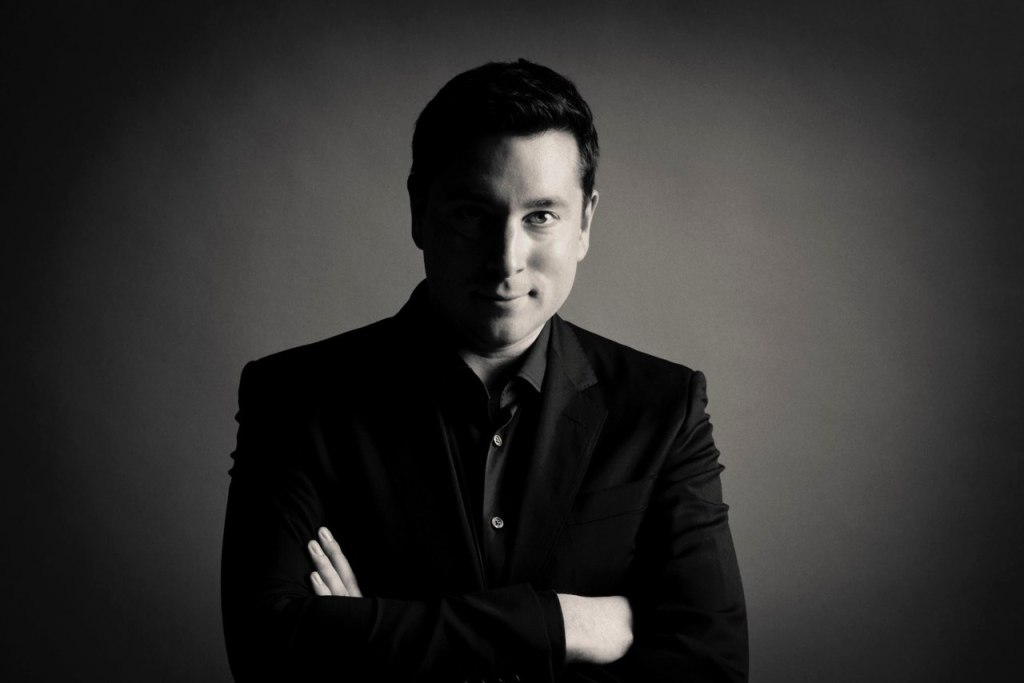
Thomas Hobbs, tenor (photo by B Ealovega)
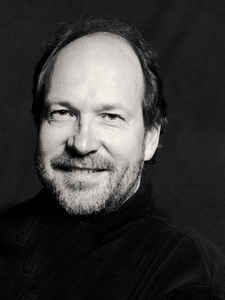
Peter Kooij, bass
Cantata 183 from 1725 is noteworthy because it uses a text by Christiane Mariana von Ziegler and features a striking instrumentation: two oboi d’amore and two oboi da caccia in the bass recitative; a violoncello piccolo in the tenor aria; again the two oboe pairs in the alto recitative; two oboi da caccia in the soprano aria; all these instruments in the closing chorale.
My absolute favorite recording of this cantata is the one by Bach Collegium Japan. They struck gold with this recording, thanks to the combination of Badiarov playing the violoncello piccolo da spalla, fabulous oboe players, and terrific vocal soloists: soprano Carolyn Sampson, countertenor Robin Blaze, tenor Gerd Türk, and bass Peter Kooij. I think the entire album (also featuring the recording of cantata 85 discussed here) is very inspired, and it has become one of my favorite Bach cantata CDs.
Listen to this Bach Collegium Japan recording of cantata 183 on Spotify.
Purchase this Bach Collegium Japan recording of cantata 183 (and 85!) on Amazon or on iTunes.
Find the German text with English translation of Cantata 183 here, and the score here.
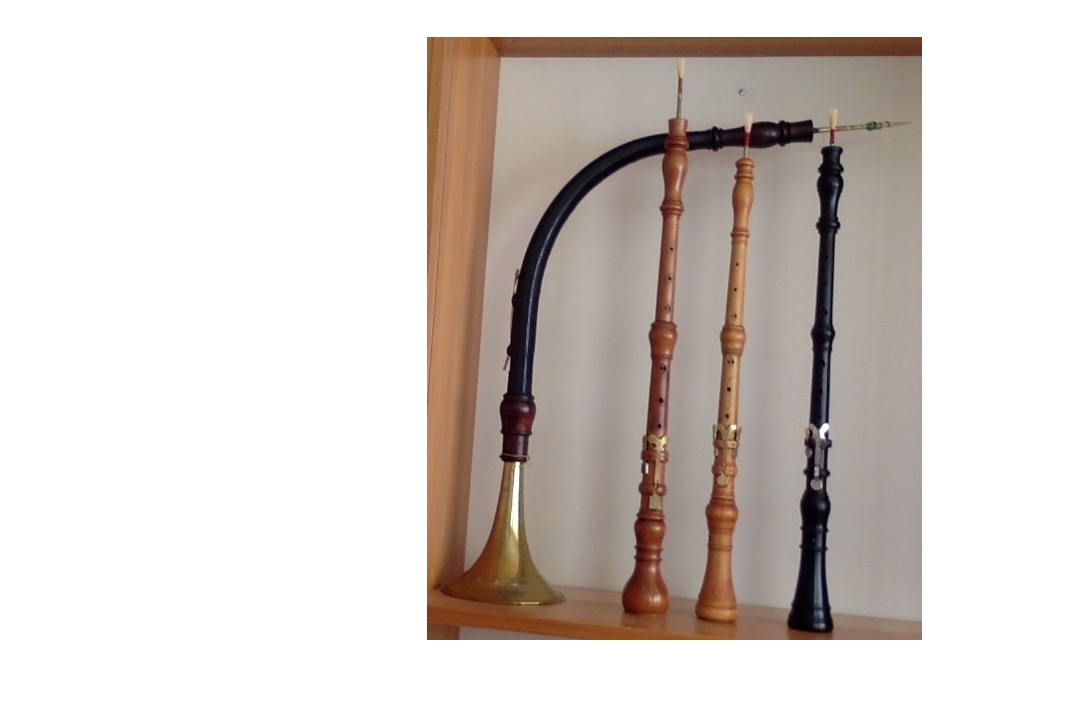
Why is this scoring for the oboes so unusual? In Bach’s time there were “regular” oboes (to the right on this photo), oboes d’amore (with a bell-like widening in the wood at the end, second from left), and oboes da caccia (or “hunting” oboes, completely curved, and with a trumpet-like brass bell at the end, far left).
From left to right: oboe da caccia, oboe d’amore, oboes. Photo courtesy of Marianne Richert Pfau; instruments built after 18th century examples by Sand Dalton, Harry van Dias, and Paul van der Linden, respectively.
Bach often used the oboe da caccia, but only on a handful of occasions would he write for two da caccias. And even if he would write for two da caccias or two d’amores and “regular” oboes in the same cantata (or passion) they would not all be playing at the same time. On most occasions there were between one or two oboe players in the orchestra, sometimes three, alternating between the different instruments from one movement to the next. The only times Bach needed four oboists in one cantata, playing two da caccias and two d’amores at the same time, was in cantata 2 of the Christmas Oratorio (1734) and in this cantata 183. So there must have been some good oboe playing visitors in town around this time of Ascension and Pentecost in 1725.
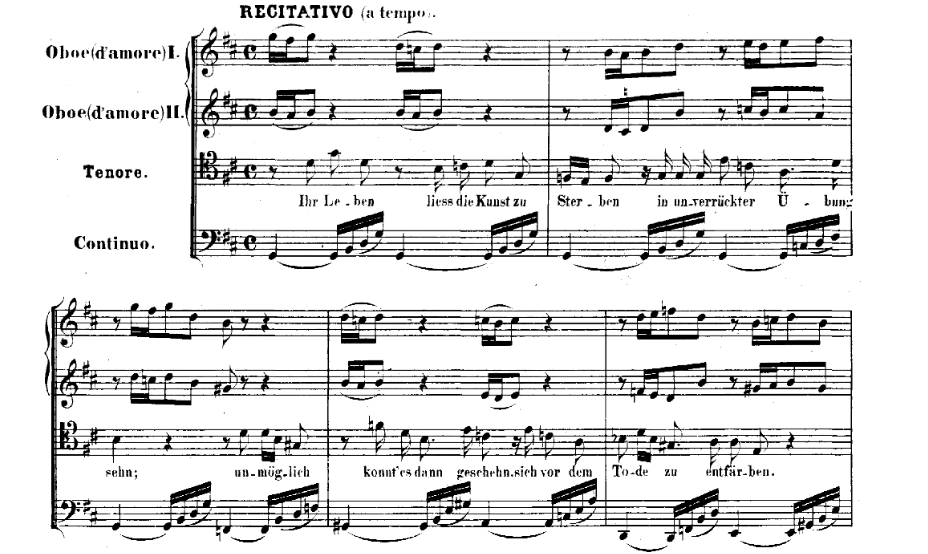
The four oboes can be heard clearly in the alto recitative, where Bach has each of them repeat the four-note theme from the “ich bin bereit”-text in the vocal part:
When I hear this, I immediately have to think of the tenor recitative in Bach’s beautiful Trauer Ode, cantata 198, this time reduced to a 3-note theme and without the da caccias:
Or listen to this recitative from cantata 198 on YouTube
It is of course not exactly the same composition, but I wonder if Bach had to think back of this cantata from 1725 when he wanted to illustrate life and death in one and the same piece of music in the Trauer Ode of 1727.
After this alto recitative comes the most glorious soprano aria, richly scored with the two oboes da caccia playing the oboe part in unisono, as well as parts for violin 1, violin 2, and viola. Harnoncourt says that even though both da caccia have this aria written in, he says it is “clearly not intended to be chorally played” and on their recording they decide to have this part covered by only one oboe da caccia. Perhaps the original full score was not available to Harnoncourt at the time he made that decision, because it clearly says: “tutti gli Oboi in unisono:”
excerpt from the soprano aria from cantata 183, with Bach’s indication for “all the oboes in unisono,” Staatsbibiothek zu Berlin, Preußischer Kulturbesitz
One would almost think Bach dreamt of allfour oboes playing this, also the d’amores, but when his copyists double-checked with him, he decided that was just silly, it would overpower the poor boy who had to sing this, and they only wrote it into the parts for the da caccias (it says “Arie Tacet” in the parts for the oboi d’amore).
To learn more about Cantata 183, I wholeheartedly recommend you study with Rudolf Lutz of the J.S. Bach Foundation a little bit. Find a link to his fabulous (English spoken!) lecture and improvisation about this cantata in my blog post from May 24, 2020.
Wieneke Gorter, May 8, 2016, updated May 23, 2020.




 Weekly Cantata