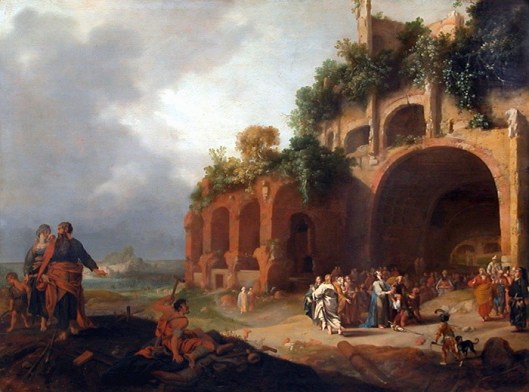
Jesus healing a deaf and mute man at Decapolis, by Bartholomeus Breenbergh, 1635
Last week, Bach gave his principal trumpet and horn player Gottfried Reiche a little break, but this week he needs him back: after the “old style” church motet opening chorus for Trinity 11, this week’s cantata for Trinity 12 opens with festive trumpets and timpani.
Listen to this cantata 69a Lobe den Herrn, meine Seele in the recording by Bach Collegium Japan on Spotify, with Toshio Shimada on trumpet.
Even though the text of the Gospel for this Sunday, the story of Jesus healing a deaf and mute man, is a jubilant one, it is still unusual that for a “regular” Sunday Bach would use three trumpets and timpani in the orchestra. Had the council complained about him teaching too much of his stern theology, being too somber, in the past cantatas? Was perhaps Anna Magdalena’s father (the principal trumpeter at the court of Saxe-Weissenfels, and most probably a friend of Reiche, who was from that same region) in Leipzig to see his daughter and grandkids, and wanted to play in the orchestra with his friend? Again, all good material for a movie script …
In his journal of their cantata pilgrimage in 2000, John Eliot Gardiner writes that the trumpet part in the opening chorus makes him think of the last seven bars of the Cum Sancto Spiritu from the Mass in B minor. I agree, but the start of this opening chorus also really makes me think back to cantata 147 for the feast of the Visitation of Mary on July 2.
Just like last week’s cantata, and many other cantatas from this period, today’s composition ended up in Bach’s top 15, in the sense that he re-used it many times afterwards, and reworked it into important other works. In this case he changed the tenor aria with oboe da caccia and recorder into an alto aria for oboe and violin for a performance in 1727, and reworked the entire cantata into a celebratory cantata for the re-election of the council in 1749 (BWV 69).
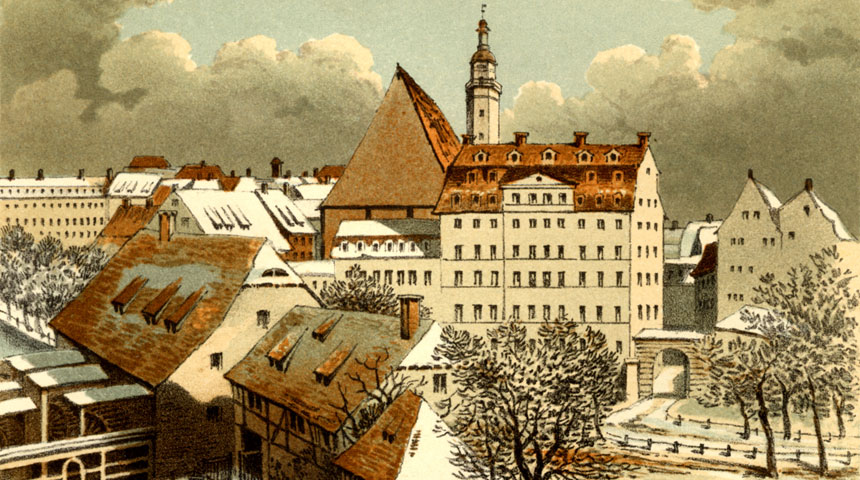
Mendelssohn’s sketch of the Thomasschule (St. Thomas School) and, behind it, the Thomaskirche (St. Thomas Church) in Leipzig.
Thank you for following this blog, and thank you for reading this long post all the way to the end!
For Trinity 11 (August 8 in 1723), we’re listening to Cantata179 Siehe zu, daß deine Gottesfurcht nicht Heuchelei sei, with a superb opening chorus and one of the most beautiful soprano arias Bach ever wrote.
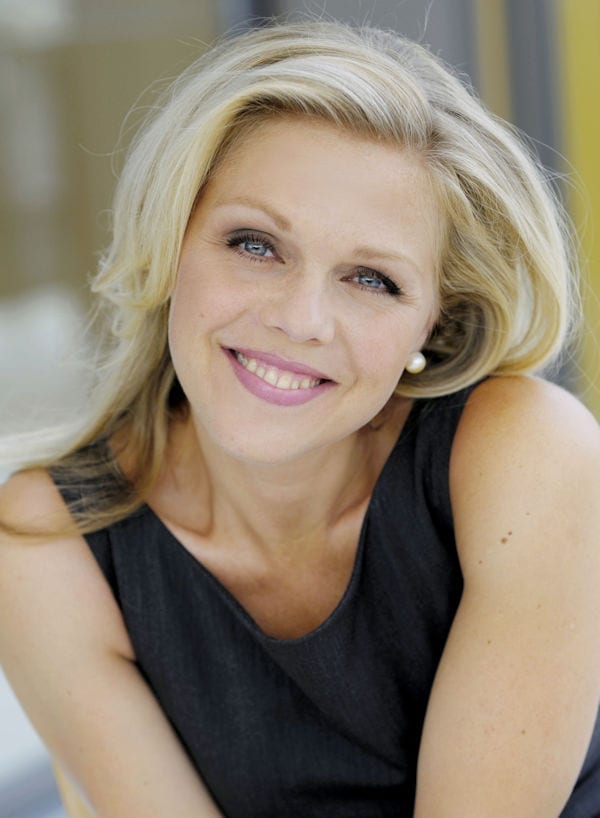
Miah Persson. Photo by Monika Rittershaus.
I prefer Bach Collegium Japan’s recording of this cantata. It’s a special recording, with Miah Persson singing the soprano aria. She’s having quite a career now, so I think we’re lucky to have her beautiful voice and sensitive interpretation on this recording from 1999. You can find it on Youtube or Spotify. Please consider purchasing this recording on jpc.de, Amazon, or iTunes. Soloists on this recording are Miah Persson, soprano; Makoto Sakurada, tenor; and Peter Kooij, bass.
Please find the score here (it’s fun to read along with the recording, especially in the opening chorus, to see what Bach does with the fugue) and the German text with English translation here.
It is now more than two months since Bach started his new job in Leipzig, and he is about three weeks into writing a brand new composition every week, and I’m sorry if I sound too casual here, but he’s on a roll. He must now have a vision of what it is he really wants to do for these churches (see the tiny preludes to his Passions he incorporates in cantatas 105 and 46), and he must have the classes at the St. Thomas School organized, and his singers sufficiently trained, so that he can now have them sing a new and challenging opening chorus every week. Just listening to the opening choruses alone, starting with the one of cantata 136 for Trinity 8, I marvel at what he comes up with every time. Every single one of them is stunning, but at the same time completely different from the one of the previous Sunday. This time Bach chooses to write a perfect “old style” (Palestrina-style) motet fugue as opening chorus.
As always, to fully understand the cantata and not miss any of Bach’s hidden messages, it is important to look at the Gospel reading for the day. In this case it is the parable of the Pharisee and the Publican (or Pharisee and the Tax Collector), a story Jesus tells as an illustration on how to pray: the Pharisee is full of himself, telling God how good he is, while the Publican in his own prayer merely asks for mercy, and tells God how bad he is. This concept of “how to be a good Christian before God” was very important to Bach and apparently his librettist got the message loud and clear. He or she uses the opportunity to first write a strong protest against fake religion and hypocrisy in “Christianity today” in movements 1 to 3 (probably having certain people in Leipzig in mind), after which he/she states that all Christians should take the humbleness of the publican as example in movements 4 to 6. For another example of how Bach interprets this Bible story, read my post about Cantata 113, written for this same 11th Sunday after Trinity, in 1724.
The most special feature of the fugue in the opening chorus is that since the text talks about beautiful outer appearance versus a bad character, Bach uses a mirror-fugue, which he used as well in fugues 5-7 from the Art of the Fugue (the theme of six bars is first introduced by the basses, and then is answered by the tenors in an “inversion:” every step up from the basses becomes a step down in the tenor part.)
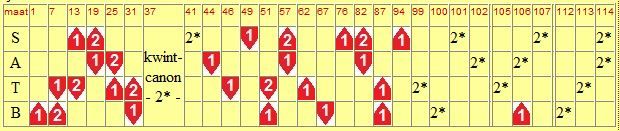
To understand how Bach built this intricate fugue I am sharing the excellent music example and diagram by Dutch Bach writer Eduard van Hengel, with his permission:
Even though the text here is in Dutch, the diagram speaks for itself, with this quick explanation of the numbers and symbols:
1 = The theme (or first half-sentence of the text: Siehe zu, dass deine Gottesfurcht nicht Heuchelei sei). Note the ascending line on the word “Gottesfurcht” (fear of God/love of God) and the descending line on the word “Heuchelei” (hypocrisy).
2 = The counter-subject (or second half-sentence of this text: und diene Gott nicht mit falschem Herzen). Note here that there is a chromatic line every time the word “falschem” appears in the text: for the chromatic line the composers needs accidentals that are not part of the key the piece is written in, which in the “old polyphony” would be seen as “falsch” (not right, off-key).
2* = a more compact (only 4 bars instead of 6 bars long) theme which is derived from the first counterpoint/counter-subject on the words und diene Gott nicht mit falschem Herzen, still with the chromatic line on falschem Herzen.
The numbers at the top are measure (“maat”) numbers.
Bach himself must have greatly valued this cantata. About 15 years later, he used no less than three movements from this cantata for use in his short masses, or Lutheran masses.**
The opening chorus was later “recycled” as the first movement (Kyrie) in the Mass in G Major, BWV 236. Keep listening, or scroll to 18:00 and you’ll discover that the tenor aria Quoniam (sung here by Thomas Hobbs) was, with some changes and a much slower tempo, recycled from the tenor aria in this cantata 179. In cantata 179 the tenor aria gets a colorful accompaniment of two oboes and first violins in unison. The second violins and violas fill in the meaningless middle part (representing the “nothingness, emptiness”). When recycling this later for the Quoniam in the Mass in G Major, Bach uses only one solo oboe for the accompaniment, and completely leaves out all strings (confirming that with a different text, the meaningless middle part is not relevant anymore).
This cantata’s wonderful soprano aria (with two oboi da caccia and basso continuo) was later reworked into the Qui Tollis for the Mass in A Major, BWV 234 (with two flutes and only high strings as continuo). This was actually how I first knew and loved this soprano aria, I didn’t know cantata 179 until I started listening to it for this blog. Please click on this link and listen to the amazing Agnès Mellon sing the Qui Tollis from the Mass in A Major.
Wieneke Gorter, August 14, 2016, links updated August 15, 2023.
** These are called “short” or “Lutheran” masses because they consisted of only the Kyrie and Gloria part of the traditional Catholic mass. Bach wrote four of them (BWV 233-236), and they are all made up of existing movements from cantatas, but reworked and compiled in a very smart way and they are all absolutely beautiful. You can purchase an album with Herreweghe’s recording of all of them on jpc.de, iTunes, or Amazon.
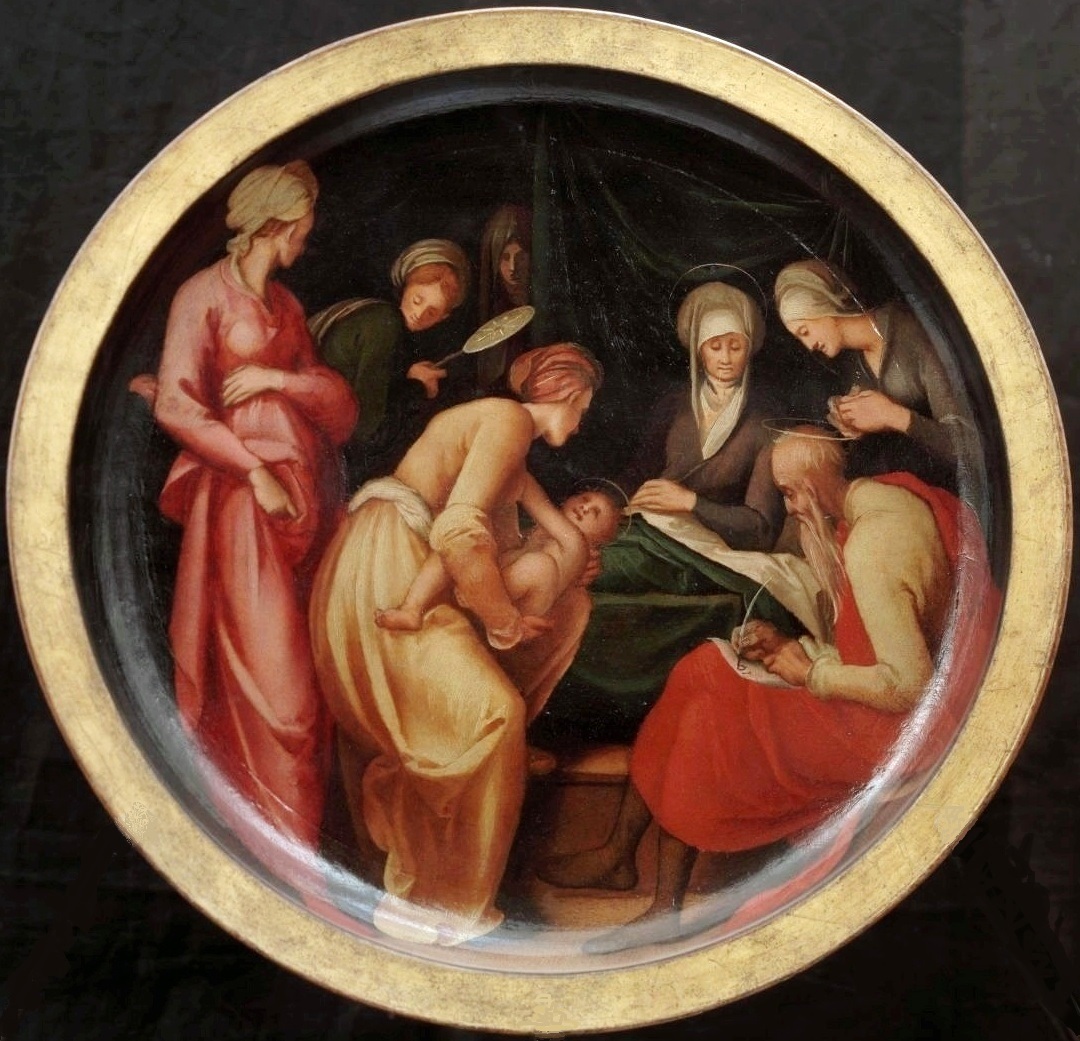
Birth of St. John the Baptist, Zechariah writing “His name is John,” by Jacopo Pontormo, c. 1526. Uffizi, Florence, Italy.
In Bach’s time, June 24 was an important feast day, celebrating the birth of John the Baptist. In the Lutheran faith, it is believed that John the Baptist paved the way for Jesus to come into the world, and his birthday was thus dated exactly six months before Jesus’ birthday. Many paintings from the 16th century onward show Mary with a baby Jesus in her lap, while John the Baptist, or St. John, usually depicted as an already standing infant, is looking on or playing with Jesus.
It means that on this day, June 24, 1723, the Leipzig congregation got to hear a new cantata already on Thursday: cantata 167, Ihr Menschen, rühmet Gottes Liebe.
My favorite recording of this cantata is the one by Montreal Baroque, with terrific singing especially by tenor Charles Daniels and soprano Suzie Leblanc.
A little more than a week later, on July 2, the church would celebrate the feast of the Visitation (Mary visiting her relative Elizabeth), strongly related to St. John. (Another wonderful cantata for that coming up next week!)
So let’s imagine two consecutive weeks of festival buzz in Leipzig, since both these holidays were important. Thanks to Gardiner’s research, we know that during trade fairs, the Leipzig population would grow to 30,000, and that Bach would often have extra students and colleagues visiting. The feasts of St. John and the Visitation did not fall during a trade fair, but we can assume that there were nonetheless a few hundred, or maybe even a few thousand visitors in Leipzig for these holidays.
And it really looks and sounds to me as if Bach is showing off to his fellow musicians in the writing of this St. John cantata from 1723. While it is a small-scale and intimately scored work, it showcases impressive composition talent and skills: a lovely tenor aria with wonderful melismas on the word “preiset” (praise), brilliant meter changes in the already striking soprano-alto duet, a bass recitative which gives the listeners a “sneak peek” at the melody of the closing chorale, and a terrific setting of the closing chorale.
The Gospel reading for this day is the declamation by Zechariah from Luke 1: 57-80. Zechariah, the father of St. John the Baptist, has been made mute by Gabriel because he didn’t believe Gabriel’s announcement that he and his wife Elisabeth would have a son. At the time of his son’s birth, Zechariah carves a sign to tell the community “His name is John,” and as soon as he has done this, he regains his voice, and praises God. The unknown librettist of this cantata reworks this song of praise (also known as the Benedictus) into the text for the tenor aria as well as the alto recitative in this aria, sometimes quoting directly from the Gospel.
This past Sunday, in cantata 24, Bach decided to let a recitative blossom out into an arioso at the end, probably to emphasize the text. It was not a new thing, as he had actually often written recitatives this way in Weimar and Köthen. But it created a wonderful effect in cantat 24, and he must have liked it himself, because he uses the same “trick” in this cantata, at the end of the alto recitative as well as at the end of the bass recitative.
The exquisite soprano-alto duet, which at times sounds more like a motet than an aria, moves into a 4/4 canon on the text “was er in dem Paradies,” and then–still within that middle-part–moves smoothly back into 3/4, so when music and text goes back to the beginning, as if it were a standard “da capo” aria, the meter has already been back to 3/4 for a while.
In the bass recitative the Weimar/Köthen characteristic feature of letting a recitative blossom out into an arioso Bach already played with in cantata 24 gets even better: The call to action to see Zachary as an example and now also praise God is illustrated by musically quoting the closing chorale on the words “und stimmet ihn ein Loblied an” (and sing praise unto him). It is a witty joke, which, just like the clever move with the meter in the duet, only fellow musicians would have fully appreciated. But that is just my own humble opinion …
The impressive features of this cantata are more obvious in the closing chorale. As Gardiner points out, and as those who remember cantata 75 might have already heard: Bach wrote the closing chorale of this cantata 167 in the same way he wrote the closing chorales for cantatas 22 (the cantata which he performed as part of his audition in Leipzig in February 1723) and 75 (his debut piece on Trinity 1). While the chorus sings a “standard” chorale setting, the orchestra parts, moving to a walking bass, are completely separate, and form another piece of music around the chorale, just like a beautifully ornamented Baroque frame around an already great painting. In this case the frame is a golden one, because of the extra luster the trumpet part brings to the music.
The Parable of the Great Supper / the Great Banquet, by anonymous Dutch painter “the Braunschweig (Brunswick) Monogrammist,” ca. 1525
Trinity season in the Lutheran Church year means no feast days until Christmas, no stories about Jesus’ life in the Gospel texts, and no Vox Christi bass recitatives. To still keep this blog exciting for myself and you loyal readers, I decided to make it into a true weekly series, and will be following all of Bach’s 1723 Leipzig cantatas until Advent, without taking any detours to his Weimar cantatas or later Leipzig cantatas.
A few things that make it irresistible for me to try this: Bach started working in Leipzig on the first Sunday after Trinity in 1723 (see last week’s blog post); the dates of the Lutheran Church year in 2016 are practically the same as in 1723 – off by only one day; and I believe that by following this 1723 sequence, we can better imagine how it must have been for the Leipzig audiences (congregation) to hear one cantata after the other, and perhaps get a little insight in how it must have been for Bach himself to write one after the other.
The second Sunday after Trinity in 1723 marked Bach’s debut in the Thomaskirche (St. Thomas Church). On Sunday June 6, he performed cantata 76 Die Himmel erzählen die Ehre Gottes there, and this one is even more impressive than 75, and includes a festive opening chorus which makes me think of Bach’s later Ascension Oratorio.
There are many similarities between cantata 75 and 76, the most obvious one being that they share the ambitious length of 14 movements in total, divided over two parts. From a superficial point of view, both cantatas start with a psalm text in the opening chorus, have challenging soprano arias, feature bass arias with trumpet, and -never seen again in later cantatas- an instrumental sinfonia at the start of the second part (after the sermon). However there are more (hidden) similarities and cross-references between the two, so that one could almost think about these two first cantatas of the 1723/1724 cycle as a diptych.
I appreciate Gardiner’s interpretation of cantata 76 the most of all recordings I listened to. And the universe will have it that this one was recorded in the Basilique de Saint-Denis (directly north of Paris), which was my subway stop for four fabulous music-filled months in 1994. In his journal from 2000, Gardiner writes that they were very concerned about the enormous size of this Gothic cathedral, and feared that a large audience (needed to balance out the acoustics) wouldn’t show up because it was the night of the France-Italy final in the Euro soccer competition. But everything turned out fine: there were more than 1200 people in the audience, and France won.
Listen to Gardiner’s recording of cantata 76 Die Himmel erzählen die Ehre Gottes on Spotify or on YouTube, or buy this recording on Amazon.
Cantata 76 starts with a text about heaven: the first and third verse of Psalm 19, Die Himmel erzählen die Ehre Gottes. To illustrate this, the heavenly trumpet (in cantata 75 not introduced until the start of the second half) is heard right away. The fugue on the text “Es ist keine Sprache noch Rede, da man nicht ihre Stimme höre” is fantastic, Bach at his best in my opinion.
After this, the text of the cantata refers to the Gospel reading of the day: the parable of the Great Supper from Luke 14: 16-24 about a man who has invited many guests to a Dinner/Supper/Banquet, receives one cancellation after the other, after which he decides to invite all the beggars and cripples his servant can find, and serves them the dinner instead, not leaving one place open for any of the previously invited guests. All this combined with the “Brotherly love” theme from the Epistle reading of the day: 1 John 3: 13-18.
Another example, though through a completely opposite story as the one from cantata 75, of why it is good to share food and love with others.
Besides the incredible opening chorus, the highlights of this cantata for me are: the soprano aria with violin/cello accompaniment (no. 3), the bass aria with trumpet (no. 5), the incredible sinfonia for oboe d’amore and viola da gamba at the start of the second half (no. 8), the dramatic, operatic tenor aria (no. 10, fabulously performed by James Gilchrist, including the “shake” Bach wrote on the word “Hasse”), and the alto recitative with viola da gamba (no. 11).
For those who have extra time: listen to the violin/cello duet in the soprano aria accompaniment in an unrivaled (as far as I am concerned) interpretation by Alice and Nikolaus Harnoncourt on their recording from 1976 (scroll to 06:11)
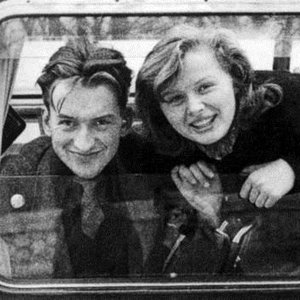
Nikolaus & Alice Harnoncourt, 1951, before they were married, on tour with the Vienna Chamber Orchestra
Read the German text with English translations of this cantata here, and find the score here.
If you don’t want to miss an episode of this 1723 Trinity season series, please consider signing up to receive an email every time I’ve posted a new story.
Please feel free to share this on Facebook, or forward to anyone you think might enjoy coming along for this ride. Thank you!
Wieneke Gorter, June 4, 2016, links updated June 12, 2021.
Lazarus and the Rich Man / Lazarus and Dives, Codex Aureus of Echternach, 11th century
On this First Sunday after Trinity (for short:Trinity 1), Sunday May 30, 1723, Bach started his first cycle of weekly cantatas in Leipzig. It was two days before his official installation, and one week after he and his family had arrived in the city.
Trinity is also the start of the part of the church year that deals exclusively with issues of faith and doctrine, instead of celebrating events from Jesus’ life, as was done in the period between Advent and Pentecost. This change must have been important to Bach too, because all three surviving cantatas for Trinity 1 are large-scale, musically ambitious works.
The composition with which Bach made his debut in the St. Nicholas Church (he would not perform in the St. Thomas Church until one week later) was cantata 75 Die Elenden sollen essen, a piece of considerable length, containing no less than 14 movements, seven before the sermon, seven after.
Listen to Herreweghe’s recording of cantata 75 Die Elenden sollen essen (with soloists Carolyn Sampson, Daniel Taylor, Mark Padmore, and Peter Kooy) on YouTube
Purchase Herreweghe’s recording of cantata 75 Die Elenden sollen essen and two other cantatas on Amazon
Find the complete German text with English translation of this cantata here.
The text of the opening chorus is from Psalm 22, but it is strongly related to the Gospel of the day: the story of Lazarus (a poor leper, who lies in front of the door of a rich man’s house, asking the rich man for food every day) and Dives (the rich man, who ends up in hell when he dies because he didn’t share his blessings/wealth with those in need).
When I listen to the opening chorus, I keep wondering if Bach wrote a Kyrie in Köthen which he never finished or which got lost for another reason. This is not backed up by any of the commentary about this cantata, but in these first measures I can’t stop myself from hearing “Ky-ri-e-e-le–” in my head when the choir sings “Die-ie E-e-le–.” The music accents the second syllable of the word Elenden, while in the spoken language the stress would be on the first syllable. I find it strange that Bach would have ignored word stress in such an important composition, which he spent extra time on, and probably already wrote before he arrived in Leipzig (Gardiner notes that the paper of the manuscript was not from Leipzig, and that the handwriting was extremely neat). So I’m hoping something will turn up in my lifetime to substantiate this hunch I have ….
Wherever the opening chorus originated from, it is beautifully written, as are all the arias. The soprano aria has a tender, plaintive oboe d’amore accompaniment, the alto aria floats on a rich blanket of strings, and the bass aria is a show-off piece with virtuosic music for the singer as well as the trumpeter.
There is a symmetry to the order in which the recitatives and arias appear in the cantata which is rarely seen in other Bach cantatas.
But of course it is typical for Bach to use mathematical design when wanting to make a lasting impression with a composition (such as with the St. Matthew Passion and the Mass in B minor). Also the fact that there are 14 movements to this cantata is not a coincidence: it is the sum of the numbers B, A, C, and H in the alphabet.
There is more symmetry in the cantata: The text of the first half refers to the Gospel story from Luke about Lazarus and Dives, and talks about earthly life and material possessions. In contrast to this, the second half of the cantata moves up to a spiritual level, and up to heaven. This change is illustrated by the introduction of the instrument that was associated with heaven: the trumpet. In the opening movement of the second half of this cantata the trumpet plays the chorale tune with which the first half had ended, Was Gott tut, das ist wohlgetan, and then later accompanies the bass in a stand-out virtuosic aria.
There is also more “showing off” in this cantata. As Gardiner points out, Bach seems to have wanted to make it clear that he was a skilled court composer (which he had been at Köthen before he took the position in Leipzig): after the French Ouverture of the opening chorus, all the arias together from a French Suite: The tenor aria is a Polonaise, the soprano aria a Minuet, the alto aria a Passepied, and the Bass aria a Gigue.
From left to right, the St. Thomas School in Leipzig, where the Bach family lived in a large apartment on the left side (or front, seen like this, with a view over the park), the St. Thomas Church right next to the School (with such a high roof and spire it could be seen from all over the city), and the St. Nicholas Church at walking distance. Bach’s cantatas were performed in both churches.
No discussion of Bach cantatas until Easter, because Bach did not write any cantatas for Lent (the 40 days before Easter). Read more about this in my post from last week.
Johann Sebastian Bach (1685-1750) wrote most of his cantatas, motets, masses, and passions in Leipzig. He moved there on Saturday May 22, 1723.
Christoph Wolff includes this account of the event by a Hamburg newspaper in his The New Bach Reader: “This past Saturday at noon, four wagons loaded with household goods arrived here from Köthen; they belonged to the former Princely Kapellmeister there, now called to Leipzig as Cantor Figuralis. He himself arrived with his family on two carriages at 2 o’clock and moved into the newly renovated apartment in the St. Thomas School.”
By that time, Bach’s family consisted of:
his wife Anna Magdalena (he married her in Köthen in 1721 when she was 20 years old),
four children from his first wife Maria Barbara (she died in 1720).
one child from Anna Magdalena,
and most probably his sister-in-law Friedelena Margaretha Bach (sister of his first wife Maria Barbara, who -according to Wolff- lived in the Bach household from at least 1709 at age 34 to her death in 1729. I will probably write an entire post about all the stories and non-stories about Bach’s wives soon, but let’s just leave it at this for now, here :-)). That her last name is also Bach is because these sisters were Bach’s second cousins.
Until 1742, Anna Magdalena and Johann Sebastian would have 12 more children in Leipzig, of which they would lose six. They would also take some nephews under their wings (a normal thing to do in the extended Bach family—Bach himself had lived with a relative after his parents died) and have a mind-boggling number of private students.
Leipzig was a bustling town, the second largest in the region, with a highly regarded university as well as three annual trade fairs, which brought merchants, artists, and tourists from all over Europe to the city. It happened most probably during one of these fairs that Leipzig instrument maker J.H. Eichentopf came into contact with some eastern instruments on which he based the concept of the oboe da caccia he developed around the time of Bach’s arrival in the city, and which Bach used in many compositions, such as cantata 65. The only thing the city didn’t have was an opera house. The one in Dresden was about 112 kilometers, or 70 miles, or a day’s travel away. The other famous one, in Hamburg, was almost three times as far away.
In addition to teaching the boys of the St. Thomas School in music and many other subjects, Bach was to supply music for all Sundays and church feast days in both the St. Thomas and St. Nicholas churches. No-one had specified that these had to be cantatas. A simpler form of composition would probably have suited the council better, as many of the members opposed the Italian, operatic style of some of the arias, or the French character of many of the opening sinfonias. If Bach would sometimes have programmed music by other composers, that would not have been a problem either.* It was his own choice to write a new cantata for every Sunday, most probably driven by a strong desire, a promise to himself (or “life goal,” as he calls it when moving from Mühlhausen to Weimar) to change the concept of church music, glorifying God but also educating the congregation in Lutheran theology. And as far as we know now, he kept that promise, writing a new cantata every week, for almost three full years.
The churches would be full, with one to three thousand (!) people attending the services. But however large in number, the congregation did not necessarily form a captive audience. Many of them, especially the women, seated in the main, “ground floor” section of pews, would arrive late and make quite an entrance, taking time to greet their neighbors, and making sure to get the attention of the men who were sitting in the balconies. The men would sometimes throw the 18th-century equivalent of paper airplanes to the women to catch their attention. Upper class families had their own boxes, or “chapels” in the church, and were often laughing and talking very loudly in them.
In another part of his Leipzig life, Bach had more attentive audiences in “Zimmermann’s,” one of the six coffee houses in Leipzig, where he lead the Collegium Musicum of the university in performances of instrumental music and secular cantatas. They performed at least once a week on Wednesdays, and twice a week during the three annual trade fairs. At first Bach was principal guest conductor, from 1729 he was the director of this elite ensemble of virtuoso instrumentalists. It is safe to say that even though he owned an entire library of theological books and was committed to teaching his “neighbor” through his church music, he composed and performed as much (and maybe more!) instrumental and secular music in Leipzig as he did sacred music.
Wieneke Gorter, February 21, 2016, updated February 20, 2021
*After a while, Bach did indeed perform music by other composers. Read more about this in a background article I wrote for California Bach Society’s blog, here.





 Weekly Cantata