Weekly Cantata

Weekly Cantata

Tag Archives: according to Lutheran Church year

Trinity 3: from Weimar, with love

12 Sunday Jun 2016

Posted by cantatasonmymind in 1723 Trinity season special series, Cantatas, Leipzig, Trinity, Weimar

≈ Comments Off on Trinity 3: from Weimar, with love

Tags

according to Lutheran Church year, Alfred Dürr, Bach, Bach Collegium Japan, Barbara Schlick, cantatas, Christoph Wolff, Collegium Vocale Gent, Lutheran Church year, Masaaki Suzuki, Monika Frimmer, Peter Kooy, Phlippe Herreweghe, Rachel Podger, Vivaldi
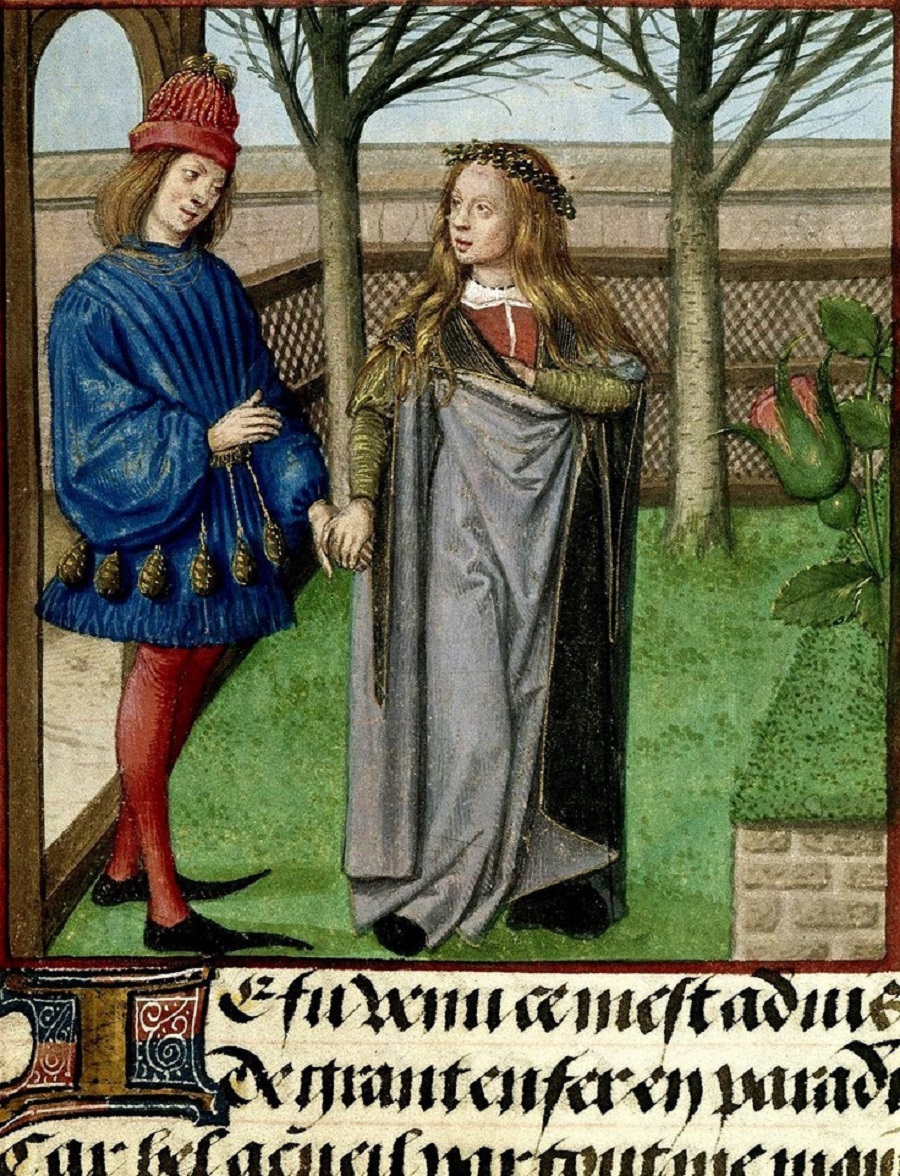
Roman de la Rose, Netherlands (Bruges), c. 1490-c. 1500

Only three episodes into this special 1723 Leipzig Trinity season series,  I’m already taking a detour to Weimar. It’s Bach’s fault, because, after the two newly written cantatas he presented on May 30 and June 6, 1723, he “recycled” his Weimar cantata for this third Sunday after Trinity: cantata 21 Ich hatte viel Bekümmernis, written in 1714, or possibly in 1713.

We dont’ know for sure why Bach chose to use an “old” composition this early in his first season (though probably nobody except his own family knew it was not new), but  I think that he couldn’t wait to impress the Leipzig Council and congregation with a composition that was one of his all-time favorites. He had written and performed it at least twice in Weimar, then presented it in Hamburg or Köthen in 1720* and would perform it many more times in Leipzig on future third Sundays after Trinity. Another reason I believe  it was Bach’s plan all along to present this cantata 21 on Trinity 3 in Leipzig: it seems to me that when writing the masterful fugue in the opening chorus of cantata 76, Bach must have had the fugue in no. 6 of cantata 21 on his mind.

Whether it was thanks to the multiple performances during Bach’s lifetime, or to Mattheson mentioning it (however unfavorably!) in his writings, cantata 21 was known among Bach’s colleagues and students throughout the 18th and 19th centuries, and is still one of the most well-known and most frequently performed cantatas today.

Instead of talking about the music, I would like to shine some light on the history of this cantata, and show you that it was not a stand-alone masterpiece that Bach created out of nothing. Most of the findings here below are from  books by Alfred Dürr and Christoph Wolff.

There are parts of this cantata that fit extremely well within the style of the 1714 Weimar cantatas. To hear cantata 21 in this context, if you have time, before you listen to the sinfonia (no. 1) of cantata 21, I invite you to first listen to the sinfonia of cantata 12. They are remarkably similar. Next, just for the fun of it, you might want to listen to the “love” duet from Weimar Pentecost cantata 172 (beautifully sung by soprano Dorothee Mields and countertenor Alex Potter during a streamed concert from 2021)

 Soprano (Soul)

Komm, laß mich nicht länger warten,
Come , let me wait no longer,
Komm, du sanfter Himmelswind,
come, you gentle wind of heaven,
Wehe durch den Herzensgarten!
blow through the garden of my heart

 Alto (Holy Spirit)

Ich erquicke dich, mein Kind.
I refresh you, my child

Liebste Liebe, die so süße,
Dearest love, who are so delightful,
Aller Wollust Überfluß,
abundance of all joys,
Ich vergeh, wenn ich dich misse.
I shall die, if I have to be without you

Nimm von mir den Gnadenkuß.
Take from me the kiss of grace.

Sei im Glauben mir willkommen,
Welcome in faith to me,
Höchste Liebe, komm herein!
Highest love, come within!
Du hast mir das Herz genommen.
You have taken my heart from me

Ich bin dein, und du bist mein!
I am yours, and you are mine!

and compare it to the “love” duet from cantata 21:

Soprano (Soul):

Komm, mein Jesu, und erquicke,

Bass (Jesus):

Ja, ich komme und erquicke

Come, my Jesus, and restore

Yes, I come and restore

Und erfreu mit deinem Blicke.

Dich mit meinem Gnadenblicker,

and rejoice with your look

you with my look of grace

Diese Seele,

Deine Seele,

This soul

Your soul

 Die soll sterben,

 Die soll leben,

that must die

that must live

Und nicht leben

 Und nicht sterben

and not live

and not die

 Und in ihrer Unglückshöhle

Hier aus dieser wunden Höhle

and in its den of misfortune

here from this den of wounds

Ganz verderben.

Sollst du erben

wholly perish.

 you shall be given

 Ich muß stets in Kummer schweben,

Heil! durch diesen Saft der Reben,

I must always be suspended in misery

Salvation! throught this juice of the grape

Ja, ach ja, ich bin verloren!

Nein, ach nein, du bist erkoren!

Yes, oh, yes, I am lost

No,oh, no, you are chosen

 Nein, ach nein, du hassest mich!

Ja, ach ja, ich liebe dich!

No, ah, no, you hate me!

Yes, oh, yes,I love you!

 Ach, Jesu, durchsüße mir Seele und Herze,

Entweichet, ihr Sorgen, verschwinde, du Schmerze!

Jesus, sweeten my soul and heart.

Give way, worries, vanish, pain!

Komm, mein Jesus, und erquicke

Ja, ich komme und erquicke

Come, Jesus, and restore

Yes, I come and restore

Mit deinem Gnadenblicke!

Dich mit meinem Gnadenblicke

 with your look of grace

 you with my look of grace.

Of course none of these are officially  meant to speak of earthly love. But still, both these duets are extremely cute, musically completely similar to opera love duets from that time, and their texts could at least partly be interpreted as such love duets, so I can imagine the Weimar poet and the young Bach must have enjoyed writing these.

To really appreciate “the making of” the opening chorus (no. 2) of cantata 21, it’s worth listening to a magnificent Vivialdi violin concerto and one of Bach’s lesser known organ prelude and fugues, to hear where Bach found the theme for the Ich hatte viel Bekümmernis fugue:

In the spring of 1713, the half-brother of Bach’s employer in Weimar, prince Johann Ernst, “a great lover of music and an incomparable violinist” (according to a testimony by Philipp David Kräuter, a student of Bach in Weimar) went on a study trip, and spent a long time in the Netherlands. Upon his return, he had brought “much fine Italian and French” music with him. One of the pieces was Vivaldi’s Concerto in D minor Opus 3, no. 11  for two violins from Book II of L’Estro armonico (RV 565), published in Amsterdam in 1711.

Listen to this Vivaldi concerto in the award-winning interpretation by the fabulous Rachel Podger with Brecon Baroque on Spotify, or on YouTube

Maybe Bach, an accomplished violinist himself, and the prince played this together after the prince returned in July 1713. Bach rewrote this Vivaldi concerto into an organ concerto (BWV 596), but also used the theme in his organ prelude and fugue in B minor, BWV 544,  written in Weimar as well.  It is in this piece in particular that I can hear the relation with cantata 21 Dürr wants to point out in his book.

About recordings of cantata 21: While Bach Collegium Japan deserves a medal for  taking the trouble to research all the different versions and record the ones from 1720 and 1714 on their volume 6 , and the true 1723 Leipzig version (with trombones added in no. 9 and solo/tutti distinctions in the choruses) on their volume 12, I still like Herreweghe’s recording of this cantata the best, mainly because of the strong, crisp choruses and the music always having long lines and strong sense of direction. Listen to Herreweghe’s interpretation of  this cantata on Spotify or on YouTube.

Update from 2021: find an absolutely stunning performance of the 1720 version (with only soprano and bass soloists) on the YouTube channel of the J.S. Bach Foundation here.

Read the German text with English translations of cantata 21 here, and find the score here.

If you don’t want to miss an episode of this 1723 Trinity season series, please consider signing up to receive an email every time I’ve posted a new story.

Please feel free to share this on Facebook, or forward to anyone you think might enjoy coming along for this ride. Thank you!

Wieneke Gorter, June 12, 2016. Updated June 19, 2021.

*Bach visited Hamburg in November 1720, to apply for an organist and cantor post there. It turned out, however, that the post needed to be “bought” and the job went to a lesser talented but wealthy candidate. Most scholars are confident there was a performance of this cantata in 1720 in either Köthen or Hamburg, based on the surviving manuscripts of the parts. Because it was the Hamburg-based writer Mattheson who criticized the cantata in a letter  in 1725, it is probable that the performance took place in Hamburg during Bach’s visit there.

According to Bach Collegium Japan’s leader Masaaki Suzuki, the 1720 performance featured only a soprano and a bass, with the soprano also singing all the arias and recitatives we know nowadays as written for tenor.

Season 1, episode 2

04 Saturday Jun 2016

Posted by cantatasonmymind in 1723 Trinity season special series, Bach's life, Cantatas, Leipzig, Trinity

≈ Comments Off on Season 1, episode 2

Tags

according to Lutheran Church year, Bach, cantatas, Harnoncourt, James Gilchrist, John Eliot Gardiner

Brunswick_Monogrammist_Great_Banquet

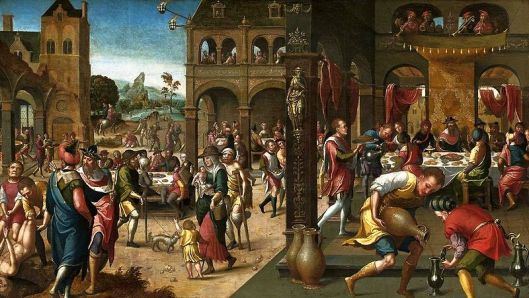
The Parable of the Great Supper / the Great Banquet, by anonymous Dutch painter “the Braunschweig (Brunswick) Monogrammist,” ca. 1525

Trinity season in the Lutheran Church year means no feast days until Christmas, no stories about Jesus’ life in the Gospel texts, and no Vox Christi bass recitatives. To still keep this blog exciting for myself and you loyal readers, I decided to make it into a true weekly series, and will be following all of Bach’s 1723 Leipzig cantatas until Advent, without taking any detours to his Weimar cantatas or later Leipzig cantatas.

A few things that make it irresistible for me to try this: Bach started working  in Leipzig  on the first Sunday after Trinity in 1723 (see last week’s blog post); the dates of the Lutheran Church year in 2016 are practically the same as in 1723 – off by only one day; and I believe that by following this 1723 sequence, we can better imagine how it must have been for the Leipzig audiences (congregation) to hear one cantata after the other, and perhaps get a little insight in how it must have been for Bach himself to write one after the other.

So, here we go with season 1, episode 2:

Previously on Weekly Cantata: Bach arrived in Leipzig on Saturday May 22, 1723,, and made his debut with cantata 75 Die Elenden sollen essen in the Nicolaikirche (St. Nicholas Church) on Sunday May 30, the first Sunday after Trinity.

The second Sunday after Trinity in 1723 marked Bach’s debut in the Thomaskirche (St. Thomas Church). On Sunday June 6, he performed cantata 76 Die Himmel erzählen die Ehre Gottes there, and this one is even more impressive than 75, and includes a festive opening chorus which makes me think of Bach’s later Ascension Oratorio.

There are many similarities between cantata 75 and 76, the most obvious one being that they share the ambitious length of 14 movements in total, divided over two parts. From a superficial point of view, both cantatas start with a psalm text in the opening chorus, have challenging soprano arias, feature bass arias with trumpet, and -never seen again in later cantatas- an instrumental sinfonia at the start of the second part (after the sermon). However there are more (hidden) similarities and cross-references between the two, so that one could almost think about these two first cantatas of the 1723/1724 cycle as a diptych.

I appreciate Gardiner’s interpretation of cantata 76 the most of all recordings I listened to. And the universe will have it that this one was recorded in the Basilique de Saint-Denis (directly north of Paris), which was my subway stop for four fabulous music-filled months in 1994. In his journal from 2000, Gardiner writes that they were very concerned about the enormous size of this Gothic cathedral, and feared that a large audience (needed to balance out the acoustics) wouldn’t show up because it was the night of the France-Italy final in the Euro soccer competition. But everything turned out fine: there were more than 1200 people in the audience, and France won.

Listen to Gardiner’s recording of cantata 76 Die Himmel erzählen die Ehre Gottes on Spotify  or on YouTube, or buy this recording on Amazon.

Cantata 76 starts with a text about heaven: the first and third verse of Psalm 19, Die Himmel erzählen die Ehre Gottes. To illustrate this, the heavenly trumpet (in cantata 75 not introduced until the start of the second half) is heard right away. The fugue on the text “Es ist keine Sprache noch Rede, da man nicht ihre Stimme höre” is fantastic, Bach at his best in my opinion.

After this, the text of the cantata refers to the Gospel reading of the day: the parable of the Great Supper from Luke 14: 16-24 about a man who has invited many guests to a Dinner/Supper/Banquet, receives one cancellation after the other, after which he decides to invite all the beggars and cripples his servant can find, and serves them the dinner instead, not leaving one place open for any of the previously invited guests. All this combined with the “Brotherly love” theme from the Epistle reading of the day: 1 John 3: 13-18.

Another example, though through a completely opposite story as the one from cantata 75, of why it is good to share food and love with others.

Besides the incredible opening chorus, the highlights of this cantata for me are: the soprano aria with violin/cello accompaniment (no. 3), the bass aria with trumpet (no. 5), the incredible sinfonia for oboe d’amore and viola da gamba at the start of the second half (no. 8),  the dramatic, operatic tenor aria (no. 10, fabulously performed by James Gilchrist, including the “shake” Bach wrote on the word “Hasse”), and the alto recitative with viola da gamba (no. 11).

For those who have extra time: listen to the violin/cello duet in the soprano aria accompaniment in an unrivaled (as far as I am concerned) interpretation by Alice and Nikolaus Harnoncourt on their recording from 1976 (scroll to 06:11)

e1712a1a564449d6c9c7a2aad5045250

Nikolaus & Alice Harnoncourt, 1951, before they were married, on tour with the Vienna Chamber Orchestra

Read the German text with English translations of this cantata here, and find the score here.

If you don’t want to miss an episode of this 1723 Trinity season series, please consider signing up  to receive an email every time I’ve posted a new story.

Please feel free to share this on Facebook, or forward to anyone you think might enjoy coming along for this ride. Thank you!

Wieneke Gorter, June 4, 2016, links updated June 12, 2021.

Hidden messages

16 Saturday Jan 2016

Posted by cantatasonmymind in Cantatas, Chorale cantatas 1724/1725, Epiphany, Leipzig

≈ Comments Off on Hidden messages

Tags

according to Lutheran Church year, Bach, Bach Collegium Japan, BWV 13, BWV 155, BWV 3, cantatas, Dorothee Mields, Epiphany, Epiphany 2, Gerald Finley, Joanne Lunn, Julian Podger, Pascal Bertin, Peter Kooy, Richard Wyn Roberts

marten_de_vos_004_le_nozze_di_cana_1597
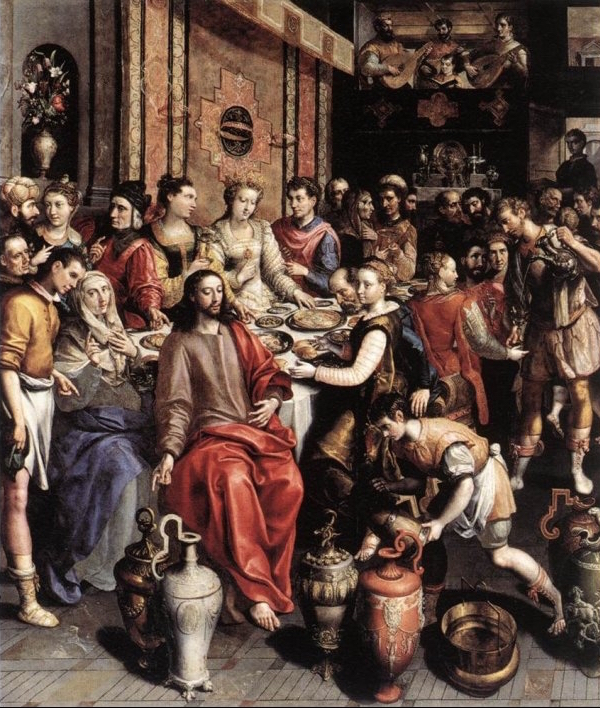
Marriage at Cana by Marten de Vos, 1597. Cathedral of Our Lady, Antwerp, Belgium.

Judging by the text and lamenting style of their opening choruses or opening arias, all cantatas for this Sunday (155, 3, and 13) are very sad at first glance. Which seems strange, since the reading for the day is the miracle of Jesus turning water into wine at the Marriage at Cana. So let’s dig a little deeper in the cantata for this Sunday that I love the most, Cantata 3 Ach Gott, wie manches Herzeleid, from 1725.

My favorite interpretation of this cantata the one by Bach Collegium Japan. The choir sopranos (including Dorothee Mields) sing a truly heavenly “zum Himmel” in the opening chorus,  bass soloist Peter Kooy does an excellent job in his on purpose difficult aria and doesn’t hold back in the chorale tune in the opening chorus, and last but not least: fabulous singing by soprano Dorothee Mields and counter-tenor Pascal Bertin in the duet.

Listen to Bach Collegium Japan’s recording of Cantata 3 on Spotify

If you can’t listen on Spotify or prefer not to, you can find Gardiner’s recording here on YouTube. Soprano: Joanne Lunn; Counter-tenor: Richard Wyn Roberts; Tenor: Julian Podger; Bass: Gerald Finley.

Find the text of Cantata 3 Ach Gott, wie manches Herzeleid here, and the score here.

Bach was not just a strong believer but also a self-taught theologian, and stated several times that his church music was intended for the glorification of God and to instruct his “neighbor.” On this day of the Marriage at Cana reading, he might have been compelled to illustrate the deeper meaning of the Bible story: earthly troubles can turn into heavenly bliss if you are patient and believe strongly enough that Jesus will lead you. So either he himself or his librettist decided not to mention the Bible story at all in the the text of this cantata.*

It is then not so strange anymore that in the music of this cantata Bach keeps, brilliantly, combining the struggle and the salvation in almost every part of the work.

The achingly beautiful opening chorus at first just sounds like a lament, but has some hidden messages which reveal the salvation. First, in the instrumental introduction,  there is an ascending (the way to salvation/heaven) line in the violins at the same time as there is a chromatic descending line (the struggle/affliction) in the oboes, illustrating the last two lines of the text of that chorus:

Der schmale Weg ist trübsalvoll, (The narrow way is full of affliction)
Den ich zum Himmel wandern soll. (by which I must travel to heaven.)

Click here to see that visualized by Thomas Braatz on the Bach Cantatas website.

While the Leipzig congregation might have missed this first hidden message, they would have gotten the second: the text communicated through the well-known chorale tune. The same way my Dutch calvinist great-grandmother had all the verses of all the Psalm texts memorized, the Lutherans in Bach’s time knew all their chorales and would immediately think of the text when hearing the tune. For this opening chorus, Bach chose the tune of O Jesu Christ mein’s Lebens Licht, so there was some glorification of Jesus right there amidst the lamentation:

O Jesu Christ mein’s Lebens Licht
Mein Hort, mein Trost, mein Zuversicht
Auf Erden bin ich nur ein Gast
Und drückt mich sehr der Sünden Last
.

O Jesus Christ, light of my life,
my refuge, my comfort, my reassurance,
on earth I am only a guest

And the burden of sin presses down heavily upon me.

And to make this stand out, Bach uses his “pay attention!” trick again, letting this chorale melody appear in a for him very unusual place: the vocal bass line. To emphasize it, he doubles it with a trombone (which is probably also the reason why this cantata is almost never performed today, because who is going to hire an expensive trombonist just to play along with the choir in one part of the cantata?).

In the other outstanding part of this cantata, the soprano/alto duet, this is all reversed: the music sounds absolutely happy, but if you look at the score, you see a visual illustration of the text in the middle section:  Mein Kreuz hilft Jesus tragen (Jesus helps to bear my cross). When the oboe line goes up, the continuo line goes down, and when one vocal line goes up, the other vocal line goes down. On top of that, there are four sharps in the key signature (in Bach’s manuscript this would look like four crosses and a sharp is also called a “cross” in German). We know from other works that hidden messages like this are not a coincidence in Bach’s writing.

Wieneke Gorter, January 16, 2016.  Links updated January 10, 2018 and January 31, 2020.

*Seen in the context of the chorale cantata series of 1724/1725, this is not unusual at all. On Several occasions before this Sunday in 1725, Bach had decided to focus more on the text of the chorale he had chosen for the cantata than on the Gospel reading for that day. See for example my post about December 31, 1724 and January 1, 1725.


A Bach Cantata for Three Kings Day can swing both ways

06 Wednesday Jan 2016

Posted by cantatasonmymind in Cantatas, Epiphany

≈ Comments Off on A Bach Cantata for Three Kings Day can swing both ways

Tags

according to Lutheran Church year, Bach, Bach Collegium Japan, cantatas, Charles Daniels, Epiphany, Harnoncourt, Harry van der Kamp, Kooy, Kurt Equiluz, Leonhardt, Matthew White, Montreal Baroque, Which cantata which Sunday, Which cantata which week

Adoration of Magi

Some of us love to keep the tree and the lights for a few more days, others are (eagerly or not) looking ahead, facing reality (and finally starting that blog).  The same two sentiments can be found in Bach’s music for this time of year. The cantata for January 6 (Epiphany) from 1724 is very Christmas-y, the one from 1725 absolutely not. Both are well worth a listen.

Let’s start with the one that is still in full Christmas swing, from 1724: cantata 65 Sie werden aus Saba alle kommen, with a happy text incorporating the story of the Three Kings visiting the baby Jesus, and featuring 2 horns, 2 recorders, and 2 oboes da caccia in the orchestra. As a child I loved this cantata. It was mainly because of the special instrumentation, the horns prominent in the tenor aria, the oboes in the bass aria. But I also clearly remember it was so cool that the bass aria talks about the New Year!

I grew up with the Harnoncourt recording, and though that interpretation of the tenor aria (sung by Kurt Equiluz)  is still one of the best, my “favorite overall” recording of this cantata today is that of Bach Collegium Japan. Tenor James Gilchrist and bass Peter Kooy do a fabulous and compelling job at their arias, and the horns sound beautiful.

Listen to cantata 65 by Bach Collegium Japan on Spotify

Listen to cantata 65 by Harnoncourt on YouTube

Click here for the full German text with English translation of cantata 65

The next year, in 1725, Bach wrote cantata 123 Liebster Immanuel, Herzog der Frommen. A gem of a cantata, with little strands of the chorale woven into the opening chorus, extremely beautiful. Both music and text are much more poignant than the Epiphany cantata of the year before. There are even references to the cross. And then there’s the bass aria. When you listen to this cantata for the first time, and you hear the flute start this aria, you will never guess it is going to be a bass aria! It is a very unusual combination of voice and instrument for Bach, and that usually means: pay attention! And yes, there it is in the text, the core of Bach’s 18th century Lutheran faith: even if society casts you out, you don’t belong, you are lonely, then you will still be saved by Jesus.

My favorite recording of this cantata is the one by Montréal Baroque, on which Dutch bass Harry van der Kamp and flutist Grégoire Jeay make something truly special out of that bass aria. I love the liveliness of this interpretation overall, including an opening chorus that immediately grabs my attention and moves me, and fabulous performances by countertenor Matthew White and tenor Charles Daniels in their arias as well.

The only downside for me of the Montréal Baroque recording is that the chorus pieces are all sung one-on-a-part, by the four soloists only. Not only do I have a personal (maybe not historically accurate, but so be it!) preference for 3-5 voices on a part, I also find that soprano Monika Mauch is outbalanced by the men in the opening chorus. I can hardly hear her, which is too bad because I’m sure she’s an equally great singer as the other three.

Listen to cantata 123 by Montreal Baroque on Spotify

Listen to cantata 123 by Montreal Baroque on YouTube

Listen to cantata 123 by Harnoncourt on YouTube

Click here for the full German text with English translation

If you enjoy listening to these recordings, please consider supporting the artists and purchase them!
BWV 65 by Bach Collegium Japan is here
BWV 123 by Montréal Baroque is here
BWV 123 by Bach Collegium Japan is here
Wieneke Gorter, January 6, 2016
(links updated January 3, 2017 and November 20, 2020)
Newer posts →

Recent Posts

  • “Missa Miniatura” by CONTINUUM/Elina Albach Even More Moving in 2025
  • Bachfest Leipzig 2025
  • Bach Cantatas for Christmas – 1724 and 1734 editions
  • Fourth Sunday of Advent – more insight into Cantata 62 helped me better understand Bach’s Christmas Oratorio
  • Saint Ambrose and Luther in Milan – Second Sunday of Advent

Archives

  • August 2025
  • July 2025
  • December 2024
  • November 2024
  • June 2024
  • January 2024
  • December 2023
  • October 2023
  • September 2023
  • August 2023
  • April 2022
  • February 2022
  • January 2022
  • December 2021
  • November 2021
  • June 2021
  • May 2021
  • April 2021
  • February 2021
  • January 2021
  • December 2020
  • November 2020
  • October 2020
  • September 2020
  • August 2020
  • July 2020
  • May 2020
  • April 2020
  • March 2020
  • February 2020
  • January 2020
  • December 2019
  • November 2019
  • May 2018
  • April 2018
  • March 2018
  • February 2018
  • January 2018
  • December 2017
  • November 2017
  • October 2017
  • September 2017
  • August 2017
  • July 2017
  • June 2017
  • May 2017
  • April 2017
  • March 2017
  • February 2017
  • January 2017
  • December 2016
  • November 2016
  • October 2016
  • September 2016
  • August 2016
  • July 2016
  • June 2016
  • May 2016
  • April 2016
  • March 2016
  • February 2016
  • January 2016

Enter your email address to follow this blog and receive notifications of new posts by email.

Join 338 other subscribers

Categories

  • 1723 Trinity season special series
  • Advent
  • After Easter
  • Ascension
  • Bach's life
  • Cantatas
  • Chorale cantatas 1724/1725
  • Christmas
  • Easter
  • Epiphany
  • Following Bach in 1725
  • Köthen
  • Leipzig
  • Septuagesima
  • Travel
  • Trinity
  • Weimar

Meta

  • Create account
  • Log in
  • Entries feed
  • Comments feed
  • WordPress.com

Website Built with WordPress.com.

  • Subscribe Subscribed
    • Weekly Cantata
    • Join 158 other subscribers
    • Already have a WordPress.com account? Log in now.
    • Weekly Cantata
    • Subscribe Subscribed
    • Sign up
    • Log in
    • Report this content
    • View site in Reader
    • Manage subscriptions
    • Collapse this bar
 

Loading Comments...