Weekly Cantata

Weekly Cantata

Tag Archives: Charles Daniels

Mary’s lament

14 Saturday Jan 2017

Posted by cantatasonmymind in Cantatas, Epiphany, Weimar

≈ Leave a comment

Tags

Bach, Bachstiftung, BWV 155, BWV 3, Charles Daniels, Epiphany, Epiphany 2, Harry van der Kamp, Julius Pfeifer, Lamento della Ninfa, Luther, Margot Oitzinger, Mary, Monika Mauch, Monteverdi, Montreal Baroque, Nuria Rial, Raphael Jud, Rudolf Lutz, Wedding at Cana, Weimar
marriage_cana_david
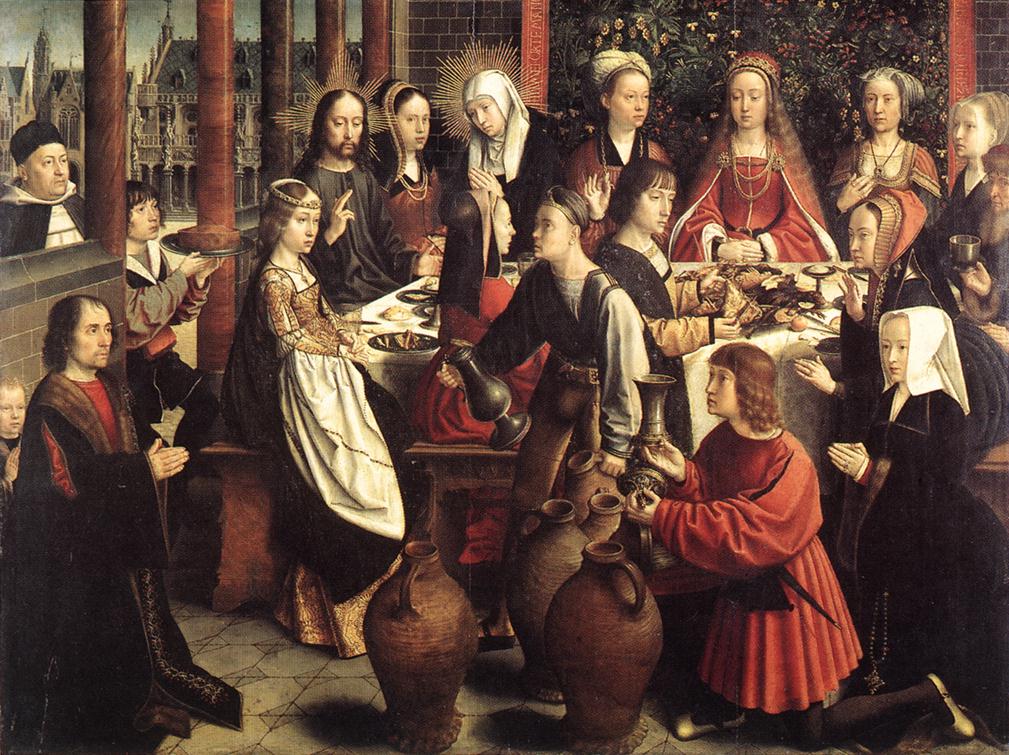
The Marriage at Cana, c. 1500, by Gérard David. Musée du Louvre, Paris. Mary pleads and worries, but Jesus says: “Woman, what have I to do with thee? Mine hour is not yet come.”

This week, I watched a very good video by the Swiss Bach Foundation (Bachstiftung) about today’s cantata 155 Mein Gott, wie lang, ach lange? I found it very insightful, helpful, and even entertaining, but was struck by its Calvinist character and was a bit disappointed by the director’s statement that he doesn’t know why this cantata starts with a movement for solo soprano. When reading Gardiner’s and Van Hengel’s discussions of this cantata, I liked their suggestions that the soprano lament refers to  Mary’s role in the Bible story of this Sunday, the Marriage at Cana. It made sense to me. This cantata, from 1715 and repeated in 1724, contains references to the wine as well as to the fact that Jesus says to his mother: “my time has not come yet.”

While the Lutheran church in Bach’s time did not regard Mary as a saint, let alone a mediator between God and the people, she was still an important person in the faith, and thus probably also for Bach. The three Marian feast days*  Luther kept on the calendar were important holidays and Bach wrote cantatas for all of them. Also, Bach wrote this cantata 155 in his Weimar years, when he explored a large number of works by (Catholic) Italian composers.

Listen to Montreal Baroque’s recording of cantata 155 on YouTube through a playlist I created. With Monika Mauch, soprano; Franziska Gottwald, alto; Charles Daniels, tenor; Harry van der Kamp, bass; Anna Marsh, bassoon. If you prefer to watch a live recording, you can find the live performance by the J.S. Bach Foundation here, with Julia Neumann, soprano; Margot Oitzinger, alto; Julius Pfeifer, tenor; and Raphael Jud, bass.

Read the German text with English translation of this cantata here, and find the score here.

The cantata is not so much a musical play with the soprano taking the role of Mary, but more a reference to her role in the Gospel story and an exploration of that theme: try to trust that everything will be okay in the end, try to not be in control all the time. The first movement has the character of a lament in music and text, you can picture the hand-wringing, the desperation. There is also the steady pedal point in the bass, similar to what Bach will use later in the opening chorus of the St. Matthew Passion.

However it is the second movement, not even sung by the soprano, and with text that is trying to urge her to “let go,” that secretly is the true lament, in the music that is. To hear or see this, the video by the Swiss Bach Foundation is terrific. Rudolf Lutz explains extremely well (with music examples) how the notes of the solo bassoon part form in fact a lament for three voices. This video has English subtitles. watch from 12:10  By the way: the composition I had to think of when hearing the “lamento bass” was Monteverdi’s  Lamento della Ninfa

If you would like to explore other cantatas for this second Sunday after Epiphany, I invite you to read my post about cantata 3 from 1725 here. It is all about hidden messages in the music of a an extremely beautiful composition with an equally heart wrenching—but completely different—opening movement as this cantata 155.

Wieneke Gorter, January 14, 2017, links updated January 31, 2020. Link for the score updated January 16, 2021, link for the J.S. Bach Foundation video with English subtitles updated January 15, 2022.

*The Purification of Mary on February 2, The Annunciaton of Mary on March 25, and the Visitation of Mary on July 2.
June 24 = Feast of St. John

23 Thursday Jun 2016

Posted by cantatasonmymind in 1723 Trinity season special series, Bach's life, Cantatas, Leipzig, Trinity

≈ Comments Off on June 24 = Feast of St. John

Tags

according to Lutheran Church year, cantatas, Charles Daniels, John Eliot Gardiner, John the Baptist, Montreal Baroque, Suzie LeBlanc

Pontormo,_natività_del_battista

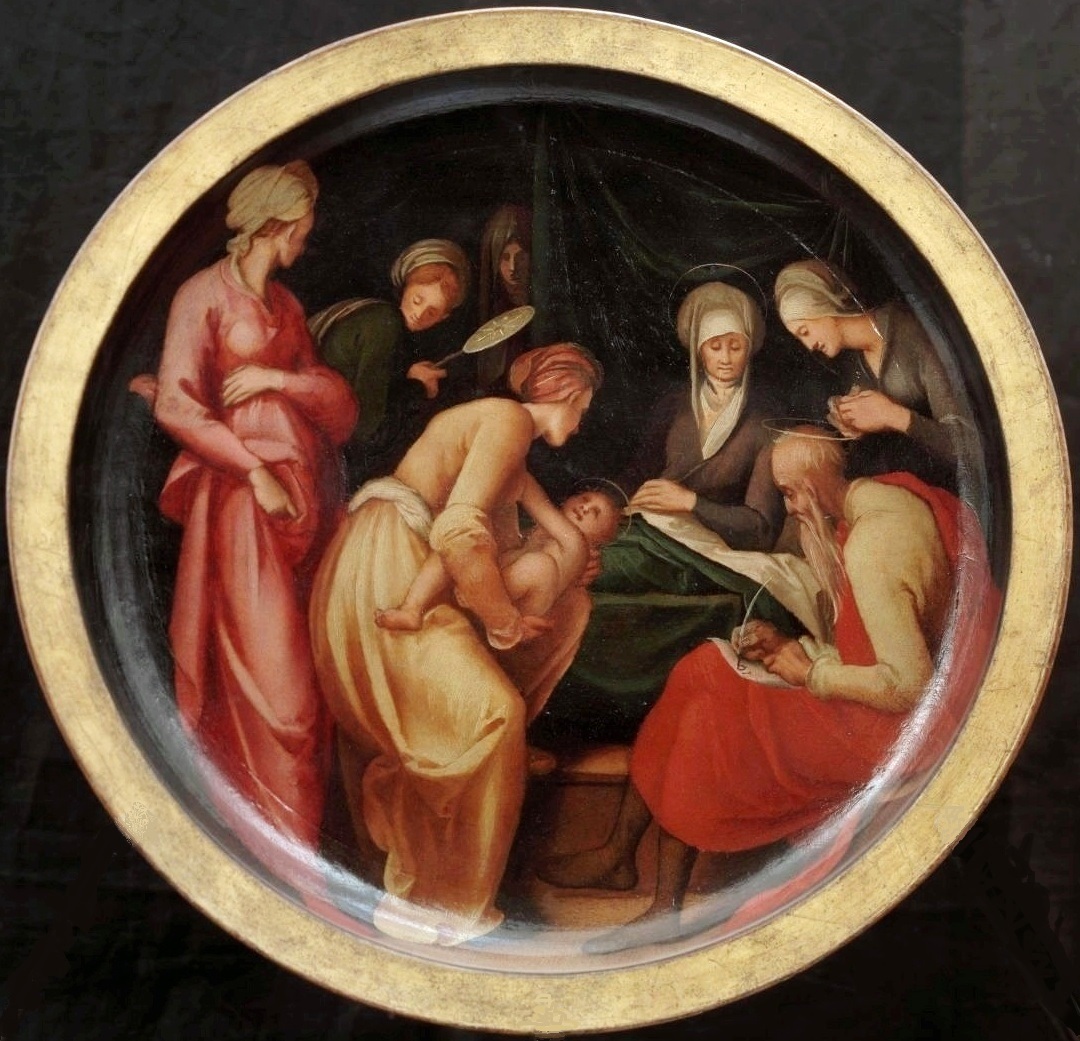
Birth of St. John the Baptist, Zechariah writing “His name is John,” by Jacopo Pontormo, c. 1526. Uffizi, Florence, Italy.

In Bach’s time, June 24 was an important feast day, celebrating the birth of John the Baptist. In the Lutheran faith, it is believed that John the Baptist paved the way for Jesus to come into the world, and his birthday was thus dated exactly six months before Jesus’ birthday. Many paintings from the 16th century onward show Mary with a baby Jesus in her lap, while John the Baptist, or St. John, usually depicted as an already standing infant, is looking on or playing with Jesus.

It means that on this day, June 24, 1723, the Leipzig congregation got to hear a new cantata already on Thursday: cantata 167, Ihr Menschen, rühmet Gottes Liebe.

My favorite recording of this cantata is the one by Montreal Baroque, with terrific singing especially by tenor Charles Daniels and soprano Suzie Leblanc.

Listen to this recording on YouTube or on Spotify.

Find the text here, and the score here.

A little more than a week later, on July 2, the church would celebrate the feast of the Visitation (Mary visiting her relative Elizabeth), strongly related to St. John. (Another wonderful cantata for that coming up next week!)

So let’s imagine two consecutive weeks of festival buzz in Leipzig, since both these holidays were important. Thanks to Gardiner’s research, we know that during trade fairs, the Leipzig population would grow to 30,000, and that Bach would often have extra students and colleagues visiting. The feasts of St. John and the Visitation did not fall during a trade fair, but we can assume that there were nonetheless a few hundred, or maybe even a few thousand visitors in Leipzig  for these holidays.

And it really looks and sounds to me as if Bach is showing off to his fellow musicians in the writing of this St. John cantata from 1723. While it is a small-scale and intimately scored work, it showcases impressive composition talent and skills: a lovely tenor aria with wonderful melismas on the word “preiset” (praise), brilliant meter changes in the already striking soprano-alto duet, a bass recitative which gives the listeners a “sneak peek” at the melody of the closing chorale, and a terrific setting of the closing chorale.

The Gospel reading for this day is the declamation by Zechariah from Luke 1: 57-80. Zechariah, the father of St. John the Baptist, has been made mute by Gabriel because he didn’t believe Gabriel’s announcement that he and his wife Elisabeth would have a son. At the time of his son’s birth, Zechariah carves a sign to tell the community “His name is John,” and as soon as he has done this, he regains his voice, and praises God. The unknown librettist of this cantata reworks this song of praise (also known as the Benedictus) into the text for the tenor aria as well as the alto recitative in this aria, sometimes quoting directly from the Gospel.

This past Sunday, in cantata 24, Bach decided to let a recitative blossom out into an arioso at the end, probably to emphasize the text. It was not a new thing, as he had actually often written recitatives this way in Weimar and Köthen. But it created a wonderful effect in cantat 24, and he must have liked it himself, because he uses the same “trick” in this cantata, at the end of the alto recitative as well as at the end of the bass recitative.

The exquisite soprano-alto duet, which at times sounds more like a motet than an aria, moves into a 4/4 canon on the text “was er in dem Paradies,” and then–still within that middle-part–moves smoothly back into 3/4, so when music and text goes back to the beginning, as if it were a standard “da capo” aria, the meter has already been back to 3/4 for a while.

In the bass recitative the Weimar/Köthen characteristic feature of letting a recitative blossom out into an arioso Bach already played with in cantata 24 gets even better: The call to action to see Zachary as an example and now also praise God is illustrated by musically quoting the closing chorale on the words “und stimmet ihn ein Loblied an” (and sing praise unto him). It is a witty joke, which, just like the clever move with the meter in the duet, only fellow musicians would have fully appreciated. But that is just my own humble opinion …

The impressive features of this cantata are more obvious in the closing chorale. As Gardiner points out, and as those who remember cantata 75 might have already heard: Bach wrote the closing chorale of this cantata 167 in the same way he wrote the closing chorales for cantatas 22 (the cantata which he performed as part of his audition in Leipzig in February 1723) and 75 (his debut piece on Trinity 1). While the chorus sings a “standard” chorale setting, the orchestra parts, moving to a walking bass, are completely separate, and form another piece of music around the chorale, just like a beautifully ornamented Baroque frame around an already great painting. In this case the frame is a golden one, because of the extra luster the trumpet part brings to the music.

Wieneke Gorter, June 23, 2016


A Bach Cantata for Three Kings Day can swing both ways

06 Wednesday Jan 2016

Posted by cantatasonmymind in Cantatas, Epiphany

≈ Comments Off on A Bach Cantata for Three Kings Day can swing both ways

Tags

according to Lutheran Church year, Bach, Bach Collegium Japan, cantatas, Charles Daniels, Epiphany, Harnoncourt, Harry van der Kamp, Kooy, Kurt Equiluz, Leonhardt, Matthew White, Montreal Baroque, Which cantata which Sunday, Which cantata which week

Adoration of Magi

Some of us love to keep the tree and the lights for a few more days, others are (eagerly or not) looking ahead, facing reality (and finally starting that blog).  The same two sentiments can be found in Bach’s music for this time of year. The cantata for January 6 (Epiphany) from 1724 is very Christmas-y, the one from 1725 absolutely not. Both are well worth a listen.

Let’s start with the one that is still in full Christmas swing, from 1724: cantata 65 Sie werden aus Saba alle kommen, with a happy text incorporating the story of the Three Kings visiting the baby Jesus, and featuring 2 horns, 2 recorders, and 2 oboes da caccia in the orchestra. As a child I loved this cantata. It was mainly because of the special instrumentation, the horns prominent in the tenor aria, the oboes in the bass aria. But I also clearly remember it was so cool that the bass aria talks about the New Year!

I grew up with the Harnoncourt recording, and though that interpretation of the tenor aria (sung by Kurt Equiluz)  is still one of the best, my “favorite overall” recording of this cantata today is that of Bach Collegium Japan. Tenor James Gilchrist and bass Peter Kooy do a fabulous and compelling job at their arias, and the horns sound beautiful.

Listen to cantata 65 by Bach Collegium Japan on Spotify

Listen to cantata 65 by Harnoncourt on YouTube

Click here for the full German text with English translation of cantata 65

The next year, in 1725, Bach wrote cantata 123 Liebster Immanuel, Herzog der Frommen. A gem of a cantata, with little strands of the chorale woven into the opening chorus, extremely beautiful. Both music and text are much more poignant than the Epiphany cantata of the year before. There are even references to the cross. And then there’s the bass aria. When you listen to this cantata for the first time, and you hear the flute start this aria, you will never guess it is going to be a bass aria! It is a very unusual combination of voice and instrument for Bach, and that usually means: pay attention! And yes, there it is in the text, the core of Bach’s 18th century Lutheran faith: even if society casts you out, you don’t belong, you are lonely, then you will still be saved by Jesus.

My favorite recording of this cantata is the one by Montréal Baroque, on which Dutch bass Harry van der Kamp and flutist Grégoire Jeay make something truly special out of that bass aria. I love the liveliness of this interpretation overall, including an opening chorus that immediately grabs my attention and moves me, and fabulous performances by countertenor Matthew White and tenor Charles Daniels in their arias as well.

The only downside for me of the Montréal Baroque recording is that the chorus pieces are all sung one-on-a-part, by the four soloists only. Not only do I have a personal (maybe not historically accurate, but so be it!) preference for 3-5 voices on a part, I also find that soprano Monika Mauch is outbalanced by the men in the opening chorus. I can hardly hear her, which is too bad because I’m sure she’s an equally great singer as the other three.

Listen to cantata 123 by Montreal Baroque on Spotify

Listen to cantata 123 by Montreal Baroque on YouTube

Listen to cantata 123 by Harnoncourt on YouTube

Click here for the full German text with English translation

If you enjoy listening to these recordings, please consider supporting the artists and purchase them!
BWV 65 by Bach Collegium Japan is here
BWV 123 by Montréal Baroque is here
BWV 123 by Bach Collegium Japan is here
Wieneke Gorter, January 6, 2016
(links updated January 3, 2017 and November 20, 2020)
Newer posts →

Recent Posts

  • “Missa Miniatura” by CONTINUUM/Elina Albach Even More Moving in 2025
  • Bachfest Leipzig 2025
  • Bach Cantatas for Christmas – 1724 and 1734 editions
  • Fourth Sunday of Advent – more insight into Cantata 62 helped me better understand Bach’s Christmas Oratorio
  • Saint Ambrose and Luther in Milan – Second Sunday of Advent

Archives

  • August 2025
  • July 2025
  • December 2024
  • November 2024
  • June 2024
  • January 2024
  • December 2023
  • October 2023
  • September 2023
  • August 2023
  • April 2022
  • February 2022
  • January 2022
  • December 2021
  • November 2021
  • June 2021
  • May 2021
  • April 2021
  • February 2021
  • January 2021
  • December 2020
  • November 2020
  • October 2020
  • September 2020
  • August 2020
  • July 2020
  • May 2020
  • April 2020
  • March 2020
  • February 2020
  • January 2020
  • December 2019
  • November 2019
  • May 2018
  • April 2018
  • March 2018
  • February 2018
  • January 2018
  • December 2017
  • November 2017
  • October 2017
  • September 2017
  • August 2017
  • July 2017
  • June 2017
  • May 2017
  • April 2017
  • March 2017
  • February 2017
  • January 2017
  • December 2016
  • November 2016
  • October 2016
  • September 2016
  • August 2016
  • July 2016
  • June 2016
  • May 2016
  • April 2016
  • March 2016
  • February 2016
  • January 2016

Enter your email address to follow this blog and receive notifications of new posts by email.

Join 338 other subscribers

Categories

  • 1723 Trinity season special series
  • Advent
  • After Easter
  • Ascension
  • Bach's life
  • Cantatas
  • Chorale cantatas 1724/1725
  • Christmas
  • Easter
  • Epiphany
  • Following Bach in 1725
  • Köthen
  • Leipzig
  • Septuagesima
  • Travel
  • Trinity
  • Weimar

Meta

  • Create account
  • Log in
  • Entries feed
  • Comments feed
  • WordPress.com

Website Built with WordPress.com.

  • Subscribe Subscribed
    • Weekly Cantata
    • Join 158 other subscribers
    • Already have a WordPress.com account? Log in now.
    • Weekly Cantata
    • Subscribe Subscribed
    • Sign up
    • Log in
    • Report this content
    • View site in Reader
    • Manage subscriptions
    • Collapse this bar
 

Loading Comments...