Weekly Cantata

Weekly Cantata

Tag Archives: Eric Milnes

Bach Cantatas for Christmas – 1724 and 1734 editions

23 Monday Dec 2024

Posted by cantatasonmymind in Cantatas, Chorale cantatas 1724/1725, Christmas, Epiphany, Leipzig

≈ 4 Comments

Tags

Alex Potter, Antonia Frey, baroque-music, Bart Aerbeydt, Bernhard Bechtold, Carine Tinney, Charles Daniels, Christmas, Christmas Oratorio, Collegium Vocale Gent, Concerto Copenhagen, Daniel Johannsen, Eric Milnes, Florian Sievers, Harry van der Kamp, J.S. Bach Foundation, J.S. Bach Stiftung, Jan Kobow, Julia Doyle, Lars Ulrik Mortensen, Lucia Giraudo, Margot Oitzinger, Maria Keohane, Mark Padmore, Matthew Brook, Matthew White, Milo Maestri, Monika Mauch, Montreal Baroque, Netherlands Bach Society, Peter Kooij, Philippe Herreweghe, Rodrigo Lopez-Paz, Rudolf Lutz, Sarah Connolly, Stephan MacLeod, Tomáš Král, Vasiljka Jezovsek

Merry Christmas! Below are my recommendations for recordings of Bach’s chorale cantatas for the Christmas season, written in 1724/1725, as well as a link to the video of this year’s wonderful live performance by the Netherlands Bach Society of Bach’s Christmas Oratorio, written in 1734/1735. Before I get to that, I wanted to share a personal story. (If you want to “jump to the recipe,” just scroll down three paragraphs to the next header).

As regular readers of this blog know, Christmas morning for me = “Jauchtzet, frohlocket,” the first entrance of Bach’s Christmas Oratorio*. But ten days ago, during the first-ever Christmas Oratorio concert of my life as a chorus member, I couldn’t sing those words.

I had unwittingly set myself up for it, because I had just done two things to remember my late mother. It was very cold in the church, and I had lent one of my mother’s scarves to a friend who was singing next to me. As we were getting on stage, I told her: “this scarf has been in many a Bach concert, because my mother used to sing in a Bach choir too.” And then I showed her how I had copied my mother’s signature from her old piano reduction to the new one I was using now.

So while I had been completely fine during all the rehearsals, now with the audience there and those memories, the first notes of the timpani made me choke up. Fortunately, that first soprano entrance is low and doubled by many other voices, so nobody noticed. And I was fine for the rest of the concert, and thoroughly enjoyed getting to sing cantatas 1, 2, 5, and 6 of Bach’s Christmas Oratorio with a good orchestra and great soloists.

Do you have special memories associated with Bach’s or other Christmas music? Please let me know in the comments. Here are my recommendations for recordings:

Christmas Cantatas from Bach’s Chorale Cantata cycle, 1724/1725

Christmas Day: Cantata 91 Gelobet seist du, Jesu Christ by the J.S. Bach Foundation/Rudolf Lutz, with Monika Mauch – Soprano; Margot Oitzinger – Alto; Bernhard Berchtold – Tenor; and Peter Kooji – Bass. Find the score here, and English translations here.

Second Christmas Day: Cantata 121 Christum wir sollen loben schon by Concerto Copenhagen/Lars Ulrik Mortensen, with Maria Keohane – Soprano; Alex Potter – Alto; Jan Kobow – Tenor; and Matthew Brook – Bass. Find the score here, and English translations here.

Third Christmas Day: Cantata 133 Ich freue mich in dir by Concerto Copenhagen/Lars Ulrik Mortensen, with Maria Keohane – Soprano; Alex Potter – Alto; Jan Kobow – Tenor; and Matthew Brook – Bass. Find the score here, and the English translations here.

Maria Keohane

Sunday after Christmas: Cantata 122 Das neugeborene Kindelein by Collegium Vocale Gent/Philippe Herreweghe, with Vasiljka Jezovsek – Soprano; Sarah Connolly – Alto; Mark Padmore – Tenor; and Peter Kooij – Bass. Find the score here, and the English translations here.

New Year’s Day: Cantata 41 Jesu nun sei gepreiset by the J.S. Bach Foundation/Rudolf Lutz, with Julia Doyle – Soprano; Antonia Frey – Alto; Florian Sievers – Tenor; and Stephan MacLeod – Bass. Find the score here, and the English translations here.

Jan 6, Epiphany: Cantata 123 Liebster Immanuel, Herzog der Frommen by Montréal Baroque/Eric Milnes, with Matthew White, alto; Charles Daniels, tenor; and Harry van der Kamp, bass. Find the score here, and the English translations here.

From Bach’s Christmas Oratorio, 1734/1735

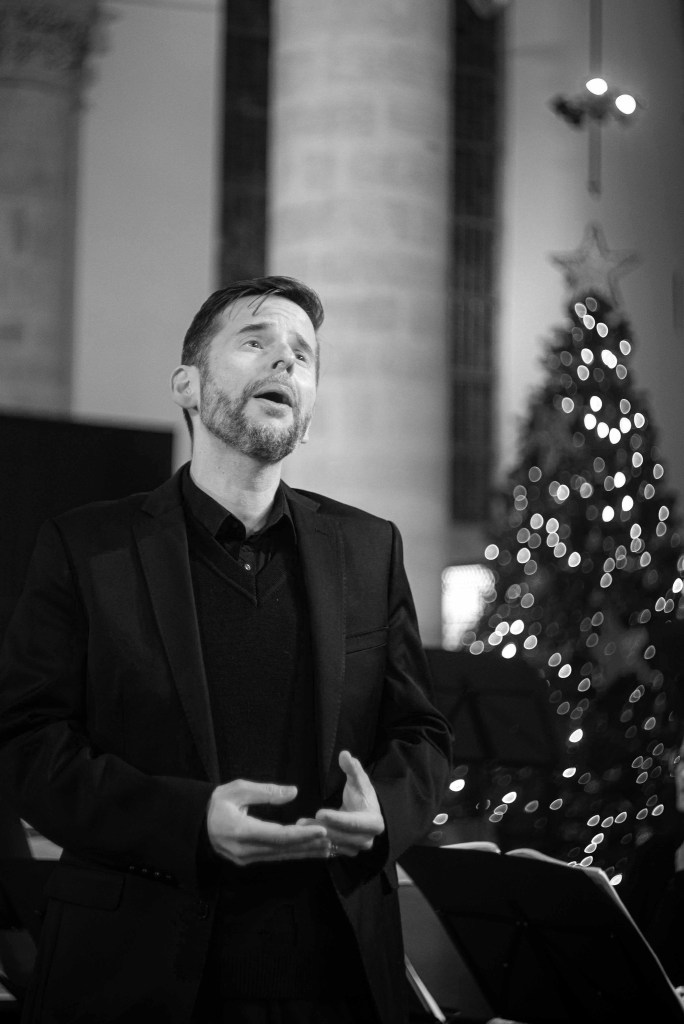
Bart Aerbeydt and Milo Maestri
Lucia Giraudo
Daniel Johannsen

All photos above by Donald Bentvelsen. Find him on Instagram at @bentvel.

I highly recommend the video of the most recent live performance by the Netherlands Bach Society under the direction of Lars Ulrik Mortensen. They performed cantatas 1, 4, 5, and 6 of Bach’s Christmas Oratorio in the Netherlands earlier this month. I attended the concert in Naarden on December 11, the video below is from the performance in Utrecht, two days later. The choir could have been a bit larger for my personal taste, but for the rest I absolutely loved this performance, with text-focused singing by all soloists, and fabulous and sensitive playing by the instrumentalists, allowing for musical dialogues with the singers. I especially enjoyed the contributions by tenor Daniel Johannsen, oboist Rodrigo Lopez-Paz (photo in my previous post), violinist Lucia Giraudo, and horn players Bart Aerbeydt and Milo Maestri. I very much ejoyed reading the program booklet, especially the the interview with director Lars Ulrik Mortensen.

Read the English program book for this performance here. Read a bit more on the fifth cantata from this same performance in my previous post.

Please consider subscribing to this blog (just click on the button below), it really helps me!

Best wishes for the New Year,

Wieneke Gorter, December 23, 2024.

* if you don’t know the story, please find it here.
Palm Sunday 1714

05 Sunday Apr 2020

Posted by cantatasonmymind in Bach's life, Cantatas, Leipzig, Weimar

≈ Leave a comment

Tags

BWV 18, BWV 182, BWV 21, BWV 61, Charles Daniels, Eric Milnes, Hanneke van Proosdij, Harry van der Kamp, Matthew White, Monika Mauch, Montreal Baroque, Rachel Podger, Voices of Music, Weimar

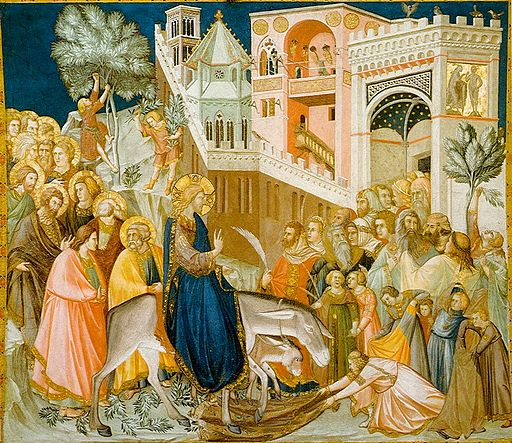
Jesus Entrance into Jerusalem. First picture is Lorenzetti’s version, in the Basilica of Assisi, 1320. Second picture is Giotto’s version from 1305, in the Capella Scrovengni in Padua, third is Duccio’s, created between 1308 and 1311, as part of an altar piece, currently in the Museo dell’Opera Metropolitana del Duomo in Siena. The first two are frescoes, the last one is tempera on wood. 

We’re on Day 20 of “shelter in place” here in the San Francisco Bay Area. We’re counting our blessings, trying to figure out how we can be most helpful to others while also taking good care of ourselves, and trying to wean ourselves off spending too much time on social media. I definitely need my “church” of regular check-ins with family and friends, daily mindfulness exercises, and lots of yoga classes to stay sane through all of this.

Back to Bach’s church. Today is Palm Sunday! Bach never officially wrote a cantata for this Sunday, since no music was to be performed in the churches during Lent. However, in 1714, Palm Sunday fell on the same day as the feast of the Annunciation of Mary, March 25. This way, while specifying “for the feast of the Annunciation of Mary” on the title page of the cantata manuscript, Bach could still write music for Palm Sunday with cantata 182 Himmelskönig, sei wilkommen! (Welcome, King of Heaven!)

If you’re not in the mood for a long story and would just like to listen to a short piece of calming music, I recommend the live performance of the opening sinfonia of this cantata on the YouTube channel of Voices of Music, with two fabulous soloists: Hanneke van Proosdij on recorder and Rachel Podger on violin. You can find that video here.

Many of Bach’s Weimar cantatas start with an elaborate instrumental ouverture or sinfonia.* There are two possible reasons for this. First of all, it was in Weimar that Bach studied lots of French and Italian compositions, and he might have wanted to “show off” that he could also write such a fashionable ouverture. But there might have also been a more practical reason: such an opening movement was the perfect piece of music during which the Duke and his entourage would slowly walk into the chapel and take their seats, and not miss anything of the cantata itself.

For the entire cantata, my all-time favorite still is the recording by Montreal Baroque. Listen here on Spotify, or here on YouTube. Their one-on-a-part performance is similar to how this would have sounded from the small organ loft in Weimar, and features fabulous singing all around (soprano Monika Mauch, countertenor Matthew White, tenor Charles Daniels, bass Harry van der Kamp).

Find the text of cantata 182 here, and the score here.

If you would like to learn more about Bach’s time in Weimar, please visit my post about Bach in Weimar I wrote in 2016. I’ve just updated it with some new photos, including a picture of the organ loft, and it has all the same links for the recording, text, and score as mentioned here.

In Leipzig in 1724, Bach performed this cantata again, on the feast of the Annunciation of Mary, which that year fell eight days before Palm Sunday.

Wieneke Gorter, April 5, 2020.

*(for example cantata 21 Ich hatte viel Bekummernis, 18 Gleichwie der Regen und Schnee vom Himmel fällt, and 61 Nun Komm der Heiden Heiland)

The cantata that started my music writing career

24 Saturday Mar 2018

Posted by cantatasonmymind in Cantatas, Chorale cantatas 1724/1725, Leipzig

≈ Leave a comment

Tags

Annunciation, Charles Daniels, Eric Milnes, Harnoncourt, Matthew White, Monika Mauch, Montreal Baroque, Palm Sunday, Stephan MacLeod

1024px-pietro_di_giovanni_d27ambrogio-_entry_into_jerusalem-_1435-40-_pinacoteca_stuard2c_parma

Entry of Christ into Jerusalem by Pietro di Giovanni d’Ambrogio, 1435-1440. Pinacoteca Stuard, Parma, Italy.

Following Bach’s cantata writing in 1725, we have now come to Cantata 1 Wie schön leuchtet der Morgenstern, an oh so pretty composition with two horns in the orchestra, also the very last of Bach’s 1724/1725 cycle of chorale cantatas. And Bach probably knew that when he was writing it. It is based on the chorale about the Morning Star, a metaphor for Christ.

The recording of this cantata I like best is the one by Montreal Baroque, with soprano Monika Mauch, counter-tenor Matthew White, tenor Charles Daniels, and bass Stephan MacLeod. Please find it here in my playlist on Spotify. If you don’t have access to Spotify, you can purchase the album here on Amazon or listen to Harnoncourt’s recording on YouTube.

Find the text here: http://bach-cantatas.com/Texts/BWV1-Eng3P.htm

Find the score here: http://bach-cantatas.com/BGA/BWV001-BGA.pdf

This cantata was the first I ever wrote about. It was in college, as an assignment for Frits de Haen: we had to compare a modern-instrument and a period-instrument recording of a piece of our choice. I don’t remember why I selected this cantata. At the time the only period-instrument recording I had was the one by Harnoncourt. Frits loved the review I wrote (in Dutch) and kept giving me nudges to write more. For several years in a row after that first review I wrote for his class, I would run into him at the Utrecht Early Music Festival or at another concert, and he would always ask “are you still writing?” or “why aren’t you writing?” and told me that I should really write every day or every week. His words have always stayed with me and are one of several reasons why I started writing this blog in January 2016.

You might think it is because of Palm Sunday that there was music in the Leipzig churches again on this Sunday. However, in Leipzig Palm Sunday was firmly part of Lent (the 40 days of introspection before Easter): no thinking beyond the crucifixion until Good Friday, and thus not celebrated with music. Or was it?

An exception was always made for the Annunciation of Mary: if that day, March 25, fell within Lent, it would still be celebrated, an thus Bach could write a cantata for that day.

The only surviving Bach cantatas for the Annunciation of Mary, Cantata 182 Himmelskönig, sei wilkommen from 1714** and Cantata 1 Wie schön leuchtet der Morgenstern from 1725 were written for days when this holiday fell on Palm Sunday. And perhaps not surprisingly, both these cantatas are also very much Palm Sunday cantatas, or at least Bach’s librettist interprets the Annunciation as yet another announcement of the arrival of Christ. The references to the coming of Christ outnumber the references to Mary, in the text as well as in the music.

I think it is striking that in Cantata 1 Wie schön leuchtet der Morgenstern Bach uses a chorale that was so strongly associated with the Christmas season, and writes music that is festive and perhaps even regal, but at the same time humble, with horns in the orchestra instead of the trumpets and timpani he would have used for a bigger holiday. Whether he was indeed illustrating the Palm Sunday story (a humble king entering Jerusalem, riding on a donkey) I don’t know, but it is very well possible.

Wieneke Gorter, March 23, 2018.

**Read more about Cantata 182 in this post.


The Feast of St. John 1724

28 Wednesday Jun 2017

Posted by cantatasonmymind in Cantatas, Chorale cantatas 1724/1725, Leipzig, Trinity

≈ Leave a comment

Tags

Charles Daniels, Daniel Taylor, Eric Milnes, Montreal Baroque, Stephan MacLeod

stjohn
The Naming of St. John the Baptist by Fra Angelico, 1434 or 1435. Basilica di San Marco, Florence, Italy.

As I explained in my post for the first Sunday after Trinity in 1724, Bach most probably intended for the first four chorale cantatas of this 1724 Trinity season to form a set, or at least to present some kind of order:

  1. For the first Sunday after Trinity in 1724, June 11: Cantata 20 O Ewigkeit, du Donnerwort: French Overture, with cantus firmus in the soprano
  2. For the second Sunday after Trinity in 1724, June 18: Cantata 2 Ach Gott, vom Himmel sieh darein: Chorale motet, cantus firmus in alto.
  3. For the Feast of St. John in 1724, Saturday June 24: Cantata 7 Christ unser Herr zum Jordan kam: Italian concerto, cantus firmus in tenor.
  4. For the third Sunday after Trinity in 1724, June 25: Cantata 135 : Ach Herr, mich armen Sünder: Chorale fantasia, cantus firmus in bass.

The Feast of St. John, celebrating the birth of St. John the Baptist, always falls on June 24 (exactly six months before Jesus’ birth). Read more about this feast day in my blog post from last year. This means that in 1724, this date came *after* the second Sunday after Trinity, while of course this year (2017) it came *before* that date.

Because I’m trying to follow the order in which Bach wrote his cantatas in 1724, I did not write about this cantata this past Saturday, but feel it should be presented within the order Bach wrote them in: between this past Sunday and next Sunday. So after the French Overture in cantata 20 and the chorale motet in cantata 2, Bach now presents you with an Italian concerto in this cantata 7 Christ unser Herr zum Jordan kam. The performance I like best is the one by Montreal Baroque, because of the opening movement and because of  Charles Daniels singing the tenor aria. Other soloists are Daniel Taylor, countertenor, and Stephan MacLeod, bass. You can enjoy this performance here on YouTube. The phrasing of the orchestra is beautiful and overall this recording is much more thoughtful and satisfying to me than many others I listened to.

Find the German text with English translation of this cantata here, and the score here.

Wieneke Gorter, June 27, 2017.

Recent Posts

  • “Missa Miniatura” by CONTINUUM/Elina Albach Even More Moving in 2025
  • Bachfest Leipzig 2025
  • Bach Cantatas for Christmas – 1724 and 1734 editions
  • Fourth Sunday of Advent – more insight into Cantata 62 helped me better understand Bach’s Christmas Oratorio
  • Saint Ambrose and Luther in Milan – Second Sunday of Advent

Archives

  • August 2025
  • July 2025
  • December 2024
  • November 2024
  • June 2024
  • January 2024
  • December 2023
  • October 2023
  • September 2023
  • August 2023
  • April 2022
  • February 2022
  • January 2022
  • December 2021
  • November 2021
  • June 2021
  • May 2021
  • April 2021
  • February 2021
  • January 2021
  • December 2020
  • November 2020
  • October 2020
  • September 2020
  • August 2020
  • July 2020
  • May 2020
  • April 2020
  • March 2020
  • February 2020
  • January 2020
  • December 2019
  • November 2019
  • May 2018
  • April 2018
  • March 2018
  • February 2018
  • January 2018
  • December 2017
  • November 2017
  • October 2017
  • September 2017
  • August 2017
  • July 2017
  • June 2017
  • May 2017
  • April 2017
  • March 2017
  • February 2017
  • January 2017
  • December 2016
  • November 2016
  • October 2016
  • September 2016
  • August 2016
  • July 2016
  • June 2016
  • May 2016
  • April 2016
  • March 2016
  • February 2016
  • January 2016

Enter your email address to follow this blog and receive notifications of new posts by email.

Join 338 other subscribers

Categories

  • 1723 Trinity season special series
  • Advent
  • After Easter
  • Ascension
  • Bach's life
  • Cantatas
  • Chorale cantatas 1724/1725
  • Christmas
  • Easter
  • Epiphany
  • Following Bach in 1725
  • Köthen
  • Leipzig
  • Septuagesima
  • Travel
  • Trinity
  • Weimar

Meta

  • Create account
  • Log in
  • Entries feed
  • Comments feed
  • WordPress.com

Website Built with WordPress.com.

  • Subscribe Subscribed
    • Weekly Cantata
    • Join 158 other subscribers
    • Already have a WordPress.com account? Log in now.
    • Weekly Cantata
    • Subscribe Subscribed
    • Sign up
    • Log in
    • Report this content
    • View site in Reader
    • Manage subscriptions
    • Collapse this bar
 

Loading Comments...