Weekly Cantata

Weekly Cantata

Tag Archives: James Taylor

Lessons learned from last year

01 Sunday Apr 2018

Posted by cantatasonmymind in Bach's life, Cantatas, Easter, Leipzig

≈ 1 Comment

Tags

Barbara Schlick, Easter, Easter Oratorio, James Taylor, Kai Wessel, Peter Kooij, Philippe Herreweghe

hubert_van_eyck_-_the_three_marys_at_the_tomb_-_wga7586

The three Marys at the Empty Tomb by Jan van Eyck or Hubert van Eyck, ca. 1425-1435. Museum Boijmans-Van Beuningen, Rotterdam, The Netherlands.

I’m in movie script mode again today. While I don’t know this for sure at all, I think that early in 1725, Bach had probably already decided to not to let things get as crazy as the previous year (in 1724) around Easter. That year, he had seriously run out of time, and had to adjust many of his plans. Gardiner thinks this happened because the writing, rehearsing, and performing of his Passion according to St. John had taken Bach much more time than he thought, and had forced him to make several shortcuts in the weeks ahead. Read more about all this in my post about Easter 1724 and subsequent posts.

So I imagine that this year, in 1725, Bach must have been planning ahead. Without any more “old” Easter cantatas in his portfolio, he had to have something else ready for the choir and orchestra to rehearse alongside the Passion for Good Friday, whatever that Passion was going to be.

So when the friendly Duke Christian von Sachsen-Weissenfels asked for some Tafelmusik to be performed for his 44th birthday on February 23, 1725, Bach might very well have thought from the beginning: perfect, that music can double as an Oratorio for Easter Sunday.

Listen to Herreweghe’s recording of the Easter Oratorio here on YouTube. Soloists are Barbara Schlick, soprano; Kai Wessel, alto; James Taylor, tenor; and Peter Kooy, bass.

Find the text here, and the score here.

The Tafelmusik for Duke Christian became Entfliehet, verschwindet, entweichet, ihr Sorgen, also known as Schäferkantate, BWV 249a. When recycling this into the Easter Oratorio, Kommt, eilet und laufet BWV 249, Bach kept the  cheerful opening sinfonia and the exquisite, plaintive adagio, two instrumental movements that were probably originally from a concerto he wrote in Köthen. He also kept the music of the opening and closing chorus, and of all the arias, only changing the text.

Here you can see how little he did change the text in this table, courtesy of Eduard van Hengel:

Schäferkantate (BWV 249a, 23/2/25) Oster-oratorium (BWV 249, 1/4/1725)
3.
Entfliehet, verschwindet, entweichet, ihr Sorgen
verwirret die lustigen Regungen nicht!
Lachen und Scherzen
erfüllet die Herzen
die Freude malet das Gesicht.

5. Hunderttausend Schmeicheleien
wallen jetzt in meiner Brust.
Und die Lust
so die Zärtlichkeiten zeigen,
kann die Zunge nicht verschweigen.

7. Wieget euch, ihr satten Schafe,
in dem Schlafe
unterdessen selber ein!
Dort in jenen tiefen Gründen,
wo schon junge Rasen sein,
werden/wollen wir euch wieder finden.

9. Komm doch, Flora, komm geschwinde,
hauche mit dem Westenwinde
unsre Felder lieblich an!
Daß ein treuer Untertan
seinem milden Christian
Pflicht und Schuld bezahlen kann.

11. Glück und Heil
bleibe dein beständig Teil!
Großer Herzog, dein Vergnügen
müsse wie die Palmen stehn,
die sich niemals niederbiegen,
sondern bis zum Wolken gehn!
So werden sich künftig
bei stetem Gedeihen
die deinen mit Lachen
und Scherzen erfreuen.


Kommt, eilet und laufet, ihr flüchtigen Füße,
Erreichet die Höhle, die Jesum bedeckt!
Lachen und Scherzen
Begleitet die Herzen,
Denn unser Heil ist auferweckt.

Seele, deine Spezereien
Sollen nicht mehr Myrrhen sein.
Denn allein
Mit dem Lorbeerkranze prangen,
Stillt dein ängstliches Verlangen.

Sanfte soll mein Todeskummer,
Nur ein Schlummer,
Jesu, durch dein Schweißtuch sein.
Ja, das wird mich dort erfrischen
Und die Zähren meiner Pein
Von den Wangen tröstlich wischen.

Saget, saget mir geschwinde,
Saget, wo ich Jesum finde,
Welchen meine Seele liebt!
Komm doch, komm, umfasse mich;
Denn mein Herz ist ohne dich
Ganz verwaiset und betrübt.

Preis und Dank
Bleibe, Herr, dein Lobgesang.
Höll und Teufel sind bezwungen,
Ihre Pforten sind zerstört.
Jauchzet, ihr erlösten Zungen,
Dass man es im Himmel hört.
Eröffnet, ihr Himmel,
die prächtigen Bogen,
Der Löwe von Juda
kommt siegend gezogen!

In order to tell the story of two Marys (yes I realize the painting I use here has three Marys – each Gospel has a different version of this story), Peter, and John finding the empty tomb, Bach added recitatives in between the arias. Note that he doesn’t write a part for an evangelist, the way he did that in his Passions and in his Christmas Oratorio.

Wieneke Gorter, April 1, 2018.
Easter Monday 1724

17 Monday Apr 2017

Posted by cantatasonmymind in After Easter, Bach's life, Cantatas, Leipzig

≈ Leave a comment

Tags

Collegium Vocale Gent, Easter Monday, James Taylor, Kai Wessel, Peter Kooy, Phlippe Herreweghe

Screenshot 2017-04-17 11.44.51

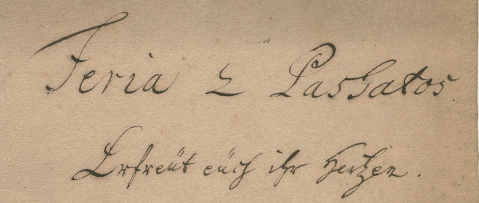
Excerpt from the title page of Bach’s manuscript from 1735 of cantata 66 Erfreut euch ihr Herzen. The manuscript from 1724 did not survive.

In Bach’s time there were three Easter days, as there were three Christmas days and three Pentecost days. I wrote yesterday that Bach planned to write four new works between April 10 and 23, 1724, but that is only somewhat true, it depends who you ask …

Gardiner believes that what Bach planned to do after Easter 1724,  was to write cantata 6 for Easter Monday, 42 and 67 for the first Sunday after Easter, and 85 for the second Sunday after Easter, instead of writing 6, 42, and 85 in 1725. As he painstakingly explains in his book “Bach: Music in the Castle of Heaven,”  Gardiner believes that the work (composing and rehearsing) on the Passion according to St. John must have cost Bach much more time than he thought, and he thus had to adjust his plans.

Following Gardiner’s theory, when Bach realized he had too much on his plate for Easter 1724, including having to write a cantata for Easter Tuesday he might not have planned on, he decided to write parodies (using existing music with some changes, but with different texts) for Easter Monday and Easter Tuesday of that year.

For Easter Monday 1724, he wrote cantata 66 Erfreut euch, ihr Herzen. Most of the music of this cantata is based on the secular cantata 66a Der Himmel dacht auf Anhalts Ruhm und Glück (Heaven thinks of Anhalt’s Fame and Fortune) , composed by Bach in 1718 to celebrate the 24th birthday of Prince Leopold of Anhalt-Cöthen. If you have 40 minutes, listen to a reconstruction of the entire Birthday cantata 66a from 1718 here, with soprano Gudrun Sidonie Otto, alto Wiebke Lehmkuhl, tenor Hans Jörg Mammel, and bass Karsten Krüger. If you only have 10 minutes, scroll to 11:17 for the soprano/alto duet with violin.

Listen to Herreweghe’s recording of cantata 66 Erfreut euch, ihr Herzen here. Soloists: alto Kai Wessel, tenor James Taylor, and bass Peter Kooij. I like Herreweghe’s recording of this cantata the best of all I listened to, because to me the tempo of the opening chorus is perfect for me, Collegium Vocale’s singing is fabulous as always, and I enjoy listening to Peter Kooy in the bass aria.

Find the text of cantata 66 here, and the score here.

Since we only have a manuscript of this cantata from 1735, when Bach repeated this cantata in Leipzig, we don’t know for sure what Bach changed in 1724.  However, based on what we know, and comparing the two recordings I present in this post, Bach used the following movements from the Köthen Birthday cantata 66a in the Leipzig church cantata 66: The impressive and very festive opening chorus of 66 is the closing chorus of 66a, the bass aria of 66 is the alto aria of 66a, and the alto-tenor duet (beautifully sung by Kai Wessel and James Taylor) with violin of 66 is the soprano-alto duet with violin from 66a.

Movement 4 and 5 (the recitative and duet for alto and tenor) are written as a dialogue. Whenever Bach uses that technique in his church cantatas, the two characters are usually Jesus and the Soul (see for example cantata 21). In this case, the Happiness of Anhalt (the alto) from 66a has been transformed to Furcht (Fear) in 66, and  Fama (the godess of fame and reputation, soprano in 66a) has been transformed to Hoffnung (Hope, tenor in 66). With these two characters Bach refers to the Gospel reading of the day: two followers of Jesus walk to the town of Emmaus, only a few days after Jesus’ death and burial. They talk about their hope that he was the Messiah, but are at the same time fearful having heard the news that his body has disappeared from the grave.

In the Birthday cantata 66a, the two characters are in agreement, and therefore sing the same notes. However in cantata 66 Furcht and Hoffnung often disagree, even though they are still singing the same notes. Normally Bach would never have let this happen, but perhaps this is an illustration of how quickly he had to work on this cantata for Easter Monday.

Wieneke Gorter, April 17, 2017

Recent Posts

  • “Missa Miniatura” by CONTINUUM/Elina Albach Even More Moving in 2025
  • Bachfest Leipzig 2025
  • Bach Cantatas for Christmas – 1724 and 1734 editions
  • Fourth Sunday of Advent – more insight into Cantata 62 helped me better understand Bach’s Christmas Oratorio
  • Saint Ambrose and Luther in Milan – Second Sunday of Advent

Archives

  • August 2025
  • July 2025
  • December 2024
  • November 2024
  • June 2024
  • January 2024
  • December 2023
  • October 2023
  • September 2023
  • August 2023
  • April 2022
  • February 2022
  • January 2022
  • December 2021
  • November 2021
  • June 2021
  • May 2021
  • April 2021
  • February 2021
  • January 2021
  • December 2020
  • November 2020
  • October 2020
  • September 2020
  • August 2020
  • July 2020
  • May 2020
  • April 2020
  • March 2020
  • February 2020
  • January 2020
  • December 2019
  • November 2019
  • May 2018
  • April 2018
  • March 2018
  • February 2018
  • January 2018
  • December 2017
  • November 2017
  • October 2017
  • September 2017
  • August 2017
  • July 2017
  • June 2017
  • May 2017
  • April 2017
  • March 2017
  • February 2017
  • January 2017
  • December 2016
  • November 2016
  • October 2016
  • September 2016
  • August 2016
  • July 2016
  • June 2016
  • May 2016
  • April 2016
  • March 2016
  • February 2016
  • January 2016

Enter your email address to follow this blog and receive notifications of new posts by email.

Join 336 other subscribers

Categories

  • 1723 Trinity season special series
  • Advent
  • After Easter
  • Ascension
  • Bach's life
  • Cantatas
  • Chorale cantatas 1724/1725
  • Christmas
  • Easter
  • Epiphany
  • Following Bach in 1725
  • Köthen
  • Leipzig
  • Septuagesima
  • Travel
  • Trinity
  • Weimar

Meta

  • Create account
  • Log in
  • Entries feed
  • Comments feed
  • WordPress.com

Website Built with WordPress.com.

  • Subscribe Subscribed
    • Weekly Cantata
    • Join 156 other subscribers
    • Already have a WordPress.com account? Log in now.
    • Weekly Cantata
    • Subscribe Subscribed
    • Sign up
    • Log in
    • Report this content
    • View site in Reader
    • Manage subscriptions
    • Collapse this bar
 

Loading Comments...