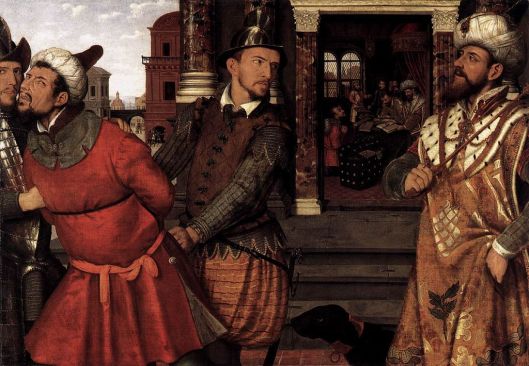
Parable of the Unmerciful Servant by an unknown master from Northern Germany, ca. 1560. Gemäldegalerie, Berlin.
For this 22nd Sunday after Trinity, October 24 in 1723, Bach wrote cantata 89 Was soll ich aus dir machen, Ephraim?
Apart from providing you with the title of the cantata, the stunning painting, and a pretty YouTube video, you’re on your own this week for reading and listening more about this, as I’ve been busy producing these two fabulous concerts.
To find an overview of the recordings, links to the text & translations, and links to the score of this cantata, please visit this page of the “Bach Cantata Bible” by Aryeh Oron.
For a very beautiful interpretation of the soprano aria (fifth movement) from this cantata, please watch this video of the Bach Stiftung, with soprano Nuria Rial, in Trogen, Switzerland. I first heard the fabulous Nuria Rial sing on the German radio in December 2010 and have been a fan since. Watch her sing Cavalli arias at the Utrecht Early Music Festival in the summer of 2016. I’ll talk about her again on the first Sunday of Advent, in about a month 🙂
Parabel of the Laborers in the Vineyard by Jan Luyken, print, 1703
A number of Dutch things converged for me when writing this post. Whenever I think about the parable of the Laborers in the Vineyard, the Bible story for this Septuagesima Sunday, or the third Sunday before Lent, I see the windows of my 3rd or 4th grade classroom.* I also have to think of my late grandfather reading this story from the Bible. Quickly summarized, this story is: A landlord pays all his laborers equally, no matter how many hours they worked. Those that worked all day object.
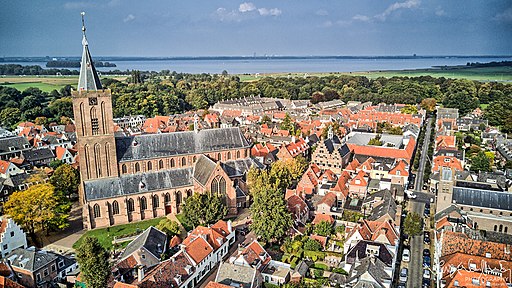
My favorite recording of cantata 144 Nimm, was dein ist, und gehe hin (first performed on Sunday February 6, 1724) turns out to have two connections to my home country: It was recorded in the Grote Kerk in Naarden, during the Bach Pilgrimage tour of Gardiner/English Baroque Soloists, and it features Dutch singer Wilke te Brummelstoete as alto soloist. Counter-tenor fan that I am, I can safely state that I will mention no more than a handful of female altos on this blog each year, so this is pretty special.
Naarden, The Netherlands
The icing on the cake is the illustration I discovered when searching for a good picture to go with this blog post: an etching by Haarlem artist Jan Luyken as published in the Amsterdam Mortierbijbel (Bible published by Pieter Mortier) in 1703, from the collection of the Rijksmuseum in Amsterdam.
Soloists: Miah Persson, soprano; Wilke te Brummelstroete, alto; James Oxley, tenor; Jonathan Brown, bass.
As I’m updating this post on February 8, 2020, the J.S. Bach Foundation has just released their entire live video recording of this cantata, and that one is wonderful too, especially because Nuria Rial sings the soprano aria. Find that video here on YouTube. Soloists are Nuria Rial, soprano; Markus Forster, alto; Raphael Höhn, tenor.
What to listen for in cantata 144 Nimm, was dein ist, und gehe hin:
In the opening chorus: the illustration of the text gehe hin, gehe hin! (off you go!) with ascending figures, each gehe hin “retaken” so that the text really leaps off the page, more on the Gardiner recording than on other ones. Also listen how beautifully the sopranos and violins enhance each other’s sound in this movement. That happens too on the J.S. Bach Foundation recording.
In the alto aria: The illustration of the grumbling workers by the repeated 8th-notes in the strings. The music on the text “Murre nicht” (Don’t grumble) is always low, the music with the text “Lieber Christ” (please note that this means “dear Christian,” not “dear Christ”) always goes up. Very well done in an appropriate style by Wilke te Brummelstoete on the Gardiner recording.
In the soprano aria: the glorification of the “Genügsamkeit” (being satisfied with what you have, a concept that must have been very important to Bach), and the wonderful voice of soprano Miah Persson on the Gardiner recording or the always radiant Nuria Rial on the J.S. Bach Foundation recording. Read more about Miah Persson in my blog post about cantata 179 and those about cantatas 186 and 186a. Read more about Nuria Rial in my posts about Cantata 36 and Cantata 89.
Thank you for reading! Please leave your email address in the “follow this blog” section on the left side of this blog post. You will receive an email by WordPress whenever I have posted a new story. Please note that the choice of words and spelling in their confirmation email is by WordPress, not me. My apologies for that, and many thanks to you for your patience while I work on a more elegant solution!
To support this blog, please consider purchasing Gardiner’s album featuring cantata 144 on Amazon. I receive a small percentage of every sale made through this link. And it would be so fun if someone would actually buy a CD through this link. So far (February 13, 2020), it hasn’t happened 😉 Thank you!
Wieneke Gorter, February 6, 2016, updated January 27, 2024.
*Though a protestant school, it was pretty moderate in its teachings, and I don’t really remember Bible reading in the classroom. However, we learned a hymn every week and the reason I have to think of the classroom when reading this parable probably has to do with the hymn “De eersten zijn de laatsten” (The first will be the last) which is based on this same story.


 Weekly Cantata