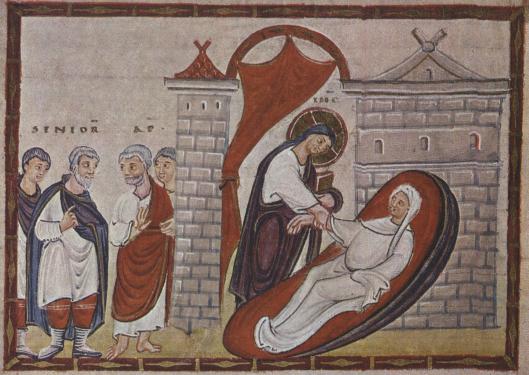
The Resurrection of Jairus’ Daughter, from the Codex Egberti, 980-993. City Library, Trier, Germany. This story was the Gospel reading for the 24th Sunday after Trinity.
Over the past ten years, I’ve truly enjoyed writing about the two cantatas Bach wrote for this Sunday, the 24th after Trinity. I’ve updated all three posts and added a new recording. Just click on the article below to find it all. Happy listening!
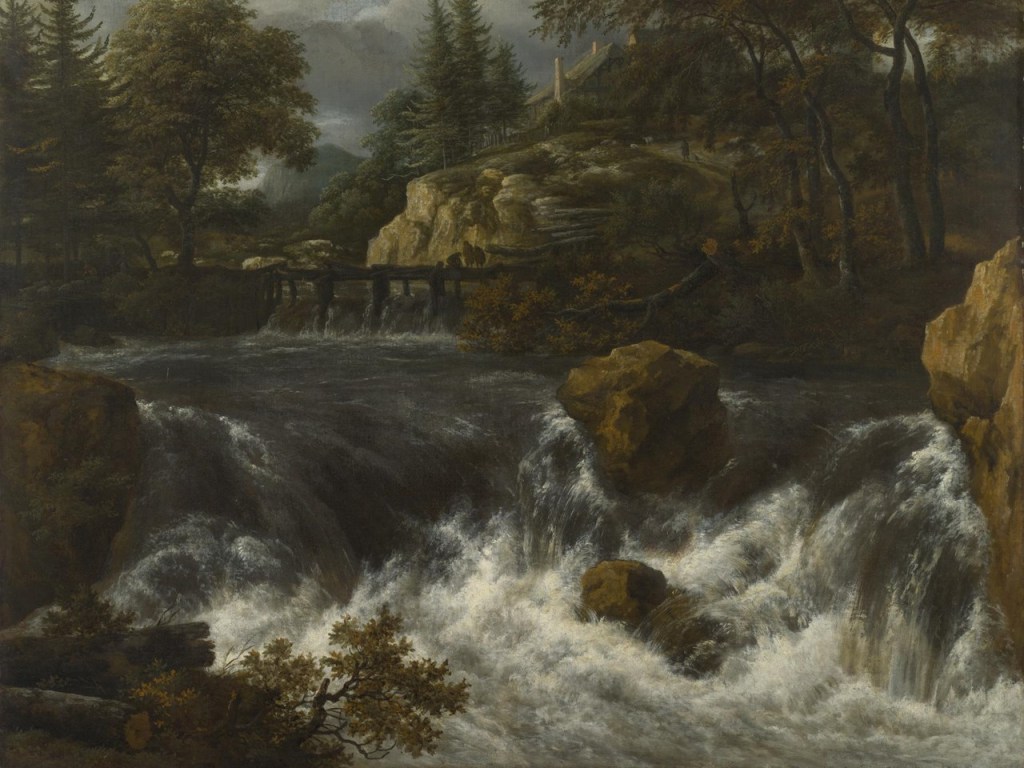
A Waterfall in a Rocky Landscape by Jacob van Ruisdael, probably 1660-70. Oil on canvas. The National Gallery, London, UK.
Depending on the year, the 24th Sunday after Trinity can fall anywhere in November, from the 1st to the 26th day of the month.
In 1723, during Bach’s first year in Leipzig, this day fell on November 7, with two more Sundays to go before Advent. For that day Bach wrote the apocalyptic Cantata 60, O Ewigkeit, du Donnerwort! I have the best memories of doing the research for this cantata, from finding out how Bach’s music had inspired a lithographer in 1914 as well as Alban Berg in 1935, to being pleasantly surprised by Robin Blaze’s marvelous singing on the Bach Collegium Japan recording. Read it all in my post from 2016.
Update from 2026: I still love the Bach Collegium Japan recording of this cantata, but there’s now also an excellent live recording by the Netherlands Bach Society from 2022 on YouTube. Find it here. Soloists are Alex Potter, alto; Thomas Hobbs, tenor; and Stephan MacLeod, bass. Find the score for Cantata 60 here, and the texts & translations here.
The next year, in 1724, this Sunday fell November 19. For that Sunday Bach wrote Cantata 26 Ach wie flüchtig, ach wie nichtig. When I first listened to this cantata in 2017, I labeled it “The Water Cantata” in my head, because there is moving water in both the tenor aria and the bass aria, from a rushing brook to a stormy white water river. The combination of bass voice with the three oboes and bassoon even made me think of Hades in Monteverdi’s Orfeo. I remember finding it special, all that water, especially since I had just come back from a short visit to Yosemite National Park with my family, where I had admired waterfalls and rivers.
There is now an excellent J.S. Bach Foundation video of this cantata available on YouTube. You can really hear the water move, especially in Daniel Johannsen’s terrific rendition of the tenor aria. Find it here. Soloists are Susanne Frei soprano; Antonia Frey, alto; Daniel Johannsen; tenor; Klaus Häger, bass.
Find the score for Cantata 26 here, and the texts & translations here.
I would love it if you would share this article with a friend! Thank you! Not an email subscriber yet? You can sign up below. I won’t use your email address for anything else.
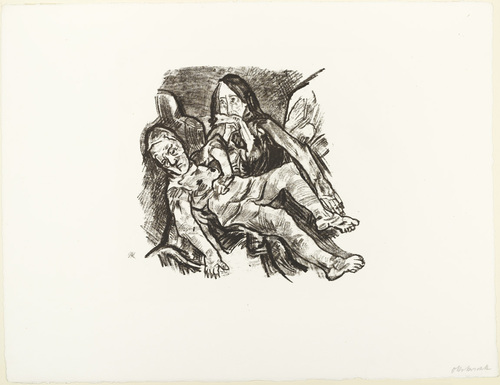
Pietà (It is enough) / Pietà (Es ist genug), plate 11 from a series of 11 lithographs O Ewigkeit, Du Donnerwort by Oskar Kokoschka, 1914/1916. Museum of Modern Art, New York.
In Vienna, they were all talking about Bach’s cantata 60 O Ewigkeit, Du Donnerwort. The astonishing harmonization in the closing chorale as well as the structure of a “dialogue” between Fear (alto) and Hope (tenor) made it one of the most unusual among his cantatas, and apparently something worth discussing. In the first half of the 20th century, that is. In 1935 Alban Berg used the “modern” harmonization from the closing chorale Es ist genug in the final movement of his violin concerto To the Memory of an Angel–an instrumental Requiem for Manon Gropius, daughter of Bauhaus architect Walter Gropius and Mahler’s widow, Alma Schindler.
Several years before, the same Alma Schindler had a short-lived affair with Czech painter Oskar Kokoschka. After they broke up, Kokoschka processed his torment by making a series of 11 lithographs to illustrate the cantata. The dialogue between Fear (the alto) and Hope (the tenor) in the cantata became a dialogue between Alma and himself, in pictures only: click here to see the entire series. Many thanks to Eduard van Hengel for pointing this out.
Listen to Bach Collegium Japan’s recording of this cantata on Spotify, with countertenor Robin Blaze and tenor Gerd Türk. Find the German text with English translations here, and the score here.
Bach wrote this cantata 60 O Ewigkeit, Du Donnerwort for the 24th Sunday after Trinity in 1723, the Sunday normally linked to the Gospel story of the Raising of Jairus’ Daughter. However, in 1723–as now in 2016–this day fell on the first Sunday in November: All Hallows Sunday, All Saints Sunday, however you want to call it, but the Sunday on which the congregation would have commemorated all who had passed away that year. None of the commentaries I have read mention this, but I think it is important, because I feel this cantata is much more about how horrible it might be to die, or the thoughts one has when sitting at a loved one’s deathbed, than it is about the Raising of Jairus’ Daughter.
Of all the recordings I listened to, I like Bach Collegium Japan’s the best, because of Robin Blaze’s interpretation of the alto part. I always love his voice, but he is usually quite understated in his singing. He explains this well in this interview on San Francisco Classical Voice (sorry this link only works if you’re inside the USA). I sometimes wish he would indeed sing with Kate Bush and “let go” a little, so I was thrilled to hear that in this cantata he actually does go a bit wild, for his standards at least, and that Suzuki lets him do it. His conviction in the opening chorale is already terrific (also note the wonderful blend with the horn doubling his part), but the way he sings the text “Und martert diese Glieder” (and tortures these limbs) in movement 2 is amazing, spot-on, and unrivaled by any others I listened to.
As we have seen before in the course of these 1723 Trinity Season cantatas (read for example my post on cantata 105) there are elements of Bach’s passions already present in this cantata. The agitated singing of the tenor in the stunningly beautiful duet (movement 3) resembles the Ach, mein Sinn! tenor aria from the St. John Passion. The repeated tremolo in the violins in movement 1 is something Bach often uses to illustrate fear, and this will show up again in the tenor arioso O Schmerz! Hier zittert das gequälte Herz in his St. Matthew Passion.