Weekly Cantata

Weekly Cantata

Category Archives: Advent

The Shining Star of the Netherlands Bach Society

04 Wednesday Dec 2019

Posted by cantatasonmymind in Advent, Cantatas, Leipzig, Trinity, Weimar

≈ Leave a comment

Tags

16th Sunday after Trinity, Alex Potter, All of Bach, All Souls, Bachvereniging, BWV 161, BWV 36, Grote Kerk Naarden, Hans van der Woerd, Marco Borggreve, Netherlands Bach Society, Nieuwe Kerk Den Haag, Shunske Sato, St. Matthew Passion, The Hague, Thomas Hobbs, Zsuzi Tóth
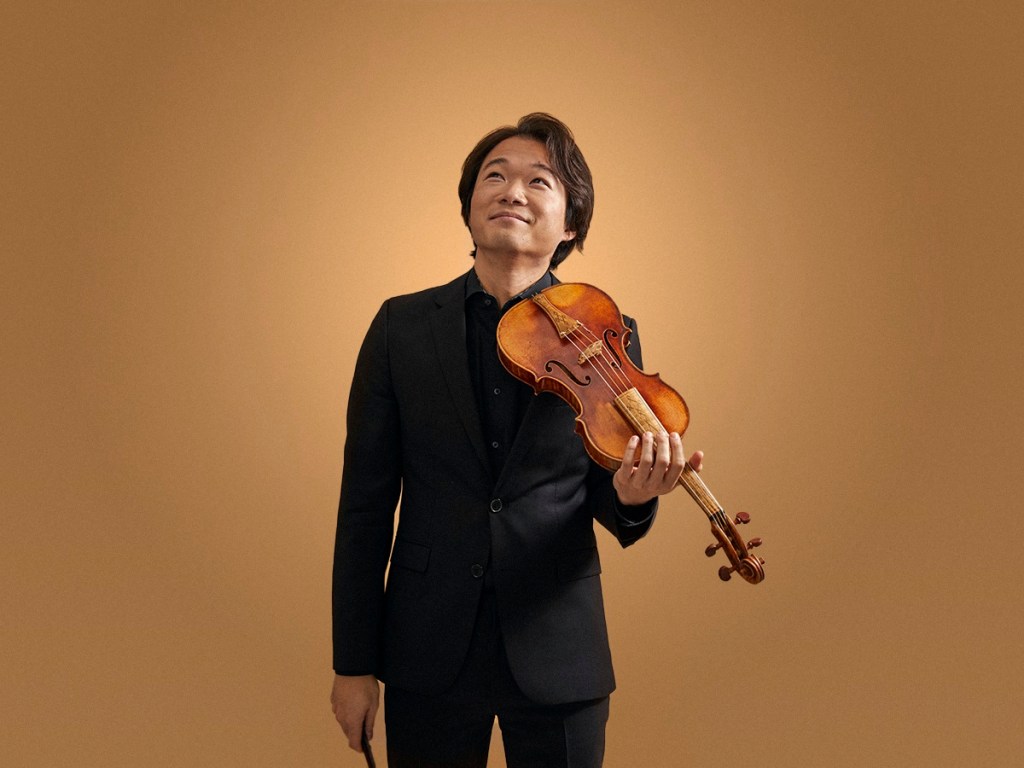
Shunske Sato, concertmaster since 2013 and artistic director since 2018 of the Netherlands Bach Society. Photo by Dana van Leeuwen.

To find the Weekly Cantata Advent Calendar, please click here.

Several people have asked me what made me start writing for this blog again. The answer is simple: Shunske Sato’s violin playing in the “Mein Verlangen” tenor aria from Cantata 161 Komm, du süsse Todesstunde. I had already heard that Sato was “a good one” from people with authority on the matter, and had enjoyed listening to his recordings, but it took these live concerts to experience the magic that happens when he is a soloist in a Bach aria.

During a visit to my home country, the Netherlands, I attended the Netherlands Bach Society’s “All Souls” concerts on October 31 in the Grote Kerk in Naarden and on November 3 in the Nieuwe Kerk in The Hague. I had been unsure how to talk about these concerts in the framework of this blog, especially now that it’s more than a month ago and we’re in Advent already (yes there is Advent music in this post, please keep reading) and there is no recording of these concerts.

Solo sonatas and partitas on All of Bach

But it turns out that this week is the perfect time for a spotlight on Shunske Sato, because this Thursday December 5, 2019, the Netherlands Bach Society will publish the final episode of his series of solo violin sonatas and partitas on All of Bach, their online video archive of Bach performances. Just click on this link and the entire series is right there, under “recently added.”

Sato was appointed concertmaster of the Netherlands Bach Society in 2013, and became their artistic director in June 2018. For the concerts I attended, he was concertmaster only, having invited alto Alex Potter to program and lead this production. (Alex Potter deserves a blog post too, but that will come later). By inviting a different guest director for each program, Sato has breathed fresh air into the he group of musicians I feel.

Instead of the standard biographies, the program booklet featured personal stories from Sato and the four vocal soloists. As a person who’s produced many program books in her lifetime, I felt this was a breath of fresh air too. And as a mom of two teenagers who are finding their way through school and life, I especially liked this part from Sato’s story:

“Things got tricky in my teens: I began spending lots of time away from school playing concerts, and my grades at school were impressively low (except for French and Maths).  Giving up on school, I often spent my weekdays at my favorite bookstore instead and read about history, computer programming and linguistics, and composed string quartets.  Saturdays always came as a relief: classes and lessons at the Juilliard School in New York, where hung out with my “real” friends.”

Playing Weimar style

Back to what happened in the concert in Naarden on October 31. For this entire program, the violinists were playing one-on-a-part, the same way it was probably done in Weimar, where Bach first performed Cantata 161 on the small organ loft in 1716. This meant that Sato was thus the instrumental soloist in the tenor aria “Mein Verlangen,” and with the rest of the ensemble completely in sync with him, he could truly do his own thing.

And then there was light
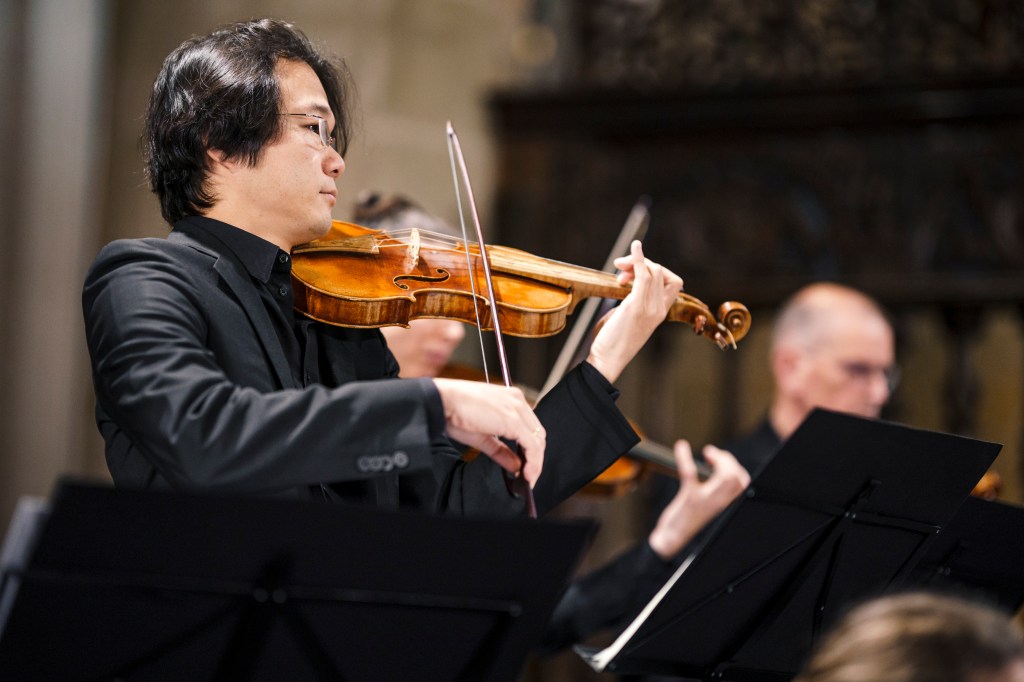
Shunske Sato in Naarden, October 31, 2019. Photo by Hans van der Woerd, courtesy of The Netherlands Bach Society.

And boy, did he do that! Every time he played the “Mein Verlangen” theme, he stretched the tempo just a little bit, every time slightly differently. It created a halo over the entire aria. Even though the tenor wasn’t singing yet, the text was already there: the longing (“Verlangen”) but also the pure radiance (“reiner Schein”) of the soul and the image of angels. He truly brought light into the music, and also for me personally into my heart and mind. It made all my frustrations and worries melt away, and it made the other instrumentalists play and tenor Thomas Hobbs sing with even more inspiration than they already had in this concert.

“The more I let go, the more I risk, the more I dare to really tell the story”

Witnessing Sato communicate the text of the aria before the singing started, I was immediately reminded of this wonderful interview with him for All of Bach. It is specifically about the “Erbarme dich” aria from the St. Matthew Passion, but his message “The more I let go and the more I risk, the more I dare to really tell the story…” applies just as well to this aria that I saw him play.

I went to the “All Souls” concert again three days later in the beautiful concert venue the Nieuwe Kerk has become. Sato’s playing there was possibly even more moving and the effect on those on stage and in the audience possibly stronger too. Several people had tears in their eyes.

Watch for yourself in this Advent aria

See the “Sato magic” happen in the soprano aria from Cantata 36 Schwingt freudig euch empor on All of Bach, with soprano Zsuzsi Tóth. Never did I enjoy a “da capo” this much. To read more about this cantata, the third one Bach wrote (or adapted) for the first Sunday of Advent, read my blog post from 2017 here.

With special thanks to Marloes Biermans and Annelie Bulsing of the Netherlands Bach Society for their generosity in providing photos and copy for me to use,

Wieneke Gorter, December 3, 2019.

To find the Weekly Cantata Advent Calendar, please click here.

Weekly Cantata Advent Calendar now online

01 Sunday Dec 2019

Posted by cantatasonmymind in Advent, Bach's life, Cantatas, Christmas, Leipzig, Weimar

≈ Leave a comment

I created an Advent Calendar for you, so you can easily find my posts about Bach’s Advent cantatas, enjoy some more videos that have come out since I originally wrote these posts, and get recommendations for Christmas gifts.

Bonus Advent cantata

10 Sunday Dec 2017

Posted by cantatasonmymind in Advent, Cantatas, Leipzig

≈ Leave a comment

Tags

1st Sunday of Advent, Advent, Bach, BWV 36, Christmas, Christoph Pregardien, Collegium Vocale Gent, J.S. Bach Foundation, J.S. Bach Stiftung, Nuria Rial, Peter Kooy, Phlippe Herreweghe, Sarah Connolly, Sybilla Rubens

Nuria Rial, my favorite interpreter of the soprano aria from Cantata 36.

In Leipzig in Bach’s time, the period between the first Sunday of Advent and Christmas was a “tempus clausum,” when no figural music was allowed in the churches. So if I would follow Bach’s cantata writing in 1724 very strictly, I would not have any music for you today.

So let’s take a detour to 1725. Sometime in that year, Bach wrote a congratulatory cantata for a teacher at the St. Thomas School in Leipzig. The cantata, with the title Schwingt freudig euch empor, had nine movements: an opening chorus, four recitatives and three arias. The cantata also featured a closing chorus alternated with recitatives for all the soloists, the way Bach would also use that in the before-last movement of his St. Matthew Passion. For the text of this cantata, please see this entry on Eduard van Hengel’s website. Scroll all the way down to find a table with all the different texts for the different cantatas.

In the fall of 1726, Bach received a request from his previous employer, prince Leopold of Köthen, to write a cantata for this birthday of his second wife, princess Charlotte Friederike Wilhelmine, on November 26 of that year. Scholars think that at the same time Bach was reworking this cantata from 1725 into this Birthday cantata, he was also reworking it into an Advent cantata. However the music of that particular cantata has not survived.

In 1731 Bach again, or finally, was able to make the original of 1725 into an Advent cantata, by replacing all the recitatives with chorales. This is cantata 36 Schwingt freudig euch empor, one of three cantatas for the first Sunday of Advent that have survived. (The other two are Cantata 61 I discussed last year, and Cantata 62 I discussed last week). Again please see Eduard van Hengel’s table of the different texts of all the various cantatas here. Find the English translations of Cantata 36 here, and find the score of Cantata 36 here.

My favorite recording of the entire cantata is the one by Herreweghe from 1997 (from the same album I discussed last week). I like this recording the best because of the most sparkling interpretation of the opening chorus, gorgeous singing by Christoph Prégardien in the tenor solos and by Peter Kooy in the bass aria, and a wonderful soprano/alto duet by Sybilla Rubens and Sarah Connolly. Find this recording here on YouTube. Or follow the links in my post from last week to purchase the entire album of Advent cantatas by Herreweghe. It is a great Christmas gift 🙂 !

If you prefer to watch a live recording, I recommend the one by the J.S. Bach Foundation. They just released the entire video recording of this cantata this week, and this performance contains my absolute favorite interpretation of the soprano aria by Nuria Rial.

Wieneke Gorter, December 9, 2017, links updated and photo added December 3, 2019.

Cantata 62: one of my favorite opening choruses and a magnificent bass aria

02 Saturday Dec 2017

Posted by cantatasonmymind in Advent, Bach's life, Cantatas, Chorale cantatas 1724/1725, Leipzig

≈ Leave a comment

Tags

Advent, Bach, chorale cantata, Christmas, Christophe Pregardien, Damien Guillon, Grace Davidson, Harry van der Kamp, Marcel Ponseele, oboe, Peter Kooy, Thomas Hobbs

Adventskranz 1. Advent

I don’t know if it is because the oboes already announce the chorale melody in the instrumental part of this opening chorus, or because of the overall Advent sparkle, but I have always found the first movement of Cantata 62 Nun komm der Heiden Heiland one of the most beautiful of all Bach’s cantata opening choruses. I especially cherish the Herreweghe recording from 1997. Find that recording here on YouTube. Soloists are Sibylla Rubens, soprano; Sarah Connolly, alto; Christoph Prégardien, tenor; and Peter Kooij, bass. This cantata also features an impressive recitative and aria for bass.

I remember an anecdote from my mom’s time as a member of the Twents Bachkoor, somewhere in the early 1980s. Bass soloist Harry van der Kamp showed up for an Advent concert, thinking he was coming to sing the other cantata with the same Nun komm der Heiden Heiland title, Cantata 61, which includes a beautiful recitative for bass (discussed on this blog here), but nothing really challenging for bass otherwise. He found out during the warm-up rehearsal that it was in fact 62. He did a fabulous job and part of my admiration for him stems from witnessing that as an audience member during that concert.

In the bass recitative, listen for Bach’s musical illustration of the words “laufen” (walking — upwards sequence), “Gefall’ne” (fallen — 7th down), and “heller Glanz” (bright luster — a sparkling highest note).

Find the text of Cantata 62 here, and the score here.

Bach wrote this cantata for the first Sunday in Advent in Leipzig in 1724, as part of his series of chorale cantatas of 1724/1725. For nine and a half months, starting on June 11, 1724, he would write every cantata according to this same template: the opening movement is a chorale fantasia on the first stanza of an existing Lutheran hymn or chorale, with the tune appearing as a cantus firmus. The last movement has the last stanza of the same hymn as text, in a four-part harmonization of the tune. The text of those choral, outer movements was used verbatim, while the text of the solo, inner movements was paraphrased, but still based on the inner stanzas of the same hymn.

I have been following all these chorale cantatas in the order they were written in 1724 on this blog. If you missed it, you can start reading here. If you subscribe to this blog (on the left-hand side of this text when reading on a desktop computer, or at the bottom of this text when reading on a smartphone) you will receive an email every time I have posted a new story.

There is also a wonderful live performance by Herreweghe of this cantata on YouTube, albeit with different soprano, alto, and tenor soloists (Grace Davidson, soprano; Damien Guillon, countertenor; Thomas Hobbs, tenor), but again with Peter Kooij singing bass, and again Marcel Ponseele playing first oboe. It was recorded in the St. Roch Church in Paris in 2015 and you can find it here on Youtube. The camera direction in the beginning is a bit strange: perhaps the TV director didn’t know the piece or didn’t have the score in front of her/him, because the camera is on the altos when the sopranos have an entrance, and on the back of the basses and tenors when the altos have an entrance, but later on it gets better, and it is a wonderful selection of Advent and Christmas cantatas they present there in that concert.

The CD recording from 1997  is part of a very good album, which also includes the two other Advent cantatas: Cantata 36 Schwingt freudig euch empor from 1731 (more about this in the next few weeks) and Cantata 61 Nun komm der Heiden Heiland from 1713 (discussed here on this blog). Please consider supporting the artists by purchasing this album in its reprint from 2014. Or purchase the box from 2010, which also includes two CDs with Christmas cantatas.

Wieneke Gorter, December 2, 2017.

Another boy soprano hero: Sebastian Hennig

17 Saturday Dec 2016

Posted by cantatasonmymind in Advent, Cantatas, Weimar

≈ Leave a comment

Tags

Advent, Advent 4, Bach, BWV 132, Gustav Leonhardt, Max van Egmond, Sebastian Hennig, Weimar

hennig-sebastian-1boy

Sebastian Hennig

I remember some of the cantatas my mother played on the turntable in our house more vividly than others. One of those is cantata 132 Bereitet die Wege, bereitet die Bahn!, written for the fourth Sunday of Advent in Weimar in 1715.

To understand this, it helps to know how the Christmas season was celebrated  in our house in The Netherlands in the early 80s. Christmas didn’t feature in store windows or on television until after St. Nicholas (December 5). We would not have a Christmas tree in our house until December 16. And while at school we would sing Christmas carols in the last week before the break and have a “Christmas breakfast” on the last Friday, at home we would not have any real Christmas music, including Bach’s Christmas Oratorio until Christmas Day (more about this next week). Until then it was Advent cantatas only as far as Bach’s music was concerned. And since my mother was also a fan of Sebastian Hennig, the soprano soloist in the 1983 Leonhardt recording of cantata 132, she probably played this cantata pretty frequently in the last week before Christmas.

(for other boy sopranos from the Leonhardt/Harnoncourt recordings my mother admired, see my posts about Seppi Kronwitter in cantata 61, Peter Jelosits in cantata 44 and Peter Jelosits in cantata 59)

Listen to the Leonhardt recording of cantata 132 Bereitet die Wege, bereitet die Bahn! on Youtube.

Find the text here, and the score here.

As a child, I was very impressed by the soprano aria at the start of this cantata too, but I also vividly remember the “Wer bist du” words in the bass aria, sung by Max van Egmond on this Leonhardt recording. Except for perhaps the tenor aria, their recording of this cantata is unrivaled as far as I’m concerned.

If you like to watch a live performance of this (including some more wonderful playing by Shunske Sato in the alto aria),  there is a wonderful live video performance of this cantata by the Netherlands Bach Society available here on YouTube. Soloists are Julia Doyle, soprano; Tim Mead, alto; Jan Kobow, tenor; and Dominik Wörner, bass.

If you have more time and would like to learn more about this cantata, I can highly recommend that you also watch the “background” videos that go with this Netherlands Bach Society recording, presented as interviews, in this order: conductor Alfredo Bernardini, soprano Julia Doyle, and bass Dominik Wörner.

Wieneke Gorter, December 17, 2016, updated with new YouTube links December 19, 2019.

Third Sunday in Advent: Two adorable infants and a reconstruction of cantata 186a

10 Saturday Dec 2016

Posted by cantatasonmymind in Advent, Cantatas, Weimar

≈ Leave a comment

Tags

Advent, Advent 3, Bach, BWV 186, BWV 186a, cantatas, chorales, Collegium Vocale Gent, Miah Persson, Peter Kooy, Phlippe Herreweghe, reconstruction, Robin Blaze, Weimar

madonna_meadow

Madonna with the Christ Child and St. John the Baptist, also known as Madonna of the Meadow, by Raphael, 1506. Kunsthistorisches Museum, Vienna.

For those of you who already saw this on the third Sunday of Advent 2016: please keep reading, because I considerably revised this post, clarifying the information about the reconstruction and including one more painting 🙂

Growing up, I had a cousin. She was almost exactly six  months older than me. My baby photo album holds several pictures of the two of us together, me a helpless baby, her an infant who could already sit up by herself. I’m always touched by those photos. Not just because they make me think of the cousin I lost when we were both 19, but also because they represent how fast a baby grows up, and how soon the “older” baby can be of help and entertainment for the younger one, and how adorable it is to see that.

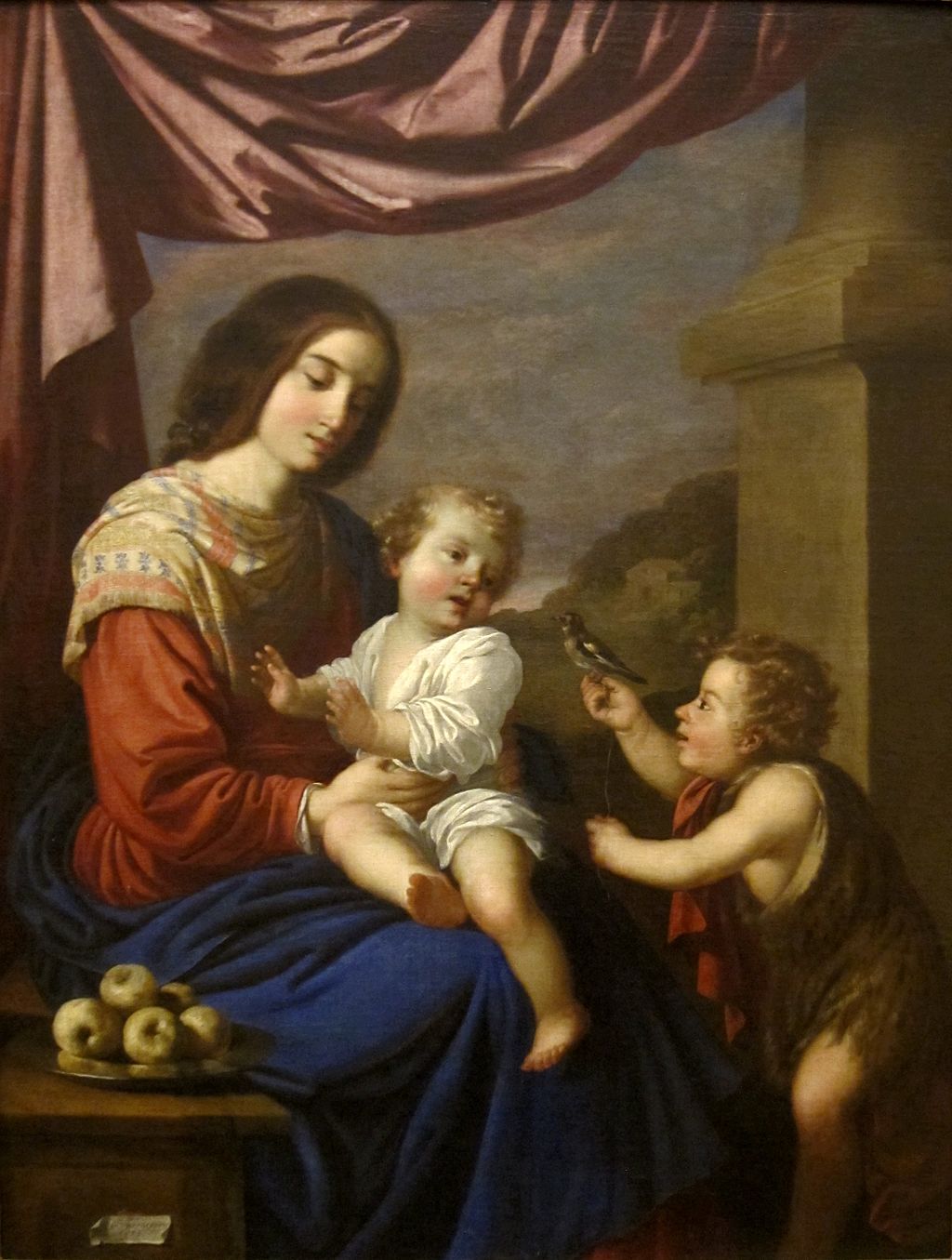
Many painters were aware of this cuteness factor too. Especially in the Renaissance, the concept of a one-year-old John playing with or helping a six-month-old Jesus in Madonna and Child paintings became an extremely popular subject, starting with  Leonardo da Vinci. Raphael in particular painted several variations on this theme, including the Alba Madonna, La belle jardinière, Aldobrandini Madonna, Madonna della seggiola, and the Madonna dell’Impannata. The tradition continued well into the 17th century, see this beautiful example from 1658 by Francisco de Zurbarán in the San Diego Museum of Art:

Zurbaran_Madonna_and_Child

Why is all this relevant to Advent? Well, on this third Sunday of Advent, many Christian churches read about John the Baptist, as they believe John was Jesus’ forerunner. Because of a mention in the Gospel of Luke, the Catholic church in the very early Middle Ages determined that St. John’s birthday must have been exactly six months before Christmas — and decided to celebrate this on June 24th.*  You can read more about this in my post about the Feast of St. John.

As far as we know, Bach wrote only one cantata for this Sunday, the third Sunday of Advent. It is the one listed in the BWV catalog as Cantata 186a, Ärgre dich, o Seele, nicht, first performed in Weimar on Sunday December 13, 1716. No original music score is left of this cantata. However, thanks to Bach’s librettist, Weimar court poet Salomo Franck, who published the full libretto for this cantata in a poetry volume in 1717, we do have the original text of 186a.

And, it is not hard to make an educated guess as to what the music would have been.

On July 9, 1723, for the 7th Sunday after Trinity in Leipzig, Bach expanded the music of the 1716 Weimar cantata with four additional recitatives and two chorales (per his usual template for reviving Weimar cantatas for Leipzig), and we do have that music: it is Cantata 186, also with the title Ärgre dich, o Seele, nicht.**

To reconstruct the original 1716 Weimar Advent version, or Cantata 186a, one would have to eliminate all the recitatives Bach added in 1723 as well as both chorales, superimpose different texts on some of the arias, and select alternative music for the original closing chorale. There have been a few performances of these kind of reconstructions, but unfortunately there are no recordings of those.

So I invite you listen to Bach Collegium Japan playing this music via my playlist on Spotify. To imagine the original texts superimposed over this music, and learn why I selected this particular closing chorale, please keep reading.

Opening chorus: This has the same text in 1716 as in 1723. We should imagine a smaller ensemble singing this though, as the maximum number of singers in the Weimar chapel was 7. This opening chorus is again a beautiful example of how Bach provides an “entrada” for the Duke as well as an opportunity for himself to show off his skills with the “fashionable” music, the way he almost always did in the Weimar cantatas.***

Ärgre dich, o Seele, nicht,
Daß das allerhöchste Licht,
Gottes Glanz und Ebenbild,
Sich in Knechtsgestalt verhüllt,
Ärgre dich, o Seele, nicht!
Do not be confounded, o soul,
because the all-highest light,
God’s radiance and very image,
is concealed in the form of a servant;
do not be confounded!

For the Bass aria, imagine this Advent text instead of the Trinity 7 text you hear (changes in bold type):

Bist du, der da kommen soll,
Seelen-Freund, in Kirchen-Garten?
Mein Gemüt ist Zweifels-voll,
Soll ich eines andern warten!
Doch, o Seele, zweifle nicht.
Lass Vernunft dich nicht verstricken,
Deinen Schilo, Jacobs Licht,
Kannst du in der Schrift erblicken!
Are You He, who should come,
Friend of souls, to the Church’s garden?
My spirit is full of doubt,
perhaps I should wait for someone else!
Yet, o soul, do not doubt.
Do not let reason beguile you.
Your Messiah, Jacob’s light,
is visible to you in the scripture.(translation of original text by me, unchanged words courtesy of bach-cantatas.com website)

For the Tenor aria,  imagine this Advent text instead of the Trinity 7 text you hear (changes in bold type):

Messias läßt sich merken
Aus seinen Gnaden-Werken.
Unreine werden rein.
Die geistlich Lahme gehen,
Die geistlich Blinde sehen
Den hellen Gnaden Schein.
The Messiah lets Himself be seen
in His works of grace.
The impure become purified.
Those lame of spirit will walk,
Those blind of spirit will see
the clear brilliance of the mercy.(translation of original text by me, unchanged words courtesy of bach-cantatas.com website)

There is only one word change in the Soprano aria: In the last line the 1716 text is “des Lebens Wort” instead of “das Lebenswort” from 1723.

Die Armen will der Herr umarmen
The Lord will embrace the poor
Mit Gnaden hier und dort;
With his mercy here and there;
Er schenket ihnen aus Erbarmen
Out of his compassion he sends to them
Den höchsten Schatz, das Lebenswort.
His greatest treasure, the word of life.

Enjoy Miah Persson’s beautiful voice and interpretation. If you would like to hear and more about her, read my post about cantata 179. Cantata 179 appears on the same album by Bach Collegium Japan as this cantata 186.

Soprano-alto duet: This is the original text from 1716, unchanged in 1723. The text promises the believer the crown (die Krone) of the everlasting life, but only if he stays faithful (getreu) and only in the afterlife, when free of the body (wenn des Leibes frei).

Laß, Seele, kein Leiden
My soul, let no sorrow
Von Jesu dich scheiden,
Separate you from Jesus
Sei, Seele, getreu!
Be faithful, my soul!
Dir bleibet die Krone
The Crown weight you
Aus Gnaden zu Lohne,
Is your reward through grace
Wenn du von Banden des Leibes nun frei.
When you will be free from the body’s prison.

In Weimar in 1716, for the closing chorale Bach used the 8th verse of Von Gott will ich nicht lassen from 1563, based on the French tune Une jeune fillette from 1557. Since this is not the same melody as Es ist das Heil uns kommen her Bach used in 1723 it is very plausible that both chorales from the 1723 version are new, in text as well as in music. So in an effort to reconstruct the 1716 version,  we need to think of a different solution for the music than the tune from 1723. A good fit would be a simple setting of the Von Gott will ich nicht lassen chorale, the way Bach would set for example verse 5 of this chorale as closing movement of cantata 73 in 1723 or 1724. So that’s why, for now, I’ve included that music (from a Herreweghe recording) in the Spotify playlist. The text would be this:

Darum ob ich schon dulde
Hie Wiederwärtigkeit,
wie ich auch wohl verschulde,
kommt doch die Ewigkeit,
ist aller Freuden voll,
die ohne alles Ende,
dieweil ich Christum kenne,
mir widerfahren soll.
Therefore, even if I endure
unpleasantness here,
as I have well deserved,
eternity is coming
filled with all joy;
this for ever
will befall me
while I acknowledge Christ.

All translations of existing text and closing chorale courtesy of bach-cantatas.com website, translations of changed texts by me.

© Wieneke Gorter, December 10, 2016, revised December 15, 2017.

* Luke 1:36 (about the Annunciation) mentions that the angel Gabriel also informed Mary that her cousin Elizabeth was already six months pregnant. The June 24 date was most probably also chosen to give a Christian meaning to already existing Pagan Midsummer celebrations. The Feast of St. John being celebrated on June 24 shows up in records as early as the year 506.

**I discussed this 1723 version of the cantata here, and recommended the recording by Bach Collegium Japan with soprano Miah Persson, alto Robin Blaze, tenor Makoto Sakurada, and bass Peter Kooij.

***Read more about Bach’s Weimar cantatas in my posts about cantata 182, 12, 147, and 21

Many things to be proud of

26 Saturday Nov 2016

Posted by cantatasonmymind in Advent, Cantatas, Leipzig, Weimar

≈ 2 Comments

Tags

Advent, Bach, BWV 61, Christophe Pregardien, Eduard van Hengel, First Sunday of Advent, French ouverture, Harnoncourt, Leipzig, Luther, Nuria Rial, Peter Kooy, Seppi Kronwitter, Sybilla Rubens, Weimar

giotto-entry-into-jerusalem

The Entry into Jerusalem by Giotto, ca. 1305. Fresco in the Scrovengni Chapel, Padua, Italy.

Bach performed this cantata 61 Nun komm der Heiden Heiland in Leipzig on November 28, 1723, as a “rerun” of the first performance in Weimar in 1714. Why did he not write a new cantata? The prevailing scholarly answer is that Bach was giving himself a break from composing in between the three-week frenzy of cantatas 60, 90, and 70 and the new works (including a Magnificat) he was planning for the Christmas days.  I think Bach was proud of his Weimar cantatas, and I believe he wanted to show off the special features in this cantata to his colleagues and to the thousands of Lutherans that he knew would flock to the Leipzig churches on holidays.

I myself am proud of having followed Bach’s cantata writing of 1723 every week for the entire Trinity season. After all this listening and reading, I see a pattern in Bach reviving some of his Weimar cantatas on Leipzig feast days*, and I now look at cantata 61 Nun komm der Heiden Heiland in a new way.

This cantata had already been in my top five because of the moving interpretation of the soprano aria by Seppi Kronwitter (soprano) and Nikolaus Harnoncourt (cello) on the Harnoncourt recording from 1976. My mother loved this aria and played this recording many times, and I have fond memories of listening to it with her.

Harnoncourt-cello

I had always found the bass recitative that precedes it very charming, with the musical illustration of the knocking on the door, but not more than that.  I had seen this recitative in the context of all the Bach cantatas and passions that I knew, and had compared it with other typical Bach “Vox Christi” writing for bass. But those were all written after November 28, 1723.  So now, after having tried to place myself in the shoes of the Leipzig congregations for the entire 1723 Trinity season, I am fully aware that they had not heard a “Vox Christi” at all in any of the cantatas leading up to this one.** And thus I finally realize how it must not have been charming, but truly moving to them to hear this announcement presented in this way, on the first Sunday they started looking forward to the birth of Christ.

In the text of the recitative, Jesus says: “See, I am in front of your door! I’m knocking!” The librettist means the door of the believer’s heart, in which he’s planning to live. The pizzicato in the strings, as well as the staccato and the intervals in the voice part illustrate the knocking, and the dissonances at the beginning only resolve until the final “klopfe an.” The form of this recitative is highly unusual, and perhaps also something Bach wanted to show off in Leipzig.

However Bach’s greatest source of pride was probably the opening chorus of this cantata. To understand this, we need to do a mini music history class. First, in the 4th century, Ambrosius created the hymn Veni Redemptor Gentium, beautifully sung here on this video by Giovanni Vianini, director of the Schola Gregoriana Mediolanensis in Milan, Italy. Then, in 1524, Luther turned that hymn into Nun komm der Heiden Heiland, which sounds like this and which all Lutherans in Bach’s time knew very well.

In Weimar Bach had come into contact with French and Italian court music, and had adopted the habit of writing almost every opening chorus or opening sinfonia of his cantatas as a royal “entrada,” to show off his skills in French ouverture writing as well as to please the Duke.

So now Bach needed/wanted to merge the timeless hymn with a fashionable French ouverture. And the result is stunning. Or, as Eduard van Hengel says: Bach wrote “brilliant fusion” at the age of 29. Listen to this in the recording by Philippe Herreweghe on YouTube (Sybilla Rubens, soprano; Christoph Prégardien, tenor; Peter Kooij, bass).

Find the German text with English translations here and the score here.

The first line of the hymn is sung one voice part at a time, an illustration of the Bible reading for this Sunday: the people greeting the messiah who is riding into Jerusalem. The second line is then sung as a simple four-part hymn, while the instrumental parts keep playing the first part of the ouverture. The third line becomes a mini motet in the fast and happy (“Gai”) middle part of the ouverture, in 3/4. 

The fourth line of text is then again a simple four-part setting on the third part of the ouverture.

For the closing chorale, Bach chose the last two lines of Wie schön leuchtet der Morgenstern as melody. And again he marries the chorale tune beautifully with the instrumental writing.

Wieneke Gorter, November 26, 2016, updated December 1, 2019.

*Read more about this in my post about the feast of St. John the Baptist on June 24, The Visitation on July 2, and last week’s post about cantata 70. Read how proud Bach was of his Weimar cantatas in this post about cantata 12.

** unless they had a really good memory, and were present at Bach’s “audition” in February 1723. There is a Vox Christi in Cantata 22 which he presented at that time, but didn’t repeat in Leipzig until that same time in the church year in 1724.

Newer posts →

Recent Posts

  • “Missa Miniatura” by CONTINUUM/Elina Albach Even More Moving in 2025
  • Bachfest Leipzig 2025
  • Bach Cantatas for Christmas – 1724 and 1734 editions
  • Fourth Sunday of Advent – more insight into Cantata 62 helped me better understand Bach’s Christmas Oratorio
  • Saint Ambrose and Luther in Milan – Second Sunday of Advent

Archives

  • August 2025
  • July 2025
  • December 2024
  • November 2024
  • June 2024
  • January 2024
  • December 2023
  • October 2023
  • September 2023
  • August 2023
  • April 2022
  • February 2022
  • January 2022
  • December 2021
  • November 2021
  • June 2021
  • May 2021
  • April 2021
  • February 2021
  • January 2021
  • December 2020
  • November 2020
  • October 2020
  • September 2020
  • August 2020
  • July 2020
  • May 2020
  • April 2020
  • March 2020
  • February 2020
  • January 2020
  • December 2019
  • November 2019
  • May 2018
  • April 2018
  • March 2018
  • February 2018
  • January 2018
  • December 2017
  • November 2017
  • October 2017
  • September 2017
  • August 2017
  • July 2017
  • June 2017
  • May 2017
  • April 2017
  • March 2017
  • February 2017
  • January 2017
  • December 2016
  • November 2016
  • October 2016
  • September 2016
  • August 2016
  • July 2016
  • June 2016
  • May 2016
  • April 2016
  • March 2016
  • February 2016
  • January 2016

Enter your email address to follow this blog and receive notifications of new posts by email.

Join 336 other subscribers

Categories

  • 1723 Trinity season special series
  • Advent
  • After Easter
  • Ascension
  • Bach's life
  • Cantatas
  • Chorale cantatas 1724/1725
  • Christmas
  • Easter
  • Epiphany
  • Following Bach in 1725
  • Köthen
  • Leipzig
  • Septuagesima
  • Travel
  • Trinity
  • Weimar

Meta

  • Create account
  • Log in
  • Entries feed
  • Comments feed
  • WordPress.com

Website Built with WordPress.com.

  • Subscribe Subscribed
    • Weekly Cantata
    • Join 156 other subscribers
    • Already have a WordPress.com account? Log in now.
    • Weekly Cantata
    • Subscribe Subscribed
    • Sign up
    • Log in
    • Report this content
    • View site in Reader
    • Manage subscriptions
    • Collapse this bar
 

Loading Comments...