Weekly Cantata

Weekly Cantata

Category Archives: Bach’s life

Bach’s holiday planning in 1724

17 Sunday Dec 2017

Posted by cantatasonmymind in Bach's life, Cantatas, Chorale cantatas 1724/1725, Christmas, Leipzig

≈ Leave a comment

15289642939_dcd9f28f1e_b

Christmas market in Berlin at the end of the 18th century. Leipzig had a Christmas market since the year 458. I don’t know if there was a market during the tempus clausum in 1724.

In Bach’s time in Leipzig, between the first Sunday of Advent and Christmas Day, there was no music allowed in the churches other than singing chorales. This tempus clausum (“closed” time) was also in effect during the 40 days before Easter, and was intended for introspection.

Bach’s employer in Weimar, where he worked from 1708 to 1717, did not impose a tempus clausum for Advent, so there are Advent cantatas from Bach’s Weimar time for the second, third, and fourth Sunday of Advent. For a reconstruction of the cantata that would have sounded in the ducal chapel in Weimar on the third Sunday of Advent in 1716, please read my updated post from last year.

In 1724 the tempus clausum was a welcome break for Bach, because he needed to work ahead and rehearse the choir. While the previous year he had sometimes “recycled” cantatas from Weimar, this year he could not do that. In the summer of 1724 he had started a series of chorale cantatas (read more about that here), and if he wanted to keep composing according to this template, he had to write a brand new work for every feast day.

For the 1724/1725 Christmas season, that schedule would look like this:

Monday Dec 25, Christmas Day: Cantata 91 Gelobet seist du, Jesu Christ

Tuesday Dec 26, Second Christmas Day: Cantata 121 Christum wir sollen loben schon

Wednesday Dec 27, Third Christmas Day: Cantata 133 Ich freue mich in dir

Sunday Dec 31, Sunday after Christmas: Cantata 122 Das neugeborene Kindelein

Monday Jan 1, New Year’s Day: Cantata 41 Jesu nun sei gepreiset

Saturday Jan 6, Epiphany: Cantata 123 Liebster Immanuel, Herzog der Frommen

Sunday Jan 7, First Sunday after Epiphany: Cantata 124 Meinen Jesum laß ich nicht

Wieneke Gorter, December 17, 2017, updated November 21, 2020

Cantata 62: one of my favorite opening choruses and a magnificent bass aria

02 Saturday Dec 2017

Posted by cantatasonmymind in Advent, Bach's life, Cantatas, Chorale cantatas 1724/1725, Leipzig

≈ Leave a comment

Tags

Advent, Bach, chorale cantata, Christmas, Christophe Pregardien, Damien Guillon, Grace Davidson, Harry van der Kamp, Marcel Ponseele, oboe, Peter Kooy, Thomas Hobbs

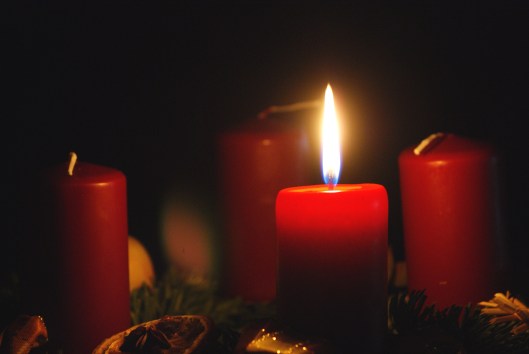
Adventskranz 1. Advent

I don’t know if it is because the oboes already announce the chorale melody in the instrumental part of this opening chorus, or because of the overall Advent sparkle, but I have always found the first movement of Cantata 62 Nun komm der Heiden Heiland one of the most beautiful of all Bach’s cantata opening choruses. I especially cherish the Herreweghe recording from 1997. Find that recording here on YouTube. Soloists are Sibylla Rubens, soprano; Sarah Connolly, alto; Christoph Prégardien, tenor; and Peter Kooij, bass. This cantata also features an impressive recitative and aria for bass.

I remember an anecdote from my mom’s time as a member of the Twents Bachkoor, somewhere in the early 1980s. Bass soloist Harry van der Kamp showed up for an Advent concert, thinking he was coming to sing the other cantata with the same Nun komm der Heiden Heiland title, Cantata 61, which includes a beautiful recitative for bass (discussed on this blog here), but nothing really challenging for bass otherwise. He found out during the warm-up rehearsal that it was in fact 62. He did a fabulous job and part of my admiration for him stems from witnessing that as an audience member during that concert.

In the bass recitative, listen for Bach’s musical illustration of the words “laufen” (walking — upwards sequence), “Gefall’ne” (fallen — 7th down), and “heller Glanz” (bright luster — a sparkling highest note).

Find the text of Cantata 62 here, and the score here.

Bach wrote this cantata for the first Sunday in Advent in Leipzig in 1724, as part of his series of chorale cantatas of 1724/1725. For nine and a half months, starting on June 11, 1724, he would write every cantata according to this same template: the opening movement is a chorale fantasia on the first stanza of an existing Lutheran hymn or chorale, with the tune appearing as a cantus firmus. The last movement has the last stanza of the same hymn as text, in a four-part harmonization of the tune. The text of those choral, outer movements was used verbatim, while the text of the solo, inner movements was paraphrased, but still based on the inner stanzas of the same hymn.

I have been following all these chorale cantatas in the order they were written in 1724 on this blog. If you missed it, you can start reading here. If you subscribe to this blog (on the left-hand side of this text when reading on a desktop computer, or at the bottom of this text when reading on a smartphone) you will receive an email every time I have posted a new story.

There is also a wonderful live performance by Herreweghe of this cantata on YouTube, albeit with different soprano, alto, and tenor soloists (Grace Davidson, soprano; Damien Guillon, countertenor; Thomas Hobbs, tenor), but again with Peter Kooij singing bass, and again Marcel Ponseele playing first oboe. It was recorded in the St. Roch Church in Paris in 2015 and you can find it here on Youtube. The camera direction in the beginning is a bit strange: perhaps the TV director didn’t know the piece or didn’t have the score in front of her/him, because the camera is on the altos when the sopranos have an entrance, and on the back of the basses and tenors when the altos have an entrance, but later on it gets better, and it is a wonderful selection of Advent and Christmas cantatas they present there in that concert.

The CD recording from 1997  is part of a very good album, which also includes the two other Advent cantatas: Cantata 36 Schwingt freudig euch empor from 1731 (more about this in the next few weeks) and Cantata 61 Nun komm der Heiden Heiland from 1713 (discussed here on this blog). Please consider supporting the artists by purchasing this album in its reprint from 2014. Or purchase the box from 2010, which also includes two CDs with Christmas cantatas.

Wieneke Gorter, December 2, 2017.

A mini-break with Anna Magdalena

22 Saturday Jul 2017

Posted by cantatasonmymind in Bach's life, Cantatas, Chorale cantatas 1724/1725, Leipzig

≈ Leave a comment

bilcoplan

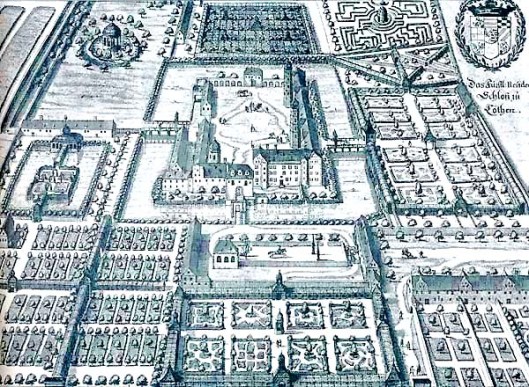
Köthen court plan

There is no cantata for Trinity 6 from 1724.  A little research gives the reason: Bach took a trip with his wife Anna Magdalena to the court of Köthen, where they had both worked until their move to Leipzig in 1723.

According to The New Bach Reader, the court account books state the following for July 18, 1724:

“To the Director Musices Bach and his wife, who performed, in settlement rthl* 60”

We don’t know what they performed and for exactly how many days they stayed, but Bach was back in time to compose and rehearse the cantata for Trinity 7 that year.

*rthl = Reichsthaler

Wieneke Gorter, July 15, 2017.

First Sunday after Easter 1724

23 Sunday Apr 2017

Posted by cantatasonmymind in After Easter, Bach's life, Cantatas, Leipzig

≈ Leave a comment

Tags

Alex Potter, Bach, cantatas, corno da tirarsi, Jos van Veldhoven, Peter Kooy, Thomas Hobbs, tromba da tirarsi

caravaggio_-_the_incredulity_of_saint_thomas

The Incredulity of Saint Thomas by Caravaggio, 1601-1602, Sanssouci Palace, Potsdam, Germany

In the past two weeks I ran out of time to work on this blog because of being sick, performing concerts with California Bach Society, and being on a trial jury for the first time since becoming a United States citizen in 2011. So this post for the First Sunday after Easter in 1724 is post-dated, and short, but contains lots of information to learn more about this beautiful cantata.

Previously in 1724: Bach “premiered” his Passion according to St. John on Good Friday, April 7, 1724. Then he ran out of time and energy and, without too much care for detail and text illustration, created cantatas out of existing music for Easter Monday and Easter Tuesday of that year.

This means that the first new composition he wrote after the St. John Passion was this cantata 67 Halt im Gedächtnis Jesum Christ (keep thinking of Jesus Christ), based on the Gospel text of Jesus appearing to his disciples. A famous cantata, already known and admired in the early 19th century, especially because of the dramatic fourth movement for choir and bass, which Bach would later transform into the Gloria of his Missa Brevis in A (BWV 234).

For the background of this cantata I will refer you to the experts, in this 15-minute video by the Netherlands Bach Society, published within their AllofBach series. The video is in Dutch, with English subtitles. It talks about Bach including a flute (not a recorder!) for the first time in a cantata, the meaning behind the text, and the use of the slide-trumpet “corno da tirarsi.”

Listen to and watch their performance here, find the text here, and find the score here. The Netherlands Bach Society, conducted by Jos van Veldhoven, with countertenor Alex Potter, tenor Thomas Hobbs, and bass Peter Kooij.

Wieneke Gorter, April 30, 2017.

A quick fix for Easter Tuesday 1724

18 Tuesday Apr 2017

Posted by cantatasonmymind in After Easter, Bach's life, Cantatas, Leipzig

≈ Leave a comment

Tags

Eduard van Hengel, Gustav Leonhardt, Leonhardt, Marius van Altena, René Jacobs

As I explained on Easter Sunday and Easter Monday, after his Passion according to St. John, Bach had no time or energy left to write anything new for the three Easter days in 1724. On Easter Sunday he repeated two Easter cantatas from earlier years. On Easter Monday he used existing music from a Birthday cantata from Köthen, didn’t seem to care too much about the music not illustrating the text, perhaps didn’t even write a new score, we don’t know, because the only manuscript that survived is from 1735, not from 1724.

On Easter Tuesday, he used Die Zeit, die Tag und Jahre macht (BWV 134a), a “serenata” for New Year’s Day, also from Köthen. For the Leipzig church cantata, cantata 134 Ein Herz, das seinen Jesum lebend Weiß he didn’t change any music at all, gave the instrumentalists the parts from Köthen, and also used the score from Köthen, writing the new sacred text under the original secular text.

Listening to this cantata is like listening to one of Bach’s instrumental works, because the text and the meaning of the text don’t really matter in this case. Listen to Gustav Leonhardt’s recording of this cantata, with René Jacobs, countertenor, and Marius van Altena, tenor.

Thanks to Eduard van Hengel, it is easy to see side-by-side how the new text compares to the original:

Serenata for New Year’s Day in Köthen 1719
Cantata 134 for Easter Tuesday in Leipzig 1724
1. Die Zeit, die Tag und Jahre macht,
Hat Anhalt manche Segensstunden
Und itzo gleich ein neues Heil gebracht.

2. Auf, Sterbliche, lasset ein Jauchzen ertönen.
[…] Auf, Seelen, ihr müsset ein Opfer bereiten,
Bezahlet dem Höchsten mit Danken die Pflicht.

1. Ein Herz, das seinen Jesum lebend weiß,
Empfindet Jesu neue Güte
Und dichtet nur auf seines Heilands Preis.

2. Auf, Gläubige, singet die lieblichen Lieder.
[…] Auf, Seelen, ihr müsset ein Opfer bereiten,
Bezahlet dem Höchsten mit Danken die Pflicht.

Easter Monday 1724

17 Monday Apr 2017

Posted by cantatasonmymind in After Easter, Bach's life, Cantatas, Leipzig

≈ Leave a comment

Tags

Collegium Vocale Gent, Easter Monday, James Taylor, Kai Wessel, Peter Kooy, Phlippe Herreweghe

Screenshot 2017-04-17 11.44.51

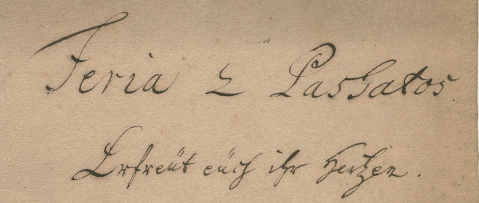
Excerpt from the title page of Bach’s manuscript from 1735 of cantata 66 Erfreut euch ihr Herzen. The manuscript from 1724 did not survive.

In Bach’s time there were three Easter days, as there were three Christmas days and three Pentecost days. I wrote yesterday that Bach planned to write four new works between April 10 and 23, 1724, but that is only somewhat true, it depends who you ask …

Gardiner believes that what Bach planned to do after Easter 1724,  was to write cantata 6 for Easter Monday, 42 and 67 for the first Sunday after Easter, and 85 for the second Sunday after Easter, instead of writing 6, 42, and 85 in 1725. As he painstakingly explains in his book “Bach: Music in the Castle of Heaven,”  Gardiner believes that the work (composing and rehearsing) on the Passion according to St. John must have cost Bach much more time than he thought, and he thus had to adjust his plans.

Following Gardiner’s theory, when Bach realized he had too much on his plate for Easter 1724, including having to write a cantata for Easter Tuesday he might not have planned on, he decided to write parodies (using existing music with some changes, but with different texts) for Easter Monday and Easter Tuesday of that year.

For Easter Monday 1724, he wrote cantata 66 Erfreut euch, ihr Herzen. Most of the music of this cantata is based on the secular cantata 66a Der Himmel dacht auf Anhalts Ruhm und Glück (Heaven thinks of Anhalt’s Fame and Fortune) , composed by Bach in 1718 to celebrate the 24th birthday of Prince Leopold of Anhalt-Cöthen. If you have 40 minutes, listen to a reconstruction of the entire Birthday cantata 66a from 1718 here, with soprano Gudrun Sidonie Otto, alto Wiebke Lehmkuhl, tenor Hans Jörg Mammel, and bass Karsten Krüger. If you only have 10 minutes, scroll to 11:17 for the soprano/alto duet with violin.

Listen to Herreweghe’s recording of cantata 66 Erfreut euch, ihr Herzen here. Soloists: alto Kai Wessel, tenor James Taylor, and bass Peter Kooij. I like Herreweghe’s recording of this cantata the best of all I listened to, because to me the tempo of the opening chorus is perfect for me, Collegium Vocale’s singing is fabulous as always, and I enjoy listening to Peter Kooy in the bass aria.

Find the text of cantata 66 here, and the score here.

Since we only have a manuscript of this cantata from 1735, when Bach repeated this cantata in Leipzig, we don’t know for sure what Bach changed in 1724.  However, based on what we know, and comparing the two recordings I present in this post, Bach used the following movements from the Köthen Birthday cantata 66a in the Leipzig church cantata 66: The impressive and very festive opening chorus of 66 is the closing chorus of 66a, the bass aria of 66 is the alto aria of 66a, and the alto-tenor duet (beautifully sung by Kai Wessel and James Taylor) with violin of 66 is the soprano-alto duet with violin from 66a.

Movement 4 and 5 (the recitative and duet for alto and tenor) are written as a dialogue. Whenever Bach uses that technique in his church cantatas, the two characters are usually Jesus and the Soul (see for example cantata 21). In this case, the Happiness of Anhalt (the alto) from 66a has been transformed to Furcht (Fear) in 66, and  Fama (the godess of fame and reputation, soprano in 66a) has been transformed to Hoffnung (Hope, tenor in 66). With these two characters Bach refers to the Gospel reading of the day: two followers of Jesus walk to the town of Emmaus, only a few days after Jesus’ death and burial. They talk about their hope that he was the Messiah, but are at the same time fearful having heard the news that his body has disappeared from the grave.

In the Birthday cantata 66a, the two characters are in agreement, and therefore sing the same notes. However in cantata 66 Furcht and Hoffnung often disagree, even though they are still singing the same notes. Normally Bach would never have let this happen, but perhaps this is an illustration of how quickly he had to work on this cantata for Easter Monday.

Wieneke Gorter, April 17, 2017

A Discovery for Third Christmas Day

27 Tuesday Dec 2016

Posted by cantatasonmymind in Bach's life, Cantatas, Christmas, Leipzig

≈ Leave a comment

Tags

Bach, Bach Collegium Japan, Christmas, Leipzig, Peter Jelosits, Peter Kooy, Robin Blaze, trombone

bwv64facsimile
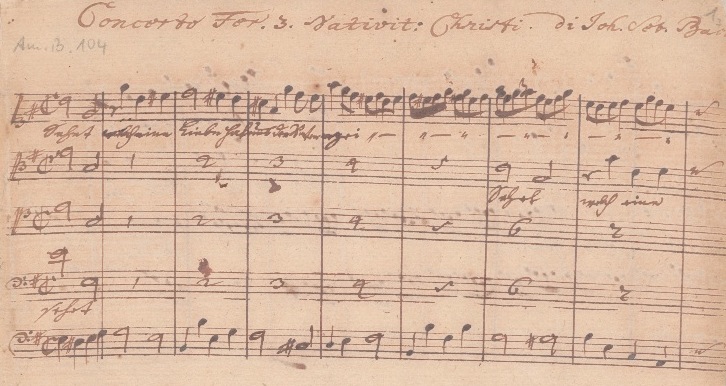
First page of Bach’s original score for cantata 64 Sehet, welch eine Liebe hat uns der Vater erzeiget for the Third Day of Christmas. Staatsbibliothek zu Berlin (Amalienbibliothek), Berlin.

The third cantata of Bach’s Christmas Oratorio was very popular in our house, and it was my sister’s all-time favorite. That is probably why I had never heard the beautiful cantata 64 Sehet, welch eine Liebe hat uns der Vater erzeiget before doing research for this blog, even though it has trombones in the opening chorus and in all three (!) chorales, and Peter Jelosits is singing the soprano aria on the Harnoncourt recording.

Listen to Bach Collegium Japan’s recording of cantata 64 on Spotify. Soloists: Yukari Nonoshita, soprano; Robin Blaze, countertenor; Peter Kooij, bass. With Concerto Palatino: Yoshimichi Hamada, cornetto; Simen van Mechelen, Charles Toet, and Wim Becu, trombones.

Find the text here, and the score here.

Bach wrote this cantata in 1723 and the structure, with the three chorales, is very similar to cantata 40 from yesterday, written that same year.

During his four-week  Advent Break that first year in Leipzig (he repeated a Weimar cantata on the first Sunday of Advent, and was not to perform any music in the churches for the next three Sundays), Bach wrote six new cantatas for the period from December 26, 1723, to January 9, 1724 (cantatas 40, 64, 190, 153, 65, and 154). But that was not all. For Christmas Day 1723, he supplemented cantata 63 from Weimar with a newly written Magnificat. Knowing how hard it is for a choir to sing that Magnificat (on the same level as the Mass in B Minor and the Motets), it is clear that Bach did not have a “break” at all, but was very busy rehearsing his choir in addition to writing all this new music.

Wieneke Gorter, December 27, 2016, Harnoncourt link updated December 26, 2019.

Children’s stories

03 Saturday Sep 2016

Posted by cantatasonmymind in 1723 Trinity season special series, Bach's life, Cantatas, Leipzig, Trinity

≈ 1 Comment

Tags

according to Lutheran Church year, Bach, Bach-Archiv Leipzig, BWV 138, cantatas, Collegium Vocale Gent, Damien Guillon, Deborah York, Dorothee Mields, Eduard van Hengel, Hana Blazikova, Ingeborg Danz, Leipzig Bach Festival, Lutheran Church year, Mark Padmore, Peter Kooy, Phlippe Herreweghe, Thomas Hobbs, Trinity 15

Bergrede_Brueghel

The Sermon on the Mount, oil on copper painting by Jan Brueghel the Elder, 1598

In 1723 Bach wrote cantata 138 Warum betrübst du dich, mein Herz.  Again I prefer Herreweghe’s interpretation, but it’s not so easy to choose between his recording from 1998 (with soloists Deborah York, Ingeborg Danz, Mark Padmore, and Peter Kooij) and the one from 2013 (with soloists Hana Blazikova, Damien Guillon, Thomas Hobbs, and Peter Kooij). Update from 2021: there now is an extremely inspired Herreweghe recording with all my favorite soloists (Dorothee Mields, Alex Potter, Guy Cutting, Peter Kooij), recorded live at De Singel in Antwerp on Sunday January 31, 2021 (during the Covid19 pandemic, so without audience). Find it here.

Listen to the entire 1998 recording on Youtube or listen to one long track of the 2013 recording with Hana Blazikova and Damien Guillon on YouTube. Please consider supporting the artists by purchasing the 1998 version (used copies available only) or the 2013 version  on Amazon.

Find the text, based on the Sermon on the Mount, of this cantata here, and the score here.

It is often not immediately clear what a Bach cantata is about, what the text means, or what Bach wanted to convey with it. In an absolutely wonderful interview (with excellent English subtitles) for the Leipzig Bach Festival, soprano Dorothee Mields says that even she, as a native German speaker, often feels the need to look at English translations, go back to the Bible texts, and read more about the subject, because she didn’t necessarily recognize the text from her children’s bible.

The image of the children’s bible stuck with me since first watching the interview seven months ago. And when listening to the cantata for this Sunday, I had to think of it again, because the choice of words in this cantata is very moving, but at the same time so simple, that it is almost as if the librettist is speaking to children. Listen, for example, to the text the soprano sings in the third movement:

Nur ich, ich weiss nicht, auf was Weise ich armes Kind mein bisschen Brot soll haben; Wo ist jemand, der sich zu meiner Rettung findt?

(It is just that I, poor child, don’t know how I should receive a bit of bread; Where is the person who will save me?)

Eduard van Hengel hilariously remarks that it reminds him a bit of Calimero (a popular children’s cartoon about a little chick, which aired in The Netherlands, Belgium, France, and Italy in the early 1970s. Watch this first episode to get an idea).

I wonder who the librettist for this cantata was. I imagine a different person than who wrote texts for the last few cantatas. Last week, the Bachs possibly had their house full with the families of Anna Magdalena’s brother and sisters, visiting because the men, all trumpet players, were needed for two cantatas. Perhaps one of the visitors had talent for entertaining the children with stories and making up poems on the spot? Did Bach ask this person to write the libretto for this cantata? Or was his own head still filled with children’s stories and did he write the text himself?

These are all just assumptions and we don’t know for sure if last week’s extra players were the relatives of Bach’s wife, but my potential movie script is getting better and better …

There’s of course more to this cantata than the charming texts. Musically, as far as the form and structure is concerned, this cantata is unique within this first cycle of Leipzig cantatas. Bach takes a chorale as the base for the cantata, yet it is not at all the same as his series of chorale cantatas from the 1724/1725 cycle. In those later chorale cantatas, he always uses all the verses and keeps a strict structure of one soloist per movement. In this cantata 138, he only uses three verses of the chorale, and gives the cantata a very free form, with a different number of soloists for each movement. He is obviously experimenting. And I wonder again: might he have been influenced by his visitors from last week? Did he have discussions about his compositions with his colleagues? And how is this playing around with the form of the cantata related to using a different librettist or no librettist? Did he not want to bother a professional writer with his experimenting?

There is one more–for me at least–exciting aspect to this cantata: when I first started listening to it, I discovered that I already knew the bass aria. Same singer (Peter Kooij) and same music, but a different text, because I had until then only heard this as the Gratias from Bach’s Mass in G Major, BWV 236 from the mid 1730s. Listen to both, and marvel at Bach’s talent for subtle recycling.

Wieneke Gorter, September 3, 2016, updated September 19, 2020 and February 13, 2021.

Christmas in August

27 Saturday Aug 2016

Posted by cantatasonmymind in 1723 Trinity season special series, Bach's life, Cantatas, Leipzig, Trinity

≈ Leave a comment

Tags

according to Lutheran Church year, Anhalt-Zerbst, Anna Magdalena Bach, Bach, Bruce Dickey, cantatas, City Council, Collegium Vocale Gent, concerto palatino, cornetto, Deborah York, Eduard van Hengel, Hana Blazikova, Ingeborg Danz, Köthen, Leipzig, Lutheran Church year, Mark Padmore, Peter Kooy, Phlippe Herreweghe, Ratswechsel, recorder, Saxe-Weissenfels, Thomas Hobbs, Trinity 14, trombone, trumpet, Wilcke

gesu_lebbrosi
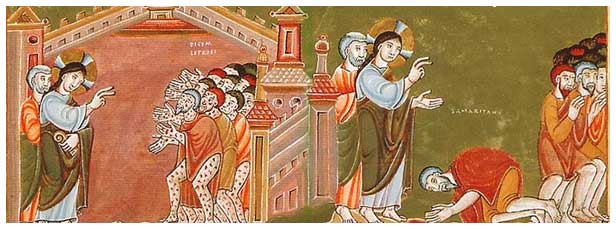
Jesus heals ten lepers, from the Codex Aureus of Echternach, c. 1035-1040

Only a handful of Bach cantatas ask for the Renaissance/Early Baroque ensemble of one cornetto and three trombones in the opening and closing chorus. This instrumentation was considered somewhat “old fashioned” in Bach’s time, while at the same time it was still very normal in cities to hear Stadtpfeifers (city pipers) play chorales from the towers during the day, to remind the citizens of their Christian duties. In this Cantata 25 Es ist nichts Gesundes an meinem Leibe, for the 14th Sunday after Trinity (August 29 in 1723), the playing of the chorale tune by this ensemble in the opening chorus stands for the way it has always been, the way it has been true for centuries.

palatino
Concerto Palatino, the leading cornetto/trombone ensemble for the past 25 years. Photo by Sabrina Flauger. Learn more about them here.

My preferred recording of Cantata 25 is the one by Herreweghe, on the same album as cantata 105 for Trinity 9 and cantata 46 for Trinity 10, as well as cantata 138 for next week. Soloists in cantata 25: soprano Hana Blažíková, tenor Thomas Hobbs, and bass Peter Kooij. Cornetto: Bruce Dickey  (pictured above, front row, on left); trombones: Claire McIntyre, Simen van Mechelen (pictured above, top row, on left), and Joost Swinkels.

Listen to this recording on Spotify or on YouTube. Please consider supporting the artists by purchasing this album (containing four cantatas for this 1723 Trinity season) on Amazon.

Read the text of this cantata here, and find the score here.

I could write an entire blog post about the opening chorus alone, the way I did last week for cantata 77 and two weeks earlier for cantata 179. But in the interest of variety, I’m going to keep this section short, and I will just say that the opening chorus  is an incredible, unrivaled complex composition for ten voices, again completely different than any opening chorus the Leipzig congregations had heard before during this Trinity season of 1723. By having the “ancient” brass quartet play the chorale melody of Herzlich tut mich verlangen nach einem selgen End (With my whole heart I long for my blessed End / my Salvation)** Bach shows that the promise of salvation after death will always provide a silver lining to the sorrow of the daily, sinful human condition. He also illustrates this “salvation” with the recorders in the uplifting and soothing soprano aria (Hana Blažíková in top shape!), and the brass and recorders in the closing chorale, and intensifies the “sickness” of the human sins by setting these texts to “dry” recitatives  (though listen to that bass arioso, beautifully sung by Peter Kooij) in between. Again, it was completely normal in his day and age to think this way, and Bach saw it as his mission in life to teach this theology to his fellow Lutherans by way of his church music.

But, listen to the festive, large orchestra for this cantata! No less than four brass players (one cornetto and three trombones) and five wind players (two oboists and three recorder players) were required at the same time in the opening chorus and closing chorale. For a cantata about the healing of ten lepers? Well, it turns out that this weekend it was Christmas in August for Bach, and the extra players were probably in town for the much more important and incredibly festive Cantata 119 Preise, Jerusalem, den Herrn that was on the calendar for the next day, Monday August 30, the day of the inauguration of the new City Council (Ratswechsel). *** As I already suggested in my post about cantata 147, Bach might have sometimes used guest musicians in his orchestra who were in town for other reasons, and judging from the level of playing required for the Brandenburg concerto-like Cantata 119, the extra brass (all playing trumpet in 119) and wind (playing oboe and recorder in 119) players might have been needed to be of the level of court chamber musician, not just Stadtpfeifer (usually a lower rank, and not necessarily used to playing the complicated court music). So in my probably not so unlikely movie script fantasy, Bach hired musicians from the not too far away courts where he had worked before or where his in-laws worked (Köthen, Weissenfels, Zerbst) to play in the orchestra on Monday August 30, and he had asked them to also play in the service on Sunday August 29.

Listen to the Ratswechsel cantata 119 Preise, Jerusalem, den Herrn by Herreweghe on YouTube. (Soloists: soprano Deborah York; alto Ingeborg Danz; tenor Mark Padmore, bass Peter Kooij.)

Wieneke Gorter, August 24, 2016, updated September 8, 2023.

** Several writers have suggested the chorale best known to the congregation at the time (on the melody we have later come to know as O Haupt voll Blut und Wunden) would have been instead Ach Herr, mich armen Sünder, but I agree with Eduard van Hengel that because of Bach’s use of the angel-like recorders and the heavenly brass it makes more sense to go with Herzlich tut mich verlangen nach einem selgen End.

*** The new city council was always chosen on August 24, and then inaugurated on the first Monday following August 24, which was Monday August 30 in 1723.

About Weekly Cantata

I am a bilingual writer, publicist, choral singer, art and nature lover, happy wife, and blessed mother of two. I started this blog in 2016, inspired by my late mother’s love for Bach’s cantatas. After 23 years in the San Francisco Bay Area, I’m now back in the Netherlands.

If you are on social media, please follow me:

  • Facebook
  • Instagram

Please subscribe!

Please join my readers from all over the world and subscribe to this blog! Simply fill in your email address and you’ll receive an email every time I’ve published a new post. Thank you so much / Vielen Dank / Merci mille fois / 감사합니다 / 谢谢 / ありがとう / Mille grazie / Muchas gracias / Muito obrigado / Takk / Terima kasih / Dankuwel!

Designed with WordPress.com

A most amazing trumpet part

21 Sunday Aug 2016

Posted by cantatasonmymind in 1723 Trinity season special series, Bach's life, Cantatas, Leipzig, Trinity

≈ Leave a comment

Tags

Anhalt-Zerbst, Anna Magdalena Bach, Bach, Bach Collegium Japan, BWV 635, BWV 678, BWV 679, BWV 75, BWV 76, BWV 77, Gottfried Reiche, John Eliot Gardiner, Köthen, Kirsten Sollek, Luther, Lutheran Church year, Masaaki Suzuki, organ preludes, Peter Kooy, Saxe-Weissenfels, slide trumpet, Toshio Shimada, tromba da tirarsi, trumpet, Wilcke

master_of_the_good_samaritan_001
The Good Samaritan by “the Master of the Good Samaritan,” Dutch, 1537

To fully appreciate today’s cantata, I encourage you to first listen to Luther’s hymn,  Dies sind die heil’gen Zehn Gebot (These are the holy Ten Commandments). I was not familiar with this tune, and had to do some research to understand what the slide trumpet was playing in the opening chorus. It was a very well-known hymn in Bach’s time. The Leipzig congregations sang it many times a year, and also sang it during the church services on Sunday August 22, 1723, the 13th Sunday after Trinity (probably preceded by an organ prelude in the style of BWV 635, see below). It was an important hymn for Bach. You can listen to his own chorale setting of it here.

It is also worthwhile to listen how Bach used this melody in three very different organ works: BWV 635, BWV 678, and BWV 679. He wrote BWV 635 as part of the Orgelbüchlein, in Weimar, the other two in the mid 1730s as part of the Clavier-Übung III.

The cantata for this Sunday, cantata 77 Du sollt Gott, deinen Herren, lieben features this chorale-tune in the opening chorus, but only in the tromba da tirarsi (slide trumpet) part and the continuo part. In the continuo it appears in long notes, and is not as clearly audible as in the trumpet part. There are exactly ten entrances for the trumpet within that opening chorus, the last time featuring the entire chorale tune, of course pointing to the ten commandments.

Bach Collegium Japan’s recording showcases this feature the best of all recordings I listened to, superbly played by Toshio Shimada, on a real tromba da tirarsi. I also like his playing the best in the alto aria. Listen to this recording on Spotify or on YouTube.

Read the text here, and find the score here.

John Eliot Gardiner suggests that Bach made a theological statement by presenting his first two Trinity cantatas in Leipzig,  75 for Trinity 1 (focusing on the love of God/how to be before God) and 76 for Trinity 2 (focusing on brotherly love/how to love one’s neighbor) in close relation to each other, and that all through this 1723 Trinity season he has tried to reinforce the idea that those themes are connected, and how the believers should apply the laws from the Bible to themselves and to their own daily lives. He further argues that with this opening chorus he comes full circle back to that connection, by using a double fugue, by reminding the listeners of the “law” by way of the chorale in  the trumpet part, and by setting the text of the Gospel immediately preceding the parable of the Good Samaritan (Luke 10):

27. Er antwortete und sprach: Du sollst GOtt, deinen HErrn, lieben von ganzem Herzen, von ganzer Seele, von allen Kräften und von ganzem Gemüt und deinen Nächsten als dich selbst.

[27] And he answering said, Thou shalt love the Lord thy God with all thy heart, and with all thy soul, and with all thy strength, and with all thy mind; and thy neighbour as thyself.

After the bass recitative and soprano aria further elaborating on the “Love for God”-theme, and the tenor aria on the “Good Samaritan / Love your neighbor”-theme, we are treated to the most amazing tromba da tirarsi playing of all Bach cantatas written for this instrument, in this very unusual and humble alto aria, beautifully sung by mezzo-soprano Kirsten Sollek, and expertly played on the slide trumpet by Toshio Shimada.

This is an incredibly difficult part for the tromba da tirarsi, and almost impossible to play well on a “regular” Baroque trumpet. Was this Bach’s way of illustrating the “Unvolkommenheit” in the text? Would even Reiche not have been able to play this perfectly, with only a few days rehearsal time? And/or did Bach want people in the church to pay attention, so that this would be a true moment of reflection in the service?

In the region where Bach lived and worked, the trumpeters were very good, and Bach knew them and their world well, especially since he had married into a trumpet family in 1721. All the men in Anna Magdalena Wilcke’s family that we know of (father, brother, and husbands of all three sisters) were well-regarded trumpeters at the Anhalt-Zerbst court, about 17 miles (28 km) directly north of Köthen, and the Saxe-Weissenfels court, about 22 miles (35 km) south-west of Leipzig. The trumpeters in Leipzig were all Stadtpfeifer, employed by the city, and thus not always available to him.

Wieneke Gorter, August 20, 2016, updated August 28, 2023.

← Older posts
Newer posts →

Recent Posts

  • “Missa Miniatura” by CONTINUUM/Elina Albach Even More Moving in 2025
  • Bachfest Leipzig 2025
  • Bach Cantatas for Christmas – 1724 and 1734 editions
  • Fourth Sunday of Advent – more insight into Cantata 62 helped me better understand Bach’s Christmas Oratorio
  • Saint Ambrose and Luther in Milan – Second Sunday of Advent

Archives

  • August 2025
  • July 2025
  • December 2024
  • November 2024
  • June 2024
  • January 2024
  • December 2023
  • October 2023
  • September 2023
  • August 2023
  • April 2022
  • February 2022
  • January 2022
  • December 2021
  • November 2021
  • June 2021
  • May 2021
  • April 2021
  • February 2021
  • January 2021
  • December 2020
  • November 2020
  • October 2020
  • September 2020
  • August 2020
  • July 2020
  • May 2020
  • April 2020
  • March 2020
  • February 2020
  • January 2020
  • December 2019
  • November 2019
  • May 2018
  • April 2018
  • March 2018
  • February 2018
  • January 2018
  • December 2017
  • November 2017
  • October 2017
  • September 2017
  • August 2017
  • July 2017
  • June 2017
  • May 2017
  • April 2017
  • March 2017
  • February 2017
  • January 2017
  • December 2016
  • November 2016
  • October 2016
  • September 2016
  • August 2016
  • July 2016
  • June 2016
  • May 2016
  • April 2016
  • March 2016
  • February 2016
  • January 2016

Enter your email address to follow this blog and receive notifications of new posts by email.

Join 336 other subscribers

Categories

  • 1723 Trinity season special series
  • Advent
  • After Easter
  • Ascension
  • Bach's life
  • Cantatas
  • Chorale cantatas 1724/1725
  • Christmas
  • Easter
  • Epiphany
  • Following Bach in 1725
  • Köthen
  • Leipzig
  • Septuagesima
  • Travel
  • Trinity
  • Weimar

Meta

  • Create account
  • Log in
  • Entries feed
  • Comments feed
  • WordPress.com

Website Built with WordPress.com.

  • Subscribe Subscribed
    • Weekly Cantata
    • Join 156 other subscribers
    • Already have a WordPress.com account? Log in now.
    • Weekly Cantata
    • Subscribe Subscribed
    • Sign up
    • Log in
    • Report this content
    • View site in Reader
    • Manage subscriptions
    • Collapse this bar
 

Loading Comments...