There is no cantata for the 4th Sunday after Trinity from 1724, because that year it fell on the same day as The Feast of the Visitation. See my previous post for a longer explanation, and for a list of upcoming cantatas.

08 Saturday Jul 2017
Posted in Cantatas
There is no cantata for the 4th Sunday after Trinity from 1724, because that year it fell on the same day as The Feast of the Visitation. See my previous post for a longer explanation, and for a list of upcoming cantatas.
01 Saturday Jul 2017
Posted in Cantatas, Chorale cantatas 1724/1725, Leipzig, Trinity
In my effort to follow Bach’s compositions in the order in which he wrote them in 1724, I sometimes get a bit confused, because in 2017 the Sundays of the church year are exactly one week later than in 1724. Where it gets tricky is around the Feast days of St. John and the Visitation of Mary, which are always on the same date: June 24 and July 2 respectively.
See how the dates of 1724 compare to the dates of 2017 in this table here below, and you’ll understand my dilemma for today: in Bach’s time, if the feast of the Visitation fell on a Sunday, it would cancel out the theme and thus the cantata for that Sunday. That is why there is no cantata for Trinity 4 from 1724, and why Weekly Cantata will be on break next week.
| Sunday/Feast day | 1724 | 2017 | Cantata |
| Trinity 1 | June 11 | June 18 | 20: O Ewigkeit, du Donnerwort |
| Trinity 2 | June 18 | June 25 | 2: Ach Gott, vom Himmel sieh darein |
| St. John (Johannis) | June 24 | June 24 | 7: Christ, unser Herr, zum Jordan kam |
| Trinity 3 | June 25 | (July 2) | 135: Ach Herr, mich armen Sünder |
| Visitation (Mariä Heimsuchung) | July 2 | July 2 | 10: Meine Seele erhebt den Herren |
| Trinity 4 | July 2 | July 9 | (no cantata from 1724 because same day as Visitation) |
| Trinity 5 | July 9 | July 16 | 93: Wer nur den lieben Gott lässt walten |
| Trinity 6 | July 16 | July 23 | (no cantata from 1724 because of Bach’s visit to Köthen) |
| Trinity 7 | July 23 | July 30 | 107: Was willst du dich betrüben |
| Trinity 8 | July 30 | Aug 6 | 178 Wo Gott der Herr nicht bei uns hält |
So officially, I should present you only with the cantata for the feast of the Visitation today, but since we are listening in order of 1724, I give you some highlights of cantata 135 Ach Herr mich armen Sünder first. An update from 2021: Since I first wrote this post, a beautiful live video recording of this cantata has been released on YouTube by the J.S. Bach Foundation. Find it here.
The cantata is the last of the set of four I described in this post, and thus has the cantus firmus in the bass in the opening chorus. This is nicely done on the J.S. Bach Foundation recording, with a trombone doubling the choral bass part. But the best choral basses are still on the recording by Bach Collegium Japan. Listen to that recording on Spotify.
While the boy sopranos have a bit more work in the opening chorus (as was the case the last two weeks), there is again no soprano aria in this cantata. The Leipzig congregations haven’s heard a soprano solo since Trinity Sunday.
But then, on July 2, 1724, they get to hear the cantata for the feast of the Visitation: cantata 10 Meine Seel erhebt den Herren. With a soprano aria directly after the opening chorus, and a virtuoso one too. It might be that a talented new student had enrolled in the school, or Bach was finally ready training one, or there is a talented boy visiting for the holiday.* There is a very nice live video of Ton Koopman performing this in the St. Thomas Church in Leipzig during the Bach Festival there in 2003, with Deborah York singing the soprano aria.
Wieneke Gorter, July 1, 2017. Updated March 26, 2020, and June 19, 2021.
*Read more about the possibility of musicians visiting for this feast day in my post from last year about the Visitation. Read more about the soprano problem in this post.
28 Wednesday Jun 2017
Posted in Cantatas, Chorale cantatas 1724/1725, Leipzig, Trinity

As I explained in my post for the first Sunday after Trinity in 1724, Bach most probably intended for the first four chorale cantatas of this 1724 Trinity season to form a set, or at least to present some kind of order:
The Feast of St. John, celebrating the birth of St. John the Baptist, always falls on June 24 (exactly six months before Jesus’ birth). Read more about this feast day in my blog post from last year. This means that in 1724, this date came *after* the second Sunday after Trinity, while of course this year (2017) it came *before* that date.
Because I’m trying to follow the order in which Bach wrote his cantatas in 1724, I did not write about this cantata this past Saturday, but feel it should be presented within the order Bach wrote them in: between this past Sunday and next Sunday. So after the French Overture in cantata 20 and the chorale motet in cantata 2, Bach now presents you with an Italian concerto in this cantata 7 Christ unser Herr zum Jordan kam. The performance I like best is the one by Montreal Baroque, because of the opening movement and because of Charles Daniels singing the tenor aria. Other soloists are Daniel Taylor, countertenor, and Stephan MacLeod, bass. You can enjoy this performance here on YouTube. The phrasing of the orchestra is beautiful and overall this recording is much more thoughtful and satisfying to me than many others I listened to.
Find the German text with English translation of this cantata here, and the score here.
Wieneke Gorter, June 27, 2017.
25 Sunday Jun 2017
Posted in Cantatas, Chorale cantatas 1724/1725, Leipzig, Trinity
Tags
Alex Potter, alto, Bach Collegium Japan, Collegium Vocale Gent, Eduard van Hengel, Phlippe Herreweghe

Regular readers of this blog know that I have a soft spot for the Herreweghe choir sopranos*. But the alto section of Collegium Vocale Gent is often equally impressive, and they deserve a special mention for their fabulous sound in the cantus firmus of this cantata’s opening chorus. Listen to Herreweghe’s recording of cantata 2 Ach Gott, vom Himmel sieh darein on YouTube.
Find the text of this cantata here (read along so you can see the brilliant text-illustration in the music), and the score (where you can see which instruments double which vocal parts) here.
Bach wrote this cantata for the 2nd Sunday after Trinity, which fell on June 18 in 1724. As I explained last week, this is the second in a series of four cantatas at the start of Bach’s 1724/1725 Leipzig cycle, and according to the master’s orderly design for these first four chorale cantatas, the cantus firmus of the hymn tune (always the same as the cantata title) is now in the alto part.
This Herreweghe recording is from before the time that soloists joined the choir sections of Collegium Vocale, which means that alto soloist Ingeborg Danz does not sing in this excellent group of one mezzo (Mieke Wouters), two contraltos (Yvonne Fuchs and Cécile Pilorger), and one countertenor (Alex Potter). Also the blend with the instruments doubling this alto part (two oboes and one trombone) is so marvelous it gives me goose bumps. Then again, there aren’t many things in music that move me more than a Bach opening chorus with trombones.
Whenever Bach uses the archaic form of chorale motet as opening chorus, especially when he combines it with the use of the Renaissance/Early Baroque trombone quartet (1 cornetto and 3 trombones), he wants to stress the timeless importance, the authoritative character of a message. In this case the at that point already two centuries old message is the chorale, one of Luther’s own. For readers who understand German: Eduard van Hengel’s website (in Dutch) has a very insightful overview of the original German text of Psalm 12, the text of Luther’s chorale, and how Bach’s librettist changed that into the text for the cantata. You can find it here.
Bach alto and tenor arias are at their prettiest, I find, when they are written as a trio sonata, and there is a wonderful example of that in the alto aria Tilg, o Gott in this cantata. It is a plea for help in fighting the “Rottengeister,” or the sectarians amidst the Lutherans. Alto soloist Ingeborg Danz does a terrific job interpreting the text. When the alto starts singing the word Rottengeistern, we see that it was that word we had already heard many times in the triplets of the violin part. As Eduard van Hengel says, it is the “popular easy talk of the sectarians, and that is also the reason why the other two parts don’t have this motive” [to further illustrate the schism].
In his effort to educate his fellow Lutherans (the Leipzig congregations) with his music, Bach wants to make it clear that he’s still preaching by means of the well-known chorale, and uses longer notes for the direct quotation (in music and text) of the chorale in this aria: der uns will meistern.
The best interpretation of the tenor aria Durchs Feuer wird das Silber rein actually appears on another recording, that of Bach Collegium Japan with tenor Gerd Türk. You can listen to that aria here. Here we have arrived at the solution/salvation part of the cantata, and so this music is more pleasant, easier to listen to. But Bach is still preaching: there are some crossing (!) lines in the music, and in the middle section, which tells the listeners to be patient (sei geduldig) and Bach stresses the words Kreuz und Not.
So one wonders: was Bach’s decision to focus on chorales for this 1724/1725 cantata cycle inspired by his need to make things easier for the boy sopranos, or by a wish to explain the theology to the congregations in a way that was more obvious to them than the more complicated, sometimes perhaps too hidden, messages he had so far delivered by way of his music? Or had the City Council or the church elders told him to to this?
*Read more about that in this post.
Wieneke Gorter, June 25, 2017
18 Sunday Jun 2017
Posted in Cantatas, Chorale cantatas 1724/1725, Leipzig, Trinity
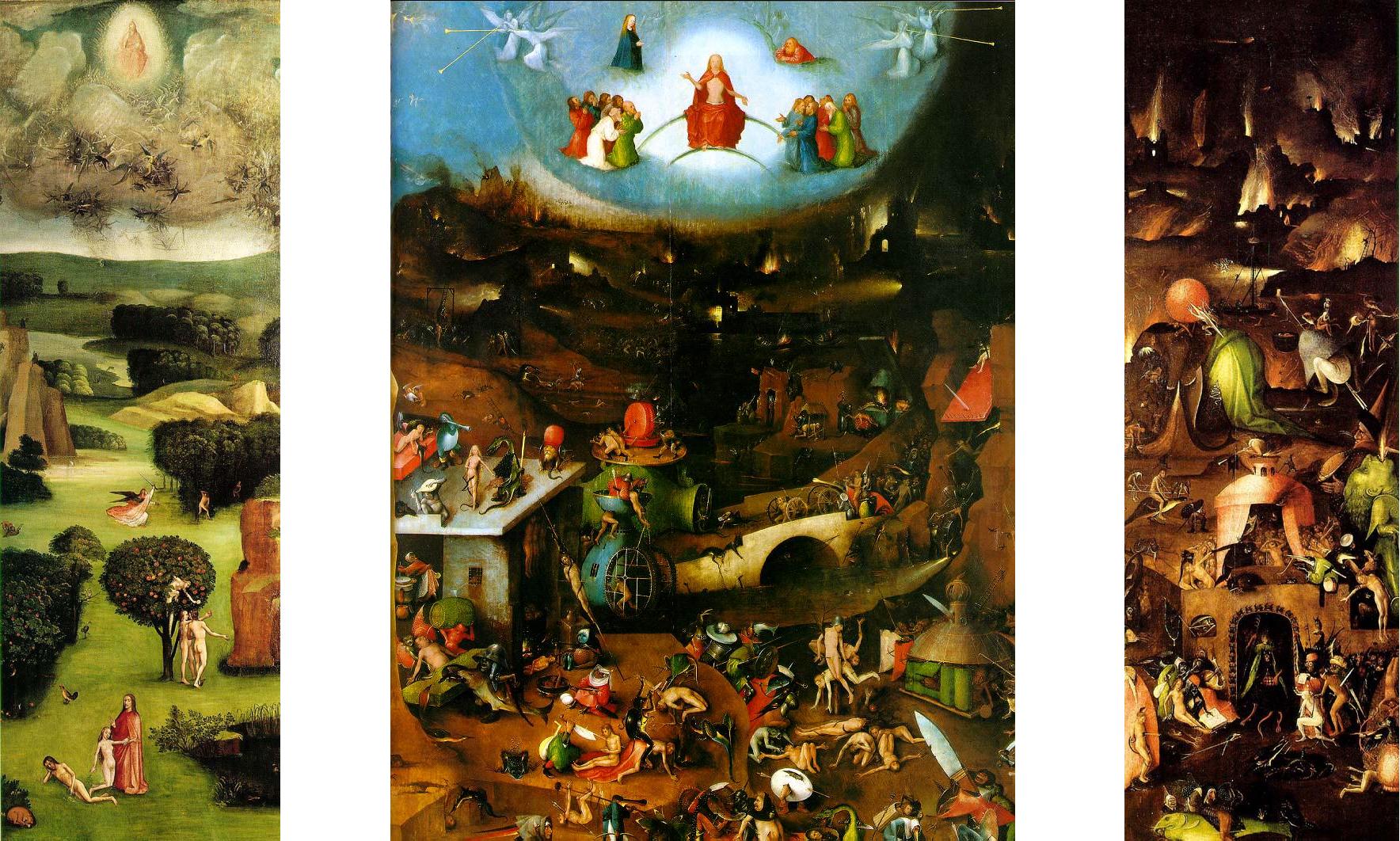
On this First Sunday after Trinity (or “Trinity 1” for short) in 1724, Bach started his second cycle of cantatas in Leipzig.* He was well aware of the importance of this occasion, and wrote one of his most dramatic cantatas for this day: cantata 20 O Ewigkeit, du Donnerwort. The cantata features a wealth of opera-style writing for the soloists, and such a stately French overture, that one wonders if the use of this style was ironic: see, if you behave in this rich, arrogant way, things will end horribly for you. A lesson like this would be fitting for this cantata, because the Gospel reading for this Trinity 1 Sunday was that of Lazarus and Dives: The poor leper Lazarus lies in front of the rich man Dives’ house, asking him for food every day. Dives ends up in hell when he dies because he didn’t share his blessings/wealth with those in need.
Over the course of writing this blog, whenever a cantata contains significant operatic writing, I tend to give the prize for best recording/interpretation to Gardiner, because he and Harnoncourt seem to be the only ones not shy to “overdo” it in these cases. This time it is no different. I especially love Paul Agnew in the tenor aria and Wilke te Brummelstoete and Paul Agnew together in the duet, where they illustrate the “chattering of teeth” perfectly. Bass Dietrich Henschel does a good job too, though I’m not sure I prefer him over Peter Kooy on the Herreweghe recording. Listen to Gardiner’s recording of cantata 20 O Ewigkeit, du Donnerwort : here on YouTube
Find the text here, and the score here.
Bach marked this “second beginning” in Leipzig in several different ways, for himself as well as for others:
First of all, on this Sunday he starts an entire series of new** cantatas, which we now call his chorale cantatas. For nine and a half months, including the entire Christmas season, he would write every cantata according to this same template: the opening movement is a chorale fantasia on the first stanza of an existing Lutheran hymn or chorale, with the tune appearing as a cantus firmus. The last movement has the last stanza of the same hymn as text, in a four-part harmonization of the tune. The text of those choral, outer movements was used verbatim, while the text of the solo, inner movements was paraphrased, but still based on the inner stanzas of the same hymn.
If you believe in the theory that Bach lost his soprano soloist sometime in the spring of 1724, and was having trouble training a new one, this concept of a chorale cantata would have been a brilliant move to solve this problem. This way, Bach still presented a series of impressive cantatas (arguably more impressive than his 1723/1724 cycle), while limiting the rehearsal hours needed with the choir boys. In many of these cantatas, as is the case for today’s cantata 20 O Ewigkeit, du Donnerwort, the choir boys would only have to sing the chorale melody in the opening chorus, and there would be no soprano recitative or aria among the inner movements at all. If in later cantatas in this series the boys would get assigned something a bit more complicated, it would still be based on the chorale melody they already knew by heart, so it would require much less rehearsal time with them.
As if with this dramatic cantata 20 Bach didn’t already make enough of a splash, he most probably intended for the first four chorale cantatas of this 1724 Trinity season to form a set, or at least to present some kind of order, if you look at the composition form of the opening movement, and which voice has the cantus firmus of the chorale tune in that chorus:
We know that Bach liked to use order and symmetry when he wanted to impress other people with a composition. But perhaps he was also thinking of his legacy. When he started composing cantatas at the Weimar court in 1714, albeit on a monthly instead of weekly basis, his first four cantatas formed a similar portfolio of composition styles in the opening choral movements:
This symmetry with his Weimar days must have been lost on others, even his fellow musicians, since they heard all these Weimar cantatas in Leipzig over the course of the 1723/1724 cycle, but not in this order they were created in Weimar.
In today’s cantata, cantata 20 O Ewigkeit, du Donnerwort, there are more links to other compositions nobody or only a few fans would have noticed: In the music as well as the text, Bach makes some pretty strong references to the first and the last cantata of the 1723 Trinity season. References to the first one (cantata 75, discussed here on this blog) appear in the decision to go back to this long, two-part format, the use of the trumpet as symbol for the heavens, and the illustration in the music of the word “Flammen” (flames). References to the last one (cantata 70, discussed here on this blog) present themselves in the selection of the chorale that talks about the Day of Judgement, and the operatic writing for the soloists, especially the bass and tenor.
After having followed Bach’s weekly compositions during the Trinity season of 1723, I feel it could be interesting to see this cantata 20, the first of the 1724 Trinity season, as the immediate successor of cantata 70, the last of the 1723 Trinity season. I realize that by doing so, I would ignore a few gems from early 1724, and an entire St. John Passion, but I do believe that as educator of his fellow Lutherans, Bach found Trinity season the most important part of the church year, and perhaps sometimes in his mind indeed ignored all the other stuff in between.
During the Trinity season, the theology moves away from the stories about the life of Christ, and instead focuses on the Lutheran doctrine, how one behaves before God, and on doing good deeds. So with this cantata, and the series that was to come, I think Bach wanted to make sure the Leipzig congregations were fully aware that the Trinity season was starting. The text “Wacht auf, wacht auf” (Wake up, wake up!) in the bass aria is testament to this, but also the writing of the opening chorus and the alto-tenor duet: it all makes you sit up and pay attention.
Wieneke Gorter, June 19, 2017.
*Bach had made his Leipzig debut on Trinity 1, 1723, with cantata 75 Die Elenden sollen essen. Read more about that fabulous cantata in this blog post.
**During this period, there will be no repeats of existing cantatas at all. It is stunning to realize that Bach made this huge commitment to himself, knowing how often during the 1723/1724 cycle he “recycled” music from Köthen and cantatas from Weimar.
12 Monday Jun 2017
Posted in Cantatas

part of my new office space, with a space for my mom, and a space for my books 🙂
I did not write about Pentecost last week, even though in Bach’s time this was a three-day holiday with a cantata on Sunday, Monday, and Tuesday. And I am late with this Trinity post. Even her in California it is not Sunday anymore. However, it is all for a good reason …
Over the last couple of months I started missing my Bach books (which were scattered all over the house and which I sometimes did not even read anymore) and yearned for a space in my house that’s dedicated to my blog. So, after some visits to the local hardware store and the Swedish furniture store (always a little bit like going home for me) and a lot of help from my wonderful family, I now have a streamlined, quiet looking office, where I can look out of a window while I sit at the computer, and where I have the Bach books right by my side.
And how happy I was to go back to the books, the real research, instead of relying mostly on websites for my information. In my reading for Trinity Sunday in 1724, I discovered a very interesting new fact, something I wished I had known in October 2016.
I won’t beat myself up about it, since I still vividly remember October 2016 as my busiest month of the last five years, so I’ll forgive myself that I brought you a bit of fake news: I stated in this post that Bach didn’t write a cantata for Trinity 23 in 1724 because it was Reformation Day, October 31. If I had checked the “chronology” chapter in “The New Bach Reader” by David, Mendel, and Wolff, I would have seen that in that week in 1723, Bach went to inspect a new organ in the nearby town of Strömthal. He wrote a 12-movement-long cantata for the dedication of the new organ and the new church building in that village on November 2, 1723: cantata 194 Höcherwunschtes Freudenfest.
He repeated this cantata on Trinity Sunday 1724, though perhaps not in its entirety. Gardiner suggests Bach performed only the first six movements instead of all twelve in Leipzig, but I can’t find any explanation for this anywhere, so I’ll need to do more research on that subject, or, who knows, ask Gardiner? Would he email me back?
Listen to the opening chorus and the soprano aria from cantata 194 Höcherwunschtes Freudenfest by Bach Collegium Japan on YouTube, with soprano Yukari Nonoshita.
Find the German text with English translations here, and the score here.
When listening to this music, two things might jumped out at me:
If indeed only the first half of this cantata was performed on Trinity Sunday in 1724, Bach would have added cantata 165 O heilges Geist- und Wasserbad, which bears a much stronger relation to the Gospel of the day: Jesus’ nighttime conversation with Nicodemus, stating that only those who are reborn through water baptism and the Spirit (or Holy Ghost) can reach eternal life. (Find the text of that part of the Gospel of John here).
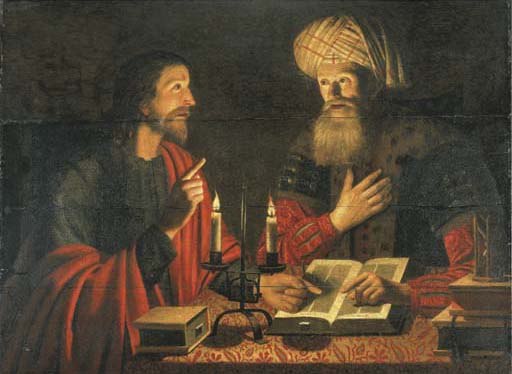
Jesus and Nicodemus, by Dutch painter Crijn Hendricksz Volmarijn (1601-1645)
This cantata 165 was not a new composition either: Bach wrote it in Weimar in 1715. It is not completely certain that this cantata was also performed on Trinity Sunday in 1724, but most sources mention it and it is an interesting cantata with pretty arias and good word painting in the music, so I decided to include it here.
No recording of this cantata was satisfying to me in all the movements, so I made a playlist on YouTube with the soprano, alto, and tenor from the Gardiner recording (Ruth Holton, Daniel Taylor, Paul Agnew), and the bass from the Leonhardt recording (Max van Egmond). The opening aria is extremely hard and Ruth Holton does the best job of all recordings I listened to.
Find the text of cantata 165 O heilges Geist- und Wasserbad here, and the score here.
Listen for:
Wieneke Gorter, June 11, 2017.
*Bach started working in Leipzig on the first Sunday after Trinity in 1723.
28 Sunday May 2017
Posted in Cantatas
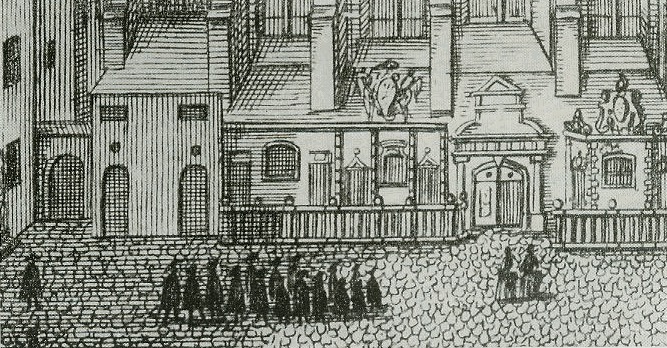
Boys of the St. Thomas school on their way to St. Thomas church, 1723.
In last week’s post, I pointed out that Bach might have lost his soprano soloist this spring of 1724. There might not have been a boy in his choir good enough to sing complicated solo arias. Or perhaps there was a boy who had a good voice, but who needed several weeks of coaching by the maestro before he was ready to sing an aria. Because during this spring semester of 1724 in Leipzig, Bach’s cantatas featured a soprano aria (not counting solos consisting of only a chorale tune) only every 3-4 weeks.
Some writers suggest Bach might have been training a new soprano in the weeks between Easter and Pentecost of 1724, so this boy would be able to sing the aria for this Sunday (Exaudi, or the Sunday after Ascension) and the arias in the upcoming Pentecost cantatas. I myself think that Bach’s problems with the boys of the school might have persisted for the long-term, but that he had a temporary solution for these few weeks. What if one of the boys who had moved away earlier in the year would be back temporarily, visiting Leipzig with his family for the Pentecost holiday –a three-day holiday in Leipzig, as important for the church as Easter and Christmas? Or perhaps Bach knew that one of the extra oboists or trumpet players would be bringing his talented son with him? After all, as I’ve come to believe over the course of doing research for this blog, it is likely that musician friends and musician relatives visited Leipzig for two weeks or longer around the time of major holidays.
Whatever the background story, on this Sunday in 1724 there was finally a glorious soprano aria in the churches again, a favorite from my childhood. I wrote about it last year in this post.
Wieneke Gorter, May 27, 2017
21 Sunday May 2017
Posted in After Easter, Cantatas, Leipzig
Tags
5th Sunday after Easter, Bach, BWV 198, BWV 86, BWV 87, Christoph Prégardien, John Eliot Gardiner, Katharine Fuge, Kati Debretzeni, Klaus Mertens, Leipzig, Netherlands Bach Society, Robin Blaze, Robin Tyson, Rogate Sunday, roses, Shunske Sato, Stephan Loges, Steve Davisilim, Westerland

This week I don’t feel a lot of connection with the Bach cantata from 1724 for this Sunday (the 5th after Easter, or Rogate Sunday), cantata 86 Wahrlich, wahrlich, ich sage euch. When I came home from the funeral of one friend, I learned that another friend had passed away suddenly the day before. Because these were both very strong, kind, beautiful, and inspiring women, and I can’t believe they are gone, I feel much more inclined to listen to cantata 198, Lass, Fürstin, Lass nun einen Strahl, which Bach wrote for the funeral of a well-loved Queen than to a cantata which promotes that “God always knows best.”
But I’ll still write about cantata 86. The only connection I have with it this week are the roses in the text of the alto aria. It is my favorite movement of this cantata, because of the splendid violin solo. The interpretation of that violin solo I like best of all the recordings I listened to* is the one by Kati Debretzeni on the Gardiner recording. You can find that recording here on Amazon or here on iTunes. Soloists on the Gardiner recording are Katharine Fuge, soprano; Robin Tyson, counter-tenor; Steve Davisilim, tenor; and Stephan Loges, bass.
For better interpretations of the bass and tenor solos, I recommend listening to the Koopman recording with tenor Christoph Prégardien and bass Klaus Mertens. You can find that recording on YouTube, Amazon, or iTunes.
2020 update: read my blog post of May 15, 2020, to find links to the live video recording by The Netherlands Bach Society, with Robin Blaze, coutertenor, and Shunske Sato, violin.
For the text and translations of cantata 86, please visit this page, and for the score, please go here.
Why the connection with roses? About one week ago, on Friday May 12, I went to drop off a card for a friend who was dying. I learned she was in her last days on Tuesday, but it took me until Friday morning to find the right words, finish writing the card, and to drop it off. When I walked to her door I noticed a hedge of sweet pink roses in the front yard. I felt peace from seeing the roses, and from the knowledge that she liked roses, but I also felt miserable and angry that she would be taken away from all this, from her family, her life, her home. The next day, we heard she passed away during that night.
This past Friday was the day of her funeral. I didn’t know how it would go, how my kids would handle it (my oldest and her oldest are friends), and tried to find some strength for myself, so I would be able to be there for them. I realized that I associate this woman’s kindness and warmth with the pinkish apricot color of my favorite rose in the Berkeley rose garden, Westerland. So I decided to walk through the rose garden to experience the color and scent of this amazing flower, and it helped. This is what she looked like that day: 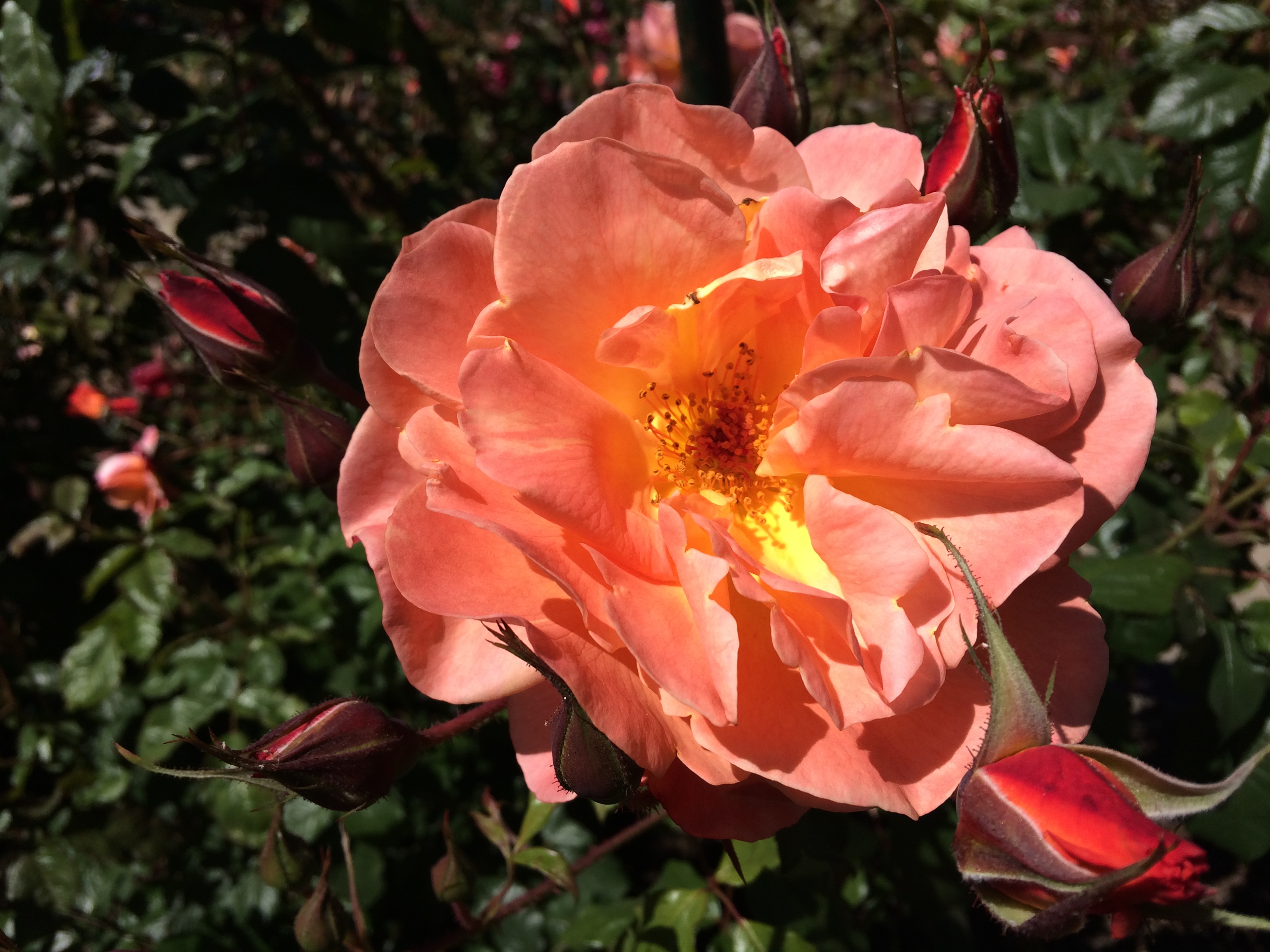
What to listen for in cantata 86:
In the opening movement, notice how Bach accentuates the fact that Jesus is speaking important, timeless words by setting these words in the form of an archaic motet. While the motet has multiple voices, the way it was done in the Renaissance, Bach can still make it clear that the words come from Christ’s mouth only, by giving all the other “voice parts” to instruments instead of to other singers.
In the alto aria, hear how the words “brechen” (to pick [roses]) and “stechen” (to prick) are illustrated by short notes and “broken” chords in the voice part, and broken chords in the violin part.
In the soprano aria, hear how low in the soprano range this is set — it could just as well have been sung by an alto. Bach has not given significant solos to a soprano since Easter of this year, 1724, and actually pretty sporadically since the start of the new year. Many scholars suggest that during that spring of 1724, Bach might have lost his boy soprano soloist (due to him leaving the school or due to his voice changing, we don’t know), and documents suggest that he was frustrated with the low quality of the boy sopranos of the St. Thomas School in general. They believe that this is why he started the chorale cantatas (cantatas of which each movement is based on a different verse of one and the same chorale tune) after Pentecost of that year. Keep following this blog and you’ll learn more about that soon 🙂
Wieneke Gorter, May 21, 2017, updated May 15, 2020.
*I did all this listening last year, when I actually ended up writing about cantata 87, the one Bach wrote for this same Sunday, but then in 1725. Read that post here.
13 Saturday May 2017
Posted in After Easter, Cantatas, Leipzig
Tags

Interior of the Thomaskirche (St. Thomas Church) in Leipzig.
For “Cantate” Sunday, or the fourth Sunday after Easter in 1724, Bach wrote a short but masterful cantata: BWV 166 Wo gehest du hin? I wrote a long but educational and hopefully also entertaining post about this cantata last year. I explain how Bach illustrates that this is the “singing” Sunday, why there is so much talk of “going away” in this cantata, and why I recommend the recording by Ton Koopman/Amsterdam Baroque Orchestra. Read that post here.
Wieneke Gorter, May 12, 2017
07 Sunday May 2017
Posted in After Easter, Cantatas, Leipzig
For this Jubilate Sunday (the third Sunday after Easter) in 1724, Bach did not write a new cantata the way he had done the previous two weeks*, but repeated one he had written in Weimar in 1714. That cantata: Weinen, Klagen, Sorgen, Zagen was not any old cantata, but a composition Bach was most probably very proud of: he would later use the opening chorus as template for the Crucifixus in his Mass in B minor. Read all about this cantata and the recordings I recommend in this post I wrote last year.
Wieneke Gorter, May 7, 2017
*see this post about the first Sunday after Easter in 1724 and this one about the second Sunday after Easter in 1724
 Weekly Cantata