Weekly Cantata

Weekly Cantata

Tag Archives: BWV 179

Playing with fugues & Bach’s harpsichord at Köthen

24 Thursday Aug 2023

Posted by cantatasonmymind in 1723 Trinity season special series, Bach's life, Cantatas, Köthen, Leipzig, Trinity

≈ Leave a comment

Tags

Berlin, BWV 179, BWV 872, Charlottenburg Castle, Christine Schornsheim, Eduard van Hengel, fugue, harpsichord, Köthen, Leipzig, Michael Mietke, Netherlands Bach Society, Richard Atkinson, Trinity 11, Well Tempered Clavier

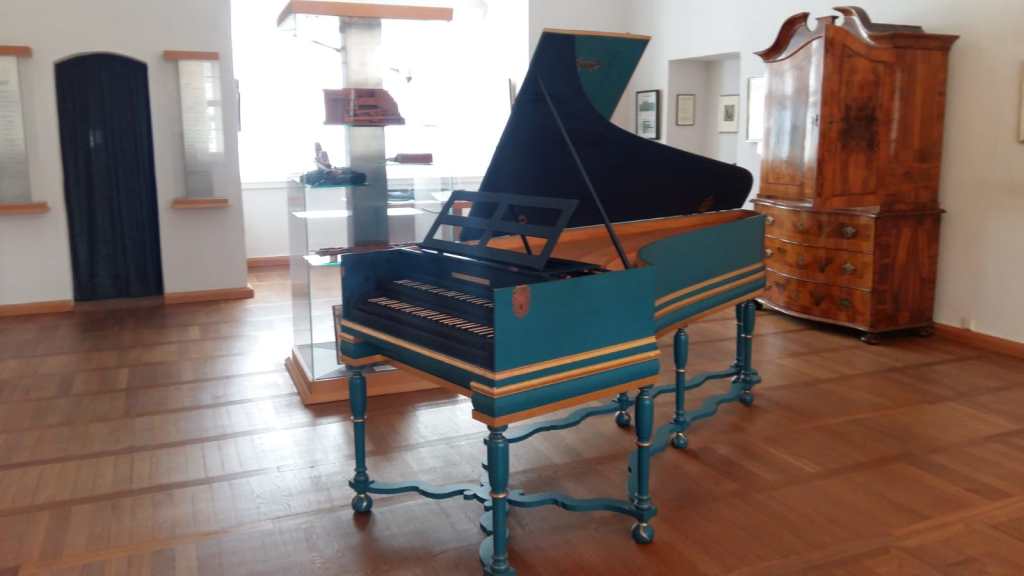
“The White Mietke,” a single manual* harpsichord built by Michael Mietke in Berlin, circa 1700. Lacquer artist: Gérard Dagly. Charlottenburg Castle, Berlin, Germany. In his last four years in Köthen, Bach played on a double manual harpsichord by the same builder, built especially for him in 1719.

This past Sunday was the 11th Sunday after Trinity, for which Bach wrote Cantata 179 Siehe zu, daß deine Gottesfurcht nicht Heuchelei sei (See that your fear of God is not hypocrisy) in 1723 in Leipzig. 

Much has been written about the stunning fugue in the opening chorus of this cantata, and I happily refer you to my posts from 2016 and 2020 for more information and a link to my favorite recording. But last week I learned something completely new about this opening chorus, thanks to yet another fabulous video series that saw the light during the pandemic: Richard Atkinson’s Bach Analyses. Since I’m a visual learner, I truly love watching videos like these. At first I merely started watching Richard’s video on the opening chorus of Cantata 179 to see if it would perhaps make the complex structure of the composition a bit easier to understand than Eduard van Hengel’s written explanation I had discussed in 2016.

And indeed it really helped me understand the music better! But what’s more, in that video Richard points out that the fugue from Cantata 179 shares some unusual composition techniques as well as themes with another mind boggling fugue by Bach, namely that of his Prelude and fugue no. 3 in C-sharp major (BWV 872) from the Well Tempered Clavier, Book II. As far as I know, no other Bach scholar or commentator ever mentioned this. Listen to that fugue here, played by Christine Schornsheim. We don’t know when exactly Bach wrote the keyboard piece, because we only have the publication date of the collection in which it appeared (Well Tempered Clavier Book II, 1740). It is possible that the cantata came first, but it is just as likely that Bach would have written the keyboard work before the cantata, while still employed at Köthen.   

Thinking of Bach playing with fugues on the harpsichord in Köthen brings me to another bit about Bach’s life I learned last week, while watching the interview with Christine Schornsheim by the Netherlands Bach Society: that we actually know what kind of harpsichord Bach played in Köthen, from 1719 to 1723. To be clear: most harpsichord players and all harpsichord builders already know this, but I didn’t, and I thought it worth mentioning here.

Historical records show that the Prince of Köthen allowed Bach to order a harpsichord from the famous builder Michael Mietke in Berlin sometime in 1718, and got to pick it up in March 1719.

On March 1, 1719, the accounts read: “To the Capellmeister Bach for the Berlin-made harpsichord and travel expenses 130 Thaler”. On March 14, Gottschalk, the chamber servant, also received eight thalers in “wages for transporting the Berlin harpsichord.”

The instrument remained in the princely music chamber; Bach did not get to take it with him when he moved  to Leipzig in May 1723. In 1784, the instrument is still mentioned: “The large harpsichord or grand piano with 2 manuals, by Michael Mietke in Berlin, 1719, defect.”

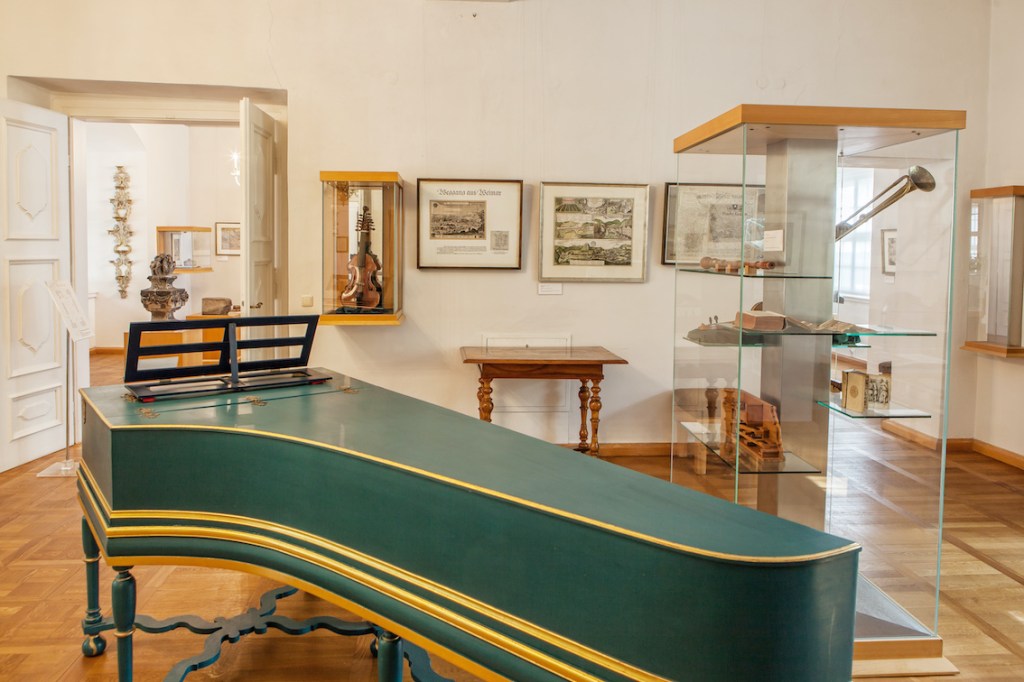
Many harpsichord builders have created copies of Bach’s “Mietke harpsichord.” In the video registration of the Prelude and fugue no. 3 in C-sharp major (BWV 872), Christine Schornsheim plays a terrific copy by Bruce Kennedy. The Köthen Castle had a copy made in 1992 by Martin-Christian Schmidt, pictured here: 
For the picture at the top of this blog post I chose one of the very few original Mietke harpsichords that have survived to this day, the “White Mietke” at the Charlottenburg Castle in Berlin. It was built almost two decades earlier than Bach’s harpsichord, it only has one single keyboard, and it was decorated by the court painter at Charlottenburg. 

Wieneke Gorter, August 23, 2023. 

*manual = keyboard

About Weekly Cantata

I am a bilingual writer, publicist, choral singer, art and nature lover, happy wife, and blessed mother of two. I started this blog in 2016, inspired by my late mother’s love for Bach’s cantatas. After 23 years in the San Francisco Bay Area, I’m now back in the Netherlands.

If you are on social media, please follow me:

  • Facebook
  • Instagram

Please subscribe!

Please join my readers from all over the world and subscribe to this blog! Simply fill in your email address and you’ll receive an email every time I’ve published a new post. Thank you so much / Vielen Dank / Merci mille fois / 감사합니다 / 谢谢 / ありがとう / Mille grazie / Muchas gracias / Muito obrigado / Takk / Terima kasih / Dankuwel!

Designed with WordPress.com

Sinful pride versus humility

22 Saturday Aug 2020

Posted by cantatasonmymind in 1723 Trinity season special series, Bach's life, Cantatas, Chorale cantatas 1724/1725, Leipzig, Trinity, Weimar

≈ Leave a comment

Tags

Bach Collegium Japan, BWV 102, BWV 113, BWV 179, BWV 199, BWV 46, Miah Persson, Peter Kooij, Robin Blaze, Trinity 11

Church interior with the parable of the Pharisee and the Publican by Dutch painters Dirck van Delen (church interior) and Cornelis van Poelenburch (figures), 1653. Oil on panel. The Clark Art Institute, Williamstown, MA, USA, currently not on view.

The reading for this Sunday, the 11th after Trinity, is the parable of the Pharisee and the Publican (or Tax Collector) from the Gospel of Luke. In the parable, these two men come into the temple to pray around the same time, but talk to God in very different ways. While the Pharisee puts on a fake show about how good he is, the tax collector is very humble, “wouldn’t even lift up his eyes to heaven” and asks for forgiveness.

“There’s something with this Sunday,” I wrote three years ago, and I still feel that way when I listen to the cantatas Bach wrote for this Sunday in 1723 and 1724.

In 1723, his first year in Leipzig, Bach performed two cantatas on this Sunday: Cantata 179 Siehe zu, daß deine Gottesfurcht kein Heuchelei sei (See that your fear of God is not hypocrisy) before the sermon, and his solo cantata for soprano Cantata 199 Mein Herze schwimmt in Blut (from his early years in Weimar) afterwards. Cantata 199 is only loosely related to the Gospel story, and was probably never written with this story in mind. Because of its multi-layered history and the many different recordings, I will discuss that composition some other time.

Cantata 179 focuses on the hypocrisy of the Pharisee, and just like cantatas 46 and 102 I discussed last week, it must have been one of Bach’s own favorites, because he re-used three movements in later works. Read all about it in my post from 2016, which I have updated with better images and new video links.

In 1724, Bach wrote cantata 113 Herr Jesu Christ, du höchstes Gut, which, surprise, surprise, focuses on the Publican asking for mercy. The only recording that does this cantata justice and gives me the good kind of stomachache is the one by Bach Collegium Japan. Peter Kooij’s and Robin Blaze’s singing is outstanding, and Yukari Nonoshita and Robin Blaze make the duet into a lovely piece of music, which is–judging from a lot of other recordings–not an easy thing to do. I updated my blog post from 2017 with all the correct links to stream or purchase this recording. Please find it here.

Wieneke Gorter, August 22, 2020.

Something with this Sunday & Robin Blaze’s art of singing a chorale melody

27 Sunday Aug 2017

Posted by cantatasonmymind in Cantatas, Chorale cantatas 1724/1725, Leipzig, Trinity

≈ Leave a comment

Tags

alto, Bach, Bach Collegium Japan, BWV 113, BWV 179, cantatas, flute, Gerd Türk, John Eliot Gardiner, Leipzig, Masaaki Suzuki, Peter Kooij, Robin Blaze, Trinity, Trinity 11, Yukari Nonoshita

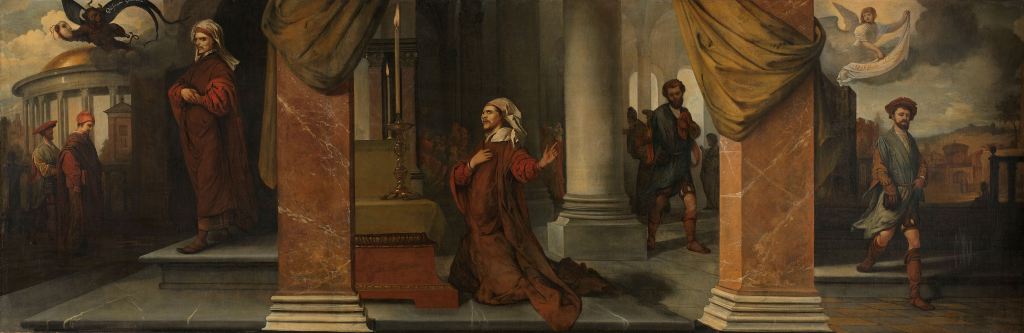
The Pharisee and the Publican by Barent Fabritius, 1661. Oil on canvas. Rijksmuseum, Amsterdam, the Netherlands.

In 1723, Bach wrote an exceptional cantata for this Sunday, the 11th after Trinity. I liked that cantata 179 so much that I gave my blog post last year the title “Bach on a roll” and I’ve been listening to it again this week. In 1724, Bach wrote cantata 113 Herr Jesu Christ, du höchstes Gut for this same Sunday. Both these cantatas truly move me. I feel as if Bach was especially humbled by this particular Sunday.

The only recording that does Cantata 113 Herr Jesu Christ, du höchstes Gut justice and gives me the good kind of stomachache is the one by Bach Collegium Japan, because of Peter Kooij’s and Robin Blaze’s terrific singing, beautiful oboe and flute playing, and the fact that Yukari Nonoshita and Robin Blaze make the duet into a lovely piece of music (instead of struggling through it, the way it seems to be on some other recordings). Listen to this recording by Bach Collegium Japan on Spotify, or on Youtube. Soloists on this recording are: Yukari Nonoshita, soprano; Robin Blaze, alto; Gerd Türk, tenor; and Peter Kooij, bass. Please consider supporting the artists by purchasing this recording on jpc.de or iTunes.

Find the text and translation here, and the score here.

That Bach might have might have felt a special touch or inspiration on this 11th Sunday after Trinity makes sense when you look at the Gospel reading for the day. It is the parable of the Pharisee and the Publican (or Pharisee and the Tax Collector), a story Jesus tells as an illustration on how to pray: the Pharisee is full of himself, telling God how good he is, while the Publican in his own prayer merely asks for mercy, and tells God how bad he is. This concept of how to be a good Christian before God, to be true, not fake, was very important to Bach.

In cantata 113 the chorale melody turns up much more often than in most of the other 1724/1725 chorale cantatas. It is even present in some of the arias that don’t have the chorale text. For the first time since starting this series of chorale cantatas, Bach doesn’t use the chorale melody as a cantus firmus in the opening chorus. Instead, he writes a simple four-part harmonized setting of the chorale melody. But, then there’s the unusual twist: Bach changes the usual 4/4 beat in which a chorale is normally sung to a 3/4, which allows him to write long suspensions in the vocal lines, thus intensifying the pleading character of the music (and the good stomach ache I get when I listen to it).

Robin Blaze. Photo by Dorothea Heise.

In the aria that follows, Bach makes up for the missing cantus firmus from the opening chorus. Any late-comers to that church service on Sunday August 20, 1724 would not have missed what chorale this cantata was based on: the alto sings the text as well as the melody of the chorale’s second stanza in long notes, against strings playing in unison.

Singing a chorale melody like this is not easy, and most recordings were unsatisfying to me because of this aria (as well as the duet). But Robin Blaze knows how to do it: sing with a brilliant sound, clearly placing each note, but also sustaining the sound throughout every note, and keeping it moving, while not forgetting word accents. It is a special art, and he masters it. I can listen to that five times in a row and not tire of it.

The bass aria could -as far as the music is concerned- easily have been inserted into the Christmas Oratorio, with the pretty oboe accompaniment. Note the word illustrations on “Zittern” (trembling) and “zerbräche” (would break), expertly sung by Peter Kooij. If this is all not pretty enough, Bach presents his talented flute player again, and gives him a beautiful but unbelievably challenging part, more virtuoso than ever before,  in the tenor aria “Jesus nimmt die Sünder an.” And then there is the duet.

Wieneke Gorter, August 27, 2017, updated August 15, 2023.

Trinity 11, 1723: Bach on a roll

14 Sunday Aug 2016

Posted by cantatasonmymind in 1723 Trinity season special series, Bach's life, Cantatas, Leipzig, Trinity

≈ Leave a comment

Tags

11th Sunday after Trinity, according to Lutheran Church year, Agnès Mellon, Bach Collegium Japan, BWV 105, BWV 136, BWV 179, BWV 234, BWV 236, BWV 46, Collegium Vocale Gent, Masaaki Suzuki, Miah Persson, Peter Kooij, Philippe Herreweghe, Thomas Hobbs

8ea433d635c0bd84d61c155e0969f602c9c37beb
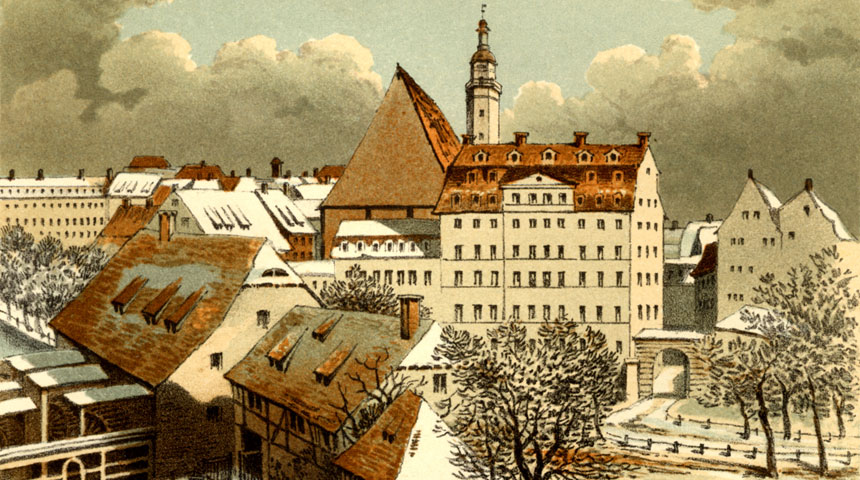
Mendelssohn’s sketch of the Thomasschule (St. Thomas School) and, behind it, the Thomaskirche (St. Thomas Church) in Leipzig.

Thank you for following this blog, and thank you for reading this long post all the way to the end!

For Trinity 11 (August 8 in 1723), we’re listening to Cantata 179 Siehe zu, daß deine Gottesfurcht nicht Heuchelei sei, with a superb opening chorus and one of the most beautiful soprano arias Bach ever wrote.

MiahPersson_MonikaRittershaus
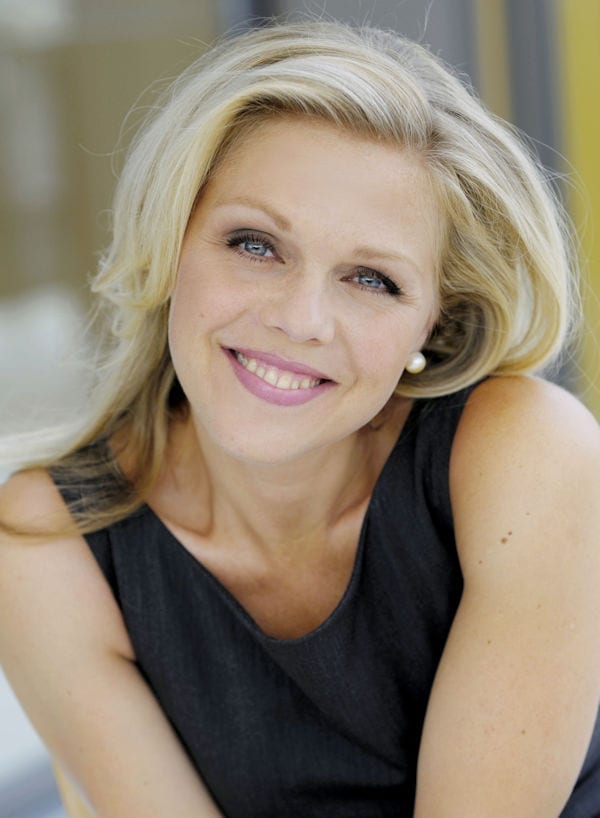
Miah Persson. Photo by Monika Rittershaus.

I prefer Bach Collegium Japan’s recording of this cantata. It’s a special recording, with Miah Persson singing the soprano aria. She’s having quite a career now, so I think we’re lucky to have her beautiful voice and sensitive interpretation on this recording from 1999. You can find it on Youtube or Spotify. Please consider purchasing this recording on jpc.de, Amazon, or iTunes. Soloists on this recording are Miah Persson, soprano; Makoto Sakurada, tenor; and Peter Kooij, bass.

Please find the score here (it’s fun to read along with the recording, especially in the opening chorus, to see what Bach does with the fugue) and the German text with English translation here.

It is now more than two months since Bach started his new job in Leipzig, and he is about three weeks into writing a brand new composition every week, and I’m sorry if I sound too casual here, but he’s on a roll. He must now have a vision of what it is he really wants to do for these churches (see the tiny preludes to his Passions he incorporates in cantatas 105 and 46), and he must have the classes at the St. Thomas School organized, and his singers sufficiently trained, so that he can now have them sing a new and challenging opening chorus every week.  Just listening to the opening choruses alone, starting with the one of cantata 136 for Trinity 8, I marvel at what he comes up with every time. Every single one of them is stunning, but at the same time completely different from the one of the previous Sunday. This time Bach chooses to write a perfect “old style” (Palestrina-style) motet fugue as opening chorus.

As always, to fully understand the cantata and not miss any of Bach’s hidden messages, it is important to look at the Gospel reading for the day. In this case it is the parable of the Pharisee and the Publican (or Pharisee and the Tax Collector), a story Jesus tells as an illustration on how to pray: the Pharisee is full of himself, telling God how good he is, while the Publican in his own prayer merely asks for mercy, and tells God how bad he is.  This concept of “how to be a good Christian before God” was very important to Bach and apparently his librettist got the message loud and clear. He or she uses the opportunity to first write a strong protest against fake religion and hypocrisy in “Christianity today” in movements 1 to 3 (probably having certain people in Leipzig in mind), after which he/she states that all Christians should take the humbleness of the publican as example in movements 4 to 6. For another example of how Bach interprets this Bible story, read my post about Cantata 113, written for this same 11th Sunday after Trinity, in 1724.

The most special feature of the fugue in the opening chorus is that since the text talks about beautiful outer appearance versus a bad character, Bach uses a mirror-fugue, which he used as well in fugues 5-7 from the Art of the Fugue (the theme of six bars is first introduced by the basses, and then is answered by the tenors in an “inversion:” every step up from the basses becomes a step down in the tenor part.)

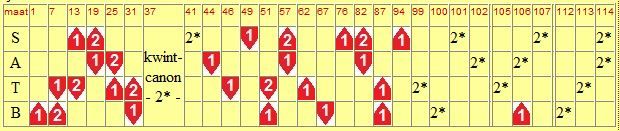
To understand how Bach built this intricate fugue I am sharing the excellent music example and diagram by Dutch Bach writer Eduard van Hengel, with his permission:

179_diagram1
179-diagram2

Even though the text here is in Dutch, the diagram speaks for itself, with this quick explanation of the numbers and symbols:

1 = The theme (or first half-sentence of the text: Siehe zu, dass deine Gottesfurcht nicht Heuchelei sei). Note the ascending line on the word “Gottesfurcht” (fear of God/love of God) and the descending line on the word “Heuchelei” (hypocrisy).

2 = The counter-subject (or second half-sentence of this text: und diene Gott nicht mit falschem Herzen). Note here that there is a chromatic line every time the word “falschem” appears in the text: for the chromatic line the composers needs accidentals that are not part of the key the piece is written in, which in the “old polyphony” would be seen as “falsch” (not right, off-key).

Upward arrow = fugue theme regular

Downward arrow = fugue theme inversed (mirror fugue)

2* = a more compact (only 4 bars instead of 6 bars long) theme which is derived from the first counterpoint/counter-subject on the words und diene Gott nicht mit falschem Herzen, still with the chromatic line on falschem Herzen.

The numbers at the top are measure (“maat”) numbers.

Bach himself must have greatly valued this cantata. About 15 years later, he used no less than three movements from this cantata for use in his short masses, or Lutheran masses.**

The opening chorus was later “recycled” as the first movement (Kyrie) in the Mass in G Major, BWV 236. Keep listening, or scroll to 18:00 and you’ll discover that the tenor aria Quoniam (sung here by Thomas Hobbs) was, with some changes and a much slower tempo, recycled from the tenor aria in this cantata 179. In cantata 179 the tenor aria gets a colorful accompaniment of two oboes and first violins in unison. The second violins and violas fill in the meaningless middle part (representing the “nothingness, emptiness”). When recycling this later for the Quoniam in the Mass in G Major, Bach uses only one solo oboe for the accompaniment, and completely leaves out all strings (confirming that with a different text, the meaningless middle part is not relevant anymore).

This cantata’s wonderful soprano aria (with two oboi da caccia and basso continuo) was later reworked into the Qui Tollis for the Mass in A Major, BWV 234 (with two flutes and only high strings as continuo). This was actually how I first knew and loved this soprano aria, I didn’t know cantata 179 until I started listening to it for this blog. Please click on this link and listen to the amazing Agnès Mellon sing the Qui Tollis from the Mass in A Major.

Wieneke Gorter, August 14, 2016, links updated August 15, 2023.

** These are called “short” or “Lutheran” masses because they consisted of only the Kyrie and Gloria part of the traditional Catholic mass. Bach wrote four of them (BWV 233-236), and they are all made up of existing movements from cantatas, but reworked and compiled in a very smart way and they are all absolutely beautiful. You can purchase an album with Herreweghe’s recording of all of them on jpc.de, iTunes, or Amazon.

Recent Posts

  • “Missa Miniatura” by CONTINUUM/Elina Albach Even More Moving in 2025
  • Bachfest Leipzig 2025
  • Bach Cantatas for Christmas – 1724 and 1734 editions
  • Fourth Sunday of Advent – more insight into Cantata 62 helped me better understand Bach’s Christmas Oratorio
  • Saint Ambrose and Luther in Milan – Second Sunday of Advent

Archives

  • August 2025
  • July 2025
  • December 2024
  • November 2024
  • June 2024
  • January 2024
  • December 2023
  • October 2023
  • September 2023
  • August 2023
  • April 2022
  • February 2022
  • January 2022
  • December 2021
  • November 2021
  • June 2021
  • May 2021
  • April 2021
  • February 2021
  • January 2021
  • December 2020
  • November 2020
  • October 2020
  • September 2020
  • August 2020
  • July 2020
  • May 2020
  • April 2020
  • March 2020
  • February 2020
  • January 2020
  • December 2019
  • November 2019
  • May 2018
  • April 2018
  • March 2018
  • February 2018
  • January 2018
  • December 2017
  • November 2017
  • October 2017
  • September 2017
  • August 2017
  • July 2017
  • June 2017
  • May 2017
  • April 2017
  • March 2017
  • February 2017
  • January 2017
  • December 2016
  • November 2016
  • October 2016
  • September 2016
  • August 2016
  • July 2016
  • June 2016
  • May 2016
  • April 2016
  • March 2016
  • February 2016
  • January 2016

Enter your email address to follow this blog and receive notifications of new posts by email.

Join 338 other subscribers

Categories

  • 1723 Trinity season special series
  • Advent
  • After Easter
  • Ascension
  • Bach's life
  • Cantatas
  • Chorale cantatas 1724/1725
  • Christmas
  • Easter
  • Epiphany
  • Following Bach in 1725
  • Köthen
  • Leipzig
  • Septuagesima
  • Travel
  • Trinity
  • Weimar

Meta

  • Create account
  • Log in
  • Entries feed
  • Comments feed
  • WordPress.com

Website Built with WordPress.com.

  • Subscribe Subscribed
    • Weekly Cantata
    • Join 158 other subscribers
    • Already have a WordPress.com account? Log in now.
    • Weekly Cantata
    • Subscribe Subscribed
    • Sign up
    • Log in
    • Report this content
    • View site in Reader
    • Manage subscriptions
    • Collapse this bar
 

Loading Comments...