Weekly Cantata

Weekly Cantata

Tag Archives: BWV 20

Bachfest Leipzig 2025

09 Wednesday Jul 2025

Posted by cantatasonmymind in Cantatas, Leipzig, Travel

≈ Leave a comment

Tags

Adina Apartment Hotel Leipzig, Alex Potter, Anna-Sylvia Goldammer, Apartmenthotel Quartier M., Bach, Bach Akademie Stuttgart, Bach-Archiv Leipzig, Bachakademie Stuttgart, Bachfest 2025, Bachfest 2026, Bachfest Leipzig, Bachfest Leipzig 2025, Bachfest Leipzig 2026, Bachfest Malaysia, Bachstiftung, BWV 198, BWV 20, BWV 233, BWV 79, Christiane Mariana von Ziegler, Christiane Mariane von Ziegler, Collegium Vocale Gent, Continuum Berlin, David Chin, David de Winter, Elina Albach, Gardiner, Hans-Christoph Rademann, Heinrich Schütz, Innside Leipzig, J.S. Bach Foundation, J.S. Bach Stiftung, Johann Hermann Schein, johann-sebastian-bach, Koopman, linden trees, Maria Küstner, Merseburg, Merseburger Dom, Michael Maul, Miriam Feuersinger, Motel One Leipzig, Nikolaikirche, Patrick Grahl, Philippe Herreweghe, Rick Fulkner, Romanus-Haus, Rudolf Lutz, Schütz, Schein, Solomon's Knot, Thomaskirche, Tobias Berndt, Tomáš Král, Wir glauben all an einen Gott
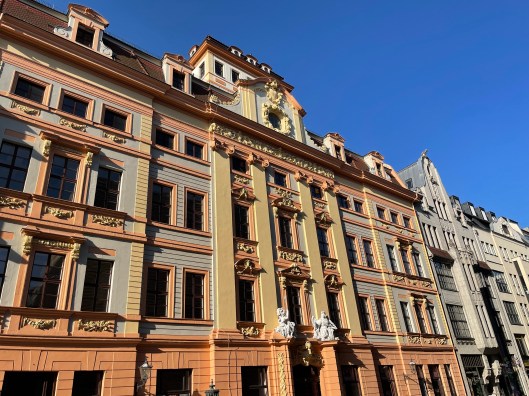
Romanus-Haus in Leipzig, the house where poet Christiane Mariane von Ziegler held salons in the 1720s and 1730s.

I visited Bachfest Leipzig again this year, from Tuesday evening, June 17, through Sunday, June 22, attending eight concerts in six days. Read my highlights below, and please subscribe to this blog so you don’t miss future posts. I joined a festival trip to Merseburg, took walks, caught up with friends from all over the world, and met some new fellow Bach lovers. For me, the camaraderie has almost become a more important reason to return each year than the concerts.

That said, next year’s cantata programming is not to be missed, with Herreweghe AND Lutz AND Rademann, so if you would like to attend you should probably get organized – my tips for that at the end of this post.

Summer in Leipzig

June is the perfect time of year in this city. People are out on café terraces everywhere, and walking in the streets. Then there’s the summer green: entire rose bushes for sale on the street in the middle of the center, and linden trees in bloom wherever you go. The scent of linden delights me, and I learned something new about them this year, thanks to our Bachfest tour guide Anna-Sylvia Goldammer on the organ trip to Merseburg: Leipzig has apparently always been full of linden trees! The latin word for Leipzig, Lipsi, was derived from the Slavic word for linden tree, lipa. Most of downtown, inside the ring, is car-free, with only taxis and necessary vehicles allowed in. This makes it feel safe and, dare I say it, more walkable than Amsterdam.

The free performances can be the most meaningful

Inspired by a seatmate on the trip to Köthen last year, I attended more of the free or almost-free performances this year. You can still fully enjoy the camaraderie with other Bach fans and hear beautiful music without spending a fortune. There are no assigned seats for the church services, so as long as you line up early, you can enjoy the best view for free.

This year I had missed the free performances on the market square, but on Saturday morning, June 21, I was so lucky to attend an unforgettable, absolutely exquisite rendition of the duet from Cantata 79 Gott der Herr ist Sonn und Schild by soprano Miriam Feuersinger and baritone Tobias Berndt during the “Mette” (morning service) in the Nikolaikirche. The Sunday morning service in the Thomaskirche was special too. The service was a reconstruction of what a church service in Bach’s time would have been like (I could write an entire blog post about that!), I got to hear Johannes Lang play the organ, Tomáš Král sing the bass arias in Cantata 20 O Ewigkeit, du Donnerwort, and tenor Patrick Grahl sing not only the tenor aria in that cantata but also the cantor-bits in the service as well as the reading from the New Testament (yes this was sung, beautiful!). But I also happened to sit and sing (in the congregational singing) next to the 80-year-old father of choir director Maria Küstner. With great determination he had climbed all the stairs to the balcony, even though he was walking with a cane. When after the service I thanked him for his clear and confident singing, he told me that decades ago, on frequent car trips between Leipzig and Berlin, he would sing Luther’s “Wir glauben all an einen Gott” (one of the Lutheran chorales we had just sung in the service) to keep himself and the family awake. I forgot to ask him if this was still during GDR time, but it might very well have been.

Catching up with David Chin

This year I also finally had the opportunity to have lunch with David Chin, director of Bachfest Malaysia and creator of the excellent documentary Encountering Bach which I have referenced already a few times on this blog. We started conversations on Facebook during the Covid pandemic after David published his first episodes of the documentary, then met in person at the Thüringer Bachwochen in 2022, but only managed to say a few quick hellos at last year’s Bachfest. So grateful it worked out to talk this year!

Concert highlights: Alex Potter and David de Winter
Alex Potter in the Nikolaikirche on June 17. Photo courtesy of Sascha Wolff.

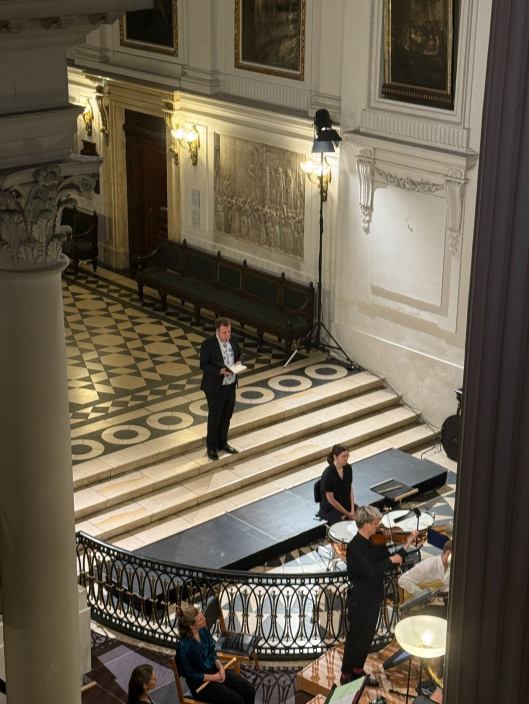
I had only just arrived to Leipzig on Tuesday June 17. I had not even unpacked yet, but I had a chance to hear “Missa Miniatura,” Elina Albach’s adaptation of Bach’s Mass in B Minor again, and I am a big fan of that production. So I ate a quick dinner and made it to the Nikolaikirche just in time. Alex Potter’s stunning rendition of the Agnus Dei at this concert was definitely a highlight of this Bachfest for me. In order to have a bit more acoustic, he had climbed up a few steps so he stood directly under an arch in the Nikolaikirche. Thanks to Sascha Wolff for capturing that moment on photo. After this aria I felt “we can now all die happily.” The other aria that transported me to a similar state of bliss was David de Winter’s “Der Ewigkeit saphirnes Haus” from Cantata 198 Laß, Fürstin, laß noch einen Strahl with Solomon’s Knot on Friday, June 20, in the Evangelisch-Reformierte Kirche. I had never heard this aria sung so beautifully.

Bach’s “50 best cantatas” by Lutz, Herrewege, and Rademann, Vox Luminis, Koopman, and Gardiner in 2026 – how to get organized

Disclaimer: I’m not getting paid to write this. Below is a reflection of my personal opinion and personal interpretation of the information that is available at the time of writing this blog post. I do not accept responsibility if your experience is different. I just thought it might be helpful to curate the information from various websites for you.

Anyone reading this who has visited Bachfest in the last few years: please feel free to add your own advice in the comments. Thank you!

Next year’s cantata programming at the festival is going to be a hit parade of the “50 best cantatas” (chosen by the audience, read more about the how and why in this interview with festival director Michael Maul by blogger Rick Fulkner) with two concerts each by Herreweghe, Lutz, Koopman, Gardiner, Rademann, and Vox Luminis. Here are my tips to get organized:

If you already know you want to attend all 12 cantata concerts (= two concerts per day, six days in a row, of two to three cantatas each, each cantata preceded by a motet by Schütz or Schein), you can purchase your “packet” here. You’ll go through two seat selection screens, one to select your seat for the Thomaskirche (the screen doesn’t specify this, but it is the seatmap that has the stage at the bottom, and “Südempore” on the right), and, once you have clicked the checkout button, another one for the Nikolaikirche (not specified either, but this is the map that has the stage at the top and 1. Empore and 2. Empore).

Please note for Thomaskirche:

  • For concerts with choir and orchestra, the performers are located on the organ loft of the Sauer-organ (the bottom of the seating map).
  • The majority of the pews downstairs, where the sound is likely best, have their backs to the performers. Many people don’t mind this, but it surprised me. Thus, if it is important for you to see the performers, choose a premium seat (yellow on the map) on one of the balconies, where the sound is wonderful too.
  • Some seats on the Empore (balconies) have partially blocked views of the performers due to large pillars, even the premium seats are not all equal, so don’t get your hopes up too much.

Please note for Nikolaikirche:

The sound is good everywhere in the church, but most seats on the balconies have limited leg space, so keep that in mind if you are tall, since these cantata concerts will be pretty long. The Bach Museum shop sells cute portable cushions for making your church pew seat more comfortable, see picture on the left, pillow folded in half. I also saw people who traveled with inflatable pillows.

If you want to pick and choose, only want to go to one concert per day, or don’t want to commit to spending a thousand euros just yet, mark your calendar:

  • November 11, 2025: Advance sales start for Patrons of the Bachfest/Bach-Archiv Leipzig and for members of the Neue Bachgesellschaft.
    • Become a patron of the Bachfest here (access to VIP seating for three concerts or more, depending on level of giving).
    • Become a member of the Neue Bachgesellschaft here (no special seating, just the earlier access to ticket sales).
  • November 25, 2025: Regular ticket sales start.

Where to stay: People I met had good experiences at Innside (hotel directly across the ring from the Thomaskirche, in a nice neighborhood), Motel One (close to the Nikolaikirche), and Adina Apartment Hotel (apartments close to the Nikolaikirche, 24-hour reception, pool, restaurant, bar). I myself stayed in Apartmenthotel Quartier M. which I loved because of the excellent organic supermarket on the ground floor of the same building, the good price, and the short walking distance to the Thomaskirche.

Copyright Wieneke Gorter, July 9, 2025.
Trombones and altos from heaven (a guide to BWV 2)

26 Thursday Mar 2020

Posted by cantatasonmymind in Bach's life, Cantatas, Chorale cantatas 1724/1725, Leipzig, Trinity

≈ Leave a comment

Tags

Alex Potter, BWV 12, BWV 135, BWV 172, BWV 18, BWV 182, BWV 2, BWV 20, BWV 21, BWV 7, chorale cantata, cornetto, Eduard van Hengel, Georg Poplutz, J.S. Bach Foundation, J.S. Bach Stiftung, Luther, Markus Volpert, Psalm 12, Renate Steinmann, Rudolf Lutz, Trinity 2, trombone

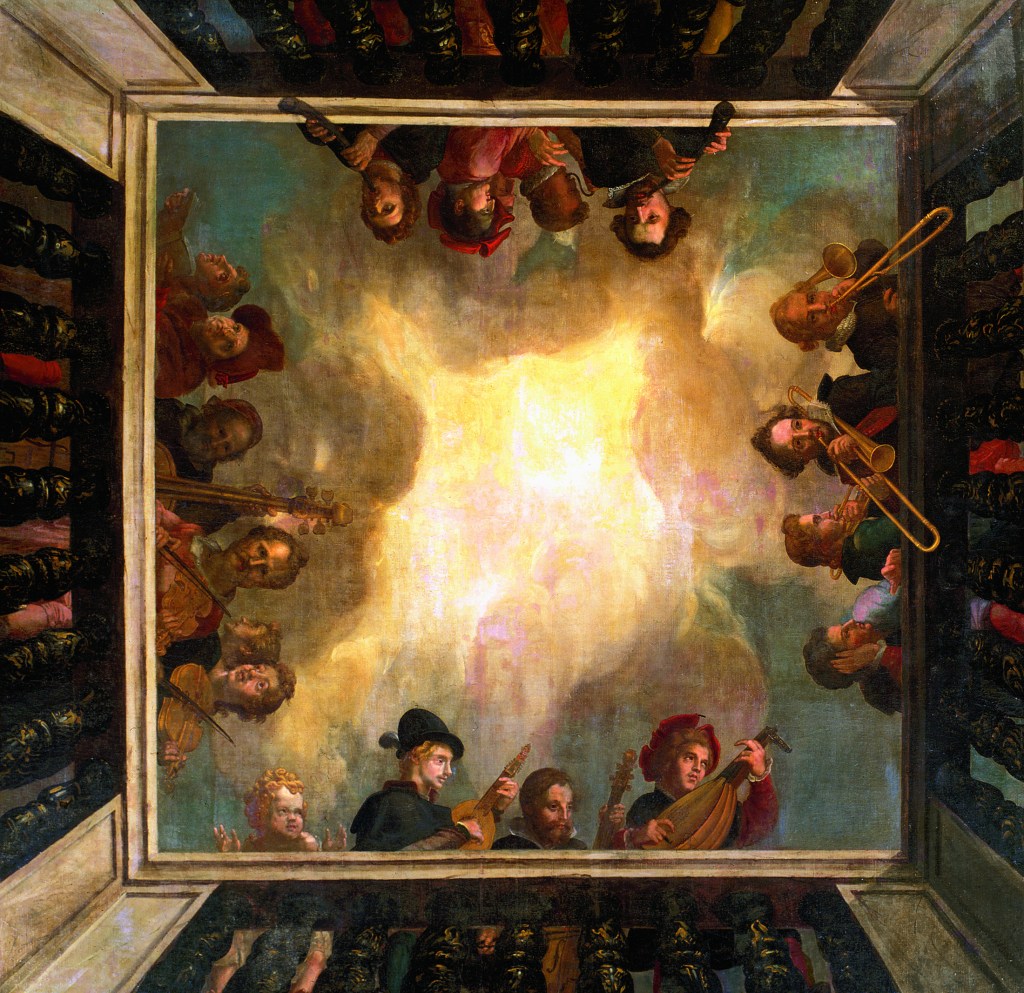
Ceiling painting installed around 1700 in Christian V’s Hall in Rosenborg Castle, Denmark. Possibly by Reinhold Timm, ca. 1620, originally for for a music pavilion in Kongens Have. *

Yesterday, Wednesday March 25, 2020, the J.S. Bach Foundation published their live video recording of Cantata 2 Ach Gott, vom Himmel sieh darein (Please God, look down from Heaven) on their YouTube channel. I thought it might be nice to provide a listening guide to go with this performance.

I love this cantata because it has trombones in the orchestra, doubling the choir parts, and because the altos have the cantus firmus (=they sing the chorale melody in long notes) in the opening chorus, which sounds incredibly good, and is unique within Bach’s writing.

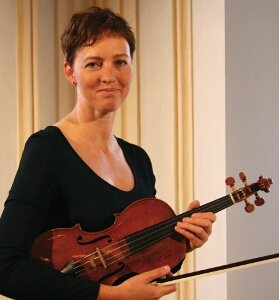
Find the video recording by the J.S. Bach Foundation here on YouTube. Soloists are Alex Potter, alto; Georg Poplutz, tenor; and Markus Volpert, bass.

Find the German texts with English translations here, and the full score here.

This cantata was the second in Bach’s 1724 series of Chorale Cantatas. He most probably intended for the first four cantatas in that series to form a set, or at least to present some kind of order,  if you look at the composition form of the opening movement, and which voice has the cantus firmus of the chorale tune in that chorus:

  1. Cantata 20 O Ewigkeit, du Donnerwort: French Overture, with cantus firmus in the soprano (find my blog post about this cantata here)
  2. Cantata 2 Ach Gott, vom Himmel sieh darein: Chorale motet, cantus firmus in alto (the cantata discussed here)
  3. Cantata 7 Christ unser Herr zum Jordan kam: Italian concerto, cantus firmus in tenor. (find my blog post about this cantata here)
  4. Cantata 135 : Ach Herr, mich armen Sünder: Chorale fantasia, cantus firmus in bass. (find my blog post about this cantata here)

We know that Bach liked to use order and symmetry when he wanted to impress other people with a composition. But perhaps he was also thinking of his legacy. When he started composing cantatas at the Weimar court in 1714, albeit on a monthly instead of weekly basis, his first four cantatas formed a similar portfolio of composition styles in the opening choral movements:

  1. Cantata 182 Himmelskönig, sei wilkommen: Choral fugue
  2. Cantata 12 Weinen, klagen, sorgen, zagen: Passacaglia
  3. Cantata 172 Erschallet, ihr Lieder, erklinget, ihr Saiten!: Concerto
  4. Cantata 21 Ich hatte viel Bekümmernis: Motet.

Back to this Cantata 2 Ach Gott, vom Himmel sieh darein (Please God, look down from Heaven), and what to listen for.

Opening chorus:

The chorale, based on Psalm 12, is by Luther. For an idea what Luther’s original song would have sounded like, you can watch this video. For readers who understand German: Eduard van Hengel’s website (in Dutch) has a very insightful overview of the original German text of Psalm 12, the text of Luther’s chorale, and how Bach’s librettist changed that into the text for the cantata.  You can find it here.

When Bach uses a chorale by Luther in a cantata, he often demonstrates his reverence for the father of his faith by using the archaic form of chorale motet as opening chorus combined with the equally archaic trombone quartet (1 cornetto and 3 trombones) to double the choir parts.**

Giving the cantus firmus to the altos is however not something Bach does very often. If only he had! In this case it is especially wonderfully orchestrated, with doubling by one trombone, two oboes, and all second violins. Both on this video recording by the J.S. Bach Foundation as well on the Herreweghe audio recording I recommended back in 2017, Alex Potter’s voice significantly enhances this winning blend of alto voices and instruments, and on this J.S. Bach Foundation video recording he also sings the beautiful alto aria. It definitely made my day yesterday.

Alto aria:

Bach alto and tenor arias are at their prettiest, I find, when they are written as a trio sonata, and the alto aria Tilg, o Gott in this cantata is a beautiful example of that. Wonderful singing and playing by alto Alex Potter and violinist Renate Steinmann. The aria is a plea for help in fighting the “Rottengeister,” or the sectarians amidst the Lutherans. When the alto starts singing the word “Rottengeistern,” we realize we had heard this word already many times in the triplets of the violin part. As Eduard van Hengel says, it is the “popular easy talk of the sectarians, and that is also the reason why the other two parts don’t have this motive” [to further illustrate the schism].

Renate Steinmann, violin and Alex Potter, alto. Photo of Alex Potter by Annelies van der Vegt.

Bass recitative:

Definitely keep the text & translations handy for this one, because this movement contains a wealth of text illustrations in the music. On the word Armen  (the poor) sounds a sorrowful diminished seventh, the word seufzend (sighing) has a rest/sigh in the middle of the word, and more such things happening on the words Ach (sighing) and Klagen (complaining). In contrast to this, a few lines later, the chord on the word Gott (God) sounds open and liberating, after which God himself gets to speak, and the music turns to an arioso (similarly to how Bach does that in his much earlier Cantata 18 when God speaks). At the word heller Sonnenschein (bright sunshine) the light gets turned on in the music too: the harmony changes to C Major.

Tenor aria:

Here we have arrived at the solution/salvation part of the cantata, and so this music is more pleasant, easier to listen to. But Bach is still preaching: there are some crossing (!) lines in the music, and in the middle section, which tells the listeners to be patient (sei geduldig) and Bach stresses the words Kreuz und Not.

With many thanks to Eduard van Hengel and Rudolf Lutz for their explanations of this cantata,

Wieneke Gorter, March 26, 2020.

*more information about this painting and the other objects in Christian V’s Hall in Rosenborg Castle can be found here.

**The best examples of this are cantatas 2, 25, 38, and 121.

Bach’s most famous duet

17 Sunday Sep 2017

Posted by cantatasonmymind in Cantatas, Chorale cantatas 1724/1725, Leipzig, Trinity

≈ Leave a comment

Tags

Allan Fast, BWV 10, BWV 101, BWV 113, BWV 20, BWV 25, BWV 33, BWV 78, Charles Brett, Eduard van Hengel, Howard Crook, Ingrid Schmithüsen, Joshua Rifkin, Julianne Baird, Peter Kooij, Trinity 14

Julianne Baird
Allan Fast

Of this cantata 78 Jesu, der du meine Seele, most people only know the  soprano-alto duet Wir eilen mit schwachen, doch emsigen Schritten. The best rendition of this I have ever heard in my life is by Julianne Baird and Allan Fast on the Rifkin recording from 1988. Listen to it here. Fast passed away in 1995 at age 41.

Bach wrote this cantata for the 14th Sunday after Trinity, September 10, 1724. It was not the first time he wrote a “cute” duet — there are gorgeous examples  in sacred and secular cantatas from his Weimar and Köthen years. However, at the start of his second Leipzig cycle, for the Trinity season of 1724, there are more and more duets in his cantatas.  Alto-tenor duets appear in cantatas 20 and 10, spaced three weeks apart. A series of soprano-alto duets follows on July 9 in cantata 93, a month later in cantata 101, and the next week in cantata 113. Then there’s the terrific tenor-bass duet in cantata 33 on September 3, and this duet on September 10.

This is why I like it so much to listen to Bach’s cantatas in the order he wrote and performed them. I would never have noticed connections such as these otherwise.

The rest of the cantata is wonderful too, especially the opening chorus, which is among the most complex Bach ever wrote. For those who read Dutch, I encourage you to read Eduard van Hengel’s splendid article about this cantata here.

For the entire cantata I prefer Herreweghe’s recording, also from 1988. Soprano: Ingrid Schmithüsen; Alto: Charles Brett; Tenor: Howard Crook; Bass: Peter Kooy. Find the recording here on YouTube. Find the German text and English translations of the cantata here, and the score here.

More listening for this Sunday: cantata 25 from 1723. It has a much bigger orchestra, including many brass players. Find my explanation for that here.

Wieneke Gorter, September 17, 2017, updated September 8, 2023.

About Weekly Cantata

I am a bilingual writer, publicist, choral singer, art and nature lover, happy wife, and blessed mother of two. I started this blog in 2016, inspired by my late mother’s love for Bach’s cantatas. After 23 years in the San Francisco Bay Area, I’m now back in the Netherlands.

If you are on social media, please follow me:

  • Facebook
  • Instagram

Please subscribe!

Please join my readers from all over the world and subscribe to this blog! Simply fill in your email address and you’ll receive an email every time I’ve published a new post. Thank you so much / Vielen Dank / Merci mille fois / 감사합니다 / 谢谢 / ありがとう / Mille grazie / Muchas gracias / Muito obrigado / Takk / Terima kasih / Dankuwel!

Designed with WordPress.com

Recent Posts

  • “Missa Miniatura” by CONTINUUM/Elina Albach Even More Moving in 2025
  • Bachfest Leipzig 2025
  • Bach Cantatas for Christmas – 1724 and 1734 editions
  • Fourth Sunday of Advent – more insight into Cantata 62 helped me better understand Bach’s Christmas Oratorio
  • Saint Ambrose and Luther in Milan – Second Sunday of Advent

Archives

  • August 2025
  • July 2025
  • December 2024
  • November 2024
  • June 2024
  • January 2024
  • December 2023
  • October 2023
  • September 2023
  • August 2023
  • April 2022
  • February 2022
  • January 2022
  • December 2021
  • November 2021
  • June 2021
  • May 2021
  • April 2021
  • February 2021
  • January 2021
  • December 2020
  • November 2020
  • October 2020
  • September 2020
  • August 2020
  • July 2020
  • May 2020
  • April 2020
  • March 2020
  • February 2020
  • January 2020
  • December 2019
  • November 2019
  • May 2018
  • April 2018
  • March 2018
  • February 2018
  • January 2018
  • December 2017
  • November 2017
  • October 2017
  • September 2017
  • August 2017
  • July 2017
  • June 2017
  • May 2017
  • April 2017
  • March 2017
  • February 2017
  • January 2017
  • December 2016
  • November 2016
  • October 2016
  • September 2016
  • August 2016
  • July 2016
  • June 2016
  • May 2016
  • April 2016
  • March 2016
  • February 2016
  • January 2016

Enter your email address to follow this blog and receive notifications of new posts by email.

Join 338 other subscribers

Categories

  • 1723 Trinity season special series
  • Advent
  • After Easter
  • Ascension
  • Bach's life
  • Cantatas
  • Chorale cantatas 1724/1725
  • Christmas
  • Easter
  • Epiphany
  • Following Bach in 1725
  • Köthen
  • Leipzig
  • Septuagesima
  • Travel
  • Trinity
  • Weimar

Meta

  • Create account
  • Log in
  • Entries feed
  • Comments feed
  • WordPress.com

Website Built with WordPress.com.

  • Subscribe Subscribed
    • Weekly Cantata
    • Join 158 other subscribers
    • Already have a WordPress.com account? Log in now.
    • Weekly Cantata
    • Subscribe Subscribed
    • Sign up
    • Log in
    • Report this content
    • View site in Reader
    • Manage subscriptions
    • Collapse this bar
 

Loading Comments...