Weekly Cantata

Weekly Cantata

Tag Archives: Eduard van Hengel

Christmas in August

27 Saturday Aug 2016

Posted by cantatasonmymind in 1723 Trinity season special series, Bach's life, Cantatas, Leipzig, Trinity

≈ Leave a comment

Tags

according to Lutheran Church year, Anhalt-Zerbst, Anna Magdalena Bach, Bach, Bruce Dickey, cantatas, City Council, Collegium Vocale Gent, concerto palatino, cornetto, Deborah York, Eduard van Hengel, Hana Blazikova, Ingeborg Danz, Köthen, Leipzig, Lutheran Church year, Mark Padmore, Peter Kooy, Phlippe Herreweghe, Ratswechsel, recorder, Saxe-Weissenfels, Thomas Hobbs, Trinity 14, trombone, trumpet, Wilcke
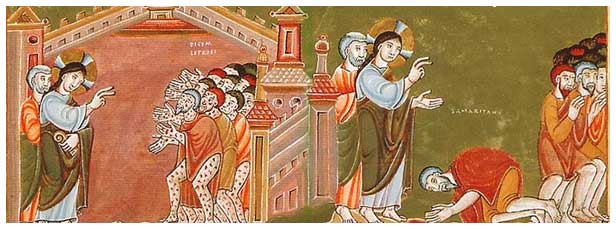
gesu_lebbrosi
Jesus heals ten lepers, from the Codex Aureus of Echternach, c. 1035-1040

Only a handful of Bach cantatas ask for the Renaissance/Early Baroque ensemble of one cornetto and three trombones in the opening and closing chorus. This instrumentation was considered somewhat “old fashioned” in Bach’s time, while at the same time it was still very normal in cities to hear Stadtpfeifers (city pipers) play chorales from the towers during the day, to remind the citizens of their Christian duties. In this Cantata 25 Es ist nichts Gesundes an meinem Leibe, for the 14th Sunday after Trinity (August 29 in 1723), the playing of the chorale tune by this ensemble in the opening chorus stands for the way it has always been, the way it has been true for centuries.

palatino
Concerto Palatino, the leading cornetto/trombone ensemble for the past 25 years. Photo by Sabrina Flauger. Learn more about them here.

My preferred recording of Cantata 25 is the one by Herreweghe, on the same album as cantata 105 for Trinity 9 and cantata 46 for Trinity 10, as well as cantata 138 for next week. Soloists in cantata 25: soprano Hana Blažíková, tenor Thomas Hobbs, and bass Peter Kooij. Cornetto: Bruce Dickey  (pictured above, front row, on left); trombones: Claire McIntyre, Simen van Mechelen (pictured above, top row, on left), and Joost Swinkels.

Listen to this recording on Spotify or on YouTube. Please consider supporting the artists by purchasing this album (containing four cantatas for this 1723 Trinity season) on Amazon.

Read the text of this cantata here, and find the score here.

I could write an entire blog post about the opening chorus alone, the way I did last week for cantata 77 and two weeks earlier for cantata 179. But in the interest of variety, I’m going to keep this section short, and I will just say that the opening chorus  is an incredible, unrivaled complex composition for ten voices, again completely different than any opening chorus the Leipzig congregations had heard before during this Trinity season of 1723. By having the “ancient” brass quartet play the chorale melody of Herzlich tut mich verlangen nach einem selgen End (With my whole heart I long for my blessed End / my Salvation)** Bach shows that the promise of salvation after death will always provide a silver lining to the sorrow of the daily, sinful human condition. He also illustrates this “salvation” with the recorders in the uplifting and soothing soprano aria (Hana Blažíková in top shape!), and the brass and recorders in the closing chorale, and intensifies the “sickness” of the human sins by setting these texts to “dry” recitatives  (though listen to that bass arioso, beautifully sung by Peter Kooij) in between. Again, it was completely normal in his day and age to think this way, and Bach saw it as his mission in life to teach this theology to his fellow Lutherans by way of his church music.

But, listen to the festive, large orchestra for this cantata! No less than four brass players (one cornetto and three trombones) and five wind players (two oboists and three recorder players) were required at the same time in the opening chorus and closing chorale. For a cantata about the healing of ten lepers? Well, it turns out that this weekend it was Christmas in August for Bach, and the extra players were probably in town for the much more important and incredibly festive Cantata 119 Preise, Jerusalem, den Herrn that was on the calendar for the next day, Monday August 30, the day of the inauguration of the new City Council (Ratswechsel). *** As I already suggested in my post about cantata 147, Bach might have sometimes used guest musicians in his orchestra who were in town for other reasons, and judging from the level of playing required for the Brandenburg concerto-like Cantata 119, the extra brass (all playing trumpet in 119) and wind (playing oboe and recorder in 119) players might have been needed to be of the level of court chamber musician, not just Stadtpfeifer (usually a lower rank, and not necessarily used to playing the complicated court music). So in my probably not so unlikely movie script fantasy, Bach hired musicians from the not too far away courts where he had worked before or where his in-laws worked (Köthen, Weissenfels, Zerbst) to play in the orchestra on Monday August 30, and he had asked them to also play in the service on Sunday August 29.

Listen to the Ratswechsel cantata 119 Preise, Jerusalem, den Herrn by Herreweghe on YouTube. (Soloists: soprano Deborah York; alto Ingeborg Danz; tenor Mark Padmore, bass Peter Kooij.)

Wieneke Gorter, August 24, 2016, updated September 8, 2023.

** Several writers have suggested the chorale best known to the congregation at the time (on the melody we have later come to know as O Haupt voll Blut und Wunden) would have been instead Ach Herr, mich armen Sünder, but I agree with Eduard van Hengel that because of Bach’s use of the angel-like recorders and the heavenly brass it makes more sense to go with Herzlich tut mich verlangen nach einem selgen End.

*** The new city council was always chosen on August 24, and then inaugurated on the first Monday following August 24, which was Monday August 30 in 1723.

About Weekly Cantata

I am a bilingual writer, publicist, choral singer, art and nature lover, happy wife, and blessed mother of two. I started this blog in 2016, inspired by my late mother’s love for Bach’s cantatas. After 23 years in the San Francisco Bay Area, I’m now back in the Netherlands.

If you are on social media, please follow me:

  • Facebook
  • Instagram

Please subscribe!

Please join my readers from all over the world and subscribe to this blog! Simply fill in your email address and you’ll receive an email every time I’ve published a new post. Thank you so much / Vielen Dank / Merci mille fois / 감사합니다 / 谢谢 / ありがとう / Mille grazie / Muchas gracias / Muito obrigado / Takk / Terima kasih / Dankuwel!

Designed with WordPress.com

72 and 73

24 Sunday Jan 2016

Posted by cantatasonmymind in Cantatas, Epiphany, Leipzig

≈ Comments Off on 72 and 73

Tags

Bach Collegium Japan, Bist du bei mir, Collegium Vocale Gent, Dorothee Mields, Eduard van Hengel, Leichenglocken, Lutheran Church year, Masaaki Suzuki, Monika Mauch, Montreal Baroque, Peter Kooy, Phlippe Herreweghe, Rachel Nicholls, Robin Blaze, Thomas Hobbs

ChristCleansing

Christ cleansing a leper, Jean-Marie Melchior Doze, 1864

For this third Sunday after Epiphany, we find no less than four gems in Bach’s treasure trove: cantatas 73, 111, 72, and 156. I decided to highlight 73 and 72, because of the interesting references between the two. As far as we can tell, Bach loved these cantatas too: He performed cantata 73 at least one more time, and transcribed the opening chorus of cantata 72 into the Gloria of his Mass in G minor.

From the chronology of performances in Leipzig, it looks as if Bach wrote cantata 73 in 1724 and cantata 72 two years later. However, some scholars argue that (a large part of) cantata 72 was probably already written around 1715, since most of the poetry is from a collection Bach used when working in Weimar at that time. But whether 72 was first or 73 was first, it doesn’t matter that much for the appreciation of these two beautiful cantatas.

I have a soft spot for cantata 73 because I love the way Herreweghe performs this, have listened to the 1990 recording many times since it came out, and then to the (better!) 2013 recording. The best parts are the opening chorus and the bass aria (sung by Peter Kooy on both recordings) and I’m grateful for Eduard van Hengel’s Bach website (in Dutch) where I learned a lot about the many possible bits of reference in this cantata to other works.

Listen first to Cantata 72 Alles nur nach Gottes willen by Bach Collegium Japan/Masaaki Suzuki on Spotify

soloists: Rachel Nicholls (one of the most “boy soprano”-like voices of the soprano soloists in that series, I love it), Robin Blaze (counter-tenor), Peter Kooy (bass)

If you only have access to YouTube, you could listen to Montreal Baroque’s recording or to Gardiner’s recording instead.

What to listen for in cantata 72:

The most important words from the Bible text for this third Sunday after Epiphany (the story of Jesus cleansing a leper, from the gospel of Matthew):

Da er aber vom Berg herabging, folgte ihm viel Volks nach. Und siehe, ein Aussätziger kam und betete ihn an und sprach: Herr, so du willst, kannst du mich wohl reinigen. Und Jesus streckte seine Hand aus, rührte ihn an und sprach: Ich will’s tun; sei gereinigt!

(When He had come down from the mountain, great multitudes followed Him. And behold, a leper came and worshiped Him, saying, Lord, if You are willing, You can make me clean. Then Jesus put out His hand and touched him, saying, I am willing; be cleansed.)

In the opening chorus: The illustration of the word “Alles” (Everything): one can hear all the instruments in the orchestra, and when the voices come in, they first jump an octave over two quarter notes, signifying all the possible notes in the chord, and then run up in 16th notes, singing every single note in the chord.

In the alto aria: nine times the words “Herr, so du willt” – make sure to remember this melody!

In the bass aria: the text is set in the third person, but it is almost as if Jesus himself is speaking here, and this is where the text moves to the “Ich will’s tun” (I will do it / I am willing) words from the gospel.

In the soprano aria*: the happy and sweet elaboration on the “Ich will’s tun” – which here turns into “my Jesus will do it!”

The closing chorale: the same text and tune Bach uses throughout cantata 111 for this same Sunday in 1725, as well as in the St. Matthew Passion (but in that case with different harmonies in the last four lines!)

***

Next, listen to cantata 73 Herr, wie du willt, so schick’s mit mir in a fantastic recording by Collegium Vocale Gent/Philippe Herreweghe, from 2013, on Spotify soloists: Dorothee Mields (soprano), Thomas Hobbs (tenor), Peter Kooy (bass)

or their 1990 recording here on YouTube soloists: Barbara Schlick (soprano), Howard Crook (tenor) and Peter Kooij (bass).

Please note: these are two different Herreweghe recordings. The newest one, on Herreweghe’s own label, features a different soprano and tenor soloist than on his earlier recording of this same cantata (Virgin Classics, 1990, with soprano Barbara Schlick and tenor Howard Crook). I like this new one better. The entire CD is wonderful, and also features fabulous counter-tenor Damien Guillon in the other cantatas on the disc. If you like this recording, please consider supporting the artists by purchasing it on Amazon.

What to listen for in cantata 73:

In the opening chorus: the first four notes of the original chorale Herr, wie du willt, so schick’s mit mir in Leiden und Sterben, used as a four-note “Leitmotiv,” first appearing staccato in the horn in the orchestra:

Screenshot 2016-01-22 23.47.40
and at the very end of the movement, homophonically in the choir, repeated three times, not something Bach normally does in cantata opening choruses:
Screenshot 2016-01-22 23.54.06

In the bass aria: now the “Herr, wie du willt” from the chorale text turns in to “Herr, so du willt” from the gospel text. And to accentuate this, Bach again gives this text its own “Leitmotiv”-like melody. However, it might not have been a new melody. It is very similar to “Bist du bei mir” from Anna Magdalena’s music book. She wrote this aria in her book much later, but it was copied from an opera aria by Stölzel from 1717. Perhaps this opera aria was already being hummed in the Bach household in 1724, we will never know. Later in the bass aria in cantata 73, the “Herr, so du willt”-melody from the alto aria of cantata 72 returns!

What I love especially in this bass-aria is the illustration of “Leichenglocken” (death bells) by pizzicato strings and a somewhat “tolling” movement in the vocal part. My mother (a walking Bach encyclopedia who played a cantata on the turntable / CD player every Sunday) would always point features like this out to me. Bach used it in many other cantatas, for example in (cantata number/movement number): 8/1, 95/5, 105/4, 127/3, 161/4, 198/4. [Thanks again to Eduard van Hengel, I didn’t have to look this up myself].

* While overall I like Bach Collegium Japan’s recording of cantata 72 best, and I love how Rachel Nicholls sings the soprano aria, I would like to mention that on Montreal Baroque’s recording of this work, the soprano aria by Monika Mauch is excellent and worth listening to. How she makes everything calm on the words “sanft und still” is very special.

More links:
German text with English translation for cantata 72
Score for cantata 72
German text with English translation for cantata 73
Score for cantata 73

Wieneke Gorter, January 24, 2016; links updated January 25, 2020, and January 23, 2021.

Newer posts →

Recent Posts

  • “Missa Miniatura” by CONTINUUM/Elina Albach Even More Moving in 2025
  • Bachfest Leipzig 2025
  • Bach Cantatas for Christmas – 1724 and 1734 editions
  • Fourth Sunday of Advent – more insight into Cantata 62 helped me better understand Bach’s Christmas Oratorio
  • Saint Ambrose and Luther in Milan – Second Sunday of Advent

Archives

  • August 2025
  • July 2025
  • December 2024
  • November 2024
  • June 2024
  • January 2024
  • December 2023
  • October 2023
  • September 2023
  • August 2023
  • April 2022
  • February 2022
  • January 2022
  • December 2021
  • November 2021
  • June 2021
  • May 2021
  • April 2021
  • February 2021
  • January 2021
  • December 2020
  • November 2020
  • October 2020
  • September 2020
  • August 2020
  • July 2020
  • May 2020
  • April 2020
  • March 2020
  • February 2020
  • January 2020
  • December 2019
  • November 2019
  • May 2018
  • April 2018
  • March 2018
  • February 2018
  • January 2018
  • December 2017
  • November 2017
  • October 2017
  • September 2017
  • August 2017
  • July 2017
  • June 2017
  • May 2017
  • April 2017
  • March 2017
  • February 2017
  • January 2017
  • December 2016
  • November 2016
  • October 2016
  • September 2016
  • August 2016
  • July 2016
  • June 2016
  • May 2016
  • April 2016
  • March 2016
  • February 2016
  • January 2016

Enter your email address to follow this blog and receive notifications of new posts by email.

Join 336 other subscribers

Categories

  • 1723 Trinity season special series
  • Advent
  • After Easter
  • Ascension
  • Bach's life
  • Cantatas
  • Chorale cantatas 1724/1725
  • Christmas
  • Easter
  • Epiphany
  • Following Bach in 1725
  • Köthen
  • Leipzig
  • Septuagesima
  • Travel
  • Trinity
  • Weimar

Meta

  • Create account
  • Log in
  • Entries feed
  • Comments feed
  • WordPress.com

Website Built with WordPress.com.

  • Subscribe Subscribed
    • Weekly Cantata
    • Join 156 other subscribers
    • Already have a WordPress.com account? Log in now.
    • Weekly Cantata
    • Subscribe Subscribed
    • Sign up
    • Log in
    • Report this content
    • View site in Reader
    • Manage subscriptions
    • Collapse this bar
 

Loading Comments...