Weekly Cantata

Weekly Cantata

Tag Archives: Eva Borhi

J.S. Bach Foundation with Nuria Rial review and live video

18 Thursday Nov 2021

Posted by cantatasonmymind in Cantatas, Köthen, Leipzig, Weimar

≈ Leave a comment

Tags

Amy Power, Bach, Bachstiftung, BWV 199, bwv 202, BWV 82, cantatas, Daniel Rosin, Eva Borhi, J.S. Bach Foundation, J.S. Bach Stiftung, Manuel Walser, Nuria Rial, Rudolf Lutz, Sonoko Asabuki

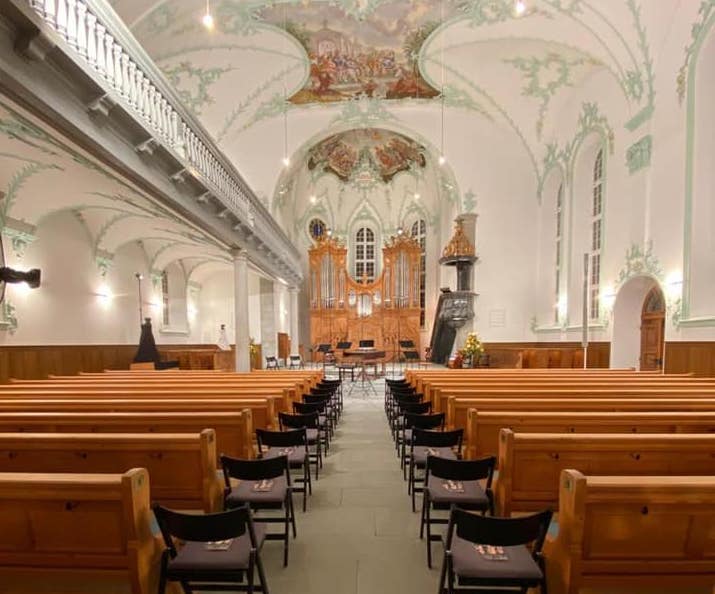
The church in Trogen, Switzerland, where the 15th anniversary concert of the J.S. Bach Foundation was recorded on November 17, 2021. Find it here on YouTube.
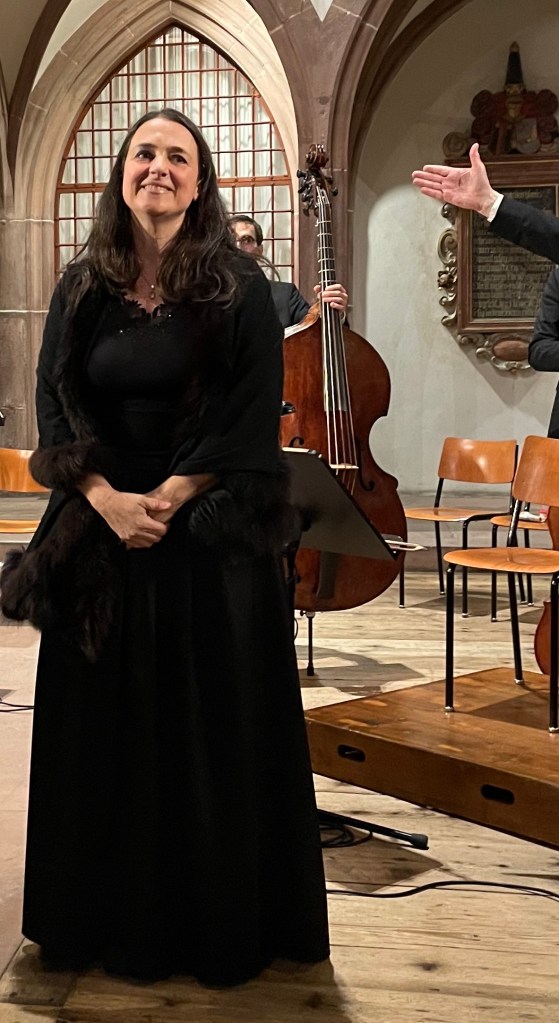
Nuria Rial in Basel

This week, the J.S. Bach Foundation celebrated 15 years of recording Bach cantatas with a special anniversary program in three cities in Switzerland: Basel, Trogen, and Zürich. I am still pinching myself that I got to attend the concert in Basel on Tuesday November 16, sitting only 6 feet (2 meters) from the amazing soprano Nuria Rial, who sang Cantata 199 Mein Herze schwimmt im Blut and Cantata 202 Weichet nur, betrübte Schatten.

Her performance was everything I had been hoping for and more. Her voice pulls you in from the start, and the energy and joy she exudes are just extraordinary. And then there’s her playfulness. I will never forget how special it was to experience that from up-close. I also realized what a true ensemble member she is, always in contact with the instrumentalists.
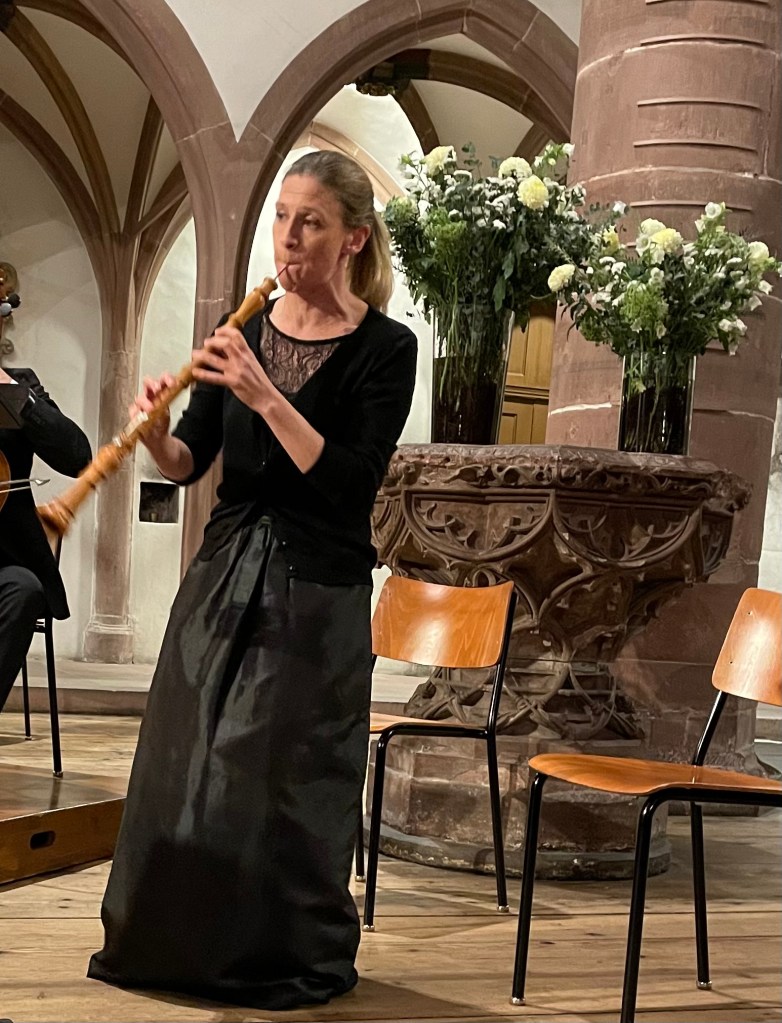
Amy Power in Basel

And those instrumentalists really need to be mentioned! Oboist Amy Power’s playing was lyrical throughout, with beautiful ornamentations in the “da capo” parts of the arias. I especially enjoyed the call-and response between her and Nuria Rial in the first movement of Weichet nur, betrübte Schatten. Her accomplishments were even more impressive knowing that she had been summoned from Graz less than 8 days before the concert, when the J.S. Bach Foundation heard that oboist Andreas Helm had to isolate at home because of contracting Covid-19.

First violinist Eva Borhi’s sensitive playing was especially gorgeous in the “Tief gebückt” aria from Canatata 199 and “Schlummert ein” aria from Cantata 82 with Manuel Walser. But my favorite was her interaction with Nuria Rial in the “Wenn die Frühlingslufte streichen” aria from Cantata 202.

Violist Sonoko Asabuki had an exquisite solo in the Chorale “Ich, dein betrübtes Kind” from Cantata 199, and cellist Daniel Rosin did a great illustration of Phoebus’ speeding horses in the third movement of Cantata 202, which earned a “Bravo” cheer from the audience, as if we were at the opera. (Always better than the audience member who fell asleep during “Schlummert ein,” snoring and all, a few rows behind me).

Last but not least, Rudolf Lutz, who directed the others from the harpsichord, improvised tasteful and effective mini-preludes leading up to the recitatives in Cantata 199, and very sensitively employed the lute register in the da capo of “Schlummert ein,” which formed a beautiful accompaniment to the pianissimo playing strings. He was also his usual witty self, making audience and performers laugh with his short speeches. My sister mentioned that even though we were here together at the concert because of our mother, she was actually strongly reminded of our grandfather. Also a man who always appeared very proper and Calvinist, but would then surprise you with his terrific sense of humor.

Watch this same performance, recorded live in Trogen, a day later than the one I attended in Basel here on YouTube.

Wieneke Gorter, November 19, 2021.

A new photo and a new video (BWV 48 and 5 for Trinity 19)

17 Saturday Oct 2020

Posted by cantatasonmymind in 1723 Trinity season special series, Cantatas, Chorale cantatas 1724/1725, Leipzig, Trinity

≈ Leave a comment

Tags

19th Sunday after Trinity, Bachstiftung, BWV 48, BWV 5, Capella Brancacci, Eva Borhi, Florence, Italy, J.S. Bach Foundation, J.S. Bach Stiftung, Jan Börner, Manuel Walser, Mirjam Berli, Patrick Henrichs, Philippe Herreweghe, Raphael Höhn, Rudolf Lutz, Santa Maria del Carmine, Trinity 19

Fresco’s in the Brancacci Chapel of Santa Maria del Carmine, Florence, Italy, by Masolino, 1424-25. One of the miracles pictured is The Healing of the Cripple, which was the Gospel story for the 19th Sunday after Trinity. Photo by the author.

At the end of a two-week trip to Italy in the summer of 2018 (my family’s first visit to that country), we would have only one afternoon and night in Florence. After booking our hotel in a neighborhood a good friend had recommended, I saw on Google maps that the hotel was around the corner from a church called Santa Maria del Carmine.

The name rang a bell, but I didn’t immediately realize why. Then I started searching my blog, and yes: there it was, the fresco of The Healing of the Cripple, from the Brancacci Chapel in that church, in my blog post from 2016 about Cantata 48. After seeing a lot of art in other cities in Italy and with a big train trip ahead of us, we decided to have this be the only art we would go see in Florence, and save the rest for another trip. It was a good decision, because this way I could really let it sink in that I was seeing these frescos in real life, and this way we had some time left to eat ice cream, rest, see the sun set over the city, and enjoy a good meal.

In my blog post from 2016, I recommended Herreweghe’s recording of Cantata 48 Ich elender Mensch. (from 1723), and I still stand by that choice. Find all the links to the recording, a comparison with the St. Matthew Passion, and my explanation of the silver lining in the opening chorus here.

One year later, in 2017, I wrote about Cantata 5, Wo soll ich fliehen hin? which Bach wrote for this same 19th Sunday after Trinity, in 1724. Since then, I have a new favorite recording of this cantata: the excellent 2018 performance by the J.S. Bach Foundation that was released to YouTube in April 2019. You can find that video here. Soloists are: Soprano: Mirjam Berli; Alto: Jan Börner; Tenor: Raphael Höhn; Bass: Manuel Walser; Violin: Eva Borhi; Tromba da tirarsi: Patrick Henrichs.

Find the German text with English translation of Cantata 5 here, and the score here.

For a list of the bass arias with trumpet the Leipzig congregations would have heard between June 1723 (when Bach started working in Leipzig) and October 1724 (when he wrote Cantata 5), including links for listening, read my blog post from 2017 here.

Wieneke Gorter, October 17, 2020

Follow this blog on Facebook or Instagram

Recent Posts

  • “Missa Miniatura” by CONTINUUM/Elina Albach Even More Moving in 2025
  • Bachfest Leipzig 2025
  • Bach Cantatas for Christmas – 1724 and 1734 editions
  • Fourth Sunday of Advent – more insight into Cantata 62 helped me better understand Bach’s Christmas Oratorio
  • Saint Ambrose and Luther in Milan – Second Sunday of Advent

Archives

  • August 2025
  • July 2025
  • December 2024
  • November 2024
  • June 2024
  • January 2024
  • December 2023
  • October 2023
  • September 2023
  • August 2023
  • April 2022
  • February 2022
  • January 2022
  • December 2021
  • November 2021
  • June 2021
  • May 2021
  • April 2021
  • February 2021
  • January 2021
  • December 2020
  • November 2020
  • October 2020
  • September 2020
  • August 2020
  • July 2020
  • May 2020
  • April 2020
  • March 2020
  • February 2020
  • January 2020
  • December 2019
  • November 2019
  • May 2018
  • April 2018
  • March 2018
  • February 2018
  • January 2018
  • December 2017
  • November 2017
  • October 2017
  • September 2017
  • August 2017
  • July 2017
  • June 2017
  • May 2017
  • April 2017
  • March 2017
  • February 2017
  • January 2017
  • December 2016
  • November 2016
  • October 2016
  • September 2016
  • August 2016
  • July 2016
  • June 2016
  • May 2016
  • April 2016
  • March 2016
  • February 2016
  • January 2016

Enter your email address to follow this blog and receive notifications of new posts by email.

Join 338 other subscribers

Categories

  • 1723 Trinity season special series
  • Advent
  • After Easter
  • Ascension
  • Bach's life
  • Cantatas
  • Chorale cantatas 1724/1725
  • Christmas
  • Easter
  • Epiphany
  • Following Bach in 1725
  • Köthen
  • Leipzig
  • Septuagesima
  • Travel
  • Trinity
  • Weimar

Meta

  • Create account
  • Log in
  • Entries feed
  • Comments feed
  • WordPress.com

Website Built with WordPress.com.

  • Subscribe Subscribed
    • Weekly Cantata
    • Join 158 other subscribers
    • Already have a WordPress.com account? Log in now.
    • Weekly Cantata
    • Subscribe Subscribed
    • Sign up
    • Log in
    • Report this content
    • View site in Reader
    • Manage subscriptions
    • Collapse this bar
 

Loading Comments...