Weekly Cantata

Weekly Cantata

Tag Archives: Trinity 19

It’s Not What You Think – The Kreuzstab Cantata for Trinity 19

10 Saturday Oct 2026

Posted by cantatasonmymind in Cantatas, Leipzig, Leipzig 1726/1727

≈ Leave a comment

Tags

Adolf Theill, Bach, Bach-Archiv Leipzig, BWV 56, cantatas, Christine Blanken, Christoph Birkmann, Collegium Vocale Gent, Daniel R. Melamed, Il Gardellino, Kreuzstab, Marcel Ponseele, Michael Marissen, Peter Kooij, Philippe Herreweghe, Trinity 19
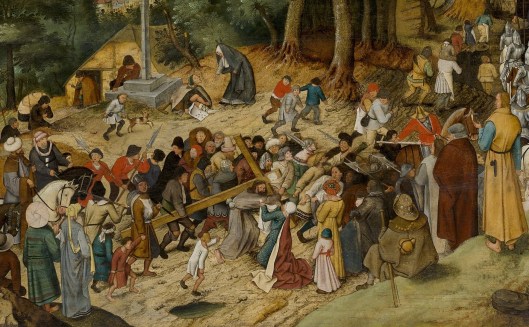
Detail of Pieter Brueghel II’s Landschap met Kruisdraging (Landscape with Christ Carrying the Cross) from around 1605. Oil on oak wood. Bonnefantenmuseum, Maastricht, the Netherlands. Click here to see the entire painting and its eventful history in the 1940s.

What do you think of when you hear the text of the solo cantata for bass “Ich will den Kreuzstab gerne tragen”? My mental image was similar to the painting above, but this week, that got turned on its head when I read research published in 2015. However, my favorite recording is still the same! My love for this particular performance is older than my marriage!

Peter Kooij, image taken from a video by the Netherlands Bach Society.

That favorite recording of Cantata 56 Ich will den Kreuzstab gerne tragen is the one by Herreweghe with Peter Kooij and Marcel Ponseele, from 1991. Not this same piece by Peter Kooij with other conductors or orchestras, only Herreweghe. Because for me, it’s the combination that makes the magic. Peter Kooij’s musicality, voice, and text-awareness is always there, but under Herreweghe’s direction the music flows and every musical line takes you to a point far beyond the note that’s currently in your ears.
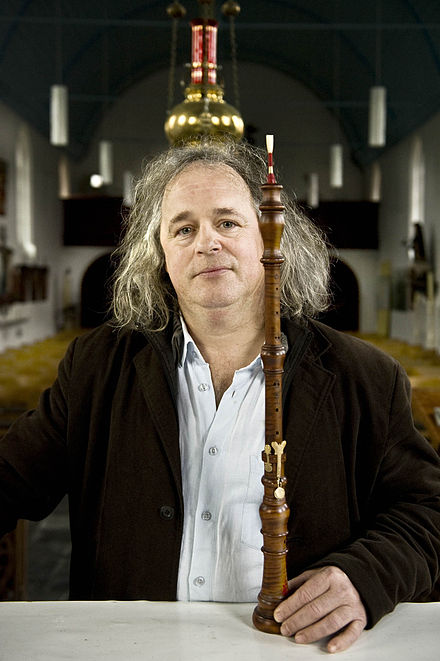
Marcel Ponseele

And then there’s Marcel Ponseele’s oboe playing. I know no other recording where the oboe and the voice dance so beautifully together in the third movement “Endlich, endlich wird mein Joch” (Finally, finally will my yoke). Kooij and Ponseele were both with Herreweghe for decades, but Kooij, 72, has retired from touring, and Ponseele, 69, has recently left Herreweghe’s ensembles to focus more on his own projects. (see my previous post for an example of the fabulous productions he creates with his ensemble Il Gardellino).

The score of Cantata 56 Ich will den Kreuzstab gerne tragen can be found here. The German text with a thorough and thoughtful English translation by Michael Marissen & Daniel R. Melamed can be found here. In their translation, Kreuzstab is correctly translated as cross staff, such as a Bishop’s staff, or even a medieval navigation device as pictured at the very bottom of this post (more about that later!). But in about half of the English translations out there, it is translated as cross beam.

Wy did I also have that image of the cross beam in my head, instead of a cross staff? For me, that has to do with the word “Joch” (yoke) in the third movement, but also with Bach’s St. Matthew Passion. As a Dutch choral singer, I know the St. Matthew Passion libretto from memory, and thus, for me, that text always comes to mind first. Concert programs also sometimes feature the “Komm, süsses Kreuz” (Come, sweet cross) bass aria from the St. Matthew Passion together with this Kreuzstab cantata.

In the St. Matthew Passion, leading up to that “Kom, süsses Kreuz” aria, the Evangelist sings the Gospel text from Matthew:

Und da sie ihn verspottet hatten, zogen sie ihm den Mantel aus und zogen ihm seine Kleider an und führeten ihn hin, dass sie ihn kreuzigten. Und indem sie hinausgingen, funden sie einen Menschen von Kyrene mit Namen Simon; den zwungen sie, dass er ihm sein Kreuz trug.

And when they [the Roman soldiers] had ridiculed him, they took the cloak off him and put his own clothing on him, and led him forth, so that they might crucify him. And as they were going out, they found a man from Cyrene named Simon; they forced him to carry Jesus’ cross for him.

Thus, that image of literally carrying Jesus’ wooden cross is a vivid one. Then, in the “Komm, süsses Kreuz” aria, Bach’s librettist, in his 18th-century reflection on the Gospel text, makes the connection to suffering, metaphorically bearing a cross.

Komm, süsses Kreuz, so will ich sagen,
Mein Jesu, gib es immer her!
Wird mir mein Leiden einst zu schwer,
So hilfst du mir es wieder tragen.

Come, sweet cross, so I will say,
My Jesus, ever give it here [for me to bear]!
If someday my suffering becomes too heavy for me,
Then you will help me bear it [the cross] again.

But this Kreuzstab Cantata 156 is only partly about that. Foremost, the text talks about finding a way through one’s life, letting God lead the way, and finding a safe harbor, using a wealth of metaphors from marine navigation. See for example the analogy in the second movement “Mein Wandel auf der Welt ist einer Schiffahrt gleich: Betrübnis, Kreuz und Not sind Wellen, welche mich bedecken und auf den Tod mich täglich schrecken” (My course of life in the world is like a ship voyage: distress, cross-bearing, and hardship are waves that cover me and daily scare me) and these words in the closing chorale: “Löse meines Schiffleins Ruder, bringe mich an sichern Port!” (Free the rudder of my little ship, bring me to safe harbor). So in that sense, the image of a cross staff is more appropriate than that of “the” wooden Cross.

I didn’t come up with this myself of course. Already in 1985, Gustav Adolf Theill explained that the cross-staff was a nautical device used to determine distances and positional coordinates. It would take until the 1730s for this to be replaced by the sextant. Theill linked the description of a cross-staff with Bach’s succession of notes in the bass motif (Ich – will – den – Kreuz – stab) of the first movement.

Dr. Christine Blanken

Thirty years later, in 2015, Dr. Christine Blanken of Bach-Archiv Leipzig presented more evidence. She had discovered that Bach’s student Christoph Birkmann was most likely the librettist of this and other solo cantatas from the fall and winter of 1726. In addition, she showed that only two months before Bach’s performance of this cantata, Birkmann, also a mathematician and physicist, had given an academic presentation about trigonometrical calculations requiring the use of cross staffs such as pictured at the bottom of this post.

So, while Bach might have had both Jesus’ wooden cross and a cross staff in mind, his librettist was definitely thinking of the latter.

Read more about all of this in Dr. Christine Blanken’s article from 2015.

To everyone who recently started following me here on WordPress or on Instagram @weeklycantata , welcome and thank you for being part of my Bach family! Please feel free to share this article with a friend.

Not an email subscriber yet? Sign up below! I won’t use your email address for anything else.

© Wieneke Gorter, October 10, 2026.

Frontispiece to the Introductio geographica, by Petrus Apianus, 1532. The illustration depicts the use of a cross-staff, or Jacob’s staff, to measure angles. The instrument was used in astronomy, navigation, and surveying.

A new photo and a new video (BWV 48 and 5 for Trinity 19)

17 Saturday Oct 2020

Posted by cantatasonmymind in 1723 Trinity season special series, Cantatas, Chorale cantatas 1724/1725, Leipzig, Trinity

≈ Leave a comment

Tags

19th Sunday after Trinity, Bachstiftung, BWV 48, BWV 5, Capella Brancacci, Eva Borhi, Florence, Italy, J.S. Bach Foundation, J.S. Bach Stiftung, Jan Börner, Manuel Walser, Mirjam Berli, Patrick Henrichs, Philippe Herreweghe, Raphael Höhn, Rudolf Lutz, Santa Maria del Carmine, Trinity 19

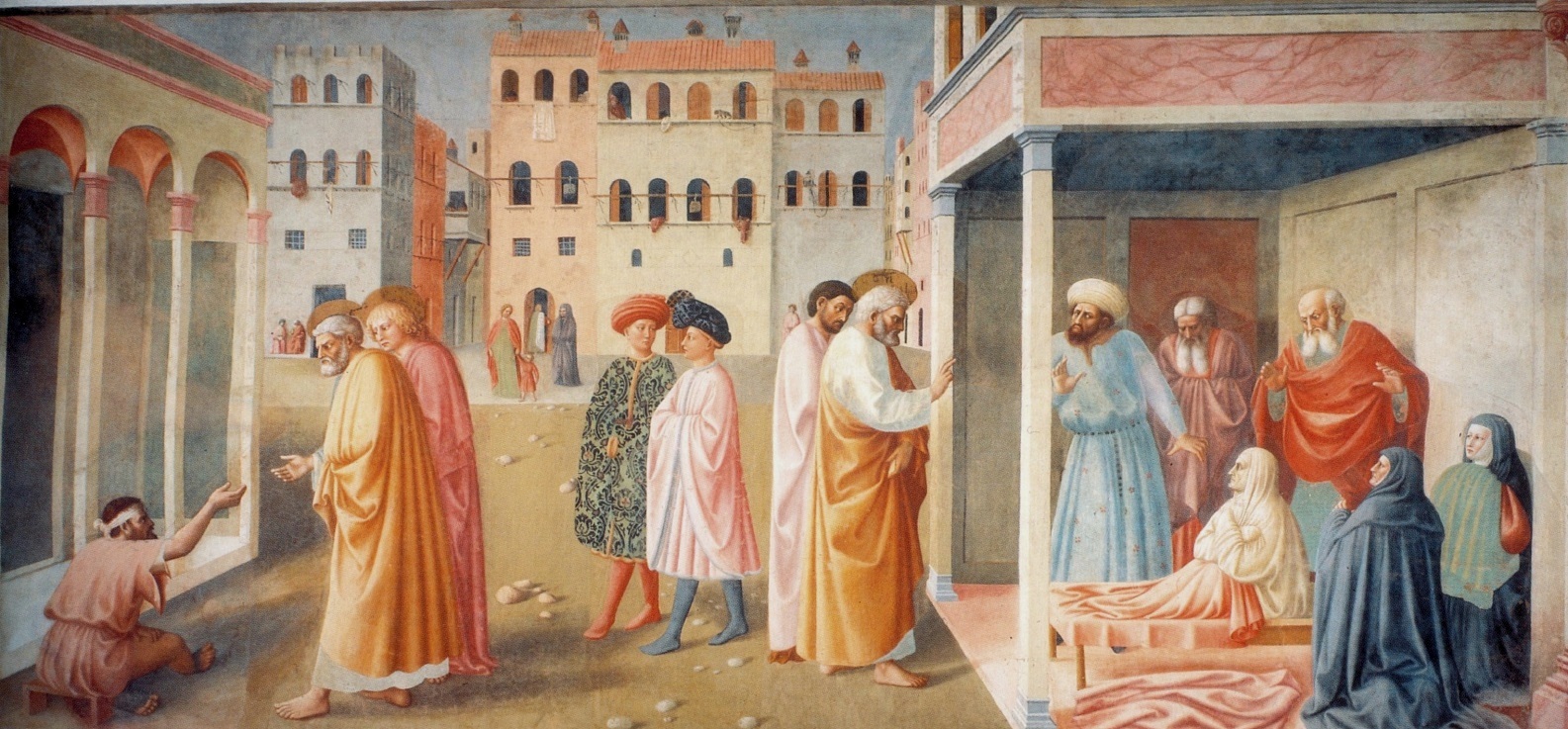
Fresco’s in the Brancacci Chapel of Santa Maria del Carmine, Florence, Italy, by Masolino, 1424-25. One of the miracles pictured is The Healing of the Cripple, which was the Gospel story for the 19th Sunday after Trinity. Photo by the author.

At the end of a two-week trip to Italy in the summer of 2018 (my family’s first visit to that country), we would have only one afternoon and night in Florence. After booking our hotel in a neighborhood a good friend had recommended, I saw on Google maps that the hotel was around the corner from a church called Santa Maria del Carmine.

The name rang a bell, but I didn’t immediately realize why. Then I started searching my blog, and yes: there it was, the fresco of The Healing of the Cripple, from the Brancacci Chapel in that church, in my blog post from 2016 about Cantata 48. After seeing a lot of art in other cities in Italy and with a big train trip ahead of us, we decided to have this be the only art we would go see in Florence, and save the rest for another trip. It was a good decision, because this way I could really let it sink in that I was seeing these frescos in real life, and this way we had some time left to eat ice cream, rest, see the sun set over the city, and enjoy a good meal.

In my blog post from 2016, I recommended Herreweghe’s recording of Cantata 48 Ich elender Mensch. (from 1723), and I still stand by that choice. Find all the links to the recording, a comparison with the St. Matthew Passion, and my explanation of the silver lining in the opening chorus here.

One year later, in 2017, I wrote about Cantata 5, Wo soll ich fliehen hin? which Bach wrote for this same 19th Sunday after Trinity, in 1724. Since then, I have a new favorite recording of this cantata: the excellent 2018 performance by the J.S. Bach Foundation that was released to YouTube in April 2019. You can find that video here. Soloists are: Soprano: Mirjam Berli; Alto: Jan Börner; Tenor: Raphael Höhn; Bass: Manuel Walser; Violin: Eva Borhi; Tromba da tirarsi: Patrick Henrichs.

Find the German text with English translation of Cantata 5 here, and the score here.

For a list of the bass arias with trumpet the Leipzig congregations would have heard between June 1723 (when Bach started working in Leipzig) and October 1724 (when he wrote Cantata 5), including links for listening, read my blog post from 2017 here.

Wieneke Gorter, October 17, 2020

Follow this blog on Facebook or Instagram

Bass arias with trumpet

22 Sunday Oct 2017

Posted by cantatasonmymind in Cantatas, Leipzig, Trinity

≈ Leave a comment

Tags

19th Sunday after Trinity, Amsterdam Baroque Choir, Amsterdam Baroque Orchestra, Annette Markert, Azumi Takada, Bach, Bach Collegium Japan, cantatas, Christoph Prégardien, Gerd Türk, Gottfried Reiche, Klaus Mertens, Leipzig, Pascal Bertin, Peter Kooij, Peter Kooy, slide trumpet, Stephen Keavy, Susanne Rydén, Sybilla Rubens, Ton Koopman, Trinity, Trinity 19, trumpet

bwv5_manuscript_tromba

Excerpt from the trumpet part of Cantata 5 Wo soll ich fliehen hin? copied out by J.A. Kuhnau, Bach’s principal copyist, a nephew of Bach’s predecessor at Leipzig. Bach-Archiv Leipzig/Bach Digital.

The cantata from 1724 for this Sunday, the 19th after Trinity, is terrific, with a beautiful tenor aria with viola (or violin on some recordings) and rousing bass aria with trumpet. I prefer Bach Collegium Japan’s recording of this Cantata 5, Wo soll ich fliehen hin? because of Peter Kooij’s singing in the bass aria, Azumi Takada’s viola playing in the tenor aria, and the many colors of Susanne Rydén’s voice. Listen to it on YouTube via a playlist I created. Soloists are Susanne Rydén, soprano; Pascal Bertin, countertenor; Gerd Türk, tenor; Peter Kooij, bass.

Koopman’s recording of this cantata is good too, with perhaps a nicer tempo in the opening chorus, fabulous trumpet playing by Stephen Keavy in the bass aria, and good singing by Christoph Prégardien in the tenor aria. Listen to Koopman’s recording here. Soloists on this recording are Sybilla Rubens, soprano; Annette Markert, alto; Christoph Prégardien, tenor; Klaus Mertens, bass.

Find the German text with English translation here, and the score here.

Bach’s principal trumpet player, Gottfried Reiche, was an excellent musician, probably famous in the entire region, and apparently the only one who could play the tromba da tirarsi (slide trumpet) as well as the corno da tirarsi (slide horn — these were two different instruments!). And since Anna Magdalena’s father and all her three brothers-in-law were trumpet players at the regional courts, Bach knew their world well, and was most likely very well connected to many excellent players and their students. Around the feast of St. Michael’s (September 29), thousands of visitors from all over Europe would come to the Fair in Leipzig, and stay for a bit. Did Bach want to show Reiche off to all these visitors on September 29 (for Cantata 130, see below) and again this time on October 15, 1724, or were the trumpeter and/or bass singer themselves guests from out of town?

Bach paired the trumpet most often with the bass voice when writing arias. The most impressive bass arias with trumpet the Leipzig congregations would have heard between June 1723 (when Bach started working in Leipzig) and October 1724 are:

July 2, 1723: “Ich will von Jesu Wundern singen” from Cantata 147 (J.S. Bach Foundation recording from 2015 with Wolff-Matthias Friedrich, bass; Patrick Henrichs, trumpet)

August 1, 1723: “Dein Wetter zog sich auf von weiten” from Cantata 46 (Herreweghe recording from 2012 with Peter Kooij, bass; Alain De Rudder, Tromba da tirarsi).

November 14, 1723: “So löschet im Eifer der rächende Richter” from Cantata 90 (Bach Stiftung video with Klaus Häger, bass; Patrick Henrichs, trumpet)

May 28, 1724: “Heiligste Dreieinigkeit” from Cantata 172 (Leonhardt recording from 1985 with Max van Egmond, bass; Friedemann Immer, Klaus Osterloh, and Susan Willems, trumpets)

June 11, 1724: “Wacht auf, wacht auf, verloren Schafen” from Cantata 20 (Koopman recording from 1998 with Klaus Mertens, bass; Stephen Keavy, Tromba da tirarsi)

September 29, 1724, feast of St. Michael’s: “Der alte Drache brennt vor Neid” from Cantata 130 (Koopman recording from 2007 with Klaus Mertens, bass; Stephen Keavy, Jonathan Impett, and Michael Harrison, trumpets)

Wieneke Gorter, October 22, 2017, updated October 15, 2020.

If you don’t want to miss an episode of this 1724/1725 chorale cantata exploration, please consider signing up  to receive an email every time I’ve posted a new story. How to do this: If you are on a desktop computer, look to the left of this text, where it says “Follow Blog via Email,” enter your email address, and press the “Follow” button. If you are reading this on a smartphone, keep scrolling down until you find the same text.

The Opening Chorus’ Silver Lining

01 Saturday Oct 2016

Posted by cantatasonmymind in 1723 Trinity season special series, Cantatas, Leipzig, Trinity

≈ Leave a comment

Tags

19th Sunday after Trinity, Bach, BWV 48, Collegium Vocale Gent, Damien Guillon, Leipzig, Philippe Herreweghe, Thomas Hobbs, Trinity 19, tromba da tirarsi, trumpet

genezing_lamme_masolino

Healing of the Cripple (on left) and Raising of Tabitha (on right) by Masolino da Panicale, 1424-25. Fresco in the Brancacci Chapel, Santa Maria del Carmine, Florence, Italy.

My head has been in the St. Matthew Passion. For a few weeks already. Yes, that is pretty strange for me, having grown up in a house where Bach’s music was played often, but only on the Sundays and holidays for which it was written (read more about that in this blog post). However, it can happen when one sings in a Bach Choir in the United States. While in The Netherlands all 180 (!) St. Matthew Passion concerts happen in the weeks before Easter, here in the USA the piece is presented much less often, and the only classical music performances with a strong seasonal tie are those of Handel’s Messiah in the weeks before Christmas.

But working on the St. Matthew Passion and this Weekly Cantata blog at the same time has been a blessing, as the two areas of study influence each other. Nine months of research for this blog have inspired me to read more about the St. Matthew Passion and study the music in more detail. In that process I have learned many new things about the piece I thought I already knew so well. And experiencing the composition Bach’s sons referred to as their father’s Great Passion on a deeper level has, I believe, improved my understanding of Bach’s cantata writing.

Let’s just look at the opening chorus of this week’s cantata 48 Ich elender Mensch, written for the 19th Sunday after Trinity (October 3 in 1723).

I listened to Bach Collegium Japan (with Robin Blaze and Gerd Türk), Koopman (with Bernhard Landauer and Christoph Prégardien), Gardiner (with William Towers and James Gilchrist), Harnoncourt (with Paul Esswood and Kurt Equiluz), and Herreweghe (with Damien Guillon and Thomas Hobbs), and find Herreweghe’s interpretation the most moving. Herreweghe is also the only one who uses a tromba da tirarsi in the opening chorus, and I  love that sound. Listen to Herreweghe’s recording on YouTube or on Spotify. Please consider supporting the artists by purchasing the recording on Amazon: click here for USA, here for UK, here for Germany, or here for France.

Please find the German text with English translation here and the score here.

The main music is hauntingly beautiful (It’s not just the Herreweghe sopranos that give me goose bumps this time – the altos and tenors move me to tears, and none of this could happen without the basses providing that wonderful foundation for everyone to build on) but extremely downcast. It is clearly full of Elend (misery), in reference to the Gospel text of the day.* The same holds for the main music and words of the opening chorus of the St. Matthew Passion. It is clearly full of klagen (lamenting), and paints the picture of the Via Crucis, Jesus on his way to the cross.

However, in the midst of all the misery, a J.S. Bach opening chorus almost always provides a preview of the salvation that is to come later in the piece, or that is implied in the Gospel. In the opening chorus of the St. Matthew Passion he does this by superimposing the German Agnus Dei – the chorale O Lamm Gottes Unschuldig (O Lamb of God, unspotted), sung by a treble choir in G major, over the lamenting E minor of the two other choirs and orchestras. The repeated  auf unsre Schuld (for our sins) of Choir I is answered by the treble chorus with: All Sünd hast du getragen (you took away all sins).

The congregation in Leipzig, where the St. Matthew Passion was first performed on the afternoon of Good Friday in 1727, would have sung this German Agnus Dei earlier that day at the conclusion of the morning service. Back to this week’s cantata for October 3, 1723: in that Sunday service, the congregation might have sung the chorale Herr Jesu Christ, ich schreie zu dir:

Herr Jesu Christ ich schreie zu dir
Mit ganz betrübter Seele:
Dein Allmacht laß erscheinen mir
Und mich nicht also quäle.
Viel grösser ist die Angst und Schmerz.
So anficht und turbirt mein Herz,
Als daß ich kan erzählen.
Lord Jesus Christ, I cry to you
With a soul that is wholly troubled:
Let your almighty power appear to me
And do not punish me in this way.
Far greater is the anguish and pain
That challenge and confuse my heart
Than I can explain

The congregation might thus have heard those words in their head, when two bars after the soprano entrance the tromba da tirarsi starts playing this melody, later followed by two oboes in unison. In this way, these three instruments accompany every choral passage with a new line from the chorale, and the chorale thus starts forming the frame of the opening chorus.

After this preview message in the opening chorus that Jesus might be able to offer salvation, we have to wait until the tenor aria for the all-around convincing message that everything will be OK, in music as well as in text:

Vergibt mir Jesus meine Sünden,

If Jesus forgives me my sins,
So wird mir Leib und Seele gesund.
then my body and soul will become healthy.
Er kann die Toten lebend machen
He can make the dead live
Und zeigt sich kräftig in den Schwachen,
and shows himself to be mighty in those who are weak,
Er hält den längst geschloßnen Bund,
he keeps the covenant made long ago
Daß wir im Glauben Hilfe finden.
that in faith we find support.

Wieneke Gorter, October 1, 2016, links updated October 15, 2020.

* The Gospel story for this 19th Sunday after Trinity was the miracle of Jesus healing a cripple. From the time the Gospel was written through Bach’s time, unfortunately, having a disability or illness was seen as carrying a sin. When Jesus heals the man, he also takes his sins away.

Recent Posts

  • It’s Not What You Think – The Kreuzstab Cantata for Trinity 19
  • A Rainbow of Colors – Cantata 169 for Trinity 18
  • Gli Angeli Genève’s Chorale Cantata Box & Cantata 114 for Trinity 17
  • Family stories and more “Vision Bach” – BWV 179 and 199 for Trinity 11
  • Almost Unbearable, It’s that Good: Hannes Rux-Brachtendorf and Matthias Winckhler in BWV 46 on Rademann’s Vision Bach, Volume 3.

Archives

  • October 2026
  • September 2026
  • August 2026
  • August 2025
  • July 2025
  • December 2024
  • November 2024
  • June 2024
  • January 2024
  • December 2023
  • October 2023
  • September 2023
  • August 2023
  • April 2022
  • February 2022
  • January 2022
  • December 2021
  • November 2021
  • June 2021
  • May 2021
  • April 2021
  • February 2021
  • January 2021
  • December 2020
  • November 2020
  • October 2020
  • September 2020
  • August 2020
  • July 2020
  • May 2020
  • April 2020
  • March 2020
  • February 2020
  • January 2020
  • December 2019
  • November 2019
  • May 2018
  • April 2018
  • March 2018
  • February 2018
  • January 2018
  • December 2017
  • November 2017
  • October 2017
  • September 2017
  • August 2017
  • July 2017
  • June 2017
  • May 2017
  • April 2017
  • March 2017
  • February 2017
  • January 2017
  • December 2016
  • November 2016
  • October 2016
  • September 2016
  • August 2016
  • July 2016
  • June 2016
  • May 2016
  • April 2016
  • March 2016
  • February 2016
  • January 2016

Enter your email address to follow this blog and receive notifications of new posts by email.

Join 336 other subscribers

Categories

  • 1723 Trinity season special series
  • Advent
  • After Easter
  • Ascension
  • Bach's life
  • Cantatas
  • Chorale cantatas 1724/1725
  • Christmas
  • Easter
  • Epiphany
  • Following Bach in 1725
  • Köthen
  • Leipzig
  • Leipzig 1726/1727
  • Septuagesima
  • Travel
  • Trinity
  • Weimar

Meta

  • Create account
  • Log in
  • Entries feed
  • Comments feed
  • WordPress.com

Website Built with WordPress.com.

  • Subscribe Subscribed
    Weekly Cantata
    Join 156 other subscribers

    Have a WordPress.com account? Log in now.

  • Weekly Cantata
    View site in Reader
    Manage subscriptionsSign upLog in
    Report this content
    Collapse this bar
Loading Comments...