Weekly Cantata

Weekly Cantata

Category Archives: Leipzig 1726/1727

Remember Those Covid-Era Concerts Without Audiences? – Cantatas 98 and 109 for Trinity 21

24 Saturday Oct 2026

Posted by cantatasonmymind in 1723 Trinity season special series, Cantatas, Chorale cantatas 1724/1725, Leipzig, Leipzig 1726/1727

≈ 2 Comments

Tags

Agnes Glassner, Alex Potter, Armin Bereuter, Bettina Messerschmidt, Bettina Simon, BWV 109, BWV 188, BWV 38, BWV 98, Collegium Vocale Gent, Cosimo Stawiarski, Daniel Johannsen, Guro Hjemli, J.S. Bach Foundation, Jan Börner, Johannes Frisch, Johannes Hämmerle, Johannes Kaleschke, Kantaten in Vorarlberg, Katharina Verhaar, Lea Elisabeth Müller, Manuel Walser, Miriam Feuersinger, Netherlands Bach Society, Philippe Herreweghe, Regula Keller, Robert Vanryne, Rodrigo Lopez-Paz, Rudolf Lutz, Shunske Sato, Trinity 21, Wolf Matthias Friedrich
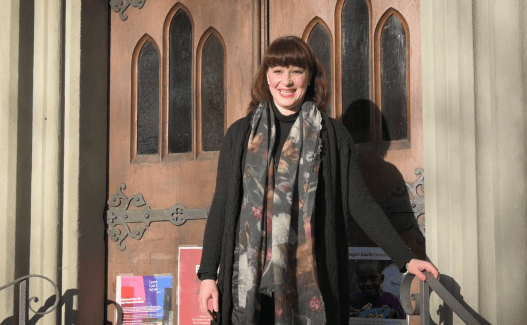
Soprano Miriam Feuersinger introducing the “Bachkantaten in Vorarlberg” concert on November 15, 2020 in Bregenz, Austria.

For this 21st Sunday after Trinity, I would like to share two wonderful videos that were recorded during the Covid pandemic. I have so much respect for all the musicians involved in these concerts. While I can clearly see that it was a joy for them to sing and play Bach, and to make music with their colleagues again, let’s not forget that it must have been incredibly demanding, to perform for an empty church. They all had to pull it from somewhere else, that extra energy that performing for an audience normally gives you.

Cantata 98 Was Gott tut, das ist wohlgetan [I] by Miriam Feuersinger and Friends

The first video features Cantata 98 Was Gott tut, das ist wohlgetan [I] from 1726, performed in Bregenz, Austria, on November 15, 2020, by Miriam Feuersinger, soprano; Lea Elisabeth Müller, alto; Daniel Johannsen, tenor; Wolf Matthias Friedrich, bass; Bettina Simon and Agnes Glaßner, oboe; Regula Keller and Cosimo Stawiarski, violin; Johannes Frisch, viola; Bettina Messerschmidt, violoncello; Armin Bereuter, violone; and Johannes Hämmerle, organ. Watch the video here.

This recording is part of Miriam Feuersinger’s own Bach cantata series in her home state of Vorarlberg, Austria.

Find the German texts with English translations for Cantata 98 here, and the score here.

Cantata 109 Ich glaube, lieber Herr, hilf meinem Unglauben! by the Netherlands Bach Society

Next up: Cantata 109 Ich glaube, lieber Herr, hilf meinem Unglauben! From 1723, performed in Amsterdam, The Netherlands, on May 28, 2021, by the Netherlands Bach Society under the direction of Shunske Sato, with beautiful singing by countertenor Alex Potter and tenor Daniel Johannsen, and fabulous playing by Rodrigo Lopez Paz and Katharina Verhaar on oboe and Robert Vanryne on slide trumpet. Watch the video here.

Alex Potter and Daniel Johannsen both communicate the text in such an extraordinary and moving way, it’s the best kind of storytelling.

Find the German texts with English translations for Cantata 109 here, the score here, and my article from 2016 about this cantata here.
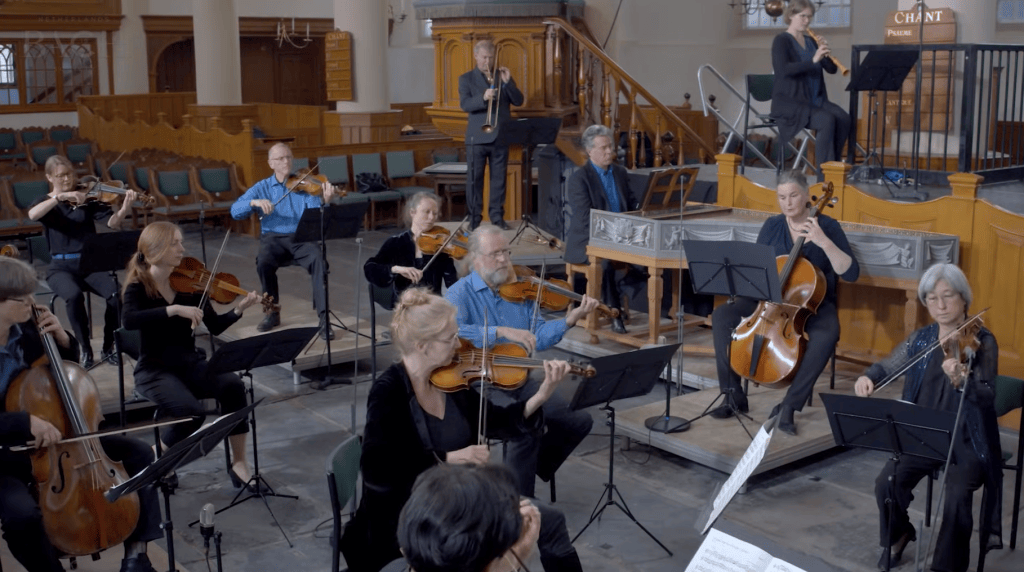
The Netherlands Bach Society in an empty Walloon Church in Amsterdam, May 2021

Other cantatas for this Sunday

Bach wrote Cantata 38 Aus tiefer Not schrei ich zu dir in 1724, as part of his 1724-1725 Chorale Cantata cycle. In my post from 2017 I recommend the Herreweghe/Collegium Vocale Gent recording, in my post from 2020 the Lutz/J.S. Bach Foundation recording. Those articles also include updated links for the score and texts.

For Cantata 188 Ich habe meine Zuversicht from 1728, there’s a lovely video recording by the J.S. Bach Foundation under the direction of Rudolf Lutz, with soprano Guro Hjemli, countertenor Jan Börner, tenor Johannes Kaleschke, and bass Manuel Walser. Find it here. Find the score here, and the German texts with English translations here.

I would love it if you would share this article with a friend!

Not an email subscriber yet? You can sign up below. I won’t use your email address for anything else.

© Wieneke Gorter, October 24, 2026.
It’s Not What You Think – The Kreuzstab Cantata for Trinity 19

10 Saturday Oct 2026

Posted by cantatasonmymind in Cantatas, Leipzig, Leipzig 1726/1727

≈ Leave a comment

Tags

Adolf Theill, Bach, Bach-Archiv Leipzig, BWV 56, cantatas, Christine Blanken, Christoph Birkmann, Collegium Vocale Gent, Daniel R. Melamed, Il Gardellino, Kreuzstab, Marcel Ponseele, Michael Marissen, Peter Kooij, Philippe Herreweghe, Trinity 19

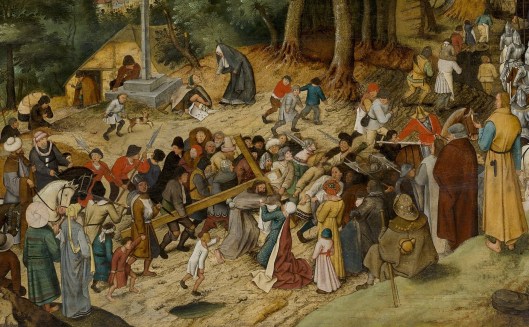
Detail of Pieter Brueghel II’s Landschap met Kruisdraging (Landscape with Christ Carrying the Cross) from around 1605. Oil on oak wood. Bonnefantenmuseum, Maastricht, the Netherlands. Click here to see the entire painting and its eventful history in the 1940s.

What do you think of when you hear the text of the solo cantata for bass “Ich will den Kreuzstab gerne tragen”? My mental image was similar to the painting above, but this week, that got turned on its head when I read research published in 2015. However, my favorite recording is still the same! My love for this particular performance is older than my marriage!

Peter Kooij, image taken from a video by the Netherlands Bach Society.

That favorite recording of Cantata 56 Ich will den Kreuzstab gerne tragen is the one by Herreweghe with Peter Kooij and Marcel Ponseele, from 1991. Not this same piece by Peter Kooij with other conductors or orchestras, only Herreweghe. Because for me, it’s the combination that makes the magic. Peter Kooij’s musicality, voice, and text-awareness is always there, but under Herreweghe’s direction the music flows and every musical line takes you to a point far beyond the note that’s currently in your ears.

Marcel Ponseele

And then there’s Marcel Ponseele’s oboe playing. I know no other recording where the oboe and the voice dance so beautifully together in the third movement “Endlich, endlich wird mein Joch” (Finally, finally will my yoke). Kooij and Ponseele were both with Herreweghe for decades, but Kooij, 72, has retired from touring, and Ponseele, 69, has recently left Herreweghe’s ensembles to focus more on his own projects. (see my previous post for an example of the fabulous productions he creates with his ensemble Il Gardellino).

The score of Cantata 56 Ich will den Kreuzstab gerne tragen can be found here. The German text with a thorough and thoughtful English translation by Michael Marissen & Daniel R. Melamed can be found here. In their translation, Kreuzstab is correctly translated as cross staff, such as a Bishop’s staff, or even a medieval navigation device as pictured at the very bottom of this post (more about that later!). But in about half of the English translations out there, it is translated as cross beam.

Wy did I also have that image of the cross beam in my head, instead of a cross staff? For me, that has to do with the word “Joch” (yoke) in the third movement, but also with Bach’s St. Matthew Passion. As a Dutch choral singer, I know the St. Matthew Passion libretto from memory, and thus, for me, that text always comes to mind first. Concert programs also sometimes feature the “Komm, süsses Kreuz” (Come, sweet cross) bass aria from the St. Matthew Passion together with this Kreuzstab cantata.

In the St. Matthew Passion, leading up to that “Kom, süsses Kreuz” aria, the Evangelist sings the Gospel text from Matthew:

Und da sie ihn verspottet hatten, zogen sie ihm den Mantel aus und zogen ihm seine Kleider an und führeten ihn hin, dass sie ihn kreuzigten. Und indem sie hinausgingen, funden sie einen Menschen von Kyrene mit Namen Simon; den zwungen sie, dass er ihm sein Kreuz trug.

And when they [the Roman soldiers] had ridiculed him, they took the cloak off him and put his own clothing on him, and led him forth, so that they might crucify him. And as they were going out, they found a man from Cyrene named Simon; they forced him to carry Jesus’ cross for him.

Thus, that image of literally carrying Jesus’ wooden cross is a vivid one. Then, in the “Komm, süsses Kreuz” aria, Bach’s librettist, in his 18th-century reflection on the Gospel text, makes the connection to suffering, metaphorically bearing a cross.

Komm, süsses Kreuz, so will ich sagen,
Mein Jesu, gib es immer her!
Wird mir mein Leiden einst zu schwer,
So hilfst du mir es wieder tragen.

Come, sweet cross, so I will say,
My Jesus, ever give it here [for me to bear]!
If someday my suffering becomes too heavy for me,
Then you will help me bear it [the cross] again.

But this Kreuzstab Cantata 156 is only partly about that. Foremost, the text talks about finding a way through one’s life, letting God lead the way, and finding a safe harbor, using a wealth of metaphors from marine navigation. See for example the analogy in the second movement “Mein Wandel auf der Welt ist einer Schiffahrt gleich: Betrübnis, Kreuz und Not sind Wellen, welche mich bedecken und auf den Tod mich täglich schrecken” (My course of life in the world is like a ship voyage: distress, cross-bearing, and hardship are waves that cover me and daily scare me) and these words in the closing chorale: “Löse meines Schiffleins Ruder, bringe mich an sichern Port!” (Free the rudder of my little ship, bring me to safe harbor). So in that sense, the image of a cross staff is more appropriate than that of “the” wooden Cross.

I didn’t come up with this myself of course. Already in 1985, Gustav Adolf Theill explained that the cross-staff was a nautical device used to determine distances and positional coordinates. It would take until the 1730s for this to be replaced by the sextant. Theill linked the description of a cross-staff with Bach’s succession of notes in the bass motif (Ich – will – den – Kreuz – stab) of the first movement.

Dr. Christine Blanken

Thirty years later, in 2015, Dr. Christine Blanken of Bach-Archiv Leipzig presented more evidence. She had discovered that Bach’s student Christoph Birkmann was most likely the librettist of this and other solo cantatas from the fall and winter of 1726. In addition, she showed that only two months before Bach’s performance of this cantata, Birkmann, also a mathematician and physicist, had given an academic presentation about trigonometrical calculations requiring the use of cross staffs such as pictured at the bottom of this post.

So, while Bach might have had both Jesus’ wooden cross and a cross staff in mind, his librettist was definitely thinking of the latter.

Read more about all of this in Dr. Christine Blanken’s article from 2015.

To everyone who recently started following me here on WordPress or on Instagram @weeklycantata , welcome and thank you for being part of my Bach family! Please feel free to share this article with a friend.

Not an email subscriber yet? Sign up below! I won’t use your email address for anything else.

© Wieneke Gorter, October 10, 2026.

Frontispiece to the Introductio geographica, by Petrus Apianus, 1532. The illustration depicts the use of a cross-staff, or Jacob’s staff, to measure angles. The instrument was used in astronomy, navigation, and surveying.

Recent Posts

  • The End of Times and Christmas Combined – Cantata 116 for Trinity 25
  • From the Archives, with a New Recording – Cantatas 60 and 26 for Trinity 24
  • A Controversy and a Coin Collection – Cantata 163 for Trinity 23
  • Giving the Choir a Breather? – Cantata 89 for Trinity 22
  • Remember Those Covid-Era Concerts Without Audiences? – Cantatas 98 and 109 for Trinity 21

Archives

  • November 2026
  • October 2026
  • September 2026
  • August 2026
  • August 2025
  • July 2025
  • December 2024
  • November 2024
  • June 2024
  • January 2024
  • December 2023
  • October 2023
  • September 2023
  • August 2023
  • April 2022
  • February 2022
  • January 2022
  • December 2021
  • November 2021
  • June 2021
  • May 2021
  • April 2021
  • February 2021
  • January 2021
  • December 2020
  • November 2020
  • October 2020
  • September 2020
  • August 2020
  • July 2020
  • May 2020
  • April 2020
  • March 2020
  • February 2020
  • January 2020
  • December 2019
  • November 2019
  • May 2018
  • April 2018
  • March 2018
  • February 2018
  • January 2018
  • December 2017
  • November 2017
  • October 2017
  • September 2017
  • August 2017
  • July 2017
  • June 2017
  • May 2017
  • April 2017
  • March 2017
  • February 2017
  • January 2017
  • December 2016
  • November 2016
  • October 2016
  • September 2016
  • August 2016
  • July 2016
  • June 2016
  • May 2016
  • April 2016
  • March 2016
  • February 2016
  • January 2016

Enter your email address to follow this blog and receive notifications of new posts by email.

Join 338 other subscribers

Categories

  • 1723 Trinity season special series
  • Advent
  • After Easter
  • Ascension
  • Bach's life
  • Cantatas
  • Chorale cantatas 1724/1725
  • Christmas
  • Easter
  • Epiphany
  • Following Bach in 1725
  • Köthen
  • Leipzig
  • Leipzig 1726/1727
  • Septuagesima
  • Travel
  • Trinity
  • Weimar

Meta

  • Create account
  • Log in
  • Entries feed
  • Comments feed
  • WordPress.com

Website Built with WordPress.com.

  • Subscribe Subscribed
    Weekly Cantata
    Join 158 other subscribers

    Have a WordPress.com account? Log in now.

  • Weekly Cantata
    View site in Reader
    Manage subscriptionsSign upLog in
    Report this content
    Collapse this bar
Loading Comments...