Weekly Cantata

Weekly Cantata

Tag Archives: Jan Kobow

Bach Cantatas for Christmas – 1724 and 1734 editions

23 Monday Dec 2024

Posted by cantatasonmymind in Cantatas, Chorale cantatas 1724/1725, Christmas, Epiphany, Leipzig

≈ 4 Comments

Tags

Alex Potter, Antonia Frey, baroque-music, Bart Aerbeydt, Bernhard Bechtold, Carine Tinney, Charles Daniels, Christmas, Christmas Oratorio, Collegium Vocale Gent, Concerto Copenhagen, Daniel Johannsen, Eric Milnes, Florian Sievers, Harry van der Kamp, J.S. Bach Foundation, J.S. Bach Stiftung, Jan Kobow, Julia Doyle, Lars Ulrik Mortensen, Lucia Giraudo, Margot Oitzinger, Maria Keohane, Mark Padmore, Matthew Brook, Matthew White, Milo Maestri, Monika Mauch, Montreal Baroque, Netherlands Bach Society, Peter Kooij, Philippe Herreweghe, Rodrigo Lopez-Paz, Rudolf Lutz, Sarah Connolly, Stephan MacLeod, Tomáš Král, Vasiljka Jezovsek

Merry Christmas! Below are my recommendations for recordings of Bach’s chorale cantatas for the Christmas season, written in 1724/1725, as well as a link to the video of this year’s wonderful live performance by the Netherlands Bach Society of Bach’s Christmas Oratorio, written in 1734/1735. Before I get to that, I wanted to share a personal story. (If you want to “jump to the recipe,” just scroll down three paragraphs to the next header).

As regular readers of this blog know, Christmas morning for me = “Jauchtzet, frohlocket,” the first entrance of Bach’s Christmas Oratorio*. But ten days ago, during the first-ever Christmas Oratorio concert of my life as a chorus member, I couldn’t sing those words.

I had unwittingly set myself up for it, because I had just done two things to remember my late mother. It was very cold in the church, and I had lent one of my mother’s scarves to a friend who was singing next to me. As we were getting on stage, I told her: “this scarf has been in many a Bach concert, because my mother used to sing in a Bach choir too.” And then I showed her how I had copied my mother’s signature from her old piano reduction to the new one I was using now.

So while I had been completely fine during all the rehearsals, now with the audience there and those memories, the first notes of the timpani made me choke up. Fortunately, that first soprano entrance is low and doubled by many other voices, so nobody noticed. And I was fine for the rest of the concert, and thoroughly enjoyed getting to sing cantatas 1, 2, 5, and 6 of Bach’s Christmas Oratorio with a good orchestra and great soloists.

Do you have special memories associated with Bach’s or other Christmas music? Please let me know in the comments. Here are my recommendations for recordings:

Christmas Cantatas from Bach’s Chorale Cantata cycle, 1724/1725

Christmas Day: Cantata 91 Gelobet seist du, Jesu Christ by the J.S. Bach Foundation/Rudolf Lutz, with Monika Mauch – Soprano; Margot Oitzinger – Alto; Bernhard Berchtold – Tenor; and Peter Kooji – Bass. Find the score here, and English translations here.

Second Christmas Day: Cantata 121 Christum wir sollen loben schon by Concerto Copenhagen/Lars Ulrik Mortensen, with Maria Keohane – Soprano; Alex Potter – Alto; Jan Kobow – Tenor; and Matthew Brook – Bass. Find the score here, and English translations here.

Third Christmas Day: Cantata 133 Ich freue mich in dir by Concerto Copenhagen/Lars Ulrik Mortensen, with Maria Keohane – Soprano; Alex Potter – Alto; Jan Kobow – Tenor; and Matthew Brook – Bass. Find the score here, and the English translations here.

Maria Keohane

Sunday after Christmas: Cantata 122 Das neugeborene Kindelein by Collegium Vocale Gent/Philippe Herreweghe, with Vasiljka Jezovsek – Soprano; Sarah Connolly – Alto; Mark Padmore – Tenor; and Peter Kooij – Bass. Find the score here, and the English translations here.

New Year’s Day: Cantata 41 Jesu nun sei gepreiset by the J.S. Bach Foundation/Rudolf Lutz, with Julia Doyle – Soprano; Antonia Frey – Alto; Florian Sievers – Tenor; and Stephan MacLeod – Bass. Find the score here, and the English translations here.

Jan 6, Epiphany: Cantata 123 Liebster Immanuel, Herzog der Frommen by Montréal Baroque/Eric Milnes, with Matthew White, alto; Charles Daniels, tenor; and Harry van der Kamp, bass. Find the score here, and the English translations here.

From Bach’s Christmas Oratorio, 1734/1735

Bart Aerbeydt and Milo Maestri
Lucia Giraudo
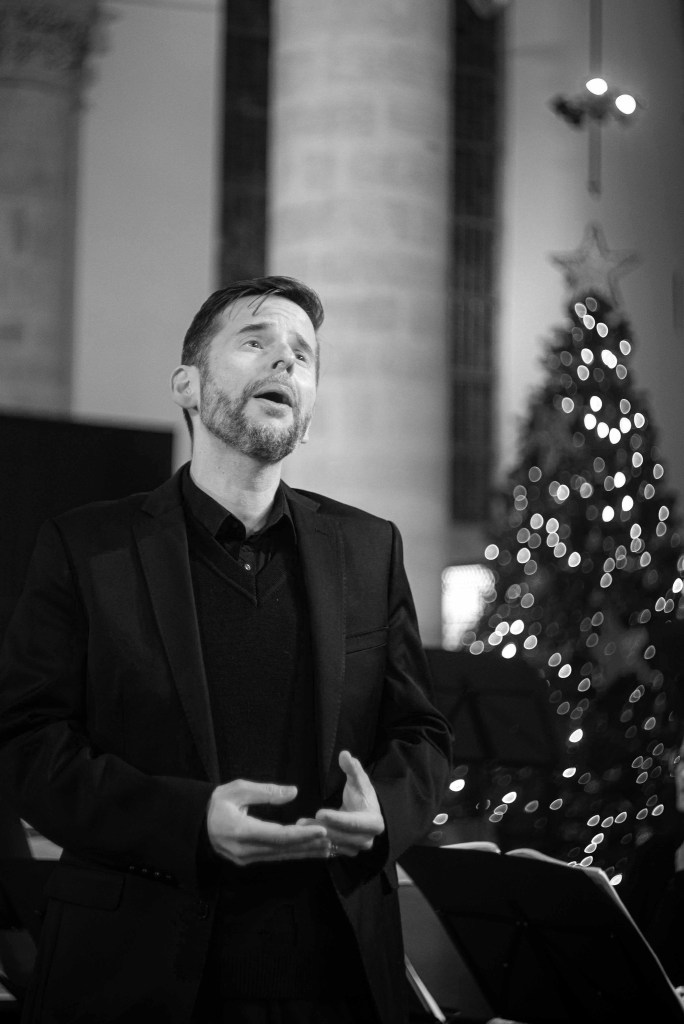
Daniel Johannsen

All photos above by Donald Bentvelsen. Find him on Instagram at @bentvel.

I highly recommend the video of the most recent live performance by the Netherlands Bach Society under the direction of Lars Ulrik Mortensen. They performed cantatas 1, 4, 5, and 6 of Bach’s Christmas Oratorio in the Netherlands earlier this month. I attended the concert in Naarden on December 11, the video below is from the performance in Utrecht, two days later. The choir could have been a bit larger for my personal taste, but for the rest I absolutely loved this performance, with text-focused singing by all soloists, and fabulous and sensitive playing by the instrumentalists, allowing for musical dialogues with the singers. I especially enjoyed the contributions by tenor Daniel Johannsen, oboist Rodrigo Lopez-Paz (photo in my previous post), violinist Lucia Giraudo, and horn players Bart Aerbeydt and Milo Maestri. I very much ejoyed reading the program booklet, especially the the interview with director Lars Ulrik Mortensen.

Read the English program book for this performance here. Read a bit more on the fifth cantata from this same performance in my previous post.

Please consider subscribing to this blog (just click on the button below), it really helps me!

Best wishes for the New Year,

Wieneke Gorter, December 23, 2024.

* if you don’t know the story, please find it here.

First Sunday of Advent 1724: Bach helps commemorate and explain a 200-year-old hymn text

30 Saturday Nov 2024

Posted by cantatasonmymind in Advent, Cantatas, Chorale cantatas 1724/1725, Leipzig

≈ Leave a comment

Tags

Advent 1, Antonia Frey, bachhaus-eisenach, Bachstiftung, baroque-music, Benedikt Kristjánsson, BWV 62, choral-music, erfurter-enchiridion, erfurter-handbuchlein, evangelischer-lieder-commentarius, history, J.S. Bach Foundation, J.S. Bach Stiftung, Jan Kobow, johann-martin-schamel, John Eliot Gardiner, l500b300, Lisa Andres, Lydia Vroegindeweij, martin-luther, Rudolf Lutz

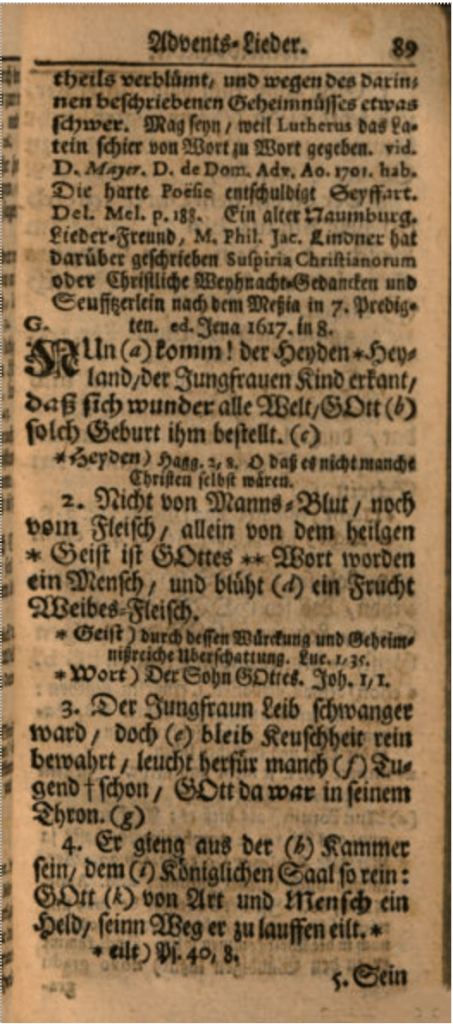
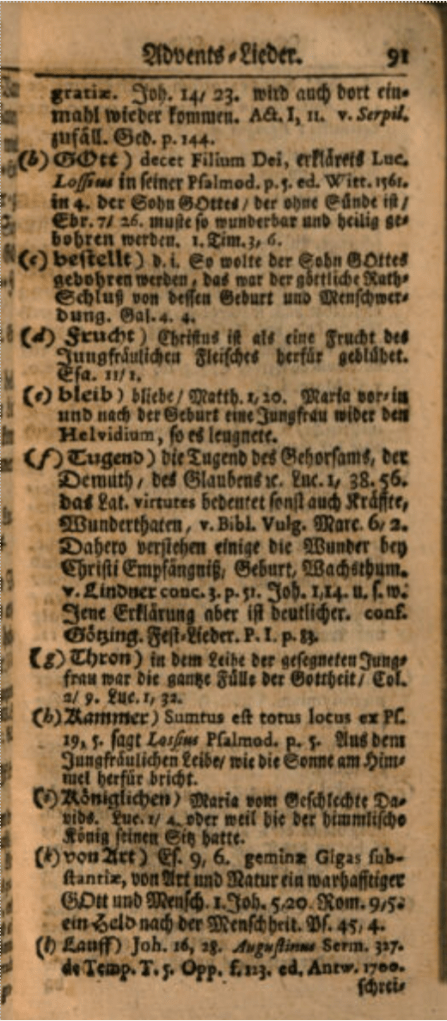
Evangelischer Lieder-Commentarius (Evangelical Hymn Commentary) by Johann Martin Schamel from 1724: an annotated hymnal, published to commemorate the bi-centenary of Luther’s first hymnals. From left to right: the title page; page 89 with the first four verses of Luther’s hymn “Nun komm, der Heiden Heiland,” with lower-case letters and asterisks referring to footnotes; page 91 with the footnotes.

Please open this post in your internet browser (just click on the title at the top) to see the images placed the correct way – thank you!

Today’s cantata – Happy 1st Advent!

Warning: If you don’t feel like reading science journalism, and just came here to listen to a beautiful cantata, I got you: here is Cantata 62 Nun komm, der Heiden Heiland in an excellent new live performance by the J.S. Bach Foundation under the direction of Rudolf Lutz. I especially love the opening chorus as well as the tenor aria, sung from memory by Benedikt Kristjánsson (read more about him in my post about the Bachfest in Leipzig this past summer). Other soloists are Lisa Andres, soprano; Antonia Frey, alto; and Peter Harvey, bass.

Find the German text with English translation here, and the score here.

A special exhibition in Eisenach

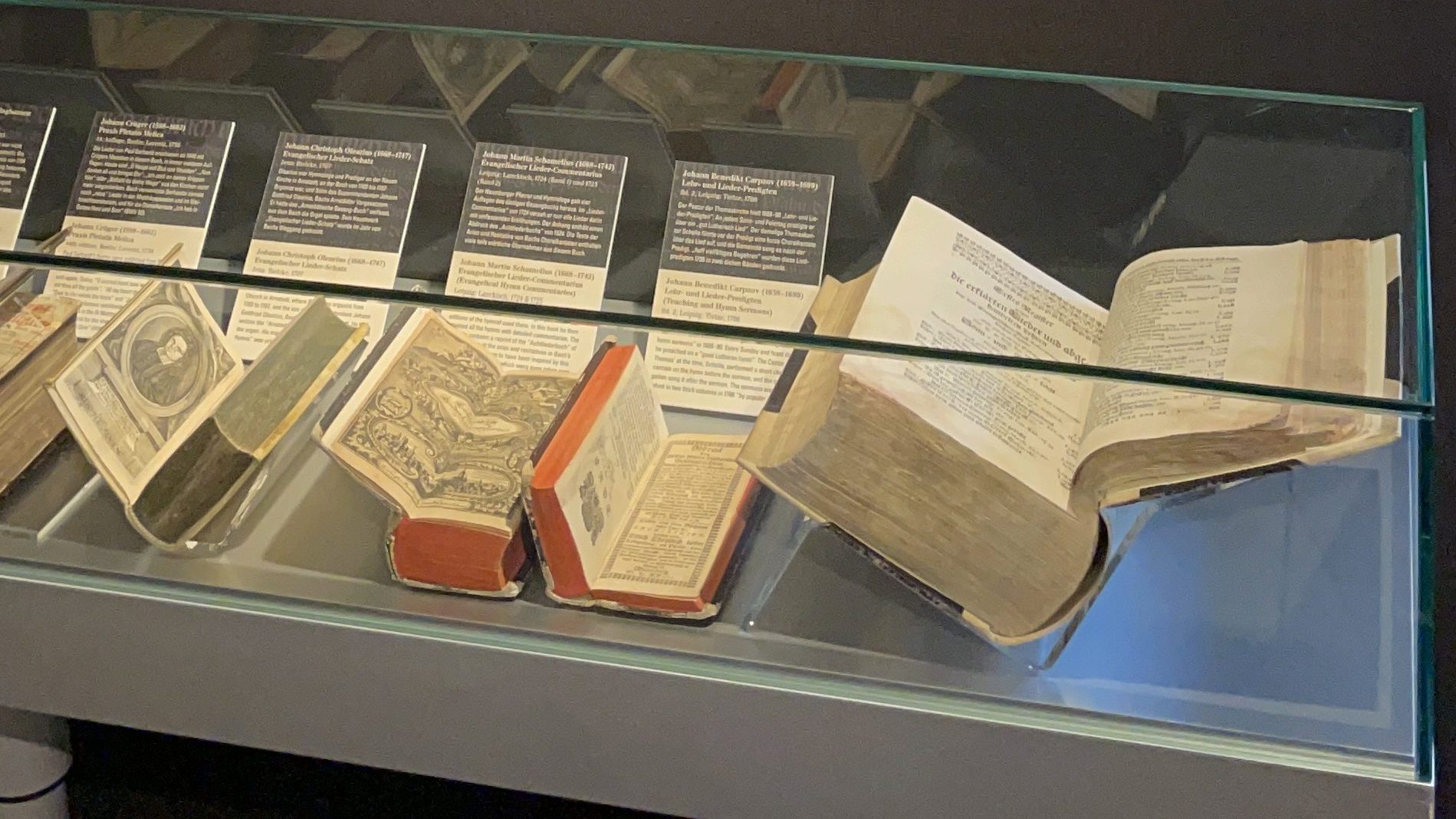
A month ago, I traveled to Eisenach (Bach’s birthplace in Germany) to catch the last days of a special exhibition at the Bachhaus on the double anniversary of Luther’s hymns (500 years) and Bach’s chorale cantatas (300 years) and the connection between the two. I got to see in real life many hymnals that were in use during Bach’s time. What struck me right away was how small and narrow they are! They were truly meant to be held in one hand (so one could leaf through it with the other hand). This is of course exactly what Luther envisioned when he published the very first German-language hymnals in 1524: that churchgoers could read and sing along during the church service, and also easily use the hymnals at home and at school. This photo gives a good idea of their size compared to a larger book:

Luther’s “Nun komm, der Heiden Heiland”

“Nun komm, der Heiden Heiland” in the Erfurter Enchiridion from 1524.

While most of the hymnals were displayed as in the photo above, the two oldest and rarest, on loan from libraries in Regensburg and Strasbourg, were hidden behind thick felt flaps to protect them from the light. One of these, Luther’s Erfurter Enchiridion (Erfurter Handbook) from 1524, lay opened to his Advent hymn “Nun komm, der Heiden Heiland,” the hymn Bach used two hundred years later, for Cantata 62 Nun komm, der Heiden Heiland for the first Sunday of Advent. Luther based this hymn on the then still well-known “Veni redemptor gentium” from the 4th century, closely translating the latin, and only slightly altering the melody.

Publications commemorating the bi-centenary of Luther’s hymnals in 1724 likely influenced Bach

Bach scholars have always wondered why Bach wrote an entire cycle of cantatas based on hymns. Some offer that his first cycle of cantatas (1723/1724) must have been too complicated for his audience (the Leipzig churchgoers) and that Bach, or possibly his employers, thus came up with something extremely familiar (the hymns) as a common thread for the second cycle of cantatas. Others say that the ability of the boy sopranos must have been so bad, judging by letters Bach later wrote to complain about this, that he switched to chorale cantatas so the choir sopranos would only have to sing the well-known chorale melody while the altos, tenors, and basses would sing more complicated parts.

While none, a combination, or part of these hypotheses might be true, recent research by Dutch theologian Dr. Lydia Vroegindeweij provides us with a third theory: Bach was very likely influenced by a strong movement in Lutheran Germany in the first quarter of the 18th century for the preservation and clarification of the original Lutheran hymns. His choice of 1724 as the year to start a cycle of chorale cantatas would thus not have been a coincidence at all, but a way to help commemorate the centenary of Luther’s first hymnals. The most important figures in this movement operated in Bach’s circle of friends and colleagues and of course Bach was a great admirer of Luther, having Luther’s entire oeuvre of writings in his library. So he would have been more than interested to support the efforts to preserve and better explain Luther’s hymns.

Specifically, Lydia makes a strong case that Bach and/or his anonymous librettist must have consulted Johann Martin Schamel’s Evangelischer Lieder-Commentarius (see the caption heading this post) for the recitative and aria texts for several if not all of his chorale cantatas. She has pointed out that many chorale cantata texts correspond to Schamel’s explanations, use the exact same words, or even follow Schamel’s suggestion to combine Luther’s psalm in question with another one (as is the case in Cantata 38, read more here).

As Lydia explains in a podcast she now has on a Dutch radio station, Luther’s hymn “Nun komm, der Heiden Heiland” especially needed clarification, because in an effort to make the text rhyme and stay as close as possible to the original “Veni redemptor gentium,” Luther had made the text so compact that it had puzzled many hymnologists and clergy.

How does Bach illustrate Schamel’s explanations of this particular hymn?

In the first stanza (the literal text of the opening chorus), Schamel puts (a) after the word “Nun” (now) and explains [freely translated]: “As if it meant: Oh come now, you promised! Instead, it is the poetic style, and is not meant as if the Savior had yet to come into the world. But he comes to believers daily, again and again, each time as a new step of grace.” This concept of “again and again” and the “steps” are clearly present in the music of the opening chorus of Cantata 62.

Lydia says: “Schamel substantiates this with a reference to John 14:23. This corresponds with Luther’s own explanation of this verse in the Calov Bible [which Bach was also familiar with, and added to his own library in 1733]. There Luther also talks about daily contact, and about Jesus who would like to live with people in their houses and share a meal with them.”

The emphasis in this cantata is placed more on the sacred miracle of the human birth and less on the “coming”. This “Wunder” (miracle/wonder) is even more celebrated in the tenor aria. Lydia says: “The aria emphasizes that God encompasses the whole world with that kind of miracle and that we can only admire that grace.”

And the prize for the best interpretation of the tenor aria goes to …

When two years ago Lydia and I searched for the best interpretation of the tenor aria, i.e. the one that really emphasizes the “wonder,” our prize went to Jan Kobow on the Gardiner recording from 2000. Listen to it here. Kobow does a beautiful job expressing the wonder, not only in the first phrase, but also in the B-section when he sings “o, Wunder”. He also makes a striking contrast between those wondrous and quiet-making aspects of the miracle and the stronger, more convinced text of “Herrscher.”

However, now that I’ve heard and seen Benedikt Kristjánsson sing on the recording with the J.S. Bach Foundation, his singing strikes me as the perfect illustration of “God encompasses the whole world with that kind of mystery.”

Further reading

If you would like to do your own reading and interpreting of Schamel’s commentary, you can find it here (in German). If you would like to subscribe to Lydia’s newsletter, you can do so here. Also, please don’t forget to subscribe to my blog – just fill in your email address here below, and you will receive an email every time I post a new story. Thank you!

Wieneke Gorter, November 30, 2024.

About Weekly Cantata

I am a bilingual writer, publicist, choral singer, art and nature lover, foodie, happy wife, and blessed mother of two. I started this blog in 2016, inspired by my late mother’s love for Bach’s cantatas. After 23 years in the San Francisco Bay Area, I’m now back in the Netherlands.

If you are on social media, please follow me:

  • Facebook
  • Instagram

Please subscribe!

Please subscribe to this blog! Simply fill in your email address and you’ll receive an email every time I’ve published a new post. Thank you!

Memorable for at least 47 days. Leave it to Alex Potter.

22 Saturday Feb 2020

Posted by cantatasonmymind in Cantatas, Leipzig

≈ 1 Comment

Tags

Alex Potter, bwv 127, BWV 159, BWV 22, BWV 23, Dorothee Mields, Estomihi, Jan Kobow, Matthew White, Miriam Feuersinger, Netherlands Bach Society, Peter Kooij, Philippe Herreweghe, Stephan MacLeod, Thomas Hobbs

Between Estomihi Sunday (or the last Sunday before Lent) and Good Friday, there were 47 days in 1729. During that entire time the Leipzig congregations would hear no music in the churches, except for chorales. So Bach’s last music had to be as memorable as possible, had to give them hope, and ideally also prepare them for the St. Matthew Passion they would get to hear on Good Friday.

Bach successfully checked all these boxes with Cantata 159 Sehet! wir gehn hinauf gen Jerusalem. And leave it to alto Alex Potter to bring all this out in a performance. Opera-like drama, heart-breaking emotion, the promise of hope and redemption, it is all there in his singing, and in that voice with the beautiful variety of colors.

Listen to / watch the performance by the Netherlands Bach Society here on YouTube. Soprano: Miriam Feuersinger; Alto: Alex Potter; Tenor: Thomas Hobbs; Bass: Stephan MacLeod. Read some comments by Alex Potter on this cantata here on the AllofBach website.

Find the German texts with English translations here, and the score here.

The Herreweghe recording deserves a mention here too. Dorothee Mields’ singing in the duet with Matthew White is very moving, and Peter Kooij’s interpretation of the bass aria “Es ist vollbracht” on this recording is unrivaled. Find that recording here on YouTube, but better yet, support the artists and purchase the entire album Jesu, deine Passion here on Amazon or here on iTunes. It contains all four cantatas Bach wrote for this Sunday, and they are all excellent. Read more about Cantatas 127, 22, and 23 in my blogpost from 2018 here.

Wieneke Gorter, February 22, 2020, updated February 13, 2021.

Pelting rain, growing crops, it is the low instruments that do it

16 Sunday Feb 2020

Posted by cantatasonmymind in Cantatas, Weimar

≈ Leave a comment

Tags

2nd Sunday before Lent, Ageet Zweistra, American Bach Soloists, Andrew Schwartz, Anthony Martin, Armelle Plantier, Benjamin Butterfield, BWV 18, Dominik Wörner, four violas, François Fernandez, Francis Jacob, Gaëlle Lecoq, Gaëlle Volet, George Thomson, Iris Finkbeiner, J.S. Bach Foundation, James Weaver, Jan Kobow, Jeffrey Thomas, Joanna Bilger, John Butt, Josep Borras I Rocca, Julianne Baird, Kaori Uemura, Katharine Fuge, Kees Boeke, Lisa Grodin, litany, Luis Otavio Santos, Makoto Sakurada, Martina Bischof, Maya Amrein, Michael Eagan, Michele Zeoll, Neue Bach Ausgabe, Nikolaus Broda, Norbert Zeilberger, Nuria Rial, Philippe Pierlot, rain, Renate Steinmann, Rudolf Lutz, Sally Butt, Sexagesima, snow, Stephan MacLeod, Susanna Hefti, viola, Warren Stewart, Weimar

Finally I get to write about Cantata 18 Gleichwie der Regen und Schnee vom Himmel fällt (“the same way rain and snow falls from heaven”), which Bach wrote for this Sunday (Sexagesima, or the 2nd Sunday before Lent) in Weimar in 1713 or 1714. I don’t remember this cantata from my childhood, but have been impressed with it since I purchased the American Bach Soloists’ CD in 2010.

Find the German text with English translations here, and the NBA score here (Neue Bach Ausgabe score, based on the original Weimar score, the same one used by the American Bach Soloists, without recorders in the orchestra).

There is so much happening in this cantata that I could write two or three blog posts about it. To start, I’d like to share three recordings that stand out to me.

My first love of this Cantata 18, the American Bach Soloists’ recording from 1994, can be found here on Spotify. Or purchase the CD or MP3 on Amazon USA, or on Amazon DE, or on iTunes. Soloists are: Julianne Baird, soprano; Benjamin Butterfield, tenor; James Weaver, bass. Violas: Anthony Marin, Lisa Grodin, Sally Butt, George Thomson; Violoncello: Warren Stewart; Bassoon: Andrew Schwartz; Archlute: Michael Eagan; Organ: John Butt.

Director Jeffrey Thomas chooses a slower tempo for the opening sinfonia than most others, which I like. It makes the music more dramatic, and it allows the instrumentalists to paint a truly cold, wintry rain, completely appropriate for this time of year in Germany. The sound of the four violas together is wonderful throughout, and I love Julianne Baird’s singing of Luther’s “litany” in the third movement.

The next two recordings use a later* version of the score, with the addition of recorders in the orchestra.

I highly recommend the recording by Ricercar Consort from 2004, available here on YouTube. With: Katharine Fuge (Soprano); Jan Kobow (Tenor); Stephan MacLeod (Bass); François Fernandez (Viola); Luis Otavio Santos (Viola); Philippe Pierlot (Viola da gamba); Kaori Uemura (Viola da gamba); Ageet Zweistra (Violoncello); Kees Boeke (Recorder); Gaëlle Lecoq (Recorder); Josep Borras I Rocca (Bassoon); Michele Zeoll (Double-bass); Francis Jacob (Organ).

What I like about this recording: the orchestration with two violas and two viola da gambas instead of four violas. The bass instruments do an absolutely fabulous and unrivaled job of bringing out Bach’s illustration of the text “und macht sie fruchtbar und wachsend” (and make it fruitful and fertile) in the second movement. You can truly hear plants growing and blossoming there. And bass Stephan MacLeod, whose singing I usually appreciate much more in Renaissance music than in Bach, is superb in that second movement. His voice is a beautiful “Voice of God” in the text from Isaiah 55: 10-12.

Final recommendation, for now: the live video recording by the J.S. Bach Foundation from 2009, available here on YouTube. With: Núria Rial, soprano; Makoto Sakurada; tenor; Dominik Wörner, bass; Recorders: Armelle Plantier, Gaëlle Volet; Bassoon: Nikolaus Broda; Violas: Susanna Hefti, Renate Steinmann, Martina Bischof, Joanna Bilger; Violoncello: Maya Amrein; Violone: Iris Finkbeiner; Organ: Norbert Zeilberger

What I enjoy most about this recording is Nuria Rial’s singing of the soprano aria (the fourth movement). The aria is incredibly difficult, but, as always, she makes it seem effortless, and her “Fort mit allen, fort, nur fort!” is the best of all recordings I have listened to. I also enjoy the choir sopranos’ singing of the “litany” in the third movement, and the mere fact that you can watch everyone make music, since this is a live video recording.

If you would like to read about another cantata for this Sunday, find my post about Cantata 126 here. Bach wrote that cantata also for Sexagesima Sunday, in 1725.

Wieneke Gorter, February 16, 2020.

*from 1724 in Leipzig, when Bach performed this cantata again.

Two Weimar cantatas for the fourth Sunday of Advent

21 Saturday Dec 2019

Posted by cantatasonmymind in Advent, Bach's life, Cantatas, Christmas, Leipzig, Weimar

≈ Leave a comment

Tags

Advent, Advent 4, Alfredo Bernardini, All of Bach, Bachvereniging, BWV 132, BWV 147, BWV 147a, Christmas, Dominik Wörner, Hana Blazikova, J.S. Bach Foundation, J.S. Bach Stiftung, Jakob Pilgram, Jan Kobow, Julia Doyle, Margot Oitzinger, Netherlands Bach Society, Rudolf Lutz, Tim Mead, Weimar, Wolf Matthias Friedrich

For the fourth Sunday of Advent, Bach wrote two cantatas in Weimar: Cantata 132 Bereitet die Wege, bereitet die Bahn in 1715, and Cantata 147a Herz und Mund und Tat und Leben in 1716.

Bach rewrote Cantata 147, the same way he did that with cantatas 70 and 186, into a cantata for another time of the year in Leipzig, in this case the feast of the Visitation on July 2, 1723. Read more about that here in my post from 2016. I have now updated that post with a link to the wonderful live performance of Cantata 147 by the J.S. Bach Foundation, with with Hana Blažiková, soprano; Margot Oitzinger, alto; Jakob Pilgram, tenor; and Wolf Matthias Friedrich, bass.

Cantata 132 was not transformed into a cantata for another time in the church year in Leipzig, so today’s performances of this cantata still reflect the Advent cantata from Weimar. Watch a beautiful live performance of this cantata by the Netherlands Bach Society here on YouTube. Soloists are Julia Doyle, soprano; Tim Mead, alto; Jan Kobow, tenor; and Dominik Wörner, bass.

Find the German text with English translations here, and the score here.

As I already pointed out in my Advent Calendar earlier this week, the text of the joyful opening aria refers to the story of John the Baptist, who was believed to have come to prepare the way for Jesus, and includes the Isaiah quote as it appears in the scripture: “Messias kömmt an!” (The Messiah is coming). Bach gives this text to the soprano three times, and to give it extra emphasis, each time omits all instrumental accompaniment on those three words.

The rest of the cantata stays close to the story of John the Baptist. The bass aria refers to the Pharisees interrogating John, but then Bach’s text writer (Salomo Franck, who was also the Weimar court librarian) projects the question “Wer bist du?” (Who are you?) onto the believer: ask your conscience: are you a true person or a false person?

As a child, I was enormously impressed by this bass aria, even more than by the wonderful soprano aria at the beginning of the piece. I loved how Max van Egmond sings the “Wer bist du?” text on the Leonhardt recording from 1983. You can find that recording, and read more about those childhood memories, in this blog post from 2016. I had no idea at the time that in those very cool opening notes Bach is quoting this organ piece by Buxtehude. I only learned that this week, by watching the “extra videos” the Netherlands Bach Society provides along with their live recordings on All of Bach.

If you are not following this blog yet, please consider signing up (on the left of this text if you are on a desktop computer, at the bottom of this post when you are reading on a smartphone). This way you won’t miss any posts about the many cantatas Bach wrote for all three Christmas Days (yes there were three in his time), New Year’s Day, and the Sundays after those feast days.

Wieneke Gorter, December 21, 2019.

Bach’s “most beautiful cantata” connected to a dear memory

11 Sunday Feb 2018

Posted by cantatasonmymind in Bach's life, Cantatas, Chorale cantatas 1724/1725, Leipzig

≈ Leave a comment

Tags

bwv 127, Caroline Stam, Collegium Vocale Gent, Dorothee Mields, Eduard van Hengel, Estomihi, Jan Kobow, Peter Kooij, Philippe Herreweghe, St. Matthew Passion

kloosterkerk
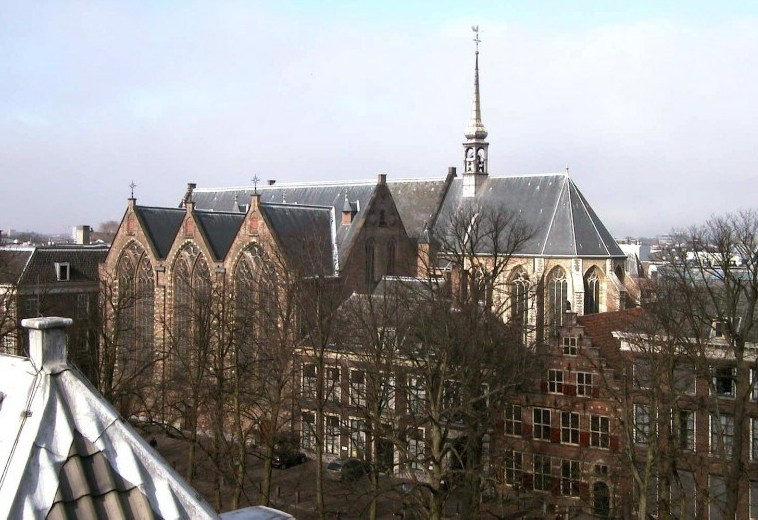
Kloosterkerk, The Hague, The Netherlands, where Caroline Stam sang the aria from Cantata 127 during my mother’s funeral service in 2010. This church is also the site of the monthly cantata services performed by the Residentie Bach Ensembles.

What are your five favorite cantatas? This question was asked this week on Facebook by the Residentie Bach Ensembles, the choirs and orchestra of the monthly cantata services in the Kloosterkerk in The Hague, the Netherlands. A hard question to answer, and I would probably have a different Top Five every month. However, Cantata 127 Herr Jesu Christ, wahr’ Mensch und Gott, today’s cantata from 1725, will probably always be in it. The soprano aria from this cantata is forever linked in my heart and mind with the funeral service for my mother in this same Kloosterkerk in The Hague (read a bit more about that in this post), but having carefully listened to about 120 cantatas over the past two years I am struck by how special this cantata is within Bach’s oeuvre.

I’m not alone in my appreciation of Cantata 127 Herr Jesu Christ, wahr’ Mensch und Gott. Eduard van Hengel calls it an “exceptionally inspired cantata,” 19th century Bach biographer Spitta called it “perhaps the most important” cantata, and it received “the most beautiful” qualification by Arnold Schering as well as Ton Koopman.  

My favorite recording of this cantata is now [update from 2021] Herreweghe’s live recording from January 31, 2021. Find it here on YouTube.

Find the text of Cantata 127 here, and the score here.

There are several reasons why this last Sunday before Lent, or Quinquagesima Sunday or Estomihi Sunday, was such an important day for Bach, and maybe especially in 1725:

  1. This was the day, in 1723, on which he had auditioned for his job in Leipzig, with Cantatas 22 and 23, his first performance ever for the Leipzig congregation and city council. In 1724 he would repeat the same cantatas on this same Sunday.
  2. After this Sunday, his audience (=the Leipzig congregations of the St. Thomas and St. Nicholas churches) would not hear any of Bach’s music until March 25, on the feast of the Annunciation of Mary. No figural music (only chorale singing) was allowed in the Lutheran churches in Leipzig during Lent (the approximately 40 days before Easter), with the exception of the Annunciation. In 1724 this period was 33 days, but in 1725 it was 41 days (from February 11 to March 25). So Bach might have wished to leave his audience with something special, something they would remember for 41 days.
  3. If it is true that Andreas Stübel had been Bach’s librettist for his entire chorale cantata cycle, Bach would have now known that this was the last regular chorale cantata of the cycle for now: Stübel died on January 31, 1725. So perhaps Bach wanted to “go out with a bang” for that reason. It is striking to me that he chooses a bass recitative/arioso with trumpet talking about the Day of Judgement, a similar combination of voice, instrument, and subject matter he uses at the end of the Trinity period in 1723, and again (though less dramatically) at the end of the Trinity period in 1724. Is this Bach’s way of saying: this is the end of an important series?

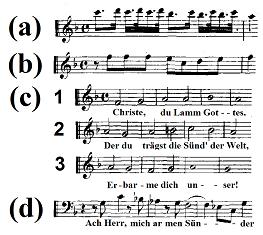
Compared to all opening choruses that had come before, this opening chorus is the most complex and intricate. It is the same as chorale fantasias in previous chorale cantatas in the sense that the six lines of text of the chorale Herr Jesu Christ, wahr’ Mensch und Gott appear in six sections, with the chorale melody (the cantus firmus) in the soprano and trumpet part.  However the orchestra greatly enhances the meaning of Bach’s message by referring to this chorale plus two others. The instrumental groups (recorders, oboes, strings, and continuo) represent four musical themes referring to these chorales. Eduard van Hengel illustrates this extremely well with two diagrams on his website, which I am copying here with his permission:

127-VHengel

(a) The recorders play a dotted rhythm which in both the St. John and St. Matthew Passions illustrates punishment and suffering.
(b) The oboes introduce the “Leitmotiv” that will sound 78 times throughout the entire movement, and stands for the Herr Jesu Christ, wahr Mensch und Gott chorale. Jesus was a true (“wahr”) man and God. Probably Bach’s most important message here.
(c) The strings quote the chorale Christe, du Lamm Gottes, or Luther’s Agnus Dei. It would show up again in the opening chorus of the St. Matthew Passion, which Bach might already have been working on around this time, see my post about Cantata 125 last week.
(d) In the continuo we hear six times the first seven notes of Ach Herr mich armen Sünder, nowadays better known as O Haupt voll Blut und Wunden, one of the main building stones of the St. Matthew Passion. In the seventh section of the opening chorus, when the sopranos are already done singing the chorale melody, Bach repeats this particular theme in the vocal bass line in the choir, as if to make sure that even those who might have missed the quotation earlier would now hear it loud and clear.

Van Hengel adds this extra diagram to show in which measures of the opening chorus the different themes appear:

127-schemaVHengel

At this point Bach might still have been planning to prepare his audiences for a first St. Matthew Passion, not abandoning that plan until much closer to March 30, Good Friday, 1725. Not only are the references in this opening chorus a striking example of that, but also in the extraordinary bass recitative/aria do we see the theme of the Sind Blitze, sind Donner chorus from the St. Matthew Passion appear on the text “Ich breche mit starker und helfender Hand.”

Regular followers of this blog will notice that Bach had been making a study for this bass recitative/aria in the previous three cantatas: combining lines of the chorale text with “free” text in the bass solo of Cantatas 92 and 125, and then using Sind Blitze, sind Donner material and trumpet accompaniment in the bass solo in Cantata 126.

Wieneke Gorter, February 10, 2018, updated February 22, 2020 and February 13, 2021.

* Herreweghe’s album “Jesu, deine Passion” features cantatas 22, 23, 127, and 159. Cantata 23 has exceptionally beautiful choruses and Cantata 22 represents the first introduction of Bach’s version of the “Vox Christi”(voice of Christ) to the Leipzig congregations, considered by some as an intentional preparation for the listeners of what would be to come in the Passions. Cantata 159 on this album is fantastic too, with an unrivaled interpretation by Peter Kooij of the fourth movement, the bass aria “Es ist vollbracht.”

Recent Posts

  • “Missa Miniatura” by CONTINUUM/Elina Albach Even More Moving in 2025
  • Bachfest Leipzig 2025
  • Bach Cantatas for Christmas – 1724 and 1734 editions
  • Fourth Sunday of Advent – more insight into Cantata 62 helped me better understand Bach’s Christmas Oratorio
  • Saint Ambrose and Luther in Milan – Second Sunday of Advent

Archives

  • August 2025
  • July 2025
  • December 2024
  • November 2024
  • June 2024
  • January 2024
  • December 2023
  • October 2023
  • September 2023
  • August 2023
  • April 2022
  • February 2022
  • January 2022
  • December 2021
  • November 2021
  • June 2021
  • May 2021
  • April 2021
  • February 2021
  • January 2021
  • December 2020
  • November 2020
  • October 2020
  • September 2020
  • August 2020
  • July 2020
  • May 2020
  • April 2020
  • March 2020
  • February 2020
  • January 2020
  • December 2019
  • November 2019
  • May 2018
  • April 2018
  • March 2018
  • February 2018
  • January 2018
  • December 2017
  • November 2017
  • October 2017
  • September 2017
  • August 2017
  • July 2017
  • June 2017
  • May 2017
  • April 2017
  • March 2017
  • February 2017
  • January 2017
  • December 2016
  • November 2016
  • October 2016
  • September 2016
  • August 2016
  • July 2016
  • June 2016
  • May 2016
  • April 2016
  • March 2016
  • February 2016
  • January 2016

Enter your email address to follow this blog and receive notifications of new posts by email.

Join 338 other subscribers

Categories

  • 1723 Trinity season special series
  • Advent
  • After Easter
  • Ascension
  • Bach's life
  • Cantatas
  • Chorale cantatas 1724/1725
  • Christmas
  • Easter
  • Epiphany
  • Following Bach in 1725
  • Köthen
  • Leipzig
  • Septuagesima
  • Travel
  • Trinity
  • Weimar

Meta

  • Create account
  • Log in
  • Entries feed
  • Comments feed
  • WordPress.com

Website Built with WordPress.com.

  • Subscribe Subscribed
    • Weekly Cantata
    • Join 158 other subscribers
    • Already have a WordPress.com account? Log in now.
    • Weekly Cantata
    • Subscribe Subscribed
    • Sign up
    • Log in
    • Report this content
    • View site in Reader
    • Manage subscriptions
    • Collapse this bar
 

Loading Comments...