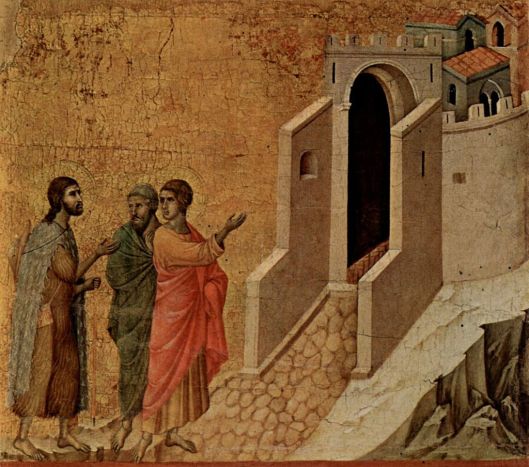
On the Road to Emmaus by Duccio, 1308-1311. Museo del’Opera del Duomo, Siena, Italy.
After the rewritten St. John Passion on Good Friday (read more about this in my post from this past Friday) and the “recycled” birthday cantata with new recitatives for the Easter-Oratorio (read more about this in yesterday’s post), Bach was now, in 1725, getting ready for performances of three new cantatas that form a beautiful sub-group within the cantatas of the 1724/1725 cycle.
Cantata 6 Bleib bei uns, denn es will Abend werden for Easter Monday (Bible story: Jesus appeared before two of his disciples while they were walking on the road to Emmaus).
Cantata 42 Am Abend aber desselbigen Sabbats, for the first Sunday after Easter (Bible story: while a small group of his disciples are inside a house in Jerusalem, with all the doors and windows locked, Jesus appears in their midst).
Gardiner believes that in Bach’s ideal plan, these cantatas were actually meant for the Easter season in 1724, not in 1725. In his book “Bach: Music in the Castle of Heaven,” he explains why cantata 6, 42, 67 and 85 share more characteristics with other 1724 cantatas, and were thus probably planned for that year. When Bach got behind with cantata composing because of the Passion according to St. John in 1724, he must have tabled the ideas for 6, 42, and 85 for 1725, and only wrote 67 in 1724.
My favorite recording of Cantata 6 Bleib bei uns, denn es will Abend werden is by Herreweghe, recorded live at a concert on June 12, 2014 in the Eglise Saint-Roch in Paris. Find the recording (audio only) here on YouTube.
Soloists are Dorothee Mields (soprano), Damien Guillon (countertenor), and Peter Kooij (bass).
Rosa centifolia ‘Major’, dated as far back as the 16th century in the Netherlands. Courtesy of http://rudolfshistorischer-rosen-park.blogspot.com/ , a website I found when looking for roses that would have existed in Germany in Bach’s time
This week I don’t feel a lot of connection with the Bach cantata from 1724 for this Sunday (the 5th after Easter, or Rogate Sunday), cantata 86 Wahrlich, wahrlich, ich sage euch. When I came home from the funeral of one friend, I learned that another friend had passed away suddenly the day before. Because these were both very strong, kind, beautiful, and inspiring women, and I can’t believe they are gone, I feel much more inclined to listen tocantata 198, Lass, Fürstin, Lass nun einen Strahl, which Bach wrote for the funeral of a well-loved Queen than to a cantata which promotes that “God always knows best.”
But I’ll still write about cantata 86. The only connection I have with it this week are the roses in the text of the alto aria. It is my favorite movement of this cantata, because of the splendid violin solo. The interpretation of that violin solo I like best of all the recordings I listened to* is the one by Kati Debretzeni on the Gardiner recording. You can find that recording here on Amazon or here on iTunes. Soloists on the Gardiner recording are Katharine Fuge, soprano; Robin Tyson, counter-tenor; Steve Davisilim, tenor; and Stephan Loges, bass.
For better interpretations of the bass and tenor solos, I recommend listening to the Koopman recording with tenor Christoph Prégardien and bass Klaus Mertens. You can find that recording on YouTube, Amazon, or iTunes.
2020 update: read my blog post of May 15, 2020, to find links to the live video recording by The Netherlands Bach Society, with Robin Blaze, coutertenor, and Shunske Sato, violin.
For the text and translations of cantata 86, please visit this page, and for the score, please go here.
Why the connection with roses? About one week ago, on Friday May 12, I went to drop off a card for a friend who was dying. I learned she was in her last days on Tuesday, but it took me until Friday morning to find the right words, finish writing the card, and to drop it off. When I walked to her door I noticed a hedge of sweet pink roses in the front yard. I felt peace from seeing the roses, and from the knowledge that she liked roses, but I also felt miserable and angry that she would be taken away from all this, from her family, her life, her home. The next day, we heard she passed away during that night.
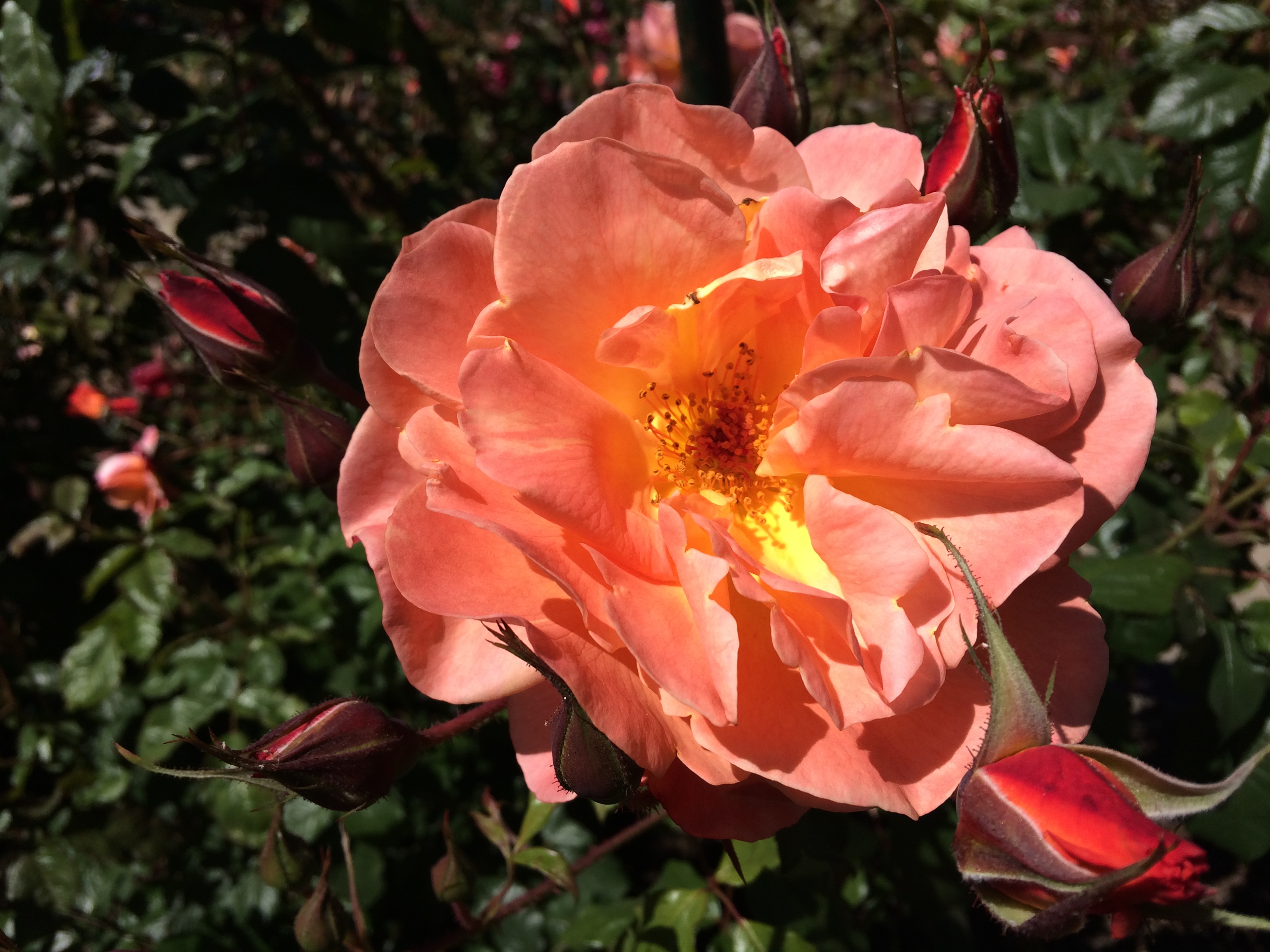
This past Friday was the day of her funeral. I didn’t know how it would go, how my kids would handle it (my oldest and her oldest are friends), and tried to find some strength for myself, so I would be able to be there for them. I realized that I associate this woman’s kindness and warmth with the pinkish apricot color of my favorite rose in the Berkeley rose garden, Westerland. So I decided to walk through the rose garden to experience the color and scent of this amazing flower, and it helped. This is what she looked like that day:
What to listen for in cantata 86:
In the opening movement, notice how Bach accentuates the fact that Jesus is speaking important, timeless words by setting these words in the form of an archaic motet. While the motet has multiple voices, the way it was done in the Renaissance, Bach can still make it clear that the words come from Christ’s mouth only, by giving all the other “voice parts” to instruments instead of to other singers.
In the alto aria, hear how the words “brechen” (to pick [roses]) and “stechen” (to prick) are illustrated by short notes and “broken” chords in the voice part, and broken chords in the violin part.
In the soprano aria, hear how low in the soprano range this is set — it could just as well have been sung by an alto. Bach has not given significant solos to a soprano since Easter of this year, 1724, and actually pretty sporadically since the start of the new year. Many scholars suggest that during that spring of 1724, Bach might have lost his boy soprano soloist (due to him leaving the school or due to his voice changing, we don’t know), and documents suggest that he was frustrated with the low quality of the boy sopranos of the St. Thomas School in general. They believe that this is why he started the chorale cantatas (cantatas of which each movement is based on a different verse of one and the same chorale tune) after Pentecost of that year. Keep following this blog and you’ll learn more about that soon 🙂
Wieneke Gorter, May 21, 2017, updated May 15, 2020.
*I did all this listening last year, when I actually ended up writing about cantata 87, the one Bach wrote for this same Sunday, but then in 1725. Read that post here.
Interior of the Thomaskirche (St. Thomas Church) in Leipzig.
For “Cantate” Sunday, or the fourth Sunday after Easter in 1724, Bach wrote a short but masterful cantata: BWV166 Wo gehest du hin? I wrote a long but educational and hopefully also entertaining post about this cantata last year. I explain how Bach illustrates that this is the “singing” Sunday, why there is so much talk of “going away” in this cantata, and why I recommend the recording by Ton Koopman/Amsterdam Baroque Orchestra. Read that post here.
For this Jubilate Sunday (the third Sunday after Easter) in 1724, Bach did not write a new cantata the way he had done the previous two weeks*, but repeated one he had written in Weimar in 1714. That cantata:Weinen, Klagen, Sorgen, Zagen was not any old cantata, but a composition Bach was most probably very proud of: he would later use the opening chorus as template for the Crucifixus in his Mass in B minor. Read all about this cantata and the recordings I recommend in this post I wrote last year.
Wieneke Gorter, May 7, 2017
*see this post about the first Sunday after Easter in 1724 and this one about the second Sunday after Easter in 1724
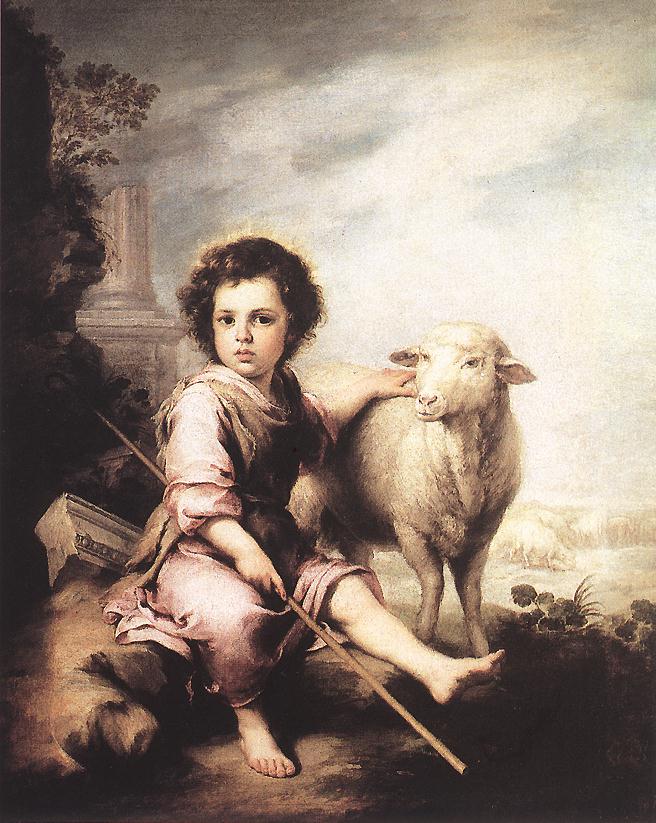
Christ the Good Shepherd, by Bartolome Esteban Murillo, c. 1660. Museo del Prado, Madrid.
We keep following Bach in 1724. For the second Sunday after Easter of that year, he composed cantata 104 Du Hirte Israel, höre. Of all the recordings I listened to, I prefer the one of Ton Koopman with his Amsterdam Baroque Orchestra and Choir, here on YouTube.
Please consider purchasing this recording here on Amazon, or here on iTunes.
Find the text of this cantata 104 here, and the score here.
Paul Agnew
My main reason for choosing this recording is tenor Paul Agnew’s fabulous singing. Type his name in the “search” box on this blog and you’ll find more fan mail from me 🙂
But also: this recording has the best balance among the voice parts in the choir in the opening chorus, and Klaus Mertens presents a bass aria I can actually listen to without getting irritated.
This is a very pretty cantata, entirely based on the “good shepherd” theme for this Sunday, using pastoral motifs in the music, oboes in the orchestra, and displaying an innocent character overall, much more so than the more complicated cantata 85 Bach would write for this same Sunday a year later, which I wrote about last year in this post.
The Incredulity of Saint Thomas by Caravaggio, 1601-1602, Sanssouci Palace, Potsdam, Germany
In the past two weeks I ran out of time to work on this blog because of being sick, performing concerts with California Bach Society, and being on a trial jury for the first time since becoming a United States citizen in 2011. So this post for the First Sunday after Easter in 1724 is post-dated, and short, but contains lots of information to learn more about this beautiful cantata.
Previously in 1724: Bach “premiered” his Passion according to St. John on Good Friday, April 7, 1724. Then he ran out of time and energy and, without too much care for detail and text illustration, created cantatas out of existing music for Easter Monday and Easter Tuesday of that year.
This means that the first new composition he wrote after the St. John Passion was this cantata 67 Halt im Gedächtnis Jesum Christ (keep thinking of Jesus Christ), based on the Gospel text of Jesus appearing to his disciples. A famous cantata, already known and admired in the early 19th century, especially because of the dramatic fourth movement for choir and bass, which Bach would later transform into the Gloria of his Missa Brevis in A (BWV 234).
For the background of this cantata I will refer you to the experts, in this 15-minute video by the Netherlands Bach Society, published within their AllofBach series. The video is in Dutch, with English subtitles. It talks about Bach including a flute (not a recorder!) for the first time in a cantata, the meaning behind the text, and the use of the slide-trumpet “corno da tirarsi.”
Listen to and watch their performance here, find the text here, and find the score here. The Netherlands Bach Society, conducted by Jos van Veldhoven, with countertenor Alex Potter, tenor Thomas Hobbs, and bass Peter Kooij.
As I explained on Easter Sunday and Easter Monday, after his Passion according to St. John, Bach had no time or energy left to write anything new for the three Easter days in 1724. On Easter Sunday he repeated two Easter cantatas from earlier years. On Easter Monday he used existing music from a Birthday cantata from Köthen, didn’t seem to care too much about the music not illustrating the text, perhaps didn’t even write a new score, we don’t know, because the only manuscript that survived is from 1735, not from 1724.
On Easter Tuesday, he used Die Zeit, die Tag und Jahre macht (BWV 134a), a “serenata” for New Year’s Day, also from Köthen. For the Leipzig church cantata, cantata 134 Ein Herz, das seinen Jesum lebend Weiß he didn’t change any music at all, gave the instrumentalists the parts from Köthen, and also used the score from Köthen, writing the new sacred text under the original secular text.
Listening to this cantata is like listening to one of Bach’s instrumental works, because the text and the meaning of the text don’t really matter in this case. Listen to Gustav Leonhardt’s recording of this cantata, with René Jacobs, countertenor, and Marius van Altena, tenor.
Thanks to Eduard van Hengel, it is easy to see side-by-side how the new text compares to the original:
Serenata for New Year’s Day in Köthen 1719
Cantata 134 for Easter Tuesday in Leipzig 1724
1. Die Zeit, die Tag und Jahre macht,
Hat Anhalt manche Segensstunden
Und itzo gleich ein neues Heil gebracht.
2. Auf, Sterbliche, lasset ein Jauchzen ertönen.
[…] Auf, Seelen, ihr müsset ein Opfer bereiten,
Bezahlet dem Höchsten mit Danken die Pflicht.
1. Ein Herz, das seinen Jesum lebend weiß,
Empfindet Jesu neue Güte
Und dichtet nur auf seines Heilands Preis.
2. Auf, Gläubige, singet die lieblichen Lieder.
[…] Auf, Seelen, ihr müsset ein Opfer bereiten,
Bezahlet dem Höchsten mit Danken die Pflicht.
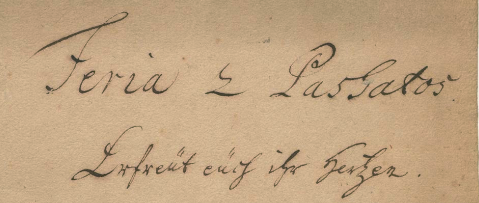
Excerpt from the title page of Bach’s manuscript from 1735 of cantata 66 Erfreut euch ihr Herzen. The manuscript from 1724 did not survive.
In Bach’s time there were three Easter days, as there were three Christmas days and three Pentecost days. I wrote yesterday that Bach planned to write four new works between April 10 and 23, 1724, but that is only somewhat true, it depends who you ask …
Gardiner believes that what Bach planned to do after Easter 1724, was to write cantata 6 for Easter Monday, 42 and 67 for the first Sunday after Easter, and 85 for the second Sunday after Easter, instead of writing 6, 42, and 85 in 1725. As he painstakingly explains in his book “Bach: Music in the Castle of Heaven,” Gardiner believes that the work (composing and rehearsing) on the Passion according to St. John must have cost Bach much more time than he thought, and he thus had to adjust his plans.
Following Gardiner’s theory, when Bach realized he had too much on his plate for Easter 1724, including having to write a cantata for Easter Tuesday he might not have planned on, he decided to write parodies (using existing music with some changes, but with different texts) for Easter Monday and Easter Tuesday of that year.
For Easter Monday 1724, he wrote cantata 66 Erfreut euch, ihr Herzen. Most of the music of this cantata is based on the secular cantata 66a Der Himmel dacht auf Anhalts Ruhm und Glück (Heaven thinks of Anhalt’s Fame and Fortune) , composed by Bach in 1718 to celebrate the 24th birthday of Prince Leopold of Anhalt-Cöthen. If you have 40 minutes, listen to a reconstruction of the entire Birthday cantata 66a from 1718 here, with soprano Gudrun Sidonie Otto, alto Wiebke Lehmkuhl, tenor Hans Jörg Mammel, and bass Karsten Krüger. If you only have 10 minutes, scroll to 11:17 for the soprano/alto duet with violin.
Listen to Herreweghe’s recording of cantata 66 Erfreut euch, ihr Herzenhere. Soloists: alto Kai Wessel, tenor James Taylor, and bass Peter Kooij. I like Herreweghe’s recording of this cantata the best of all I listened to, because to me the tempo of the opening chorus is perfect for me, Collegium Vocale’s singing is fabulous as always, and I enjoy listening to Peter Kooy in the bass aria.
Find the text of cantata 66 here, and the score here.
Since we only have a manuscript of this cantata from 1735, when Bach repeated this cantata in Leipzig, we don’t know for sure what Bach changed in 1724. However, based on what we know, and comparing the two recordings I present in this post, Bach used the following movements from the Köthen Birthday cantata 66a in the Leipzig church cantata 66: The impressive and very festive opening chorus of 66 is the closing chorus of 66a, the bass aria of 66 is the alto aria of 66a, and the alto-tenor duet (beautifully sung by Kai Wessel and James Taylor) with violin of 66 is the soprano-alto duet with violin from 66a.
Movement 4 and 5 (the recitative and duet for alto and tenor) are written as a dialogue. Whenever Bach uses that technique in his church cantatas, the two characters are usually Jesus and the Soul (see for example cantata 21). In this case, the Happiness of Anhalt (the alto) from 66a has been transformed to Furcht (Fear) in 66, and Fama (the godess of fame and reputation, soprano in 66a) has been transformed to Hoffnung (Hope, tenor in 66). With these two characters Bach refers to the Gospel reading of the day: two followers of Jesus walk to the town of Emmaus, only a few days after Jesus’ death and burial. They talk about their hope that he was the Messiah, but are at the same time fearful having heard the news that his body has disappeared from the grave.
In the Birthday cantata 66a, the two characters are in agreement, and therefore sing the same notes. However in cantata 66 Furcht and Hoffnung often disagree, even though they are still singing the same notes. Normally Bach would never have let this happen, but perhaps this is an illustration of how quickly he had to work on this cantata for Easter Monday.
The title page of cantata 183 in Bach’s handwriting: Dominica Exaudi // Sie werden eüch in den Bann tun // à 4 Voci, 2 Hautb d’Amore, 2 Hautb da Caccia, 2 Violini, Viola, Violoncello piccolo e Continuo // di Joh. Sebas. Bach. Staatsbibiothek zu Berlin – Preußischer Kulturbesitz
There are two cantatas for this Sunday Exaudi, aka the Sunday after Ascension, or in the practical reality of the man who had to write the music and rehearse the choir: the Sunday in between Ascension and the three-day-long feast of Pentecost. Because they refer to the same Gospel text, the cantatas share the title Sie werden euch in den Bann tun, but except for the fact that they each contain a glorious soprano aria, they have nothing in common.
I discuss both cantatas in this blog post. Keep reading for Cantata 183, but let’s first look at the one Bach wrote in 1724: Cantata 44 Sie werden euch in den Bann tun.
The soprano aria from this cantata, Es ist und bleibt der Christen Trost, sung by the amazing Peter Jelosits on the Harnoncourt recording from 1975 is among the most happiest music memories of my childhood. I suspect my mom loved it so much that she played it more often than just on this Sunday. I didn’t realize how well this aria is engraved in my brain until I surprised myself during a choir carpool, singing the entire thing from memory, illustrating a story about how some of these boy sopranos could sing very complicated arias.
Es ist und bleibt der Christen Trost, The consolation of Christians is and remains Dass Gott vor seine Kirche wacht. God’s watchful care over his church. Denn wenn sich gleich die Wetter türmen, For even though at times the clouds gather, So hat doch nach den Trübsalstürmen yet after the storms of affliction Die Freudensonne bald gelacht. the sun of joy has soon smiled on us.
If you would like to listen to the entire cantata, I recommend Herreweghe’s recording from 2013. The opening tenor/bass duet is the best here, with bass Peter Kooij singing out much more than on their 1993 recording of this same cantata, and his and Thomas Hobbs’ voice matching better than his and Christoph Prégardien’s (as much as I love Prégardien’s voice!).
Also, Herreweghe’s interpretation of the soprano aria on this 2013 recording is the most musical and the most cheerful, not in the least because it has the highest tempo of all recordings I listened to. That this proves a bit of a challenge for the always fabulous soprano Dorothee Mields is only audible in the text: after she comes out of the expertly executed but super tricky long runs, she slips back into the edition she probably studied from, which uses the more modern “für seine Kirche” instead of the edition they’re performing from, which uses the archaic “vor seine Kirche,” so it ends up being a mix of the two texts. While this bugs me a little bit, a retake of the recording would probably have been at the expense of the magic that happens in this aria, so it is probably a good thing that they left it in.
Purchase the Herreweghe recording of cantata 44 on Amazon or on iTunes. (This album also features the beautiful recording of cantata 73 discussed here).
Find the entire German text of cantata 44 with English translations here, and the score here.
Thomas Hobbs, tenor (photo by B Ealovega)
Peter Kooij, bass
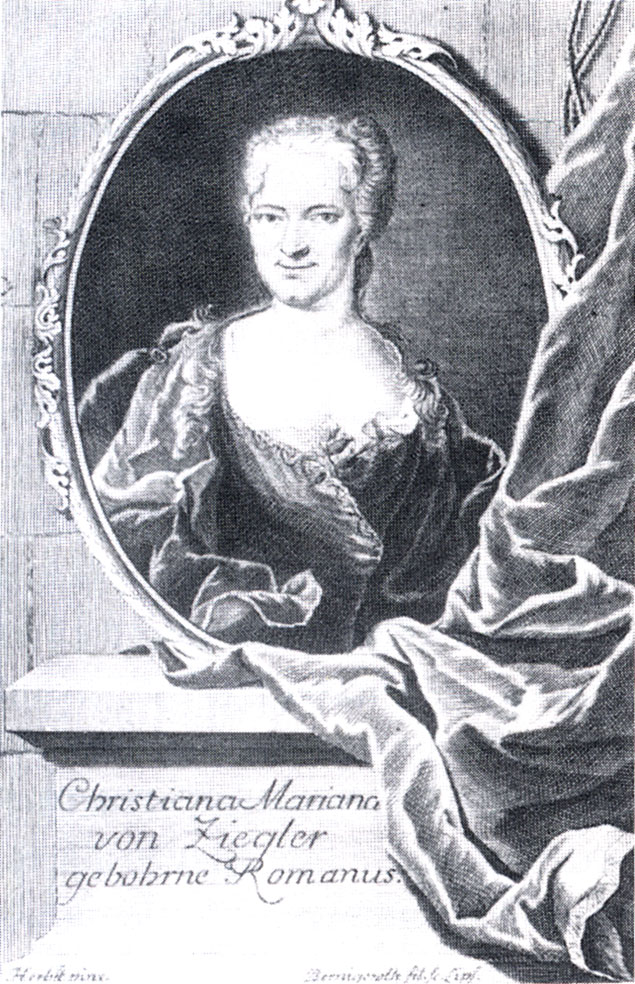
Cantata 183 from 1725 is noteworthy because it uses a text by Christiane Mariana von Ziegler and features a striking instrumentation: two oboi d’amore and two oboi da caccia in the bass recitative; a violoncello piccolo in the tenor aria; again the two oboe pairs in the alto recitative; two oboi da caccia in the soprano aria; all these instruments in the closing chorale.
My absolute favorite recording of this cantata is the one by Bach Collegium Japan. They struck gold with this recording, thanks to the combination of Badiarov playing the violoncello piccolo da spalla, fabulous oboe players, and terrific vocal soloists: soprano Carolyn Sampson, countertenor Robin Blaze, tenor Gerd Türk, and bass Peter Kooij. I think the entire album (also featuring the recording of cantata 85 discussed here) is very inspired, and it has become one of my favorite Bach cantata CDs.
Listen to this Bach Collegium Japan recording of cantata 183 on Spotify.
Purchase this Bach Collegium Japan recording of cantata 183 (and 85!) on Amazon or on iTunes.
Find the German text with English translation of Cantata 183 here, and the score here.
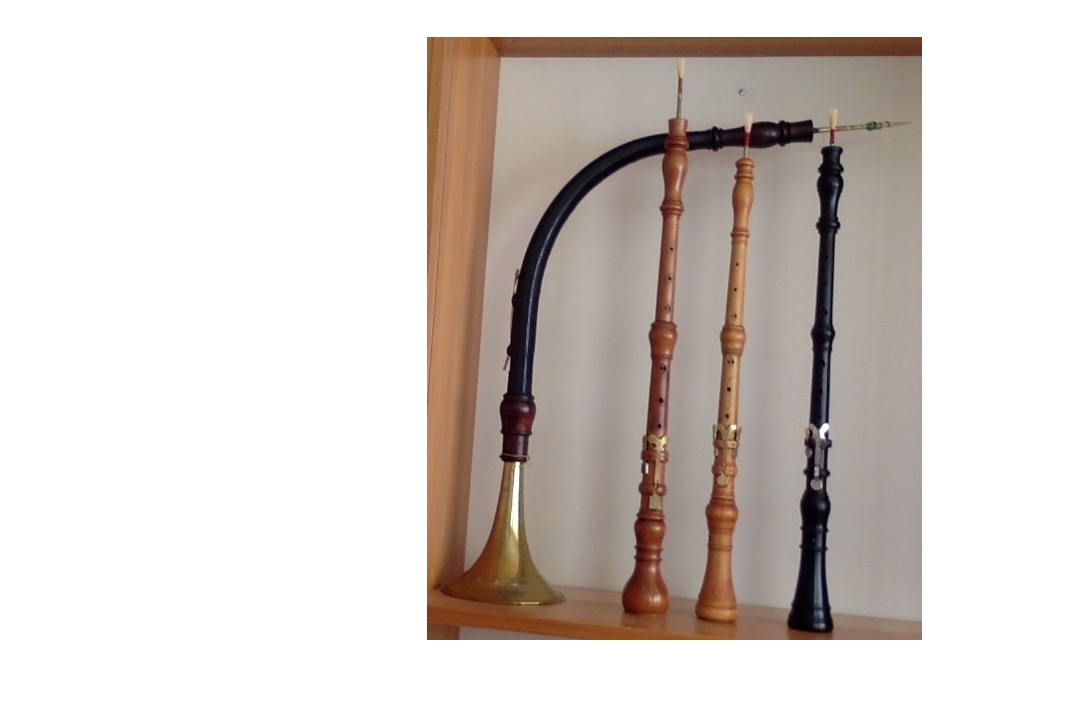
Why is this scoring for the oboes so unusual? In Bach’s time there were “regular” oboes (to the right on this photo), oboes d’amore (with a bell-like widening in the wood at the end, second from left), and oboes da caccia (or “hunting” oboes, completely curved, and with a trumpet-like brass bell at the end, far left).
From left to right: oboe da caccia, oboe d’amore, oboes. Photo courtesy of Marianne Richert Pfau; instruments built after 18th century examples by Sand Dalton, Harry van Dias, and Paul van der Linden, respectively.
Bach often used the oboe da caccia, but only on a handful of occasions would he write for two da caccias. And even if he would write for two da caccias or two d’amores and “regular” oboes in the same cantata (or passion) they would not all be playing at the same time. On most occasions there were between one or two oboe players in the orchestra, sometimes three, alternating between the different instruments from one movement to the next. The only times Bach needed four oboists in one cantata, playing two da caccias and two d’amores at the same time, was in cantata 2 of the Christmas Oratorio (1734) and in this cantata 183. So there must have been some good oboe playing visitors in town around this time of Ascension and Pentecost in 1725.
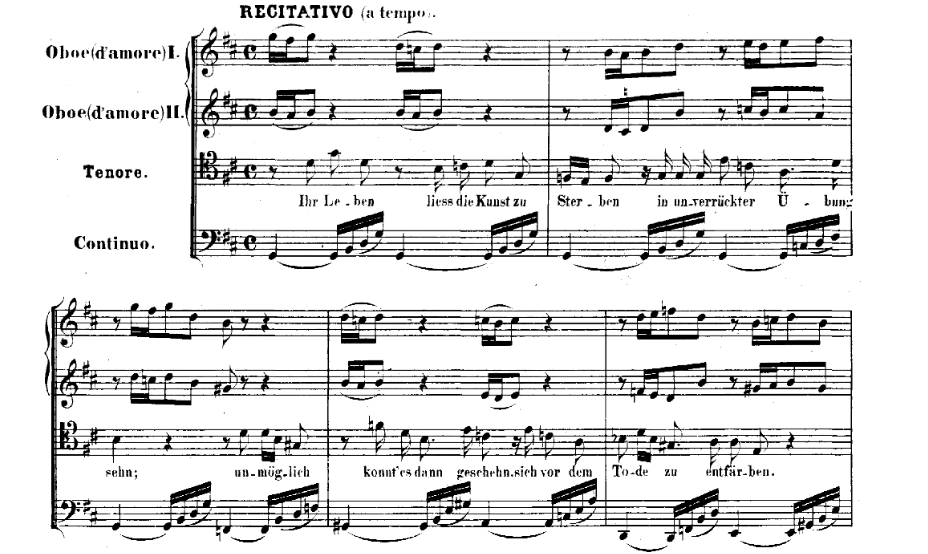
The four oboes can be heard clearly in the alto recitative, where Bach has each of them repeat the four-note theme from the “ich bin bereit”-text in the vocal part:
When I hear this, I immediately have to think of the tenor recitative in Bach’s beautiful Trauer Ode, cantata 198, this time reduced to a 3-note theme and without the da caccias:
Or listen to this recitative from cantata 198 on YouTube
It is of course not exactly the same composition, but I wonder if Bach had to think back of this cantata from 1725 when he wanted to illustrate life and death in one and the same piece of music in the Trauer Ode of 1727.
After this alto recitative comes the most glorious soprano aria, richly scored with the two oboes da caccia playing the oboe part in unisono, as well as parts for violin 1, violin 2, and viola. Harnoncourt says that even though both da caccia have this aria written in, he says it is “clearly not intended to be chorally played” and on their recording they decide to have this part covered by only one oboe da caccia. Perhaps the original full score was not available to Harnoncourt at the time he made that decision, because it clearly says: “tutti gli Oboi in unisono:”
excerpt from the soprano aria from cantata 183, with Bach’s indication for “all the oboes in unisono,” Staatsbibiothek zu Berlin, Preußischer Kulturbesitz
One would almost think Bach dreamt of allfour oboes playing this, also the d’amores, but when his copyists double-checked with him, he decided that was just silly, it would overpower the poor boy who had to sing this, and they only wrote it into the parts for the da caccias (it says “Arie Tacet” in the parts for the oboi d’amore).
To learn more about Cantata 183, I wholeheartedly recommend you study with Rudolf Lutz of the J.S. Bach Foundation a little bit. Find a link to his fabulous (English spoken!) lecture and improvisation about this cantata in my blog post from May 24, 2020.
Wieneke Gorter, May 8, 2016, updated May 23, 2020.
In 1725, between Easter and Pentecost, Bach set nine cantatas in a row to texts by Christiane Mariana von Ziegler (1695–1760). And it is in part thanks to her poetry that I’m favoring the cantata from 1725 over the one from 1724 for this “Rogate” Sunday – the fifth Sunday after Easter.
This cantata 87 from 1725, Bisher habt ihr nichts gebeten in meinem Namen, contains two jewels of arias: the alto aria (no 2) and the tenor aria (no 6). Von Ziegler’s poetry combined with Bach’s sublime scoring in those arias completely knocked me over when I first listened to this cantata this week. I found Gardiner’s recording of this cantata (which I happened upon by accident – read more about this at the very end of this post) the most moving.
(This album is absolutely worth purchasing – cantata 86 is beautiful too, and the violin accompaniment in the alto aria of that cantata 86 on this recording is the best)
About Christiane Mariana von Ziegler: A female librettist, who didn’t have to hide behind a male alias to get recognition or to get her works published? In 18th century Leipzig? When I first heard about this I could not believe it. But it turns out that by unusual circumstances, Christiane Mariane von Ziegler was as “free” as probably no other woman at that time was, at least between 1722 and 1741.
In that time period, there was no husband or other male relative by whose rules she had to live: her father had been in jail since she was 11, she had been twice widowed, and had lost both her children (one from each marriage). Despite all this, she was still in possession of her family’s house and fortune, and was well respected in Leipzig society. She wrote poetry, sang, and played many musical instruments. In 1722 (at age 27) she was appointed the official guardian of her family’s household, a position normally never awarded to a woman. For the next two decades her house served as the salon where many artists and intellectuals could meet. She would promote artists, poets and writers, and introduce them to representatives of the university who also attended her events.
In 1730, Von Ziegler became the first and only female member of Gottsched’s German Literary Society. She was named “poet laureate,” crowned by the emperor in 1733. In 1732 and 1734 she received the poetry prize from the German Literary Society. Her last published work appeared in 1739. In 1741, she married Professor Balthasar von Steinwehr and lived with him in Frankfurt an der Oder until her death in 1760. As far as we know, she did not write anything in this last period of her life.
In 1728, she published Versuch in gebundener Schreib=Art, which contains the texts for the nine 1725 Bach Cantatas (103, 108, 87, 128, 183, 74, 68, 175, 176). In 1729 she published In Gebundener Schreib-Art: Anderer und letzter Theil, which contains the rest of a complete yearly cantata cycle which Bach never set to music.
Since there is no correspondence between Von Ziegler and Bach left to us, we don’t know why they started working together, we don’t know why the working relationship ended, nor why Bach never used the other texts she had provided for the rest of the cantata cycle. There are some theories that she must have been vexed about Bach altering her texts on several occasions in 1725. However, the only proof we have for what her “original” texts would have been are her publications from several years later. She might have changed them herself between Bach first using them and her later publishing them. We do know that Bach first worked with Picander, the poet with whom he would later collaborate extensively (including for the St. Matthew Passion) in February 1725.
Back to this cantata. It was Bach’s life goal to not only praise God, but also educate “his neighbor” (the congregation, his fellow believers) with his church music, and it seems that Von Ziegler definitely shared this vision. To not make this post too long, I’ll only highlight the alto aria, since it is the piece that impressed me most, but the rest of the cantata is well worth listening to, especially the tenor aria.
The Gospel reading for this Sunday was the last part of Jesus’ speech to his disciples, from John. Note verse 24 (quoted in the bass arioso opening) and the overall stress on speaking in proverbs versus speaking plainly.
23. Und an demselbigen Tage werdet ihr mich nichts fragen. Wahrlich, wahrlich, ich sage euch: So ihr den Vater etwas bitten werdet in meinen Namen,so wird er’s euch geben.
[23] And in that day ye shall ask me nothing. Verily, verily, I say unto you, Whatsoever ye shall ask the Father in my name, he will give it you.
24. Bisher habt ihr nichts gebeten in meinem Namen. Bittet, so werdet ihr nehmen, daß eure Freude vollkommen sei.
[24] Hitherto have ye asked nothing in my name: ask, and ye shall receive, that your joy may be full.
25. Solches hab’ ich zu euch durch Sprichwörter geredet. Es kommt aber die Zeit, daß ich nicht mehr durch Sprichwörter mit euch reden werde, sonderneuch frei heraus verkündigen von meinem Vater.
[25] These things have I spoken unto you in proverbs: but the time cometh, when I shall no more speak unto you in proverbs, but I shall shew you plainly of the Father.
26. An demselbigen Tage werdet ihr bitten in meinem Namen. Und ich sage euch nicht, daß ich den Vater für euch bitten will;
[26] At that day ye shall ask in my name: and I say not unto you, that I will pray the Father for you:
27. denn er selbst, der Vater, hat euch lieb, darum daß ihr mich liebet und glaubet, daß ich von GOtt ausgegangen bin.
[27] For the Father himself loveth you, because ye have loved me, and have believed that I came out from God.
28. Ich bin vom Vater ausgegangen und kommen in die Welt; wiederum verlasse ich die Welt und gehe zum Vater.
[28] I came forth from the Father, and am come into the world: again, I leave the world, and go to the Father.
29. Sprechen zu ihm seine Jünger: Siehe, nun redest du frei heraus und sagest kein Sprichwort.
[29] His disciples said unto him, Lo, now speakest thou plainly, and speakest no proverb.
30. Nun wissen wir, daß du alle Dinge weißt und bedarfst nicht, daß dich jemand frage. Darum glauben wir, daß du von GOtt ausgegangen bist.
[30] Now are we sure that thou knowest all things, and needest not that any man should ask thee: by this we believe that thou camest forth from God.
After the Vox Christi bass arioso opening (beautifully scored as an opening “chorus” for strings, oboes, and bass voice), Von Ziegler doesn’t hold back in communicating what the believers should take away from this lesson, and writes this text for the alto recitative:
O Wort, das Geist und Seel erschreckt! O word, that terrifies spirit and soul! Ihr Menschen, merkt den Zuruf, was dahinter steckt! You people, notice the call hidden behind these words! Ihr habt Gesetz und Evangelium vorsätzlich übertreten; You have deliberately transgressed the law and gospel; Und dies möcht’ ihr ungesäumt in Buß und Andacht beten. And because of this you should pray without delay in repentance and devotion.
And then gives them the prayer they should be saying in the alto aria, and this is the part that bowled me over, because of the combination of the music, the text, and the humble interpretation of it on the Gardiner recording:
Vergib, o Vater, unsre Schuld Forgive, O Father, our guilt Und habe noch mit uns Geduld, and still have patience with us, Wenn wird in Andacht beten when we devoutly pray Und sagen: Herr, auf dein Geheiß, and say: Lord, at your command, Ach, rede nicht mehr sprichwortsweis, Ah, speak no more proverbs, Hilf uns vielmehr vertreten. Instead help us represent ourselves.
Here’s the story of how I happened upon the Gardiner recording of this cantata, and this aria in particular: I was only familiar with cantata 86, not with 87. When comparing several recordings of the alto aria in cantata 86 (because of the stunningly beautiful and very virtuosic violin accompaniment), I decided I liked the violin playing on Gardiner’s recording the best. Satisfied that I had found this and knew what my blog post was going to be about, I took a break while letting the album play, and of course cantata 87 was next. I was on the floor on my yoga mat, just lying there, letting the music wash over me, unable to do anything else.
I am rarely so physically moved by a Gardiner recording, so I went and looked up his journal of the live performances (and recordings) in question, and found this:
“In addition to our habitual position of “bringing coals to Newcastle,” the potential impertinence of interpreting Bach to the Germans, we faced the far pricklier issue of performing Bach in the city [Dresden] whose cultural treasure had been wantonly destroyed by British bombs in one mad night towards the end of the war and with colossal loss of life.”
So there it was: the prayer for forgiveness and better representation had been as meaningful to the British musicians in the German city at the time of this recording as it was to me this week.
Wieneke Gorter, May 1, 2016, links updated May 19, 2024.








 Weekly Cantata