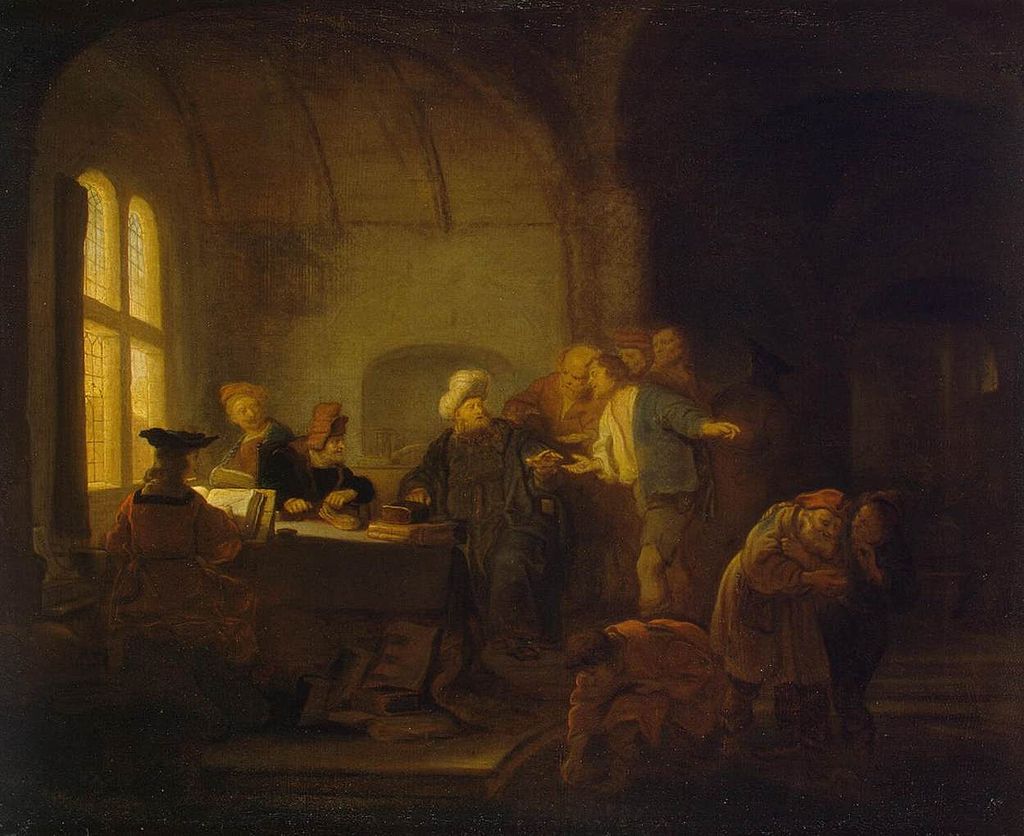
Parable of the workers in the vineyard by Salomon Koninck. Between 1647 and 1649. Hermitage Museum.
On the third Sunday before Lent in 1724, Bach performed Cantata 144 Nimm, was dein ist, und gehe hin. Read all about this short but wonderful work in my blog post from 2016, in which I discuss an unrivaled recording by Gardiner with mezzo soprano Wilke te Brummelstoete and soprano Miah Persson.
In that cantata from 1724 Bach wrote one soprano aria on the concept of “Genügsamkeit” (being satisfied with what you have), but three years later, he dedicated an entire solo work for soprano to this theme: Cantata 84 Ich bin vergnügt mit meinem Glücke (I am content in my good fortune), featuring the delightful aria Ich esse mit Freuden mein weniges Brot(It is with joy that I eat my meager piece of bread). We can probably take this as proof that Genügsamkeit was very important to Bach.
Find the German texts with English translations of Cantata 84 here, and the score here.
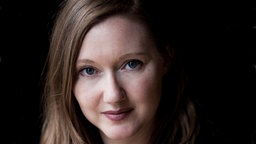
Dorothee Mields
I myself count among my blessings that Herreweghe’s recording of this cantata features one of my favorite sopranos, Dorothee Mields. Read more about her in my post about the Herreweghe sopranos.
I listened to many recordings of this cantata, and I still (2020) love this interpretation the best. Mields is a terrific chamber musician together with the instrumentalists throughout this cantata, listen to the interplay between her and oboist Marcel Ponseele. I feel her voice sounds the most natural in aria “Ich esse mit Freuden mein weniges Brot.” The way she starts “Ein ruhig gewissen” the first time that comes around is just to die for as far as I’m concerned. I also like Herreweghe’s tempos the best of all the recordings I’ve listened to.
Enjoy Dorothee Mields’ singing and her being a terrific chamber musician together with the instrumentalists on Herreweghe’s recording of cantata 84 Ich bin vergnügt mit meinem Glücke on YouTube or on Spotify. The cantata appears on Herreweghe’s album Christus der ist mein Leben from 2007, which also includes two other fabulous cantatas: 95 and 161. If you like these recordings, please consider purchasing (the MP3 of) this album on Amazon.de or on Amazon.com. Or purchase the album on iTunes or whatever platform you prefer. Thanks for supporting the artists!
Wieneke Gorter, February 18, 2017, last updated January 27, 2024.
There is no cantata left to us for this Sunday, Epiphany 5. So I decided it was the perfect time to fix something that had been bothering me for a while: my post about cantata 148 from September 2016.
Sitting in the music library this week, doing research for cantata 83, I was very excited. At first it was the sheer pleasure of being in that building and feeling like a musicology student again, but while reading, I realized that Dirksen’s article is an excellent argument for my hypothesis that Bach had guest musicians playing in his Leipzig orchestra around feast days. And what is more, I was now convinced cantata 148 was written in 1725 and not in 1723. So I decided to completely revise my post from September 2016 about the cantata with the violin solo that moved me to tears. Read it here.
Presentation in the Temple (1640/1641) by Simon Vouet (1590-1649). Musée du Louvre, Paris.
In many traditions, from pre-Christian European to contemporary American, February 2 marks the end of the dark part of the winter. Feasts on this day celebrate the daylight, looking ahead to spring, and the start of new things. Growing up in a Calvinist protestant culture in the Netherlands, I wasn’t aware of any of these holidays.
Let’s start with the silly American holiday on February 2: Groundhog Day. If the groundhog (some sort of marmot) comes out of her hole on this day while it is cloudy, spring will be early; if it is sunny and the groundhog will thus see her own shadow when she comes out of her hole, she will be scared and go back inside and spring won’t start for another six weeks. Grown men actually observe the groundhogs on February 2.
People from Celtic cultures celebrate Imbolc or Brigid’s Day on February 2 because it is the midway point between the winter solstice and the spring equinox. The holiday is a celebration of the lengthening days and the early signs of spring. The lighting of candles and fires represented the return of warmth and the increasing power of the Sun over the coming months.
The Catholic feast of Candlemas also originates in pre-Christian times, and originally marked the end of a period of light feasts which started around mid November. After the early Christians established that Jesus was born on December 25, it was easy to declare Saint Martin (Nov 11, 40 days before Christmas) the start of the great Christmas season and February 2 (40 days after Christmas) the end of it. I read that in some countries people leave their Christmas decorations up until Candlemas. I would have loved to have that tradition in the Netherlands too, because I had serious trouble with the bleak, grey, uneventful month of January there. And all procrastinators are now absolved: you didn’t know it, but you were doing the right thing to leave those lights up until February!
The Catholic Church merged Candlemas with the feast of the Purification of Mary and the Presentation of Jesus at the Temple. In the Jewish tradition, a new mother was “unclean” for the first 40 days after giving birth. On the 40th day, she would have to visit the temple for a purification ceremony, and to present her son to the priests. Luther kept this Catholic feast on the calendar, but focused much more on the Presentation of Jesus at the Temple than on the Purification of Mary. What is more, he turned Simeon’s song of praise into a message of “Now I can die in peace.” This is why all five cantatas (BWV 82 (the famous Ich habe genug), 83, 125, 157, and 158) Bach wrote for this holiday are mostly about the joy of dying. But not to worry, the cantata from 1724 is actually very festive.
Listen to/watch cantata 83 Erfreute Zeit im neuen Bundeby the Netherlands Bach Society on YouTube. Shunske Sato, violin and direction; Robin Blaze, alto; Daniel Johannsen, tenor; Stephan MacLeod, bass. I prefer this recording because this cantata is a violin concerto and here we can see one of the best Baroque violinists and Bach interpreters, Shunske Sato, at work.* However for the most magical rendition of the second movement please also listen to the Bach Collegium Japan recording (Natsumi Wakamatsu, violin; Robin Blaze, alto; James Gilchrist, tenor; Peter Kooij, bass)
Find the German text with English translations of Cantata 83 here, and the score here.
The first and third movement are written like a violin concerto and celebrate the “new” era. According to an excellent study by Dutch musicologist Pieter Dirksen, presented at a Bach Symposium in Germany in 2000, the impressive violin part was most likely written for violin virtuoso Johann Georg Pisendel from Dresden. Dirksen makes a very convincing case that Bach wrote this past Sunday’s operatic cantata 81 and this cantata 83 (both from the same week in 1724) specifically to please musicians and perhaps also dignitary guests from Dresden, giving them the two musical forms the Dresden court favored most: an opera in the form of cantata 81 and a concerto in the form of cantata 83. There are no documents supporting the suggestion that Pisendel was in Leipzig around the time this cantata was played. However, as I have mentioned before in this blog, it seems evident from Bach’s writing around special holidays that there were either guest musicians or colleagues to impress in those weeks. Also, Dirksen gives many plausible examples of links to Dresden in the style and instrumentation of these compositions, and argues that Bach had no other violinist available, including himself, who would have been able to play this and that this is why he didn’t write virtuoso violin solos in any cantatas from the first Leipzig cycle.
The second movement symbolizes the “old” tradition Simon stands for in the Gospel story. In a way he has never done this in any other cantata, Bach sets Luther’s translation of Simeon’s words (“Herr, nun lässest du deinen Diener in Friede fahren …”) to the old Gregorian psalmtone for Nunc Dimittis, which was the Roman version of Simeon’s words. It is likely he wanted to show the Catholic guests from Dresden he was familiar with their tradition too, or perhaps he wanted to honor the Catholic history of this feast day. The very best rendition of this movement is sung by Peter Kooij on the Bach Collegium Japan recording of this cantata. My late mother used to say: “Peter Kooij must have a special line with God.” He definitely has a special line with Bach.
Wieneke Gorter, February 2, 2017, updated February 2, 2020 and February 2, 2023.
*read how Shunske Sato’s playing made me want to write for this blog again in this post
If I would have to come up with a “top 5” of blog posts, the one about cantata 81 for today, the fourth Sunday after Epiphany, is definitely one of them. There is lots to read and learn, and a marvelous tenor aria to listen to. You can find that post here.
I’ve created a Google calendar for the upcoming Sundays and other holidays. You can find that here. When you click on the Sunday or holiday, you will find a link to the blog post connected to that day.
There are four Bach cantatas for this Sunday, the third after Epiphany. Last year I wrote about two of them: cantatas 72 and 73. You can read that post here.
This year I’d like to share a little bit about cantata 156 Ich steh mit einem Fuß im Grabe. I did not grow up with this cantata, my mother didn’t play this one for us. Whether this was because the Harnoncourt recording of this cantata is not very satisfying, or because she liked the three other cantatas for this Sunday much better, I don’t know.
I heard cantata 156 for the first time around 2008 or so, on a recording by American Bach Soloists from 1992, and was blown away by the rich sound of the strings and by the “groove” the ensemble finds so easily, it seems, in the opening movement and in the tenor aria. I have not heard such comfort with the rhythm in any other recording of this cantata. It is also a historic recording: it is one of the few ABS cantata recordings on which director Jeffrey Thomas sings the tenor arias himself. While Thomas’ voice is perhaps not as full as Gerd Türk’s on the recording by Bach Collegium Japan, I enjoy the music-making in this movement so much that it was comfort-music for me in the weeks and months after my mother passed away in 2010, and it is still one of my favorite Bach cantata recordings.
Other soloists on this recording:
oboe: John Abberger; violin: Jörg-Michael Schwarz; counter-tenor: Steven Rickards; bass: James Weaver. Choir sopranos singing in the tenor aria: Julianne Baird, Christine Earl, and Claire Kelm.
Find the German text with English translations here, and the score here.
You might recognize the opening movement of this cantata as the second movement of Bach’s harpsichord concerto, BWV1056. However, Bach based both the cantata movement and the harpsichord concerto movement on an oboe concerto from Köthen which is now lost.
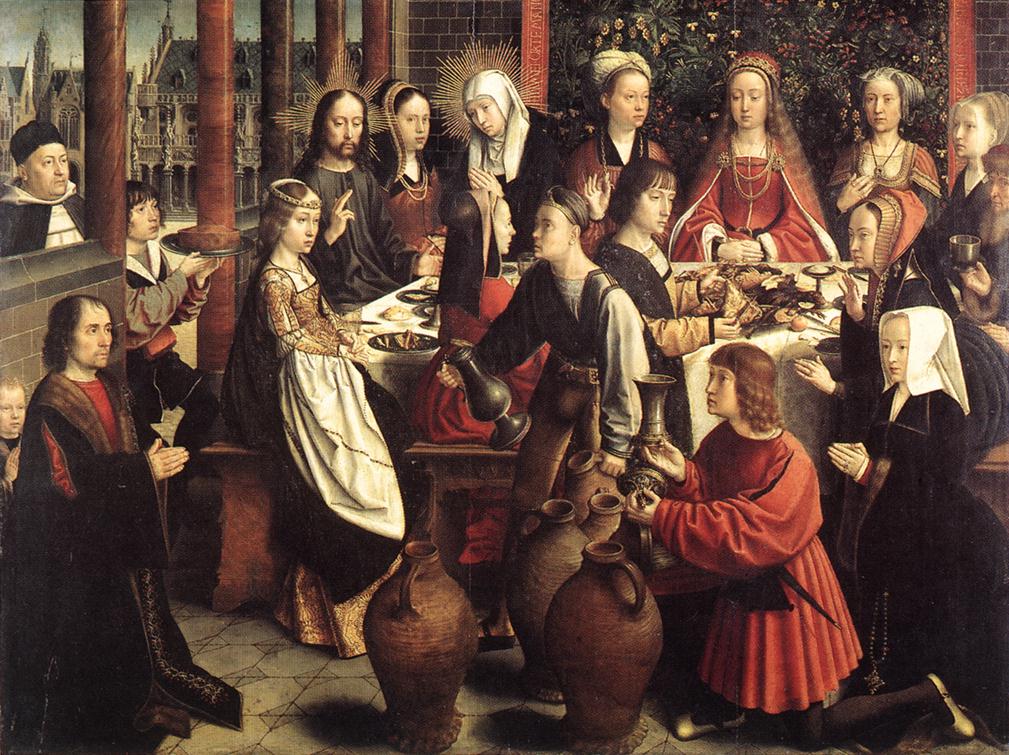
The Marriage at Cana, c. 1500, by Gérard David. Musée du Louvre, Paris. Mary pleads and worries, but Jesus says: “Woman, what have I to do with thee? Mine hour is not yet come.”
This week, I watched a very good video by the Swiss Bach Foundation (Bachstiftung) about today’s cantata 155 Mein Gott, wie lang, ach lange? I found it very insightful, helpful, and even entertaining, but was struck by its Calvinist character and was a bit disappointed by the director’s statement that he doesn’t know why this cantata starts with a movement for solo soprano. When reading Gardiner’s and Van Hengel’s discussions of this cantata, I liked their suggestions that the soprano lament refers to Mary’s role in the Bible story of this Sunday, the Marriage at Cana. It made sense to me. This cantata, from 1715 and repeated in 1724, contains references to the wine as well as to the fact that Jesus says to his mother: “my time has not come yet.”
While the Lutheran church in Bach’s time did not regard Mary as a saint, let alone a mediator between God and the people, she was still an important person in the faith, and thus probably also for Bach. The three Marian feast days* Luther kept on the calendar were important holidays and Bach wrote cantatas for all of them. Also, Bach wrote this cantata 155 in his Weimar years, when he explored a large number of works by (Catholic) Italian composers.
Listen to Montreal Baroque’s recording of cantata 155 on YouTube through a playlist I created. With Monika Mauch, soprano; Franziska Gottwald, alto; Charles Daniels, tenor; Harry van der Kamp, bass; Anna Marsh, bassoon. If you prefer to watch a live recording, you can find the live performance by the J.S. Bach Foundation here, with Julia Neumann, soprano; Margot Oitzinger, alto; Julius Pfeifer, tenor; and Raphael Jud, bass.
Read the German text with English translation of this cantata here, and find the score here.
The cantata is not so much a musical play with the soprano taking the role of Mary, but more a reference to her role in the Gospel story and an exploration of that theme: try to trust that everything will be okay in the end, try to not be in control all the time. The first movement has the character of a lament in music and text, you can picture the hand-wringing, the desperation. There is also the steady pedal point in the bass, similar to what Bach will use later in the opening chorus of the St. Matthew Passion.
However it is the second movement, not even sung by the soprano, and with text that is trying to urge her to “let go,” that secretly is the true lament, in the music that is. To hear or see this, the video by the Swiss Bach Foundation is terrific. Rudolf Lutz explains extremely well (with music examples) how the notes of the solo bassoon part form in fact a lament for three voices. This video has English subtitles. watch from 12:10 By the way: the composition I had to think of when hearing the “lamento bass” was Monteverdi’s Lamento della Ninfa
If you would like to explore other cantatas for this second Sunday after Epiphany, I invite you to read my post about cantata 3 from 1725 here. It is all about hidden messages in the music of a an extremely beautiful composition with an equally heart wrenching—but completely different—opening movement as this cantata 155.
Wieneke Gorter, January 14, 2017, links updated January 31, 2020. Link for the score updated January 16, 2021, link for the J.S. Bach Foundation video with English subtitles updated January 15, 2022.
*The Purification of Mary on February 2, The Annunciaton of Mary on March 25, and the Visitation of Mary on July 2.
The Weekly Cantata blog is one year old this weekend! When I started on January 6, 2016, I was not sure I could actually write a post every week, but thanks to the support of my wonderful family, the encouragement of so many readers, and the inspiring music and research, I made it, and am happy to continue.
While I celebrate the blog’s anniversary with my family this weekend, I invite you to read my post for Epiphany/Three Kings Day (January 6) here, and my post for the first Sunday after Epiphany here.
There are many Bach cantatas for New Year’s Day, or the Feast of the Circumcision and naming of Jesus. Apart from the fourth cantata of the Christmas Oratorio I discuss here, those are: BWV 190 from 1724, BWV 41 from 1725, BWV 16 from 1726, and BWV 171 from 1729. They are all impressive, usually with trumpets and timpani in the orchestra, but rarely get performed anywhere. I hope that will change sometime.
Today is also the first Sunday after Christmas. If that day did not fall on Third Christmas Day, Bach would write a cantata for that too, as you can see in this overview. It means there is an overwhelming treasure trove of cantatas to choose from today.
The ones I like best are cantata 122 Das neugeborne Kindelein (for the first Sunday after Christmas in 1724) and the fourth cantata from the Christmas OratorioFallt mit Danken, fallt mit Loben (for New Year’s Day or the Feast of the Circumcision and naming of Jesus in 1735).
Listen to Herreweghe’s recording of cantata 122 Das neugeborne Kindelein on YouTube. It’s only 14 minutes long, but contains so many jewels. With soprano Vasiljka Jezovsek (stunning performance in the recitative), alto Sarah Connolly, tenor Mark Padmore, and bass Peter Kooij. I love every part of this cantata, but as a child I was most excited about the choruses: they still sounded like pretty Christmas music, but talked about the New Year!
Find the text of cantata 122 here, and the score here.
For Herreweghe’s interpretation of the 4th cantata from the Christmas OratorioFallt mit Danken, fallt mit Loben you have two options: There is a beautiful CD recording from 1989, which you can purchase here. Soloists on this recording are soprano Barbara Schlick, tenor Howard Crook, and bass Peter Kooij.
There is also a wonderful DVD recording from 2013, with soloists Dorothee Mields, countertenor Damien Guillon (not singing in part 4), tenor Thomas Hobbs, and bass Peter Kooij. I can highly recommend watching this. This DVD is available at ArkivMusic, Barnes and Noble, and can also be streamed on Amazon Prime.
Find the text of cantata 4 from the Christmas Oratoriohere, and the score here.
I love this part of the Christmas Oratorio the best, because of the moving bass-soprano duet, the trio sonata disguised as a tenor aria with two violins, the famous echo-aria for soprano, and of course because it has horns in the orchestra! The presence of horns in the orchestra is the reason this cantata is often skipped in concert performances of the Christmas Oratorio. The entire oratorio is a bit too long for a regular concert program, there are no horns required in any of the other five parts, and natural horn players are expensive and hard to find, so presenters can save on production costs by not hiring any horn players at all.
By the way: Bach never intended for the Christmas Oratorio to be performed as a whole. He wrote each cantata for the six consecutive church Holidays in 1734/1735: First Christmas Day, Second Christmas Day, Third Christmas Day, New Year’s Day (or Feast of the Circumcision), Sunday after New Year, and Epiphany, and the separate cantatas were performed during the church services on those days. The music for the oratorio was largely based on existing choruses and arias from secular works. In this case of the fourth cantata, the opening chorus, soprano aria, and tenor aria all come from BWV 213 Laßt uns sorgen, laßt uns wachen aka Hercules at the Crossroads written in 1733 for the 11th Birthday of Prince Friedrich Christian, son of the Elector of Saxony.
I wish you a good 2017!
Wieneke Gorter, December 29, 2016, links updated December 28, 2019.
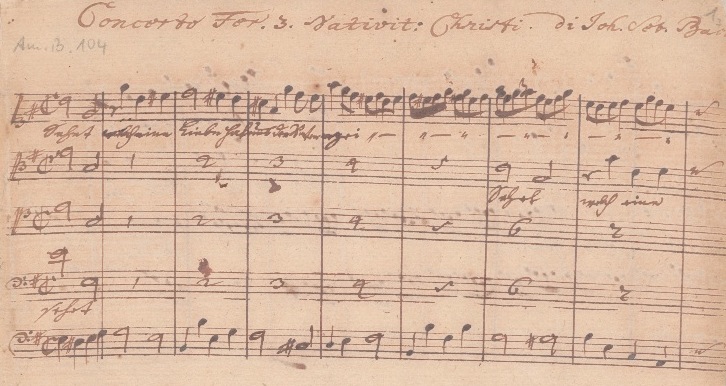
First page of Bach’s original score for cantata 64 Sehet, welch eine Liebe hat uns der Vater erzeiget for the Third Day of Christmas. Staatsbibliothek zu Berlin (Amalienbibliothek), Berlin.
The third cantata of Bach’s Christmas Oratorio was very popular in our house, and it was my sister’s all-time favorite. That is probably why I had never heard the beautiful cantata 64 Sehet, welch eine Liebe hat uns der Vater erzeiget before doing research for this blog, even though it has trombones in the opening chorus and in all three (!) chorales, and Peter Jelosits is singing the soprano aria on the Harnoncourt recording.
Listen to Bach Collegium Japan’s recording of cantata 64 on Spotify. Soloists: Yukari Nonoshita, soprano; Robin Blaze, countertenor; Peter Kooij, bass. With Concerto Palatino: Yoshimichi Hamada, cornetto; Simen van Mechelen, Charles Toet, and Wim Becu, trombones.
Bach wrote this cantata in 1723 and the structure, with the three chorales, is very similar to cantata 40 from yesterday, written that same year.
During his four-week Advent Break that first year in Leipzig (he repeated a Weimar cantata on the first Sunday of Advent, and was not to perform any music in the churches for the next three Sundays), Bach wrote six new cantatas for the period from December 26, 1723, to January 9, 1724 (cantatas 40, 64, 190, 153, 65, and 154). But that was not all. For Christmas Day 1723, he supplemented cantata 63 from Weimar with a newly written Magnificat. Knowing how hard it is for a choir to sing that Magnificat (on the same level as the Mass in B Minor and the Motets), it is clear that Bach did not have a “break” at all, but was very busy rehearsing his choir in addition to writing all this new music.
Wieneke Gorter, December 27, 2016, Harnoncourt link updated December 26, 2019.
Adoration of the Shepherds by Dutch painter Gerard van Honthorst, 1622. Pommersches Landesmuseum (Pomerania State Museum), Germany.
In Bach’s time, there were three Christmas Days. In many countries in Europe there are still two Christmas Days. In the Netherlands, a country so small that you can easily travel to all your relatives within a day, people are expected to visit one side of the family on Christmas Day, and the other side on Second Christmas Day. Or at least that is how I remember it.
Of course, you could continue listening to the Christmas Oratorio, via the links for either Harnoncourt’s recording or Herreweghe’s recording I gave you yesterday. The second cantata is a charming one, evoking the pastoral scene of the shepherds on the field. But this composition has never grabbed or moved me the way the first or fourth cantata of the Christmas Oratorio do. The cantata I am eager to share with you today is cantata 40 Darzu ist erschienen der Sohn Gottes, written for Second Christmas Day in 1723.
The interpretation I grew up with is Leonhardt’s recording from 1974, with countertenor René Jacobs, tenor Marius van Altena, and bass Max van Egmond. There is a good live recording by Herreweghe of this cantata from a concert in Paris in 2015. You can watch this here on YouTube. Soloists are Damien Guillon, alto; Thomas Hobbs, tenor; and Peter Kooij, bass.
This cantata is really Christmas for me. I don’t know exactly why: perhaps because on Second Christmas Day we didn’t have to go to church, so I associate it with a more relaxed, unscheduled day. Perhaps because of the horns in the orchestra in the opening chorus and the tenor aria (I have a soft spot for horns or trombones in Bach cantatas), because of the impressive “Höllische schlange” (Snake of Hell) bass aria (yes, I have a soft spot for bass arias too), or because of the closing chorale that is so pretty, going up so high on the text Wonne, Wonne über Wonne! Er ist die Genadensonne. (Delight, delight upon delight! He is the son of mercy.) I sang this cantata in a Bach cantata reading group mid November this year, sitting directly behind the horns, standing next to one of my best friends, and I couldn’t believe my luck I got to sing this closing chorale.
Wieneke Gorter, December 26, 2016, updated December 24, 2019.




 Weekly Cantata