Weekly Cantata

Weekly Cantata

Tag Archives: Julia Doyle

Bach Cantatas for Christmas – 1724 and 1734 editions

23 Monday Dec 2024

Posted by cantatasonmymind in Cantatas, Chorale cantatas 1724/1725, Christmas, Epiphany, Leipzig

≈ 4 Comments

Tags

Alex Potter, Antonia Frey, baroque-music, Bart Aerbeydt, Bernhard Bechtold, Carine Tinney, Charles Daniels, Christmas, Christmas Oratorio, Collegium Vocale Gent, Concerto Copenhagen, Daniel Johannsen, Eric Milnes, Florian Sievers, Harry van der Kamp, J.S. Bach Foundation, J.S. Bach Stiftung, Jan Kobow, Julia Doyle, Lars Ulrik Mortensen, Lucia Giraudo, Margot Oitzinger, Maria Keohane, Mark Padmore, Matthew Brook, Matthew White, Milo Maestri, Monika Mauch, Montreal Baroque, Netherlands Bach Society, Peter Kooij, Philippe Herreweghe, Rodrigo Lopez-Paz, Rudolf Lutz, Sarah Connolly, Stephan MacLeod, Tomáš Král, Vasiljka Jezovsek

Merry Christmas! Below are my recommendations for recordings of Bach’s chorale cantatas for the Christmas season, written in 1724/1725, as well as a link to the video of this year’s wonderful live performance by the Netherlands Bach Society of Bach’s Christmas Oratorio, written in 1734/1735. Before I get to that, I wanted to share a personal story. (If you want to “jump to the recipe,” just scroll down three paragraphs to the next header).

As regular readers of this blog know, Christmas morning for me = “Jauchtzet, frohlocket,” the first entrance of Bach’s Christmas Oratorio*. But ten days ago, during the first-ever Christmas Oratorio concert of my life as a chorus member, I couldn’t sing those words.

I had unwittingly set myself up for it, because I had just done two things to remember my late mother. It was very cold in the church, and I had lent one of my mother’s scarves to a friend who was singing next to me. As we were getting on stage, I told her: “this scarf has been in many a Bach concert, because my mother used to sing in a Bach choir too.” And then I showed her how I had copied my mother’s signature from her old piano reduction to the new one I was using now.

So while I had been completely fine during all the rehearsals, now with the audience there and those memories, the first notes of the timpani made me choke up. Fortunately, that first soprano entrance is low and doubled by many other voices, so nobody noticed. And I was fine for the rest of the concert, and thoroughly enjoyed getting to sing cantatas 1, 2, 5, and 6 of Bach’s Christmas Oratorio with a good orchestra and great soloists.

Do you have special memories associated with Bach’s or other Christmas music? Please let me know in the comments. Here are my recommendations for recordings:

Christmas Cantatas from Bach’s Chorale Cantata cycle, 1724/1725

Christmas Day: Cantata 91 Gelobet seist du, Jesu Christ by the J.S. Bach Foundation/Rudolf Lutz, with Monika Mauch – Soprano; Margot Oitzinger – Alto; Bernhard Berchtold – Tenor; and Peter Kooji – Bass. Find the score here, and English translations here.

Second Christmas Day: Cantata 121 Christum wir sollen loben schon by Concerto Copenhagen/Lars Ulrik Mortensen, with Maria Keohane – Soprano; Alex Potter – Alto; Jan Kobow – Tenor; and Matthew Brook – Bass. Find the score here, and English translations here.

Third Christmas Day: Cantata 133 Ich freue mich in dir by Concerto Copenhagen/Lars Ulrik Mortensen, with Maria Keohane – Soprano; Alex Potter – Alto; Jan Kobow – Tenor; and Matthew Brook – Bass. Find the score here, and the English translations here.

Maria Keohane

Sunday after Christmas: Cantata 122 Das neugeborene Kindelein by Collegium Vocale Gent/Philippe Herreweghe, with Vasiljka Jezovsek – Soprano; Sarah Connolly – Alto; Mark Padmore – Tenor; and Peter Kooij – Bass. Find the score here, and the English translations here.

New Year’s Day: Cantata 41 Jesu nun sei gepreiset by the J.S. Bach Foundation/Rudolf Lutz, with Julia Doyle – Soprano; Antonia Frey – Alto; Florian Sievers – Tenor; and Stephan MacLeod – Bass. Find the score here, and the English translations here.

Jan 6, Epiphany: Cantata 123 Liebster Immanuel, Herzog der Frommen by Montréal Baroque/Eric Milnes, with Matthew White, alto; Charles Daniels, tenor; and Harry van der Kamp, bass. Find the score here, and the English translations here.

From Bach’s Christmas Oratorio, 1734/1735

Bart Aerbeydt and Milo Maestri
Lucia Giraudo
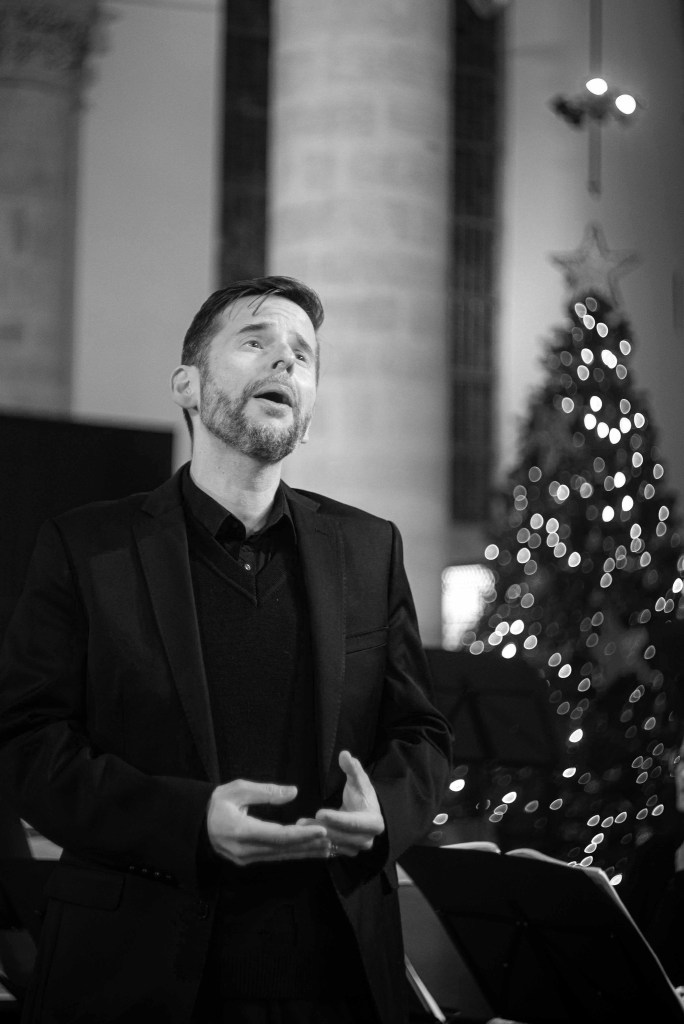
Daniel Johannsen

All photos above by Donald Bentvelsen. Find him on Instagram at @bentvel.

I highly recommend the video of the most recent live performance by the Netherlands Bach Society under the direction of Lars Ulrik Mortensen. They performed cantatas 1, 4, 5, and 6 of Bach’s Christmas Oratorio in the Netherlands earlier this month. I attended the concert in Naarden on December 11, the video below is from the performance in Utrecht, two days later. The choir could have been a bit larger for my personal taste, but for the rest I absolutely loved this performance, with text-focused singing by all soloists, and fabulous and sensitive playing by the instrumentalists, allowing for musical dialogues with the singers. I especially enjoyed the contributions by tenor Daniel Johannsen, oboist Rodrigo Lopez-Paz (photo in my previous post), violinist Lucia Giraudo, and horn players Bart Aerbeydt and Milo Maestri. I very much ejoyed reading the program booklet, especially the the interview with director Lars Ulrik Mortensen.

Read the English program book for this performance here. Read a bit more on the fifth cantata from this same performance in my previous post.

Please consider subscribing to this blog (just click on the button below), it really helps me!

Best wishes for the New Year,

Wieneke Gorter, December 23, 2024.

* if you don’t know the story, please find it here.

The Bachs’ summer trip to Köthen in 1724, new insights, and new videos (BWV 107)

25 Saturday Jul 2020

Posted by cantatasonmymind in Cantatas, Chorale cantatas 1724/1725, Leipzig

≈ Leave a comment

Tags

Anna Magdalena Bach, Bachfest Leipzig, Bachfest Malaysia, Bachstiftung, BWV 107, David Chin, David Yearsley, Encountering Bach, Julia Doyle, Köthen, Makoto Sakurada, Michael Maul, Philippe Herreweghe, Rudolf Lutz, Trinity 7, Wolf Matthias Friedrich

Backside of the complex in which Bach rented an apartment in Köthen from 1719 to 1723. His wedding to Anna Magdalena in December 1721 was celebrated in this house, and several of their fellow court musicians had an apartment here too.

This week I’ve been paying a bit more attention to all the YouTube channels I subscribe to. So I can point you just in time to the live recording of cantata 107 Was willst du dich betrüben by the J.S Bach Foundation. Soloists are Julia Doyle, soprano; Makoto Sakurada, tenor; and Wolf-Matthias Friedrich, bass. My favorite recording of this cantata is still the one by Herreweghe from 1993 (the lines in the opening chorus! the bass solos!) but I love this one by the Bach Foundation too. It is very well done and very moving, and with no live concerts here in California at all yet, I appreciate watching live performances even more right now.

Another YouTube discovery I especially enjoy this Covid summer is the “Encountering Bach” documentary series. This wonderful production by Bachfest Malaysia currently has six episodes available, and more are still to come. The episodes are nice and short (between 8 and 13 minutes), but full of information, and very well geared towards a global audience. Bachfest Malaysia’s artistic director David Chin travels to all the places where Bach worked, and he does this together with German Bach specialist Michael Maul.* In all the locations they get help from local experts, from a soprano soloist who’s also a St. Thomas School mom, to the organist who nowadays plays the “Bach organ” in Arnstadt, to a manuscript specialist of the Bach Archives in Leipzig. Believe it or not, but I myself have never visited any of these places, and I travel vicariously through their experiences.

For the benefit of some more background for this blog post, I’d like you to watch episode 5, which is about Bach’s time in Köthen, and how he appreciated his employer there. It is no problem to watch this before you watch the other episodes. If you have more time, treat yourself to the entire series.

Episode 5 explains that Bach’s employer in Köthen belonged to the Calvinist church, where music other than chorale singing and organ playing wasn’t allowed. However the video also shows the Lutheran church where Bach and many of his fellow court musicians would have attended services. The experts suggest that it could have been here that Bach and friends would have performed re-runs of Bach’s Weimar cantatas. When I watched this, it dawned on me that a scenario I came up with in 2017 should be adjusted a bit.

In my 2017 blog post about Cantata 107, I explained that in July 1724, Bach and Anna Magdalena left Leipzig for a while (anywhere from a few days to almost two weeks) in order to visit their previous employer in Köthen and perform at his castle. Bach had been Capellmeister there, and Anna Magdalena a very highly paid soprano.

In that post, I painted a “movie scenario,” imagining that cantata 107 Was willst du dich betrüben would have been “tested” in the castle in Köthen, but I now realize it would probably have happened in the local Lutheran church instead. And in that case it would not have been very likely that Anna Magdalena would have sung the soprano aria. (Though they might have played the music through at the house of one of the other court musicians, who knows. Hoping that David Yearsley’s book on Anna Magdalena Bach will give me some more clarity on this.)

This all also means that I would like to circle back to my post from last week. I said:

“For 1724, it is very likely that Bach never wrote a cantata that year for this Sunday. Because later in his life, Bach most probably wrote Cantata 9 Es ist das Heil uns kommen her for this moment in the church year, in an effort to fill the gaps within his 1724/1725 chorale cantata cycle.”

That is all still true, but I had obviously forgotten to mention the second reason why there is no cantata from 1724 for Trinity 6, namely that Bach was in Köthen that Sunday. For some of my friends it might come as a relief that I forget some things now and then (you know who you are) but I myself was pretty shocked that I had forgotten this story that I had written about only three years ago.

Wieneke Gorter, July 25, 2020

*Michael Maul, born 1978, has been the Artistic Director of the Bachfest Leipzig since 2018, and is the most famous Bach scholar of his generation.

Alex Potter and Julia Doyle – 6th Sunday after Trinity

17 Friday Jul 2020

Posted by cantatasonmymind in 1723 Trinity season special series, Cantatas, Chorale cantatas 1724/1725, Leipzig

≈ Leave a comment

Tags

1723, 1724, 1726, Alex Potter, All of Bach, Amandine Beyer, BWV 170, BWV 9, Charles Daniels, J.S. Bach Foundation, J.S. Bach Stiftung, Julia Doyle, Leo van Doeselaar, Marc Hantaï, Netherlands Bach Society, Rudolf Lutz, Trinity 6

soprano Julia Doyle, photo by Louise O’Dwyer

In my opinion, one of the absolute best background videos on AllofBach is the one in which countertenor Alex Potter explains the different layers of solo cantata 170 Vergnügte Ruh, beliebte Seelenlust from 1726. I remember how happy and impressed I was when I first found this video. So instead of offering you my own discussion, I suggest you watch Alex Potter’s here on YouTube.

Then watch the excellent and moving live performance of this cantata by Alex Potter with the Netherlands Bach Society here on YouTube.

A lot more information, including the German text with English translations, a list of all participating instrumentalists, the staff that made this beautiful document possible, and a short but insightful interview (in text only) with organist Leo van Doeselaar, can be found here on AllofBach.

Bach’s first two cycles in Leipzig didn’t include a cantata for this Sunday (the 6th after Trinity). My speculations for why this might have happened in 1723 are mentioned in this blog post. For 1724, it is very likely that Bach never wrote a cantata that year for this Sunday. Because later in his life, Bach most probably wrote Cantata 9 Es ist das Heil uns kommen her for this moment in the church year, in an effort to fill the gaps within his 1724/1725 chorale cantata cycle.

There’s a wonderful live performance of Cantata 9 on YouTube, by the J.S. Bach Foundation under direction of Rudolf Lutz. Watch it here. My favorite part of this cantata is the glorious duet Herr, du siehst statt guter Werke, beautifully sung by soprano Julia Doyle and alto Alex Potter. I love how well their voices and singing style match for this! This performance also features exquisite music-making by flutist Marc Hantaï, violinist Amandine Beyer, and tenor Charles Daniels.

Wieneke Gorter, July 17, 2020.

Two Weimar cantatas for the fourth Sunday of Advent

21 Saturday Dec 2019

Posted by cantatasonmymind in Advent, Bach's life, Cantatas, Christmas, Leipzig, Weimar

≈ Leave a comment

Tags

Advent, Advent 4, Alfredo Bernardini, All of Bach, Bachvereniging, BWV 132, BWV 147, BWV 147a, Christmas, Dominik Wörner, Hana Blazikova, J.S. Bach Foundation, J.S. Bach Stiftung, Jakob Pilgram, Jan Kobow, Julia Doyle, Margot Oitzinger, Netherlands Bach Society, Rudolf Lutz, Tim Mead, Weimar, Wolf Matthias Friedrich

For the fourth Sunday of Advent, Bach wrote two cantatas in Weimar: Cantata 132 Bereitet die Wege, bereitet die Bahn in 1715, and Cantata 147a Herz und Mund und Tat und Leben in 1716.

Bach rewrote Cantata 147, the same way he did that with cantatas 70 and 186, into a cantata for another time of the year in Leipzig, in this case the feast of the Visitation on July 2, 1723. Read more about that here in my post from 2016. I have now updated that post with a link to the wonderful live performance of Cantata 147 by the J.S. Bach Foundation, with with Hana Blažiková, soprano; Margot Oitzinger, alto; Jakob Pilgram, tenor; and Wolf Matthias Friedrich, bass.

Cantata 132 was not transformed into a cantata for another time in the church year in Leipzig, so today’s performances of this cantata still reflect the Advent cantata from Weimar. Watch a beautiful live performance of this cantata by the Netherlands Bach Society here on YouTube. Soloists are Julia Doyle, soprano; Tim Mead, alto; Jan Kobow, tenor; and Dominik Wörner, bass.

Find the German text with English translations here, and the score here.

As I already pointed out in my Advent Calendar earlier this week, the text of the joyful opening aria refers to the story of John the Baptist, who was believed to have come to prepare the way for Jesus, and includes the Isaiah quote as it appears in the scripture: “Messias kömmt an!” (The Messiah is coming). Bach gives this text to the soprano three times, and to give it extra emphasis, each time omits all instrumental accompaniment on those three words.

The rest of the cantata stays close to the story of John the Baptist. The bass aria refers to the Pharisees interrogating John, but then Bach’s text writer (Salomo Franck, who was also the Weimar court librarian) projects the question “Wer bist du?” (Who are you?) onto the believer: ask your conscience: are you a true person or a false person?

As a child, I was enormously impressed by this bass aria, even more than by the wonderful soprano aria at the beginning of the piece. I loved how Max van Egmond sings the “Wer bist du?” text on the Leonhardt recording from 1983. You can find that recording, and read more about those childhood memories, in this blog post from 2016. I had no idea at the time that in those very cool opening notes Bach is quoting this organ piece by Buxtehude. I only learned that this week, by watching the “extra videos” the Netherlands Bach Society provides along with their live recordings on All of Bach.

If you are not following this blog yet, please consider signing up (on the left of this text if you are on a desktop computer, at the bottom of this post when you are reading on a smartphone). This way you won’t miss any posts about the many cantatas Bach wrote for all three Christmas Days (yes there were three in his time), New Year’s Day, and the Sundays after those feast days.

Wieneke Gorter, December 21, 2019.

Recent Posts

  • “Missa Miniatura” by CONTINUUM/Elina Albach Even More Moving in 2025
  • Bachfest Leipzig 2025
  • Bach Cantatas for Christmas – 1724 and 1734 editions
  • Fourth Sunday of Advent – more insight into Cantata 62 helped me better understand Bach’s Christmas Oratorio
  • Saint Ambrose and Luther in Milan – Second Sunday of Advent

Archives

  • August 2025
  • July 2025
  • December 2024
  • November 2024
  • June 2024
  • January 2024
  • December 2023
  • October 2023
  • September 2023
  • August 2023
  • April 2022
  • February 2022
  • January 2022
  • December 2021
  • November 2021
  • June 2021
  • May 2021
  • April 2021
  • February 2021
  • January 2021
  • December 2020
  • November 2020
  • October 2020
  • September 2020
  • August 2020
  • July 2020
  • May 2020
  • April 2020
  • March 2020
  • February 2020
  • January 2020
  • December 2019
  • November 2019
  • May 2018
  • April 2018
  • March 2018
  • February 2018
  • January 2018
  • December 2017
  • November 2017
  • October 2017
  • September 2017
  • August 2017
  • July 2017
  • June 2017
  • May 2017
  • April 2017
  • March 2017
  • February 2017
  • January 2017
  • December 2016
  • November 2016
  • October 2016
  • September 2016
  • August 2016
  • July 2016
  • June 2016
  • May 2016
  • April 2016
  • March 2016
  • February 2016
  • January 2016

Enter your email address to follow this blog and receive notifications of new posts by email.

Join 338 other subscribers

Categories

  • 1723 Trinity season special series
  • Advent
  • After Easter
  • Ascension
  • Bach's life
  • Cantatas
  • Chorale cantatas 1724/1725
  • Christmas
  • Easter
  • Epiphany
  • Following Bach in 1725
  • Köthen
  • Leipzig
  • Septuagesima
  • Travel
  • Trinity
  • Weimar

Meta

  • Create account
  • Log in
  • Entries feed
  • Comments feed
  • WordPress.com

Website Built with WordPress.com.

  • Subscribe Subscribed
    • Weekly Cantata
    • Join 158 other subscribers
    • Already have a WordPress.com account? Log in now.
    • Weekly Cantata
    • Subscribe Subscribed
    • Sign up
    • Log in
    • Report this content
    • View site in Reader
    • Manage subscriptions
    • Collapse this bar
 

Loading Comments...