For those of you who have been following this blog for a while now, there’s a beautiful new recording of a pretty aria for this 20th Sunday after Trinity: “Ich bin herrlich, ich bin schön” from Cantata 49 Ich geh und suche mit Verlangen from 1726. Watch Dorothee Mields perform this gem with the Netherlands Bach Society here on YouTube. This live registration (recorded during Covid times so without audience) is extra noteworthy because of a rare appearance of the fabulous Marcel Ponseele on oboe d’amore. For more information (in English!) about this cantata and especially the instruments in this aria, visit the website of the Netherlands Bach Society here and click on “Story”.
Why do all cantatas for this Sunday talk about dressing up? Read about it in my post from 2020, with links to one of the best lectures by Rudolf Lutz of the J.S. Bach Foundation in Switzerland (with English subtitles).
And read my post from 2016 to learn more out about the wedding these cantatas are associated with.
Today is the Third Sunday of Advent. I continue to recommend La Festa Musicale’s beautiful series of Advent Chorales on YouTube. Their offering for this Sunday is Johann Crüger’s 1640 setting of Wie schön leuchtet der Morgenstern (How beautifully shines the morning star). With an almost overwhelming number of performances appearing online over the past weeks, I really wanted to offer some new writing today. There is so much to tell about this particular chorale and all the ways Bach used it in his cantatas. And it helps that today is a rainy Sunday here in the San Francisco Bay Area.
When Crüger wrote his setting in 1640, the chorale melody already existed. The chorale is generally attributed to Philipp Nicolai (1556–1608), but the melody of Nicolai’s hymn might have been based on an existing hymn (with different text) from Wolff Köphel’s 1538 Psalter hymnal. Nicolai wrote the hymn in 1597, when the town where he preached was ravaged by the plague. During that time, as Eduard van Hengel suggests, Nicolai must have had to bury dozens of members of his congregation each day. He published it two years later, as part of a hymnal meant to provide comfort in those trying times, called Freudenspiegel des ewigen Lebens (Mirror of Joy of the Life Everlasting). This publication also featured the famous Wachet auf ruft uns die Stimme (Wake up, the voice calls us).
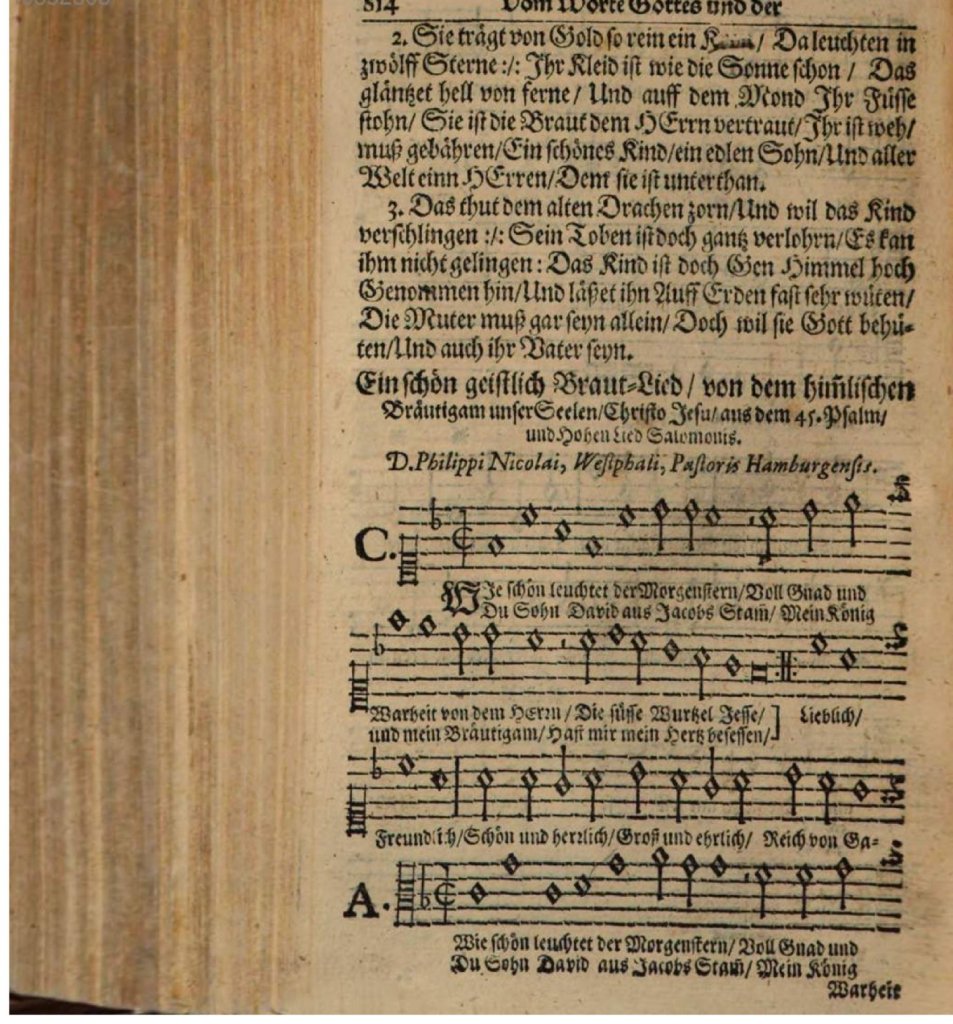
Wie schön leuchtet der Morgenstern in Nicolai’s hymnal from 1599
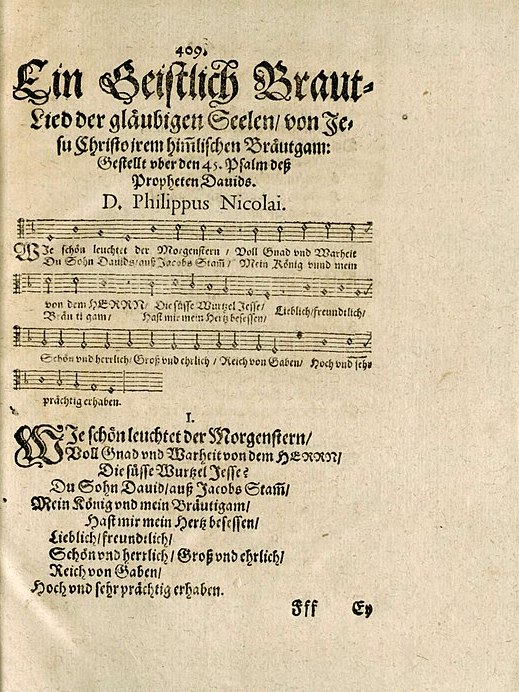
Nicolai’s hymn in a later hymnal which Bach might have used
Wie schön leuchtet der Morgenstern was most likely a compelling chorale for Bach. He used it in many cantatas (see below), but the melody first appears in an organ work. In fact, the score of this organ fantasia on Wie schön leuchtet der Morgenstern (BWV 739) is the oldest surviving manuscript by Bach. Paper analysis has shown that the piece must have been notated between 1703 and 1709. (Thanks to the Netherlands Bach Society for providing this information on their website).
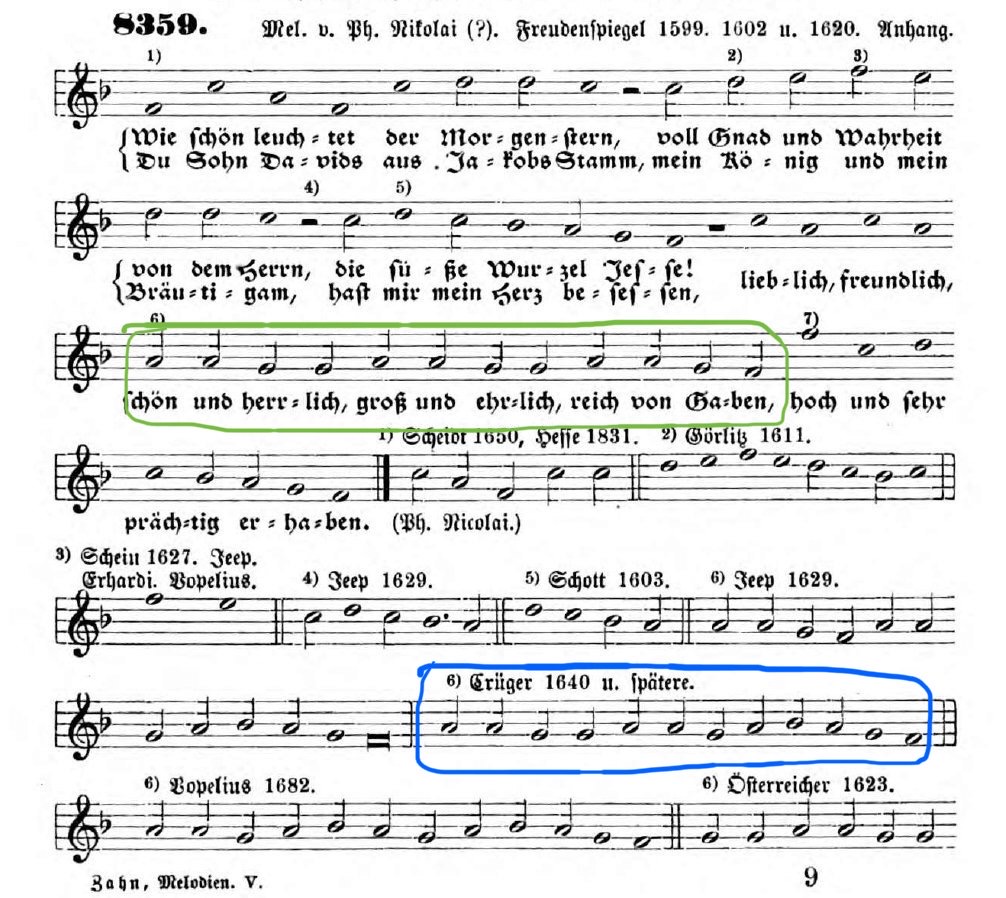
After that, in cantata movements, Bach would either use the original melody (Nicolai’s, see picture above), or Crüger’s version of it. The difference appears in the third line of text, and can be seen in this image, at superscript number 6. Green is Nicolai’s version, blue is Crüger’s.
In these two cantatas, Bach used Crüger’s version:
Cantata 1 Wie schön leuchtet der Morgenstern, written for the Annunciation of Mary, March 25, in 1725. It is one of my favorites because of the two French horns in the opening chorus. This was the last of Bach’s 1724/1725 continuous series of chorale cantatas, and to me, it communicates a similar Advent sparkle as Cantata 62 from that same series.* Per the standard format for these cantatas, Bach featured the first verse of the chorale in the opening movement, and the last verse in the final movement. Watch a live performance of this cantata by the J.S. Bach Foundation here. Soloists are Eva Oltiványi, soprano; Makoto Sakurada, tenor; and Manuel Walser, bass. To understand why it might make sense that the theme of Advent is celebrated on the feast of the Annunciation, please find my blog post from 2018 about Cantata 1 here.
Cantata 36 Schwingt freudig euch empor (Soar joyfully up), an extra-long cantata in two parts, written for the first Sunday of Advent in 1731. The cantata was based on a secular cantata from 1725** but for this First Advent occasion, Bach included several movements based on two Advent chorales: Nun komm, der Heiden Heiland (Come now, Savior of the Gentiles) in the soprano-alto duet, the second tenor aria, and the closing chorale; and the sixth verse of Wie schön leuchtet der Morgenstern in the chorale at the end of Part I of the cantata.
Bach used Nicolai’s version of Wie schön leuchtet der Morgenstern in the following cantata movements, each time in a different way:
The penultimate movement of Cantata 172 Erschallet, ihr Lieder, erklinget, ihr Saiten! (Ring out, you songs, resound, you strings!) for Pentecost in 1714 (verse 4)
The closing chorus from Cantata 61 Nun komm, der Heiden Heiland for the First Sunday of Advent in 1714 (last 4 lines of verse 7)
The chorale for soprano and alto (3rd movement) from Cantata BWV 37 Wer da gläubet und getauft wird (Whoever believes and is baptized) for the feast of Ascension in 1724 (verse 5)
The aria for bass with chorale for soprano (6th movement) from Cantata 49 Ich geh und suche mit Verlangen for the 20th Sunday after Trinity in 1726 (verse 7)
As far as we know, Bach wrote only one cantata for this Third Sunday of Advent. It is the one listed in the BWV catalog as Cantata 186a, Ärgre dich, o Seele, nicht, first performed in Weimar on Sunday December 13, 1716. Read my blog post from 2016 and 2017 about this cantata here.
Wieneke Gorter, December 13, 2020.
*Find my first blog post about Cantata 62 here and a more detailed explanation of how it fits into the series of chorale cantatas here.
**Read more about the history of Cantata 36 in my post from 2017 here.
We don’t have any letters in which Bach writes about his own compositions, so we officially don’t know which ones were his own favorites. But when we see which cantatas he gave a “second life” in another work, and which cantatas were performed by his sons, we can make an educated guess.
Two of these cantatas, Cantata 46 Schauet doch und sehet, ob irgend ein Schmerz sei (from 1723) and Cantata 102 Herr, deine Augen sehen nach dem Glauben! (from 1726), were written for this Sunday, the 10th after Trinity.
Bach gave the opening chorus from Cantata 46Schauet doch und sehet, ob irgendein Schmerz sei a second life in the Qui Tollis in his Mass in B minor. Find a YouTube video of just that opening chorus, from Herreweghe’s performance at the 2013 Saintes Festival in France, here. Find my post from 2016 about this cantata, with links to translations, score, and my favorite recording here.
Cantata 102 Herr, deine Augen sehen nach dem Glauben! received even more second lives (see table below), and was performed at least twice in Hamburg by Bach’s second surviving son, Carl Philipp Emmanuel Bach. My favorite performance of this cantata was the one by Herreweghe I attended in January 2018 at the Bruges Bach Festival, with Dorothee Mields, Alex Potter, Thomas Hobbs, and Peter Kooij. Alas there is no recording of this. Of all recordings currently available, my favorite is here on YouTube, by oboist Marcel Ponseele’s Ensemble Il Gardellino, with Damien Guillon, countertenor; Marcus Ullman, tenor; and Lieven Termont, bass. Especially the Aria Weh der Seele, die den Schaden by countertenor Damien Guillon and oboist Marcel Ponseele (both pictured at the top of this post) is to die for, and this combination of singer and oboist is simply unrivaled by any other recordings.
Find the texts & translations of Cantata 102 here, and the score here.
Movement from Cantata 102
Movement in later work
Opening chorus
Opening chorus of the Missa Brevis in g minor, BWV 235
Alto aria
Soprano aria “Qui tollis peccata mundi” of the Missa Brevis in F Major, BWV 233
Tenor aria
Alto aria “Quoniam to solus sanctus” of the Missa Brevis in F Major, BWV 233
A little more about the early “revival” of this cantata by Carl Philipp Emmanuel Bach. In 1768, C.Ph.E. Bach succeeded Telemann as music director of the five largest churches in Hamburg, and remained in that position until his death in 1788. As such, he performed a handful of his father’s cantatas, albeit with adaptations. In 1776 or 1777 as well as in 1781, he performed Cantata 102 Herr, deine Augen sehen nach dem Glauben!
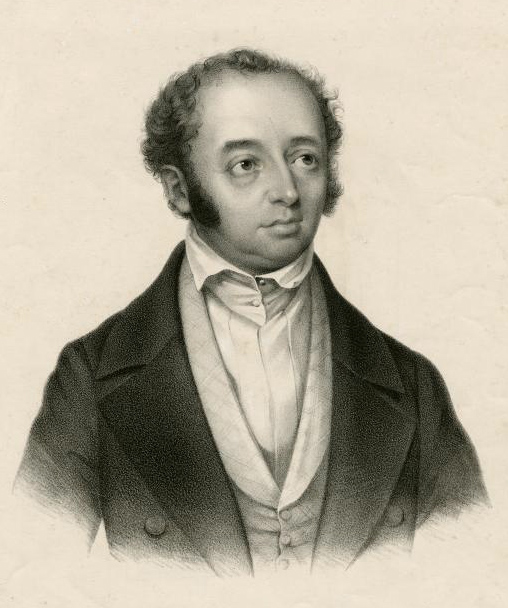
Adolf Bernhard Marx
These early “promotions” of this cantata must have inspired more performances or at least discussions about them, and eventually this composition along with some other cantatas likely reached the circle around Mendelssohn. In 1830, shortly after Mendelssohn’s Berlin revival of Bach’s St. Matthew Passion in 1829, Adolf Bernhard Marx published three Bach cantatas BWV nrs 101, 102, and 103. It was the firsts time since 1709 that a Bach cantata appeared in print.
Christ Taking Leave of the Apostles by Duccio di Buoninsegna, between 1308 and 1311. Tempera on wood. Museo dell’Opera del Duomo, Siena, Italy.
2020 update: If you can afford to financially support the artists, please consider purchasing your favorite recording. Just click on the Amazon or iTunes link at the end of the paragraph that describes the recording.
In 1725, between Easter and Pentecost, Bach set nine cantatas in a row to beautiful poetry by Christiane Mariana von Ziegler: Cantatas 103, 108, 87, 128, 183, 74, 68, 175, and 176. Read more about this multi-talented female librettist, arts benefactor, and fellow Lutheran “preacher” in this post.
The first cantata in this series is Cantata 103: Ihr werdet weinen und heulen, for the third Sunday after Easter in 1725.
My favorite overall recording of this cantata is by Herreweghe, with vocal soloists Damien Guillon, Thomas Hobbs, and Peter Kooij, and Jan Van Hoecke on flauto piccolo. Listen to their opening chorus here on YouTube. Listen to the entire recording by Herreweghe here on Spotify. If you like this recording, please purchase it on Amazon or iTunes.
However for the best energy and intensity in the tenor aria, I prefer Mark Padmore on the Gardiner recording. Listen to their interpretation of the tenor aria here on Spotify. If you like this recording, please purchase it on Amazon or iTunes.
Robin Blaze’s singing and Dan Laurin’s playing in the alto aria on the Bach Collegium Japan recording is exceptional, and perhaps more moving than Damien Guillon’s on the Herreweghe recording. Listen to that aria here on Spotify. And it is a good problem for me, not being able to choose between countertenors 🙂 If you like this recording, please purchase it on Amazon or iTunes.
Find the texts & translations here, and the score here.
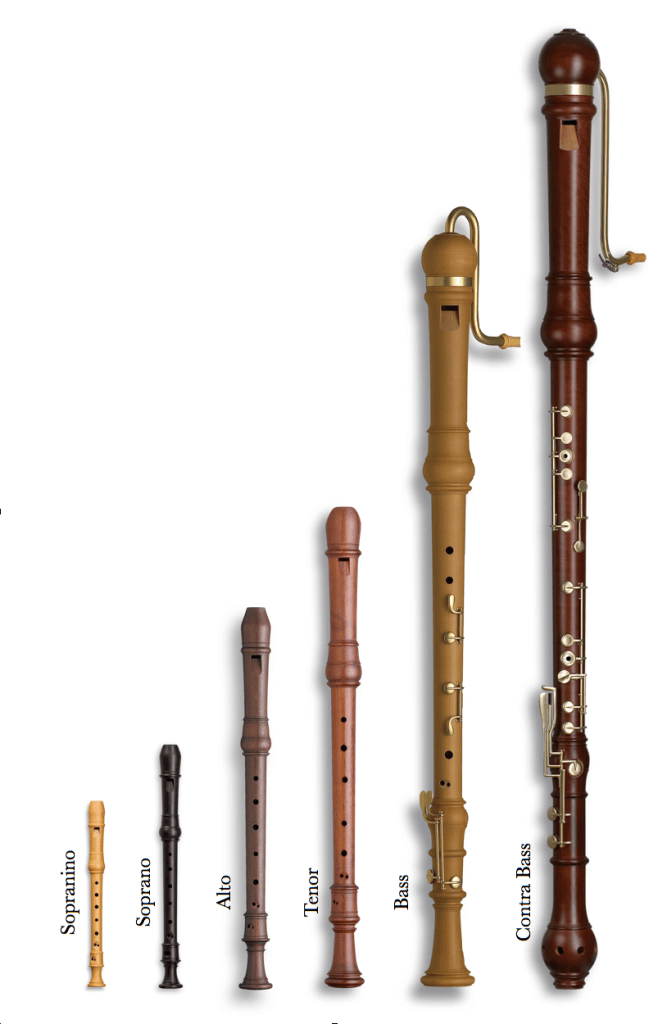
Two noteworthy things about this cantata are the dramatic change from sadness to joy, and the use of the sopranino recorder, or “flauto piccolo” in the opening chorus and the alto aria.
The sadness on this “Jubilate” Sunday is because of the Gospel story for this Sunday: Jesus announces to his disciples that he is going to leave them, and that they will go through a period of hardship during which the rest of the world will mock them. Other cantatas Bach wrote for this Sunday are Cantata 12 Weinen, Klagen, Sorgen, Zagen and Cantata 146 Wir müssen durch viel Trübsal. But in the alto recitative (fourth movement), the turning point is announced: “dass meine Traurigkeit in Freude soll verkehret werden” (that my sorrow will be turned to joy). Bach makes a big deal here of illustrating the word “Freude” and then does that again, even more exuberantly in the tenor aria that follows: there the illustration of the word “Freude” is six measures and almost 100 notes long.
In both cases, Bach used the sopranino part to illustrate the word “Morgenstern” (Morning Star) in the text, creating an extra constellation over the highest notes of the sopranos with the even higher notes of the recorder. It is not completely clear why Bach uses the sopranino this time, in Cantata 103. There are theories that the instrument is meant to illustrate the “mocking” of the outside world. But, as Bach always paints the entire story of a cantata already in the opening chorus, I think he perhaps might have used the recorder to convey the message of “there will be joy at the end” in the otherwise very sad opening chorus. But who knows, his reason for using the instrument might simply have been that the virtuoso player was in town again, since it was around the time of the big Easter Trade Fair that Bach was writing this music.
Whatever the reason, it is very likely that there was only one person in 1725 among Bach’s colleagues who could play this. When Bach performed the piece again in later years, he changed the accompanying instrument in the alto aria to violin. There are also parts for a transverse flute. Herreweghe, Koopman, and Suzuki use a sopranino recorder in the alto aria, while Gardiner uses violin, and Ponseele (on the Il Gardellino recording) uses transverse flute.
To learn more about this cantata, you can now (2020) watch the excellent introduction (“Workshop”) by Rudolf Lutz of the J.S. Bach Foundation here on YouTube. The J.S. Bach Foundation just added English subtitles this video, so it is now also accessible to those who don’t understand German.
I don’t know if it is because the oboes already announce the chorale melody in the instrumental part of this opening chorus, or because of the overall Advent sparkle, but I have always found the first movement of Cantata 62 Nun komm der Heiden Heiland one of the most beautiful of all Bach’s cantata opening choruses. I especially cherish the Herreweghe recording from 1997. Find that recording here on YouTube. Soloists are Sibylla Rubens, soprano; Sarah Connolly, alto; Christoph Prégardien, tenor; and Peter Kooij, bass. This cantata also features an impressive recitative and aria for bass.
I remember an anecdote from my mom’s time as a member of the Twents Bachkoor, somewhere in the early 1980s. Bass soloist Harry van der Kamp showed up for an Advent concert, thinking he was coming to sing the other cantata with the same Nun komm der Heiden Heiland title, Cantata 61, which includes a beautiful recitative for bass (discussed on this blog here), but nothing really challenging for bass otherwise. He found out during the warm-up rehearsal that it was in fact 62. He did a fabulous job and part of my admiration for him stems from witnessing that as an audience member during that concert.
In the bass recitative, listen for Bach’s musical illustration of the words “laufen” (walking — upwards sequence), “Gefall’ne” (fallen — 7th down), and “heller Glanz” (bright luster — a sparkling highest note).
Find the text of Cantata 62 here, and the score here.
Bach wrote this cantata for the first Sunday in Advent in Leipzig in 1724, as part of his series of chorale cantatas of 1724/1725. For nine and a half months, starting on June 11, 1724, he would write every cantata according to this same template: the opening movement is a chorale fantasia on the first stanza of an existing Lutheran hymn or chorale, with the tune appearing as a cantus firmus. The last movement has the last stanza of the same hymn as text, in a four-part harmonization of the tune. The text of those choral, outer movements was used verbatim, while the text of the solo, inner movements was paraphrased, but still based on the inner stanzas of the same hymn.
I have been following all these chorale cantatas in the order they were written in 1724 on this blog. If you missed it, you can start reading here. If you subscribe to this blog (on the left-hand side of this text when reading on a desktop computer, or at the bottom of this text when reading on a smartphone) you will receive an email every time I have posted a new story.
There is also a wonderful live performance by Herreweghe of this cantata on YouTube, albeit with different soprano, alto, and tenor soloists (Grace Davidson, soprano; Damien Guillon, countertenor; Thomas Hobbs, tenor), but again with Peter Kooij singing bass, and again Marcel Ponseele playing first oboe. It was recorded in the St. Roch Church in Paris in 2015 and you can find it here on Youtube. The camera direction in the beginning is a bit strange: perhaps the TV director didn’t know the piece or didn’t have the score in front of her/him, because the camera is on the altos when the sopranos have an entrance, and on the back of the basses and tenors when the altos have an entrance, but later on it gets better, and it is a wonderful selection of Advent and Christmas cantatas they present there in that concert.
The CD recording from 1997 is part of a very good album, which also includes the two other Advent cantatas: Cantata 36 Schwingt freudig euch empor from 1731 (more about this in the next few weeks) and Cantata 61 Nun komm der Heiden Heiland from 1713 (discussed here on this blog). Please consider supporting the artists by purchasing this album in its reprint from 2014. Or purchase the box from 2010, which also includes two CDs with Christmas cantatas.
Excerpt from the manuscript of the alto part for cantata 33 (copied out by Bach’s student Johann Andreas Kuhnau), Leipzig Bach-Archive.
It is now the 13th Sunday after Trinity — time for the story of the Good Samaritan. For a sublime cantata that stays close to that Gospel text, read my earlier post about cantata 77 Bach wrote for this Sunday in 1723.
When Bach receives the libretto for Cantata 33 Allein zu dir, Herr Jesu Christ in 1724, it is -except for one line- not related to the Bible story at all. Maybe he already knows this, since he himself was probably responsible for selecting the chorale to serve as the basis for this cantata: a hymn of penitence from 1540, asking Christ to be freed of the pressing burden of sins. The part of the libretto that might have moved him the most* is this:
Wie furchtsam wankten meine Schritte, Doch Jesus hört auf meine Bitte Und zeigt mich seinem Vater an. Mich drückten Sündenlasten nieder, Doch hilft mir Jesu Trostwort wieder, Dass er für mich genug getan.
How fearfully were faltering my footsteps, but Jesus listens to my entreaties and bears witness for me to his Father. The burden of my sins weighed down heavily on me, but Jesus’ word of comfort reassures me that he has done enough for me.
Wie zittern und wanken Der Sünder Gedanken, Indem sie sich untereinander verklagen Und wiederum sich zu entschuldigen wagen. So wird ein geängstigt Gewissen Durch eigene Folter zerrissen.
How tremble and waver the sinners’ thoughts while they bring accusations against each other and on the other hand dare to make excuses for themselves. In this way a troubled conscience is torn apart through its own torments.
Bach is in general also still exploring ways to get more drama and text illustration into the music of his cantatas without it coming across as too operatic. So after a delicate opening chorus (Gardiner describes this as “an antique ring” in which the ornate beauty of the orchestral setting almost eclipses the inner gem of the hymn setting) and a powerful bass recitative, he writes a heart-wrenching alto aria on the moving text.
Damien Guillon. Photo by Julien Mignot
Click on this link to hear the amazing interpretation by countertenor Damien Guillon and the instrumentalists of Belgian ensemble Il Gardellino. Nobody delivers such a fantastic combination of completely “getting” the text and wonderful, seemingly effortless singing. And listen to how he pronounces the consonants r-ch-t-s in the word “Furchtsam” without any concession to the vowel sounds.
When the libretto finally comes to the only quote of the Good Samaritan story: “I may love my neighbour as myself” in the fifth movement, Bach takes the opportunity to write a striking duet, including the parallel thirds and sixths characteristic of the amorous duets in Venetian operas of the time. If you thought that the famous soprano-alto duet from cantata 78 came out of the blue, here is the artist’s study for it, one week before 🙂
A wonderful live performance of this cantata by the J.S. Bach Foundation is available here on YouTube. Soloists in this video registration are Ruth Sandhoff, alto; Andreas Post, tenor; Markus Volpert, bass.
Wieneke Gorter, September 8, 2017, updated September 1, 2023.
*of course I don’t know for a fact that this was the part of the libretto that moved Bach most. It is the text that moves me most, and of course that is partly because of Bach’s beautiful setting of it.
**and of course I don’t know this for a fact either, but it is the first thing I wrote down when I listened to this cantata, without having read Gardiner’s notes, which state that this alto aria from cantata 33 “bears a striking kinship in mood, subject-matter, and even melodic outline” to the soprano aria from cantata 105. So I am not alone in noticing this.
Paolo Veronese: Jesus Among the Doctors, circa 1560, oil on canvas
Lutherans in the 18th century knew very well that on this Sunday, the first after Epiphany, they should fast-forward twelve years in Jesus’ life, to the story of his parents losing him on a trip to Jerusalem, and then finding him in the temple, conversing with the Doctors. This story often appeared on paintings from the 15th century onward, and the text from Luke was probably as familiar to the Leipzig congregation as the Christmas story :
48. Und da sie ihn sahen, entsetzten sie sich. Und seine Mutter sprach zu ihm: Mein Sohn, warum hast du uns das getan? Siehe, dein Vater und ich haben dich mit Schmerzen gesucht.
[48] And when they saw him, they were astonished. And his mother said to him : ‘My son, why have you done this to us? Your father and I have looked for you with anxiety.’
49. Und er sprach zu ihnen: Was ist’s, daß ihr mich gesucht habt? Wisset ihr nicht, daß ich sein muß in dem, was meines Vaters ist?
[49] And he said to them : ‘How is it that you looked for me?Did you not know that I must be in that which is my father’s?’
In cantata 154 Mein liebster Jesus ist verloren (from 1724, written 3 days after Sie werden aus Saba alle kommen) Bach doesn’t set the scripture literally, except for one of Jesus’ lines of text. He doesn’t let Jesus’ parents talk (as for example Schütz had done 75 years before in his Mein Sohn, warum hast du uns das getan? from Symphoniae Sacrae III) but instead it is “man” in general who thinks he has lost Jesus, and is later happy to have found him again. However, the loss of a child as well as the fear of it happening is something that Bach could relate to, and that drama is palpable in the opening tenor aria.
Find the German text with English translations here, and the score here.
For the rest this cantata feels almost like a little opera, with the very pretty alto aria asking Jesus to please not hide in the clouds, followed by the appearance of Jesus speaking “Wisset ihr nicht, daß ich sein muß in dem, was meines Vaters ist?” and then the exuberant alto/tenor duet rejoicing in the fact that Jesus has been found. Bach uses two special and wonderful orchestrations in this cantata. In the alto aria he uses a “high continuo” with violins and harpsichord to accompany the voice and the oboes, most probably to illustrate purity and innocence. And in the alto/tenor duet Bach brings both the violins of the tenor aria and the oboes from the alto aria together, the first violin and first oboe playing the same part, the second violin and the second oboe also playing the same part, as an additional illustration of the happy reunion and the last two lines of text of the duet:
Ich will dich, mein Jesu, nun nimmermehr lassen, I want never again to abandon you, my Jesus,
Ich will dich im Glauben beständig umfassen. I want to embrace you constantly in faith.
John Eliot Gardiner, in his terrific liner notes with his recording (scroll down to page 6), states that on the text “O Donnerwort in meinen Ohren” (O thunderous word in my ears) in the opening tenor aria, the orchestra should evoke “ear drumming.” (If you would like to listen to this Gardiner interpretation with tenor James Gilchrist, you can find that here on YouTube). Gardiner also points out that this tenor aria is a cousin to Peter’s Ach, mein Sinn! aria from the St. John Passion. That passion would not be performed until Good Friday of that year, 1724, but in his book Bach: Music in the Castle of Heaven Gardiner suggests that Bach was probably working on the passion, and might have been preparing the people in Leipzig for it. This included introducing them to Jesus (even a twelve-year-old one) as a bass voice. This might explain why Bach somewhat unnaturally “interjects” Jesus’ text “Wisset ihr nicht, daß ich sein muß in dem, was meines Vaters ist?” in between the alto aria and the tenor recitative in this cantata.
With cantata 32 Liebster Jesu, mein Verlangen (from 1726), Bach steps even further away from the literal story of this Sunday. It is now not even “man” anymore who has lost Jesus and then finds him again, but the “soul” in the form of a soprano voice, and Jesus. Herreweghe’s first oboist, Marcel Ponseele, recorded a handful cantatas with his own ensemble Il Gardellino and I was excited to find out that they also recorded cantata 32. Beautiful job by soprano Caroline Weynants and of course Marcel Ponseele himself in the pretty opening aria.
In closing, some food for thought: Bach incorporates the text of Psalm 84 Wie lieblich sind deine Wohnungen in the fourth movement of Cantata 32 in the soprano voice. Knowing that Schütz also used that same Psalm text at the end of his Mein Sohn, warum hast du uns das getan?, I wonder if Bach knew that particular Schütz piece and used it as inspiration for this cantata and, who knows, perhaps also for cantata 154, since that one is so operatic, shall we say Schütz-like, in nature and structure …
Wieneke Gorter, January 10, 2016, links updated January 11, 2020.








 Weekly Cantata