Weekly Cantata

Weekly Cantata

Tag Archives: Peter Kooy

Starlight shining on a Trinity cantata

15 Sunday Oct 2017

Posted by cantatasonmymind in Cantatas, Chorale cantatas 1724/1725, Leipzig, Trinity

≈ Leave a comment

Tags

18th Sunday after Trinity, Bach, Bach Collegium Japan, Bachstiftung, BWV 103, BWV 96, Christmas, cornetto, Deborah York, Epiphany, flauto piccolo, flute, Franziska Gottwald, J.S. Bach Foundation, Jan Börner, Julius Pfeifer, Maurice Steger, Nik Tasarov, Noëmi Sohn-Nad, Paul Agnew, Peter Kooij, Peter Kooy, Rudolf Lutz, sopranino recorder, St. Thomas Church, Thomaskirche, Ton Koopman, Trinity 18, Wolf Matthias Friedrich

threekings
The Adoration of the Kings, circa 1440. From a series of four boards from the former High Altar of the Heilig-Kreuz-Münsters in Rottweil, Germany.

In the summer and fall of 1724, Bach wrote an entire series of chorale cantatas, meaning that each cantata was based on a hymn. If at all possible, it was to be a hymn associated with that particular Sunday in the church year.  For this 18th Sunday after Trinity, he chose Herr Christ, der einige Gottessohn (Lord Christ, the only son of God). Keep reading to learn why.

When I first wrote about this Cantata 96 Herr Christ, der einige Gottessohn, in 2017, I recommended Ton Koopman’s recording. Listen to that recording here on Amazon, or here on Spotify. (It is not available on YouTube). Soloists are: Deborah York, soprano; Franziska Gottwald, alto; Paul Agnew, tenor; Klaus Mertens, bass; Heiko ter Schegget, sopranino recorder; and Wilbert Hazelzet, transverse flute.

However, since then a wonderful live video registration by the J.S. Bach Foundation has come out: you can find that here on YouTube. This is a terrific recording as well, with the added bonus that you can see the sopranino recorder and all the other instruments. Soloists in this performance are: Noëmi Sohn, soprano; Jan Börner, alto; Julius Pfeifer, tenor; Wolf-Matthias Friedrich, bass; and Maurice Steger, sopranino recorder.

Find the German text with English translation here and the score here.

In the Lutheran Church the chorale Herr Christ, der einige Gottessohn, one of the oldest Protestant hymns, was not so much associated with this 18th Sunday after Trinity, but more with Epiphany/Three Kings (January 6), for its reference to the Morning Star. Bach brings the luster of the Christmas season into this cantata in the most beautiful way. He gives the opening chorus a dusting of starlight by writing a part for flauto piccolo, or sopranino recorder*, over the rest of the vocal and instrumental parts. Since this time it is the altos that have the chorale melody in the opening chorus, Bach can create an ethereal link between the chorus and the flauto piccolo by way of the soprano part in the chorus. In the fifth line of the text, Er ist die Morgensterne (he is the Morning Star), he modulates to the brilliant key of E Major on the word “Morgensterne.”

But why did Bach select this chorale for a Sunday in the Trinity season? It becomes a bit more clear in the alto recitative and tenor aria. They refer to the fact that Jesus is God’s son, not David’s son. This is the only direct reference to the Gospel reading for this Sunday: Jesus giving the Jewish elders a hard time after they had claimed that he was only David’s son, not God’s son (Matthew 22: 34-46).  In the tenor aria Bach features his star flute player again.

In the soprano recitative, the focus changes to Jesus as guiding light, referring to the “he is the Morning Star” text from the chorale. The soprano’s statement that it can be hard to stay on the “right path” is illustrated in the bass aria.

We have heard faltering steps in Bach cantatas before (read my post about that here), but this time Bach offers a more theatrical illustration. In the St. Thomas Church in Leipzig a visual and aural effect would have made this even stronger: the violins, playing when the bass sings “zu rechten” (now to the right), would have stood on the right-hand balcony, the oboes, playing when the bass sings “zu linken” (now to the left) would have stood on the left-hand balcony. Also, in Bach’s rhetoric, right meant good and high, left meant bad and low.

The middle part of this cantata, with the text “Gehe doch, mein Heiland, mit” (My saviour please come with me) always moves me, especially when Peter Kooij sings it (listen to that here on Spotify, with Bach Collegium Japan).

Wieneke Gorter, October 15, 2017, updated October 8, 2020.

Follow this blog on Facebook or Instagram

*Since his arrival in Leipzig, Bach had used recorders in cantatas quite often (see this image by Nik Tarasov), but this is the very first time he writes for sopranino recorder, or “flauto piccolo.” The second time was on March 25, 1725, in Cantata 1 Wie schön leuchtet der Morgenstern, and the third time on the third Sunday after Easter in 1725, in Cantata 103 Ihr werdet weinen und heulen.
Instrumental solos that bring me to tears and a bit of farmers’ music

07 Saturday Oct 2017

Posted by cantatasonmymind in Cantatas, Chorale cantatas 1724/1725, Leipzig, Trinity

≈ Leave a comment

Tags

17th Sunday after Trinity, Agnès Mellon, BWV 114, BWV 148, flute, Gérard Lesne, Gustav Leonhardt, John Eliot Gardiner, John Elwes, Marc Hantaï, Peter Kooy, Trinity 17

feudalism

Six weeks ago, I noticed that Bach’s cantatas for the 11th Sunday after Trinity all give me a good kind of stomach ache. This week, it seems that all instrumental solos for the 17th Sunday after Trinity make me cry. It happened last year when I was listening to the violin solo in cantata 148, and it happened to me again this year with the hauntingly beautiful flute solo in the tenor aria of cantata 114 Ach, lieben Christen, seid getrost, from 1724.

It is an exceptional aria, ten minutes long, and extremely demanding for the tenor as well as the flutist. Bach must have been proud of it, because later, in January 1725, he turned this composition into a much faster paced, condensed piece of drama for tenor and oboe d’amore in Cantata 124 Meinen Jesum laß ich nicht.

The first recording I listened to set the standard for the rest: a fabulous flutist, most probably Marc Hantaï, and tenor John Elwes on a live audio recording from 1988 by La Chapelle Royale under the direction of Gustav Leonhardt.  I absolutely adore Frans Brüggen’s flute playing on the Leonhardt recording from 1980, but don’t enjoy Kurt Equiluz’ singing as much. Mark Padmore’s singing on the Gardiner recording is to die for, but flutist Rachel Beckett’s decisions on where to breathe are not as sensitive as Marc Hantaï’s, and with Hantaï’s interpretation already in my head, I found it distracting. The same goes for Wilbert Hazelzet’s playing on the Koopman recording, with tenor Christoph Prégardien.

elwes-john-2
John Elwes
marchantaii
Marc Hantaï

This La Chapelle Royale/Gustav Leonhardt recording is also a nice monument from the past for me, since it has all the soloists I was in love with at the time: soprano Agnès Mellon, countertenor Gérard Lesne, and bass Peter Kooy. When you watch the YouTube recording on a screen, you can read along in the score. And that is interesting in this case, especially in the opening chorus and the soprano aria.

Find the German text with English translation of this cantata here.

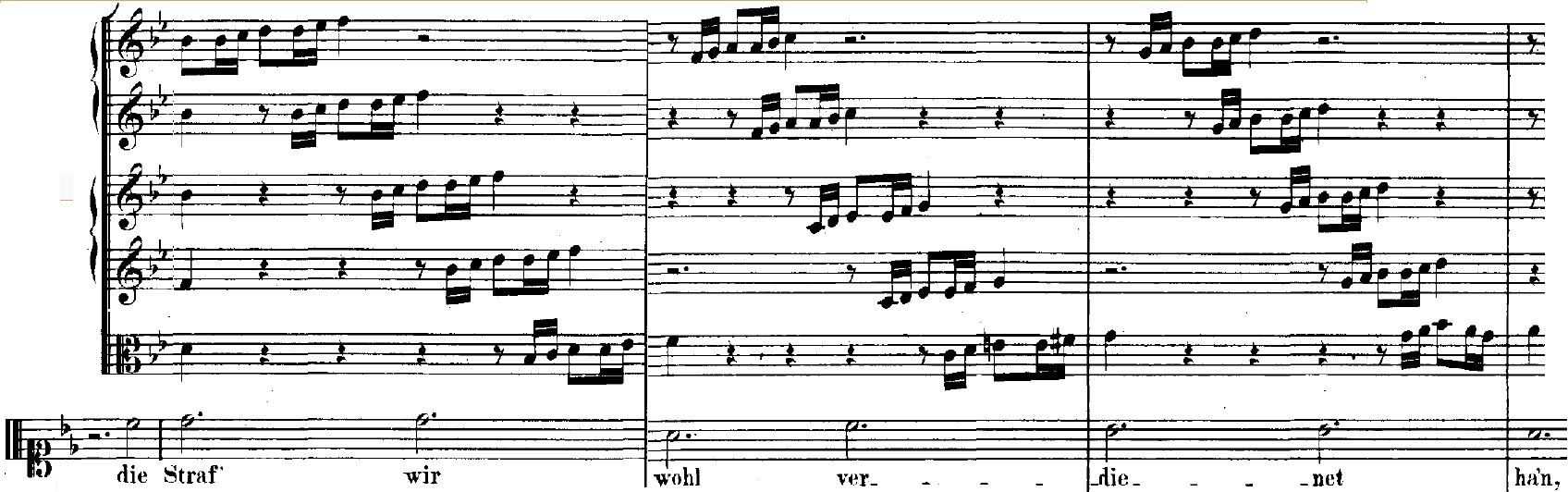
Starting at the beginning, reading along with the opening chorus, you can see that the joyful figure that is at first only in the continuo (orchestra bass) part, spreads through all the other parts, a message from Bach that the consolation in the text of the chorale is more important than the punishment. The punishment is still present though, in the repeated staccato notes in some of the instrumental parts, and, at 2 minute 24 seconds, visually only, in the score: there are the three whip lashes diagonally from top to bottom over the page in the instrumental parts, illustrating the word “Straf” (punishment) the chorus sings there. Or see this image, courtesy of Eduard van Hengel:

114-120straf20gr

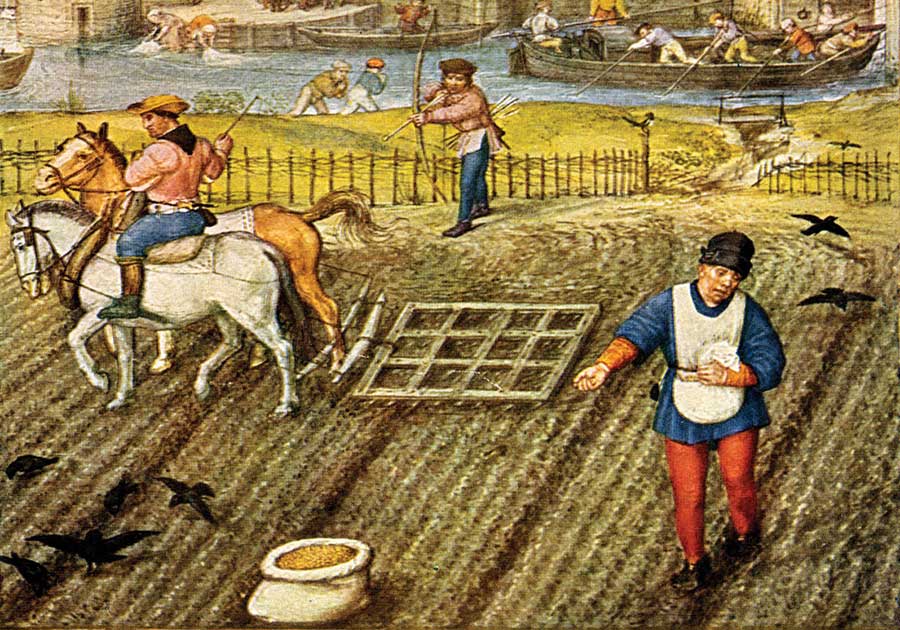
When reading along with the soprano aria, at 15 minutes 5 seconds, you can see or hear how in the continuo part, Bach illustrates the flick of the wrist of the farmer who sows the seeds.  If you have time, I encourage you to also listen to Gardiner’s remarkable take on this soprano aria. In his notes accompanying his live recording, he explains that the text “The grain of wheat will bear no fruit unless it fall into earth” can be seen as a warning to the farmer to get his timing right when sowing his winter cereals. Gardiner, a sheep farmer in his spare time and always eager to point out connections to the seasons in Bach’s music, is obviously really excited to bring out this text: he has the entire soprano section sing it, with much more fervor and much better enunciation than Agnès Mellon on the Chapelle Royale/Leonhardt recording. He also explains in his notes that they took Bach’s indication “continuo unisono” to mean that the organ should double the cello part. Since they always use church organs for their recordings, it sounds impressive. I truly appreciate hearing this movement performed this way.

Then go back to the Chapelle Royale/Leonhardt recording, and listen to Gérard Lesne, my first countertenor love*, spookily illustrating the approach of death, with similar chromatic lines as in last week’s arias.

©Wieneke Gorter, October 6, 2017, links updated October 2, 2020

*Read all about my love for Gérard Lesne in this post

The perfect combination of Bach’s writing & Herreweghe’s interpretation

29 Saturday Jul 2017

Posted by cantatasonmymind in Cantatas, Chorale cantatas 1724/1725, Leipzig, Trinity

≈ Leave a comment

Tags

Agnès Mellon, Collegium Vocale Gent, Howard Crook, Peter Kooy, Phlippe Herreweghe

dt5476

The Miracle of the Loaves and Fishes by Jacopo Tintoretto, circa 1545-1550, Metropolitan Museum of Art, New York.

1724: Bach has returned from his visit to Köthen (see previous post).

2017: I am still in Europe, but my daughter’s choir tour is done, and so is my daily commitment to write a blog for the parents who stayed back in California.

As I continue to follow Bach in 1724, the cantata for today, the 7th Sunday after Trinity, is cantata 107 Was willst du dich betrüben. If you only listen to one cantata this summer I suggest you listen to Herreweghe’s recording of this one. You will not regret the perfect combination of some of Bach’s best writing with Herreweghe’s sensitive interpretation. Find Herreweghe’s recording (from 1993, with Agnès Mellon, soprano; Howard Crook, tenor; and Peter Kooij, bass) here on YouTube. Consider purchasing it here — this album also contains the beautiful cantata 93 from two weeks ago. My favorite movements are the fabulous opening chorus, the bass recitative and aria that follows, superbly sung by Peter Kooij, and the tenor aria because of the flutes. I also love Agnès Mellon’s angelic singing in the soprano aria.

Find the text and translations here, and the score here.

A few weeks ago I explained that Bach started his second Leipzig cycle with a series of chorale cantatas, and that he would stick to that same format for nine and half months (read more about this in this post). He built all 44 cantatas in this period on a similar foundation: setting the verses of the chorale verbatim for the opening and closing choruses, while setting poetry based on the verses for the inner movements. While Bach collaborated with a librettist (probably the same one) for all of these cantatas, there was one exception within that 1724/1725 series: all of the words for cantata 107 Was willst du dich betrüben were copied verbatim from the chorale text.

We can only speculate as to why this happened. His librettist might have been sick or away.  Or did Bach perhaps compose this cantata during his visit to Köthen (see last week’s post)? We only know that he and Anna Magdalena performed at the court in Köthen, but we don’t know how long they stayed there.

I have loved this cantata 107 since I first heard it on the Herreweghe recording in the early 1990s. Just listen to that opening chorus: Bach’s excellent and poignant writing combined with the fabulous sustained lines of the Collegium Vocale chorus (read my posts about their sopranos here and their altos here) and Herreweghe’s calm tempo, and continuous focus on the direction and destination of the musical lines.

I am in movie-script mode again and taking the liberty to imagine Bach writing this cantata in Köthen, maybe even performing (parts of) it there too with all the wonderful musicians at that court, and Anna Magdalena singing the soprano aria. Bach could very well have been inspired by the change of scenery, time away from his hectic Leipzig house, and enjoying the company of his former colleagues in Köthen, all excellent musicians. If we follow this train of thought, it is not surprising that he assigns 2/3 of the principal music in the opening chorus to the orchestra and only 1/3 to the choir, and writes the closing chorus as if it were one of his orchestral suites. It has been suggested that Bach convinced one of the flute players at the Köthen court, Johann Gottlieb Würdig, to accompany him to Leipzig and stay there for a few months.

Wieneke Gorter, July 27, 2017.


Blogging from Greece

15 Saturday Jul 2017

Posted by cantatasonmymind in Cantatas, Chorale cantatas 1724/1725, Leipzig, Trinity

≈ 1 Comment

Tags

Agnès Mellon, BWV 93, Charles Brett, Howard Crook, Peter Kooy, Phlippe Herreweghe

File Jul 15, 15 46 01.jpeg
Kaisariani monastery near Athens, Greece
bloggingfromGreece

For today, the 5th Sunday after Trinity, I’m running out of time to write a post about the beautiful cantata 93 Wer nur den lieben Gott lässt walten Bach wrote for this Sunday in 1724. So I’ll just give you my favorite recording (by Herreweghe, with soloists Agnès Mellon, soprano; Charles Brett, countertenor; Howard Crook, tenor; and Peter Kooij, bass), the text & translations, and the score.

My reason is a good one: I’m on tour with my daughter’s youth choir to Greece, and I’m in charge of the blog for that tour (so parents who stay at home know we’re still alive and happy) and that’s taking up most of my limited wifi time on the island of Syros. It’s a really hard life being a blogger here 😉

kaisariani_interior.jpg

I’m very happy, because at the beginning of this week I got to see the 11th/12th century Kaisariani monastery, about 10 kilometers outside of Athens. I found out about this building once while looking for images for this blog. The cross-in-square, domed church has some beautiful wall and ceiling paintings dating from the 18th century; those in the narthex date back to 1682.

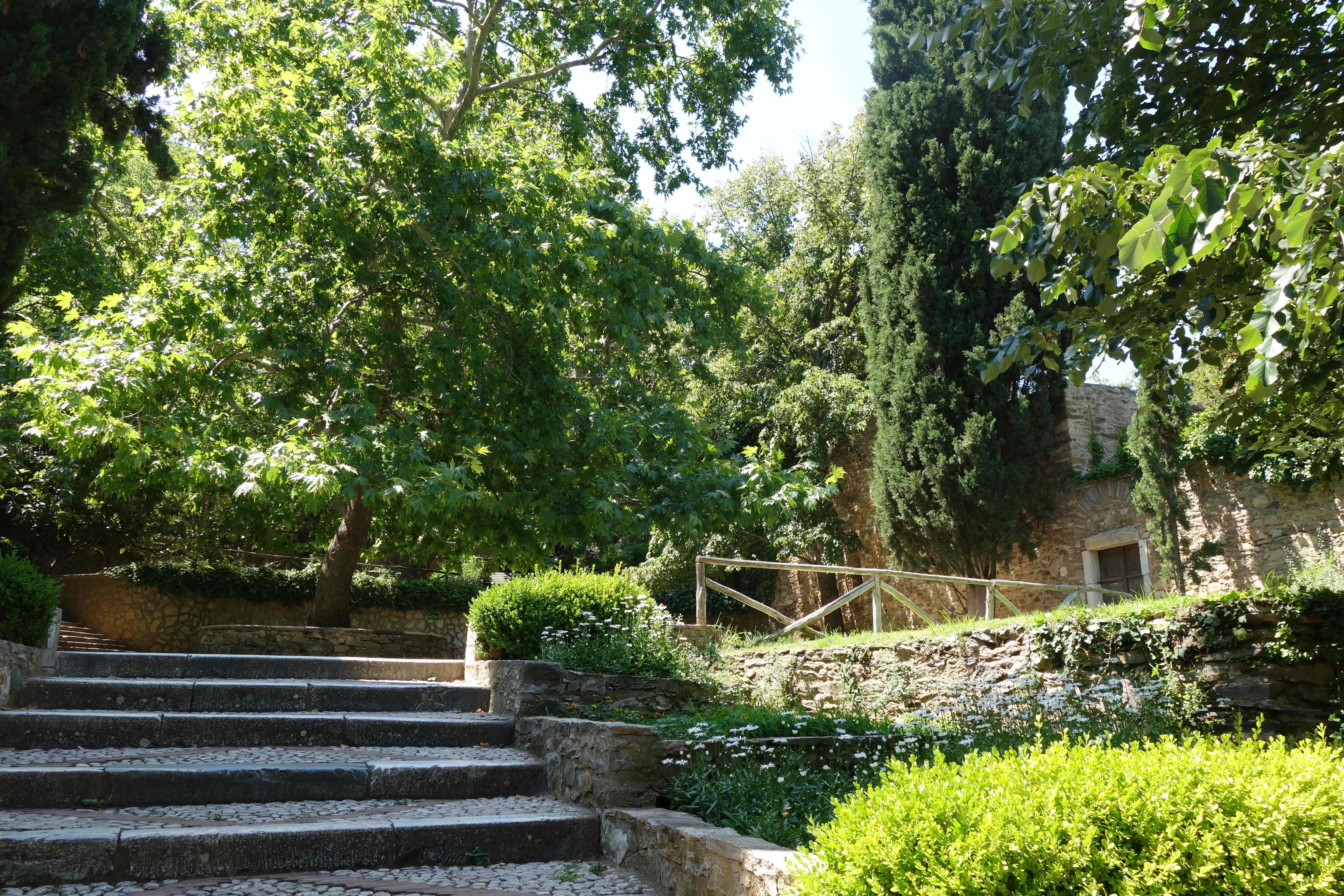
I loved seeing the paintings “live” and took lots of pictures to use in future blog posts, but also very much enjoyed the quiet (only a handful of other tourists were there), the forest air, and the gardens:

kaisariani_plants

Wieneke Gorter, July 15, 2017.

A double bill for July 2

01 Saturday Jul 2017

Posted by cantatasonmymind in Cantatas, Chorale cantatas 1724/1725, Leipzig, Trinity

≈ Leave a comment

Tags

Bach Collegium Japan, Deborah York, Gerd Türk, Pascal Bertin, Peter Kooy, Ton Koopman

In my effort to follow Bach’s compositions in the order in which he wrote them in 1724, I sometimes get a bit confused, because in 2017 the Sundays of the church year are exactly one week later than in 1724. Where it gets tricky is around the Feast days of St. John and the Visitation of Mary, which are always on the same date: June 24 and July 2 respectively.

See how the dates of 1724 compare to the dates of 2017 in this table here below, and you’ll understand my dilemma for today: in Bach’s time, if the feast of the Visitation fell on a Sunday, it would cancel out the theme and thus the cantata for that Sunday. That is why there is no cantata for Trinity 4 from 1724, and why Weekly Cantata will be on break next week.

Sunday/Feast day17242017Cantata
Trinity 1June 11June 1820: O Ewigkeit, du Donnerwort
Trinity 2June 18June 252: Ach Gott, vom Himmel sieh darein
St. John (Johannis)June 24June 247: Christ, unser Herr, zum Jordan kam
Trinity 3June 25(July 2)135: Ach Herr, mich armen Sünder
Visitation (Mariä Heimsuchung)July 2July 210: Meine Seele erhebt den Herren
Trinity 4July 2July 9(no cantata from 1724 because same day as Visitation)
Trinity 5July 9July 1693: Wer nur den lieben Gott lässt walten
Trinity 6July 16July 23(no cantata from 1724 because of Bach’s visit to Köthen)
Trinity 7July 23July 30107: Was willst du dich betrüben
Trinity 8July 30Aug 6178 Wo Gott der Herr nicht bei uns hält

So officially, I should present you only with the cantata for the feast of the Visitation today, but since we are listening in order of 1724, I give you some highlights of cantata 135 Ach Herr mich armen Sünder first. An update from 2021: Since I first wrote this post, a beautiful live video recording of this cantata has been released on YouTube by the J.S. Bach Foundation. Find it here.

The cantata is the last of the set of four I described in this post, and thus has the cantus firmus in the bass in the opening chorus. This is nicely done on the J.S. Bach Foundation recording, with a trombone doubling the choral bass part. But the best choral basses are still on the recording by Bach Collegium Japan. Listen to that recording on Spotify.

While the boy sopranos have a bit more work in the opening chorus (as was the case the last two weeks), there is again no soprano aria in this cantata. The Leipzig congregations haven’s heard a soprano solo since Trinity Sunday.

But then, on July 2, 1724, they get to hear the cantata for the feast of the Visitation: cantata 10 Meine Seel erhebt den Herren. With a soprano aria directly after the opening chorus, and a virtuoso one too. It might be that a talented new student had enrolled in the school, or Bach was finally ready training one, or there is a talented boy visiting for the holiday.* There is a very nice live video of Ton Koopman performing this in the St. Thomas Church in Leipzig during the Bach Festival there in 2003, with Deborah York singing the soprano aria.

Wieneke Gorter, July 1, 2017. Updated March 26, 2020, and June 19, 2021.

*Read more about the possibility of musicians visiting for this feast day in my post from last year about the Visitation. Read more about the soprano problem in this post.

First Sunday after Easter 1724

23 Sunday Apr 2017

Posted by cantatasonmymind in After Easter, Bach's life, Cantatas, Leipzig

≈ Leave a comment

Tags

Alex Potter, Bach, cantatas, corno da tirarsi, Jos van Veldhoven, Peter Kooy, Thomas Hobbs, tromba da tirarsi

caravaggio_-_the_incredulity_of_saint_thomas

The Incredulity of Saint Thomas by Caravaggio, 1601-1602, Sanssouci Palace, Potsdam, Germany

In the past two weeks I ran out of time to work on this blog because of being sick, performing concerts with California Bach Society, and being on a trial jury for the first time since becoming a United States citizen in 2011. So this post for the First Sunday after Easter in 1724 is post-dated, and short, but contains lots of information to learn more about this beautiful cantata.

Previously in 1724: Bach “premiered” his Passion according to St. John on Good Friday, April 7, 1724. Then he ran out of time and energy and, without too much care for detail and text illustration, created cantatas out of existing music for Easter Monday and Easter Tuesday of that year.

This means that the first new composition he wrote after the St. John Passion was this cantata 67 Halt im Gedächtnis Jesum Christ (keep thinking of Jesus Christ), based on the Gospel text of Jesus appearing to his disciples. A famous cantata, already known and admired in the early 19th century, especially because of the dramatic fourth movement for choir and bass, which Bach would later transform into the Gloria of his Missa Brevis in A (BWV 234).

For the background of this cantata I will refer you to the experts, in this 15-minute video by the Netherlands Bach Society, published within their AllofBach series. The video is in Dutch, with English subtitles. It talks about Bach including a flute (not a recorder!) for the first time in a cantata, the meaning behind the text, and the use of the slide-trumpet “corno da tirarsi.”

Listen to and watch their performance here, find the text here, and find the score here. The Netherlands Bach Society, conducted by Jos van Veldhoven, with countertenor Alex Potter, tenor Thomas Hobbs, and bass Peter Kooij.

Wieneke Gorter, April 30, 2017.

Easter Monday 1724

17 Monday Apr 2017

Posted by cantatasonmymind in After Easter, Bach's life, Cantatas, Leipzig

≈ Leave a comment

Tags

Collegium Vocale Gent, Easter Monday, James Taylor, Kai Wessel, Peter Kooy, Phlippe Herreweghe

Screenshot 2017-04-17 11.44.51

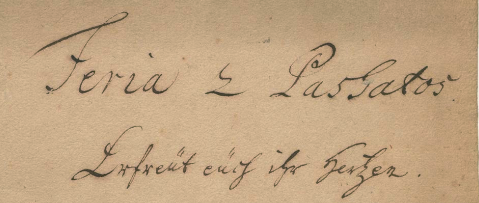
Excerpt from the title page of Bach’s manuscript from 1735 of cantata 66 Erfreut euch ihr Herzen. The manuscript from 1724 did not survive.

In Bach’s time there were three Easter days, as there were three Christmas days and three Pentecost days. I wrote yesterday that Bach planned to write four new works between April 10 and 23, 1724, but that is only somewhat true, it depends who you ask …

Gardiner believes that what Bach planned to do after Easter 1724,  was to write cantata 6 for Easter Monday, 42 and 67 for the first Sunday after Easter, and 85 for the second Sunday after Easter, instead of writing 6, 42, and 85 in 1725. As he painstakingly explains in his book “Bach: Music in the Castle of Heaven,”  Gardiner believes that the work (composing and rehearsing) on the Passion according to St. John must have cost Bach much more time than he thought, and he thus had to adjust his plans.

Following Gardiner’s theory, when Bach realized he had too much on his plate for Easter 1724, including having to write a cantata for Easter Tuesday he might not have planned on, he decided to write parodies (using existing music with some changes, but with different texts) for Easter Monday and Easter Tuesday of that year.

For Easter Monday 1724, he wrote cantata 66 Erfreut euch, ihr Herzen. Most of the music of this cantata is based on the secular cantata 66a Der Himmel dacht auf Anhalts Ruhm und Glück (Heaven thinks of Anhalt’s Fame and Fortune) , composed by Bach in 1718 to celebrate the 24th birthday of Prince Leopold of Anhalt-Cöthen. If you have 40 minutes, listen to a reconstruction of the entire Birthday cantata 66a from 1718 here, with soprano Gudrun Sidonie Otto, alto Wiebke Lehmkuhl, tenor Hans Jörg Mammel, and bass Karsten Krüger. If you only have 10 minutes, scroll to 11:17 for the soprano/alto duet with violin.

Listen to Herreweghe’s recording of cantata 66 Erfreut euch, ihr Herzen here. Soloists: alto Kai Wessel, tenor James Taylor, and bass Peter Kooij. I like Herreweghe’s recording of this cantata the best of all I listened to, because to me the tempo of the opening chorus is perfect for me, Collegium Vocale’s singing is fabulous as always, and I enjoy listening to Peter Kooy in the bass aria.

Find the text of cantata 66 here, and the score here.

Since we only have a manuscript of this cantata from 1735, when Bach repeated this cantata in Leipzig, we don’t know for sure what Bach changed in 1724.  However, based on what we know, and comparing the two recordings I present in this post, Bach used the following movements from the Köthen Birthday cantata 66a in the Leipzig church cantata 66: The impressive and very festive opening chorus of 66 is the closing chorus of 66a, the bass aria of 66 is the alto aria of 66a, and the alto-tenor duet (beautifully sung by Kai Wessel and James Taylor) with violin of 66 is the soprano-alto duet with violin from 66a.

Movement 4 and 5 (the recitative and duet for alto and tenor) are written as a dialogue. Whenever Bach uses that technique in his church cantatas, the two characters are usually Jesus and the Soul (see for example cantata 21). In this case, the Happiness of Anhalt (the alto) from 66a has been transformed to Furcht (Fear) in 66, and  Fama (the godess of fame and reputation, soprano in 66a) has been transformed to Hoffnung (Hope, tenor in 66). With these two characters Bach refers to the Gospel reading of the day: two followers of Jesus walk to the town of Emmaus, only a few days after Jesus’ death and burial. They talk about their hope that he was the Messiah, but are at the same time fearful having heard the news that his body has disappeared from the grave.

In the Birthday cantata 66a, the two characters are in agreement, and therefore sing the same notes. However in cantata 66 Furcht and Hoffnung often disagree, even though they are still singing the same notes. Normally Bach would never have let this happen, but perhaps this is an illustration of how quickly he had to work on this cantata for Easter Monday.

Wieneke Gorter, April 17, 2017

Come out of your hole to hear a violin concerto

03 Friday Feb 2017

Posted by cantatasonmymind in Cantatas, Christmas, Epiphany, Leipzig

≈ Leave a comment

Tags

Bach, Bach Collegium Japan, James Gilchrist, Leipzig, Luther, Masaaki Suzuki, Peter Kooy, Robin Blaze

presentationinthetemple
Presentation in the Temple (1640/1641) by Simon Vouet (1590-1649). Musée du Louvre, Paris.

In many traditions, from pre-Christian European to contemporary American, February 2 marks the end of the dark part of the winter.  Feasts on this day celebrate the daylight, looking ahead to spring, and the start of new things. Growing up in a Calvinist protestant culture in the Netherlands, I wasn’t aware of any of these holidays.

Let’s start with the silly American holiday on February 2: Groundhog Day. If the groundhog (some sort of marmot) comes out of her hole on this day while it is cloudy, spring will be early; if it is sunny and the groundhog will thus see her own shadow when she comes out of her hole, she will be scared and go back inside and spring won’t start for another six weeks. Grown men actually observe the groundhogs on February 2.

People from Celtic cultures celebrate Imbolc or Brigid’s Day on February 2 because it is the midway point between the winter solstice and the spring equinox. The holiday is a celebration of the lengthening days and the early signs of spring. The lighting of candles and fires represented the return of warmth and the increasing power of the Sun over the coming months.

The Catholic feast of Candlemas also originates in pre-Christian times, and originally marked the end of a period of light feasts which started around mid November. After the early Christians established that Jesus was born on December 25, it was easy to declare Saint Martin (Nov 11, 40 days before Christmas) the start of the great Christmas season and February 2 (40 days after Christmas) the end of it. I read that in some countries people leave their Christmas decorations up until Candlemas. I would have loved to have that tradition in the Netherlands too, because I had serious trouble with the bleak, grey, uneventful month of January there. And all procrastinators are now absolved: you didn’t know it, but you were doing the right thing to leave those lights up until February!

The Catholic Church merged Candlemas with the feast of the Purification of Mary and the Presentation of Jesus at the Temple. In the Jewish tradition, a new mother was “unclean” for the first 40 days after giving birth. On the 40th day, she would have to visit the temple for a purification ceremony, and to present her son to the priests. Luther kept this Catholic feast on the calendar, but  focused much more on the Presentation of Jesus at the Temple  than on the Purification of Mary.  What is more, he turned Simeon’s song of praise into a message of “Now I can die in peace.” This is why all five cantatas (BWV 82 (the famous Ich habe genug), 83, 125, 157, and 158) Bach wrote for this holiday are mostly about the joy of dying. But not to worry, the cantata from 1724 is actually very festive.

Listen to/watch cantata 83 Erfreute Zeit im neuen Bunde by the Netherlands Bach Society on YouTube. Shunske Sato, violin and direction; Robin Blaze, alto; Daniel Johannsen, tenor; Stephan MacLeod, bass. I prefer this recording because this cantata is a violin concerto and here we can see one of the best Baroque violinists and Bach interpreters, Shunske Sato, at work.* However for the most magical rendition of the second movement please also listen to the Bach Collegium Japan recording (Natsumi Wakamatsu, violin; Robin Blaze, alto; James Gilchrist, tenor; Peter Kooij, bass)

Find the German text with English translations of Cantata 83 here, and the score here.

The first and third movement  are written like a violin concerto and celebrate the “new” era. According to an excellent study by Dutch musicologist Pieter Dirksen, presented at a Bach Symposium in Germany in 2000, the impressive violin part was most likely written for violin virtuoso Johann Georg Pisendel from Dresden. Dirksen makes a very convincing case that Bach wrote this past Sunday’s operatic cantata 81 and this cantata 83 (both from the same week in 1724) specifically to please musicians and perhaps also dignitary guests from Dresden, giving them the two musical forms the Dresden court favored most: an opera in the form of cantata 81 and a concerto in the form of cantata 83. There are no documents supporting the suggestion that Pisendel was in Leipzig around the time this cantata was played. However, as I have mentioned before in this blog, it seems evident from Bach’s writing around special holidays that there were either guest musicians or colleagues to impress in those weeks. Also, Dirksen gives many plausible examples of links to Dresden in the style and instrumentation of these compositions, and argues that Bach had no other violinist available, including himself, who would have been able to play this and that this is why he didn’t write virtuoso violin solos in any cantatas from the first Leipzig cycle.

The second movement symbolizes the “old” tradition Simon stands for in the Gospel story. In a way he has never done this in any other cantata, Bach sets Luther’s translation of Simeon’s words (“Herr, nun lässest du deinen Diener in Friede fahren …”) to the old Gregorian psalmtone for Nunc Dimittis, which was the Roman version of Simeon’s words. It is likely he wanted to show the Catholic guests from Dresden he was familiar with their tradition too, or perhaps he wanted to honor the Catholic history of this feast day. The very best rendition of this movement is sung by Peter Kooij on the Bach Collegium Japan recording of this cantata. My late mother used to say: “Peter Kooij must have a special line with God.” He definitely has a special line with Bach.

Wieneke Gorter, February 2, 2017, updated February 2, 2020 and February 2, 2023.

*read how Shunske Sato’s playing made me want to write for this blog again in this post

A Discovery for Third Christmas Day

27 Tuesday Dec 2016

Posted by cantatasonmymind in Bach's life, Cantatas, Christmas, Leipzig

≈ Leave a comment

Tags

Bach, Bach Collegium Japan, Christmas, Leipzig, Peter Jelosits, Peter Kooy, Robin Blaze, trombone

bwv64facsimile
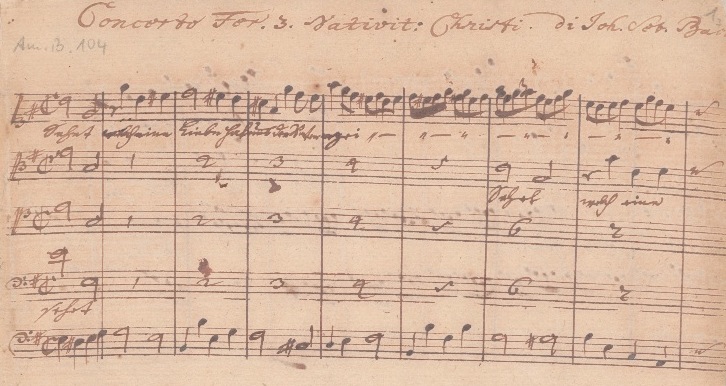
First page of Bach’s original score for cantata 64 Sehet, welch eine Liebe hat uns der Vater erzeiget for the Third Day of Christmas. Staatsbibliothek zu Berlin (Amalienbibliothek), Berlin.

The third cantata of Bach’s Christmas Oratorio was very popular in our house, and it was my sister’s all-time favorite. That is probably why I had never heard the beautiful cantata 64 Sehet, welch eine Liebe hat uns der Vater erzeiget before doing research for this blog, even though it has trombones in the opening chorus and in all three (!) chorales, and Peter Jelosits is singing the soprano aria on the Harnoncourt recording.

Listen to Bach Collegium Japan’s recording of cantata 64 on Spotify. Soloists: Yukari Nonoshita, soprano; Robin Blaze, countertenor; Peter Kooij, bass. With Concerto Palatino: Yoshimichi Hamada, cornetto; Simen van Mechelen, Charles Toet, and Wim Becu, trombones.

Find the text here, and the score here.

Bach wrote this cantata in 1723 and the structure, with the three chorales, is very similar to cantata 40 from yesterday, written that same year.

During his four-week  Advent Break that first year in Leipzig (he repeated a Weimar cantata on the first Sunday of Advent, and was not to perform any music in the churches for the next three Sundays), Bach wrote six new cantatas for the period from December 26, 1723, to January 9, 1724 (cantatas 40, 64, 190, 153, 65, and 154). But that was not all. For Christmas Day 1723, he supplemented cantata 63 from Weimar with a newly written Magnificat. Knowing how hard it is for a choir to sing that Magnificat (on the same level as the Mass in B Minor and the Motets), it is clear that Bach did not have a “break” at all, but was very busy rehearsing his choir in addition to writing all this new music.

Wieneke Gorter, December 27, 2016, Harnoncourt link updated December 26, 2019.

Third Sunday in Advent: Two adorable infants and a reconstruction of cantata 186a

10 Saturday Dec 2016

Posted by cantatasonmymind in Advent, Cantatas, Weimar

≈ Leave a comment

Tags

Advent, Advent 3, Bach, BWV 186, BWV 186a, cantatas, chorales, Collegium Vocale Gent, Miah Persson, Peter Kooy, Phlippe Herreweghe, reconstruction, Robin Blaze, Weimar

madonna_meadow

Madonna with the Christ Child and St. John the Baptist, also known as Madonna of the Meadow, by Raphael, 1506. Kunsthistorisches Museum, Vienna.

For those of you who already saw this on the third Sunday of Advent 2016: please keep reading, because I considerably revised this post, clarifying the information about the reconstruction and including one more painting 🙂

Growing up, I had a cousin. She was almost exactly six  months older than me. My baby photo album holds several pictures of the two of us together, me a helpless baby, her an infant who could already sit up by herself. I’m always touched by those photos. Not just because they make me think of the cousin I lost when we were both 19, but also because they represent how fast a baby grows up, and how soon the “older” baby can be of help and entertainment for the younger one, and how adorable it is to see that.

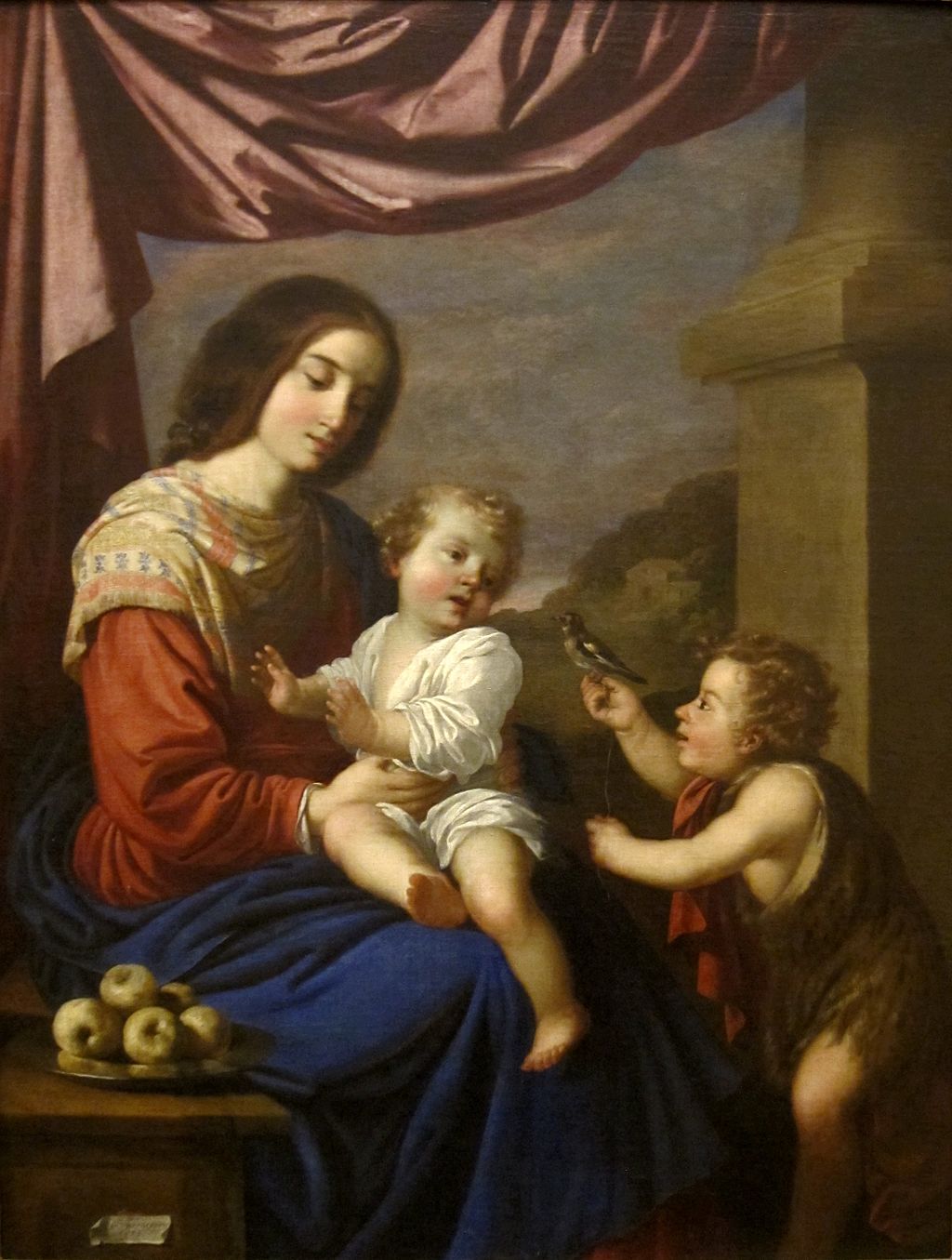
Many painters were aware of this cuteness factor too. Especially in the Renaissance, the concept of a one-year-old John playing with or helping a six-month-old Jesus in Madonna and Child paintings became an extremely popular subject, starting with  Leonardo da Vinci. Raphael in particular painted several variations on this theme, including the Alba Madonna, La belle jardinière, Aldobrandini Madonna, Madonna della seggiola, and the Madonna dell’Impannata. The tradition continued well into the 17th century, see this beautiful example from 1658 by Francisco de Zurbarán in the San Diego Museum of Art:

Zurbaran_Madonna_and_Child

Why is all this relevant to Advent? Well, on this third Sunday of Advent, many Christian churches read about John the Baptist, as they believe John was Jesus’ forerunner. Because of a mention in the Gospel of Luke, the Catholic church in the very early Middle Ages determined that St. John’s birthday must have been exactly six months before Christmas — and decided to celebrate this on June 24th.*  You can read more about this in my post about the Feast of St. John.

As far as we know, Bach wrote only one cantata for this Sunday, the third Sunday of Advent. It is the one listed in the BWV catalog as Cantata 186a, Ärgre dich, o Seele, nicht, first performed in Weimar on Sunday December 13, 1716. No original music score is left of this cantata. However, thanks to Bach’s librettist, Weimar court poet Salomo Franck, who published the full libretto for this cantata in a poetry volume in 1717, we do have the original text of 186a.

And, it is not hard to make an educated guess as to what the music would have been.

On July 9, 1723, for the 7th Sunday after Trinity in Leipzig, Bach expanded the music of the 1716 Weimar cantata with four additional recitatives and two chorales (per his usual template for reviving Weimar cantatas for Leipzig), and we do have that music: it is Cantata 186, also with the title Ärgre dich, o Seele, nicht.**

To reconstruct the original 1716 Weimar Advent version, or Cantata 186a, one would have to eliminate all the recitatives Bach added in 1723 as well as both chorales, superimpose different texts on some of the arias, and select alternative music for the original closing chorale. There have been a few performances of these kind of reconstructions, but unfortunately there are no recordings of those.

So I invite you listen to Bach Collegium Japan playing this music via my playlist on Spotify. To imagine the original texts superimposed over this music, and learn why I selected this particular closing chorale, please keep reading.

Opening chorus: This has the same text in 1716 as in 1723. We should imagine a smaller ensemble singing this though, as the maximum number of singers in the Weimar chapel was 7. This opening chorus is again a beautiful example of how Bach provides an “entrada” for the Duke as well as an opportunity for himself to show off his skills with the “fashionable” music, the way he almost always did in the Weimar cantatas.***

Ärgre dich, o Seele, nicht,
Daß das allerhöchste Licht,
Gottes Glanz und Ebenbild,
Sich in Knechtsgestalt verhüllt,
Ärgre dich, o Seele, nicht!
Do not be confounded, o soul,
because the all-highest light,
God’s radiance and very image,
is concealed in the form of a servant;
do not be confounded!

For the Bass aria, imagine this Advent text instead of the Trinity 7 text you hear (changes in bold type):

Bist du, der da kommen soll,
Seelen-Freund, in Kirchen-Garten?
Mein Gemüt ist Zweifels-voll,
Soll ich eines andern warten!
Doch, o Seele, zweifle nicht.
Lass Vernunft dich nicht verstricken,
Deinen Schilo, Jacobs Licht,
Kannst du in der Schrift erblicken!
Are You He, who should come,
Friend of souls, to the Church’s garden?
My spirit is full of doubt,
perhaps I should wait for someone else!
Yet, o soul, do not doubt.
Do not let reason beguile you.
Your Messiah, Jacob’s light,
is visible to you in the scripture.(translation of original text by me, unchanged words courtesy of bach-cantatas.com website)

For the Tenor aria,  imagine this Advent text instead of the Trinity 7 text you hear (changes in bold type):

Messias läßt sich merken
Aus seinen Gnaden-Werken.
Unreine werden rein.
Die geistlich Lahme gehen,
Die geistlich Blinde sehen
Den hellen Gnaden Schein.
The Messiah lets Himself be seen
in His works of grace.
The impure become purified.
Those lame of spirit will walk,
Those blind of spirit will see
the clear brilliance of the mercy.(translation of original text by me, unchanged words courtesy of bach-cantatas.com website)

There is only one word change in the Soprano aria: In the last line the 1716 text is “des Lebens Wort” instead of “das Lebenswort” from 1723.

Die Armen will der Herr umarmen
The Lord will embrace the poor
Mit Gnaden hier und dort;
With his mercy here and there;
Er schenket ihnen aus Erbarmen
Out of his compassion he sends to them
Den höchsten Schatz, das Lebenswort.
His greatest treasure, the word of life.

Enjoy Miah Persson’s beautiful voice and interpretation. If you would like to hear and more about her, read my post about cantata 179. Cantata 179 appears on the same album by Bach Collegium Japan as this cantata 186.

Soprano-alto duet: This is the original text from 1716, unchanged in 1723. The text promises the believer the crown (die Krone) of the everlasting life, but only if he stays faithful (getreu) and only in the afterlife, when free of the body (wenn des Leibes frei).

Laß, Seele, kein Leiden
My soul, let no sorrow
Von Jesu dich scheiden,
Separate you from Jesus
Sei, Seele, getreu!
Be faithful, my soul!
Dir bleibet die Krone
The Crown weight you
Aus Gnaden zu Lohne,
Is your reward through grace
Wenn du von Banden des Leibes nun frei.
When you will be free from the body’s prison.

In Weimar in 1716, for the closing chorale Bach used the 8th verse of Von Gott will ich nicht lassen from 1563, based on the French tune Une jeune fillette from 1557. Since this is not the same melody as Es ist das Heil uns kommen her Bach used in 1723 it is very plausible that both chorales from the 1723 version are new, in text as well as in music. So in an effort to reconstruct the 1716 version,  we need to think of a different solution for the music than the tune from 1723. A good fit would be a simple setting of the Von Gott will ich nicht lassen chorale, the way Bach would set for example verse 5 of this chorale as closing movement of cantata 73 in 1723 or 1724. So that’s why, for now, I’ve included that music (from a Herreweghe recording) in the Spotify playlist. The text would be this:

Darum ob ich schon dulde
Hie Wiederwärtigkeit,
wie ich auch wohl verschulde,
kommt doch die Ewigkeit,
ist aller Freuden voll,
die ohne alles Ende,
dieweil ich Christum kenne,
mir widerfahren soll.
Therefore, even if I endure
unpleasantness here,
as I have well deserved,
eternity is coming
filled with all joy;
this for ever
will befall me
while I acknowledge Christ.

All translations of existing text and closing chorale courtesy of bach-cantatas.com website, translations of changed texts by me.

© Wieneke Gorter, December 10, 2016, revised December 15, 2017.

* Luke 1:36 (about the Annunciation) mentions that the angel Gabriel also informed Mary that her cousin Elizabeth was already six months pregnant. The June 24 date was most probably also chosen to give a Christian meaning to already existing Pagan Midsummer celebrations. The Feast of St. John being celebrated on June 24 shows up in records as early as the year 506.

**I discussed this 1723 version of the cantata here, and recommended the recording by Bach Collegium Japan with soprano Miah Persson, alto Robin Blaze, tenor Makoto Sakurada, and bass Peter Kooij.

***Read more about Bach’s Weimar cantatas in my posts about cantata 182, 12, 147, and 21

← Older posts
Newer posts →

Recent Posts

  • “Missa Miniatura” by CONTINUUM/Elina Albach Even More Moving in 2025
  • Bachfest Leipzig 2025
  • Bach Cantatas for Christmas – 1724 and 1734 editions
  • Fourth Sunday of Advent – more insight into Cantata 62 helped me better understand Bach’s Christmas Oratorio
  • Saint Ambrose and Luther in Milan – Second Sunday of Advent

Archives

  • August 2025
  • July 2025
  • December 2024
  • November 2024
  • June 2024
  • January 2024
  • December 2023
  • October 2023
  • September 2023
  • August 2023
  • April 2022
  • February 2022
  • January 2022
  • December 2021
  • November 2021
  • June 2021
  • May 2021
  • April 2021
  • February 2021
  • January 2021
  • December 2020
  • November 2020
  • October 2020
  • September 2020
  • August 2020
  • July 2020
  • May 2020
  • April 2020
  • March 2020
  • February 2020
  • January 2020
  • December 2019
  • November 2019
  • May 2018
  • April 2018
  • March 2018
  • February 2018
  • January 2018
  • December 2017
  • November 2017
  • October 2017
  • September 2017
  • August 2017
  • July 2017
  • June 2017
  • May 2017
  • April 2017
  • March 2017
  • February 2017
  • January 2017
  • December 2016
  • November 2016
  • October 2016
  • September 2016
  • August 2016
  • July 2016
  • June 2016
  • May 2016
  • April 2016
  • March 2016
  • February 2016
  • January 2016

Enter your email address to follow this blog and receive notifications of new posts by email.

Join 338 other subscribers

Categories

  • 1723 Trinity season special series
  • Advent
  • After Easter
  • Ascension
  • Bach's life
  • Cantatas
  • Chorale cantatas 1724/1725
  • Christmas
  • Easter
  • Epiphany
  • Following Bach in 1725
  • Köthen
  • Leipzig
  • Septuagesima
  • Travel
  • Trinity
  • Weimar

Meta

  • Create account
  • Log in
  • Entries feed
  • Comments feed
  • WordPress.com

Website Built with WordPress.com.

  • Subscribe Subscribed
    • Weekly Cantata
    • Join 158 other subscribers
    • Already have a WordPress.com account? Log in now.
    • Weekly Cantata
    • Subscribe Subscribed
    • Sign up
    • Log in
    • Report this content
    • View site in Reader
    • Manage subscriptions
    • Collapse this bar
 

Loading Comments...