
Tags
1st Sunday of Advent, Advent, Advent 1, Bach-Archiv Leipzig, BWV 36, BWV 61, BWV 62, Freiberg, J.S. Bach Foundation, Rudolf Lutz, Seiffen
In German-speaking countries, people wish each other a “schönen” (beautiful, pleasant), “lieblichen” (lovely, love-filled), or “besinnlichen” (thoughtful, contemplative) Advent. I wish you all of that, and of course: happy reading and listening!
As far as we know, Bach wrote three cantatas for this First Sunday of Advent. From the dozen posts I wrote about these cantatas over the past ten years, I have selected three listening guides, one for each cantata.
For Sunday, December 2, 1715, in Weimar, Bach wrote Cantata 61 Nun komm, der Heiden Heiland. He performed this cantata again on Sunday, November 28, 1723, during his first year in Leipzig. Please find my listening guide for this cantata here. I wrote this ten years ago, but have updated all the links.
On Sunday, December 3, 1724, during Bach’s second year in Leipzig, his chorale cantata year, the congregation got to hear a new cantata with the same name, Cantata 62 Nun komm, der Heiden Heiland. Two years ago, I created the English translations for Lydia Vroegindeweij’s listening guide to this cantata. It is extremely well laid out and easy to follow, and contains a wealth of new insights about this cantata.
If, after reading Lydia’s listening guide, you would like to listen to the entire cantata again, I recommend the recording by the J.S. Bach Foundation. Why this recording? When, in 2022, Lydia and I searched for the best interpretation of the tenor aria from Cantata 62, i.e. the one that really emphasizes the “wonder,” our prize went to Jan Kobow on the Gardiner recording from 2000. Listen to it here. Kobow does a beautiful job expressing the wonder, not only in the first phrase, but also in the B-section when he sings “o, Wunder”. He also makes a striking contrast between those wondrous and quiet-making aspects of the miracle and the stronger, more convinced text of “Herrscher.” But, when I heard and saw Benedikt Kristjánsson sing on the recording with the J.S. Bach Foundation, his singing struck me as the perfect illustration of “God encompasses the whole world with that kind of mystery.”
For Sunday, December 2, 1731, Bach transformed a secular birthday cantata from 1725 into Cantata 36 Schwingt freudig euch empor. This fabulous explanation by Rudolf Lutz (With English subtitles created by the J.S. Bach Foundation, not auto-generated!) is the perfect listening guide for this cantata. Then, watch the video registration of their concert in Trogen, Switzerland, in 2007 here.
Please feel free to share this article with a friend or relative, with the choir you sing in, or with anyone you think who might appreciate it. Not an email subscriber yet? You can sign up below, and you will receive an email each time I publish a new article.
© Wieneke Gorter, November 27, 2026.
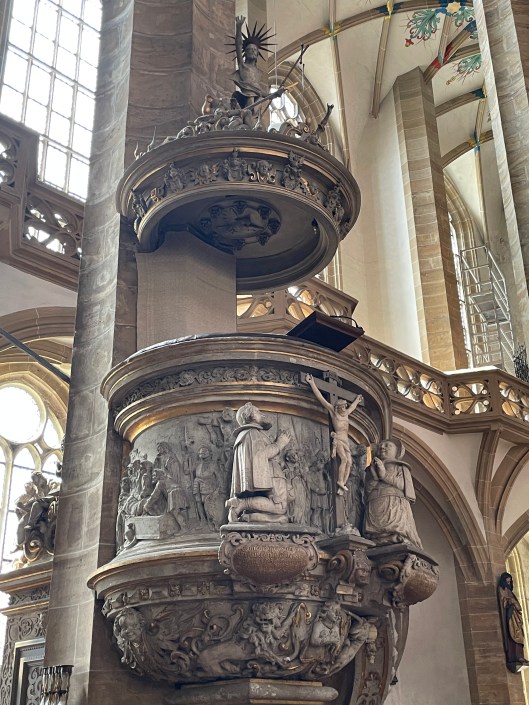
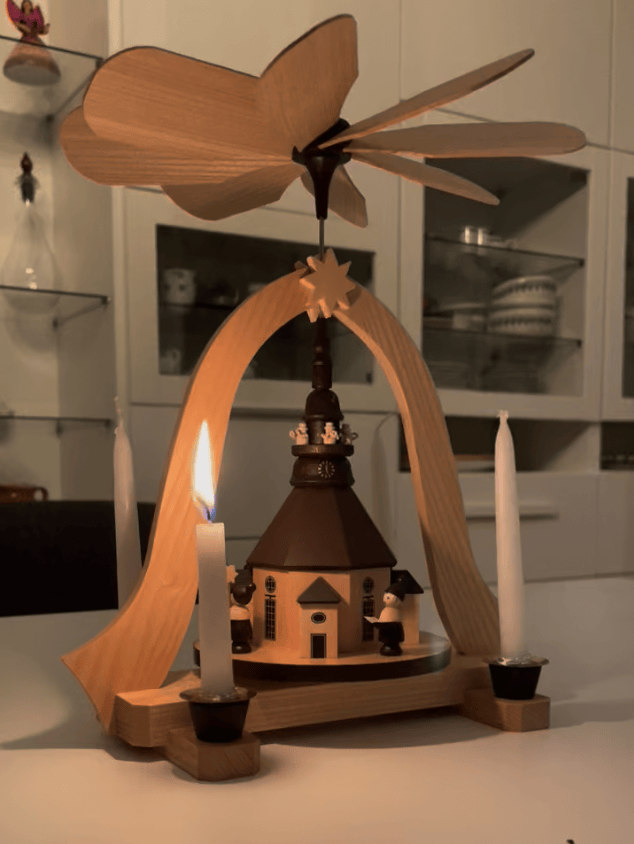
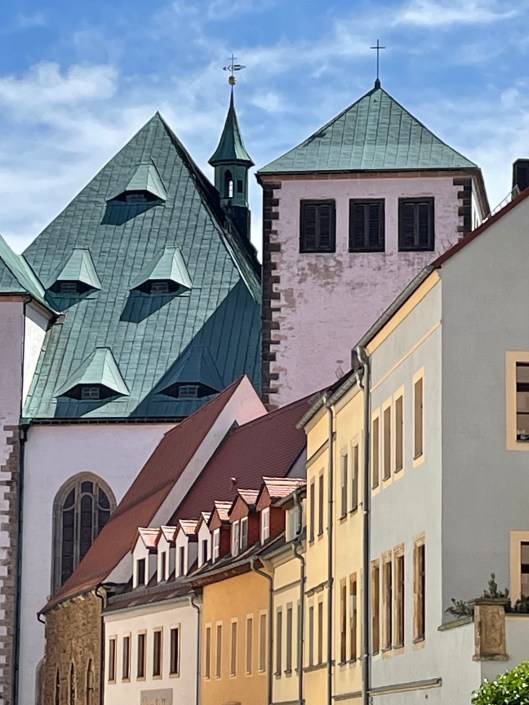
Photos at the top of this post: Left and right: Interior and exterior of the incredibly beautiful Cathedral of Freiberg, in the Erzgebirge (Iron Mountains) region of Germany. Middle picture: the “Advent Pyramid” (with choral singers walking around the church and town pipers playing from the tower) I purchased in Freiberg in June 2024, during Bachfest Leipzig. The church in the pyramid is modeled after the one in Seiffen, about 40 km (25 miles from) from Freiberg. All photos by me.

