Weekly Cantata

Weekly Cantata

Category Archives: Cantatas

A female librettist and an inspired recording

01 Sunday May 2016

Posted by cantatasonmymind in After Easter, Cantatas, Leipzig

≈ Comments Off on A female librettist and an inspired recording

Tags

Bach, cantatas, Christiane Mariana von Ziegler, John Eliot Gardiner

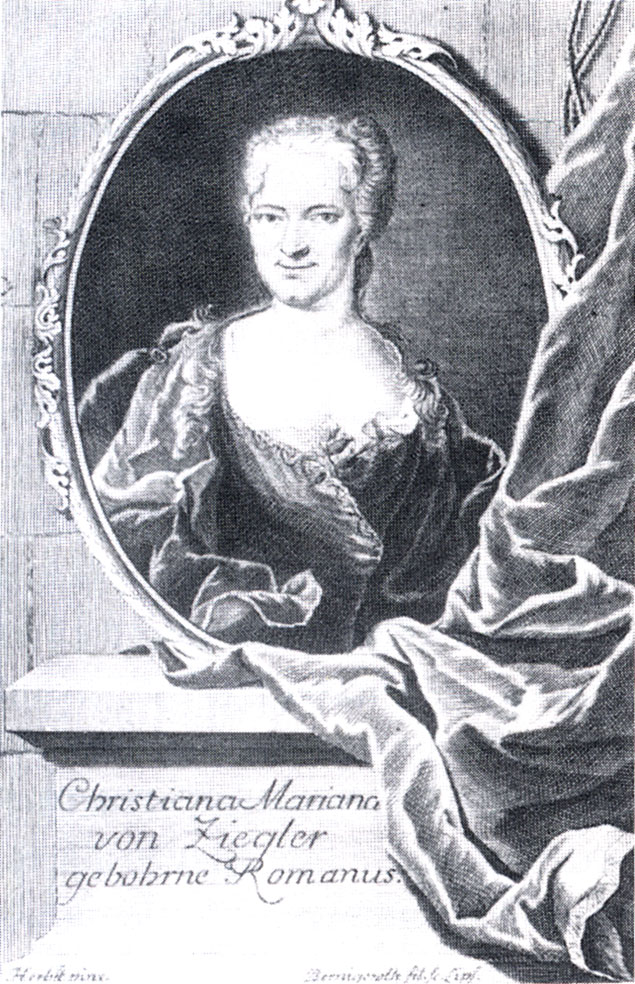
ziegler-christiane-mariane-02

In 1725, between Easter and Pentecost, Bach set nine cantatas in a row to texts by Christiane Mariana von Ziegler (1695–1760). And it is in part thanks to her poetry that I’m favoring the cantata from 1725 over the one from 1724  for this “Rogate” Sunday – the fifth Sunday after Easter.

This cantata 87 from 1725, Bisher habt ihr nichts gebeten in meinem Namen, contains two jewels of arias: the alto aria (no 2) and the tenor aria (no 6). Von Ziegler’s poetry combined with Bach’s sublime scoring in those arias completely knocked me over when I first listened to this cantata this week. I found Gardiner’s recording of this cantata (which I happened upon by accident – read more about this at the very end of this post) the most moving.

Listen to Gardiner’s recording of cantata 87 on Spotify.

Listen to Gardiner’s recording of cantata 87 on YouTube (there might be some ads in here – you can click to skip them after a few seconds).

Buy Gardiner’s live recording of cantata 86 and 87 on Amazon

(This album is absolutely worth purchasing –  cantata 86 is beautiful too, and the violin accompaniment in the alto aria of that cantata 86 on this recording is the best)

About Christiane Mariana von Ziegler: A female librettist, who didn’t have to hide behind a male alias to get recognition or to get her works published? In 18th century Leipzig? When I first heard about this I could not believe it. But it turns out that by unusual circumstances, Christiane Mariane von Ziegler was as “free” as probably no other woman at that time was, at least between 1722 and 1741.

In that time period, there was no husband or other male relative by whose rules she had to live: her father had been in jail since she was 11, she had been twice widowed, and had lost both her children (one from each marriage). Despite all this, she was still in possession of her family’s house and fortune, and was well respected in Leipzig society. She wrote poetry, sang, and played many musical instruments. In 1722 (at age 27) she was appointed the official guardian of her family’s household, a position normally never awarded to a woman. For the next two decades her house served as the salon where many artists and intellectuals could meet. She would promote artists, poets and writers, and introduce them to representatives of the university who also attended her events.

In 1730, Von Ziegler became the first and only female member of Gottsched’s German Literary Society. She was named “poet laureate,” crowned by the emperor in 1733. In 1732 and 1734 she received the poetry prize from the German Literary Society. Her last published work appeared in 1739. In 1741, she married Professor Balthasar von Steinwehr and lived with him in Frankfurt an der Oder until her death in 1760. As far as we know, she did not write anything in this last period of her life.

In 1728, she published Versuch in gebundener Schreib=Art, which contains the texts for the nine 1725 Bach Cantatas (103, 108, 87, 128, 183, 74, 68, 175, 176). In 1729 she published In Gebundener Schreib-Art: Anderer und letzter Theil, which contains the rest of a complete yearly cantata cycle which Bach never set to music.

Since there is no correspondence between Von Ziegler and Bach left to us,  we don’t know why they started working together, we don’t know why the working relationship ended, nor why Bach never used the other texts she had provided for the rest of the cantata cycle. There are some theories that she must have been vexed about Bach altering her texts on several occasions in 1725. However, the only proof we have for what her “original” texts would have been are her publications from several years later. She might have changed them herself between Bach first using them and her later publishing them. We do know that Bach first worked with Picander, the poet with whom he would later collaborate extensively (including for the St. Matthew Passion) in February 1725.

Back to this cantata. It was Bach’s life goal to not only praise God, but also educate “his neighbor” (the congregation, his fellow believers) with his church music, and it seems that Von Ziegler definitely shared this vision. To not make this post too long, I’ll only highlight the alto aria, since it is the piece that impressed me most, but the rest of the cantata is well worth listening to, especially the tenor aria.

The Gospel reading for this Sunday was the last part of Jesus’ speech to his disciples, from John. Note verse 24 (quoted in the bass arioso opening) and the overall stress on speaking in proverbs versus speaking plainly.

23. Und an demselbigen Tage werdet ihr mich nichts fragen. Wahrlich, wahrlich, ich sage euch: So ihr den Vater etwas bitten werdet in meinen Namen,so wird er’s euch geben.

[23] And in that day ye shall ask me nothing. Verily, verily, I say unto you, Whatsoever ye shall ask the Father in my name, he will give it you.

24. Bisher habt ihr nichts gebeten in meinem Namen. Bittet, so werdet ihr nehmen, daß eure Freude vollkommen sei.

[24] Hitherto have ye asked nothing in my name: ask, and ye shall receive, that your joy may be full.

25. Solches hab’ ich zu euch durch Sprichwörter geredet. Es kommt aber die Zeit, daß ich nicht mehr durch Sprichwörter mit euch reden werde, sonderneuch frei heraus verkündigen von meinem Vater.

[25] These things have I spoken unto you in proverbs: but the time cometh, when I shall no more speak unto you in proverbs, but I shall shew you plainly of the Father.

26. An demselbigen Tage werdet ihr bitten in meinem Namen. Und ich sage euch nicht, daß ich den Vater für euch bitten will;

[26] At that day ye shall ask in my name: and I say not unto you, that I will pray the Father for you:

27. denn er selbst, der Vater, hat euch lieb, darum daß ihr mich liebet und glaubet, daß ich von GOtt ausgegangen bin.

[27] For the Father himself loveth you, because ye have loved me, and have believed that I came out from God.

28. Ich bin vom Vater ausgegangen und kommen in die Welt; wiederum verlasse ich die Welt und gehe zum Vater.

[28] I came forth from the Father, and am come into the world: again, I leave the world, and go to the Father.

29. Sprechen zu ihm seine Jünger: Siehe, nun redest du frei heraus und sagest kein Sprichwort.

[29] His disciples said unto him, Lo, now speakest thou plainly, and speakest no proverb.

30. Nun wissen wir, daß du alle Dinge weißt und bedarfst nicht, daß dich jemand frage. Darum glauben wir, daß du von GOtt ausgegangen bist.

[30] Now are we sure that thou knowest all things, and needest not that any man should ask thee: by this we believe that thou camest forth from God.

After the Vox Christi bass arioso opening (beautifully scored as an opening “chorus” for strings, oboes, and bass voice), Von Ziegler doesn’t hold back in communicating what the believers should take away from this lesson, and writes this text for the alto recitative:

O Wort, das Geist und Seel erschreckt!
O word, that terrifies spirit and soul!
Ihr Menschen, merkt den Zuruf, was dahinter steckt!
You people, notice the call hidden behind these words!
Ihr habt Gesetz und Evangelium vorsätzlich übertreten;
You have deliberately transgressed the law and gospel;
Und dies möcht’ ihr ungesäumt in Buß und Andacht beten.
And because of this you should pray without delay in repentance and devotion.

And then gives them the prayer they should be saying in the alto aria, and this is the part that bowled me over, because of the combination of the music, the text, and the humble interpretation of it on the Gardiner recording:

Vergib, o Vater, unsre Schuld
Forgive, O Father, our guilt
Und habe noch mit uns Geduld,
and still have patience with us,
Wenn wird in Andacht beten
when we devoutly pray
Und sagen: Herr, auf dein Geheiß,
and say: Lord, at your command,
Ach, rede nicht mehr sprichwortsweis,
Ah, speak no more proverbs,
Hilf uns vielmehr vertreten.
Instead help us represent ourselves.

Here’s the story of how I happened upon the Gardiner recording of this cantata, and this aria in particular: I was only familiar with cantata 86, not with 87. When comparing several recordings of the alto aria in cantata 86 (because of the stunningly beautiful and very virtuosic violin accompaniment), I decided I liked the violin playing on Gardiner’s recording the best. Satisfied that I had found this and knew what my blog post was going to be about, I took a break while letting the album play, and of course cantata 87 was next. I was on the floor on my yoga mat, just lying there, letting the music wash over me, unable to do anything else.

I am rarely so physically moved by a Gardiner recording, so I went and looked up his journal of the live performances (and recordings) in question, and found this:

“In addition to our habitual position of “bringing coals to Newcastle,” the potential impertinence of interpreting Bach to the Germans, we faced the far pricklier issue of performing Bach in the city [Dresden] whose cultural treasure had been wantonly destroyed by British bombs in one mad night towards the end of the war and with colossal loss of life.”

So there it was: the prayer for forgiveness and better representation had been as meaningful to the British musicians in the German city at the time of this recording as it was to me this week.

Wieneke Gorter, May 1, 2016, links updated May 19, 2024.

When good fortune smiles – beware!

24 Sunday Apr 2016

Posted by cantatasonmymind in After Easter, Cantatas, Leipzig

≈ Comments Off on When good fortune smiles – beware!

Tags

Amsterdam Baroque Choir, Amsterdam Baroque Orchestra, Bach, Bernhard Landauer, cantatas, Crhistoph Prégardien, Ton Koopman

Vanitas

Allegory of Vanity, Antionio de Pereda, between 1632 and 1636

Bach wrote cantata 166 Wo gehest du hin?  in 1724 for the fourth Sunday after Easter, or Cantate Sunday. I recommend listening to Koopman’s recording of the cantata. I appreciate his choices of tempo and his decision to use five voices instead of just one for the soprano chorale. Also, the tenor and alto arias are absolutely marvelous.

We are now much closer to Ascension than to Easter in the Lutheran Church year, so there is definitely some of the despair about Jesus’ imminent departure in text and music. This time the text focuses more than last week on the actual “going away,” and what that means for the disciples / the believers.

However, it is Cantate Sunday, and of course Bach could not leave that alone. He uses several terrific examples of what “singing” can mean in his church music: a Vox Christi (a bass voice representing Jesus) arioso as opening, a beautiful tenor aria, a soprano chorale, and then a piece of opera for the alto. In the cantata he wrote for this same Sunday the next year, he even includes a bit of polyphonic choral motet-writing in the middle. (cantata 108, Est ist euch gut, das ich hingehe).

The bass arioso quotes only the Wo gehest du hin? from the Gospel text (John 16):

5. Nun aber gehe ich hin zu dem, der mich gesandt hat; und niemand unter euch fraget mich: Wo gehest du hin?


[5] But now I go my way to him that sent me; and none of you asketh me, Whither goest thou?

The text of the  tenor aria elaborates on this, focusing on heaven, where Jesus is going, versus world, or life on earth, that man has to do something with. Interestingly, the title of the lost Weimar cantata for this Sunday is Leb ich oder leb ich nicht (To be or not to be, freely translated).

Ich will an den Himmel denken
I want to think of heaven
Und der Welt mein Herz nicht schenken.
and not give away my heart to the world.
Denn ich gehe oder stehe,
For whether I go or stand still
So liegt mir die Frag im Sinn:
I have this question in my mind:
Mensch, ach Mensch, wo gehst du hin?
Man, ah man, where are you going?

I love this aria. It is one of the many examples in Bach cantatas where the tenor aria is a perfect trio sonata,  and I adore this soloist: Christoph Prégardien.

The soprano chorale  answers the last question of the tenor aria (and perhaps also the question asked in the bass arioso) with a firm answer from the Christian(s)  that they want to stay on the path to Christ, to heaven. Koopman’s choice to have this sung by the entire soprano section of the Amsterdam Baroque Choir is brilliant. Not only do the five sopranos (Vera Lansink, Caroline Stam, Francine van der Heijden, Annemieke Rademaker, and Melanie Greve) sound wonderful together, it is also a better balance with the string accompaniment, played unisono by the violins and violas.

Ich bitte dich, Herr Jesu Christ,
I ask you, Lord Jesus Christ,
Halt mich bei den Gedanken
keep me in your thoughts
Und lass mich ja zu keiner Frist
and do not let me at any time
Von dieser Meinung wanken,
falter in this purpose,
Sondern dabei verharren fest,
but instead let me firmly persevere
Bis dass die Seel aus ihrem Nest
until my soul from its nest
Wird in den Himmel kommen.
shall go to heaven.

The bass recitative points out the worthlessness of life on earth and worldly possesions, reminding the congregation that whenever things are going well, life can quickly take a bad turn:

Gleichwie die Regenwasser bald verfließen
Just as rainwater soon flows away
Und manche Farben leicht verschießen,
and many colours easily fade,
So geht es auch der Freude in der Welt,
so is it also with joy in this world,
Auf welche mancher Mensch so viele Stücken hält;
which many people value so highly;
Denn ob man gleich zuweilen sieht,
even though sometimes people are seen
Dass sein gewünschtes Glücke blüht,
to be flourishing with the good fortune for which they longed
So kann doch wohl in besten Tagen,
still even in the best days
Ganz unvermut’ die letzte Stunde schlagen.
quite unexpectedly the last hour may strike.

The alto aria elaborates on this thought, and Bach really shows off his vocal writing in this aria.How the friendly smile of good fortune can quickly turn into satanic laughter of sorrow/bad luck/disaster is brilliantly illustrated in the music, and wonderfully executed by countertenor Bernhard Landauer. Koopman’s and Landauer’s interpretation of this aria is unrivaled by any of the other recordings I listened to.

Man nehme sich in acht,
You should take care
Wenn das Gelücke lacht.
when good fortune smiles.
Denn es kann leicht auf Erden
For easily in this earthly life
Vor abends anders werden,
before evening things can turn out differently
Als man am Morgen nicht gedacht.
from what you thought in the morning.

Wieneke Gorter, April 23, 2016.


Weinen, Klagen, Sorgen, Zagen

16 Saturday Apr 2016

Posted by cantatasonmymind in After Easter, Cantatas, Leipzig, Weimar

≈ Comments Off on Weinen, Klagen, Sorgen, Zagen

Tags

3rd Sunday after Easter, American Bach Soloists, Bach, Benjamin Butterfield, BWV 12, BWV 182, BWV 21, cantatas, Cantus Cölln, Collegium Vocale Gent, Himmelsburg, Jeffrey Thomas, Johanna Koslowsky, John Eliot Gardiner, Konrad Junghänel, Phlippe Herreweghe, Stephen Escher, Vox Luminis, Weimar


WeinenKlagen
Fragment from Bach’s manuscript of cantata 12 in the Staatsbibliothek zu Berlin – Preußischer Kulturbesitz

For this third Sunday after Easter, I’m jumping back in time to Weimar, 1714, and Bach’s monthly cantata cycle there. Cantata 12 Weinen, Klagen, Sorgen, Zagen was the second cantata Bach wrote in Weimar after having been promoted to Konzertmeister in 1714.*

Bach repeated this cantata in Leipzig in 1724.

There are several very good recordings of this cantata, but I would recommend listening to the one by Collegium Vocale/Herreweghe, or to the one by Cantus Cölln/Konrad Junghänel, and then listen again to the tenor aria on the American Bach Soloists recording (keep reading until the end to learn why).

I love the Collegium Vocale/Herreweghe recording for the excellent timing and phrasing, the sound of the alto section in the choir, and Marcel Ponseele’s oboe playing. Listen to cantata 12 by Herreweghe on YouTube

2020 update:  if you can afford to financially support the artists (especially important now, while they have no income from performances!) please consider purchasing their recordings instead of just listening on YouTube.

Buy this recording on Amazon or on iTunes.

Cantus Cölln/Konrad Junghänel’s recording is one on a part, more similar to what it would have sounded like from the small organ loft in the Himmelsburg, and soprano Johanna Koslowsky’s singing always gives me goose bumps, no matter how many times I’ve listened to it. Listen to cantata 12 by Cantus Cölln.

Buy this recording on Amazon or on iTunes

Find the German texts with English translation of this cantata here and the score here.

The beautiful but sad opening sinfonia would probably have served as an “entrada” for the Duke and his entourage. It is very similar to the one of cantata 21 Ich hatte viel bekümmernis, also written in Weimar.

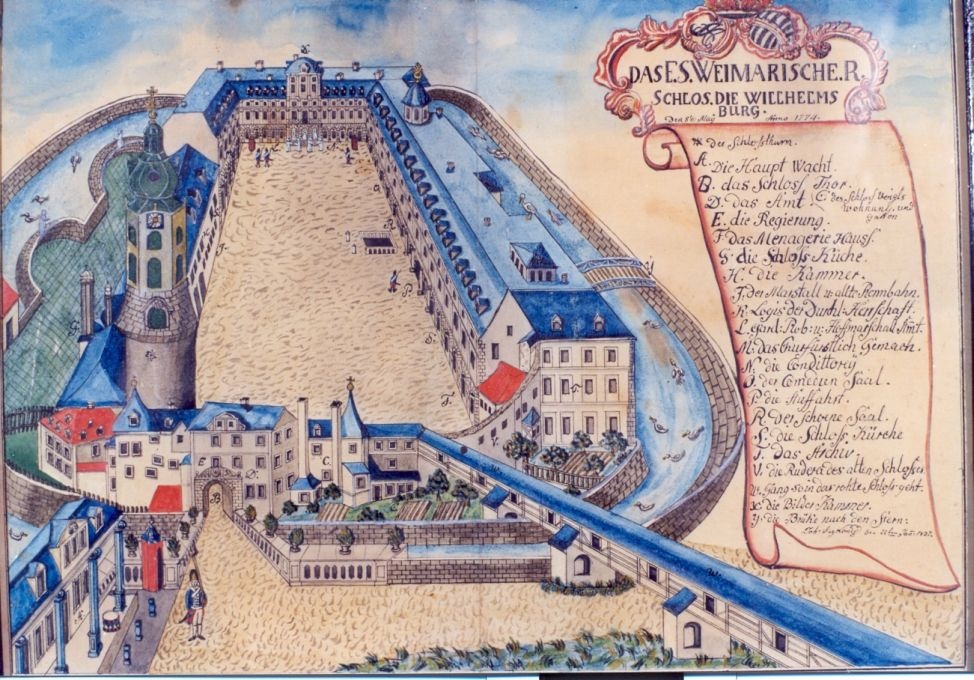
Several of Bach’s Weimar cantatas were lost when the castle’s chapel burnt down in 1774. Most of the Weimar cantatas we still have today survived only because Bach performed those again in Leipzig, sometimes several times. If he did this because he was proud of these cantatas, then Weinen, Klagen, Sorgen, Zagen must have been his greatest pride, since he later transformed its opening chorus into the Crucifixus for his Mass in B Minor.

Both the sinfonia and opening chorus convey enormous sadness, while it is “Jubilate” Sunday, and only three weeks after Easter. This has to do with the Gospel reading for this Sunday: Jesus’ speech to his disciples explaining that he will leave them, that they will go through immense suffering, but that their sorrow will turn into joy, comparing it to a woman going through childbirth.

So this cantata first conveys the feelings of the disciples, knowing they will soon be without Jesus, and the “tribulations” Jesus predicts for them. But then it explores the journey “from sadness to joy.”

First of all, the entire score can be seen as  uplifting, even though the general atmosphere is downcast. As many scholars have pointed out, the score ascends, movement by movement, in intervals of a third, alternating a minor key with its relative major: f, A flat, c, E flat, g, B flat. Gardiner says that this is the “escape ladder” Bach lowers into the pit of sorrow.

The “sorrow to joy”-theme is also cleverly portrayed in the texts, thanks to Salomo Franck, the Duke’s librarian, acting as librettist for all cantatas Bach wrote in Weimar. Many consider Franck’s poetry superior to most of the texts Bach had to work with in his Leipzig years. The alto aria is a good example: after the Gospel quote in the recitative “Wir müssen durch viel Trübsal” (we have to go through tribulation) comes an upbeat aria illuminating how “Kreuz und Krone” (cross and crown) and “Kampf and Kleinod” (conflict and jewel) are always connected.

While I love everything about this cantata, my absolute favorite part is the tenor aria Sei getreu.

The text of the tenor part refers to the Gospel text “A little while, and ye shall not see me: and again, a little while, and ye shall see me, because I go to the Father” and plays on that concept of “little while” – Franck decided it was not any longer than a period of rainy weather (which in Germany can be a few weeks in a row of course) …

Sei getreu, alle Pein
Be faithful, all pain
Wird doch nur ein Kleines sein.
will only be a little while.
Nach dem Regen
After the rain
Blüht der Segen,
blessing blossoms,
Alles Wetter geht vorbei.
all bad weather passes by.
Sei getreu, sei getreu!
Be faithful, be faithful!

And it gets better! Bach offers additional consolation by way of his music: through this aria, a trumpet plays the melody of “Jesu, meine Freude.” Everyone in attendance in the Himmelsburg would immediately have recognized the melody, and would have heard these words in their head:

Jesu, meine Freude,
Jesus, my joy,
Meines Herzens Weide,
My heart’s delight
Jesu, meine Zier,

Jesus, my treasure
Ach wie lang, ach lange
Ah how long,ah how long
Ist dem Herzen bange
must my heart be anxious
Und verlangt nach dir!
And full of longing for you!
Gottes Lamm, mein Bräutigam,
Lamb of God, my bridegroom
Außer dir soll mir auf Erden,
Besides you there is in on earth
Nichts sonst Liebers werden.
Nothing else that is dearer to me.

My all-time favorite recording of this particular aria is the one by American Bach Soloists, with Benjamin Butterfield singing tenor, and Stephen Escher playing the chorale melody on a cornetto. On most recordings (Herreweghe, Cantus Cölln, Gardiner) the part is played on a Baroque trumpet, on some (Koopman) on a Baroque oboe. The softer, more human sound of the cornetto combined with Escher’s fabulous playing makes this the most moving interpretation of this aria I’ve ever heard. Listen for yourself: find American Bach Soloists’ recording of Sei getreu on YouTube.

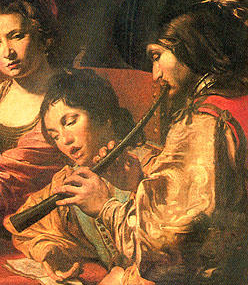
cornettplayer with singer
singer with cornetto player, anonymous, 16th century

2020 update: Since I wrote this in 2016, Vox Luminis released a wonderful recording of this cantata. They use a slide trumpet in the tenor aria, which is a beautiful middle between the Baroque trumpets of the Herreweghe, Cantus Cölln, and Gardiner recordings and the cornetto of the American Bach Soloists recording.

Find Vox Luminis’ recording of Cantata 12 on YouTube, on Amazon, or on iTunes.

Wieneke Gorter, April 16, 2016, updated April 27, 2020.

*The first cantata Bach wrote in Weimar was cantata 182 Himmelskönig, sei wilkommen for Palm Sunday.

A good shepherd, a violoncello piccolo da spalla, and a bit of St. Matthew Passion

09 Saturday Apr 2016

Posted by cantatasonmymind in After Easter, Cantatas, Leipzig

≈ Comments Off on A good shepherd, a violoncello piccolo da spalla, and a bit of St. Matthew Passion

Tags

2nd Sunday after Easter, Atsuko Ozaki, Bach, Bach Collegium Japan, BWV 42, BWV 6, BWV 85, cantatas, Caroyn Sampson, Dmitry Badiarov, Georg Poplutz, Gerd Türk, Gerlinde Säman, Harnoncourt, J.S. Bach Foundation, John Eliot Gardiner, Kurt Equiluz, Markus Volpert, Martin Zeller, Peter Kooij, Peter Kooy, Robin Blaze, Rudolf Lutz, St. Matthew Passion, Terry Wey, violoncello da spalla, violoncello piccolo

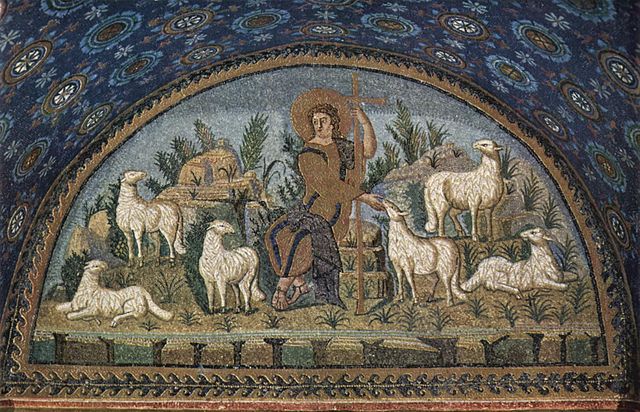
640px-meister_des_mausoleums_der_galla_placidia_in_ravenna_002
The Good Shepherd, mosaic in the Mausoleum of Galla Placidia, Ravenna, 1st half of the 5th century

There are three beautiful cantatas for this second Sunday after Easter, or “Misericordias Domini” Sunday: BWV 104, 85, and 112. Illustrating the “good shepherd” scripture for this Sunday (John 10, verse 12-16), Bach incorporated pastoral themes or orchestration in each of these cantatas.*

I’ve decided to focus on cantata 85 Ich bin ein guter Hirt, written for April 15, 1725. Of all three cantatas, this is the one I remember the best from my childhood, because of the  tenor aria “Seht, was die Liebe tut.” Also: Last week, I already mentioned the similarities between cantata 6 (for Easter Monday 1725), and cantata 42 (for the first Sunday after Easter 1725). This cantata 85 is the culmination of that “sub group” within the cantatas from 1725.

Which recording to listen to?

While I have good memories of hearing Kurth Equiluz sing the tenor aria on the Harnoncourt recording from 1977, I am enamored by Bach Collegium Japan’s recording of this cantata, and I think this is the best “overall” recording, featuring fabulous soloists Carolyn Sampson, Robin Blaze, Gerd Türk, and Peter Kooij. It is also one of the most noteworthy because of the use of a  violoncello da spalla, played by Dmitry Badiarov.

Listen to Bach Collegium Japan’s recording of cantata 85 Ich bin ein guter Hirt on Spotify. Or better yet, if you can afford to financially support the artists (especially important now, while they have no income from performances!) please consider purchasing the digital versions of Bach Collegium Japan’s recording of cantata 85 on Amazon or on iTunes.

If you prefer to watch a live recording, there is a wonderful recording available on YouTube by the J.S. Bach Foundation. Soloists are Gerlinde Sämann, soprano; Terry Wey, alto; Georg Poplutz, tenor; Markus Volpert, bass; and Martin Zeller, violoncello piccolo.

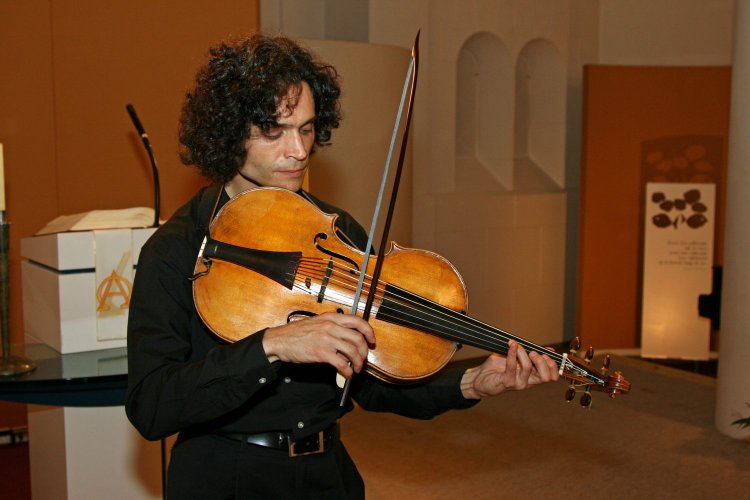
Back to the Bach Collegium Japan recording: After lovely and convincing singing by bass Peter Kooij in the opening arioso (Jesus saying “I am a good shepherd”), we get a sublime performance by countertenor Robin Blaze of the alto aria “Jesus ist ein guter Hirt,” which also features the unusual violoncello piccolo da spalla. Someone could probably write an entire PhD thesis on the difference between the  violoncello piccolo  “da spalla” (held on the shoulder, like a violin),  and the violoncello piccolo “da gamba”  (held between the legs,  like a cello), and whether Bach meant the one or the other when he wrote a part for “violoncello piccolo.”  Most recordings (Harnoncourt, Gardiner, Coin, Koopman, and J.S. Bach Foundation) feature the one held between the legs, but Bach Collegium Japan’s recording features the “da spalla” variety, played by the same person who built it in 2004, Dmitry Badiarov.

Badiarov-Dmitry-04
Dmitry Badiarov demonstrating the violoncello piccolo da spalla

Following this, we hear a radiant soprano solo chorale with oboe accompaniment (which makes me think back to the soprano solo chorale from cantata 6, in that case with the violoncello piccolo “da gamba”), beautifully sung by soprano Carolyn Sampson and expertly played by oboists Masamitsu San’nomiya and Atsuko Ozaki.

And when you didn’t think it could get any better, here comes a tenor recitative which in text and string accompaniment strongly refers to Jesus’ recitative from the St. Matthew Passion “Ich werde den Hirten schlagen, und die Schafe der Herde werden sich zerstreuen.” (Christ, having arrived at the Mount of Olives, reminds his disciples of the prophecy that the shepherd will be slain and the sheep will scatter).

With this only recitative in cantata 85, Bach has gotten everyone’s attention, so now we’re ready for the jewel in the crown of this cantata: the tenor aria “Seht, was die Liebe tut.” It is one of the most lyrical and lovely among all Bach’s tenor arias.

Seht, was die Liebe tut.
See, what love does.
Mein Jesus hält in guter Hut
My Jesus in his own safekeeping
Die Seinen feste eingeschlossen
keeps those who are his own firmly enclosed
Und hat am Kreuzesstamm vergossen
and on the beam of the cross he has shed
Für sie sein teures Blut.
for them his own precious blood.

Again there is a strong association with the St. Matthew Passion both in text and music. In his book Bach: Music in the Castle of Heaven Gardiner makes a very convincing case for his theory that Bach had wanted to perform the St. Matthew Passion on Good Friday 1725, only one year after the St. John Pasion. This didn’t happen because either the council disapproved, or Bach wasn’t ready composing the piece. If Bach had indeed been working on the St. Matthew Passion before Easter 1725, it is no wonder we’re getting glimpses of that monumental work in his cantatas after Easter 1725.

Wieneke Gorter, April 9, 2016, updated April 26, 2020

*I wrote about Cantata 104 for the Second Sunday after Easter in 1724 in this blog post.

One of my favorite cantatas

03 Sunday Apr 2016

Posted by cantatasonmymind in After Easter, Cantatas, Leipzig

≈ Comments Off on One of my favorite cantatas

Tags

1st Sunday after Easter, Barbara Schlick, BWV 21, BWV 31, BWV 4, BWV 42, BWV 6, Gérard Lesne, Howard Crook, Peter Kooij, Philippe Herreweghe

appearance-of-christ-to-his-disciples
Anthony van Dyck: Appearance of Christ to his Disciples, 1625/1626

This post is about Cantata 42 Am Abend aber desselbigen Sabbats, written for the 1st Sunday after Easter in 1725.

For Bach, Easter season in Leipzig was extremely busy. Immediately after the passion on Good Friday, he needed to have three to four cantatas ready to go: two cantatas for Easter Sunday, one for Easter Monday, and one for Easter Tuesday. And then five days later, again one for the Sunday after Easter, the one I am discussing here. If we imagine Bach having to work on most of these in the week before Easter, that same week in which he was rehearsing the Passion for Good Friday, and often adjusting the score still too, it is not so strange that he often re-used existing music at this time of year. It would either be a repeat performance of an Easter cantata from his time in Mühlhausen (Christ lag in Todesbanden) or Weimar (Der Himmel lacht! Die Erde Jubilieret!) or a new cantata, with new text, but largely based on existing secular music he had written for the Weimar or Köthen courts.

In 1725, the performance list looked like this:

Good Friday: St. John Passion, 2nd version, significantly rewritten from the year before.

Easter Sunday: Easter-Oratorio, largely based on existing court music from Köthen + a repeat of Christ Lag in Todesbanden (Bible story: Maria Magdalena and Maria Jacobi finding the empty tomb)

Easter Monday: new composition: Cantata 6 Bleib bei uns, denn es will Abend werden (Bible story: Jesus appeared before two of his disciples while they were walking on the road to Emmaus).

(If you have time, it is helpful to listen to cantata 6 (here on YouTube) before you listen to today’s cantata 42, because 42 refers to 6 in style and thought, and the use of the “two and three” in the text of the alto aria of cantata 42 might even be meant to “remind” us of these *two* disciples in that story of Easter Monday.

Easter Tuesday: we don’t know what was performed on this day in that year.

1st Sunday after Easter: Cantata 42 Am Abend aber desselbigen Sabbats, opening sinfonia and alto aria based on existing court music from Köthen (Bible story: while a small group of his disciples are inside a house in Jerusalem, with all the doors and windows locked, Jesus appears in their midst).

Ever since I started this blog at the beginning of this year, I’ve been eagerly awaiting this first Sunday after Easter, so I can finally introduce you to cantata 42 from 1725. It is one of my favorites because of the many gems strung together: a Brandenburg concerto-like sinfonia (as if Bach wanted to continue the kind of instrumental opening he had written for the Easter Oratorio from last week), a bit of Evangelist recitative (which is missing from the Easter Oratorio, so is more a reference to the St. John Passion), a terrific alto aria, a pretty soprano-tenor duet, an impressive bass aria, and a wonderful closing chorale.

I discovered this cantata about fifteen years ago, on the Ich hatte viel Bekümmernis CD Herreweghe recorded in 2000. It took me a little while to listen past the well-known cantata 21, and thus get to know cantata 42, but then I fell in love with it, especially with the alto aria, so beautifully sung by Gérard Lesne.  Later, in 2007, while watching the documentary DVD Philippe Herreweghe by himself, it was a treat to find a couple of scenes showing Herreweghe rehearsing that same alto aria  (though sadly not with Lesne).

Listen to cantata 42 on YouTube

Soloists on this Herreweghe recording are Barbara Schlick, Gérard Lesne, Howard Crook, and Peter Kooij.

Read the German text with English translation of cantata 42 here.

For a long time I thought that the gorgeous oboe parts at the start of the alto aria were based on the opening chorus of cantata 3 (and only found one other commentator ever to remark on this too) but thanks to Gardiner’s recent research, we know that the music for the aria as well as for the opening sinfonia of this cantata was copied from a (now lost) birthday serenata Bach wrote for Prince Leopold of Anhalt-Köthen (BWV 66a).

We can only guess if Bach had always meant to use the birthday music from Köthen, and selected text that would fit on the music, or if he received the “Wo zwei und drei versammlet sind” (Where two or three are gathered together) text from his librettist and only then had to think of that composition he had written in Köthen, with the groups of two and three in the orchestration …

Wieneke Gorter, April 3, 2016, updated April 26, 2020.

Easter in Weimar 1715

27 Sunday Mar 2016

Posted by cantatasonmymind in Cantatas, Easter, Weimar

≈ Comments Off on Easter in Weimar 1715

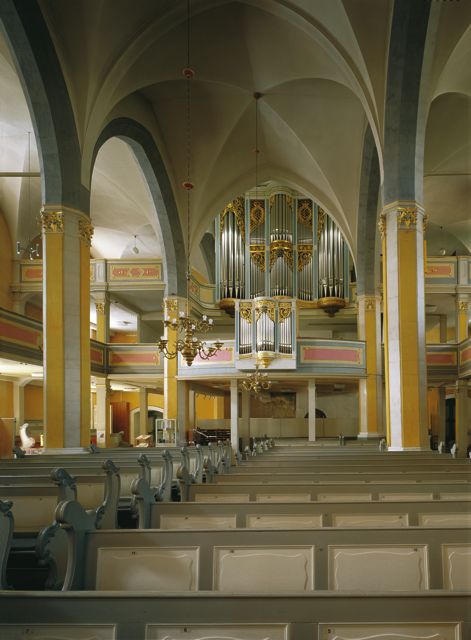
PI_2
The interior of the St. Peter & Paul or city church in Weimar: much more room on this organ loft than on the one in the castle’s chapel

While most of Bach’s cantatas in Weimar were performed in the castle’s chapel, the Himmelsburg, sometimes the Duke would visit the St. Peter und Pauli (St. Peter and Paul) church, also called the Stadtkirche (city church), and nowadays also called the Herder Kirche. It might have been for political reasons, or because of wanting to hear a certain preacher. Whatever the Duke’s motivation was on Easter 1715, it is clear from the orchestration of cantata 31 Der Himmel Lacht, die Erde Jubilieret that it cannot have been performed on the small organ loft of the castle’s chapel. (Lucky for all those musicians, they didn’t have to climb the 65 feet / 20 meters Bach climbed every day to play organ there).

Listen to cantata 31 by Harnoncourt on YouTube

Listen to cantata 31 by Harnoncourt on Spotify

Please find the German text of this cantata with English tranlations here and please find the score here.

After the first performance in Weimar on April 21, 1715, Bach performed this cantata at least two more times in Leipzig. This might have been because of writing or revising the Passions for Good Friday, he didn’t have time to write something new (he also recycled cantata 4 a couple of times), but let’s just say he really liked them.

In the fabulous opening sinfonia, one can clearly hear that Bach had been studying Vivaldi’s music and also that the start of the Christmas Oratorio (written much later, in Leipzig) was conceived already here in Weimar. At one point in the cello part, there is a reference to the brilliant writing in cantata 18 from two months earlier that same year.

Whether the sinfonia was meant to function as an “entrada” for the Duke and his entourage into the church or not, it needs to be that slow for me, that I can at least picture a ceremonial entrance happening while this music is being performed. That desire combined with strong nostalgic emotions I have when listening to this cantata, I can only recommend the Harnoncourt recording of this.

The nostalgia is of course not for  the sometimes struggling brass instruments in the opening movement. (It was not easy in the early 70s to play  historic trumpet. But those guys paved the way. And who knows, maybe that’s why Harnoncourt takes the tempo so much slower than Historical Performance conductors do that nowadays). The nostalgia is for the fabulous Peter Jelosits. In my memory this cantata got played  more often in our house than just on Easter Sunday and I truly grew up with his voice. In this cantata he gets to sing the soprano part in the five-part (!) opening chorus by himself for several measures, which is pure heaven, and he sings a fabulous aria as well. In the liner notes it only says “soloist of Wiener Sängerknaben,” but if you compare it with this recording, it is clearly him.

About the aria (the before-last movement of the cantata): after the super-happy opening chorus celebrating the resurrection and -in the subsequent movements- reflections on what Christ’s passion and resurrection mean for man, it is by now time  to turn back to the always present death, and the trust that Jesus will not leave the believer’s side. By this time Bach had already buried two of his children, and his employer was also a very devout Lutheran, so this was entirely appropriate, as dark and heavy as it might seem to us today.

So Bach already presents a “deathbed chorale” in this aria, in the melody of the upper strings, while of course the soprano voice part sings different words.  We can assume that the congregation at this church in Weimar as well as Duke Wilhelm-Ernst knew this chorale so well they could hear these words in their head:

Wenn mein Stündlein vorhanden ist,
und ich soll hinfahren meine Strasse,
geleite mich, Herr Jesu Christ,
mit Hilf mich nicht verlasse :
den Geist an meinem letzten End
befehl ich, Herr, in deine Händ ;
du wirst ihn wohl bewahren.


When the hour of my death is at hand
And I must travel on my way
Accompany me, Lord Jesus Christ,
With your help do not abandon me:
At my final end my spirit
I entrust, Lord, in your hands;
You will preserve it well.

This same tune then comes back in the closing chorale, using the original text, albeit the very last verse of it.

Wieneke Gorter, March 27, 2016, updated April 3, 2021.

Bach in Weimar (and a cantata for Palm Sunday)

27 Sunday Mar 2016

Posted by cantatasonmymind in Cantatas

≈ Comments Off on Bach in Weimar (and a cantata for Palm Sunday)

Abbildung zu Objekt Inv.Nr. 5 a V 2241 von Stadtmuseum Weimar im Bertuchhaus
The “Wilhelmsburg” of Duke Wilhelm Ernst of Saxony-Weimar. The footbridge goes to the “Rote Schloss” (the Red Palace) of Whilhelm’s nephew Ernst August. This drawing is from 1774, only a few months before the entire Wilhelmsburg, including the music archives, would go up in flames. The Red Palace was not affected by the fire, and part of it still exists today.

From 1708-1717, Bach worked at the court of the Dukes of Saxony-Weimar. Two dukes, an uncle and his nephew, co-reigned the Duchy and the town, each from their own castle: the uncle, Wilhelm Ernst, from his impressive Wilhelmsburg (pictured above); the nephew, Ernst August, from his Rote Schloss (Red Palace, so called for the red window frames in the otherwise grey colored castle). The uncle was a devout Lutheran and amateur preacher, while the nephew was much more interested in chamber music. Though the complex of buildings seems quite isolated in the image above, it was actually in town.

The “Red Palace” (Rote Schloss) of Ernst August. Bach lived around the corner.

Bach moved to Weimar from Mühlhausen with his wife Maria Barbara. They lived in an apartment on the town square, a short walk from the Wilhelmsburg, but directly around the corner from the Red Palace. Their first child was born that same year, and Maria Barbara’s older, unmarried sister Friedelena Margaretha joined them a year later, in  1709, probably to help run the household. As far as we know she stayed with the Bach family until her death in 1729 (see my post about the Bach family in Leipzig).

At first, from 1708 to 1714, Bach worked as a chamber musician for both the uncle and the nephew, but also as organist in the beautiful chapel in the Wilhelmsburg, the castle of the older Duke. The chapel was called the Himmelsburg for a painting depicting the “opening of the heavens” in the ceiling of the chapel, right above the organ loft.  The organ loft was about 65 feet (or 20 meters, or four two-story houses) above the floor of the chapel (!).

The chapel in the Wilhelmsburg complex, also called the “Himmelsburg” (Heaven’s castle)

It was here in Weimar that Bach perfected his organ playing skills and that he started studying Vivaldi’s music and incorporating Italian and French composition styles into his instrumental music. Bach was also good friends with the organist of the St. Peter und Pauli (St. Peter and Paul) church, also called the Stadtkirche (town church), and nowadays known as the Herderkirche. So while he must have practiced on the organ every day, it is possible that he did not have to climb all those stairs to the organ in the Himmelsburg every time, but also used the organ in the Peter and Paul church. For a picture of the inside of this church, see my post Easter in Weimar 1715.

In 1713 Bach went to advise the city of Halle regarding the building of a new organ, and was informally offered the post of organist there. Upon his return to Weimar, he told the Duke that he was in negotiations with Halle. When he finally received the official offer from the city of Halle, he didn’t like the terms and rejected it. The Halle authorities then got so angry, suggesting that he had led them on all that time, that they wrote to Duke Wilhelm Ernst, that Bach probably had only applied for the post in Halle so he could get a raise in Weimar. Wilhelm Ernst’s response to this was to not only double Bach’s salary, but also offer him the position of Konzertmeister (leader of the orchestra). They agreed that Bach would write a church cantata every month, for which he could use any musician from either palace.**

Whenever these cantatas were performed in the Himmelsburg, all musicians would have to stand in the small organ loft. It was a pretty small space, that only fit 7 singers and 5 instrumentalists.***

A beautiful example of the cantatas written for this space is cantata 182 Himmelskönig, sei wilkommen!  (written for March 25, 1714, when Palm Sunday and the feast of the Annunciation fell on the same day). I recommend the recording by Montreal Baroque of this cantata. Listen here on Spotify, or here on YouTube. Their one-on-a-part performance features fabulous singing all around (soprano Monika Mauch, countertenor Matthew White, tenor Charles Daniels, bass Harry van der Kamp). This cantata was repeated a couple of times in Leipzig, but never on Palm Sunday, as the Leipzig rules dictated that no music was performed on that day, it still being within the period of Lent (the 40 days before Easter).

Find the text of cantata 182 here, and the score here.

Many of Bach’s Weimar cantatas (for example cantata 21 Ich hatte viel Bekummernis, 18 Gleichwie der Regen und Schnee vom Himmel fällt, and 61 Nun Komm der Heiden Heiland) start with an elaborate instrumental ouverture or sinfonia. This is probably not just because Bach was eager to try out the Italian and French composition styles he had studied, but also for the simple reason that while these cantata openings were being performed, the Duke and his entourage would slowly walk into the chapel and take their seats.

When the post of  Kapellmeister (head of the court musical establishment) opened up in 1716, Bach was passed, in favor of an incompetent candidate. It is possible that Wilhelm Ernst had done this on purpose, to punish Bach for spending too much time with his nephew in the Red Palace. Furious, Bach asked to be dismissed. (When in the employment of royalty, one couldn’t just quit). In turn, Wilhelm Ernst had Bach jailed for four weeks in a fortress before he accepted his dismissal and Bach could move to Köthen.

Wieneke Gorter, March 26, 2016, updated April 5, 2020.

** There were two boy sopranos, one male alto, two tenors, and two basses on the list of musicians employed by the Dukes, but Bach could also use boy singers from the local gymnasium, where his own former principal from Ohrdruf was now the rector.

*** On feast days the cantatas were sometimes performed in the town church, see my post about Easter in Weimar 1715.

R.I.P. Nikolaus Harnoncourt

06 Sunday Mar 2016

Posted by cantatasonmymind in Cantatas, Leipzig

≈ Comments Off on R.I.P. Nikolaus Harnoncourt

Tags

Bach, chorales, Concentus Musicus Wien, Harnoncourt, Kurt Equiluz, Robert Holl, St. John Passion

harnoncourt

Yesterday evening, Saturday March 5, 2016, conductor and cellist Nikolaus Harnoncourt left this world. He was an important part of the Sunday Bach cantata tradition my mother started in our family, and she was a great admirer of him. Even though my mother passed away more than five years ago, I feel she died a little more for me today, now that I know Harnoncourt is gone.

Sometime in the late 1980s, with my parents and my sister, I attended a performance of Bach’s Passion according to St. John which Harnoncourt directed in the Concertgebouw in Amsterdam. We had seats in the section behind the orchestra and choir, so that we could watch him communicate with the players and singers. I will never forget that. Afterwards, my mother–who was singing in a Bach choir herself at the time–said that it would mean the world to her if she could ever sing in a choir conducted by Harnoncourt. It never happened for her, but the combination of her saying this and me seeing Harnoncourt at work inspired me to join a Bach choir in my first year of college.

Even though Harnoncourt made an incredible amount of recordings (see his timeline for a list of all of them), there is nothing like seeing (an) excellent artist(s) live on stage. To see them work, interact, and to feel their energy is an experience you’ll never forget and which is worth so much more than earthly possessions. So if there is someone you admire but only know from recordings, go hear and see them live while they’re still alive! Make the effort. You will be glad you did.

Watch Harnoncourt conduct Bach’s Passion according to St. John on this video recorded in Graz, Austria, in 1985. It is a terrific example of the world class conductor he was. Don’t be put off by  the 30-year-old sound quality, especially noticeable in the oboes in the opening chorus. It is only that bad in the beginning, the rest of the recording is a feast for the ears and eyes, not in the least because of the excellent performance (and singing technique!) by Kurt Equiluz as evangelist.

Listening to the Passion according to St. John is also appropriate in the order of things on this blog, since Bach was working on this passion during Lent in 1724, and revising it in 1725. And this way, come Good Friday (March 25, 2016), I can perhaps talk about the other passion 🙂

Wieneke Gorter, Sunday March 6, 2016.

Watch a video while you wait

03 Thursday Mar 2016

Posted by cantatasonmymind in Cantatas

≈ Comments Off on Watch a video while you wait

My apologies for not posting anything this past weekend. The other aspects of my life need(ed) my attention, time, and energy.

While you wait for my future posts, please watch this video about Bach’s life and work. It’s a BBC documentary, aka the film version of Gardiner’s book about Bach, with Gardiner actually visiting all the villages and cities where Bach lived and worked, and showing lots of historical documents in the Bach Archives in Leipzig.

To come later this month:

Sunday March 20: Palm Sunday: Cantata 182 Himmelskönig, sei willkommen

Sunday March 27: Easter Sunday: Cantata 31 Der Himmel lacht! Die Erde jubilieret

Wieneke Gorter, March 3, 2016

Bach in Leipzig

21 Sunday Feb 2016

Posted by cantatasonmymind in Bach's life, Cantatas, Leipzig

≈ Comments Off on Bach in Leipzig

lzchurch

From left to right, the St. Thomas School in Leipzig, where the Bach family lived in a large apartment on the left side (or front, seen like this, with a view over the park), the St. Thomas Church right next to the School (with such a high roof and spire it could be seen from all over the city), and the St. Nicholas Church at walking distance. Bach’s cantatas were performed in both churches.

No discussion of Bach cantatas until Easter, because Bach did not write any cantatas for Lent (the 40 days before Easter). Read more about this in my post from last week.

Johann Sebastian Bach (1685-1750) wrote most of his cantatas, motets, masses, and passions in Leipzig. He moved there on Saturday May 22, 1723.

Christoph Wolff includes this account of the event by a Hamburg newspaper in his The New Bach Reader: “This past Saturday at noon, four wagons loaded with household goods arrived here from Köthen; they belonged to the former Princely Kapellmeister there, now called to Leipzig as Cantor Figuralis. He himself arrived with his family on two carriages at 2 o’clock and moved into the newly renovated apartment in the St. Thomas School.”

By that time, Bach’s family consisted of:

his wife Anna Magdalena (he married her in Köthen in 1721 when she was 20 years old),

four children from his first wife Maria Barbara (she died in 1720).

one child from Anna Magdalena,

and most probably his sister-in-law Friedelena Margaretha Bach  (sister of his first wife Maria Barbara, who -according to Wolff- lived in the Bach household from at least 1709 at age 34 to her death in 1729. I will probably write an entire post about all the stories and non-stories about Bach’s wives soon, but let’s just leave it at this for now, here :-)). That her last name is also Bach is because these sisters were Bach’s second cousins.

Until 1742, Anna Magdalena and Johann Sebastian would have 12 more children in Leipzig, of which they would lose six. They would also take some nephews under their wings (a normal thing to do in the extended Bach family—Bach himself had lived with a relative after his parents died) and have a mind-boggling number of private students.

Leipzig was a bustling town, the second largest in the region, with a highly regarded university as well as three annual trade fairs, which brought merchants, artists, and tourists from all over Europe to the city. It happened most probably during one of these fairs that Leipzig instrument maker J.H. Eichentopf came into contact with some eastern instruments on which he based the concept of the oboe da caccia he developed around the time of Bach’s arrival in the city, and which Bach used in many compositions, such as cantata 65. The only thing the city didn’t have was an opera house. The one in Dresden was about 112 kilometers, or 70 miles, or a day’s travel away. The other famous one, in Hamburg, was almost three times as far away.

In addition to teaching the boys of the St. Thomas School in music and many other subjects, Bach was to supply music for all Sundays and church feast days in both the St. Thomas and St. Nicholas churches. No-one had specified that these had to be cantatas. A simpler form of composition would probably have suited the council better, as many of the members opposed the Italian, operatic style of some of the arias, or the French character of many of the opening sinfonias. If Bach would sometimes have programmed music by other composers, that would not have been a problem either.* It was his own choice to write a new cantata for every Sunday, most probably driven by a strong desire, a promise to himself (or “life goal,” as he calls it when moving from Mühlhausen to Weimar) to change the concept of church music, glorifying God but also educating the congregation in Lutheran theology. And as far as we know now, he kept that promise, writing a new cantata every week, for almost three full years.

The churches would be full, with one to three thousand (!) people attending the services. But however large in number, the congregation did not necessarily form a captive audience. Many of them, especially the women, seated in the main, “ground floor” section of pews, would arrive late and make quite an entrance, taking time to greet their neighbors, and making sure to get the attention of the men who were sitting in the balconies. The men would sometimes throw the 18th-century equivalent of paper airplanes to the women to catch their attention. Upper class families had their own boxes, or “chapels” in the church, and were often laughing and talking very loudly in them.

In another part of his Leipzig life, Bach had more attentive audiences in “Zimmermann’s,” one of the six coffee houses in Leipzig, where he lead the Collegium Musicum of the university in performances of instrumental music and secular cantatas. They performed at least once a week on Wednesdays, and twice a week during the three annual trade fairs. At first Bach was principal guest conductor, from 1729 he was the director of this elite ensemble of virtuoso instrumentalists. It is safe to say that even though he owned an entire library of theological books and was committed to teaching his “neighbor” through his church music, he composed and performed as much (and maybe more!) instrumental and secular music in Leipzig as he did sacred music.

To read more, I highly recommend Christoph Wolff’s The New Bach Reader and John Eliot Gardiner’s Bach: Music in the Castle of Heaven.

Wieneke Gorter, February 21, 2016, updated February 20, 2021

*After a while, Bach did indeed perform music by other composers. Read more about this in a background article I wrote for California Bach Society’s blog, here.

← Older posts
Newer posts →

Recent Posts

  • “Missa Miniatura” by CONTINUUM/Elina Albach Even More Moving in 2025
  • Bachfest Leipzig 2025
  • Bach Cantatas for Christmas – 1724 and 1734 editions
  • Fourth Sunday of Advent – more insight into Cantata 62 helped me better understand Bach’s Christmas Oratorio
  • Saint Ambrose and Luther in Milan – Second Sunday of Advent

Archives

  • August 2025
  • July 2025
  • December 2024
  • November 2024
  • June 2024
  • January 2024
  • December 2023
  • October 2023
  • September 2023
  • August 2023
  • April 2022
  • February 2022
  • January 2022
  • December 2021
  • November 2021
  • June 2021
  • May 2021
  • April 2021
  • February 2021
  • January 2021
  • December 2020
  • November 2020
  • October 2020
  • September 2020
  • August 2020
  • July 2020
  • May 2020
  • April 2020
  • March 2020
  • February 2020
  • January 2020
  • December 2019
  • November 2019
  • May 2018
  • April 2018
  • March 2018
  • February 2018
  • January 2018
  • December 2017
  • November 2017
  • October 2017
  • September 2017
  • August 2017
  • July 2017
  • June 2017
  • May 2017
  • April 2017
  • March 2017
  • February 2017
  • January 2017
  • December 2016
  • November 2016
  • October 2016
  • September 2016
  • August 2016
  • July 2016
  • June 2016
  • May 2016
  • April 2016
  • March 2016
  • February 2016
  • January 2016

Enter your email address to follow this blog and receive notifications of new posts by email.

Join 337 other subscribers

Categories

  • 1723 Trinity season special series
  • Advent
  • After Easter
  • Ascension
  • Bach's life
  • Cantatas
  • Chorale cantatas 1724/1725
  • Christmas
  • Easter
  • Epiphany
  • Following Bach in 1725
  • Köthen
  • Leipzig
  • Septuagesima
  • Travel
  • Trinity
  • Weimar

Meta

  • Create account
  • Log in
  • Entries feed
  • Comments feed
  • WordPress.com

Website Built with WordPress.com.

  • Subscribe Subscribed
    • Weekly Cantata
    • Join 157 other subscribers
    • Already have a WordPress.com account? Log in now.
    • Weekly Cantata
    • Subscribe Subscribed
    • Sign up
    • Log in
    • Report this content
    • View site in Reader
    • Manage subscriptions
    • Collapse this bar
 

Loading Comments...