Weekly Cantata

Weekly Cantata

Category Archives: Christmas

Bach Cantatas for Christmas – 1724 and 1734 editions

23 Monday Dec 2024

Posted by cantatasonmymind in Cantatas, Chorale cantatas 1724/1725, Christmas, Epiphany, Leipzig

≈ 4 Comments

Tags

Alex Potter, Antonia Frey, baroque-music, Bart Aerbeydt, Bernhard Bechtold, Carine Tinney, Charles Daniels, Christmas, Christmas Oratorio, Collegium Vocale Gent, Concerto Copenhagen, Daniel Johannsen, Eric Milnes, Florian Sievers, Harry van der Kamp, J.S. Bach Foundation, J.S. Bach Stiftung, Jan Kobow, Julia Doyle, Lars Ulrik Mortensen, Lucia Giraudo, Margot Oitzinger, Maria Keohane, Mark Padmore, Matthew Brook, Matthew White, Milo Maestri, Monika Mauch, Montreal Baroque, Netherlands Bach Society, Peter Kooij, Philippe Herreweghe, Rodrigo Lopez-Paz, Rudolf Lutz, Sarah Connolly, Stephan MacLeod, Tomáš Král, Vasiljka Jezovsek

Merry Christmas! Below are my recommendations for recordings of Bach’s chorale cantatas for the Christmas season, written in 1724/1725, as well as a link to the video of this year’s wonderful live performance by the Netherlands Bach Society of Bach’s Christmas Oratorio, written in 1734/1735. Before I get to that, I wanted to share a personal story. (If you want to “jump to the recipe,” just scroll down three paragraphs to the next header).

As regular readers of this blog know, Christmas morning for me = “Jauchtzet, frohlocket,” the first entrance of Bach’s Christmas Oratorio*. But ten days ago, during the first-ever Christmas Oratorio concert of my life as a chorus member, I couldn’t sing those words.

I had unwittingly set myself up for it, because I had just done two things to remember my late mother. It was very cold in the church, and I had lent one of my mother’s scarves to a friend who was singing next to me. As we were getting on stage, I told her: “this scarf has been in many a Bach concert, because my mother used to sing in a Bach choir too.” And then I showed her how I had copied my mother’s signature from her old piano reduction to the new one I was using now.

So while I had been completely fine during all the rehearsals, now with the audience there and those memories, the first notes of the timpani made me choke up. Fortunately, that first soprano entrance is low and doubled by many other voices, so nobody noticed. And I was fine for the rest of the concert, and thoroughly enjoyed getting to sing cantatas 1, 2, 5, and 6 of Bach’s Christmas Oratorio with a good orchestra and great soloists.

Do you have special memories associated with Bach’s or other Christmas music? Please let me know in the comments. Here are my recommendations for recordings:

Christmas Cantatas from Bach’s Chorale Cantata cycle, 1724/1725

Christmas Day: Cantata 91 Gelobet seist du, Jesu Christ by the J.S. Bach Foundation/Rudolf Lutz, with Monika Mauch – Soprano; Margot Oitzinger – Alto; Bernhard Berchtold – Tenor; and Peter Kooji – Bass. Find the score here, and English translations here.

Second Christmas Day: Cantata 121 Christum wir sollen loben schon by Concerto Copenhagen/Lars Ulrik Mortensen, with Maria Keohane – Soprano; Alex Potter – Alto; Jan Kobow – Tenor; and Matthew Brook – Bass. Find the score here, and English translations here.

Third Christmas Day: Cantata 133 Ich freue mich in dir by Concerto Copenhagen/Lars Ulrik Mortensen, with Maria Keohane – Soprano; Alex Potter – Alto; Jan Kobow – Tenor; and Matthew Brook – Bass. Find the score here, and the English translations here.

Maria Keohane

Sunday after Christmas: Cantata 122 Das neugeborene Kindelein by Collegium Vocale Gent/Philippe Herreweghe, with Vasiljka Jezovsek – Soprano; Sarah Connolly – Alto; Mark Padmore – Tenor; and Peter Kooij – Bass. Find the score here, and the English translations here.

New Year’s Day: Cantata 41 Jesu nun sei gepreiset by the J.S. Bach Foundation/Rudolf Lutz, with Julia Doyle – Soprano; Antonia Frey – Alto; Florian Sievers – Tenor; and Stephan MacLeod – Bass. Find the score here, and the English translations here.

Jan 6, Epiphany: Cantata 123 Liebster Immanuel, Herzog der Frommen by Montréal Baroque/Eric Milnes, with Matthew White, alto; Charles Daniels, tenor; and Harry van der Kamp, bass. Find the score here, and the English translations here.

From Bach’s Christmas Oratorio, 1734/1735

Bart Aerbeydt and Milo Maestri
Lucia Giraudo
Daniel Johannsen

All photos above by Donald Bentvelsen. Find him on Instagram at @bentvel.

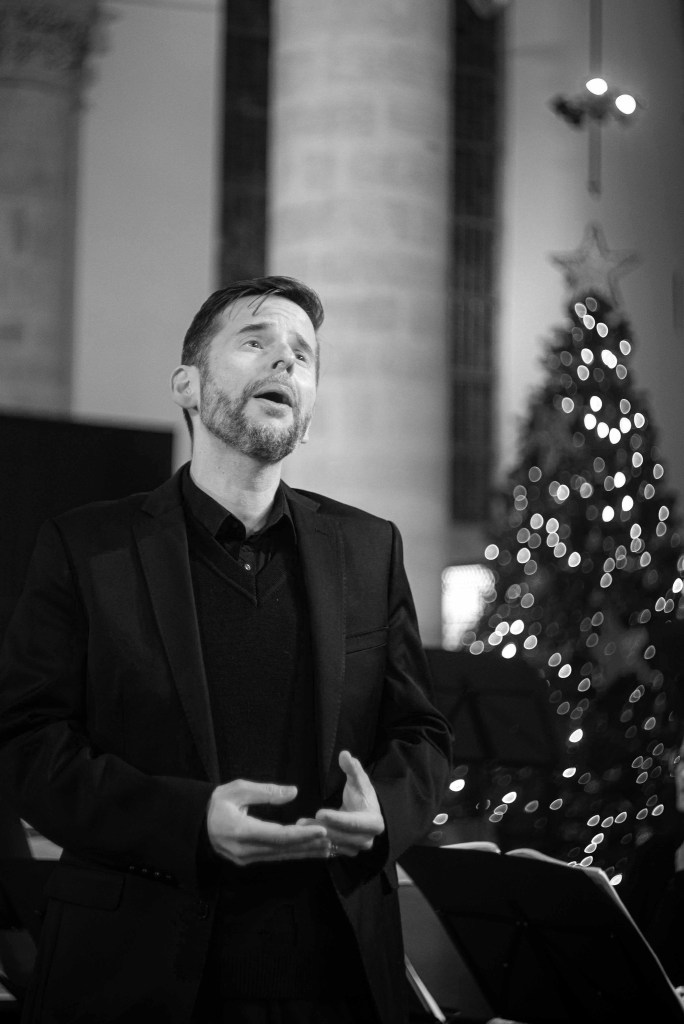
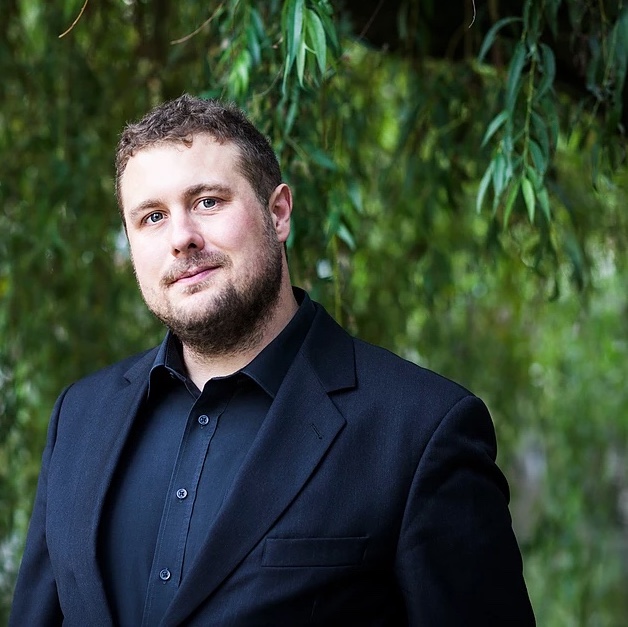
I highly recommend the video of the most recent live performance by the Netherlands Bach Society under the direction of Lars Ulrik Mortensen. They performed cantatas 1, 4, 5, and 6 of Bach’s Christmas Oratorio in the Netherlands earlier this month. I attended the concert in Naarden on December 11, the video below is from the performance in Utrecht, two days later. The choir could have been a bit larger for my personal taste, but for the rest I absolutely loved this performance, with text-focused singing by all soloists, and fabulous and sensitive playing by the instrumentalists, allowing for musical dialogues with the singers. I especially enjoyed the contributions by tenor Daniel Johannsen, oboist Rodrigo Lopez-Paz (photo in my previous post), violinist Lucia Giraudo, and horn players Bart Aerbeydt and Milo Maestri. I very much ejoyed reading the program booklet, especially the the interview with director Lars Ulrik Mortensen.

Read the English program book for this performance here. Read a bit more on the fifth cantata from this same performance in my previous post.

Please consider subscribing to this blog (just click on the button below), it really helps me!

Best wishes for the New Year,

Wieneke Gorter, December 23, 2024.

* if you don’t know the story, please find it here.
Historic Churches and a Comforting Duet – Third Day of Christmas 2023

27 Wednesday Dec 2023

Posted by cantatasonmymind in Cantatas, Christmas, Leipzig, Weimar

≈ Leave a comment

Tags

Agnes van Laar, Bach, BWV 248/3, cantatas, Christmas, Christmas 3, Christmas Oratorio, Claron MacFadden, Dietrich Henschel, germany, John Eliot Gardiner, Marc Pantus

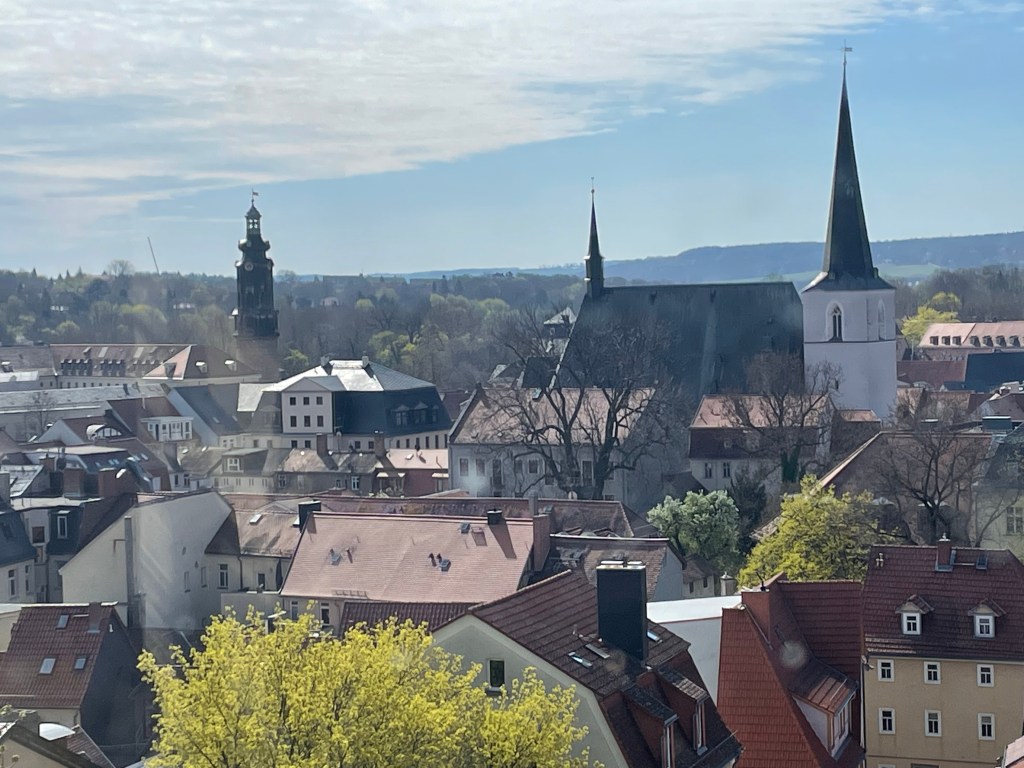
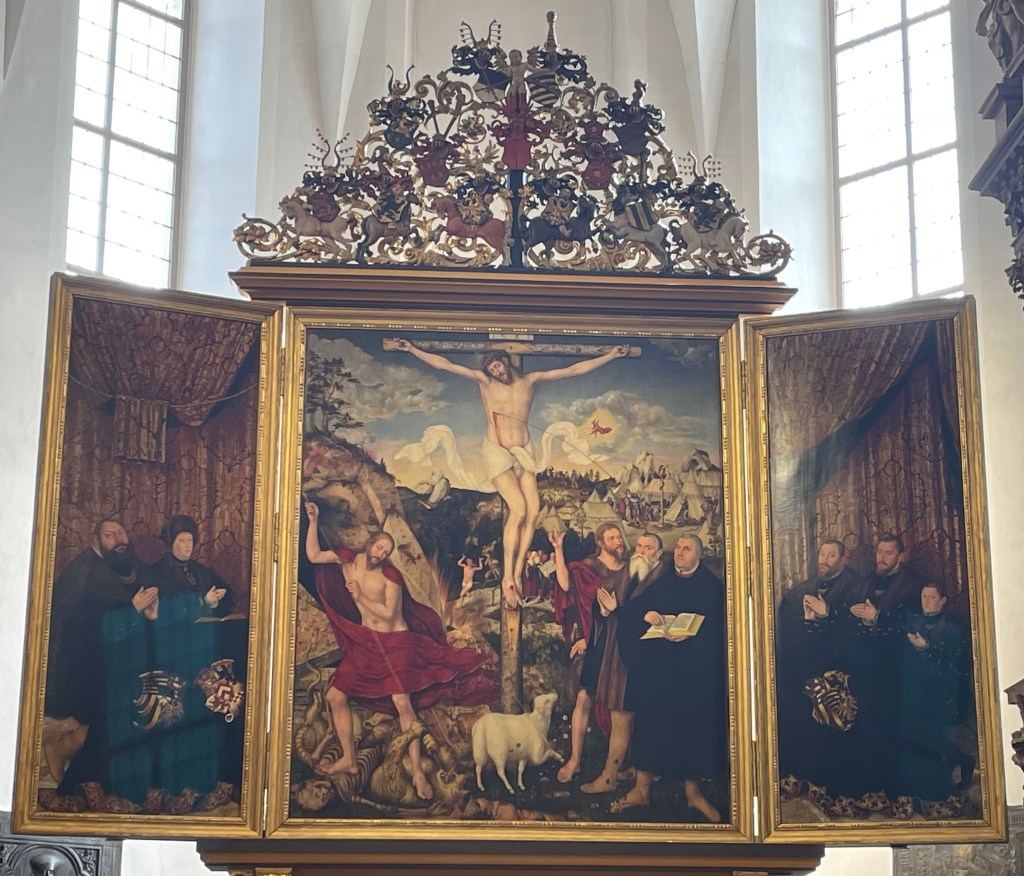
Photos from my visit to Weimar in April 2022: The famous altarpiece by Cranach in the St. Peter and Paul church or Herder church and the view over Weimar from the bell tower of St. James church. In the righmost photo you can see on the left the tower of the Bastille where Bach was held prisoner for a month, and on the right the Herder church. In addition to his job at the Duke’s castle, Bach played the organ at both St. James church and Herder church.

I hope you all had a meaningful Advent season and a merry Christmas. I needed to be with friends and family this month, and craved to hear music in old churches. It all worked out and I had one of the best Christmas seasons ever in recent years. I’m sorry that because of spending my time this way, I did not get to share any thoughts or music on this blog. If you went searching in my archives on your own, please let me know in the comments what you listened to. If you ever find youtube links that no longer work, please comment under the specific post or simply send me an email.

Why the photos of Weimar at the top of this blog post?

It’s because of a video I would like to share here today.

One of the best pieces of music I heard in an old church this month was the duet “Herr, dein Mitleid, dein Erbarmen” (Lord, your compassion, your mercy) from the third cantata of Bach’s Christmas Oratorio, written for today, the Third Day of Christmas. On December 10, I heard this excellently performed by soprano Agnes van Laar and bass Marc Pantus in the stunning Saint Martin’s church in Bolsward, the Netherlands.

This duet doesn’t usually appear among the “greatest hits” of Bach’s Christmas Oratorio but I just love the way the instrumental and vocal parts move together, and I am also moved by the text. I was searching for a good live video performance of this duet to share here today, and liked Gardiner’s the best, with soprano Claron McFadden and bass Dietrich Henschel. Please find that video here. Here is the text:

Herr, dein Mitleid, dein Erbarmen
Tröstet uns und macht uns frei.
Deine holde Gunst und Liebe,
Deine wundersamen Triebe
Machen deine Vatertreu
Wieder neu.

Lord, your compassion, your mercy
console us and make us free.
Your gracious favour and love,
your wondrous desires
make the love you have for us as a father
again new.

While watching this video, I realized that MacFadden and Henschel are singing at the Herder church in Weimar, directly in front of the famous Cranach altarpiece. I cannot really describe in words how thrilling it was for me to finally set foot in that church in April 2022. Watching the video and looking at the photos also inspired me to share more stories about my travels to Thuringia in April 2022 on this blog, and to hopefully visit the region again in the new year.

Further exploring:

Read my post from 2020 about all Bach’s other cantatas for the Third Day of Christmas here.

Find a very nice overview of Bach’s time in Weimar on the website of the Thuringia Bach Festival here.

Wieneke Gorter, December 27, 2023.

Merry Christmas!

25 Saturday Dec 2021

Posted by cantatasonmymind in Cantatas, Chorale cantatas 1724/1725, Christmas, Following Bach in 1725, Köthen, Leipzig

≈ Leave a comment

Tags

Bach, Bachakademie Stuttgart, BWV 248/1, BWV 248/2, BWV 248/3, BWV 248/4, BWV 248/5, BWV 248/6, cantatas, Christmas 1, J.S. Bach Foundation, Rudolf Lutz

Merry Christmas! My sincere apologies if you are somewhere in the world where it is not Christmas Morning anymore.

I have two new videos for you today, that will last you until January 6, just in case I don’t manage to write another blog post between now and then.

The J.S. Bach Foundation has released all six cantatas of Bach’s Christmas Oratorio to YouTube. They released these on CD and DVD for purchase last year, but have now made them available to everyone. You can find that video recording here.

What is even better: they also made the effort to provide English subtitles for Rudolf Lutz’ lecture about Part I of the Oratorio, for Christmas Day. You can find that video here. I highly recommend watching this to better understand the meaning of the music, to learn how Bach reworked some of his secular cantatas into this Oratorio, and that he perhaps planned to do that all along.

There is also a good video of parts I, II, III, and VI of Bach’s Christmas Oratorio by Bach Akademie Stuttgart. The setting in which they perform is less festive looking than the beautiful Baroque church of the J.S. Bach Foundation, but it’s also well done. You can find it here.

If you would like to read and listen more, here’s an overview of my previous blog posts for this First Christmas Day:

Our Christmas Morning, from 2016, talks about how my mother used to wake my sister and me up with Bach’s Christmas Oratorio.

Three Days of Christmas, from 2017, gives you the three cantatas Bach wrote in 1724, all three brand-new, no reworking there.

My own favorite post is Bach and the Christmas Day Message, from 2019, about Cantata 110 from 1725.

And my post from last year is Angels – We Can Use Some This Week, in which I highlight one of the 1724 cantatas.

Happy listening and watching! And please let me know if any of the links don’t work.

Wieneke Gorter, December 25, 2021.

Third Christmas Day

27 Sunday Dec 2020

Posted by cantatasonmymind in Cantatas, Chorale cantatas 1724/1725, Christmas, Leipzig

≈ Leave a comment

Tags

Alex Potter, Bachstiftung, BWV 133, Christmas 3, Concerto Copenhagen, J.S. Bach Foundation, J.S. Bach Stiftung, Maria Keohane, Miriam Feuersinger, Rudolf Lutz

Winter on the Holterberg, the “local hill” in the region where I lived from age 6 to 16.

For me, December 27 is always the Third Christmas Day , whether it falls on that other cantata day, the Sunday after Christmas, or not. In the Netherlands, where I grew up, there are two days on which people celebrate Christmas: December 25 and 26. Special meals are eaten on both days. And because the country is so small, you can visit one part of your family on the 25th and then see the other part on the 26th. Most relatives expect you to do this. So, when I was a child, Third Christmas Day was always our first “free” day during the Christmas break, without church visits, meal prep, having to dress up (even though I liked that), or commitments to family.

We had a standing arrangement with friends for this day: if there was enough snow on the ground, and if we were in town, we would go cross-country skiing together on the only hill in our region. It was a half-joke, because the Netherlands isn’t very snowy, and it would take an extraordinary winter for there to be enough snow on the ground for cross-country skiing. When I was 16 we moved away from that region, so it maybe happened only once that we actually did this together with the other family, but just the idea was fun, and it didn’t feel like something we “had” to do to any of us.

This was a long introduction to justify why I am sharing a cantata for Third Christmas Day on this blog today, when I should be sharing cantatas for the Sunday after Christmas instead, as that day officially overrides the other.

Ever since I found out this video of Cantata 133 Ich freue mich in dir (I rejoice in you) existed, on November 1st of this year, I had been planning to share it today. It features two absolutely gorgeous tender arias by some of my favorite soloists and the wonderful ambiance Concerto Copenhagen always manages to convey in their Christmas videos. So here your are: Cantata 133 Ich freue mich in dir, written in 1724, by Concerto Copenhagen, from their 2011 Christmas concert, starring Alex Potter in the alto aria and Maria Keohane and her beautiful berry-red dress in the soprano aria. Find the video here, the text and translations here, and the score here.

Cantatas for Third Christmas Day have all been discoveries for me since I started writing this blog. None of these were cantatas my mother played on the turn table at home, probably for two reasons: 1. It was the day for the third cantata from the Christmas Oratorio (and this one was my sister’s favorite); 2. After playing the one cantata, we were usually off doing other things afterwards (see above), and my mother must have felt the “freedom” of this day too.

I will take a break for the next two weeks, and not post again until Sunday, January 17. Our first-born is flying the nest exactly two weeks from today, to go live on a college campus on the other side of the country, and we won’t see him in person again until May. So I would like to spend my time these next two weeks cooking, hiking, and laughing with the family, and helping my son get ready.

Here are some links for further reading and listening during those two weeks:

More cantatas for today:

Cantata 151 Süsser Trost, mein Jesus kömmt, written for Third Christmas Day in 1725. I recommended the performance by Maria Keohane (wearing a white and gold Christmas dress) with the Netherlands Bach Society in my post from 2019. Find it here.

Cantata Cantata 122 Das neugeborne Kindelein, written for the Sunday after Christmas in 1724. In addition to recommending the Herreweghe recording, in my blog post from 2017 I share my research as to why the word “Jubeljahr” (Jubilee) appears in this cantata.

Cantata 64 Sehet, welch eine Liebe hat uns der Vater erzeiget, written for Third Christmas Day in 1723. I recommended the recording by Harnoncourt and Bach Collegium Japan in my post from 2016. Find that here.

Or watch the cantata for the Third Christmas Day from Bach’s Christmas Oratorio following my links in this post.

Cantatas for New Year’s Day:

Watch the fourth cantata of Bach’s Christmas Oratorio by the J.S. Bach Foundation. You can find it here. The fourth cantata is my favorite part of the Christmas Oratorio, and soprano Miriam Feuersinger is absolutely fabulous in this performance.

Read my blog post from 2017 about Cantata 41 Jesu, nun sei gepreiset. Or explore on your own: Bach wrote several other cantatas for this day which I haven’t discussed on this blog yet: BWV 190 in 1724, BWV 16 in 1726, and BWV 171 in 1729.

Cantatas for Epiphany:

Read my very first post on this blog, from 2016 (apologies if some of the links don’t work anymore), my post from 2018, Or watch the last (6th) cantata from Bach’s Christmas Oratorio following my links in this post.

Thank you for following this blog! “See” you in three weeks.

Wieneke Gorter, December 27, 2020.

Angels — we can use some this week

25 Friday Dec 2020

Posted by cantatasonmymind in Cantatas, Chorale cantatas 1724/1725, Christmas, Leipzig

≈ 1 Comment

Tags

Bachstiftung, Bernhard Bechtold, BWV 248/1, BWV 91, Christmas 1, Gabrieli Consort & Players, J.S. Bach Foundation, J.S. Bach Stiftung, Margot Oitzinger, Monika Mauch, Paul McCreesh, Peter Kooij, Rudolf Lutz

Hugo van der Goes, Portinari Altarpiece, detail of the center panel foreground, c. 1476, oil on wood. Uffizi galleries, Florence, Italy.

It has been hard to read the newspapers this week and not be touched or even completely floored by human suffering. That’s why Cantata 91 Gelobet seist du, Jesu Christ (from 1724) is like a warm bath to me. The two horns in the orchestra already make my day, but there is also a strong presence of angels in the text and music of this cantata.

Watch a wonderful live registration of this cantata on YouTube by the J.S. Bach Foundation, with Monika Mauch, soprano; Margot Oitzinger, alto; Bernhard Berchtold, tenor; and Peter Kooij, bass.

Find the text and translations here, and the score here.

In the opening chorus (with the ascending scale of fast notes), Bach illustrates the “host of angels” singing, or, as Eduard van Hengel says, even “flapping their wings.”

Last year I already talked about how in most of his cantatas for Christmas Day, Bach focuses on Jesus’ journey from the godly realm, the heavenly glory, to being a struggling man on earth. It is very moving then to hear this following text in the bass solo. And it is a true Christmas present to me that it is Peter Kooij who is singing this on the J.S. Bach Foundation video, because he is one of the best to interpret texts like these. Note how Bach illustrates the “Jammertal” (vale of sorrow) at the end.

O Christenheit!
Wohlan, so mache die bereit,
Bei dir den Schöpfer zu empfangen.
Der grosse Gottessohn
Kömmt als ein Gast zu dir gegangen.
Ach, lass dein Herz durch diese Liebe rühren;
Er kömmt zu dir, um dich for seinen Thron
Durch dieses Jammertal zu führen.
 O Christendom!
Come now, prepare yourself
to welcome the creator amongst you.
The mighty Son of God
has descended and comes to you as a guest.
Ah, let your heart be moved by this love;
He comes to you, in order to lead you
through this vale of sorrow to his throne.

In the beautiful soprano-alto duet (arguably the best part of this cantata), Bach brilliantly illustrates the contrast between the human suffering and the heavenly angels. He sets the suffering parts of the text to chromatic lines, similar to those just introduced on that word “Jammertal” in the bass solo. To the heavenly angels he gives happy, dotted rhythms.

While I grew up waking up to Bach’s Christmas Oratorio on Christmas Day (read more about this tradition here), these days I much prefer listening to all the other, earlier cantatas Bach wrote for the period between from December 25 to January 6. However, there are two new video projects of the Christmas Oratorio just out or about to be launched this year that I don’t wish to ignore, so for those of you eager to watch and listen to any of that, here’s my one-paragraph overview:

Bach never intended this oratorio to be performed on one day. The Christmas Oratorio consists of six cantatas that were each meant to be performed on a different Sunday or holiday: First Christmas Day, Second Christmas Day, Third Christmas Day, New Year’s Day, Sunday after New Year, and Epiphany. The J.S. Bach Foundation in Switzerland recently released all six cantatas for free on their YouTube channel. You can find the list of videos, one for each cantata, here. If you enjoy watching these videos, please consider donating to the organization so they can continue to pay their musicians and produce these wonderful registrations. Voces8’s excellent “Live from London Christmas” paid programming features all six cantatas performed by The Gabrieli Consort & Players under the direction of Paul McCreesh. Appropriately, each cantata will go live on the day for which it was intended. You can purchase this series here.

Wieneke Gorter, December 24, 2020

There are Bach cantatas I do not like

28 Saturday Dec 2019

Posted by cantatasonmymind in Bach's life, Cantatas, Christmas, Leipzig

≈ Leave a comment

Tags

BWV 122, Sunday after Christmas

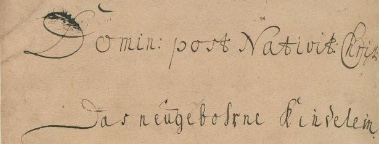
Cantata 122 for the Sunday after Christmas Das neugeborne Kindelein. Part of the title page of the manuscript. The handwriting is by J.A. Kuhnau, one of Bach’s most important copyists.

Since I most recently wrote about Bach’s cantatas for Christmas Day (Cantata 110), and the Third Day of Christmas (Cantata 151) from 1725, I had thought it would be nice to write about the two cantatas Bach performed directly after that: Cantata 28 for the Sunday after Christmas 1725, and Cantata 16 for New Year’s Day 1726.

But I don’t like them. I was listening to them yesterday and today together with my adolescent daughter, who’s pretty well versed in Baroque composers, and she said: “the first one doesn’t even sound like Bach!” I agree with her. Or at least it doesn’t sound that inspired to me. I hope this doesn’t come as a shock to you, but sometimes I don’t like what Bach wrote.

So, for this Sunday after Christmas in 2019, I’m again playing Cantata 122 Das neugeborne Kindelein, which I’ve already discussed twice on this blog, most elaborately in 2017. You can find that post here.

Wieneke Gorter, December 28, 2019.

Sweet soprano consolation for Third Christmas Day 1725, or “the one with the dirty baby”

26 Thursday Dec 2019

Posted by cantatasonmymind in Cantatas, Christmas, Leipzig

≈ Leave a comment

Tags

Alex Potter, BWV 151, Charles Daniels, Christmas 3, flute, Frank Theuns, Jos van Veldhoven, Maria Keohane, Matthias Winckhler, soprano

The Nativity of Christ, by Federico Barocci, ca. 1590. Museo del Prado, Madrid, Spain.

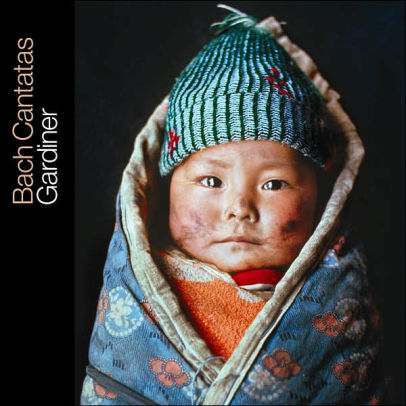
Sometime in the first decade of this century, after I had already moved to the USA, my mother acquired Gardiner’s Christmas Cantatas CD from 2000 (Volume 15 of the Cantata Pilgrimage CD series). I remember that every time a Bach lover came to visit they were urged to listen to the soprano aria from this CD. Among my mother, her sisters, and my grandma, this CD became known as “the one with the dirty baby.” (or as they said in Dutch “die met het vieze kindje”). At some point my mother allegedly said to them that this particular recording should be played at her funeral. Listen a bit to that Gardiner recording of Cantata 151 Süsser Trost, mein Jesus kömmt with Gillian Keith, soprano, and Rachel Beckett, flute, here on YouTube. Just listen for a little bit, because a much better recording of this cantata is coming up in this post! When the time came (much sooner than anyone in the early 2000s could have thought) to plan my mother’s funeral, we were blessed with a live performance, not a recording, I personally didn’t remember the “dirty baby” story that vividly, and we opted for another aria instead (read more about that here).

I don’t remember ever hearing anything more from the CD with the dirty baby than this one aria, and I never ever realized it was from a cantata for the Third Day of Christmas. (Read here why I didn’t know any other cantatas for the Third Day of Christmas than the third cantata from the Christmas Oratorio.)

Swedish soprano Maria Keohane

Fast forward to last week, when I was researching new live video recordings for Cantata 110 for Christmas Day, and discovered that the Christmas concert by the Netherlands Bach Society from 2015 also featured this Cantata 151, and that Maria Keohane does an absolutely beautiful job singing that opening movement. I also enjoy all the other soloists. Watch this live recording here on YouTube. Soloists are Frank Theuns, flute; Maria Keohane, soprano; Alex Potter, alto; Charles Daniels, tenor; and Matthias Winckhler, bass. Interestingly, Maria Keohane has recorded this cantata on video with two other ensembles: Concerto Copenhagen and Ricercar Consort. Those other performances are good too, but I very much prefer the performance and the camera work on this one with the Netherlands Bach Society.

Find the text of Cantata 151 Süsser Trost, mein Jesus kömmt here, and the score here.

Wieneke Gorter, December 26, 2019.

The message continues

25 Wednesday Dec 2019

Posted by cantatasonmymind in Cantatas, Christmas, Leipzig

≈ Leave a comment

Tags

BWV 40, Christmas 2

Adoration of the Christ Child by Josse Lieferinxe, ca. 1500. Louvre Museum, Paris, France.

While in Bach’s Christmas Oratorio the Second Christmas Day is all about the shepherds visiting the baby Jesus, in some other cantatas for this Day Bach further explores why Jesus came on earth. That is also the case in Cantata 40 Darzu ist erschienen der Sohn Gottes. While it is full of references to snake-like evil in the text, that cantata still means Christmas holiday to me. Read about it in my blog post from 2016, now with updated YouTube links.

Please check back here tomorrow for a beautiful live recording of a cantata not previously discussed on this blog for Third Christmas Day.

Wieneke Gorter, December 24, 2019.

Bach and the Christmas Day message

24 Tuesday Dec 2019

Posted by cantatasonmymind in Bach's life, Cantatas, Christmas, Leipzig

≈ 2 Comments

Tags

Alex Potter, Bachvereniging, BWV 110, Charles Daniels, Christmas 1, Christmas Day, Grote Kerk Naarden, Jos van Veldhoven, Maria Keohane, Matthias Winckhler, Netherlands Bach Society

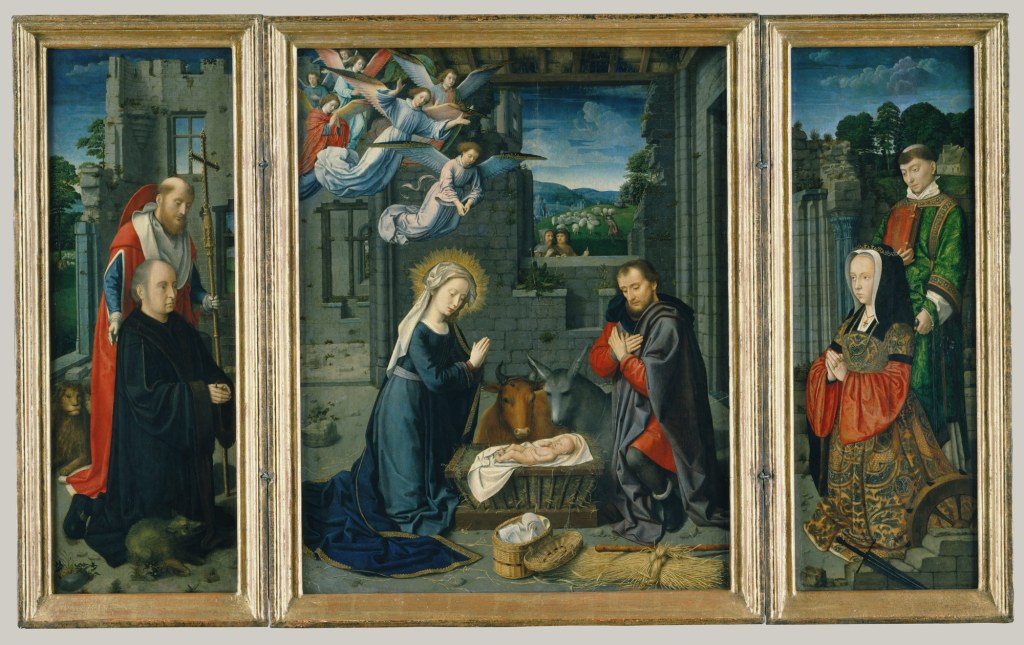
The Nativity with Donors and Saints Jerome and Leonard, by Gerard David, ca. 1510-15. Metropolitan Museum of Art, New York. More information about this painting can be found here.

On this blog I have shared only two of Bach’s compositions for Christmas Day so far: Cantata 91 from 1724 here, and of course the first cantata from the Christmas Oratorio (our family’s “wake-up call” on Christmas morning) from 1734 here. But Bach wrote at least three more cantatas for this day, as well as his Magnificat.

Today I’d love to share Cantata 110 Unser Mund sei voll Lachens (May our mouth be full of laughter) from 1725. Find The Netherlands Bach Society’s live recording of this cantata here on YouTube.

Find the text with English translations here, and the score here.

This live video registration has an abundance of Christmas presents for me: the festive setting of the Grote Kerk in Naarden; soprano Maria Keohane in a Scandinavian Christmas dress and truly enjoying herself; tenor Charles Daniels, always a delight; a promising new young bass, Matthias Winckhler, who can actually sing every note of the enormously challenging bass aria in this cantata; and the best gift of all: Alex Potter singing the alto aria, which to me is the most moving part of this cantata, and also the core message Bach wanted to communicate to his fellow believers on this Christmas Day in 1725.

Alex Potter. Photo by Annelies van der Vegt.

For the joyous opening of this cantata, Bach re-uses his Orchestral Suite no. 4 in D major (BWV 1069) to grandly illustrate the “arrival” of Jesus. In the center of the cantata, after the festivities of the opening chorus, but before the very pretty Christmas-y “Glory to God in the highest” soprano-tenor duet, and an impressive bass aria with trumpet, the music goes into a minor key, and also turns inward, in the alto aria. The text of that alto aria is as follows:

Ach Herr, was ist ein Menschenkind,
Ah, Lord, what is a child of man
Dass du sein Heil so schmerzlich suchest?
that you should seek his salvation with so much pain?
Ein Wurm, den du verfluchest,
A worm whom you curse
Wenn Höll und Satan um ihn sind;
when hell and Satan are around him;
Doch auch dein Sohn, den Seel und Geist
but also your son, whom soul and spirit
Aus Liebe seinen Erben heißt.
Through love call their inheritance.

Of course this text refers to the believers in general, that on the one hand they are worms, and on the other hand will be saved by Jesus. but I feel the choice of the word “Menschenkind” is not a coincidence. It definitely also refers to the the fact that Jesus can’t just stay in the godly realm, but in order to be a true savior, he has to come to earth, become man, and go through all the rotten reality that might imply. This theme appears more or less prominently in all Bach’s cantatas for Christmas Day, and in this cantata 110 it is already announced in the tenor aria:

Er wird Mensch, und dies allein,
He has become man, and this only
Dass wir Himmels Kinder sein.
so that we may become children of heaven.

Nine years later, in the first cantata of his Christmas Oratorio, Bach also stresses this “coming to earth” and “becoming man” of Jesus on this first Christmas Day, in what is also the most moving and inward-looking part of that particular cantata: the soprano-bass duet. The text Bach gives to the bass in that duet is as follows. Note the last line.

Wer will die Liebe recht erhöhn,
Who will rightly extol the love
Die unser Heiland vor uns hegt?
that our Saviour cherishes for us?
Ja, wer vermag es einzusehen,
Indeed, who is able to realise
Wie ihn der Menschen Leid bewegt?
how he is moved by human suffering?
Des Höchsten Sohn kömmt in die Welt,
The highest’s son came into the world
Weil ihm ihr Heil so wohl gefällt,
because its salvation pleases him so well
So will er selbst als Mensch geboren werden.
that he himself is willing to be born as a man.

Merry Christmas!

Wieneke Gorter, December 24, 2019

Two Weimar cantatas for the fourth Sunday of Advent

21 Saturday Dec 2019

Posted by cantatasonmymind in Advent, Bach's life, Cantatas, Christmas, Leipzig, Weimar

≈ Leave a comment

Tags

Advent, Advent 4, Alfredo Bernardini, All of Bach, Bachvereniging, BWV 132, BWV 147, BWV 147a, Christmas, Dominik Wörner, Hana Blazikova, J.S. Bach Foundation, J.S. Bach Stiftung, Jakob Pilgram, Jan Kobow, Julia Doyle, Margot Oitzinger, Netherlands Bach Society, Rudolf Lutz, Tim Mead, Weimar, Wolf Matthias Friedrich

For the fourth Sunday of Advent, Bach wrote two cantatas in Weimar: Cantata 132 Bereitet die Wege, bereitet die Bahn in 1715, and Cantata 147a Herz und Mund und Tat und Leben in 1716.

Bach rewrote Cantata 147, the same way he did that with cantatas 70 and 186, into a cantata for another time of the year in Leipzig, in this case the feast of the Visitation on July 2, 1723. Read more about that here in my post from 2016. I have now updated that post with a link to the wonderful live performance of Cantata 147 by the J.S. Bach Foundation, with with Hana Blažiková, soprano; Margot Oitzinger, alto; Jakob Pilgram, tenor; and Wolf Matthias Friedrich, bass.

Cantata 132 was not transformed into a cantata for another time in the church year in Leipzig, so today’s performances of this cantata still reflect the Advent cantata from Weimar. Watch a beautiful live performance of this cantata by the Netherlands Bach Society here on YouTube. Soloists are Julia Doyle, soprano; Tim Mead, alto; Jan Kobow, tenor; and Dominik Wörner, bass.

Find the German text with English translations here, and the score here.

As I already pointed out in my Advent Calendar earlier this week, the text of the joyful opening aria refers to the story of John the Baptist, who was believed to have come to prepare the way for Jesus, and includes the Isaiah quote as it appears in the scripture: “Messias kömmt an!” (The Messiah is coming). Bach gives this text to the soprano three times, and to give it extra emphasis, each time omits all instrumental accompaniment on those three words.

The rest of the cantata stays close to the story of John the Baptist. The bass aria refers to the Pharisees interrogating John, but then Bach’s text writer (Salomo Franck, who was also the Weimar court librarian) projects the question “Wer bist du?” (Who are you?) onto the believer: ask your conscience: are you a true person or a false person?

As a child, I was enormously impressed by this bass aria, even more than by the wonderful soprano aria at the beginning of the piece. I loved how Max van Egmond sings the “Wer bist du?” text on the Leonhardt recording from 1983. You can find that recording, and read more about those childhood memories, in this blog post from 2016. I had no idea at the time that in those very cool opening notes Bach is quoting this organ piece by Buxtehude. I only learned that this week, by watching the “extra videos” the Netherlands Bach Society provides along with their live recordings on All of Bach.

If you are not following this blog yet, please consider signing up (on the left of this text if you are on a desktop computer, at the bottom of this post when you are reading on a smartphone). This way you won’t miss any posts about the many cantatas Bach wrote for all three Christmas Days (yes there were three in his time), New Year’s Day, and the Sundays after those feast days.

Wieneke Gorter, December 21, 2019.

← Older posts

Recent Posts

  • “Missa Miniatura” by CONTINUUM/Elina Albach Even More Moving in 2025
  • Bachfest Leipzig 2025
  • Bach Cantatas for Christmas – 1724 and 1734 editions
  • Fourth Sunday of Advent – more insight into Cantata 62 helped me better understand Bach’s Christmas Oratorio
  • Saint Ambrose and Luther in Milan – Second Sunday of Advent

Archives

  • August 2025
  • July 2025
  • December 2024
  • November 2024
  • June 2024
  • January 2024
  • December 2023
  • October 2023
  • September 2023
  • August 2023
  • April 2022
  • February 2022
  • January 2022
  • December 2021
  • November 2021
  • June 2021
  • May 2021
  • April 2021
  • February 2021
  • January 2021
  • December 2020
  • November 2020
  • October 2020
  • September 2020
  • August 2020
  • July 2020
  • May 2020
  • April 2020
  • March 2020
  • February 2020
  • January 2020
  • December 2019
  • November 2019
  • May 2018
  • April 2018
  • March 2018
  • February 2018
  • January 2018
  • December 2017
  • November 2017
  • October 2017
  • September 2017
  • August 2017
  • July 2017
  • June 2017
  • May 2017
  • April 2017
  • March 2017
  • February 2017
  • January 2017
  • December 2016
  • November 2016
  • October 2016
  • September 2016
  • August 2016
  • July 2016
  • June 2016
  • May 2016
  • April 2016
  • March 2016
  • February 2016
  • January 2016

Enter your email address to follow this blog and receive notifications of new posts by email.

Join 338 other subscribers

Categories

  • 1723 Trinity season special series
  • Advent
  • After Easter
  • Ascension
  • Bach's life
  • Cantatas
  • Chorale cantatas 1724/1725
  • Christmas
  • Easter
  • Epiphany
  • Following Bach in 1725
  • Köthen
  • Leipzig
  • Septuagesima
  • Travel
  • Trinity
  • Weimar

Meta

  • Create account
  • Log in
  • Entries feed
  • Comments feed
  • WordPress.com

Website Built with WordPress.com.

  • Subscribe Subscribed
    • Weekly Cantata
    • Join 158 other subscribers
    • Already have a WordPress.com account? Log in now.
    • Weekly Cantata
    • Subscribe Subscribed
    • Sign up
    • Log in
    • Report this content
    • View site in Reader
    • Manage subscriptions
    • Collapse this bar
 

Loading Comments...