Weekly Cantata

Weekly Cantata

Category Archives: Weimar

Trinity 4: Two cantatas make one

18 Saturday Jun 2016

Posted by cantatasonmymind in 1723 Trinity season special series, Cantatas, Leipzig, Trinity, Weimar

≈ Comments Off on Trinity 4: Two cantatas make one

Tags

according to Lutheran Church year, Bach Collegium Japan, Gerd Türk, John Eliot Gardiner, Kai Wessel, Klaus Mertens, Robin Blaze, Ton Koopman

Brueghel_the_Blind

Pieter Brueghel the Elder: The Parable of the Blind Leading the Blind, 1568

Previously on Weekly Cantata: For his first three Sundays in Leipzig, Bach presented ambitious, two-part cantatas, the first part before the sermon, the second part after.  On this Trinity 4, June 20 1723, the congregation and the musicians in Leipzig may still have had the trumpets and timpani from the impressive closing chorus of last week’s Ich hatte viel Bekümmernis going through their heads.

Up until now, it seems to all have been part of a plan: Bach probably wrote his cantatas for Trinity 1 (cantata 75) and Trinity 2 (cantata 76) while still living in Köthen, and most likely had also been planning all along to perform cantata 21 on Trinity 3. *

But now what to do for Trinity 4? In his stack of Weimar cantata manuscripts there was a nice one, very closely referring to the Gospel for the day (Luke 6: 36-42), but it was too short, and not very impressively scored.

So, it was time to write a new cantata that could function as Part I, the part before the sermon, and then present the one from Weimar after the sermon, as part II. This newly composed piece became cantata 24 Ein ungefärbt Gemüte. Only four weeks into his new post at Leipzig,  and possibly up to his ears in getting things organized at the St. Thomas School, Bach had not had the time (or the social intelligence, we don’t know) to find a librettist, so for this cantata he used a pre-existing text by Erdmann Neumeister, a Leipzig-trained theologian, who was preaching at the St. Jacob church in Hamburg from 1715 to 1756. Bach may very well have met him there, since this was the same church where he applied for the post of cantor and organist in 1720. Neumeister’s many volumes of cantata texts were published in the early 1700s, and through the excellent library at the castle in Weimar Bach might have had access to these too, as he already used a Neumeister text for his Weimar Advent cantata 61 from 1714.

The recording of cantata 24 Ein ungefärbt Gemüte I like the best is Bach Collegium Japan’s recording, with beautiful singing by countertenor Robin Blaze and tenor Gerd Türk in the arias. Listen to this cantata on Spotify, or purchase the album on Amazon. Read the German texts with English translations here.

Though on a much smaller scale than cantata 75 from three weeks ago, this cantata 24 again displays a wonderful symmetry: Bach emphasizes that the main message “Everything that you want other people to do to you, you should do yourself for them” is at the center of the cantata text. He sets that part of the text to an intricate choral piece with the fullest instrumentation of the entire cantata, including trumpet, and scores the arias and recitatives around this main message much more soberly. In the two recitatives, Bach accentuates the words at the end of each by letting the music blossom out into an arioso in those spots. This happens on this text in the tenor recitative:

Mach aus dir selbst ein solches Bild (Make yourself such an image)
Wie du den Nächsten haben willt! (As you want your neighbour to have)

and in the bass recitative on these words:

So geht es dort, so geht es hier. (These things go on here, there and everywhere.)
Der liebe Gott behüte mich dafür! (That the dear God preserve me from this!)

Then comes Part Two, cantata 185 Barmherziges Herze der ewigen Liebe, written in Weimar in 1715. For this 1723 Leipzig re-creation of it, Bach transposed it from F sharp minor to G minor, since the tuning in Weimar was different than in Leipzig, and had a trumpet play the chorale tune in the opening duet, instead of an oboe.

Of all the recordings I listened to, only Gardiner brings to life the opening duet of this Leipzig version of cantata 185, with a trumpet playing instead of an oboe. Listen to a recording of that first movement by Gardiner, with soprano Magdalena Kozena and tenor Paul Agnew, on YouTube. However, for the wonderful alto rectitative and aria that come next, as well as the bass recitative and aria, I feel the need to switch to Koopman’s recording, with countertenor Kai Wessel and bass Klaus Mertens. Listen to this recording on YouTube, starting with the alto recitative (when you click on this link, it starts at 4m1s into the cantata).

I am too much of a countertenor lover to pass up this heavenly singing by Kai Wessel for Nathalie Stutzmann on the Gardiner recording, but I realize others might prefer it the other way around. I’m also not completely convinced by Gardiner’s argument that Bach is imitating an irritating Weimar preacher in the bass recitative and aria, so while Gardiner’s bass soloist Nicolas Testé very skillfully portrays this interpretation, it is a bit overdone to my taste.

So why not listen to the entire Koopman recording of this cantata?  Well, there’s the strange opening duet: Koopman makes the surprising choice to have the choir sopranos sing the chorale melody with text instead of having an oboe (per the Weimar version) or a trumpet (per the Leipzig version) play that part. This decision is not explained in their liner notes. And while I like soprano Barbara Schlick’s and tenor Guy de Mey’s individual voices, I feel that Schlick’s voice outbalances De Mey’s on this recording.

One wonders: was the new job as teacher at the St. Thomas School and director of the choir a bit overwhelming for Bach, or was he by this time already getting frustrated with the lack of skill and talent among the choir boys? A few years later, he would complain to the council that there weren’t enough strong voices, and that he needed the good instrumentalists among them to fill the many vacant seats in the orchestra, and could thus not use them in the choir. It is interesting to see how, after the many challenging choral pieces in cantata 21 last week, there is only one polyphonic chorus part in the  combined cantatas for today, and only an embellished chorale in the cantata for the feast of St. John the Baptist Bach was preparing for June 24.

Wieneke Gorter, June 18, 2016

*Please note: the numbers we use now for these cantatas are a product of the 19th and 20th century. Bach never gave his compositions numbers, and he must have referred to the cantatas by title only.
Trinity 3: from Weimar, with love

12 Sunday Jun 2016

Posted by cantatasonmymind in 1723 Trinity season special series, Cantatas, Leipzig, Trinity, Weimar

≈ Comments Off on Trinity 3: from Weimar, with love

Tags

according to Lutheran Church year, Alfred Dürr, Bach, Bach Collegium Japan, Barbara Schlick, cantatas, Christoph Wolff, Collegium Vocale Gent, Lutheran Church year, Masaaki Suzuki, Monika Frimmer, Peter Kooy, Phlippe Herreweghe, Rachel Podger, Vivaldi

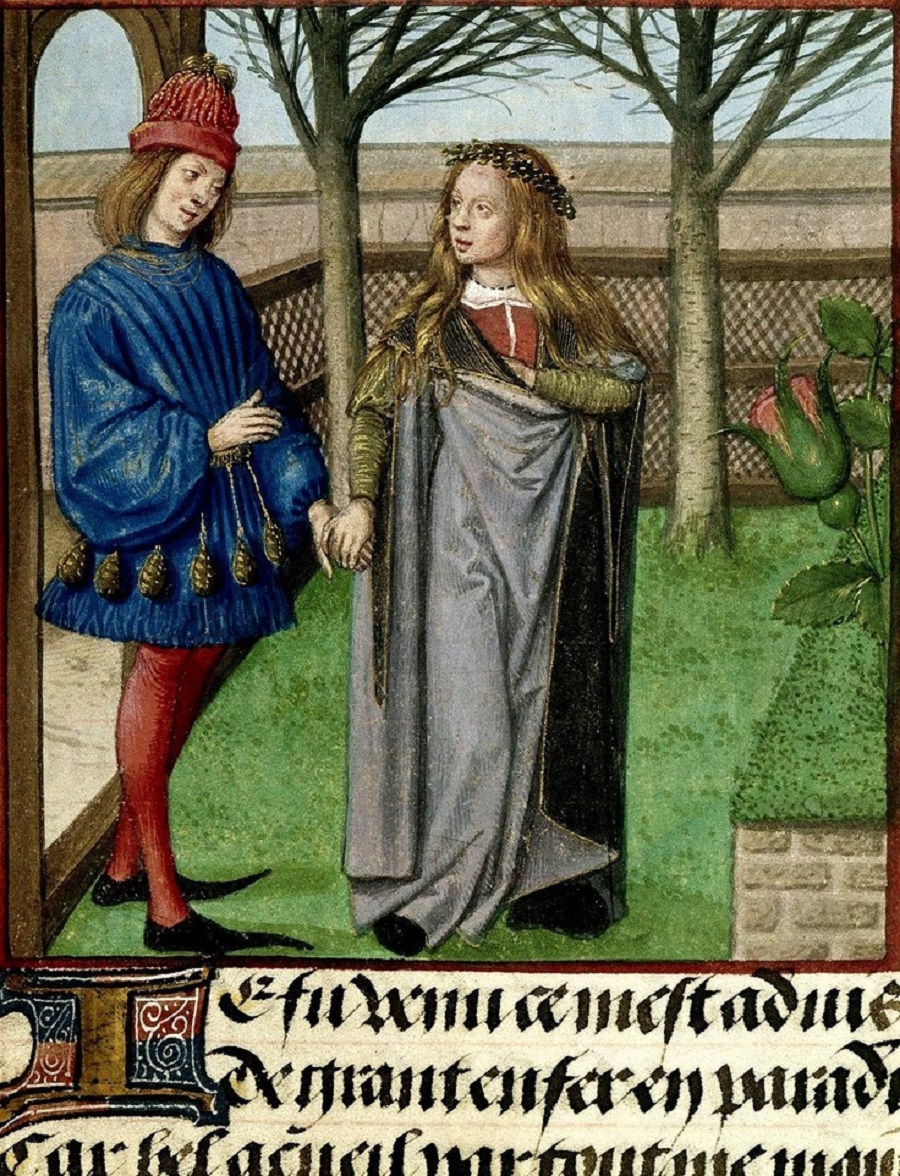
Roman de la Rose, Netherlands (Bruges), c. 1490-c. 1500

Only three episodes into this special 1723 Leipzig Trinity season series,  I’m already taking a detour to Weimar. It’s Bach’s fault, because, after the two newly written cantatas he presented on May 30 and June 6, 1723, he “recycled” his Weimar cantata for this third Sunday after Trinity: cantata 21 Ich hatte viel Bekümmernis, written in 1714, or possibly in 1713.

We dont’ know for sure why Bach chose to use an “old” composition this early in his first season (though probably nobody except his own family knew it was not new), but  I think that he couldn’t wait to impress the Leipzig Council and congregation with a composition that was one of his all-time favorites. He had written and performed it at least twice in Weimar, then presented it in Hamburg or Köthen in 1720* and would perform it many more times in Leipzig on future third Sundays after Trinity. Another reason I believe  it was Bach’s plan all along to present this cantata 21 on Trinity 3 in Leipzig: it seems to me that when writing the masterful fugue in the opening chorus of cantata 76, Bach must have had the fugue in no. 6 of cantata 21 on his mind.

Whether it was thanks to the multiple performances during Bach’s lifetime, or to Mattheson mentioning it (however unfavorably!) in his writings, cantata 21 was known among Bach’s colleagues and students throughout the 18th and 19th centuries, and is still one of the most well-known and most frequently performed cantatas today.

Instead of talking about the music, I would like to shine some light on the history of this cantata, and show you that it was not a stand-alone masterpiece that Bach created out of nothing. Most of the findings here below are from  books by Alfred Dürr and Christoph Wolff.

There are parts of this cantata that fit extremely well within the style of the 1714 Weimar cantatas. To hear cantata 21 in this context, if you have time, before you listen to the sinfonia (no. 1) of cantata 21, I invite you to first listen to the sinfonia of cantata 12. They are remarkably similar. Next, just for the fun of it, you might want to listen to the “love” duet from Weimar Pentecost cantata 172 (beautifully sung by soprano Dorothee Mields and countertenor Alex Potter during a streamed concert from 2021)

 Soprano (Soul)

Komm, laß mich nicht länger warten,
Come , let me wait no longer,
Komm, du sanfter Himmelswind,
come, you gentle wind of heaven,
Wehe durch den Herzensgarten!
blow through the garden of my heart

 Alto (Holy Spirit)

Ich erquicke dich, mein Kind.
I refresh you, my child

Liebste Liebe, die so süße,
Dearest love, who are so delightful,
Aller Wollust Überfluß,
abundance of all joys,
Ich vergeh, wenn ich dich misse.
I shall die, if I have to be without you

Nimm von mir den Gnadenkuß.
Take from me the kiss of grace.

Sei im Glauben mir willkommen,
Welcome in faith to me,
Höchste Liebe, komm herein!
Highest love, come within!
Du hast mir das Herz genommen.
You have taken my heart from me

Ich bin dein, und du bist mein!
I am yours, and you are mine!

and compare it to the “love” duet from cantata 21:

Soprano (Soul):

Komm, mein Jesu, und erquicke,

Bass (Jesus):

Ja, ich komme und erquicke

Come, my Jesus, and restore

Yes, I come and restore

Und erfreu mit deinem Blicke.

Dich mit meinem Gnadenblicker,

and rejoice with your look

you with my look of grace

Diese Seele,

Deine Seele,

This soul

Your soul

 Die soll sterben,

 Die soll leben,

that must die

that must live

Und nicht leben

 Und nicht sterben

and not live

and not die

 Und in ihrer Unglückshöhle

Hier aus dieser wunden Höhle

and in its den of misfortune

here from this den of wounds

Ganz verderben.

Sollst du erben

wholly perish.

 you shall be given

 Ich muß stets in Kummer schweben,

Heil! durch diesen Saft der Reben,

I must always be suspended in misery

Salvation! throught this juice of the grape

Ja, ach ja, ich bin verloren!

Nein, ach nein, du bist erkoren!

Yes, oh, yes, I am lost

No,oh, no, you are chosen

 Nein, ach nein, du hassest mich!

Ja, ach ja, ich liebe dich!

No, ah, no, you hate me!

Yes, oh, yes,I love you!

 Ach, Jesu, durchsüße mir Seele und Herze,

Entweichet, ihr Sorgen, verschwinde, du Schmerze!

Jesus, sweeten my soul and heart.

Give way, worries, vanish, pain!

Komm, mein Jesus, und erquicke

Ja, ich komme und erquicke

Come, Jesus, and restore

Yes, I come and restore

Mit deinem Gnadenblicke!

Dich mit meinem Gnadenblicke

 with your look of grace

 you with my look of grace.

Of course none of these are officially  meant to speak of earthly love. But still, both these duets are extremely cute, musically completely similar to opera love duets from that time, and their texts could at least partly be interpreted as such love duets, so I can imagine the Weimar poet and the young Bach must have enjoyed writing these.

To really appreciate “the making of” the opening chorus (no. 2) of cantata 21, it’s worth listening to a magnificent Vivialdi violin concerto and one of Bach’s lesser known organ prelude and fugues, to hear where Bach found the theme for the Ich hatte viel Bekümmernis fugue:

In the spring of 1713, the half-brother of Bach’s employer in Weimar, prince Johann Ernst, “a great lover of music and an incomparable violinist” (according to a testimony by Philipp David Kräuter, a student of Bach in Weimar) went on a study trip, and spent a long time in the Netherlands. Upon his return, he had brought “much fine Italian and French” music with him. One of the pieces was Vivaldi’s Concerto in D minor Opus 3, no. 11  for two violins from Book II of L’Estro armonico (RV 565), published in Amsterdam in 1711.

Listen to this Vivaldi concerto in the award-winning interpretation by the fabulous Rachel Podger with Brecon Baroque on Spotify, or on YouTube

Maybe Bach, an accomplished violinist himself, and the prince played this together after the prince returned in July 1713. Bach rewrote this Vivaldi concerto into an organ concerto (BWV 596), but also used the theme in his organ prelude and fugue in B minor, BWV 544,  written in Weimar as well.  It is in this piece in particular that I can hear the relation with cantata 21 Dürr wants to point out in his book.

About recordings of cantata 21: While Bach Collegium Japan deserves a medal for  taking the trouble to research all the different versions and record the ones from 1720 and 1714 on their volume 6 , and the true 1723 Leipzig version (with trombones added in no. 9 and solo/tutti distinctions in the choruses) on their volume 12, I still like Herreweghe’s recording of this cantata the best, mainly because of the strong, crisp choruses and the music always having long lines and strong sense of direction. Listen to Herreweghe’s interpretation of  this cantata on Spotify or on YouTube.

Update from 2021: find an absolutely stunning performance of the 1720 version (with only soprano and bass soloists) on the YouTube channel of the J.S. Bach Foundation here.

Read the German text with English translations of cantata 21 here, and find the score here.

If you don’t want to miss an episode of this 1723 Trinity season series, please consider signing up to receive an email every time I’ve posted a new story.

Please feel free to share this on Facebook, or forward to anyone you think might enjoy coming along for this ride. Thank you!

Wieneke Gorter, June 12, 2016. Updated June 19, 2021.

*Bach visited Hamburg in November 1720, to apply for an organist and cantor post there. It turned out, however, that the post needed to be “bought” and the job went to a lesser talented but wealthy candidate. Most scholars are confident there was a performance of this cantata in 1720 in either Köthen or Hamburg, based on the surviving manuscripts of the parts. Because it was the Hamburg-based writer Mattheson who criticized the cantata in a letter  in 1725, it is probable that the performance took place in Hamburg during Bach’s visit there.

According to Bach Collegium Japan’s leader Masaaki Suzuki, the 1720 performance featured only a soprano and a bass, with the soprano also singing all the arias and recitatives we know nowadays as written for tenor.

Weinen, Klagen, Sorgen, Zagen

16 Saturday Apr 2016

Posted by cantatasonmymind in After Easter, Cantatas, Leipzig, Weimar

≈ Comments Off on Weinen, Klagen, Sorgen, Zagen

Tags

3rd Sunday after Easter, American Bach Soloists, Bach, Benjamin Butterfield, BWV 12, BWV 182, BWV 21, cantatas, Cantus Cölln, Collegium Vocale Gent, Himmelsburg, Jeffrey Thomas, Johanna Koslowsky, John Eliot Gardiner, Konrad Junghänel, Phlippe Herreweghe, Stephen Escher, Vox Luminis, Weimar


WeinenKlagen
Fragment from Bach’s manuscript of cantata 12 in the Staatsbibliothek zu Berlin – Preußischer Kulturbesitz

For this third Sunday after Easter, I’m jumping back in time to Weimar, 1714, and Bach’s monthly cantata cycle there. Cantata 12 Weinen, Klagen, Sorgen, Zagen was the second cantata Bach wrote in Weimar after having been promoted to Konzertmeister in 1714.*

Bach repeated this cantata in Leipzig in 1724.

There are several very good recordings of this cantata, but I would recommend listening to the one by Collegium Vocale/Herreweghe, or to the one by Cantus Cölln/Konrad Junghänel, and then listen again to the tenor aria on the American Bach Soloists recording (keep reading until the end to learn why).

I love the Collegium Vocale/Herreweghe recording for the excellent timing and phrasing, the sound of the alto section in the choir, and Marcel Ponseele’s oboe playing. Listen to cantata 12 by Herreweghe on YouTube

2020 update:  if you can afford to financially support the artists (especially important now, while they have no income from performances!) please consider purchasing their recordings instead of just listening on YouTube.

Buy this recording on Amazon or on iTunes.

Cantus Cölln/Konrad Junghänel’s recording is one on a part, more similar to what it would have sounded like from the small organ loft in the Himmelsburg, and soprano Johanna Koslowsky’s singing always gives me goose bumps, no matter how many times I’ve listened to it. Listen to cantata 12 by Cantus Cölln.

Buy this recording on Amazon or on iTunes

Find the German texts with English translation of this cantata here and the score here.

The beautiful but sad opening sinfonia would probably have served as an “entrada” for the Duke and his entourage. It is very similar to the one of cantata 21 Ich hatte viel bekümmernis, also written in Weimar.

Several of Bach’s Weimar cantatas were lost when the castle’s chapel burnt down in 1774. Most of the Weimar cantatas we still have today survived only because Bach performed those again in Leipzig, sometimes several times. If he did this because he was proud of these cantatas, then Weinen, Klagen, Sorgen, Zagen must have been his greatest pride, since he later transformed its opening chorus into the Crucifixus for his Mass in B Minor.

Both the sinfonia and opening chorus convey enormous sadness, while it is “Jubilate” Sunday, and only three weeks after Easter. This has to do with the Gospel reading for this Sunday: Jesus’ speech to his disciples explaining that he will leave them, that they will go through immense suffering, but that their sorrow will turn into joy, comparing it to a woman going through childbirth.

So this cantata first conveys the feelings of the disciples, knowing they will soon be without Jesus, and the “tribulations” Jesus predicts for them. But then it explores the journey “from sadness to joy.”

First of all, the entire score can be seen as  uplifting, even though the general atmosphere is downcast. As many scholars have pointed out, the score ascends, movement by movement, in intervals of a third, alternating a minor key with its relative major: f, A flat, c, E flat, g, B flat. Gardiner says that this is the “escape ladder” Bach lowers into the pit of sorrow.

The “sorrow to joy”-theme is also cleverly portrayed in the texts, thanks to Salomo Franck, the Duke’s librarian, acting as librettist for all cantatas Bach wrote in Weimar. Many consider Franck’s poetry superior to most of the texts Bach had to work with in his Leipzig years. The alto aria is a good example: after the Gospel quote in the recitative “Wir müssen durch viel Trübsal” (we have to go through tribulation) comes an upbeat aria illuminating how “Kreuz und Krone” (cross and crown) and “Kampf and Kleinod” (conflict and jewel) are always connected.

While I love everything about this cantata, my absolute favorite part is the tenor aria Sei getreu.

The text of the tenor part refers to the Gospel text “A little while, and ye shall not see me: and again, a little while, and ye shall see me, because I go to the Father” and plays on that concept of “little while” – Franck decided it was not any longer than a period of rainy weather (which in Germany can be a few weeks in a row of course) …

Sei getreu, alle Pein
Be faithful, all pain
Wird doch nur ein Kleines sein.
will only be a little while.
Nach dem Regen
After the rain
Blüht der Segen,
blessing blossoms,
Alles Wetter geht vorbei.
all bad weather passes by.
Sei getreu, sei getreu!
Be faithful, be faithful!

And it gets better! Bach offers additional consolation by way of his music: through this aria, a trumpet plays the melody of “Jesu, meine Freude.” Everyone in attendance in the Himmelsburg would immediately have recognized the melody, and would have heard these words in their head:

Jesu, meine Freude,
Jesus, my joy,
Meines Herzens Weide,
My heart’s delight
Jesu, meine Zier,

Jesus, my treasure
Ach wie lang, ach lange
Ah how long,ah how long
Ist dem Herzen bange
must my heart be anxious
Und verlangt nach dir!
And full of longing for you!
Gottes Lamm, mein Bräutigam,
Lamb of God, my bridegroom
Außer dir soll mir auf Erden,
Besides you there is in on earth
Nichts sonst Liebers werden.
Nothing else that is dearer to me.

My all-time favorite recording of this particular aria is the one by American Bach Soloists, with Benjamin Butterfield singing tenor, and Stephen Escher playing the chorale melody on a cornetto. On most recordings (Herreweghe, Cantus Cölln, Gardiner) the part is played on a Baroque trumpet, on some (Koopman) on a Baroque oboe. The softer, more human sound of the cornetto combined with Escher’s fabulous playing makes this the most moving interpretation of this aria I’ve ever heard. Listen for yourself: find American Bach Soloists’ recording of Sei getreu on YouTube.

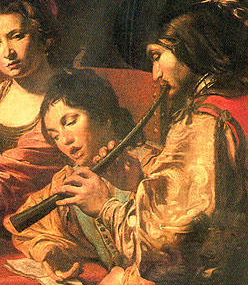
cornettplayer with singer
singer with cornetto player, anonymous, 16th century

2020 update: Since I wrote this in 2016, Vox Luminis released a wonderful recording of this cantata. They use a slide trumpet in the tenor aria, which is a beautiful middle between the Baroque trumpets of the Herreweghe, Cantus Cölln, and Gardiner recordings and the cornetto of the American Bach Soloists recording.

Find Vox Luminis’ recording of Cantata 12 on YouTube, on Amazon, or on iTunes.

Wieneke Gorter, April 16, 2016, updated April 27, 2020.

*The first cantata Bach wrote in Weimar was cantata 182 Himmelskönig, sei wilkommen for Palm Sunday.

Easter in Weimar 1715

27 Sunday Mar 2016

Posted by cantatasonmymind in Cantatas, Easter, Weimar

≈ Comments Off on Easter in Weimar 1715

PI_2
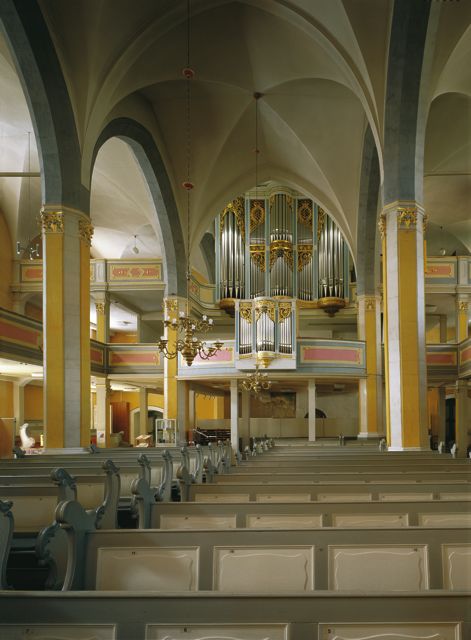
The interior of the St. Peter & Paul or city church in Weimar: much more room on this organ loft than on the one in the castle’s chapel

While most of Bach’s cantatas in Weimar were performed in the castle’s chapel, the Himmelsburg, sometimes the Duke would visit the St. Peter und Pauli (St. Peter and Paul) church, also called the Stadtkirche (city church), and nowadays also called the Herder Kirche. It might have been for political reasons, or because of wanting to hear a certain preacher. Whatever the Duke’s motivation was on Easter 1715, it is clear from the orchestration of cantata 31 Der Himmel Lacht, die Erde Jubilieret that it cannot have been performed on the small organ loft of the castle’s chapel. (Lucky for all those musicians, they didn’t have to climb the 65 feet / 20 meters Bach climbed every day to play organ there).

Listen to cantata 31 by Harnoncourt on YouTube

Listen to cantata 31 by Harnoncourt on Spotify

Please find the German text of this cantata with English tranlations here and please find the score here.

After the first performance in Weimar on April 21, 1715, Bach performed this cantata at least two more times in Leipzig. This might have been because of writing or revising the Passions for Good Friday, he didn’t have time to write something new (he also recycled cantata 4 a couple of times), but let’s just say he really liked them.

In the fabulous opening sinfonia, one can clearly hear that Bach had been studying Vivaldi’s music and also that the start of the Christmas Oratorio (written much later, in Leipzig) was conceived already here in Weimar. At one point in the cello part, there is a reference to the brilliant writing in cantata 18 from two months earlier that same year.

Whether the sinfonia was meant to function as an “entrada” for the Duke and his entourage into the church or not, it needs to be that slow for me, that I can at least picture a ceremonial entrance happening while this music is being performed. That desire combined with strong nostalgic emotions I have when listening to this cantata, I can only recommend the Harnoncourt recording of this.

The nostalgia is of course not for  the sometimes struggling brass instruments in the opening movement. (It was not easy in the early 70s to play  historic trumpet. But those guys paved the way. And who knows, maybe that’s why Harnoncourt takes the tempo so much slower than Historical Performance conductors do that nowadays). The nostalgia is for the fabulous Peter Jelosits. In my memory this cantata got played  more often in our house than just on Easter Sunday and I truly grew up with his voice. In this cantata he gets to sing the soprano part in the five-part (!) opening chorus by himself for several measures, which is pure heaven, and he sings a fabulous aria as well. In the liner notes it only says “soloist of Wiener Sängerknaben,” but if you compare it with this recording, it is clearly him.

About the aria (the before-last movement of the cantata): after the super-happy opening chorus celebrating the resurrection and -in the subsequent movements- reflections on what Christ’s passion and resurrection mean for man, it is by now time  to turn back to the always present death, and the trust that Jesus will not leave the believer’s side. By this time Bach had already buried two of his children, and his employer was also a very devout Lutheran, so this was entirely appropriate, as dark and heavy as it might seem to us today.

So Bach already presents a “deathbed chorale” in this aria, in the melody of the upper strings, while of course the soprano voice part sings different words.  We can assume that the congregation at this church in Weimar as well as Duke Wilhelm-Ernst knew this chorale so well they could hear these words in their head:

Wenn mein Stündlein vorhanden ist,
und ich soll hinfahren meine Strasse,
geleite mich, Herr Jesu Christ,
mit Hilf mich nicht verlasse :
den Geist an meinem letzten End
befehl ich, Herr, in deine Händ ;
du wirst ihn wohl bewahren.


When the hour of my death is at hand
And I must travel on my way
Accompany me, Lord Jesus Christ,
With your help do not abandon me:
At my final end my spirit
I entrust, Lord, in your hands;
You will preserve it well.

This same tune then comes back in the closing chorale, using the original text, albeit the very last verse of it.

Wieneke Gorter, March 27, 2016, updated April 3, 2021.

Newer posts →

Recent Posts

  • Three Listening Guides – First Sunday of Advent
  • The End of Times and Christmas Combined – Cantata 116 for Trinity 25
  • From the Archives, with a New Recording – Cantatas 60 and 26 for Trinity 24
  • A Controversy and a Coin Collection – Cantata 163 for Trinity 23
  • Giving the Choir a Breather? – Cantata 89 for Trinity 22

Archives

  • November 2026
  • October 2026
  • September 2026
  • August 2026
  • August 2025
  • July 2025
  • December 2024
  • November 2024
  • June 2024
  • January 2024
  • December 2023
  • October 2023
  • September 2023
  • August 2023
  • April 2022
  • February 2022
  • January 2022
  • December 2021
  • November 2021
  • June 2021
  • May 2021
  • April 2021
  • February 2021
  • January 2021
  • December 2020
  • November 2020
  • October 2020
  • September 2020
  • August 2020
  • July 2020
  • May 2020
  • April 2020
  • March 2020
  • February 2020
  • January 2020
  • December 2019
  • November 2019
  • May 2018
  • April 2018
  • March 2018
  • February 2018
  • January 2018
  • December 2017
  • November 2017
  • October 2017
  • September 2017
  • August 2017
  • July 2017
  • June 2017
  • May 2017
  • April 2017
  • March 2017
  • February 2017
  • January 2017
  • December 2016
  • November 2016
  • October 2016
  • September 2016
  • August 2016
  • July 2016
  • June 2016
  • May 2016
  • April 2016
  • March 2016
  • February 2016
  • January 2016

Enter your email address to follow this blog and receive notifications of new posts by email.

Join 338 other subscribers

Categories

  • 1723 Trinity season special series
  • Advent
  • After Easter
  • Ascension
  • Bach's life
  • Cantatas
  • Chorale cantatas 1724/1725
  • Christmas
  • Easter
  • Epiphany
  • Following Bach in 1725
  • Köthen
  • Leipzig
  • Leipzig 1726/1727
  • Septuagesima
  • Travel
  • Trinity
  • Weimar

Meta

  • Create account
  • Log in
  • Entries feed
  • Comments feed
  • WordPress.com

Website Built with WordPress.com.

  • Subscribe Subscribed
    Weekly Cantata
    Join 158 other subscribers

    Have a WordPress.com account? Log in now.

  • Weekly Cantata
    View site in Reader
    Manage subscriptionsSign upLog in
    Report this content
    Collapse this bar
Loading Comments...