Wartburg castle in Eisenach, Germany, where Luther translated the Bible from Latin into German.
For a period of nine months, starting on June 11, 1724, Bach wrote a brand-new cantata for every Sunday and feast day. It became his “chorale cantata cycle,” the second cycle of cantatas he composed in Leipzig, for the 1724/1725 season. After Bach’s death in 1750, this collection of cantatas was considered the most important part of his cantata legacy, and there are several indications that he truly meant for this collection to survive him. For example, for the twelve Sundays or feast days that had not occurred in the 1724/1725 season, he would write a chorale cantata later in his life, in order to fill the gaps in the cycle.
Cantata 14 Wär Gott nicht mit uns diese Zeitis the very last one of those added chorale cantatas, composed in 1735, exactly 10 years after the missed Sunday in 1725. Listen to it here in a live video recording from 2017 by Cantus Cölln. Soloists are Magdalene Harer, soprano; Elisabeth Popien, alto; Georg Poplutz, tenor; and Wolf-Matthias Friedrich, bass.
Please find the text and translations here, and the score here.
When Bach uses one of Luther’s original hymns as the basis for a chorale cantata, he often writes the opening chorus in the form of a motet, using a composition style from the Renaissance, which was considered very old-fashioned in his time. See for example my blog posts about Cantata 2 Ach Gott, vom Himmel sieh darein here, and Cantata 38 Aus tiefer Not schrei ich zu dirhere. It is his way of paying his respects to Luther and his hymns, which were 200 years old at the time. So it is only fitting that the very last chorale cantata he ever wrote also opens with such a motet.
However, the soprano aria and the bass aria from Cantata 14 make it clear that Bach is not in 1525 or even 1725 anymore, but firmly in 1735, the year of his Christmas Oratorio and Ascension Oratorio.
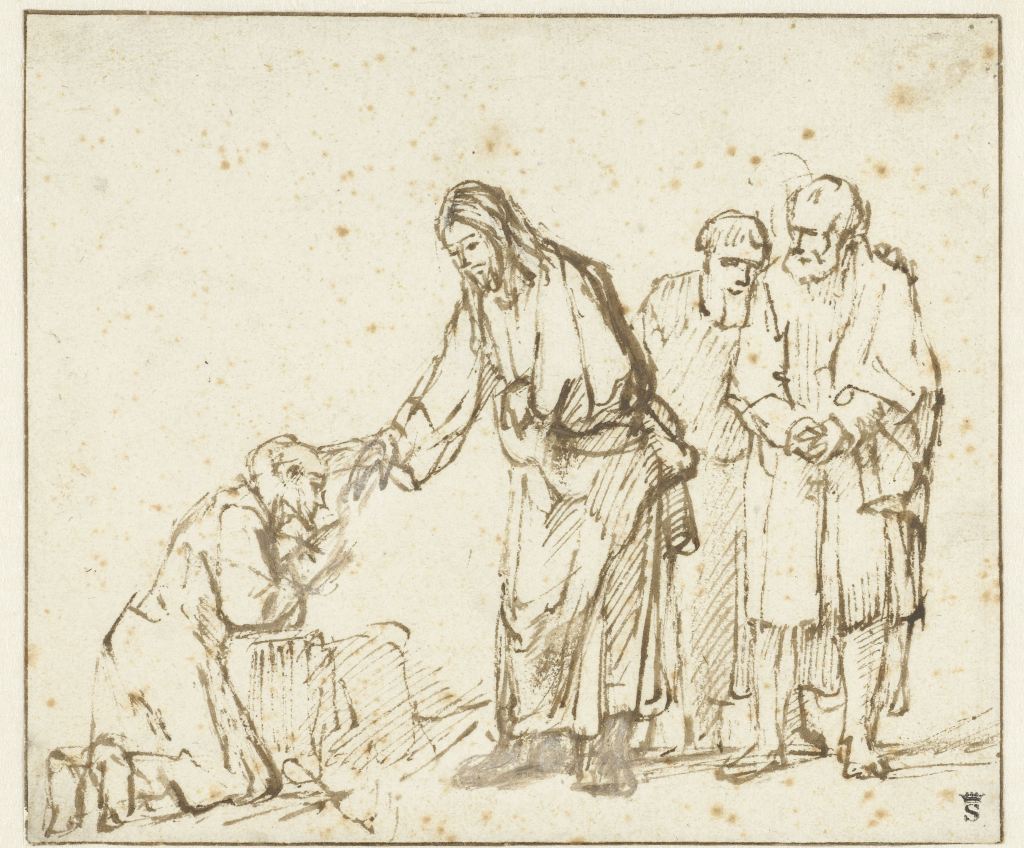
Christ healing a leper, by Rembrandt van Rijn, circa 1650-1655. Rijksmuseum, Amsterdam.
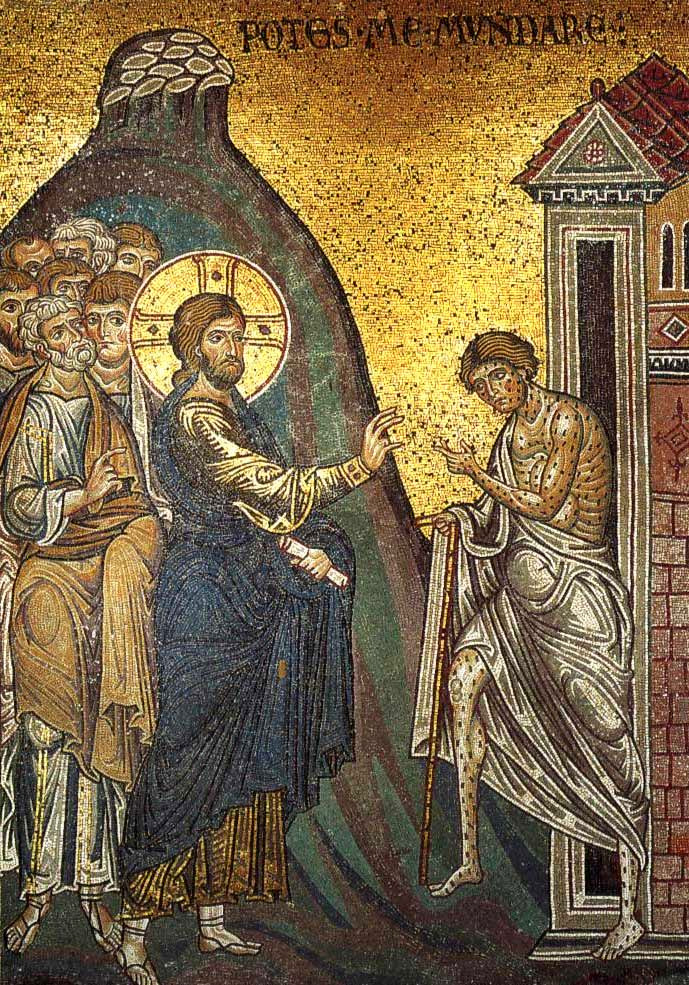
For this third Sunday after Epiphany, Bach wrote four cantatas: 73, 111, 72, and 156. The Bible story for this Sunday is about the miracle of Christ healing a leper. Last year I mentioned that I had a hard time finding the corresponding art for that story. My readers immediately came to the rescue, and pointed me to the two images featured in today’s post. Thank you again!
My favorite of all these cantatas is Cantata 73 Herr, wie du willt, so schick’s mit mir, especially in the 2013 recording by Herreweghe. Please find that recording here on Spotify. Soloists are Dorothee Mields (soprano), Thomas Hobbs (tenor), and Peter Kooij (bass). If you don’t have access to Spotify, you can find their 1990 recording here on YouTube. Soloists on this older recording are: Barbara Schlick (soprano), Howard Crook (tenor), and Peter Kooij (bass).
I had been planning to attend a live performance by Herreweghe of this cantata as well as another one of my favorites, Cantata 198, on January 29 in Brussels, but unfortunately the programming of that concert was changed to the Mass in B Minor. I completely understand the reasoning behind this, and I am absolutely thrilled for the musicians of Collegium Vocale Gent that they get to perform for an audience after all (until earlier this week, it looked as if all concerts in Belgium would be canceled until the end of this month), but I’m so sad about the cantatas!
Please find the German texts with English translations of Cantata 73 here, and the score here.
Jesus healing a leper, Mosaic, 12th century. Cathedral of the Assumption, Monreale, Sicily.
Especially the bass aria makes Herreweghe’s recording of this cantata tower above all others. It is so well done by Peter Kooij and the orchestra; it moves me every time I listen to it.
The best part for me is the illustration of “Leichenglocken” (death bells) by pizzicato strings and a somewhat “tolling” movement in the vocal part. Bach used this feature in many other cantatas, for example in (cantata number/movement number): 8/1, 95/5, 105/4, 127/3, 161/4, 198/4.
To know what else to listen for in this cantata, please read my post from 2016 . There I also explain how this cantata is connected to Cantata 72.
The Three Kings before Herod. From an unknown location in France, early 15th century. Stained glass. Musée du Moyen Age / Hôtel de Cluny, Paris.
Exactly 23 years ago today, on January 15, 1999, my husband and I moved from the Netherlands to California. Friends and family thought we would stay there forever, but this past summer we moved back.
We see it as a new adventure and it is for all good reasons. I am thrilled to be in Europe, and feel blessed that we had the opportunity to make this change. Since we moved, I have thoroughly enjoyed spending time with relatives and old friends, attending live concerts, walking and cycling through Amsterdam, and having super fresh flowers in my house every week. I also love the fact that I can hop on a train to another country, the way I did for my trip to Switzerland in November..
At the same time, moving house is stressful for any family, and being an expat in one’s own country can be quite unsettling at times. So it has been hard to focus my energy on this blog. But the New Year brings me new inspiration and new ideas, so I fully intend to post here more often and further explore some plans for other ways to share my love for Bach cantatas. Thanks for bearing with me as I figure it all out!
“New Year, New Energy” spirit at my local flower stand this week.
Now for some music: the Bach cantata I enjoyed most of everything I listened to over the holiday season was Part V of Bach’s Christmas Oratorio, performed by the J.S. Bach Foundation. The excellent soloists are Marie Luise Werneburg, soprano; Margot Oitzinger, alto; Daniel Johannsen, tenor; and Matthias Helm, bass. Bach extended the story of The Three Kings over two parts of his Christmas Oratorio: this one, written for the Sunday after New Year (January 2 in 1735), and Part VI for Epiphany.
Of course by this weekend we are already two weeks past Epiphany. Here’s an overview of my posts for this particular Sunday:
In Cantata 155 Mein Gott, wie lang, ach lange from Weimar, 1715 (and performed again during Bach’s first year in Leipzig, 1724), Bach illustrates the hand-wringing and desperation expressed by Jesus’ mother Mary in several different ways, including a Monteverdi-like “lamento bass.” Read it in my blog post from 2017, titled Mary’s Lament, now with a link to a subtitled lecture by Rudolf Lutz of the J.S. Bach Foundation in which he explains this extremely well.
Cantata 3 Ach Gott, wie manches Herzeleid, from 1725, takes up a special place within Bach’s 1724/1725 chorale cantata cycle, because the chorale melody appears in the bass part of the opening chorus. It gets doubled by a trombone, and this gives me the good kind of stomachache. But much more is happening in this cantata. Read it all in my blog post from 2016, titled Hidden messages.
When writing about Cantata 13 Meine Seufzer, meine Tränen in 2020, I realized that Bach must have been inspired by Cantata 155 when writing this one. Read it here.
Merry Christmas! My sincere apologies if you are somewhere in the world where it is not Christmas Morning anymore.
I have two new videos for you today, that will last you until January 6, just in case I don’t manage to write another blog post between now and then.
The J.S. Bach Foundation has released all six cantatas of Bach’s Christmas Oratorio to YouTube. They released these on CD and DVD for purchase last year, but have now made them available to everyone. You can find that video recording here.
What is even better: they also made the effort to provide English subtitles for Rudolf Lutz’ lecture about Part I of the Oratorio, for Christmas Day. You can find that video here. I highly recommend watching this to better understand the meaning of the music, to learn how Bach reworked some of his secular cantatas into this Oratorio, and that he perhaps planned to do that all along.
There is also a good video of parts I, II, III, and VI of Bach’s Christmas Oratorio by Bach Akademie Stuttgart. The setting in which they perform is less festive looking than the beautiful Baroque church of the J.S. Bach Foundation, but it’s also well done. You can find it here.
If you would like to read and listen more, here’s an overview of my previous blog posts for this First Christmas Day:
Our Christmas Morning, from 2016, talks about how my mother used to wake my sister and me up with Bach’s Christmas Oratorio.
Three Days of Christmas, from 2017, gives you the three cantatas Bach wrote in 1724, all three brand-new, no reworking there.
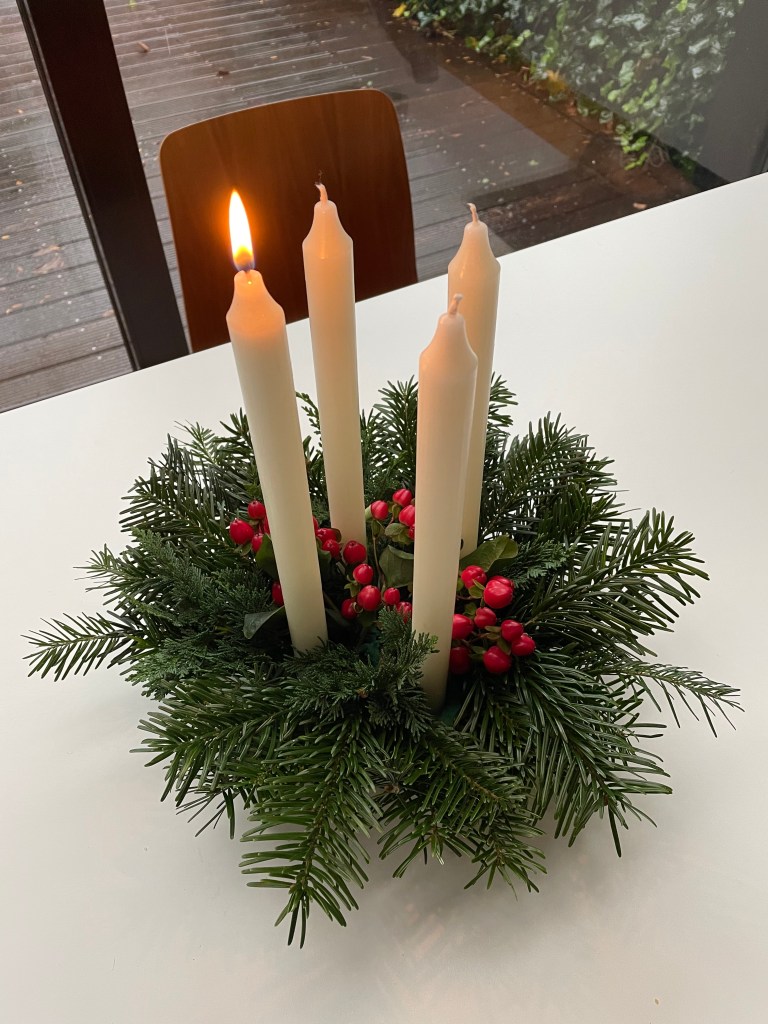
In German-speaking countries, people wish each other either a “schönen” (beautiful, pleasant), “lieblichen” (lovely, love-filled), or a “besinnlichen” (thoughtful, contemplative) Advent. I wish you all of that: beauty, love, and contemplation for the next four weeks.
On this first Sunday of Advent, I present to you again the J.S. Bach Foundation (J.S. Bachstiftung) with soprano Núria Rial, this time in Cantata 36 Schwingt freudig euch empor. In 1731, Bach transformed a secular birthday cantata from 1725 into this work for Advent. Enjoy watching these two videos by the J.S. Bach Foundation to get better acquainted with this composition:
If you would like to read, listen, or watch more, here’s a little overview of my previous posts for the first Sunday of Advent:
In Weimar, in 1714, Bach wrote Cantata 61 Nun komm, der Heiden Heiland. This one I remember the best from my childhood, because my mother loved Seppi Kronwitter’s singing of the soprano aria on the Harnoncourt recording. Read about it here. More about Bach’s prolific Advent cantata writing in Weimar next week.
In Leipzig, in 1724, Bach wrote Cantata 62 Nun komm, der Heiden Heiland. My most recent writing about this cantata is from 2020, not for this blog, but for that of California Bach Society. Find it here. My post from 2017 about this cantata is here.
Read my post about Cantata 36 Schwingt freudig euch emporhere.
Wieneke Gorter, November 28, 2021.
By the way: the video of the J.S. Bach Foundation’s 15th Anniversary concert with Núria Rial is still available here on YouTube. It is a registration of the performance in Trogen, held one day after the one I attended in Basel.
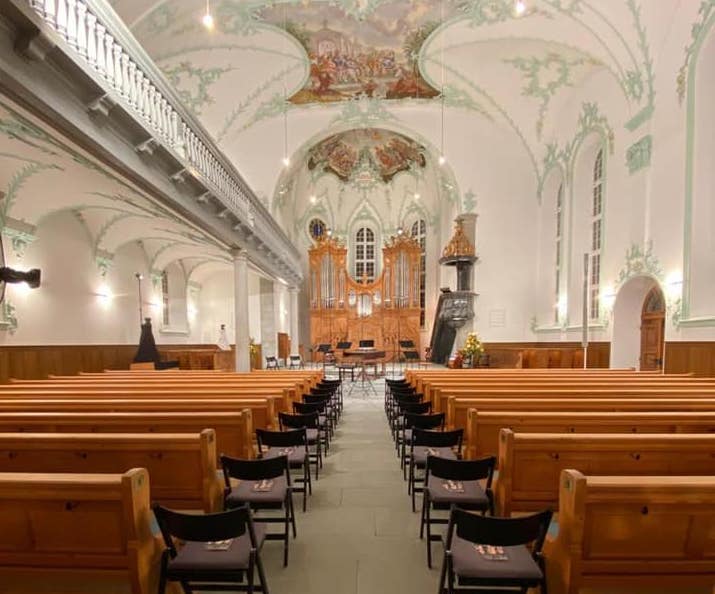
The church in Trogen, Switzerland, where the 15th anniversary concert of the J.S. Bach Foundation was recorded on November 17, 2021. Find it here on YouTube.
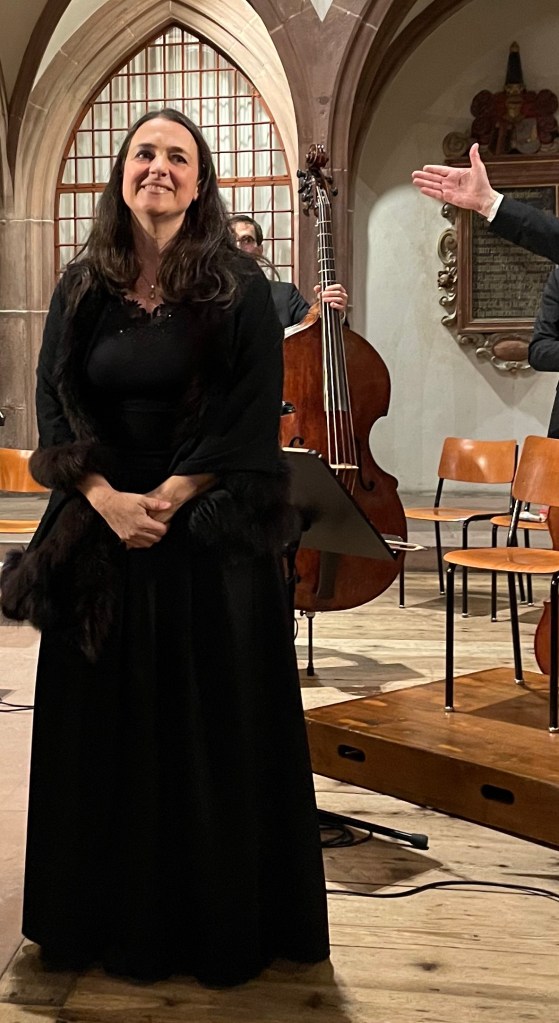
Nuria Rial in Basel
This week, the J.S. Bach Foundation celebrated 15 years of recording Bach cantatas with a special anniversary program in three cities in Switzerland: Basel, Trogen, and Zürich. I am still pinching myself that I got to attend the concert in Basel on Tuesday November 16, sitting only 6 feet (2 meters) from the amazing soprano Nuria Rial, who sang Cantata 199 Mein Herze schwimmt im Blut and Cantata 202 Weichet nur, betrübte Schatten.
Her performance was everything I had been hoping for and more. Her voice pulls you in from the start, and the energy and joy she exudes are just extraordinary. And then there’s her playfulness. I will never forget how special it was to experience that from up-close. I also realized what a true ensemble member she is, always in contact with the instrumentalists.
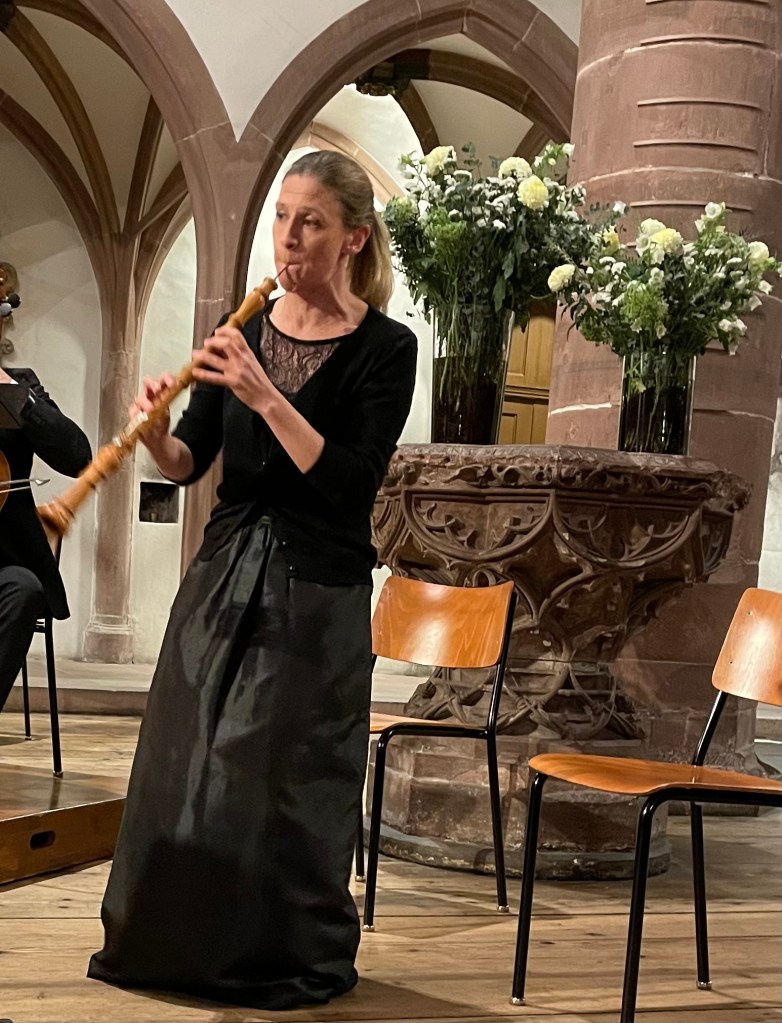
Amy Power in Basel
And those instrumentalists really need to be mentioned! Oboist Amy Power’s playing was lyrical throughout, with beautiful ornamentations in the “da capo” parts of the arias. I especially enjoyed the call-and response between her and Nuria Rial in the first movement of Weichet nur, betrübte Schatten. Her accomplishments were even more impressive knowing that she had been summoned from Graz less than 8 days before the concert, when the J.S. Bach Foundation heard that oboist Andreas Helm had to isolate at home because of contracting Covid-19.
First violinist Eva Borhi’s sensitive playing was especially gorgeous in the “Tief gebückt” aria from Canatata 199 and “Schlummert ein” aria from Cantata 82 with Manuel Walser. But my favorite was her interaction with Nuria Rial in the “Wenn die Frühlingslufte streichen” aria from Cantata 202.
Violist Sonoko Asabuki had an exquisite solo in the Chorale “Ich, dein betrübtes Kind” from Cantata 199, and cellist Daniel Rosin did a great illustration of Phoebus’ speeding horses in the third movement of Cantata 202, which earned a “Bravo” cheer from the audience, as if we were at the opera. (Always better than the audience member who fell asleep during “Schlummert ein,” snoring and all, a few rows behind me).
Last but not least, Rudolf Lutz, who directed the others from the harpsichord, improvised tasteful and effective mini-preludes leading up to the recitatives in Cantata 199, and very sensitively employed the lute register in the da capo of “Schlummert ein,” which formed a beautiful accompaniment to the pianissimo playing strings. He was also his usual witty self, making audience and performers laugh with his short speeches. My sister mentioned that even though we were here together at the concert because of our mother, she was actually strongly reminded of our grandfather. Also a man who always appeared very proper and Calvinist, but would then surprise you with his terrific sense of humor.
Watch this same performance, recorded live in Trogen, a day later than the one I attended in Basel here on YouTube.
Today is an exciting day for me, because I get to see and hear Nuria Rial sing live for the first time in my life, performing a piece I have very fond childhood memories of. I also get to hug my sister for the first time in more than two years, and I get to explore the gorgeous city of Basel. It is a special week for my sister and me, since this coming Friday is the 11th anniversary of our mother’s death.
To remember our late mother and her love of music, every year my sister and I have tried to go to a concert together. Because I used to live in California and my sister lives in France, and we both have kids, it would not work out every year, but we’ve had some memorable experiences. In March 2013 we attended Bach’s St. Matthew Passion by Herreweghe in Cuenca, Spain, during Holy Week, which in Spain comes with processions in the streets. In November 2015 we went to Monteverdi’s 1610 Vespers by Savall in the then brand-new Philharmonie de Paris, only a few days after the terrorist attacks. The last time we went to a concert together was in January 2018.
When the J.S. Bach Foundation announced their 15th anniversary concerts with Nuria Rial in Cantata 202, my choice for this year was made. I’m so grateful this is all working out and I am so excited I already woke up at 5 am this morning, as if I’m an elementary school kid, going on a field trip.
About that elementary school kid. One of my strongest childhood memories is of the time my sister and I accompanied my mother when she had to go sing at a wedding. It must have been late 1970s/early 1980s. The couple were both elementary school teachers, so they got married on a Wednesday afternoon, to make it possible for their students to attend their wedding as well. I remember absolutely nothing about all the other kids that must have been there that day. I only remember waiting for the bus, sitting on the floor of the organ loft, and hearing the music. Read more in this in this post, where you can also hear an example of the piece my mother sang that afternoon: the “Gavotte” from Cantata 202.
I have always wanted to visit Basel. It’s the place of the Schola Cantorum Basiliensis, where so many of the Baroque musicians I admire received their training. But I also heard many stories about all the great art museums, the historic city, and how beautifully it is situated on the Rhine. When we returned from our trip to Italy in 2018, we had a wonderful stop-over with a dear friend near Basel, but all we got to see of the city were the two railway stations.
I first heard Nuria Rial sing on the German radio station WDR3, exactly one month after my mother passed away in 2010. I was staying at my parents’ house in the Netherlands with my kids. My mother had always preferred the German classical music station over the Dutch one, especially for their Early music programming, so WDR3 was pre-programmed into my parents’ fancy equipment. I heard Nuria Rial sing and she literally took my breath away. After it was over I went on Facebook and told all my singer friends (that’s why I still know what day it was). To get an idea, watch her live recording of the soprano aria from Cantata 36 with the J.S. Bach Foundation. I know I already said it, but tonight is the first time I’m going to hear and see her live.
It will also be the first time I’m going to see the J.S. Bach Foundation (Bachstiftung) perform live, after having been a fan of theirs for several years now, and having shared many of their videos on my blog. Read my last post about them (and another favorite soprano) here. I feel honored I get to celebrate their 15th Anniversary with them tonight.
There really is nothing like a live performance. But if you can’t make it to Switzerland this week, you can still watch this same concert 🙂 Tomorrow, Wednesday November 17, this same program will be live-streamed from Trogen, Switzerland, at 7 pm Central European Time, which is 10 am Pacific Time, 1 pm Eastern Time, or 6 pm in the UK. For more information on the live-stream, and to download the program booklet, click here. Direct links to the live stream are here, or on the YouTube channel of the J.S. Bach Foundation.
As far as we know, Bach wrote two cantatas for this Sunday, the third after Trinity: Cantata 21 Ich hatte viel Bekümmernis and Cantata 135 Ach Herr, mich armen Sünder.
Read my post from 2017 about Cantata 135 here. Since I wrote that post, a beautiful live video recording by the J.S. Bach Foundation has been released on YouTube. Find it here.
But now about Cantata 21. It is one of Bach’s most well-known cantatas and it gets programmed often because it features several exciting choruses. The version most of us know is with three soloists: a soprano, a tenor, and a bass. Bach first wrote it like that in Weimar and later performed a similar version in Leipzig in 1723, as part of his first year there. However, in 1720, he created a different version, which he performed in Köthen as well as in Hamburg. It is likely that this version was created for a special soprano soloist (possibly Anna Magdalena?), because in this version, Bach assigns all three tenor solos to the soprano as well, thus featuring the soprano in every solo movement. The bass joins her for two duets.
Dorothee Mields
It turns out that the J.S. Bach Foundation decided to perform this 1720 version for their live video series, with soprano Dorothee Mields and bass Peter Kooij. If I had been at that concert in person, I would have joined the whooping and clapping at the end, because it is an outstanding performance by both soloists but also by the chorus. I only discovered this video recording by accident tonight. I had completely missed it when it was released earlier this month. I meant to write a very short blog post today, quickly giving you some links to previous posts and then go to sleep, but I was completely mesmerized by Dorothee Mields’ singing and was unable to close my computer.
In my post from 2016 about Cantata 21, I show how similar the duet from this cantata is to the duet from Cantata 172 (also written in Weimar). When I watched the J.S. Bach Foundation video of Cantata 21 and witnessed Mields’ art of being in sync with her duet partner, I remembered there’s another wonderful video I have wanted to share. It is Dorothee Mields and Alex Potter singing the duet from Cantata 172 in this video by the Bach Akademie Stuttgart that came out at the end of May. I enjoy very much how sensitive Mields and Potter both are to the music and the text, and how beautifully and naturally their voices move together.
For Bach, a new year of writing cantatas in Leipzig always started on this Sunday, the First Sunday after Trinity. If you joined this blog after 2017, you might have missed my following Bach’s cantata compositions in order of the Leipzig performances, starting on this Sunday in 1723 and 1724. Find my post about this Sunday in 1723, which was his Leipzig debut, here. Find my post about the start of the 1724/1725 chorale cantata cycle here.
There is no cantata for this Sunday left to us from 1725. Read more about Bach’s summer of 1725 in my previous post.