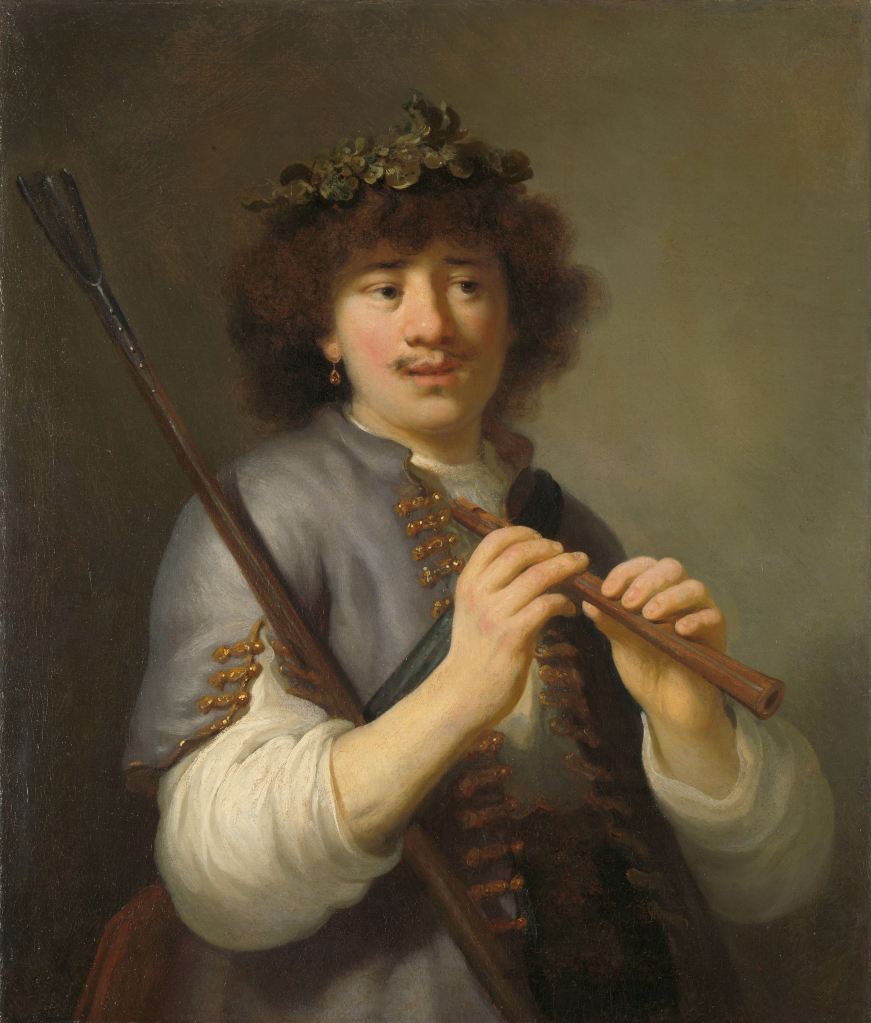
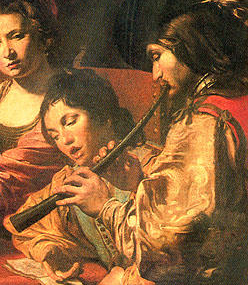
On left: Rembrandt as a Shepherd with a Staff and Flute, by Govert Flinck, 1636. Rijksmuseum, Amsterdam, Netherlands. On right: singer with cornetto player, anonymous, 16th century.
In John 16:20, Jesus announces to his disciples that he is going to leave them, and that they will go through a period of hardship during which the rest of the world will mock them. For this 3rd Sunday after Easter, this is the story on which Bach and his librettists had to base their cantatas.
In 1714 in Weimar, Bach made this into a true lament, that he would later rewrite into the Crucifixus of his Mass in B Minor: Cantata 12 Weinen, Klagen, Sorgen, Zagen.
The librettist of this cantata (and of all other cantatas Bach wrote in Weimar) was Salomo Franck, librarian to the Duke of Weimar. Franck very cleverly portrays the “sorrow to joy”-theme of this cantata. The alto aria is a good example: after the Gospel quote in the recitative “Wir müssen durch viel Trübsal” (we have to go through tribulation) comes an upbeat aria illuminating how “Kreuz und Krone” (cross and crown) and “Kampf and Kleinod” (conflict and jewel) are always connected.
While I love everything about this cantata, my absolute favorite part is the tenor aria Sei getreu. Find out why in my blog post from 2016, where you can also find links to my favorite recordings of this cantata.
Most of the texts Bach had to work with in Leipzig were not nearly as good as Franck’s libretti. But there arguably was one exception: in 1725, between Easter and Pentecost, Bach set nine cantatas in a row to beautiful poetry by Christiane Mariane von Ziegler. Von Ziegler was a single woman who had known much sadness in her life already: her father was in prison, she was twice widowed, and had also lost both her children (one from each marriage). However, her family fortune was still intact and at her disposal, and the sad circumstances meant that she didn’t have to answer to a father or a husband. She thus enjoyed much more freedom than any other woman in Leipzig at the time, and could publish under her own name.
For the third Sunday after Easter in 1725, Bach wrote Cantata 103: Ihr werdet weinen und heulen on a libretto by Von Ziegler. This cantata also starts out very sad, but there is much “Freude” (joy) in the music. A sopranino recorder illustrates the “mocking” Jesus predicted, or does it? Read it all in my blog post from 2018, which also includes a link to the excellent introduction to this cantata (now with English subtitles!) by Rudolf Lutz of the J.S. Bach Foundation in Switzerland.
Wieneke Gorter, May 2, 2020, updated May 19, 2024.
Jesus as “The Good Shepherd,” Catacomb of Priscilla, Rome. Early Christian fresco, created between the late 2nd and the 4th century. To learn more about the Catacomb of Priscilla, watch this video on Youtube.
While I have been silent on this blog since Palm Sunday this year, of course Bach’s life in Leipzig was far from quiet. In fact, Easter was a time of non-stop work on cantata compositions for him, perhaps even more intense than the Christmas season.*
Today is the second Sunday after Easter, for which Bach wrote Cantata 104 in 1724, and Cantata 85 in 1725, all on the theme of Jesus as “The Good Shepherd.” I have updated the posts I wrote about those cantatas in 2016 and 2017, making sure all the links work, and adding a link to the live performance of Cantata 85 by the J.S. Bach Foundation. If you have some extra time, you can listen to the beautiful sub-group of cantatas Bach wrote after Easter in 1725: BWV 6, 42, and 85. Just follow in the links in my post about Cantata 85.
If you can afford to financially support the artists (especially important now, while they have no income from performances!) please consider purchasing their recordings. I have included links for that too in every post.
Wieneke Gorter, April 26, 2020.
*Before Christmas in Leipzig, he would have the four-week break of Advent, while before Easter he would have been busy rehearsing, rewriting, and performing whichever Passion he performed that year.
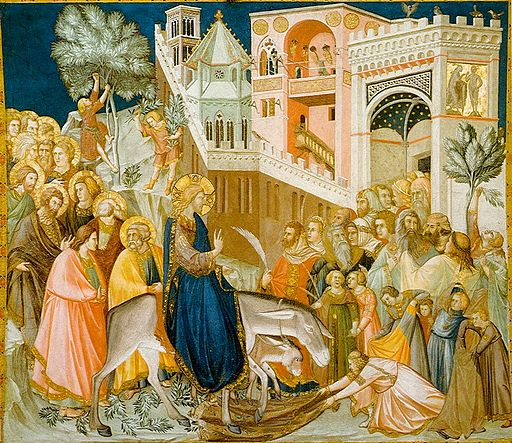
Jesus Entrance into Jerusalem. First picture is Lorenzetti’s version, in the Basilica of Assisi, 1320. Second picture is Giotto’s version from 1305, in the Capella Scrovengni in Padua, third is Duccio’s, created between 1308 and 1311, as part of an altar piece, currently in the Museo dell’Opera Metropolitana del Duomo in Siena. The first two are frescoes, the last one is tempera on wood.
We’re on Day 20 of “shelter in place” here in the San Francisco Bay Area. We’re counting our blessings, trying to figure out how we can be most helpful to others while also taking good care of ourselves, and trying to wean ourselves off spending too much time on social media. I definitely need my “church” of regular check-ins with family and friends, daily mindfulness exercises, and lots of yoga classes to stay sane through all of this.
Back to Bach’s church. Today is Palm Sunday! Bach never officially wrote a cantata for this Sunday, since no music was to be performed in the churches during Lent. However, in 1714, Palm Sunday fell on the same day as the feast of the Annunciation of Mary, March 25. This way, while specifying “for the feast of the Annunciation of Mary” on the title page of the cantata manuscript, Bach could still write music for Palm Sunday with cantata 182 Himmelskönig, sei wilkommen! (Welcome, King of Heaven!)
If you’re not in the mood for a long story and would just like to listen to a short piece of calming music, I recommend the live performance of the opening sinfonia of this cantata on the YouTube channel of Voices of Music, with two fabulous soloists: Hanneke van Proosdij on recorder and Rachel Podger on violin. You can find that video here.
Many of Bach’s Weimar cantatas start with an elaborate instrumental ouverture or sinfonia.* There are two possible reasons for this. First of all, it was in Weimar that Bach studied lots of French and Italian compositions, and he might have wanted to “show off” that he could also write such a fashionable ouverture. But there might have also been a more practical reason: such an opening movement was the perfect piece of music during which the Duke and his entourage would slowly walk into the chapel and take their seats, and not miss anything of the cantata itself.
For the entire cantata, my all-time favorite still is the recording by Montreal Baroque. Listen here on Spotify, or here on YouTube. Their one-on-a-part performance is similar to how this would have sounded from the small organ loft in Weimar, and features fabulous singing all around (soprano Monika Mauch, countertenor Matthew White, tenor Charles Daniels, bass Harry van der Kamp).
Find the text of cantata 182 here, and the score here.
If you would like to learn more about Bach’s time in Weimar, please visit my post about Bach in Weimar I wrote in 2016. I’ve just updated it with some new photos, including a picture of the organ loft, and it has all the same links for the recording, text, and score as mentioned here.
In Leipzig in 1724, Bach performed this cantata again, on the feast of the Annunciation of Mary, which that year fell eight days before Palm Sunday.
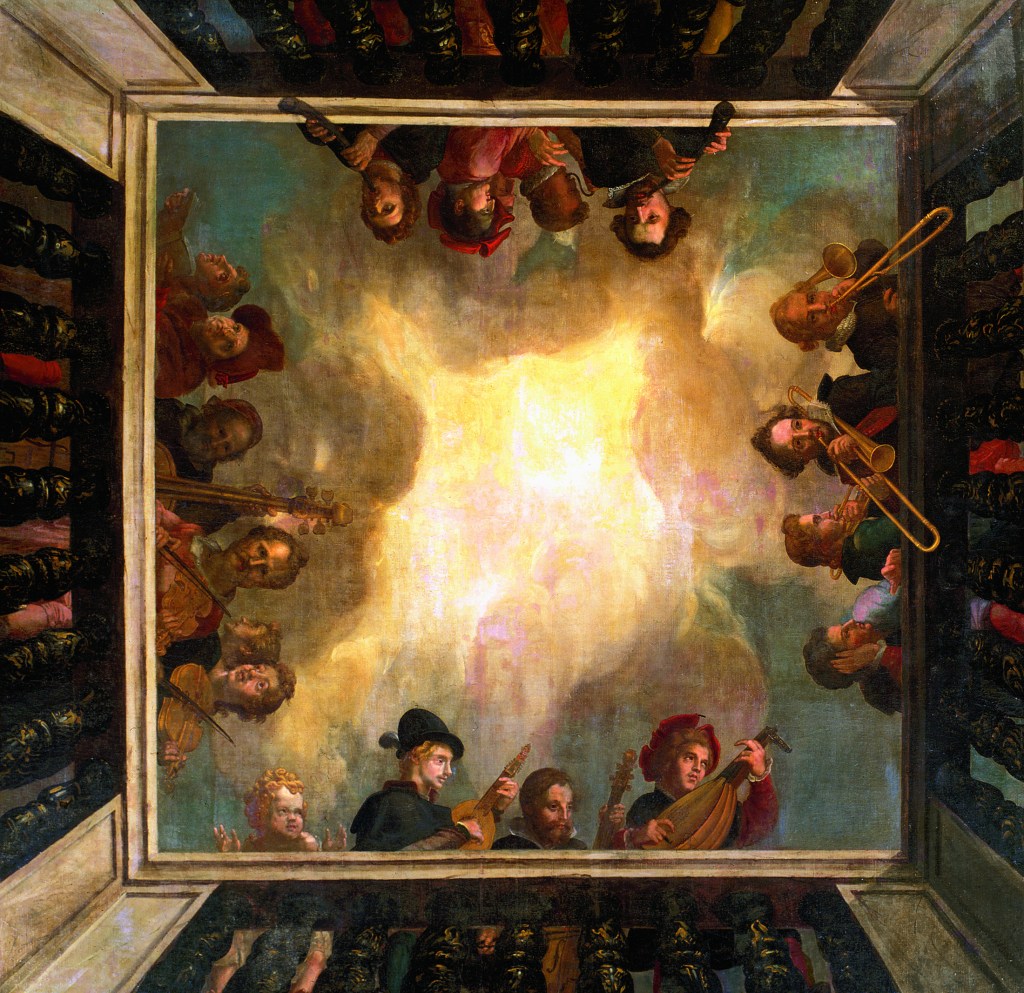
Ceiling painting installed around 1700 in Christian V’s Hall in Rosenborg Castle, Denmark. Possibly by Reinhold Timm, ca. 1620, originally for for a music pavilion in Kongens Have. *
Yesterday, Wednesday March 25, 2020, the J.S. Bach Foundation published their live video recording of Cantata 2 Ach Gott, vom Himmel sieh darein (Please God, look down from Heaven) on their YouTube channel. I thought it might be nice to provide a listening guide to go with this performance.
I love this cantata because it has trombones in the orchestra, doubling the choir parts, and because the altos have the cantus firmus (=they sing the chorale melody in long notes) in the opening chorus, which sounds incredibly good, and is unique within Bach’s writing.
Find the video recording by the J.S. Bach Foundation here on YouTube. Soloists are Alex Potter, alto; Georg Poplutz, tenor; and Markus Volpert, bass.
Find the German texts with English translations here, and the full score here.
This cantata was the second in Bach’s 1724 series of Chorale Cantatas. He most probably intended for the first four cantatas in that series to form a set, or at least to present some kind of order, if you look at the composition form of the opening movement, and which voice has the cantus firmus of the chorale tune in that chorus:
Cantata 20 O Ewigkeit, du Donnerwort: French Overture, with cantus firmus in the soprano (find my blog post about this cantata here)
Cantata 2 Ach Gott, vom Himmel sieh darein: Chorale motet, cantus firmus in alto (the cantata discussed here)
Cantata 7 Christ unser Herr zum Jordan kam: Italian concerto, cantus firmus in tenor. (find my blog post about this cantata here)
Cantata 135 : Ach Herr, mich armen Sünder: Chorale fantasia, cantus firmus in bass. (find my blog post about this cantata here)
We know that Bach liked to use order and symmetry when he wanted to impress other people with a composition. But perhaps he was also thinking of his legacy. When he started composing cantatas at the Weimar court in 1714, albeit on a monthly instead of weekly basis, his first four cantatas formed a similar portfolio of composition styles in the opening choral movements:
Back to this Cantata 2 Ach Gott, vom Himmel sieh darein (Please God, look down from Heaven), and what to listen for.
Opening chorus:
The chorale, based on Psalm 12, is by Luther. For an idea what Luther’s original song would have sounded like, you can watch this video. For readers who understand German: Eduard van Hengel’s website (in Dutch) has a very insightful overview of the original German text of Psalm 12, the text of Luther’s chorale, and how Bach’s librettist changed that into the text for the cantata. You can find it here.
When Bach uses a chorale by Luther in a cantata, he often demonstrates his reverence for the father of his faith by using the archaic form of chorale motet as opening chorus combined with the equally archaic trombone quartet (1 cornetto and 3 trombones) to double the choir parts.**
Giving the cantus firmus to the altos is however not something Bach does very often. If only he had! In this case it is especially wonderfully orchestrated, with doubling by one trombone, two oboes, and all second violins. Both on this video recording by the J.S. Bach Foundation as well on the Herreweghe audio recording I recommended back in 2017, Alex Potter’s voice significantly enhances this winning blend of alto voices and instruments, and on this J.S. Bach Foundation video recording he also sings the beautiful alto aria. It definitely made my day yesterday.
Alto aria:
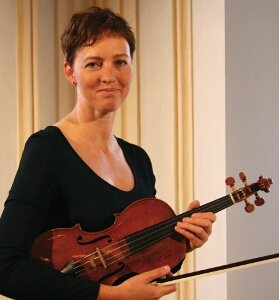
Bach alto and tenor arias are at their prettiest, I find, when they are written as a trio sonata, and the alto ariaTilg, o Gott in this cantata is a beautiful example of that. Wonderful singing and playing by alto Alex Potter and violinist Renate Steinmann. The aria is a plea for help in fighting the “Rottengeister,” or the sectarians amidst the Lutherans. When the alto starts singing the word “Rottengeistern,” we realize we had heard this word already many times in the triplets of the violin part. As Eduard van Hengel says, it is the “popular easy talk of the sectarians, and that is also the reason why the other two parts don’t have this motive” [to further illustrate the schism].
Renate Steinmann, violin and Alex Potter, alto. Photo of Alex Potter by Annelies van der Vegt.
Bass recitative:
Definitely keep the text & translations handy for this one, because this movement contains a wealth of text illustrations in the music. On the word Armen (the poor) sounds a sorrowful diminished seventh, the word seufzend (sighing) has a rest/sigh in the middle of the word, and more such things happening on the words Ach (sighing) and Klagen (complaining). In contrast to this, a few lines later, the chord on the word Gott (God) sounds open and liberating, after which God himself gets to speak, and the music turns to an arioso (similarly to how Bach does that in his much earlier Cantata 18 when God speaks). At the word heller Sonnenschein (bright sunshine) the light gets turned on in the music too: the harmony changes to C Major.
Tenor aria:
Here we have arrived at the solution/salvation part of the cantata, and so this music is more pleasant, easier to listen to. But Bach is still preaching: there are some crossing (!) lines in the music, and in the middle section, which tells the listeners to be patient (sei geduldig) and Bach stresses the words Kreuz und Not.
With many thanks to Eduard van Hengel and Rudolf Lutz for their explanations of this cantata,
Wieneke Gorter, March 26, 2020.
*more information about this painting and the other objects in Christian V’s Hall in Rosenborg Castle can be found here.
**The best examples of this are cantatas 2, 25, 38, and 121.
My front window, creation by my daughter. It is one of 28 rainbows created in the span of one day on our street in the San Francisco Bay Area, after a neighbor with young children made a request by email in the morning, so they could go on a “rainbow hunt” in the afternoon
Hello dear readers all over the world. I wanted to share a bit more than my quick message of Saturday. All of a sudden most of us are in the same boat: sheltering in place or on full lockdown. Here in the San Francisco Bay Area, we are now on day 7 of “shelter in place”, and starting week 2 of school closures.
While I’m sad, frustrated, and stressed out on a regular basis, I have also felt extremely comforted and very inspired this past week by expressions of beautiful community and wonderful creativity that have come out of this crisis already.
I’ve seen neighborhoods come together to identify who needs help and who can help; I’ve felt how uplifting it can be to share “silver linings” in a private Facebook group; I’ve experienced the power of a Zoom video conference meeting with a group of people who normally gather in person. Even if you can’t physically be in the same room with your classmates, members of your yoga studio, or extended family, it is actually extremely calming for the nervous system to see and hear people you know, and to be there for each other.
In the spirit of community and creativity, I’d love to share the video created by the Malaysia Bach Festival last week: they assembled videos of different people all over the world, singing and playing the chorale “Befiehl du deine Wege” from Bach’s St. Matthew Passion, and combined it into one video. You can find that video here. Keep your tissues handy.
In case you would like to sing along, you can find the PDF of this chorale here.
In honor of Bach’s 335th Birthday today, the Bach Archives in Leipzig created this wonderful online tool. You can do a virtual walk through Bach’s Leipzig. If you happen to have cardboard VR glasses in your house, you can explore Bach’s Leipzig even deeper by using the VR function of your smartphone.
In the coming weeks, whenever I find the time, I’ll be sharing live video performances to watch online, with some extra information whenever I can.
In the meantime, the links from my previous two posts, with a different live performance of the St. John Passion in each, are still available online.
Pilate washing his hands by Bernhard Strigel, circa 1500. The Walters Museum, Baltimore, USA.
Another St. John Passion to watch today! Available until April 13, 2020: Collegium Vocale Gent’s / Herreweghe’s dress rehearsal of the St. John Passion from Bruges, March 13.
After this rehearsal, their entire St. John tour as well as St. Matthew tour was canceled. For Baroque musicians in Europe, this time of year, with the Bach passions, is when they earn most of their money. The link to the video also includes info on how to donate to Collegium Vocale Gent, who will make sure the money is divided equally over the musicians who are otherwise not getting paid for this long period.
Julian Prégardien, tenor-evangelist Krezimir Strazanac, bass-Christ Dorothee Mields, soprano Alex Potter, countertenor Reinoud Van Mechelen, tenor Peter Kooij, bass
Romina Lischka, viola da gamba
Find the German texts with English translations here, and the score, in two parts: part 1 here, and part 2 here.
Again, I urge you to support all musicians suffering enormous loss of income during this difficult time. Donate at least the money you would otherwise have spent on tickets to their performances, but if you can, give more. Take care of each other, please take social distancing seriously, keep going for walks if allowed, check in on your elderly neighbors, and wash. your. hands.
Wieneke Gorter, March 15, 2020, updated March 21, 2020.
with Aki Matsui, soprano; Damien Guillon, alto; James Gilchrist, tenor (Evangelist); Zachary Wilder, tenor (arias); and Christian Immler, bass.
Aki Matsui replaced Hana Blazikova, who had to return that morning to her home in the Czech Republic, before that country would close its borders.
Already 1/3 into their European tour with Bach’s Passion according to St. John, Bach Collegium Japan was faced with cancellations due to European countries trying to limit the spread of the novel coronavirus. With a live stream from Cologne, Germany, already on their schedule, they decided to go ahead with the live-stream, without audience, and stay in Cologne for a few more days, and record a CD of the St. John Passion there for BIS records.
Find the German texts with English translations here, and the score, in two parts: part 1 here, and part 2 here.
I urge you to support all musicians suffering enormous loss of income during this difficult time. Donate at least the money you would otherwise have spent on tickets to their performances, but if you can, give more. Take care of each other, please take social distancing seriously, keep going for walks if allowed, check in on your elderly neighbors, and wash. your. hands.
Also: please realize that these musicians were already on tour, but at this point, please don’t copy their idea, and keep your musicians and staff safe by letting them stay home and practice true social distancing.
Wieneke Gorter, March 15, 2020, updated March 21, 2020.
Between Estomihi Sunday (or the last Sunday before Lent) and Good Friday, there were 47 days in 1729. During that entire time the Leipzig congregations would hear no music in the churches, except for chorales. So Bach’s last music had to be as memorable as possible, had to give them hope, and ideally also prepare them for the St. Matthew Passion they would get to hear on Good Friday.
Bach successfully checked all these boxes with Cantata 159 Sehet! wir gehn hinauf gen Jerusalem. And leave it to alto Alex Potter to bring all this out in a performance. Opera-like drama, heart-breaking emotion, the promise of hope and redemption, it is all there in his singing, and in that voice with the beautiful variety of colors.
Listen to / watch the performance by the Netherlands Bach Society here on YouTube. Soprano: Miriam Feuersinger; Alto: Alex Potter; Tenor: Thomas Hobbs; Bass: Stephan MacLeod. Read some comments by Alex Potter on this cantata here on the AllofBach website.
Find the German texts with English translations here, and the score here.
The Herreweghe recording deserves a mention here too. Dorothee Mields’ singing in the duet with Matthew White is very moving, and Peter Kooij’s interpretation of the bass aria “Es ist vollbracht” on this recording is unrivaled. Find that recording here on YouTube, but better yet, support the artists and purchase the entire album Jesu, deine Passion here on Amazon or here on iTunes. It contains all four cantatas Bach wrote for this Sunday, and they are all excellent. Read more about Cantatas 127, 22, and 23 in my blogpost from 2018 here.
Wieneke Gorter, February 22, 2020, updated February 13, 2021.
Finally I get to write about Cantata 18 Gleichwie der Regen und Schnee vom Himmel fällt (“the same way rain and snow falls from heaven”), which Bach wrote for this Sunday (Sexagesima, or the 2nd Sunday before Lent) in Weimar in 1713 or 1714. I don’t remember this cantata from my childhood, but have been impressed with it since I purchased the American Bach Soloists’ CD in 2010.
Find the German text with English translations here, and the NBA score here (Neue Bach Ausgabe score, based on the original Weimar score, the same one used by the American Bach Soloists, without recorders in the orchestra).
There is so much happening in this cantata that I could write two or three blog posts about it. To start, I’d like to share three recordings that stand out to me.
My first love of this Cantata 18, the American Bach Soloists’ recording from 1994, can be found here on Spotify. Or purchase the CD or MP3 on Amazon USA, or on Amazon DE, or on iTunes. Soloists are: Julianne Baird, soprano; Benjamin Butterfield, tenor; James Weaver, bass. Violas: Anthony Marin, Lisa Grodin, Sally Butt, George Thomson; Violoncello: Warren Stewart; Bassoon: Andrew Schwartz; Archlute: Michael Eagan; Organ: John Butt.
Director Jeffrey Thomas chooses a slower tempo for the opening sinfonia than most others, which I like. It makes the music more dramatic, and it allows the instrumentalists to paint a truly cold, wintry rain, completely appropriate for this time of year in Germany. The sound of the four violas together is wonderful throughout, and I love Julianne Baird’s singing of Luther’s “litany” in the third movement.
The next two recordings use a later* version of the score, with the addition of recorders in the orchestra.
I highly recommend the recording by Ricercar Consort from 2004, available here on YouTube. With: Katharine Fuge (Soprano); Jan Kobow (Tenor); Stephan MacLeod (Bass); François Fernandez (Viola); Luis Otavio Santos (Viola); Philippe Pierlot (Viola da gamba); Kaori Uemura (Viola da gamba); Ageet Zweistra (Violoncello); Kees Boeke (Recorder); Gaëlle Lecoq (Recorder); Josep Borras I Rocca (Bassoon); Michele Zeoll (Double-bass); Francis Jacob (Organ).
What I like about this recording: the orchestration with two violas and two viola da gambas instead of four violas. The bass instruments do an absolutely fabulous and unrivaled job of bringing out Bach’s illustration of the text “und macht sie fruchtbar und wachsend” (and make it fruitful and fertile) in the second movement. You can truly hear plants growing and blossoming there. And bass Stephan MacLeod, whose singing I usually appreciate much more in Renaissance music than in Bach, is superb in that second movement. His voice is a beautiful “Voice of God” in the text from Isaiah 55: 10-12.
Final recommendation, for now: the live video recording by the J.S. Bach Foundation from 2009, available here on YouTube. With: Núria Rial, soprano; Makoto Sakurada; tenor; Dominik Wörner, bass; Recorders: Armelle Plantier, Gaëlle Volet; Bassoon: Nikolaus Broda; Violas: Susanna Hefti, Renate Steinmann, Martina Bischof, Joanna Bilger; Violoncello: Maya Amrein; Violone: Iris Finkbeiner; Organ: Norbert Zeilberger
What I enjoy most about this recording is Nuria Rial’s singing of the soprano aria (the fourth movement). The aria is incredibly difficult, but, as always, she makes it seem effortless, and her “Fort mit allen, fort, nur fort!” is the best of all recordings I have listened to. I also enjoy the choir sopranos’ singing of the “litany” in the third movement, and the mere fact that you can watch everyone make music, since this is a live video recording.
If you would like to read about another cantata for this Sunday, find my post about Cantata 126 here. Bach wrote that cantata also for Sexagesima Sunday, in 1725.
Wieneke Gorter, February 16, 2020.
*from 1724 in Leipzig, when Bach performed this cantata again.







 Weekly Cantata