Weekly Cantata

Weekly Cantata

Tag Archives: Christoph Prégardien

Bach’s Music for Ascension Day

13 Thursday May 2021

Posted by cantatasonmymind in Ascension, Cantatas, Leipzig

≈ Leave a comment

Tags

Amsterdam Baroque Orchestra, Andrew Tortise, Annekathrin Laabs, Ascension, Ascension Oratorio, Barbara Schlick, Bernhard Landauer, BWV 11, BWV 128, BWV 37, BWV 43, Catherine Patriasz, Charles Daniels, Christiane Mariane von Ziegler, Christmas Oratorio, Christoph Prégardien, Collegium Vocale Gent, Dietrich Henschel, English Baroque Soloists, John Eliot Gardiner, Klaus Mertens, Lenneke Ruiten, Meg Bragle, Miriam Feuersinger, Peter Kooij, Philippe Herreweghe, Sibylla Rubens, Ton Koopman, Wolf Matthias Friedrich

The Ascension, from the illuminated 15th-century manuscript Les Très Riches Heures du duc de Berry, Folio 184r – Musée Condé, Chantilly, France.

Today was Ascension Day. In Bach’s time this was a very important holiday in the churches. Many countries in Europe have a four-day weekend starting on this Thursday. I did too as a kid growing up in the Netherlands. But we didn’t go to church on this day, and I don’t remember my mother playing the Ascension cantatas or the Ascension Oratorio on the turntable at home on this day. Instead we went for a bike ride, visit grandparents, or go camping. I didn’t know Bach’s music for Ascension Day at all until we performed BWV 11 and 43 with California Bach Society in the early 2000s. The choruses from these compositions are among the most fun I have every sung in a choir. I love the syncopated rhythms.

Here is an overview of Bach’s music for Ascension Day, as far as we know, in order of creation:

In 1724, Bach wrote Cantata 37 Wer da gläubet und getäuft wird (Whoever believes and is baptised). Listen to it here. Soloists in this recording by Ton Koopman/Amsterdam Baroque Orchestra are Sibylla Rubens, soprano; Bernhard Landauer, alto; Christoph Prégardien, tenor; and Klaus Mertens, bass.

In 1725, as part of the series of cantatas on texts by Christiane Mariane von Ziegler, Bach wrote Cantata 128 Auf Christi Himmelfahrt allein (On Christ’s ascension alone). Listen to it here. Soloists on this live recording by John Eliot Gardiner/English Baroque Soloists are Lenneke Ruiten, soprano; Meg Bragle, mezzo soprano; Andrew Tortise, tenor; and Dietrich Henschel, bass. Find my blog post from 2018 about this cantata, which includes a different recording by Gardiner here.

The last Bach cantata we have for this holiday is from 1726: Cantata 43 Gott fähret auf mit Jauchzen (God ascends with shouts of joy). Listen to it here. Soloists in this live recording by Rudolf Lutz/J.S. Bach Foundation are Miriam Feuersinger, soprano; Annekathrin Laabs, alto; Charles Daniels, tenor; and Wolf Matthias Friedrich, bass.

Nine years later, Bach wrote his Ascension Oratorio, BWV 11 Lobet Gott in seinen Reichen (Praise God in His kingdoms), incorrectly labeled as a cantata in the 19th century. Bach might have been inspired by the Christmas Oratorio he had written only five months before that.

On that Ascension Day, Thursday, May 19, 1735, this oratorio was performed in the morning service in the St. Nicholas Church, and again in the afternoon service in the St. Thomas Church. Watch the wonderful opening chorus here in a live performance by Philippe Herreweghe/Collegium Vocale Gent from 2014 from the Chapelle de la Trinité in Lyon, France. Or listen to the entire oratorio by Philippe Herreweghe/Collegium Vocale Gent on a CD recording from 1993 here. Soloists on that 1993 recording are Barbara Schlick, soprano; Catherine Patriasz, alto; Christoph Prégardien, tenor; and Peter Kooij, bass.

Wieneke Gorter, May 13, 2021.

Wedding music for the 20th Sunday after Trinity, with a gorgeous soprano aria

30 Monday Oct 2017

Posted by cantatasonmymind in Cantatas, Chorale cantatas 1724/1725, Köthen, Leipzig, Trinity

≈ Leave a comment

Tags

Advent, Bach, Bachstiftung, BWV 140, BWV 180, BWV 21, BWV 61, Christoph Prégardien, Christophe Coin, duet, Fabrice Hayoz, flute, J.S. Bach Foundation, Jan Börner, Julius Pfeifer, Köthen, Leipzig, Maria Christina Kiehr, parable of the Wedding Banquet, recorder, Rudolf Lutz, Trinity, Trinity 20, violin, Weimar

Bachsaal_Schloss_Koethen

The mirror-hall, now called “Bach hall” in Köthen, where Bach worked from 1717 to 1723.

The 1724 cantata for yesterday, Cantata 180 Schmücke dich, o liebe Seele (Adorn yourself, beloved soul) is full of luster, with an opening chorus, a tenor/flute aria and a soprano/orchestra aria that make me think of the orchestral suites Bach wrote at the court of Köthen between 1717 and 1723. With all this joy already from the beginning, it sounds like a wedding cantata.

The recording I appreciate most is the one by the Swiss J.S. Bach Foundation from 2009, because I feel they bring the most light into the opening chorus and the soprano aria, illustrate the “knocking” the best in the tenor aria, and the singers do a great job bringing out the text. Soloists: Maria Christina Kiehr, soprano; Jan Börner, counter-tenor; Julius Pfeifer, tenor; and Fabrice Hayoz, bass.  Update from 2020: When I first wrote about this cantata, in 2017, only the soprano aria from this recording was available on YouTube, but in 2018 they made it available in full length. You can find it here.

Find the German text with English translation here, and the score here.

Why all this luster in this cantata? In Bach’s time, the Gospel reading for this Sunday, the parable of the Wedding Banquet (Matthew 22: 1-14) was seen in relation to the union of the faithful with Christ, both during communion as well as during the heavenly banquet in the afterlife. If you then realize that that union between the soul of the faithful and Christ was in that time often compared to the marriage between bride and groom, it was not unusual to present something that sounds like wedding music on this communion Sunday.  Expressing the love-like relationship of Jesus and the soul was not a foreign concept for Bach. He did it beautifully in the duet in Cantata 21 from Weimar (read my post about that cantata here) and later also in Cantata 140 Wachet auf, ruft uns die Stimme.**

In addition to this important link to the Bible texts, I think Bach might have an ulterior motive to bring so much splendor in a cantata for a Communion Sunday. On those Sundays, the congregations in the Leipzig churches would have been larger, and more prominent (read: wish-to-be-seen) families would have been present. Having followed Bach’s cantata compositions in the order he wrote them in Leipzig for almost two years now, I am seeing this pattern around large events in Leipzig: important audience = time to show off his star players and singers and his composition skills.

In his lecture (2020 update: now with English subtitles!), Rudolf Lutz, the director of the J.S. Bach Foundation, points out all the musical elements that make the opening chorus so utterly joyful and full of splendor. If you start watching at 19 minutes, you can see/hear how he shows that the bass notes are already signs of glory, similar to the way how Bach expresses that in his Magnificat from 1723 and his Cantata 140. He then goes on to explain how the recorders build a “dome” over all of it, and the unisono violins and viola express the utter pleasure of lovers, or as Lutz says: “I love you, I love you, I say it to you again! Oh! Ah!”

In the tenor aria Christ is knocking on the door of the believer. This is a reference to the Revelations chapter from the Bible. When Bach received the libretto for this cantata, he must have thought back to Cantata 61 Nun komm, der Heiden Heiland from Weimar, in which this Bible text was quoted literally. In that cantata, the “Vox Christi” bass sings:

Siehe, ich stehe vor der Tür und klopfe an.
So jemand meine Stimme hören wird und die Tür auftun,
zu dem werde ich eingehen
und das Abendmahl mit ihm halten und er mit mir.


See, I stand before the door and knock.
If anyone will hear my voice
and open the door
I shall go in
and have supper with him and he with me.

This recitative/arioso is accompanied by staccato continuo, illustrating the knocking. Bach uses this feature again in the continuo for this tenor aria from Cantata 180. Except this Christ is more impatient than the one from Cantata 61. For the rest it is pure blissful music, again putting Bach’s fabulous flute player in the spotlight. The theme of the flute part is likely based on the first three notes of the chorale melody. Julius Pfeifer does a great job singing this on the J.S. Bach Foundation recording.*** 

Note Christophe Coin on violoncello piccolo in the soprano chorale.  My most favorite part of this recording by the J.S. Bach Foundation is the soprano aria. Sublime interpretation by all, with levity, freedom, and abandon in the orchestra and superb singing by Maria Christina Kiehr. If you wonder where you know her voice from: she appears on many Savall recordings alongside Montserrat Figueras.

Wieneke Gorter, October 30, 2017, updated October 21, 2023.

** Wachet auf, ruft uns die Stimme was really also a Trinity, almost Advent, cantata, but is nowadays better known as “The Wedding Cantata” (incorrectly suggesting that Bach wrote only one Wedding cantata) because of that subject matter.

***Another fabulous recording of this aria is the one by Cristoph Prégardien on the Christophe Coin CD. Listen to it here.

Bass arias with trumpet

22 Sunday Oct 2017

Posted by cantatasonmymind in Cantatas, Leipzig, Trinity

≈ Leave a comment

Tags

19th Sunday after Trinity, Amsterdam Baroque Choir, Amsterdam Baroque Orchestra, Annette Markert, Azumi Takada, Bach, Bach Collegium Japan, cantatas, Christoph Prégardien, Gerd Türk, Gottfried Reiche, Klaus Mertens, Leipzig, Pascal Bertin, Peter Kooij, Peter Kooy, slide trumpet, Stephen Keavy, Susanne Rydén, Sybilla Rubens, Ton Koopman, Trinity, Trinity 19, trumpet

bwv5_manuscript_tromba

Excerpt from the trumpet part of Cantata 5 Wo soll ich fliehen hin? copied out by J.A. Kuhnau, Bach’s principal copyist, a nephew of Bach’s predecessor at Leipzig. Bach-Archiv Leipzig/Bach Digital.

The cantata from 1724 for this Sunday, the 19th after Trinity, is terrific, with a beautiful tenor aria with viola (or violin on some recordings) and rousing bass aria with trumpet. I prefer Bach Collegium Japan’s recording of this Cantata 5, Wo soll ich fliehen hin? because of Peter Kooij’s singing in the bass aria, Azumi Takada’s viola playing in the tenor aria, and the many colors of Susanne Rydén’s voice. Listen to it on YouTube via a playlist I created. Soloists are Susanne Rydén, soprano; Pascal Bertin, countertenor; Gerd Türk, tenor; Peter Kooij, bass.

Koopman’s recording of this cantata is good too, with perhaps a nicer tempo in the opening chorus, fabulous trumpet playing by Stephen Keavy in the bass aria, and good singing by Christoph Prégardien in the tenor aria. Listen to Koopman’s recording here. Soloists on this recording are Sybilla Rubens, soprano; Annette Markert, alto; Christoph Prégardien, tenor; Klaus Mertens, bass.

Find the German text with English translation here, and the score here.

Bach’s principal trumpet player, Gottfried Reiche, was an excellent musician, probably famous in the entire region, and apparently the only one who could play the tromba da tirarsi (slide trumpet) as well as the corno da tirarsi (slide horn — these were two different instruments!). And since Anna Magdalena’s father and all her three brothers-in-law were trumpet players at the regional courts, Bach knew their world well, and was most likely very well connected to many excellent players and their students. Around the feast of St. Michael’s (September 29), thousands of visitors from all over Europe would come to the Fair in Leipzig, and stay for a bit. Did Bach want to show Reiche off to all these visitors on September 29 (for Cantata 130, see below) and again this time on October 15, 1724, or were the trumpeter and/or bass singer themselves guests from out of town?

Bach paired the trumpet most often with the bass voice when writing arias. The most impressive bass arias with trumpet the Leipzig congregations would have heard between June 1723 (when Bach started working in Leipzig) and October 1724 are:

July 2, 1723: “Ich will von Jesu Wundern singen” from Cantata 147 (J.S. Bach Foundation recording from 2015 with Wolff-Matthias Friedrich, bass; Patrick Henrichs, trumpet)

August 1, 1723: “Dein Wetter zog sich auf von weiten” from Cantata 46 (Herreweghe recording from 2012 with Peter Kooij, bass; Alain De Rudder, Tromba da tirarsi).

November 14, 1723: “So löschet im Eifer der rächende Richter” from Cantata 90 (Bach Stiftung video with Klaus Häger, bass; Patrick Henrichs, trumpet)

May 28, 1724: “Heiligste Dreieinigkeit” from Cantata 172 (Leonhardt recording from 1985 with Max van Egmond, bass; Friedemann Immer, Klaus Osterloh, and Susan Willems, trumpets)

June 11, 1724: “Wacht auf, wacht auf, verloren Schafen” from Cantata 20 (Koopman recording from 1998 with Klaus Mertens, bass; Stephen Keavy, Tromba da tirarsi)

September 29, 1724, feast of St. Michael’s: “Der alte Drache brennt vor Neid” from Cantata 130 (Koopman recording from 2007 with Klaus Mertens, bass; Stephen Keavy, Jonathan Impett, and Michael Harrison, trumpets)

Wieneke Gorter, October 22, 2017, updated October 15, 2020.

If you don’t want to miss an episode of this 1724/1725 chorale cantata exploration, please consider signing up  to receive an email every time I’ve posted a new story. How to do this: If you are on a desktop computer, look to the left of this text, where it says “Follow Blog via Email,” enter your email address, and press the “Follow” button. If you are reading this on a smartphone, keep scrolling down until you find the same text.

A better week for cantata 198 than for 86

21 Sunday May 2017

Posted by cantatasonmymind in After Easter, Cantatas, Leipzig

≈ Leave a comment

Tags

5th Sunday after Easter, Bach, BWV 198, BWV 86, BWV 87, Christoph Prégardien, John Eliot Gardiner, Katharine Fuge, Kati Debretzeni, Klaus Mertens, Leipzig, Netherlands Bach Society, Robin Blaze, Robin Tyson, Rogate Sunday, roses, Shunske Sato, Stephan Loges, Steve Davisilim, Westerland

imgp4873-1-w
 Rosa centifolia ‘Major’, dated as far back as the 16th century in the Netherlands. Courtesy of http://rudolfshistorischer-rosen-park.blogspot.com/ , a website I found when looking for roses that would have existed in Germany in Bach’s time

This week I don’t feel a lot of connection with the Bach cantata from 1724 for this Sunday (the 5th after Easter, or Rogate Sunday), cantata 86 Wahrlich, wahrlich, ich sage euch. When I came home from the funeral of one friend, I learned that another friend had passed away suddenly the day before. Because these were both very strong, kind, beautiful, and inspiring women, and I can’t believe they are gone, I feel much more inclined to listen to cantata 198, Lass, Fürstin, Lass nun einen Strahl, which Bach wrote for the funeral of a well-loved Queen than to a cantata which promotes that “God always knows best.”

But I’ll still write about cantata 86. The only connection I have with it this week are the roses in the text of  the alto aria. It is my favorite movement of this cantata, because of the splendid violin solo. The interpretation of that violin solo I like best of all the recordings I listened to* is the one by Kati Debretzeni on the Gardiner recording. You can find that recording here on Amazon or here on iTunes. Soloists on the Gardiner recording are Katharine Fuge, soprano; Robin Tyson, counter-tenor; Steve Davisilim, tenor; and Stephan Loges, bass.

For better interpretations of the bass and tenor solos, I recommend listening to the Koopman recording with tenor Christoph Prégardien and bass Klaus Mertens. You can find that recording on YouTube, Amazon, or iTunes.

2020 update: read my blog post of May 15, 2020, to find links to the live video recording by The Netherlands Bach Society, with Robin Blaze, coutertenor, and Shunske Sato, violin.

For the text and translations of cantata 86, please visit this page, and for the score, please go here.

Why the connection with roses? About one week ago, on Friday May 12, I went to drop off a card for a friend who was dying. I learned she was in her last days on Tuesday, but it took me until Friday morning to find the right words, finish writing the card, and to drop it off. When I walked to her door I noticed a hedge of sweet pink roses in the front yard. I felt peace from seeing the roses, and from the knowledge that she liked roses, but I also felt miserable and angry that she would be taken away from all this, from her family, her life, her home. The next day, we heard she passed away during that night.

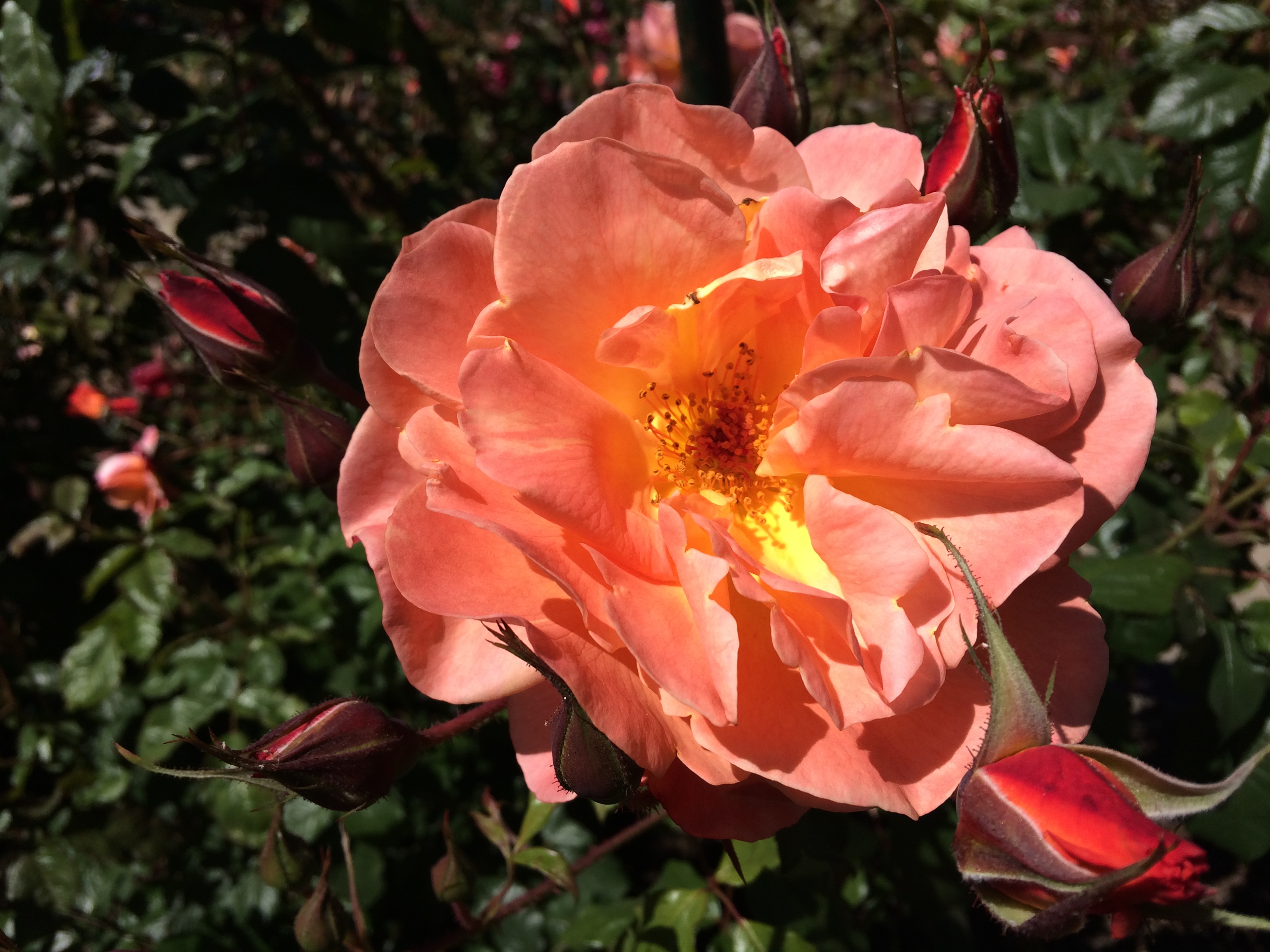
This past Friday was the day of her funeral. I didn’t know how it would go, how my kids would handle it (my oldest and her oldest are friends), and tried to find some strength for myself, so I would be able to be there for them. I realized that I associate this woman’s kindness and warmth with the pinkish apricot color of my favorite rose in the Berkeley rose garden, Westerland. So I decided to walk through the rose garden to experience the color and scent of this amazing flower, and it helped. This is what she looked like that day: Westerland

What to listen for in cantata 86:

In the opening movement, notice how Bach accentuates the fact that Jesus is speaking important, timeless words by setting these words in the form of an archaic motet. While the motet has multiple voices, the way it was done in the Renaissance, Bach can still make it clear that the words come from Christ’s mouth only, by giving all the other “voice parts” to instruments instead of to other singers.

In the alto aria, hear how the words “brechen” (to pick [roses]) and “stechen” (to prick) are illustrated by short notes and “broken” chords in the voice part, and broken chords in the violin part.

In the soprano aria, hear how low in the soprano range this is set — it could just as well have been sung by an alto. Bach has not given significant solos to a soprano since Easter of this year, 1724, and actually pretty sporadically since the start of the new year. Many scholars suggest that during that spring of 1724, Bach might have lost his boy soprano soloist (due to him leaving the school or due to his voice changing, we don’t know), and documents suggest that he was frustrated with the low quality of the boy sopranos of the St. Thomas School in general. They believe that this is why he started the chorale cantatas (cantatas of which each movement is based on a different verse of one and the same chorale tune) after Pentecost of that year. Keep following this blog and you’ll learn more about that soon 🙂

Wieneke Gorter, May 21, 2017, updated May 15, 2020.

*I did all this listening last year, when I actually ended up writing about cantata 87, the one Bach wrote for this same Sunday, but then in 1725. Read that post here.

Recent Posts

  • “Missa Miniatura” by CONTINUUM/Elina Albach Even More Moving in 2025
  • Bachfest Leipzig 2025
  • Bach Cantatas for Christmas – 1724 and 1734 editions
  • Fourth Sunday of Advent – more insight into Cantata 62 helped me better understand Bach’s Christmas Oratorio
  • Saint Ambrose and Luther in Milan – Second Sunday of Advent

Archives

  • August 2025
  • July 2025
  • December 2024
  • November 2024
  • June 2024
  • January 2024
  • December 2023
  • October 2023
  • September 2023
  • August 2023
  • April 2022
  • February 2022
  • January 2022
  • December 2021
  • November 2021
  • June 2021
  • May 2021
  • April 2021
  • February 2021
  • January 2021
  • December 2020
  • November 2020
  • October 2020
  • September 2020
  • August 2020
  • July 2020
  • May 2020
  • April 2020
  • March 2020
  • February 2020
  • January 2020
  • December 2019
  • November 2019
  • May 2018
  • April 2018
  • March 2018
  • February 2018
  • January 2018
  • December 2017
  • November 2017
  • October 2017
  • September 2017
  • August 2017
  • July 2017
  • June 2017
  • May 2017
  • April 2017
  • March 2017
  • February 2017
  • January 2017
  • December 2016
  • November 2016
  • October 2016
  • September 2016
  • August 2016
  • July 2016
  • June 2016
  • May 2016
  • April 2016
  • March 2016
  • February 2016
  • January 2016

Enter your email address to follow this blog and receive notifications of new posts by email.

Join 338 other subscribers

Categories

  • 1723 Trinity season special series
  • Advent
  • After Easter
  • Ascension
  • Bach's life
  • Cantatas
  • Chorale cantatas 1724/1725
  • Christmas
  • Easter
  • Epiphany
  • Following Bach in 1725
  • Köthen
  • Leipzig
  • Septuagesima
  • Travel
  • Trinity
  • Weimar

Meta

  • Create account
  • Log in
  • Entries feed
  • Comments feed
  • WordPress.com

Website Built with WordPress.com.

  • Subscribe Subscribed
    • Weekly Cantata
    • Join 158 other subscribers
    • Already have a WordPress.com account? Log in now.
    • Weekly Cantata
    • Subscribe Subscribed
    • Sign up
    • Log in
    • Report this content
    • View site in Reader
    • Manage subscriptions
    • Collapse this bar
 

Loading Comments...