Weekly Cantata

Weekly Cantata

Tag Archives: Harnoncourt

Many things to be proud of

26 Saturday Nov 2016

Posted by cantatasonmymind in Advent, Cantatas, Leipzig, Weimar

≈ 2 Comments

Tags

Advent, Bach, BWV 61, Christophe Pregardien, Eduard van Hengel, First Sunday of Advent, French ouverture, Harnoncourt, Leipzig, Luther, Nuria Rial, Peter Kooy, Seppi Kronwitter, Sybilla Rubens, Weimar

giotto-entry-into-jerusalem

The Entry into Jerusalem by Giotto, ca. 1305. Fresco in the Scrovengni Chapel, Padua, Italy.

Bach performed this cantata 61 Nun komm der Heiden Heiland in Leipzig on November 28, 1723, as a “rerun” of the first performance in Weimar in 1714. Why did he not write a new cantata? The prevailing scholarly answer is that Bach was giving himself a break from composing in between the three-week frenzy of cantatas 60, 90, and 70 and the new works (including a Magnificat) he was planning for the Christmas days.  I think Bach was proud of his Weimar cantatas, and I believe he wanted to show off the special features in this cantata to his colleagues and to the thousands of Lutherans that he knew would flock to the Leipzig churches on holidays.

I myself am proud of having followed Bach’s cantata writing of 1723 every week for the entire Trinity season. After all this listening and reading, I see a pattern in Bach reviving some of his Weimar cantatas on Leipzig feast days*, and I now look at cantata 61 Nun komm der Heiden Heiland in a new way.

This cantata had already been in my top five because of the moving interpretation of the soprano aria by Seppi Kronwitter (soprano) and Nikolaus Harnoncourt (cello) on the Harnoncourt recording from 1976. My mother loved this aria and played this recording many times, and I have fond memories of listening to it with her.

Harnoncourt-cello

I had always found the bass recitative that precedes it very charming, with the musical illustration of the knocking on the door, but not more than that.  I had seen this recitative in the context of all the Bach cantatas and passions that I knew, and had compared it with other typical Bach “Vox Christi” writing for bass. But those were all written after November 28, 1723.  So now, after having tried to place myself in the shoes of the Leipzig congregations for the entire 1723 Trinity season, I am fully aware that they had not heard a “Vox Christi” at all in any of the cantatas leading up to this one.** And thus I finally realize how it must not have been charming, but truly moving to them to hear this announcement presented in this way, on the first Sunday they started looking forward to the birth of Christ.

In the text of the recitative, Jesus says: “See, I am in front of your door! I’m knocking!” The librettist means the door of the believer’s heart, in which he’s planning to live. The pizzicato in the strings, as well as the staccato and the intervals in the voice part illustrate the knocking, and the dissonances at the beginning only resolve until the final “klopfe an.” The form of this recitative is highly unusual, and perhaps also something Bach wanted to show off in Leipzig.

However Bach’s greatest source of pride was probably the opening chorus of this cantata. To understand this, we need to do a mini music history class. First, in the 4th century, Ambrosius created the hymn Veni Redemptor Gentium, beautifully sung here on this video by Giovanni Vianini, director of the Schola Gregoriana Mediolanensis in Milan, Italy. Then, in 1524, Luther turned that hymn into Nun komm der Heiden Heiland, which sounds like this and which all Lutherans in Bach’s time knew very well.

In Weimar Bach had come into contact with French and Italian court music, and had adopted the habit of writing almost every opening chorus or opening sinfonia of his cantatas as a royal “entrada,” to show off his skills in French ouverture writing as well as to please the Duke.

So now Bach needed/wanted to merge the timeless hymn with a fashionable French ouverture. And the result is stunning. Or, as Eduard van Hengel says: Bach wrote “brilliant fusion” at the age of 29. Listen to this in the recording by Philippe Herreweghe on YouTube (Sybilla Rubens, soprano; Christoph Prégardien, tenor; Peter Kooij, bass).

Find the German text with English translations here and the score here.

The first line of the hymn is sung one voice part at a time, an illustration of the Bible reading for this Sunday: the people greeting the messiah who is riding into Jerusalem. The second line is then sung as a simple four-part hymn, while the instrumental parts keep playing the first part of the ouverture. The third line becomes a mini motet in the fast and happy (“Gai”) middle part of the ouverture, in 3/4. 

The fourth line of text is then again a simple four-part setting on the third part of the ouverture.

For the closing chorale, Bach chose the last two lines of Wie schön leuchtet der Morgenstern as melody. And again he marries the chorale tune beautifully with the instrumental writing.

Wieneke Gorter, November 26, 2016, updated December 1, 2019.

*Read more about this in my post about the feast of St. John the Baptist on June 24, The Visitation on July 2, and last week’s post about cantata 70. Read how proud Bach was of his Weimar cantatas in this post about cantata 12.

** unless they had a really good memory, and were present at Bach’s “audition” in February 1723. There is a Vox Christi in Cantata 22 which he presented at that time, but didn’t repeat in Leipzig until that same time in the church year in 1724.

Season 1, episode 2

04 Saturday Jun 2016

Posted by cantatasonmymind in 1723 Trinity season special series, Bach's life, Cantatas, Leipzig, Trinity

≈ Comments Off on Season 1, episode 2

Tags

according to Lutheran Church year, Bach, cantatas, Harnoncourt, James Gilchrist, John Eliot Gardiner

Brunswick_Monogrammist_Great_Banquet

The Parable of the Great Supper / the Great Banquet, by anonymous Dutch painter “the Braunschweig (Brunswick) Monogrammist,” ca. 1525

Trinity season in the Lutheran Church year means no feast days until Christmas, no stories about Jesus’ life in the Gospel texts, and no Vox Christi bass recitatives. To still keep this blog exciting for myself and you loyal readers, I decided to make it into a true weekly series, and will be following all of Bach’s 1723 Leipzig cantatas until Advent, without taking any detours to his Weimar cantatas or later Leipzig cantatas.

A few things that make it irresistible for me to try this: Bach started working  in Leipzig  on the first Sunday after Trinity in 1723 (see last week’s blog post); the dates of the Lutheran Church year in 2016 are practically the same as in 1723 – off by only one day; and I believe that by following this 1723 sequence, we can better imagine how it must have been for the Leipzig audiences (congregation) to hear one cantata after the other, and perhaps get a little insight in how it must have been for Bach himself to write one after the other.

So, here we go with season 1, episode 2:

Previously on Weekly Cantata: Bach arrived in Leipzig on Saturday May 22, 1723,, and made his debut with cantata 75 Die Elenden sollen essen in the Nicolaikirche (St. Nicholas Church) on Sunday May 30, the first Sunday after Trinity.

The second Sunday after Trinity in 1723 marked Bach’s debut in the Thomaskirche (St. Thomas Church). On Sunday June 6, he performed cantata 76 Die Himmel erzählen die Ehre Gottes there, and this one is even more impressive than 75, and includes a festive opening chorus which makes me think of Bach’s later Ascension Oratorio.

There are many similarities between cantata 75 and 76, the most obvious one being that they share the ambitious length of 14 movements in total, divided over two parts. From a superficial point of view, both cantatas start with a psalm text in the opening chorus, have challenging soprano arias, feature bass arias with trumpet, and -never seen again in later cantatas- an instrumental sinfonia at the start of the second part (after the sermon). However there are more (hidden) similarities and cross-references between the two, so that one could almost think about these two first cantatas of the 1723/1724 cycle as a diptych.

I appreciate Gardiner’s interpretation of cantata 76 the most of all recordings I listened to. And the universe will have it that this one was recorded in the Basilique de Saint-Denis (directly north of Paris), which was my subway stop for four fabulous music-filled months in 1994. In his journal from 2000, Gardiner writes that they were very concerned about the enormous size of this Gothic cathedral, and feared that a large audience (needed to balance out the acoustics) wouldn’t show up because it was the night of the France-Italy final in the Euro soccer competition. But everything turned out fine: there were more than 1200 people in the audience, and France won.

Listen to Gardiner’s recording of cantata 76 Die Himmel erzählen die Ehre Gottes on Spotify  or on YouTube, or buy this recording on Amazon.

Cantata 76 starts with a text about heaven: the first and third verse of Psalm 19, Die Himmel erzählen die Ehre Gottes. To illustrate this, the heavenly trumpet (in cantata 75 not introduced until the start of the second half) is heard right away. The fugue on the text “Es ist keine Sprache noch Rede, da man nicht ihre Stimme höre” is fantastic, Bach at his best in my opinion.

After this, the text of the cantata refers to the Gospel reading of the day: the parable of the Great Supper from Luke 14: 16-24 about a man who has invited many guests to a Dinner/Supper/Banquet, receives one cancellation after the other, after which he decides to invite all the beggars and cripples his servant can find, and serves them the dinner instead, not leaving one place open for any of the previously invited guests. All this combined with the “Brotherly love” theme from the Epistle reading of the day: 1 John 3: 13-18.

Another example, though through a completely opposite story as the one from cantata 75, of why it is good to share food and love with others.

Besides the incredible opening chorus, the highlights of this cantata for me are: the soprano aria with violin/cello accompaniment (no. 3), the bass aria with trumpet (no. 5), the incredible sinfonia for oboe d’amore and viola da gamba at the start of the second half (no. 8),  the dramatic, operatic tenor aria (no. 10, fabulously performed by James Gilchrist, including the “shake” Bach wrote on the word “Hasse”), and the alto recitative with viola da gamba (no. 11).

For those who have extra time: listen to the violin/cello duet in the soprano aria accompaniment in an unrivaled (as far as I am concerned) interpretation by Alice and Nikolaus Harnoncourt on their recording from 1976 (scroll to 06:11)

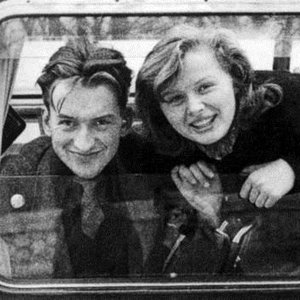
e1712a1a564449d6c9c7a2aad5045250

Nikolaus & Alice Harnoncourt, 1951, before they were married, on tour with the Vienna Chamber Orchestra

Read the German text with English translations of this cantata here, and find the score here.

If you don’t want to miss an episode of this 1723 Trinity season series, please consider signing up  to receive an email every time I’ve posted a new story.

Please feel free to share this on Facebook, or forward to anyone you think might enjoy coming along for this ride. Thank you!

Wieneke Gorter, June 4, 2016, links updated June 12, 2021.

Glorious soprano arias and unusual instrumentation

08 Sunday May 2016

Posted by cantatasonmymind in After Easter, Cantatas, Leipzig

≈ Comments Off on Glorious soprano arias and unusual instrumentation

Tags

Bach, BWV 183, bwv 44, Carolyn Sampson, Christiane Mariana von Ziegler, Dorothee Mields, Exaudi, Gerd Türk, Harnoncourt, oboe d'amore, oboe da caccia, Peter Jelosits, Peter Kooy, Phlippe Herreweghe, Robin Blaze, Rudolf Lutz, Thomas Hobbs, violoncello da spalla

BWV183titlepage

The title page of cantata 183 in Bach’s handwriting: Dominica Exaudi // Sie werden eüch in den Bann tun // à 4 Voci, 2 Hautb d’Amore, 2 Hautb da Caccia, 2 Violini, Viola, Violoncello piccolo e Continuo // di Joh. Sebas. Bach. Staatsbibiothek zu Berlin – Preußischer Kulturbesitz

There are two cantatas for this Sunday Exaudi, aka the Sunday after Ascension, or in the practical reality of the man who had to write the music and rehearse the choir: the Sunday in between Ascension and the three-day-long feast of Pentecost. Because they refer to the same Gospel text, the cantatas share the title Sie werden euch in den Bann tun, but except for the fact that they each contain a glorious soprano aria, they have nothing in common.

I discuss both cantatas in this blog post. Keep reading for Cantata 183, but let’s first look at the one Bach wrote in 1724: Cantata 44 Sie werden euch in den Bann tun.

The soprano aria from this cantata, Es ist und bleibt der Christen Trost, sung by the amazing Peter Jelosits on the Harnoncourt recording from 1975 is among the most happiest music memories of my childhood. I suspect my mom loved it so much that she played it more often than just on this Sunday. I didn’t realize how well this aria is engraved in my brain until I surprised myself during a choir carpool, singing the entire thing from memory, illustrating a story about how some of these boy sopranos could sing very complicated arias.

Es ist und bleibt der Christen Trost,
The consolation of Christians is and remains
Dass Gott vor seine Kirche wacht.
God’s watchful care over his church.
Denn wenn sich gleich die Wetter türmen,
For even though at times the clouds gather,
So hat doch nach den Trübsalstürmen
yet after the storms of affliction
Die Freudensonne bald gelacht.
the sun of joy has soon smiled on us.

If you would like to listen to the entire cantata, I recommend Herreweghe’s recording from 2013. The opening tenor/bass duet is the best here, with bass Peter Kooij singing out much more than on their 1993 recording of this same cantata, and his and Thomas Hobbs’ voice matching better than his and Christoph Prégardien’s (as much as I love Prégardien’s voice!).

Also, Herreweghe’s interpretation of the soprano aria on this 2013 recording is the most musical and the most cheerful, not in the least because it has the highest tempo of all recordings I listened to. That this proves a bit of a challenge for the always fabulous soprano Dorothee Mields is only audible in the text: after she comes out of the expertly executed but super tricky long runs, she slips back into the edition she probably studied from, which uses the more modern “für seine Kirche”  instead of the edition they’re performing from, which uses the archaic “vor seine Kirche,” so it ends up being a mix of the two texts. While this bugs me a little bit, a retake of the recording would probably have been at the expense of the magic that happens in this aria, so it is probably a good thing that they left it in.

Purchase the Herreweghe recording of cantata 44 on Amazon or on iTunes. (This album also features the beautiful recording of cantata 73 discussed here).

Find the entire German text of cantata 44 with English translations here, and the score here.

  • Thomas Hobbs, tenor (photo by B Ealovega)
  • Peter Kooij, bass

Cantata 183 from 1725 is noteworthy because it uses a text by Christiane Mariana von Ziegler and features a striking instrumentation: two oboi d’amore and two oboi da caccia in the bass recitative; a violoncello piccolo in the tenor aria; again the two oboe pairs in the alto recitative; two oboi da caccia in the soprano aria; all these instruments in the closing chorale.

My absolute favorite recording of this cantata is the one by Bach Collegium Japan. They struck gold with this recording, thanks to the combination of  Badiarov playing the violoncello piccolo da spalla, fabulous oboe players, and terrific vocal soloists: soprano Carolyn Sampson, countertenor Robin Blaze, tenor Gerd Türk, and bass Peter Kooij. I think the entire album (also featuring the recording of cantata 85 discussed here) is very inspired, and it has become one of my favorite Bach cantata CDs.

Listen to this Bach Collegium Japan recording of cantata 183 on Spotify.

Purchase this Bach Collegium Japan recording of cantata 183 (and 85!) on Amazon or on iTunes.

Find the German text with English translation of Cantata 183 here, and the score here.

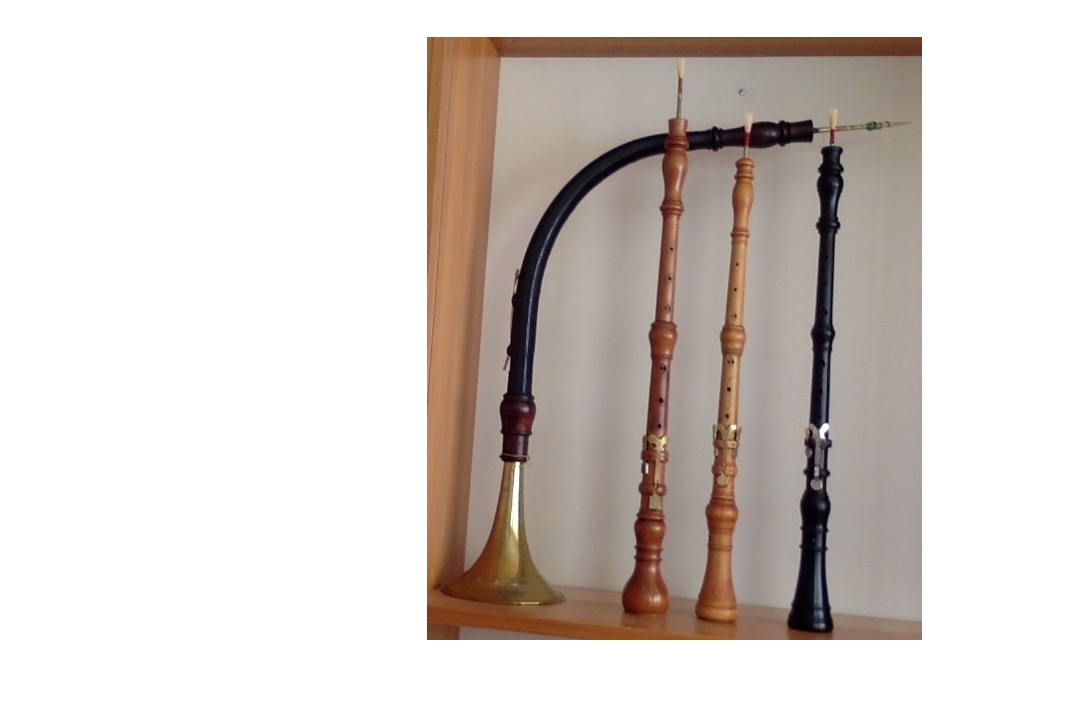
Why is this scoring for the oboes so unusual? In Bach’s time there were “regular” oboes (to the right on this photo), oboes d’amore (with a bell-like widening in the wood at the end, second from left), and oboes da caccia (or “hunting” oboes, completely curved, and with a trumpet-like brass bell at the end, far left).

Oboes
From left to right: oboe da caccia, oboe d’amore, oboes. Photo courtesy of Marianne Richert Pfau; instruments built after 18th century examples by Sand Dalton, Harry van Dias, and Paul van der Linden, respectively.

Bach often used the oboe da caccia, but only on a handful of occasions would he write for two da caccias. And even if he would write for two da caccias or two d’amores and “regular” oboes in the same cantata (or passion) they would not all be playing at the same time. On most occasions there were between one or two oboe players in the orchestra, sometimes three, alternating between the different instruments from one movement to the next. The only times Bach needed four oboists in one cantata, playing two da caccias and two d’amores at the same time, was in cantata 2 of the Christmas Oratorio (1734) and in this cantata 183. So there must have been some good oboe playing visitors in town around this time of Ascension and Pentecost in 1725.

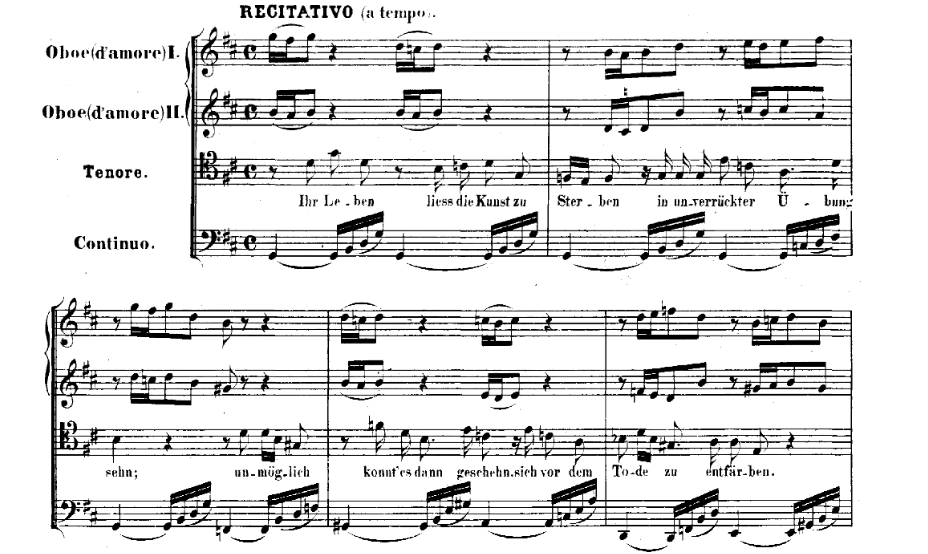
The four oboes can be heard clearly in the alto recitative, where Bach has each of them repeat the four-note theme from the “ich bin bereit”-text in the vocal part:

Screenshot 2016-05-08 10.16.33

When I hear this, I immediately have to think of the tenor recitative in Bach’s beautiful  Trauer Ode, cantata 198, this time reduced to a 3-note theme and without the da caccias:

Screenshot 2016-05-08 10.28.17

Or listen to this recitative from cantata 198 on YouTube

It is of course not exactly the same composition, but I wonder if Bach had to think back of this cantata from 1725 when he wanted to illustrate life  and death in one and the same piece of music in the Trauer Ode of 1727.

After this alto recitative comes the most glorious soprano aria, richly scored with the two oboes da caccia playing the oboe part in unisono, as well as parts for violin 1, violin 2, and viola. Harnoncourt says that even though both da caccia have this aria written in, he says it is “clearly not intended to be chorally played” and on their recording they decide to have this part covered by only one oboe da caccia. Perhaps the original full score was not available to Harnoncourt at the time he made that decision, because it clearly says: “tutti gli Oboi in unisono:”

Screenshot 2016-05-08 12.34.13
excerpt from the soprano aria from cantata 183, with Bach’s indication for “all the oboes in unisono,” Staatsbibiothek zu Berlin, Preußischer Kulturbesitz

One would almost think Bach dreamt of all four oboes playing this, also the d’amores, but when his copyists double-checked with him, he decided that was just silly, it would overpower the poor boy who had to sing this, and they only wrote it into the parts for the da caccias (it says “Arie Tacet” in the parts for the oboi d’amore).

To learn more about Cantata 183, I wholeheartedly recommend you study with Rudolf Lutz of the J.S. Bach Foundation a little bit. Find a link to his fabulous (English spoken!) lecture and improvisation about this cantata in my blog post from May 24, 2020.

Wieneke Gorter, May 8, 2016, updated May 23, 2020.

A good shepherd, a violoncello piccolo da spalla, and a bit of St. Matthew Passion

09 Saturday Apr 2016

Posted by cantatasonmymind in After Easter, Cantatas, Leipzig

≈ Comments Off on A good shepherd, a violoncello piccolo da spalla, and a bit of St. Matthew Passion

Tags

2nd Sunday after Easter, Atsuko Ozaki, Bach, Bach Collegium Japan, BWV 42, BWV 6, BWV 85, cantatas, Caroyn Sampson, Dmitry Badiarov, Georg Poplutz, Gerd Türk, Gerlinde Säman, Harnoncourt, J.S. Bach Foundation, John Eliot Gardiner, Kurt Equiluz, Markus Volpert, Martin Zeller, Peter Kooij, Peter Kooy, Robin Blaze, Rudolf Lutz, St. Matthew Passion, Terry Wey, violoncello da spalla, violoncello piccolo

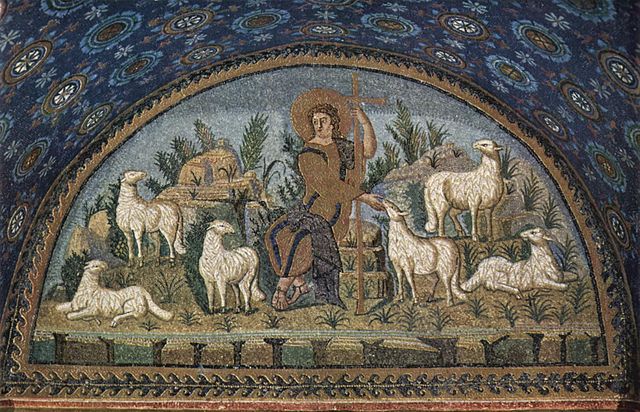
640px-meister_des_mausoleums_der_galla_placidia_in_ravenna_002
The Good Shepherd, mosaic in the Mausoleum of Galla Placidia, Ravenna, 1st half of the 5th century

There are three beautiful cantatas for this second Sunday after Easter, or “Misericordias Domini” Sunday: BWV 104, 85, and 112. Illustrating the “good shepherd” scripture for this Sunday (John 10, verse 12-16), Bach incorporated pastoral themes or orchestration in each of these cantatas.*

I’ve decided to focus on cantata 85 Ich bin ein guter Hirt, written for April 15, 1725. Of all three cantatas, this is the one I remember the best from my childhood, because of the  tenor aria “Seht, was die Liebe tut.” Also: Last week, I already mentioned the similarities between cantata 6 (for Easter Monday 1725), and cantata 42 (for the first Sunday after Easter 1725). This cantata 85 is the culmination of that “sub group” within the cantatas from 1725.

Which recording to listen to?

While I have good memories of hearing Kurth Equiluz sing the tenor aria on the Harnoncourt recording from 1977, I am enamored by Bach Collegium Japan’s recording of this cantata, and I think this is the best “overall” recording, featuring fabulous soloists Carolyn Sampson, Robin Blaze, Gerd Türk, and Peter Kooij. It is also one of the most noteworthy because of the use of a  violoncello da spalla, played by Dmitry Badiarov.

Listen to Bach Collegium Japan’s recording of cantata 85 Ich bin ein guter Hirt on Spotify. Or better yet, if you can afford to financially support the artists (especially important now, while they have no income from performances!) please consider purchasing the digital versions of Bach Collegium Japan’s recording of cantata 85 on Amazon or on iTunes.

If you prefer to watch a live recording, there is a wonderful recording available on YouTube by the J.S. Bach Foundation. Soloists are Gerlinde Sämann, soprano; Terry Wey, alto; Georg Poplutz, tenor; Markus Volpert, bass; and Martin Zeller, violoncello piccolo.

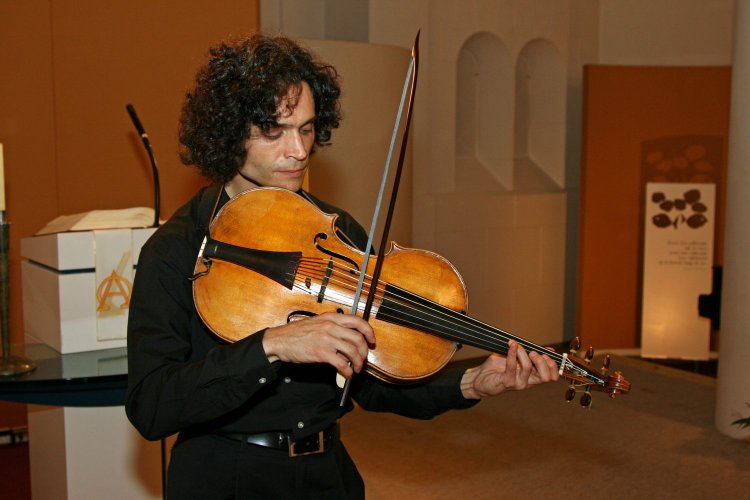
Back to the Bach Collegium Japan recording: After lovely and convincing singing by bass Peter Kooij in the opening arioso (Jesus saying “I am a good shepherd”), we get a sublime performance by countertenor Robin Blaze of the alto aria “Jesus ist ein guter Hirt,” which also features the unusual violoncello piccolo da spalla. Someone could probably write an entire PhD thesis on the difference between the  violoncello piccolo  “da spalla” (held on the shoulder, like a violin),  and the violoncello piccolo “da gamba”  (held between the legs,  like a cello), and whether Bach meant the one or the other when he wrote a part for “violoncello piccolo.”  Most recordings (Harnoncourt, Gardiner, Coin, Koopman, and J.S. Bach Foundation) feature the one held between the legs, but Bach Collegium Japan’s recording features the “da spalla” variety, played by the same person who built it in 2004, Dmitry Badiarov.

Badiarov-Dmitry-04
Dmitry Badiarov demonstrating the violoncello piccolo da spalla

Following this, we hear a radiant soprano solo chorale with oboe accompaniment (which makes me think back to the soprano solo chorale from cantata 6, in that case with the violoncello piccolo “da gamba”), beautifully sung by soprano Carolyn Sampson and expertly played by oboists Masamitsu San’nomiya and Atsuko Ozaki.

And when you didn’t think it could get any better, here comes a tenor recitative which in text and string accompaniment strongly refers to Jesus’ recitative from the St. Matthew Passion “Ich werde den Hirten schlagen, und die Schafe der Herde werden sich zerstreuen.” (Christ, having arrived at the Mount of Olives, reminds his disciples of the prophecy that the shepherd will be slain and the sheep will scatter).

With this only recitative in cantata 85, Bach has gotten everyone’s attention, so now we’re ready for the jewel in the crown of this cantata: the tenor aria “Seht, was die Liebe tut.” It is one of the most lyrical and lovely among all Bach’s tenor arias.

Seht, was die Liebe tut.
See, what love does.
Mein Jesus hält in guter Hut
My Jesus in his own safekeeping
Die Seinen feste eingeschlossen
keeps those who are his own firmly enclosed
Und hat am Kreuzesstamm vergossen
and on the beam of the cross he has shed
Für sie sein teures Blut.
for them his own precious blood.

Again there is a strong association with the St. Matthew Passion both in text and music. In his book Bach: Music in the Castle of Heaven Gardiner makes a very convincing case for his theory that Bach had wanted to perform the St. Matthew Passion on Good Friday 1725, only one year after the St. John Pasion. This didn’t happen because either the council disapproved, or Bach wasn’t ready composing the piece. If Bach had indeed been working on the St. Matthew Passion before Easter 1725, it is no wonder we’re getting glimpses of that monumental work in his cantatas after Easter 1725.

Wieneke Gorter, April 9, 2016, updated April 26, 2020

*I wrote about Cantata 104 for the Second Sunday after Easter in 1724 in this blog post.

R.I.P. Nikolaus Harnoncourt

06 Sunday Mar 2016

Posted by cantatasonmymind in Cantatas, Leipzig

≈ Comments Off on R.I.P. Nikolaus Harnoncourt

Tags

Bach, chorales, Concentus Musicus Wien, Harnoncourt, Kurt Equiluz, Robert Holl, St. John Passion

harnoncourt

Yesterday evening, Saturday March 5, 2016, conductor and cellist Nikolaus Harnoncourt left this world. He was an important part of the Sunday Bach cantata tradition my mother started in our family, and she was a great admirer of him. Even though my mother passed away more than five years ago, I feel she died a little more for me today, now that I know Harnoncourt is gone.

Sometime in the late 1980s, with my parents and my sister, I attended a performance of Bach’s Passion according to St. John which Harnoncourt directed in the Concertgebouw in Amsterdam. We had seats in the section behind the orchestra and choir, so that we could watch him communicate with the players and singers. I will never forget that. Afterwards, my mother–who was singing in a Bach choir herself at the time–said that it would mean the world to her if she could ever sing in a choir conducted by Harnoncourt. It never happened for her, but the combination of her saying this and me seeing Harnoncourt at work inspired me to join a Bach choir in my first year of college.

Even though Harnoncourt made an incredible amount of recordings (see his timeline for a list of all of them), there is nothing like seeing (an) excellent artist(s) live on stage. To see them work, interact, and to feel their energy is an experience you’ll never forget and which is worth so much more than earthly possessions. So if there is someone you admire but only know from recordings, go hear and see them live while they’re still alive! Make the effort. You will be glad you did.

Watch Harnoncourt conduct Bach’s Passion according to St. John on this video recorded in Graz, Austria, in 1985. It is a terrific example of the world class conductor he was. Don’t be put off by  the 30-year-old sound quality, especially noticeable in the oboes in the opening chorus. It is only that bad in the beginning, the rest of the recording is a feast for the ears and eyes, not in the least because of the excellent performance (and singing technique!) by Kurt Equiluz as evangelist.

Listening to the Passion according to St. John is also appropriate in the order of things on this blog, since Bach was working on this passion during Lent in 1724, and revising it in 1725. And this way, come Good Friday (March 25, 2016), I can perhaps talk about the other passion 🙂

Wieneke Gorter, Sunday March 6, 2016.

To the Opera!

31 Sunday Jan 2016

Posted by cantatasonmymind in Cantatas, Epiphany, Leipzig

≈ Comments Off on To the Opera!

Tags

Bach, Bach and opera, Bach Collegium Japan, cantatas, Harnoncourt, John Eliot Gardiner, Kurt Equiluz, Paul Agnew, Paul Esswood, Peter Kooy, Robin Blaze, Ruud van der Meer

Rembrandt_Christ_in_the_Storm_on_the_Lake_of_Galilee
The Storm on the Sea of Galilee by Rembrandt van Rijn, 1633. Formerly at the Isabella Stuart Gardner Museum, Boston, USA. Stolen in 1990.

Cantata 81 Jesus schläft, was soll ich hoffen? from 1724 closely follows the reading for the 4th Sunday after Epiphany: the story of Jesus calming the storm on the sea of Galilee.

In combining masterful text illustration with his theology, Bach presents a powerful drama rivaling a Handel opera. And I was lucky to find two conductors especially not shy of the opera-element in this cantata: Harnoncourt and Gardiner. The recording from 1978 directed by Harnoncourt has a great sense of drama as well as good singing in all the movements. For me it is the most “overall” satisfying recording of this cantata. It was not an easy decision though this week, and the fact that I grew up with the Harnoncourt recording might of course have influenced my choice. Soloists: Paul Esswood, counter-tenor; Kurt Equiluz, tenor; Ruud van der Meer, bass.

Listen to Harnoncourt’s recording of cantata 81 on Spotify

Listen to Harnoncourt’s recording of cantata 81 on YouTube

Read the full German text with English translation of cantata 81

Find the score of cantata 81 here

If you have time to listen some more: The absolute best rendition of the spectacular tenor aria in my opinion appears on the Gardiner recording, with very convincing “waves” in the orchestra (at an even higher tempo than Harnoncourt) and truly marvelous singing by Paul Agnew. Listen to this aria on Spotify.

What to keep in mind when listening:

The reading for this 4th Sunday after Epiphany, from Matthew 8:

23. Und er trat in das Schiff, und seine Jünger folgeten ihm.

[23] And when he entered into a ship, his disciples followed him.

24. Und siehe, da erhub sich ein groß Ungestüm im Meer, also daß auch das Schifflein mit Wellen bedeckt ward; und er schlief.

[24] And, behold, there arose a great tempest in the sea, insomuch that the ship was covered with the waves: but he was asleep.

25. Und die Jünger traten zu ihm und weckten ihn auf und sprachen: HERR, hilf uns, wir verderben!

[25] And his disciples came to him, and awoke him, saying, Lord, save us: we perish.

26. Da sagte er zu ihnen: Ihr Kleingläubigen, warum seid ihr so furchtsam? Und stund auf und bedräuete den Wind und das Meer; da ward es ganz stille.

[26] And he saith unto them, Why are ye fearful, O ye of little faith? Then he arose, and rebuked the winds and the sea; and there was a great calm.

27. Die Menschen aber verwunderten sich und sprachen: Was ist das für ein Mann, daß ihm Wind und Meer gehorsam ist?

[27] But the men marvelled, saying, What manner of man is this, that even the winds and the sea obey him!

In Western Europe at Bach’s time, there was probably no insight yet that the “sea” in this bible story was actually a large sweet-water lake. Bach’s Lutheran bible talked of a sea, not a lake, and most paintings from the 16th and 17th centuries depict seagulls, cliffs, or port cities in the distance. Of course a storm can also develop on a large lake, but we have to assume that Bach and his librettist had a full-blown storm at sea in mind when writing this. Bach probably never witnessed one, but Gardiner says that one of the theologian books in Bach’s library featured a vivid commentary on this part of the gospel. That book’s author, Heinrich Müller, lived in Rostock, on the Baltic sea. And who knows what interpretations of a “tempesta di mare” by other composers Bach had heard at the opera in Hamburg or seen on copied music which traveling colleagues and students might have brought with them.

Already in the opening aria Bach combines opera with theology. The recorders illustrate the “sleeping” Jesus, but also the loneliness of a life without Jesus/without faith (Bach uses recorders for this purpose more often, for example in the O Schmerz tenor-aria from the St. Matthew Passion (when for a moment Jesus feels he has lost faith), as well as in the Sanfte soll mein Todeskummer tenor-aria from the Easter Oratorio). There is also some hint in the orchestra of the calm before the storm, underlining the anxiety of the question “Was soll ich hoffen?”

The big storm at sea manifests in the tenor aria, equal to a “rage” aria by Handel, with the orchestra and the singer imitating the rolling waves and wind.

Then enters Jesus in the bass arioso, asking his disciples, but also the believers in general, why they didn’t have faith. Dürr remarks that the music is like an “Invention” and is practically a bass duet, with the other “singer” being the continuo. This is also a pivotal point in the cantata, moving from the part without Jesus/faith (nos 1-3) to the part with Jesus/faith.

Another “storm aria” follows, sung by the bass, but this time the storm is somewhat quieting down, and the oboe lines paint a quieter mood. All this to illustrate that Jesus is calming the storm. The alto recitative states/confirms that Jesus has calmed the storm, and is with us, and the chorale (second verse of the beautiful Jesu meine Freude) is the final affirmation:

Unter deinen Schirmen
Beneath your protection
Bin ich für den Stürmen
I am free from storms
Aller Feinde frei.
and all enemies.
Laß den Satan wittern,
Let Satan sniff around,
Laß den Feind erbittern,
let the enemy be exasperated
Mir steht Jesus bei.
Jesus stands by me.
Ob es itzt gleich kracht und blitzt,
Though there is thunder and lightning,
Ob gleich Sünd und Hölle schrecken,
though sin and hell terrify,
Jesus will mich decken.
Jesus will protect me.

Thank you for reading! Please leave your email address in the “follow this blog” section on the left side of this blog post. You will receive an email by WordPress whenever I have posted a new story. Please note that the choice of words and spelling in their confirmation email is by WordPress, not me. My apologies for that, and many thanks to you for your patience while I work on a more elegant solution!

Wieneke Gorter, January 31, 2016, links updated February 2, 2020

A Bach Cantata for Three Kings Day can swing both ways

06 Wednesday Jan 2016

Posted by cantatasonmymind in Cantatas, Epiphany

≈ Comments Off on A Bach Cantata for Three Kings Day can swing both ways

Tags

according to Lutheran Church year, Bach, Bach Collegium Japan, cantatas, Charles Daniels, Epiphany, Harnoncourt, Harry van der Kamp, Kooy, Kurt Equiluz, Leonhardt, Matthew White, Montreal Baroque, Which cantata which Sunday, Which cantata which week

Adoration of Magi

Some of us love to keep the tree and the lights for a few more days, others are (eagerly or not) looking ahead, facing reality (and finally starting that blog).  The same two sentiments can be found in Bach’s music for this time of year. The cantata for January 6 (Epiphany) from 1724 is very Christmas-y, the one from 1725 absolutely not. Both are well worth a listen.

Let’s start with the one that is still in full Christmas swing, from 1724: cantata 65 Sie werden aus Saba alle kommen, with a happy text incorporating the story of the Three Kings visiting the baby Jesus, and featuring 2 horns, 2 recorders, and 2 oboes da caccia in the orchestra. As a child I loved this cantata. It was mainly because of the special instrumentation, the horns prominent in the tenor aria, the oboes in the bass aria. But I also clearly remember it was so cool that the bass aria talks about the New Year!

I grew up with the Harnoncourt recording, and though that interpretation of the tenor aria (sung by Kurt Equiluz)  is still one of the best, my “favorite overall” recording of this cantata today is that of Bach Collegium Japan. Tenor James Gilchrist and bass Peter Kooy do a fabulous and compelling job at their arias, and the horns sound beautiful.

Listen to cantata 65 by Bach Collegium Japan on Spotify

Listen to cantata 65 by Harnoncourt on YouTube

Click here for the full German text with English translation of cantata 65

The next year, in 1725, Bach wrote cantata 123 Liebster Immanuel, Herzog der Frommen. A gem of a cantata, with little strands of the chorale woven into the opening chorus, extremely beautiful. Both music and text are much more poignant than the Epiphany cantata of the year before. There are even references to the cross. And then there’s the bass aria. When you listen to this cantata for the first time, and you hear the flute start this aria, you will never guess it is going to be a bass aria! It is a very unusual combination of voice and instrument for Bach, and that usually means: pay attention! And yes, there it is in the text, the core of Bach’s 18th century Lutheran faith: even if society casts you out, you don’t belong, you are lonely, then you will still be saved by Jesus.

My favorite recording of this cantata is the one by Montréal Baroque, on which Dutch bass Harry van der Kamp and flutist Grégoire Jeay make something truly special out of that bass aria. I love the liveliness of this interpretation overall, including an opening chorus that immediately grabs my attention and moves me, and fabulous performances by countertenor Matthew White and tenor Charles Daniels in their arias as well.

The only downside for me of the Montréal Baroque recording is that the chorus pieces are all sung one-on-a-part, by the four soloists only. Not only do I have a personal (maybe not historically accurate, but so be it!) preference for 3-5 voices on a part, I also find that soprano Monika Mauch is outbalanced by the men in the opening chorus. I can hardly hear her, which is too bad because I’m sure she’s an equally great singer as the other three.

Listen to cantata 123 by Montreal Baroque on Spotify

Listen to cantata 123 by Montreal Baroque on YouTube

Listen to cantata 123 by Harnoncourt on YouTube

Click here for the full German text with English translation

If you enjoy listening to these recordings, please consider supporting the artists and purchase them!
BWV 65 by Bach Collegium Japan is here
BWV 123 by Montréal Baroque is here
BWV 123 by Bach Collegium Japan is here
Wieneke Gorter, January 6, 2016
(links updated January 3, 2017 and November 20, 2020)
Newer posts →

Recent Posts

  • “Missa Miniatura” by CONTINUUM/Elina Albach Even More Moving in 2025
  • Bachfest Leipzig 2025
  • Bach Cantatas for Christmas – 1724 and 1734 editions
  • Fourth Sunday of Advent – more insight into Cantata 62 helped me better understand Bach’s Christmas Oratorio
  • Saint Ambrose and Luther in Milan – Second Sunday of Advent

Archives

  • August 2025
  • July 2025
  • December 2024
  • November 2024
  • June 2024
  • January 2024
  • December 2023
  • October 2023
  • September 2023
  • August 2023
  • April 2022
  • February 2022
  • January 2022
  • December 2021
  • November 2021
  • June 2021
  • May 2021
  • April 2021
  • February 2021
  • January 2021
  • December 2020
  • November 2020
  • October 2020
  • September 2020
  • August 2020
  • July 2020
  • May 2020
  • April 2020
  • March 2020
  • February 2020
  • January 2020
  • December 2019
  • November 2019
  • May 2018
  • April 2018
  • March 2018
  • February 2018
  • January 2018
  • December 2017
  • November 2017
  • October 2017
  • September 2017
  • August 2017
  • July 2017
  • June 2017
  • May 2017
  • April 2017
  • March 2017
  • February 2017
  • January 2017
  • December 2016
  • November 2016
  • October 2016
  • September 2016
  • August 2016
  • July 2016
  • June 2016
  • May 2016
  • April 2016
  • March 2016
  • February 2016
  • January 2016

Enter your email address to follow this blog and receive notifications of new posts by email.

Join 338 other subscribers

Categories

  • 1723 Trinity season special series
  • Advent
  • After Easter
  • Ascension
  • Bach's life
  • Cantatas
  • Chorale cantatas 1724/1725
  • Christmas
  • Easter
  • Epiphany
  • Following Bach in 1725
  • Köthen
  • Leipzig
  • Septuagesima
  • Travel
  • Trinity
  • Weimar

Meta

  • Create account
  • Log in
  • Entries feed
  • Comments feed
  • WordPress.com

Website Built with WordPress.com.

  • Subscribe Subscribed
    • Weekly Cantata
    • Join 158 other subscribers
    • Already have a WordPress.com account? Log in now.
    • Weekly Cantata
    • Subscribe Subscribed
    • Sign up
    • Log in
    • Report this content
    • View site in Reader
    • Manage subscriptions
    • Collapse this bar
 

Loading Comments...