As far as we know, Bach wrote three cantatas for this 14th Sunday after Trinity. Please find them all in my post from 2020. It was helpful for me to re-read all these posts from the past seven years. I counted my blessings that I don’t live in wildfire country anymore, and was reminded of my dream to create a podcast about the beauty of the many “trio sonata” tenor arias in Bach cantatas. It will be a while, and I have learned not to promise anything, but if you subscribe to my blog, you’ll be the first to know 🙂
I am a bilingual writer, publicist, choral singer, art and nature lover, happy wife, and blessed mother of two. I started this blog in 2016, inspired by my late mother’s love for Bach’s cantatas. After 23 years in the San Francisco Bay Area, I’m now back in the Netherlands.
Please subscribe to this blog! Simply fill in your email address and you’ll receive an email every time I’ve published a new post. Thank you so much / Vielen Dank / Dankuwel / Merci mille fois / 감사합니다 / 谢谢 / ありがとう / Mille grazie / Muchas gracias / Muito obrigado / Tusen takk / Tack så mycket / Terima kasih / شكراً جزيلاً / תודה רבה
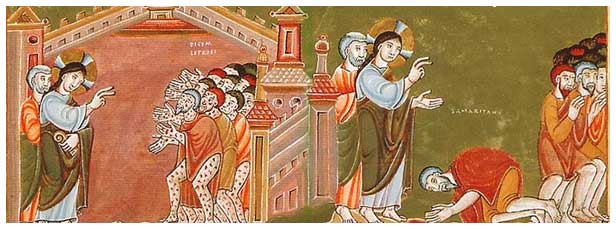
Jesus Heals Ten Lepers, from the Codex Aureus of Echternach, c. 1035-1040
While my family is not in any direct danger of the fires here in California, and we are lucky in many ways, it has been hard for me to avoid going into serious flight mode this week. What has kept me sane are yoga classes on Zoom, but also a daily gratitude practice, where I write down specific examples of things that went well or that I enjoyed, and count my blessings.
I was comforted to discover this week that Bach also focused on gratitude and joy in the third cantata he wrote for this 14th Sunday after Trinity. The Bible story for this Sunday is the miracle of Jesus healing ten lepers, from Luke 17: 11-19. While Bach’s first two cantatas for this Sunday talk about salvation from sickness, the third one, Cantata 17 Wer Dank opfert, der preiset mich (He who gives thanks, he praises me), from 1726, focuses on the second part of the story (as well as the second part in the painting above): the one man who comes forward to thank Jesus for healing him.
Of all the recordings I listened to, I prefer the live video registration by the J.S. Bach Foundation, released in March 2020. Watch that recording here on YouTube or, if you prefer to listen on Spotify, you can find my playlist here. Soloists are: Noëmi Sohn-Nad, soprano; Jan Börner; alto; Sören Richter; tenor; and Daniel Pérez, bass. I enjoyed listening to all of them.
Find the German texts with English translations of this cantata here, and the score here.
There are two unique aspects to this cantata, especially when you compare it to other cantatas for “regular” Sundays. First, there is no hardship to overcome, no sin to be absolved in this cantata. It is all one big song of praise for God’s benevolence. Quite unusual, but a nice change. Second, Bach writes an “Evangelist” part for the tenor at the start of part II, directly quoting the Bible text:
Einer aber unter ihnen, da er sahe, dass er gesund worden war, But one of them, when he saw that he was healed, kehrete um und preisete Gott mit lauter Stimme turned back and praised God with a loud voice und fiel auf sein Angesicht zu seinen Füßen and fell on his face at his feet und dankte ihm, und das war ein Samariter. and thanked him, and this man was a Samaritan.
There are only a handful of other cantatas in which this happens, but most of those are very meaningful (Cantata 22 and 42 come to mind). So I don’t think Bach is experimenting. He probably again wants to educate his fellow believers, and perhaps make them see that that part of the story is what the whole cantata is about.
I have to leave it at that, because the other two cantatas for this Sunday are not to be missed either and I don’t want this post to become too long.
Cantata 25 Es ist nichts Gesundes an meinem Leibe (Nothing healthy is to be found in my body), from 1723, starts out with an incredible opening chorus with trombones playing a chorale that begs for salvation. That salvation then appears towards the end of the cantata, in the form of a jubilant soprano aria. Read my blog post from 2016, not only to find links to Herreweghe’s fabulous recording of this cantata (with Hana Blažíková singing the soprano aria), but also to learn why Bach must have felt like a kid in a candy store that particular Sunday.
In 1724 Bach wrote Cantata 78 Jesu, der du meine Seele (Jesus, you [who saved] my soul). After a completely different, but equally beautiful and poignant opening chorus, joy presents itself much earlier, in the music of the second movement: the cute soprano-alto duet that is nowadays probably Bach’s most beloved duet. In my blog post from 2017 I recommend a Rifkin and a Herreweghe recording and I still stand by those choices today. In that post, I praised the opening chorus and the duet, but I completely forgot to discuss an often overlooked movement from this cantata: the tenor aria. I believe that Bach wrote some of his best trio sonatas in the form of tenor arias. About two years ago I started dreaming of a podcast about this underrated aspect of Bach’s compositions, and when I finally have the time and the guts to create it, this aria will definitely be in it.
Wieneke Gorter, September 12, 2020, updated September 8, 2023.
About Weekly Cantata
I am a bilingual writer, publicist, choral singer, art and nature lover, happy wife, and blessed mother of two. I started this blog in 2016, inspired by my late mother’s love for Bach’s cantatas. After 23 years in the San Francisco Bay Area, I’m now back in the Netherlands.
Please join my readers from all over the world and subscribe to this blog! Simply fill in your email address and you’ll receive an email every time I’ve published a new post. Thank you so much / Vielen Dank / Merci mille fois / 감사합니다 / 谢谢 / ありがとう / Mille grazie / Muchas gracias / Muito obrigado / Takk / Terima kasih / Dankuwel!
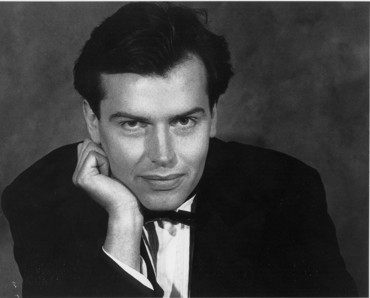
Of this cantata 78 Jesu, der du meine Seele, most people only know the soprano-alto duet Wir eilen mit schwachen, doch emsigen Schritten. The best rendition of this I have ever heard in my life is by Julianne Baird and Allan Fast on the Rifkin recording from 1988. Listen to it here. Fast passed away in 1995 at age 41.
Bach wrote this cantata for the 14th Sunday after Trinity, September 10, 1724. It was not the first time he wrote a “cute” duet — there are gorgeous examples in sacred and secular cantatas from his Weimar and Köthen years. However, at the start of his second Leipzig cycle, for the Trinity season of 1724, there are more and more duets in his cantatas. Alto-tenor duets appear in cantatas 20 and 10, spaced three weeks apart. A series of soprano-alto duets follows on July 9 in cantata 93, a month later in cantata 101, and the next week in cantata 113. Then there’s the terrific tenor-bass duet in cantata 33 on September 3, and this duet on September 10.
This is why I like it so much to listen to Bach’s cantatas in the order he wrote and performed them. I would never have noticed connections such as these otherwise.
The rest of the cantata is wonderful too, especially the opening chorus, which is among the most complex Bach ever wrote. For those who read Dutch, I encourage you to read Eduard van Hengel’s splendid article about this cantata here.
For the entire cantata I prefer Herreweghe’s recording, also from 1988. Soprano: Ingrid Schmithüsen; Alto: Charles Brett; Tenor: Howard Crook; Bass: Peter Kooy. Find the recording here on YouTube. Find the German text and English translations of the cantata here, and the score here.
More listening for this Sunday: cantata 25 from 1723. It has a much bigger orchestra, including many brass players. Find my explanation for that here.
Wieneke Gorter, September 17, 2017, updated September 8, 2023.
About Weekly Cantata
I am a bilingual writer, publicist, choral singer, art and nature lover, happy wife, and blessed mother of two. I started this blog in 2016, inspired by my late mother’s love for Bach’s cantatas. After 23 years in the San Francisco Bay Area, I’m now back in the Netherlands.
Please join my readers from all over the world and subscribe to this blog! Simply fill in your email address and you’ll receive an email every time I’ve published a new post. Thank you so much / Vielen Dank / Merci mille fois / 감사합니다 / 谢谢 / ありがとう / Mille grazie / Muchas gracias / Muito obrigado / Takk / Terima kasih / Dankuwel!
Jesus heals ten lepers, from the Codex Aureus of Echternach, c. 1035-1040
Only a handful of Bach cantatas ask for the Renaissance/Early Baroque ensemble of one cornetto and three trombones in the opening and closing chorus. This instrumentation was considered somewhat “old fashioned” in Bach’s time, while at the same time it was still very normal in cities to hear Stadtpfeifers (city pipers) play chorales from the towers during the day, to remind the citizens of their Christian duties. In this Cantata 25 Es ist nichts Gesundes an meinem Leibe, for the 14th Sunday after Trinity (August 29 in 1723), the playing of the chorale tune by this ensemble in the opening chorus stands for the way it has always been, the way it has been true for centuries.
Concerto Palatino, the leading cornetto/trombone ensemble for the past 25 years. Photo by Sabrina Flauger. Learn more about them here.
My preferred recording of Cantata 25 is the one by Herreweghe, on the same album as cantata 105 for Trinity 9 and cantata 46 for Trinity 10, as well as cantata 138 for next week. Soloists in cantata 25: soprano Hana Blažíková, tenor Thomas Hobbs, and bass Peter Kooij. Cornetto: Bruce Dickey (pictured above, front row, on left); trombones: Claire McIntyre, Simen van Mechelen (pictured above, top row, on left), and Joost Swinkels.
Listen to this recording on Spotify or on YouTube. Please consider supporting the artists by purchasing this album (containing four cantatas for this 1723 Trinity season) on Amazon.
Read the text of this cantata here, and find the score here.
I could write an entire blog post about the opening chorus alone, the way I did last week for cantata 77 and two weeks earlier for cantata 179. But in the interest of variety, I’m going to keep this section short, and I will just say that the opening chorus is an incredible, unrivaled complex composition for ten voices, again completely different than any opening chorus the Leipzig congregations had heard before during this Trinity season of 1723. By having the “ancient” brass quartet play the chorale melody of Herzlich tut mich verlangen nach einem selgen End (With my whole heart I long for my blessed End / my Salvation)** Bach shows that the promise of salvation after death will always provide a silver lining to the sorrow of the daily, sinful human condition. He also illustrates this “salvation” with the recorders in the uplifting and soothing soprano aria (Hana Blažíková in top shape!), and the brass and recorders in the closing chorale, and intensifies the “sickness” of the human sins by setting these texts to “dry” recitatives (though listen to that bass arioso, beautifully sung by Peter Kooij) in between. Again, it was completely normal in his day and age to think this way, and Bach saw it as his mission in life to teach this theology to his fellow Lutherans by way of his church music.
But, listen to the festive, large orchestra for this cantata! No less than four brass players (one cornetto and three trombones) and five wind players (two oboists and three recorder players) were required at the same time in the opening chorus and closing chorale. For a cantata about the healing of ten lepers? Well, it turns out that this weekend it was Christmas in August for Bach, and the extra players were probably in town for the much more important and incredibly festive Cantata 119 Preise, Jerusalem, den Herrn that was on the calendar for the next day, Monday August 30, the day of the inauguration of the new City Council (Ratswechsel). *** As I already suggested in my post about cantata 147, Bach might have sometimes used guest musicians in his orchestra who were in town for other reasons, and judging from the level of playing required for the Brandenburg concerto-like Cantata 119, the extra brass (all playing trumpet in 119) and wind (playing oboe and recorder in 119) players might have been needed to be of the level of court chamber musician, not just Stadtpfeifer (usually a lower rank, and not necessarily used to playing the complicated court music). So in my probably not so unlikely movie script fantasy, Bach hired musicians from the not too far away courts where he had worked before or where his in-laws worked (Köthen, Weissenfels, Zerbst) to play in the orchestra on Monday August 30, and he had asked them to also play in the service on Sunday August 29.
Listen to the Ratswechsel cantata 119 Preise, Jerusalem, den Herrn by Herreweghe on YouTube. (Soloists: soprano Deborah York; alto Ingeborg Danz; tenor Mark Padmore, bass Peter Kooij.)
Wieneke Gorter, August 24, 2016, updated September 8, 2023.
** Several writers have suggested the chorale best known to the congregation at the time (on the melody we have later come to know as O Haupt voll Blut und Wunden) would have been instead Ach Herr, mich armen Sünder, but I agree with Eduard van Hengel that because of Bach’s use of the angel-like recorders and the heavenly brass it makes more sense to go with Herzlich tut mich verlangen nach einem selgen End.
*** The new city council was always chosen on August 24, and then inaugurated on the first Monday following August 24, which was Monday August 30 in 1723.
About Weekly Cantata
I am a bilingual writer, publicist, choral singer, art and nature lover, happy wife, and blessed mother of two. I started this blog in 2016, inspired by my late mother’s love for Bach’s cantatas. After 23 years in the San Francisco Bay Area, I’m now back in the Netherlands.
Please join my readers from all over the world and subscribe to this blog! Simply fill in your email address and you’ll receive an email every time I’ve published a new post. Thank you so much / Vielen Dank / Merci mille fois / 감사합니다 / 谢谢 / ありがとう / Mille grazie / Muchas gracias / Muito obrigado / Takk / Terima kasih / Dankuwel!




 Weekly Cantata