
Tags
Anna Magdalena Bach, Bach, Bach Travel, Bachfest Leipzig, Brandenburg concertos, cello, cello-suites, Elbe-Saale, Hop farms, Leipzig courtyards, Reisen, Sachsen, Sachsen-Anhalt, Saxony, Viabundus, violin-partitas

This is the second post about my experience at Bachfest Leipzig 2024. Please find my first post, about Friday, June 7, here. Find the program for Bachfest Leipzig 2025 here.
7 am walk through Leipzig’s historic center
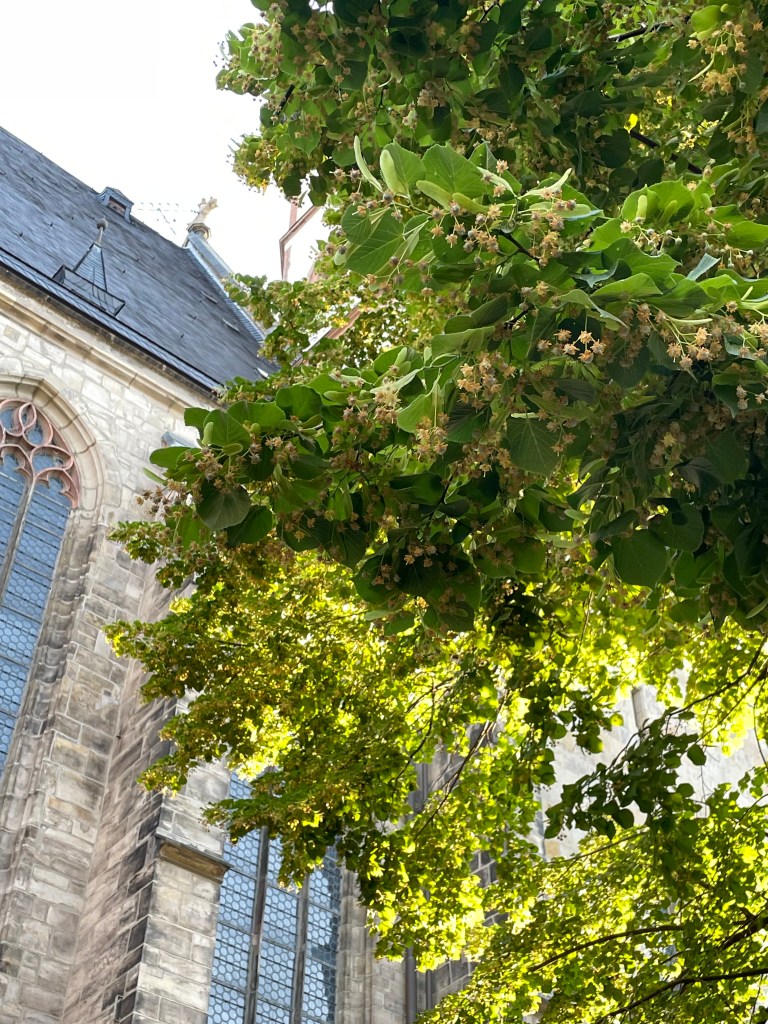
Because of the back-to-back activities on Friday I hadn’t made it to a supermarket before 10 pm, so I went on a grocery run at 7 am on Saturday. I took a little detour past the Thomaskirche, just to be sure where to locate the “main portal” where the bus to Köthen would leave from at 9:30. Something I forgot to mention in my earlier post: this time of year there are blooming linden trees everywhere in Leipzig! So many more than in Amsterdam. The blossoms provide a delightful and calming fragrance.

I’m so glad I listened to the Reisen reisen podcast before traveling to Leipzig, otherwise I wouldn’t have known to walk into the many courtyards one finds in this city. I found the one pictured here on Saturday morning, and another gorgeous one on Sunday. There are several others I missed, so I will have to come back! Walking in these courtyards I could imagine a bit better how the city must have looked in Bach’s time.
On the way back to my apartment I even found a friendly fruit and vegetable seller setting up early for the weekly open market, so I was all set for making breakfast and a sandwich to take on the bus to Köthen.
On the bus to Köthen
Around 9 am I found a seat on the festival bus to Köthen, together with 49 other Bach fans from all over the world. Köthen is where Bach lived and worked from 1717 to 1723, between his time in Weimar and his time in Leipzig. It was here that he wrote his Brandenburg concertos, cello suites, his sonatas and partitas for solo violin, and several other instrumental works. He had an appreciative employer and got to work with probably the best orchestra he ever had in his life. He retained his title of “Court Capellmeister” even after leaving his post. His wife Anna Magdalena had been a singer at this court for two years before they moved to Leipzig, and together they made the journey from Leipzig to Köthen at least three times to perform for the Prince together.
I visited Arnstadt, Mühlhausen, and Weimar in 2022, but had never been to Köthen, so it was a no-brainer for me to join this “Bach out and about” trip.* The landscape between Leipzig and Köthen, at least as seen from the freeway, is much less interesting than that of Thuringia, the region where Bach spent the first part of his life, and where I traveled in 2022. This was actually a good thing, so there were no spectacular views to distract me from our guide Gerlinde Kämmerer’s stories about Bach’s life in Köthen and his travels between Leipzig and Köthen.

Something new I learned during this bus trip: roads used by carriages in this area in the early 18th century were stone roads (“Steinwege” in German), which we should not understand as cobblestone or gravel, but a bit more like this one pictured here, rough stones hammered into sand or clay, but not as clean-looking – Gerlinde explained there would have been all kinds of dirt sticking to the surface. All this made for very uncomfortable travel and the carriage would have had to make several stops along the way. Looking it up on the fantastic new interactive map by Viabundus, a carriage-trip from Leipzig to Köthen would have taken more than one whole day in Bach’s time.
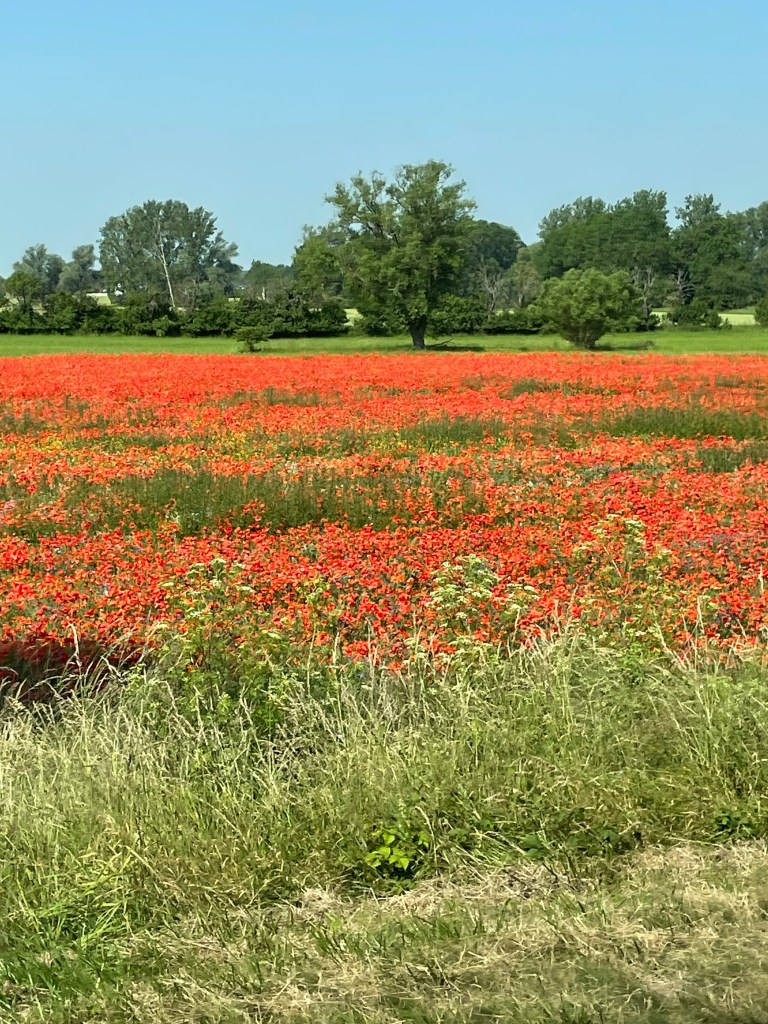
When we got close to Köthen and turned off the highway we saw fields of poppies and several hop farms. Hops have been grown in this Elbe-Saale region for centuries. The first written records date to the 9th century. Today this hop growing region is the second-largest in Germany, with around 1550 hectares (about 3830 acres).

More about this trip, and what we actually saw and heard in Köthen, in the next post.
Wieneke Gorter, June 20, 2024. Links updated November 29, 2024.
*Each year the festival organizes a handful of these trips to other towns in the region. It is a combination of city and/or museum tour in the morning and organ or chamber music concert in the afternoon. The concert is usually in collaboration with a local organization, so there will be more people attending the concert than just you and your fellow travelers. But for the rest of the day you are with your travel group only. Once at the destination, the groups gets split into English-speakers and German-speakers. The trips are well organized, you travel in a comfortable coach, and there are knowledgeable guides and excellent translators on board (more about this in the next post). There is a lunch break long enough to eat at a local restaurant or go for a walk. On the way there, you get a lecture about what you are going to see, and on the way back you can take a nap, chat with new friends you made on the trip, or organize all the photos you took. This year these trips cost €88 each and I found it well worth it.






 Weekly Cantata