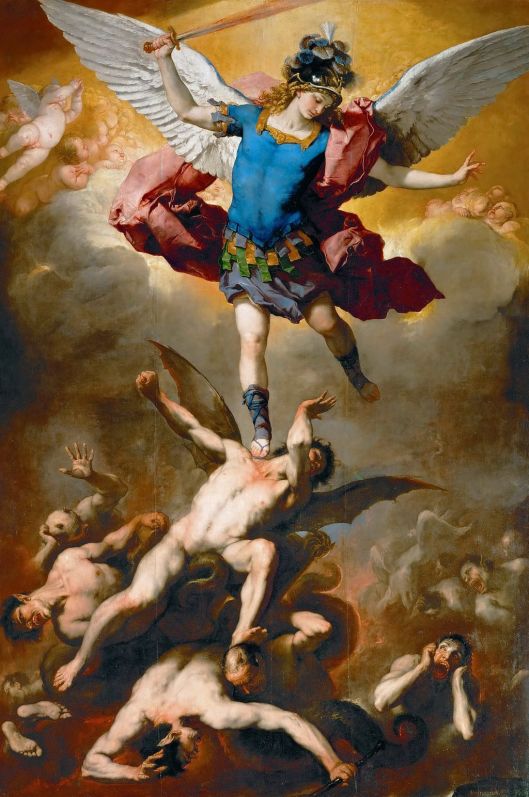
Archangel MIchael Hurls the Rebellious Angels into the Abyss, by Luca Giordano, ca. 1666. Kunsthistorisches Museum, Vienna
There is no cantata left to us for this week in 1723, the 18th Sunday after Trinity. It seems to be a pattern for the Trinity season of 1723 that in the week of a big holiday (St. Michael’s in this case), the cantata for the Sunday of that same week is missing. This happened as well around the holidays of St. John on June 24 and the Visitation of Mary on July 2. It is unclear what music Bach performed on the feast day of St. Michael, September 29, 1723. It might have been a cantata by Telemann, but the researchers are not sure.
Sleeping girl in a landscape, after Bernhard Keil, 17th century. Gemäldegalerie Alte Meister, Kassel, Germany.
In the first version of this post, I argued that cantata 148 Bringet dem Herrn Ehre seines Namens for the 17th Sunday after Trinity was written in 1723, dismissing the statements of several scholars it was probably written in 1725. I agreed with them that this cantata is a bit “out of place” between the somber but extremely beautiful and compelling cantatas of Trinity 16 and Trinity 19, and that the text looks very similar to a poem by Picander, the librettist with whom Bach did not collaborate before 1725. However, I was not convinced by their third argument that Bach’s writing in the opening chorus would be too “new” for 1723, and at first I didn’t see how Bach could have practically written the cantata in 1725.
I suggested that Bach was too busy in 1725, coming back from a trip to Dresden right before this cantata had to be performed on September 23 of that year. But when I discussed this idea with Eduard van Hengel, he reminded me that Bach would have had plenty of time to compose a cantata well ahead of his trip to Dresden, since–as far as we know–he had not written a new cantata since August 26. So that was argument number 4 for placing this cantata in 1725 instead of 1723.
Argument number 5 presented itself to me while I did my research for cantata 83, reading Pieter Dirksen’s article on Bach’s writing for violin in his first Leipzig cycle of cantatas. Dirksen points out that Bach’s new compositions from 1723 don’t feature virtuoso parts for violin at all. He suggests the reason for this is that Bach’s orchestra in Leipzig (including Bach himself*) was missing a violinist who could play technically challenging music.
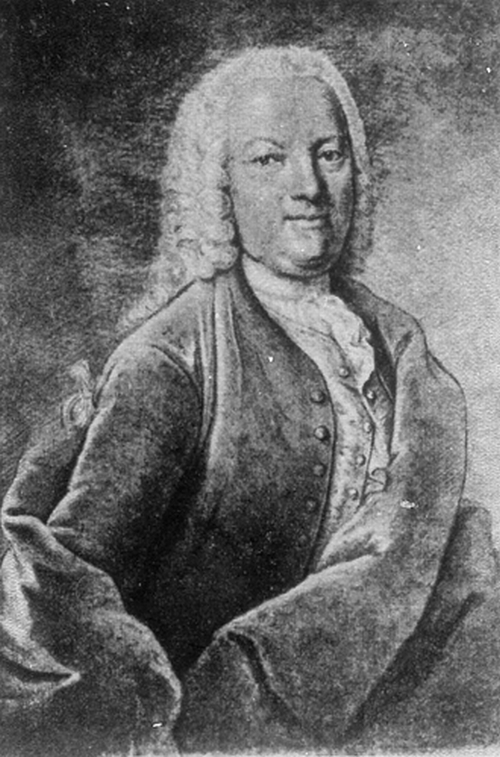
Johann Georg Pisendel
After reading Dirksen’s article on Bach’s connection with the Dresden violinist Johann Georg Pisendel,** and knowing that soon after Trinity 17 it would be Michaelmas, I got excited: the cantata 148 story was coming full circle! I was now no longer seeing Bach juggling ink and parchment on the coach back from Dresden to Leipzig on Saturday September 22, 1725, but instead I was imagining a friend in that coach with him: Johann Georg Pisendel.
If it is true that Pisendel visited Leipzig for the Purification of Mary holiday in 1724, as Dirksen suggests, it is not far-fetched to assume he would do so again for the feast of Michaelmas in 1725 (on September 29, so only six days after Trinity 17 in 1725). St. Michael’s Fair was a huge event in Leipzig, drawing visitors from as far as England and Poland, increasing the city’s population to 30,000, and thus also increasing the “audiences” for Bach’s music in the churches.
For this cantata, I prefer the recording by Bach Collegium Japan, with soloists Robin Blaze (countertenor), Gerd Türk (tenor), Toshio Shimada (trumpet), and Natsumi Wakamatsu (violin). Listen to this recording on Spotify or support the artists and purchase the album on Amazon.com, Amazon.de, or Amazon.fr.
Find the German texts with English translations here, and the score here.
The text of cantata 148 Bringet dem Herrn Ehre seines Namens talks about the importance of coming to church on Sunday, and listening to the music in the church (tenor recitative and aria), but it also talks about taking a day of rest (alto aria).
While the opening chorus is exceptional, it doesn’t sound very polished or “finished.” Gardiner, while otherwise excited about it, is not satisfied with the ending, and suggests that “perhaps Anna Magdalena called from the kitchen that dinner was on the table and the soup was getting cold.” What can I say? Only a male writer would say this!
The virtuoso violin part shows up in the tenor aria. On this recording of Bach Collegium Japan, played by Natsumi Wakamatsu, it moves me to tears. The tenor aria on the Gardiner recording is good too, with tenor Mark Padmore, and violinist Maya Homburger. You can find that one here. Whoever played this violin part in 1725, this person was not resting on Sunday …
*In his article Dirksen explains in detail how Bach went through the trouble of making the violin solo of cantata 76 relatively easy to play for an intermediate violinist, and suggests Bach was a good violinist, but perhaps not such a virtuoso as many believe him to be. Dirksen’s article appears on pages 135-156 of Bachs 1. Leipziger Kantantenjahrgang: Bericht über das 3. Dortmunder Bach-Symposion 2000 — Dortmund: Klangfarben Musikverlag, 2002.
**Pisendel had been friends with Bach since 1709 and several scholars think that it was for this Italian-trained virtuoso that Bach wrote his most complicated violin music. It is assumed that Bach had Pisendel in mind when writing the violin part of the “Laudamus te” of his Mass in B Minor.
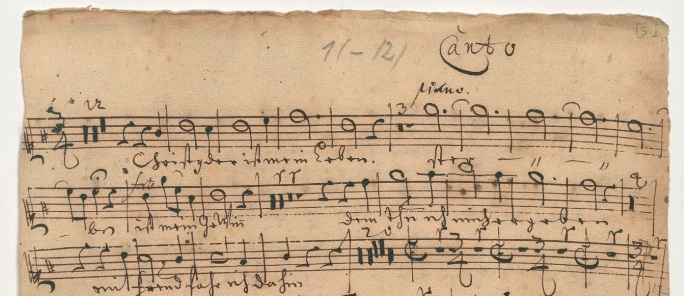
The soprano part of cantata 95 Christus, der ist mein Leben. Staatsbibliothek zu Berlin – Preußischer Kulturbesitz
After all his experimenting with the form of the cantata last week, Bach keeps exploring how he can build a cantata based on chorale melodies and chorale texts. As a result, this week’s cantata 95 Christus, der ist mein Leben again takes a unique place in Bach’s cantata collection: it features no less than four different chorales, all part of the Sterbe-lieder (Deathbed songs) that were very popular in Leipzig at the time: Christus, der ist mein Leben; Mit Fried und Freud, ich fahr dahin; Valet will ich dir geben; and Weil du vom Tod erstanden bist.
I recommend Herreweghe’s recording of this cantata. Listen to this recording on YouTube, or on Spotify. Support the artists and purchase this recording on Amazon. (Or find them in the Amazon stores for Germany and France)
Soloists: soprano Dorothee Mields, counter-tenor Matthew White, tenor Hans Jörg Mammel, bass Thomas E. Bauer. Choir sopranos: Dorothee Mields, Hana Blazikova, Dominique Verkinderen.
In the manuscript of the soprano part pictured above, it is interesting to note the dynamic markings for the text “Sterben ist mein Gewinn.” Dynamics are not very common in Bach manuscripts, but, as Alfred Dürr points out, Leipzig had a strong tradition of singing softly and slowly on the word “Sterben,” and singing loudly on “ist mein Gewinn,” going back at least to 1629. In that year, then Thomaskantor Johann Hermann Schein wrote this note for his singers:
“da singen sie adagio mit einem sehr langsamen Tactu, weiln in solchen versiculis verba emphatica enthalten” (here you should sing adagio in a very slow tempo, because verses like these contain emphatic words)
How Herreweghe’s sopranos sing this Sterben ist mein Gewinn in the first chorale takes my breath away, and this is the most important reason why I prefer this recording. Having grown accustomed to the boy choirs of the Leonhardt and Harnoncourt recordings in the 1970s, my parents, sister, and I were blown away by Herreweghe’s Collegium Vocale Gent when their first CDs started coming out in the late 1980s and early 1990s.
My mother was especially taken by the sound and blend of the sopranos, and “Herreweghe sopranos” became a household term in our family. After attending a performance by a different group, we would often say to each other: “it was nice, but they are not Herreweghe sopranos….,” and sigh a little.
This cantata is all about longing for life after death, and over the course of the cantata these statements are made: I will be happy to die (opening movement), because life on earth is worthless (soprano recitative). Saying goodbye to that will be freeing (soprano chorale), so please can I die as soon as possible (tenor recitative and aria), because death is only a sleep (bass recitative) from which I will wake up to join Jesus, who has gone before me (closing chorale).
The outstanding tenor aria features Bach’s signature “death bells” in the pizzicato strings. Bach uses these “Leichenglocken” also in cantatas 73, 8, 105, 127, 161, and 198. For an alternative recording of this movement, with gorgeous singing by Mark Padmore, listen to the Gardiner recording on Spotify.
The concept of death being only a short period of sleep after which the dying person wakes up to meet Jesus in the afterlife was an extremely important part of 18th-century Lutheran faith. When dealing with death on a daily basis, it was comforting to believe that death would ultimately lead to paradise. And by stressing this concept, Bach also refers to the Gospel for this 16th Sunday after Trinity. It is the story of the miracle at Nain: a young man who has died is carried out of the city and then woken up by Jesus.
Wieneke Gorter, September 11, 2016, updated October 7, 2025
The Sermon on the Mount, oil on copper painting by Jan Brueghel the Elder, 1598
In 1723 Bach wrote cantata 138 Warum betrübst du dich, mein Herz. Again I prefer Herreweghe’s interpretation, but it’s not so easy to choose between his recording from 1998 (with soloists Deborah York, Ingeborg Danz, Mark Padmore, and Peter Kooij) and the one from 2013 (with soloists Hana Blazikova, Damien Guillon, Thomas Hobbs, and Peter Kooij). Update from 2021: there now is an extremely inspired Herreweghe recording with all my favorite soloists (Dorothee Mields, Alex Potter, Guy Cutting, Peter Kooij), recorded live at De Singel in Antwerp on Sunday January 31, 2021 (during the Covid19 pandemic, so without audience). Find it here.
Listen to the entire 1998 recording on Youtube or listen to one long track of the 2013 recording with Hana Blazikova and Damien Guillon on YouTube. Please consider supporting the artists by purchasing the 1998 version (used copies available only) or the 2013 version on Amazon.
Find the text, based on the Sermon on the Mount, of this cantata here, and the score here.
It is often not immediately clear what a Bach cantata is about, what the text means, or what Bach wanted to convey with it. In an absolutely wonderful interview (with excellent English subtitles) for the Leipzig Bach Festival, soprano Dorothee Mields says that even she, as a native German speaker, often feels the need to look at English translations, go back to the Bible texts, and read more about the subject, because she didn’t necessarily recognize the text from her children’s bible.
The image of the children’s bible stuck with me since first watching the interview seven months ago. And when listening to the cantata for this Sunday, I had to think of it again, because the choice of words in this cantata is very moving, but at the same time so simple, that it is almost as if the librettist is speaking to children. Listen, for example, to the text the soprano sings in the third movement:
Nur ich, ich weiss nicht, auf was Weise ich armes Kind mein bisschen Brot soll haben; Wo ist jemand, der sich zu meiner Rettung findt?
(It is just that I, poor child, don’t know how I should receive a bit of bread; Where is the person who will save me?)
Eduard van Hengel hilariously remarks that it reminds him a bit of Calimero (a popular children’s cartoon about a little chick, which aired in The Netherlands, Belgium, France, and Italy in the early 1970s. Watch this first episode to get an idea).
I wonder who the librettist for this cantata was. I imagine a different person than who wrote texts for the last few cantatas. Last week, the Bachs possibly had their house full with the families of Anna Magdalena’s brother and sisters, visiting because the men, all trumpet players, were needed for two cantatas. Perhaps one of the visitors had talent for entertaining the children with stories and making up poems on the spot? Did Bach ask this person to write the libretto for this cantata? Or was his own head still filled with children’s stories and did he write the text himself?
These are all just assumptions and we don’t know for sure if last week’s extra players were the relatives of Bach’s wife, but my potential movie script is getting better and better …
There’s of course more to this cantata than the charming texts. Musically, as far as the form and structure is concerned, this cantata is unique within this first cycle of Leipzig cantatas. Bach takes a chorale as the base for the cantata, yet it is not at all the same as his series of chorale cantatas from the 1724/1725 cycle. In those later chorale cantatas, he always uses all the verses and keeps a strict structure of one soloist per movement. In this cantata 138, he only uses three verses of the chorale, and gives the cantata a very free form, with a different number of soloists for each movement. He is obviously experimenting. And I wonder again: might he have been influenced by his visitors from last week? Did he have discussions about his compositions with his colleagues? And how is this playing around with the form of the cantata related to using a different librettist or no librettist? Did he not want to bother a professional writer with his experimenting?
There is one more–for me at least–exciting aspect to this cantata: when I first started listening to it, I discovered that I already knew the bass aria. Same singer (Peter Kooij) and same music, but a different text, because I had until then only heard this as the Gratias from Bach’s Mass in G Major, BWV 236 from the mid 1730s. Listen to both, and marvel at Bach’s talent for subtle recycling.
Wieneke Gorter, September 3, 2016, updated September 19, 2020 and February 13, 2021.
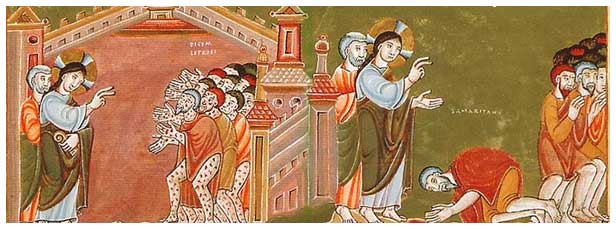
Jesus heals ten lepers, from the Codex Aureus of Echternach, c. 1035-1040
Only a handful of Bach cantatas ask for the Renaissance/Early Baroque ensemble of one cornetto and three trombones in the opening and closing chorus. This instrumentation was considered somewhat “old fashioned” in Bach’s time, while at the same time it was still very normal in cities to hear Stadtpfeifers (city pipers) play chorales from the towers during the day, to remind the citizens of their Christian duties. In this Cantata 25 Es ist nichts Gesundes an meinem Leibe, for the 14th Sunday after Trinity (August 29 in 1723), the playing of the chorale tune by this ensemble in the opening chorus stands for the way it has always been, the way it has been true for centuries.
Concerto Palatino, the leading cornetto/trombone ensemble for the past 25 years. Photo by Sabrina Flauger. Learn more about them here.
My preferred recording of Cantata 25 is the one by Herreweghe, on the same album as cantata 105 for Trinity 9 and cantata 46 for Trinity 10, as well as cantata 138 for next week. Soloists in cantata 25: soprano Hana Blažíková, tenor Thomas Hobbs, and bass Peter Kooij. Cornetto: Bruce Dickey (pictured above, front row, on left); trombones: Claire McIntyre, Simen van Mechelen (pictured above, top row, on left), and Joost Swinkels.
Listen to this recording on Spotify or on YouTube. Please consider supporting the artists by purchasing this album (containing four cantatas for this 1723 Trinity season) on Amazon.
Read the text of this cantata here, and find the score here.
I could write an entire blog post about the opening chorus alone, the way I did last week for cantata 77 and two weeks earlier for cantata 179. But in the interest of variety, I’m going to keep this section short, and I will just say that the opening chorus is an incredible, unrivaled complex composition for ten voices, again completely different than any opening chorus the Leipzig congregations had heard before during this Trinity season of 1723. By having the “ancient” brass quartet play the chorale melody of Herzlich tut mich verlangen nach einem selgen End (With my whole heart I long for my blessed End / my Salvation)** Bach shows that the promise of salvation after death will always provide a silver lining to the sorrow of the daily, sinful human condition. He also illustrates this “salvation” with the recorders in the uplifting and soothing soprano aria (Hana Blažíková in top shape!), and the brass and recorders in the closing chorale, and intensifies the “sickness” of the human sins by setting these texts to “dry” recitatives (though listen to that bass arioso, beautifully sung by Peter Kooij) in between. Again, it was completely normal in his day and age to think this way, and Bach saw it as his mission in life to teach this theology to his fellow Lutherans by way of his church music.
But, listen to the festive, large orchestra for this cantata! No less than four brass players (one cornetto and three trombones) and five wind players (two oboists and three recorder players) were required at the same time in the opening chorus and closing chorale. For a cantata about the healing of ten lepers? Well, it turns out that this weekend it was Christmas in August for Bach, and the extra players were probably in town for the much more important and incredibly festive Cantata 119 Preise, Jerusalem, den Herrn that was on the calendar for the next day, Monday August 30, the day of the inauguration of the new City Council (Ratswechsel). *** As I already suggested in my post about cantata 147, Bach might have sometimes used guest musicians in his orchestra who were in town for other reasons, and judging from the level of playing required for the Brandenburg concerto-like Cantata 119, the extra brass (all playing trumpet in 119) and wind (playing oboe and recorder in 119) players might have been needed to be of the level of court chamber musician, not just Stadtpfeifer (usually a lower rank, and not necessarily used to playing the complicated court music). So in my probably not so unlikely movie script fantasy, Bach hired musicians from the not too far away courts where he had worked before or where his in-laws worked (Köthen, Weissenfels, Zerbst) to play in the orchestra on Monday August 30, and he had asked them to also play in the service on Sunday August 29.
Listen to the Ratswechsel cantata 119 Preise, Jerusalem, den Herrn by Herreweghe on YouTube. (Soloists: soprano Deborah York; alto Ingeborg Danz; tenor Mark Padmore, bass Peter Kooij.)
Wieneke Gorter, August 24, 2016, updated September 8, 2023.
** Several writers have suggested the chorale best known to the congregation at the time (on the melody we have later come to know as O Haupt voll Blut und Wunden) would have been instead Ach Herr, mich armen Sünder, but I agree with Eduard van Hengel that because of Bach’s use of the angel-like recorders and the heavenly brass it makes more sense to go with Herzlich tut mich verlangen nach einem selgen End.
*** The new city council was always chosen on August 24, and then inaugurated on the first Monday following August 24, which was Monday August 30 in 1723.
About Weekly Cantata
I am a bilingual writer, publicist, choral singer, art and nature lover, happy wife, and blessed mother of two. I started this blog in 2016, inspired by my late mother’s love for Bach’s cantatas. After 23 years in the San Francisco Bay Area, I’m now back in the Netherlands.
Please join my readers from all over the world and subscribe to this blog! Simply fill in your email address and you’ll receive an email every time I’ve published a new post. Thank you so much / Vielen Dank / Merci mille fois / 감사합니다 / 谢谢 / ありがとう / Mille grazie / Muchas gracias / Muito obrigado / Takk / Terima kasih / Dankuwel!
The Good Samaritan by “the Master of the Good Samaritan,” Dutch, 1537
To fully appreciate today’s cantata, I encourage you to first listen to Luther’s hymn, Dies sind die heil’gen Zehn Gebot (These are the holy Ten Commandments). I was not familiar with this tune, and had to do some research to understand what the slide trumpet was playing in the opening chorus. It was a very well-known hymn in Bach’s time. The Leipzig congregations sang it many times a year, and also sang it during the church services on Sunday August 22, 1723, the 13th Sunday after Trinity (probably preceded by an organ prelude in the style of BWV 635, see below). It was an important hymn for Bach. You can listen to his own chorale setting of it here.
It is also worthwhile to listen how Bach used this melody in three very different organ works: BWV 635, BWV 678, and BWV 679. He wrote BWV 635 as part of the Orgelbüchlein, in Weimar, the other two in the mid 1730s as part of the Clavier-Übung III.
The cantata for this Sunday, cantata 77 Du sollt Gott, deinen Herren, lieben features this chorale-tune in the opening chorus, but only in the tromba da tirarsi (slide trumpet) part and the continuo part. In the continuo it appears in long notes, and is not as clearly audible as in the trumpet part. There are exactly ten entrances for the trumpet within that opening chorus, the last time featuring the entire chorale tune, of course pointing to the tencommandments.
Bach Collegium Japan’s recording showcases this feature the best of all recordings I listened to, superbly played by Toshio Shimada, on a real tromba da tirarsi. I also like his playing the best in the alto aria. Listen to this recording on Spotify or on YouTube.
John Eliot Gardiner suggests that Bach made a theological statement by presenting his first two Trinity cantatas in Leipzig, 75 for Trinity 1 (focusing on the love of God/how to be before God) and 76 for Trinity 2 (focusing on brotherly love/how to love one’s neighbor) in close relation to each other, and that all through this 1723 Trinity season he has tried to reinforce the idea that those themes are connected, and how the believers should apply the laws from the Bible to themselves and to their own daily lives. He further argues that with this opening chorus he comes full circle back to that connection, by using a double fugue, by reminding the listeners of the “law” by way of the chorale in the trumpet part, and by setting the text of the Gospel immediately preceding the parable of the Good Samaritan (Luke 10):
27. Er antwortete und sprach: Du sollst GOtt, deinen HErrn, lieben von ganzem Herzen, von ganzer Seele, von allen Kräften und von ganzem Gemüt und deinen Nächsten als dich selbst.
[27] And he answering said, Thou shalt love the Lord thy God with all thy heart, and with all thy soul, and with all thy strength, and with all thy mind; and thy neighbour as thyself.
After the bass recitative and soprano aria further elaborating on the “Love for God”-theme, and the tenor aria on the “Good Samaritan / Love your neighbor”-theme, we are treated to the most amazing tromba da tirarsi playing of all Bach cantatas written for this instrument, in this very unusual and humble alto aria, beautifully sung by mezzo-soprano Kirsten Sollek, and expertly played on the slide trumpet by Toshio Shimada.
This is an incredibly difficult part for the tromba da tirarsi, and almost impossible to play well on a “regular” Baroque trumpet. Was this Bach’s way of illustrating the “Unvolkommenheit” in the text? Would even Reiche not have been able to play this perfectly, with only a few days rehearsal time? And/or did Bach want people in the church to pay attention, so that this would be a true moment of reflection in the service?
In the region where Bach lived and worked, the trumpeters were very good, and Bach knew them and their world well, especially since he had married into a trumpet family in 1721. All the men in Anna Magdalena Wilcke’s family that we know of (father, brother, and husbands of all three sisters) were well-regarded trumpeters at the Anhalt-Zerbst court, about 17 miles (28 km) directly north of Köthen, and the Saxe-Weissenfels court, about 22 miles (35 km) south-west of Leipzig. The trumpeters in Leipzig were all Stadtpfeifer, employed by the city, and thus not always available to him.
Wieneke Gorter, August 20, 2016, updated August 28, 2023.
Jesus healing a deaf and mute man at Decapolis, by Bartholomeus Breenbergh, 1635
Last week, Bach gave his principal trumpet and horn player Gottfried Reiche a little break, but this week he needs him back: after the “old style” church motet opening chorus for Trinity 11, this week’s cantata for Trinity 12 opens with festive trumpets and timpani.
Listen to this cantata 69a Lobe den Herrn, meine Seele in the recording by Bach Collegium Japan on Spotify, with Toshio Shimada on trumpet.
Even though the text of the Gospel for this Sunday, the story of Jesus healing a deaf and mute man, is a jubilant one, it is still unusual that for a “regular” Sunday Bach would use three trumpets and timpani in the orchestra. Had the council complained about him teaching too much of his stern theology, being too somber, in the past cantatas? Was perhaps Anna Magdalena’s father (the principal trumpeter at the court of Saxe-Weissenfels, and most probably a friend of Reiche, who was from that same region) in Leipzig to see his daughter and grandkids, and wanted to play in the orchestra with his friend? Again, all good material for a movie script …
In his journal of their cantata pilgrimage in 2000, John Eliot Gardiner writes that the trumpet part in the opening chorus makes him think of the last seven bars of the Cum Sancto Spiritu from the Mass in B minor. I agree, but the start of this opening chorus also really makes me think back to cantata 147 for the feast of the Visitation of Mary on July 2.
Just like last week’s cantata, and many other cantatas from this period, today’s composition ended up in Bach’s top 15, in the sense that he re-used it many times afterwards, and reworked it into important other works. In this case he changed the tenor aria with oboe da caccia and recorder into an alto aria for oboe and violin for a performance in 1727, and reworked the entire cantata into a celebratory cantata for the re-election of the council in 1749 (BWV 69).
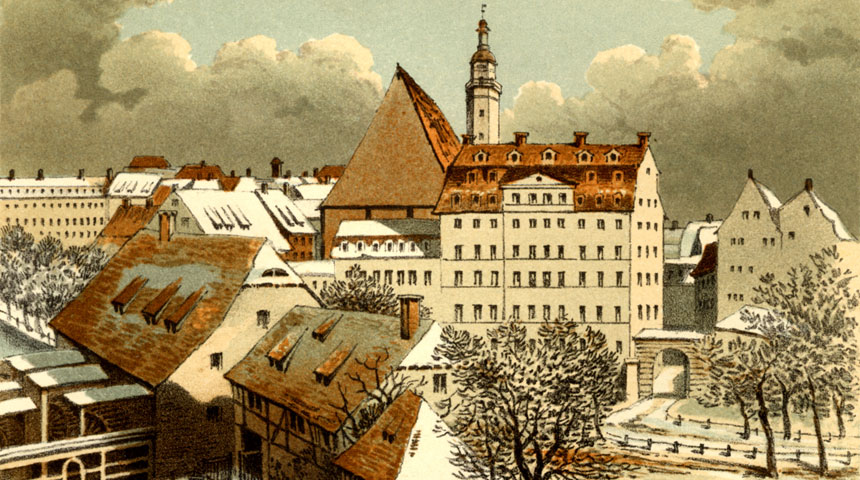
Mendelssohn’s sketch of the Thomasschule (St. Thomas School) and, behind it, the Thomaskirche (St. Thomas Church) in Leipzig.
Thank you for following this blog, and thank you for reading this long post all the way to the end!
For Trinity 11 (August 8 in 1723), we’re listening to Cantata179 Siehe zu, daß deine Gottesfurcht nicht Heuchelei sei, with a superb opening chorus and one of the most beautiful soprano arias Bach ever wrote.
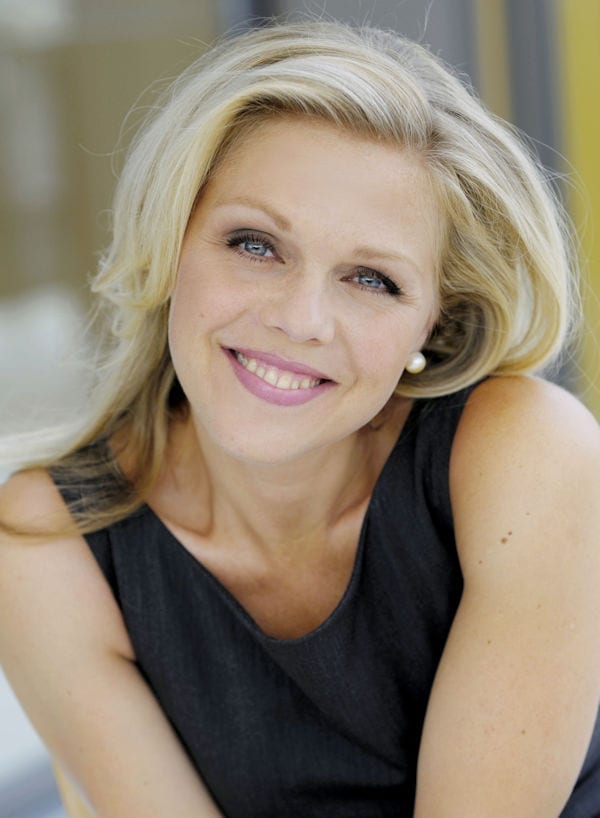
Miah Persson. Photo by Monika Rittershaus.
I prefer Bach Collegium Japan’s recording of this cantata. It’s a special recording, with Miah Persson singing the soprano aria. She’s having quite a career now, so I think we’re lucky to have her beautiful voice and sensitive interpretation on this recording from 1999. You can find it on Youtube or Spotify. Please consider purchasing this recording on jpc.de, Amazon, or iTunes. Soloists on this recording are Miah Persson, soprano; Makoto Sakurada, tenor; and Peter Kooij, bass.
Please find the score here (it’s fun to read along with the recording, especially in the opening chorus, to see what Bach does with the fugue) and the German text with English translation here.
It is now more than two months since Bach started his new job in Leipzig, and he is about three weeks into writing a brand new composition every week, and I’m sorry if I sound too casual here, but he’s on a roll. He must now have a vision of what it is he really wants to do for these churches (see the tiny preludes to his Passions he incorporates in cantatas 105 and 46), and he must have the classes at the St. Thomas School organized, and his singers sufficiently trained, so that he can now have them sing a new and challenging opening chorus every week. Just listening to the opening choruses alone, starting with the one of cantata 136 for Trinity 8, I marvel at what he comes up with every time. Every single one of them is stunning, but at the same time completely different from the one of the previous Sunday. This time Bach chooses to write a perfect “old style” (Palestrina-style) motet fugue as opening chorus.
As always, to fully understand the cantata and not miss any of Bach’s hidden messages, it is important to look at the Gospel reading for the day. In this case it is the parable of the Pharisee and the Publican (or Pharisee and the Tax Collector), a story Jesus tells as an illustration on how to pray: the Pharisee is full of himself, telling God how good he is, while the Publican in his own prayer merely asks for mercy, and tells God how bad he is. This concept of “how to be a good Christian before God” was very important to Bach and apparently his librettist got the message loud and clear. He or she uses the opportunity to first write a strong protest against fake religion and hypocrisy in “Christianity today” in movements 1 to 3 (probably having certain people in Leipzig in mind), after which he/she states that all Christians should take the humbleness of the publican as example in movements 4 to 6. For another example of how Bach interprets this Bible story, read my post about Cantata 113, written for this same 11th Sunday after Trinity, in 1724.
The most special feature of the fugue in the opening chorus is that since the text talks about beautiful outer appearance versus a bad character, Bach uses a mirror-fugue, which he used as well in fugues 5-7 from the Art of the Fugue (the theme of six bars is first introduced by the basses, and then is answered by the tenors in an “inversion:” every step up from the basses becomes a step down in the tenor part.)
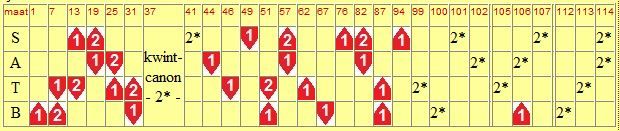
To understand how Bach built this intricate fugue I am sharing the excellent music example and diagram by Dutch Bach writer Eduard van Hengel, with his permission:
Even though the text here is in Dutch, the diagram speaks for itself, with this quick explanation of the numbers and symbols:
1 = The theme (or first half-sentence of the text: Siehe zu, dass deine Gottesfurcht nicht Heuchelei sei). Note the ascending line on the word “Gottesfurcht” (fear of God/love of God) and the descending line on the word “Heuchelei” (hypocrisy).
2 = The counter-subject (or second half-sentence of this text: und diene Gott nicht mit falschem Herzen). Note here that there is a chromatic line every time the word “falschem” appears in the text: for the chromatic line the composers needs accidentals that are not part of the key the piece is written in, which in the “old polyphony” would be seen as “falsch” (not right, off-key).
2* = a more compact (only 4 bars instead of 6 bars long) theme which is derived from the first counterpoint/counter-subject on the words und diene Gott nicht mit falschem Herzen, still with the chromatic line on falschem Herzen.
The numbers at the top are measure (“maat”) numbers.
Bach himself must have greatly valued this cantata. About 15 years later, he used no less than three movements from this cantata for use in his short masses, or Lutheran masses.**
The opening chorus was later “recycled” as the first movement (Kyrie) in the Mass in G Major, BWV 236. Keep listening, or scroll to 18:00 and you’ll discover that the tenor aria Quoniam (sung here by Thomas Hobbs) was, with some changes and a much slower tempo, recycled from the tenor aria in this cantata 179. In cantata 179 the tenor aria gets a colorful accompaniment of two oboes and first violins in unison. The second violins and violas fill in the meaningless middle part (representing the “nothingness, emptiness”). When recycling this later for the Quoniam in the Mass in G Major, Bach uses only one solo oboe for the accompaniment, and completely leaves out all strings (confirming that with a different text, the meaningless middle part is not relevant anymore).
This cantata’s wonderful soprano aria (with two oboi da caccia and basso continuo) was later reworked into the Qui Tollis for the Mass in A Major, BWV 234 (with two flutes and only high strings as continuo). This was actually how I first knew and loved this soprano aria, I didn’t know cantata 179 until I started listening to it for this blog. Please click on this link and listen to the amazing Agnès Mellon sing the Qui Tollis from the Mass in A Major.
Wieneke Gorter, August 14, 2016, links updated August 15, 2023.
** These are called “short” or “Lutheran” masses because they consisted of only the Kyrie and Gloria part of the traditional Catholic mass. Bach wrote four of them (BWV 233-236), and they are all made up of existing movements from cantatas, but reworked and compiled in a very smart way and they are all absolutely beautiful. You can purchase an album with Herreweghe’s recording of all of them on jpc.de, iTunes, or Amazon.
For this Sunday, Trinity 10, August 1, 1723 Bach wrote cantata 46 Schauet doch und sehet, ob irgend ein Schmerz sei.
This is another exquisite cantata, worth listening to (or worth watching for a bit, see link below for a wonderful video of the opening chorus by Herreweghe live at the Saintes Festival).
I recommend Herreweghe’s recording from 2012, on the same album already discussed in my previous post for cantata 105.
Purchase this recording on Amazon (the album also includes last week’s cantata 105, and two more cantatas from the 1723 Trinity season).
Listen to this Herreweghe recording from 2012 on Spotify.
Or, listen to this same recording on YouTube, via playlist I created (if this shows up as a visual on your screen, and clicking on the main “play button” results in a “this video cannot be played” message, click on the icon on the top left where it says 1/6, and it should work):
I especially enjoy this cantata because of the beautiful opening chorus, the dramatic bass aria (with terrific tromba da tirarsi playing by Alain de Rudder), and the alto aria.
You’ll recognize the first part of the opening chorus. Bach must have liked this enough to re-use it later as the Qui Tollis in his Mass in B minor. The illustration of the “Schmerz” with two recorders and two oboi da caccia in the orchestra is beautiful.
Last week, with cantata 105, Bach started using features that preluded his passions. In the alto aria in this cantata 46, there is again a reference to the St. Matthew Passion. The pastoral character of the music, as well as the text reference to Küchlein (chicks) make me think of the Sehet Jesus hat die Hand alto aria. I am a huge fan of counter-tenor Damien Guillon. In 2011, I heard him sing for the first time in a live performance of the St. Matthew Passion by Herreweghe in Europe, and have been collecting his recordings since then. He appears on recordings with his own ensemble Le Banquet Celeste, cantata recordings by Herreweghe from 2011 and later, and on several recordings of Marcel Ponseele’s ensemble Il Gardellino. Watch an interview with him (with English subtitles) on YouTube:
Wieneke Gorter, July 30, 2016, links updated August 10, 2023.
In the previous episode of this special 1723 Leipzig Trinity series we saw how Trinity 8 marked the start of the shorter cantata, containing only around 6 movements instead of 10 to 14 movements. However, that weeks’ cantata was probably still based on earlier compositions. This means that cantata 105 Herr, gehe nicht ins Gericht could be considered the start of the true Leipzig cantata.
Two striking “Leipzig only” features make an appearance in this cantata: clear references to Bach’s future Passions (see below), and the “corno da tirarsi” (slide horn).
Only three cantatas (Trinity 10’s cantata 46, as well as 162 and 67) show the full name corno da tirarsi written in the manuscript, but there are 27 cantatas from Leipzig requiring a corno in which that part is not playable on a natural horn, so must have been written for this corno da tirarsi as well. Cantata 105 is included in that group. Bach is the only composer who ever mentioned this instrument in writing, and most probably his principal brass player Gottfried Reiche was the only one who ever played it. After Reiche’s death in 1734 Bach did not write for this instrument anymore, and for repeat performances of any cantatas containing a corno da tirarsi part, Bach rewrote it for other instruments. Read more about this inOlivier Picon’s article on the “corno da tirarsi” from 2010.
Herreweghe has recorded this cantata105 Herr, gehe nicht ins Gericht twice: first in 1992 (with soloists Barbara Schlick, Gerard Lesne, Howard Crook, and Peter Kooij), and again in 2012 (with soloists Hana Blazikova, Damien Guillon, Thomas Hobbs, and again Peter Kooij).
Though that first recording from 1992 is excellent, and the soprano aria on that recording has more character to my taste, I recommend the 2012 recording for the following reasons:
At the time of the 1992 recording, no corno da tirarsi was available, which means that the tenor aria on that recording has an oboe accompaniment. The recording from 2012 does feature a corno da tirarsi in this aria.
The “Herr, Herr” exclamations are more prominent in the opening chorus of the 2012 recording, and the tempo of the opening chorus is also a bit faster, which I like.
The 2012 album, which includes three other cantatas, focuses on 1723 Trinity cantatas only, which of course is extra special for this blog’s special 1723 Trinity series.
Listen to this 2012 recording by Herreweghe on Spotify.
Listen to this 2012 recording on YouTube, by way of a playlist I created (it is possible that this only works for readers in the USA):
Support the artists and purchase this recording on Amazon. (it’s always worth it, but this time you’ll get three more cantatas in that same album that will be discussed on this blog in the coming weeks!)
Read the German text with English translations here, and find the score here.
Listen for the “Herr, Herr” exclamations in the opening chorus. They will appear in the opening chorus of the St. John Passion in early 1724. The exquisite soprano aria has no bass instrument in the continuo. Bach will later use that feature more often in other Leipzig cantatas, to either show purity or uncertainty, and it is a strong feature of the Aus Liebe aria from the St. Matthew Passion. And last but not least: when I listen to the bass arioso from this cantata 105, I am strongly reminded of the bass arioso Am Abend da es kühle war from the St. Matthew Passion. The music is not 100% the same, but very similar, and there are also references in the text.
Other stunning features of this cantata 105: the strings accompanying the soprano aria illustrate the “shivering” and “quavering” in the text, and those same “uncertain” strings turn up again in the orchestra part of the closing chorale.
Wieneke Gorter, July 30, 2016, links updated August 2, 2023.






 Weekly Cantata