Our Christmas Morning

Tags

, , , , , , , , , , , , ,

nativity_c_1490
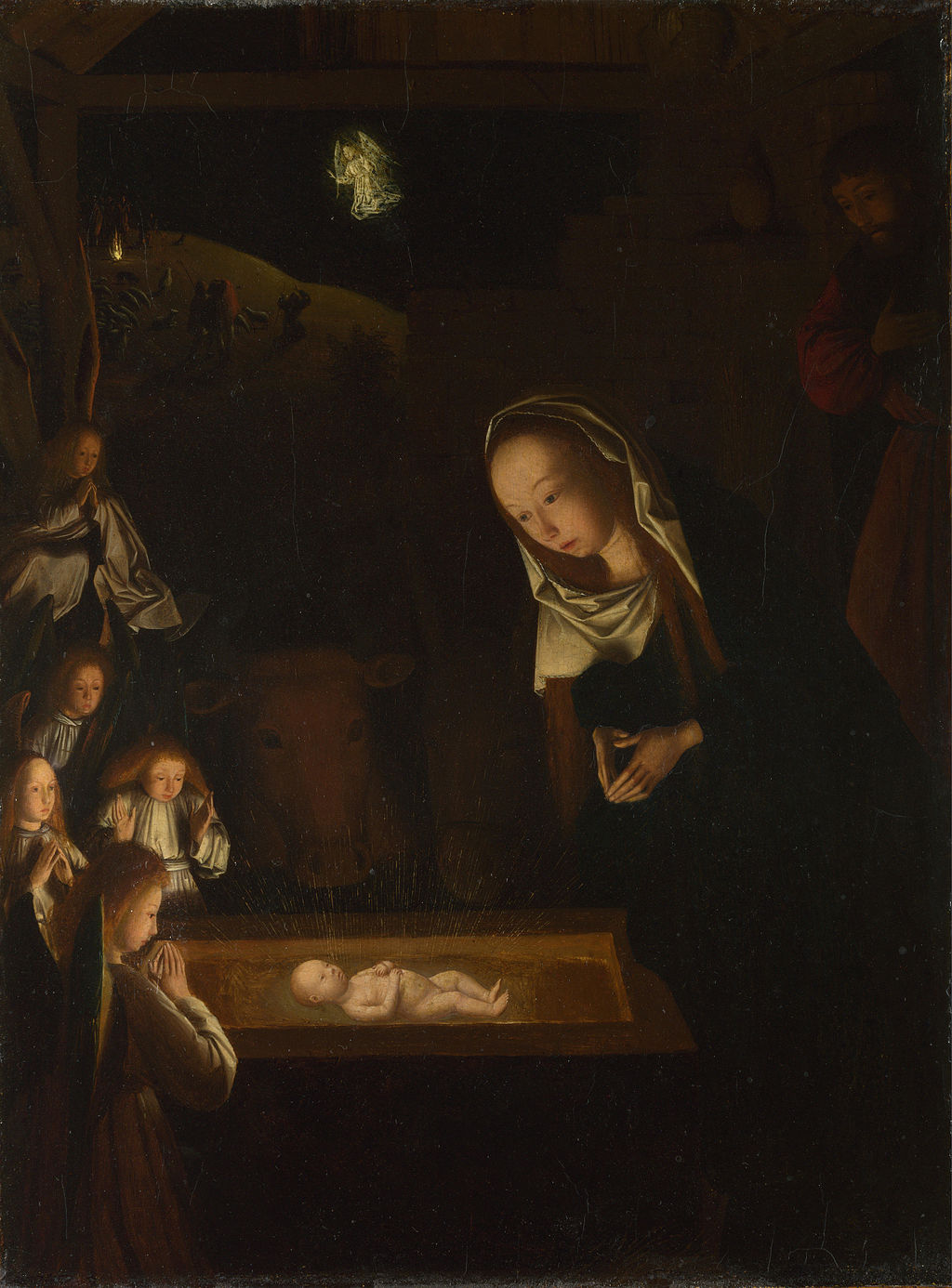
Nativity at Night by Dutch painter Geertgen tot Sint Jans, ca. 1490. National Gallery, London.

Growing up in the Netherlands, my sister and I did not expect gifts at Christmas, and certainly not under the tree. We had already received our gifts on the eve of St. Nicholas, December 5. At the dinner with relatives on Christmas Day, we would maybe receive one book, or a small piece of jewelry. It would be well coordinated between mother and grandmother that this would amount to only one present per person, and it would be next to our plate when we arrived at the well-dressed Christmas dinner table.

However, Christmas Morning was something we immensely looked forward to. The Christmas Morning breakfast was the most wonderful breakfast of the year, even better than the Easter breakfast. We would have crispy rolls from the oven, artisan sliced ham, boiled eggs, cheese, jams, and of course the sweet breakfast sprinkles American kids can’t believe Dutch kids get to eat for breakfast. And Kerststol, or Christmas Stollen, a fruit bread with an almond paste filling.

There was an unwritten rule that my parents would set out the breakfast (including my father carving a bell or Christmas tree out of the butter) and us kids would stay in bed until my mom would sound the special alarm. And the special alarm was: Harnoncourt’s recording of the opening chorus of Part One of Bach’s Christmas Oratorio at full volume, the sound of the timpani rocking the whole house. I usually play the Herreweghe recording in my own house nowadays. You can find that here on YouTube.

In 2012, Herreweghe’s performance of Bach’s Christmas Oratorio in Brussels was recorded and released on DVD. It is a beautiful registration, and has some of my favorite soloists: Dorothee Mields, soprano; Damien Guillon, alto; Thomas Hobbs, tenor; and Peter Kooij, bass. For my readers in Germany, and countries not to far from there, you can buy the regular DVD here, or the blu ray version here. For readers in the USA, if you have Amazon Prime, you can stream it here.

Read more about the history of Christmas in Europe and the USA in this extremely interesting article and join me again tomorrow for a cantata for Second Christmas Day.

Wieneke Gorter, December 24, 2016, links updated December 24, 2019.

Another boy soprano hero: Sebastian Hennig

Tags

, , , , , , ,

hennig-sebastian-1boy

Sebastian Hennig

I remember some of the cantatas my mother played on the turntable in our house more vividly than others. One of those is cantata 132 Bereitet die Wege, bereitet die Bahn!, written for the fourth Sunday of Advent in Weimar in 1715.

To understand this, it helps to know how the Christmas season was celebrated  in our house in The Netherlands in the early 80s. Christmas didn’t feature in store windows or on television until after St. Nicholas (December 5). We would not have a Christmas tree in our house until December 16. And while at school we would sing Christmas carols in the last week before the break and have a “Christmas breakfast” on the last Friday, at home we would not have any real Christmas music, including Bach’s Christmas Oratorio until Christmas Day (more about this next week). Until then it was Advent cantatas only as far as Bach’s music was concerned. And since my mother was also a fan of Sebastian Hennig, the soprano soloist in the 1983 Leonhardt recording of cantata 132, she probably played this cantata pretty frequently in the last week before Christmas.

(for other boy sopranos from the Leonhardt/Harnoncourt recordings my mother admired, see my posts about Seppi Kronwitter in cantata 61, Peter Jelosits in cantata 44 and Peter Jelosits in cantata 59)

Listen to the Leonhardt recording of cantata 132 Bereitet die Wege, bereitet die Bahn! on Youtube.

Find the text here, and the score here.

As a child, I was very impressed by the soprano aria at the start of this cantata too, but I also vividly remember the “Wer bist du” words in the bass aria, sung by Max van Egmond on this Leonhardt recording. Except for perhaps the tenor aria, their recording of this cantata is unrivaled as far as I’m concerned.

If you like to watch a live performance of this (including some more wonderful playing by Shunske Sato in the alto aria),  there is a wonderful live video performance of this cantata by the Netherlands Bach Society available here on YouTube. Soloists are Julia Doyle, soprano; Tim Mead, alto; Jan Kobow, tenor; and Dominik Wörner, bass.

If you have more time and would like to learn more about this cantata, I can highly recommend that you also watch the “background” videos that go with this Netherlands Bach Society recording, presented as interviews, in this order: conductor Alfredo Bernardini, soprano Julia Doyle, and bass Dominik Wörner.

Wieneke Gorter, December 17, 2016, updated with new YouTube links December 19, 2019.

Third Sunday in Advent: Two adorable infants and a reconstruction of cantata 186a

Tags

, , , , , , , , , , , , ,

madonna_meadow

Madonna with the Christ Child and St. John the Baptist, also known as Madonna of the Meadow, by Raphael, 1506. Kunsthistorisches Museum, Vienna.

For those of you who already saw this on the third Sunday of Advent 2016: please keep reading, because I considerably revised this post, clarifying the information about the reconstruction and including one more painting 🙂

Growing up, I had a cousin. She was almost exactly six  months older than me. My baby photo album holds several pictures of the two of us together, me a helpless baby, her an infant who could already sit up by herself. I’m always touched by those photos. Not just because they make me think of the cousin I lost when we were both 19, but also because they represent how fast a baby grows up, and how soon the “older” baby can be of help and entertainment for the younger one, and how adorable it is to see that.

Many painters were aware of this cuteness factor too. Especially in the Renaissance, the concept of a one-year-old John playing with or helping a six-month-old Jesus in Madonna and Child paintings became an extremely popular subject, starting with  Leonardo da Vinci. Raphael in particular painted several variations on this theme, including the Alba Madonna, La belle jardinière, Aldobrandini Madonna, Madonna della seggiola, and the Madonna dell’Impannata. The tradition continued well into the 17th century, see this beautiful example from 1658 by Francisco de Zurbarán in the San Diego Museum of Art:
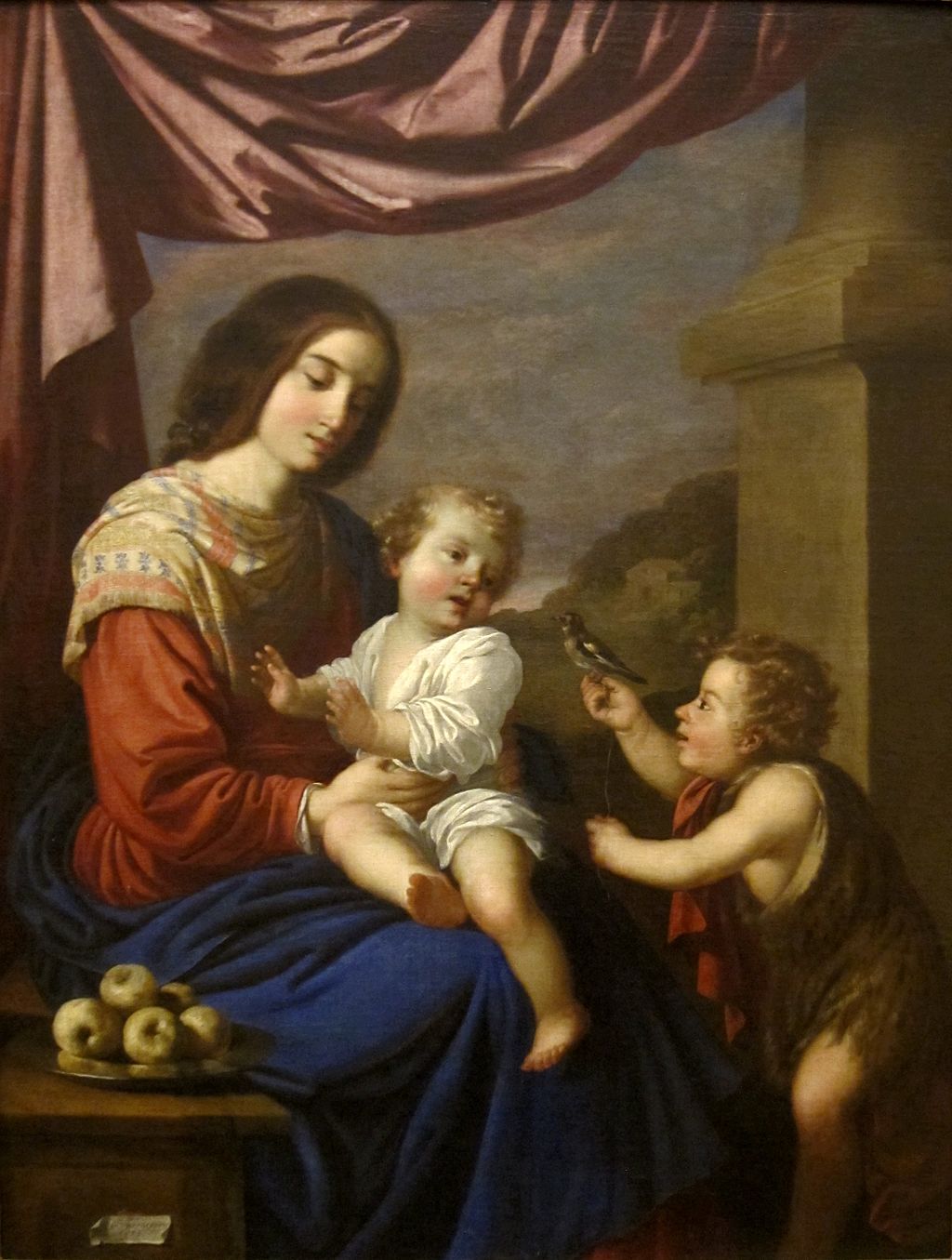
Zurbaran_Madonna_and_Child

Why is all this relevant to Advent? Well, on this third Sunday of Advent, many Christian churches read about John the Baptist, as they believe John was Jesus’ forerunner. Because of a mention in the Gospel of Luke, the Catholic church in the very early Middle Ages determined that St. John’s birthday must have been exactly six months before Christmas — and decided to celebrate this on June 24th.*  You can read more about this in my post about the Feast of St. John.

As far as we know, Bach wrote only one cantata for this Sunday, the third Sunday of Advent. It is the one listed in the BWV catalog as Cantata 186a, Ärgre dich, o Seele, nicht, first performed in Weimar on Sunday December 13, 1716. No original music score is left of this cantata. However, thanks to Bach’s librettist, Weimar court poet Salomo Franck, who published the full libretto for this cantata in a poetry volume in 1717, we do have the original text of 186a.

And, it is not hard to make an educated guess as to what the music would have been.

On July 9, 1723, for the 7th Sunday after Trinity in Leipzig, Bach expanded the music of the 1716 Weimar cantata with four additional recitatives and two chorales (per his usual template for reviving Weimar cantatas for Leipzig), and we do have that music: it is Cantata 186, also with the title Ärgre dich, o Seele, nicht.**

To reconstruct the original 1716 Weimar Advent version, or Cantata 186a, one would have to eliminate all the recitatives Bach added in 1723 as well as both chorales, superimpose different texts on some of the arias, and select alternative music for the original closing chorale. There have been a few performances of these kind of reconstructions, but unfortunately there are no recordings of those.

So I invite you listen to Bach Collegium Japan playing this music via my playlist on Spotify. To imagine the original texts superimposed over this music, and learn why I selected this particular closing chorale, please keep reading.

Opening chorus: This has the same text in 1716 as in 1723. We should imagine a smaller ensemble singing this though, as the maximum number of singers in the Weimar chapel was 7. This opening chorus is again a beautiful example of how Bach provides an “entrada” for the Duke as well as an opportunity for himself to show off his skills with the “fashionable” music, the way he almost always did in the Weimar cantatas.***

Ärgre dich, o Seele, nicht,
Daß das allerhöchste Licht,
Gottes Glanz und Ebenbild,
Sich in Knechtsgestalt verhüllt,
Ärgre dich, o Seele, nicht!
Do not be confounded, o soul,
because the all-highest light,
God’s radiance and very image,
is concealed in the form of a servant;
do not be confounded!

For the Bass aria, imagine this Advent text instead of the Trinity 7 text you hear (changes in bold type):

Bist du, der da kommen soll,
Seelen-Freund, in Kirchen-Garten?
Mein Gemüt ist Zweifels-voll,
Soll ich eines andern warten!
Doch, o Seele, zweifle nicht.
Lass Vernunft dich nicht verstricken,
Deinen Schilo, Jacobs Licht,
Kannst du in der Schrift erblicken!
Are You He, who should come,
Friend of souls, to the Church’s garden?
My spirit is full of doubt,
perhaps I should wait for someone else!
Yet, o soul, do not doubt.
Do not let reason beguile you.
Your Messiah, Jacob’s light,
is visible to you in the scripture.(translation of original text by me, unchanged words courtesy of bach-cantatas.com website)

For the Tenor aria,  imagine this Advent text instead of the Trinity 7 text you hear (changes in bold type):

Messias läßt sich merken
Aus seinen Gnaden-Werken.
Unreine werden rein.
Die geistlich Lahme gehen,
Die geistlich Blinde sehen
Den hellen Gnaden Schein.
The Messiah lets Himself be seen
in His works of grace.
The impure become purified.
Those lame of spirit will walk,
Those blind of spirit will see
the clear brilliance of the mercy.(translation of original text by me, unchanged words courtesy of bach-cantatas.com website)

There is only one word change in the Soprano aria: In the last line the 1716 text is “des Lebens Wort” instead of “das Lebenswort” from 1723.

Die Armen will der Herr umarmen
The Lord will embrace the poor
Mit Gnaden hier und dort;
With his mercy here and there;
Er schenket ihnen aus Erbarmen
Out of his compassion he sends to them
Den höchsten Schatz, das Lebenswort.
His greatest treasure, the word of life.

Enjoy Miah Persson’s beautiful voice and interpretation. If you would like to hear and more about her, read my post about cantata 179. Cantata 179 appears on the same album by Bach Collegium Japan as this cantata 186.

Soprano-alto duet: This is the original text from 1716, unchanged in 1723. The text promises the believer the crown (die Krone) of the everlasting life, but only if he stays faithful (getreu) and only in the afterlife, when free of the body (wenn des Leibes frei).

Laß, Seele, kein Leiden
My soul, let no sorrow
Von Jesu dich scheiden,
Separate you from Jesus
Sei, Seele, getreu!
Be faithful, my soul!
Dir bleibet die Krone
The Crown weight you
Aus Gnaden zu Lohne,
Is your reward through grace
Wenn du von Banden des Leibes nun frei.
When you will be free from the body’s prison.

In Weimar in 1716, for the closing chorale Bach used the 8th verse of Von Gott will ich nicht lassen from 1563, based on the French tune Une jeune fillette from 1557. Since this is not the same melody as Es ist das Heil uns kommen her Bach used in 1723 it is very plausible that both chorales from the 1723 version are new, in text as well as in music. So in an effort to reconstruct the 1716 version,  we need to think of a different solution for the music than the tune from 1723. A good fit would be a simple setting of the Von Gott will ich nicht lassen chorale, the way Bach would set for example verse 5 of this chorale as closing movement of cantata 73 in 1723 or 1724. So that’s why, for now, I’ve included that music (from a Herreweghe recording) in the Spotify playlist. The text would be this:

Darum ob ich schon dulde
Hie Wiederwärtigkeit,
wie ich auch wohl verschulde,
kommt doch die Ewigkeit,
ist aller Freuden voll,
die ohne alles Ende,
dieweil ich Christum kenne,
mir widerfahren soll.
Therefore, even if I endure
unpleasantness here,
as I have well deserved,
eternity is coming
filled with all joy;
this for ever
will befall me
while I acknowledge Christ.

All translations of existing text and closing chorale courtesy of bach-cantatas.com website, translations of changed texts by me.

© Wieneke Gorter, December 10, 2016, revised December 15, 2017.

* Luke 1:36 (about the Annunciation) mentions that the angel Gabriel also informed Mary that her cousin Elizabeth was already six months pregnant. The June 24 date was most probably also chosen to give a Christian meaning to already existing Pagan Midsummer celebrations. The Feast of St. John being celebrated on June 24 shows up in records as early as the year 506.

**I discussed this 1723 version of the cantata here, and recommended the recording by Bach Collegium Japan with soprano Miah Persson, alto Robin Blaze, tenor Makoto Sakurada, and bass Peter Kooij.

***Read more about Bach’s Weimar cantatas in my posts about cantata 182, 12, 147, and 21

Many things to be proud of

Tags

, , , , , , , , , , , , , ,

giotto-entry-into-jerusalem

The Entry into Jerusalem by Giotto, ca. 1305. Fresco in the Scrovengni Chapel, Padua, Italy.

Bach performed this cantata 61 Nun komm der Heiden Heiland in Leipzig on November 28, 1723, as a “rerun” of the first performance in Weimar in 1714. Why did he not write a new cantata? The prevailing scholarly answer is that Bach was giving himself a break from composing in between the three-week frenzy of cantatas 60, 90, and 70 and the new works (including a Magnificat) he was planning for the Christmas days.  I think Bach was proud of his Weimar cantatas, and I believe he wanted to show off the special features in this cantata to his colleagues and to the thousands of Lutherans that he knew would flock to the Leipzig churches on holidays.

I myself am proud of having followed Bach’s cantata writing of 1723 every week for the entire Trinity season. After all this listening and reading, I see a pattern in Bach reviving some of his Weimar cantatas on Leipzig feast days*, and I now look at cantata 61 Nun komm der Heiden Heiland in a new way.

This cantata had already been in my top five because of the moving interpretation of the soprano aria by Seppi Kronwitter (soprano) and Nikolaus Harnoncourt (cello) on the Harnoncourt recording from 1976. My mother loved this aria and played this recording many times, and I have fond memories of listening to it with her.

Harnoncourt-cello

I had always found the bass recitative that precedes it very charming, with the musical illustration of the knocking on the door, but not more than that.  I had seen this recitative in the context of all the Bach cantatas and passions that I knew, and had compared it with other typical Bach “Vox Christi” writing for bass. But those were all written after November 28, 1723.  So now, after having tried to place myself in the shoes of the Leipzig congregations for the entire 1723 Trinity season, I am fully aware that they had not heard a “Vox Christi” at all in any of the cantatas leading up to this one.** And thus I finally realize how it must not have been charming, but truly moving to them to hear this announcement presented in this way, on the first Sunday they started looking forward to the birth of Christ.

In the text of the recitative, Jesus says: “See, I am in front of your door! I’m knocking!” The librettist means the door of the believer’s heart, in which he’s planning to live. The pizzicato in the strings, as well as the staccato and the intervals in the voice part illustrate the knocking, and the dissonances at the beginning only resolve until the final “klopfe an.” The form of this recitative is highly unusual, and perhaps also something Bach wanted to show off in Leipzig.

However Bach’s greatest source of pride was probably the opening chorus of this cantata. To understand this, we need to do a mini music history class. First, in the 4th century, Ambrosius created the hymn Veni Redemptor Gentium, beautifully sung here on this video by Giovanni Vianini, director of the Schola Gregoriana Mediolanensis in Milan, Italy. Then, in 1524, Luther turned that hymn into Nun komm der Heiden Heiland, which sounds like this and which all Lutherans in Bach’s time knew very well.

In Weimar Bach had come into contact with French and Italian court music, and had adopted the habit of writing almost every opening chorus or opening sinfonia of his cantatas as a royal “entrada,” to show off his skills in French ouverture writing as well as to please the Duke.

So now Bach needed/wanted to merge the timeless hymn with a fashionable French ouverture. And the result is stunning. Or, as Eduard van Hengel says: Bach wrote “brilliant fusion” at the age of 29. Listen to this in the recording by Philippe Herreweghe on YouTube (Sybilla Rubens, soprano; Christoph Prégardien, tenor; Peter Kooij, bass).

Find the German text with English translations here and the score here.

The first line of the hymn is sung one voice part at a time, an illustration of the Bible reading for this Sunday: the people greeting the messiah who is riding into Jerusalem. The second line is then sung as a simple four-part hymn, while the instrumental parts keep playing the first part of the ouverture. The third line becomes a mini motet in the fast and happy (“Gai”) middle part of the ouverture, in 3/4. 

The fourth line of text is then again a simple four-part setting on the third part of the ouverture.

For the closing chorale, Bach chose the last two lines of Wie schön leuchtet der Morgenstern as melody. And again he marries the chorale tune beautifully with the instrumental writing.

Wieneke Gorter, November 26, 2016, updated December 1, 2019.

*Read more about this in my post about the feast of St. John the Baptist on June 24, The Visitation on July 2, and last week’s post about cantata 70. Read how proud Bach was of his Weimar cantatas in this post about cantata 12.

** unless they had a really good memory, and were present at Bach’s “audition” in February 1723. There is a Vox Christi in Cantata 22 which he presented at that time, but didn’t repeat in Leipzig until that same time in the church year in 1724.

The Crown on Bach’s 1723 Trinity season

lucasvanleyden_lastjudgment

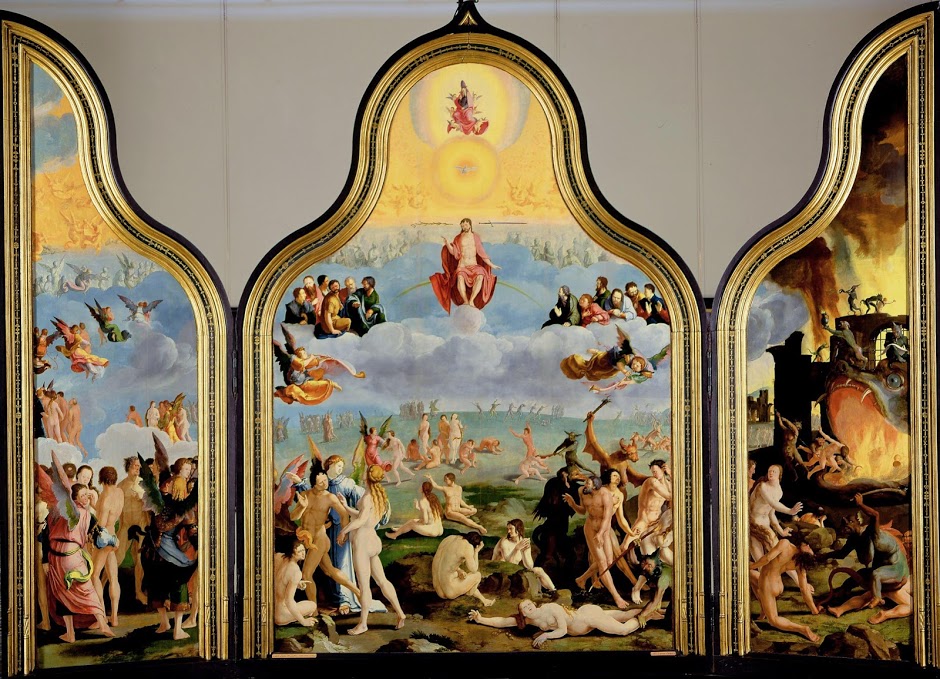
The Last Judgment by Dutch painter Lucas van Leyden, 1526-1527. Museum de Lakenhal, Leiden, Netherlands. (link for more information at the very end of this post)

When Bach accepted his post in Leipzig, he knew that between the first Sunday in Advent and Christmas Day, there wasn’t to be any music in the churches in that city. However, among the goods he moved with him to Leipzig on May 22, 1723, there was a stack of several beautiful Advent cantata manuscripts from his Weimar period (1714-1716), and I think he was eager to perform all this music for the much larger audience he had in Leipzig than the small entourage of the Duke of Weimar that would have heard the music there. So he reworked and expanded several of those Weimar Advent cantatas for other times of the church year in Leipzig.

The Weimar Advent cantatas all had a similar structure: opening chorus, arias without recitatives, closing chorale. For the performances in Leipzig, Bach added recitatives, to make the libretto closer related* to the Bible text of that particular Sunday. He would also insert a chorale in the middle, so he could perform Part I of the cantata (with the newly written closing chorale at the end of that half) before the sermon in Leipzig, and Part II (with the existing closing chorale at the end) after the sermon.

During the 1723 Trinity season he had already done this successfully with cantata 147 for the Feast of the Visitation, and  cantata 186 for the 7th Sunday after Trinity, but he truly mastered it with cantata 70, Wachet! betet! betet! wachet!, originally written for 2nd Advent in Weimar in 1716, but now dramatically expanded for the 26th Sunday after Trinity, November 21, 1723. Just as last week’s cantata, this is a Judgment Day cantata, and the stunning recitatives for bass and trumpet make that absolutely clear, but there is much more sparkle in the music and hope in the text than last week, because of the link with Advent.

As a child I loved the tenor aria from this cantata, exactly because of that sparkle and lightness in the music and the hope in the text. Also, I have beautiful but emotional memories connected with a performance of this cantata during the First Advent church service in my parents’ church in the Hague, only three days after my mom’s funeral service in that same church.

For my own sentimental reasons, and for an excellent rendition of the tenor aria by Kurt Equiluz and the bass recitatives and aria by Ruud van der Meer, I would listen to the Harnoncourt recording of this cantata. But the opening chorus and some other movements in the first half are a bit hard to listen to, so I’ll give you just the second half of that Harnoncourt recording, here on Spotify.

A joyful update from 2019: this entire cantata is now available on YouTube in an excellent performance by the J.S. Bach Foundation. Watch it here. Soloists on this live video recording are Gudrun Sidonie Otto, soprano; Margot Oitzinger, alto; Daniel Johannsen, tenor; Wolf-Matthias Friedrich, bass, and Patrick Henrichs, trumpet. For the Advent cantata version of it, just imagine it without all the recitatives and without the chorale in the middle.

For those who understand a little German, there’s also a nice interview with trumpet player Patrick Henrichs here on YouTube.

Find the German texts with English translations here, and the score here.

Apart from the beautiful light in the tenor aria, and the incredible writing for bass and trumpet, listen for two special chorales:

In the bass recitative in the second half (movement 9, not part of the original Advent cantata), the text mentions “der Posaunen Schall” (the sound of the trumpet, meaning the trumpet that announces Christ coming down from the heaven as Judge at the end of times) and then immediately after the bass sings that word, the trumpet plays a chorale, which the congregation in Bach’s time would have recognized as emphasis of the  Last Judgment theme:

Es ist gewisslich an der Zeit,
daß Gottes Sohn wird kommen
[in seiner großen Herrlichkeit,
zu richten Bös’ und Frommen.]
Dann wird das Lachen werden theur,
Wann Alles soll vergehn im Feu’r,
Wie Petrus davon zeuget.

Indeed the time is here
when God’s Son will come
[in His great glory
to judge the wicked and the righteous.]
Then laughter will be rare,
when everything goes up in flames,
as Peter bore witness.
At the very end, Bach uses the closing chorale from the original Weimar Advent cantata, and gives it as much hope and light as possible, in three ways:
First, in the melody of the chorale, which the congregation would have recognized as the to them very well-known “Meinen Jesum laß ich nicht”:

Meinen Jesum laß’ ich nicht.
Weil er sich für mich gegeben,
So erfordert meine Pflicht,
Klettenweis’ an ihm zu kleben;
Er ist meines Lebens Licht;
Meinen Jesum laß’ ich nicht.

I shall not leave my Jesus.
Since he has given himself on me,
my duty therefore demands
that I should cling to him like a limpet;
he is the light of my life;
I shall not leave my Jesus

Second, in the addition of three shimmering string parts above the regular four choral parts. Third,  in the actual text he uses here, which confirms the light (Jesum wünsch ich und sein Licht / I wish for Jesus and his light) and confirms the melody at the very end: Meinen Jesum laß ich nicht.

Wieneke Gorter, November 20, 2016, updated December 7, 2019.

More information about the painting (which was at the time I originally wrote this post on special exhibit in the Rijksmuseum in Amsterdam, but is now back at Museum de Lakenhal in Leiden) is available here.

*The texts of  the Advent cantatas were not that far removed from the new texts as we might think. In this case, the reading for the Second Sunday in Advent (Luke 21: 25-36) linked the first coming of Christ (Advent) to his second coming as judge at the end of times,  which is the reading for the 26th Sunday after Trinity (Matthew 25: 31-46).

Trying to find some beauty in ugliness

Tags

, , , , , ,

trumpetsmemling

The least gruesome detail of Hans Memling’s “The Last Judgment”, a triptych painted between 1467 and 1471. National Museum, Gdansk, Poland.

This week I’ve been trying harder than ever in my life to find islands of beauty in a sea of ugliness. I found some: I witnessed communities coming together, had a very uplifting choir rehearsal, attended a concert at my daughter’s music school where the director gave a heart-felt speech, and the choir director had included We Shall Overcome in their part of the program. I have talked with my children about what it means to “stand up” for the millions who will suffer discrimination in the next four years in this country.  I realize I have many different readers of this blog, and that some of you might not share my political opinion. But I would urge you to be there for each other. And whomever you had been meaning to contact, whether it is a friend you should have apologized to four weeks ago, someone you know who is having a hard time, a relative you haven’t called in too long, or your representative in the House or Senate, write that letter, make that phone call. Don’t put it off.

In today’s cantata 90 Es reißet euch ein schrecklich Ende (A terrible end shall sweep you away), written for November 14, 1723, the 25th Sunday after Trinity, it is not easy to find beauty either, at least not the soul-soothing kind, since it is based on the Bible story of The Last Judgement, which is an ugly concept in my opinion. However this story was important in Bach’s time, and it was thus appropriate to let the Trinity season go out with a bang: two weeks in a row of impressive cantatas, including some of the most magnificent (and difficult!) arias for bass and trumpet in all of his work.

While Bach’s audience (the congregations of the St. Thomas and St. Nicholas churches in Leipzig) got plenty of tenor drama in the fall of 1723, it had been a long time (August 1, 1723 to be exact) since they had last heard an operatic aria for bass, with the majestic trumpet as accompanying instrument.

Since this emotional week also calls for some nostalgia, I’m going with the Leonhardt recording of this cantata, because I grew up listening to Max van Egmond sing these bass arias. The trumpet player on that recording however barely makes it, so if you would like to listen to a better player in that particular aria, and also see a close-up of the instrument, watch this video (of the bass aria only) by the Bach Foundation, with Patrick Henrichs on trumpet.

Find the text here, and the score here.

Wieneke Gorter, November 13, 2016, Links updated November 24, 2019.

Bach in Vienna / Robin Blaze going wild

Tags

, , , , , , , , , , , , , ,

kokoschka_pieta

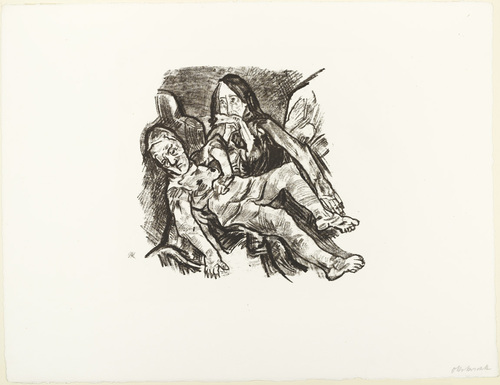
Pietà (It is enough) / Pietà (Es ist genug), plate 11 from a series of 11 lithographs O Ewigkeit, Du Donnerwort by Oskar Kokoschka, 1914/1916. Museum of Modern Art, New York.

In Vienna, they were all talking about Bach’s cantata 60 O Ewigkeit, Du Donnerwort. The astonishing harmonization in the closing chorale as well as the structure of a “dialogue” between Fear (alto) and Hope (tenor) made it one of the most unusual among his cantatas, and apparently something worth discussing. In the first half of the 20th century, that is. In 1935  Alban Berg used the “modern” harmonization from the closing chorale Es ist genug in the final movement of his violin concerto To the Memory of an Angel–an instrumental Requiem for Manon Gropius, daughter of Bauhaus architect Walter Gropius and Mahler’s widow, Alma Schindler.

Several years before, the same Alma Schindler had a short-lived affair with Czech painter Oskar Kokoschka. After they broke up, Kokoschka processed his torment by making a series of 11 lithographs to illustrate the cantata. The dialogue between Fear (the alto) and Hope (the tenor) in the cantata became a dialogue between Alma and himself, in pictures only: click here to see the entire series. Many thanks to Eduard van Hengel for pointing this out.

Listen to Bach Collegium Japan’s recording of this cantata on Spotify, with countertenor Robin Blaze and tenor Gerd Türk. Find the German text with English translations here, and the score here.

Bach wrote this cantata 60 O Ewigkeit, Du Donnerwort for the 24th Sunday after Trinity in 1723, the Sunday normally linked to the Gospel story of the Raising of Jairus’ Daughter. However, in 1723–as now in 2016–this day fell on the first Sunday in November: All Hallows Sunday, All Saints Sunday, however you want to call it, but the Sunday on which the congregation would have commemorated all who had passed away that year. None of the commentaries I have read mention this, but I think it is important, because I feel this cantata is much more about how horrible it might be to die, or the thoughts one has when sitting at a loved one’s deathbed, than it is about the Raising of Jairus’ Daughter.

Of all the recordings I listened to, I like Bach Collegium Japan’s the best, because of Robin Blaze’s interpretation of the alto part. I always love his voice, but he is usually quite understated in his singing. He explains this well in this interview on San Francisco Classical Voice. I sometimes wish he would indeed sing with Kate Bush and “let go” a little, so I was thrilled to hear that in this cantata he actually does go a bit wild, for his standards at least, and that Suzuki lets him do it. His conviction in the opening chorale is already terrific (also note the wonderful blend with the horn doubling his part), but the way he sings the text “Und martert diese Glieder” (and tortures these limbs) in movement 2 is amazing, spot-on, and unrivaled by any others I listened to.

As we have seen before in the course of these 1723 Trinity Season cantatas (read for example my post on cantata 105) there are elements of Bach’s passions already present in this cantata. The agitated singing of the tenor in the stunningly beautiful duet (movement 3) resembles the Ach, mein Sinn! tenor aria from the St. John Passion. The repeated tremolo in the violins in movement 1 is something Bach often uses to illustrate fear, and this will show up again in the tenor arioso O Schmerz! Hier zittert das gequälte Herz in his St. Matthew Passion.

For further reading, including all the amazing harmonies in this piece which impressed the Viennese composers of the early 20th century,  as well as other insights, I can highly recommend Gardiner’s journal entry about this cantata (start reading on page 5).

Wieneke Gorter, November 6, 2016, updated November 21, 2020

1723 Trinity Special Series: the Final Weeks!

95thesen_facsimile_colour

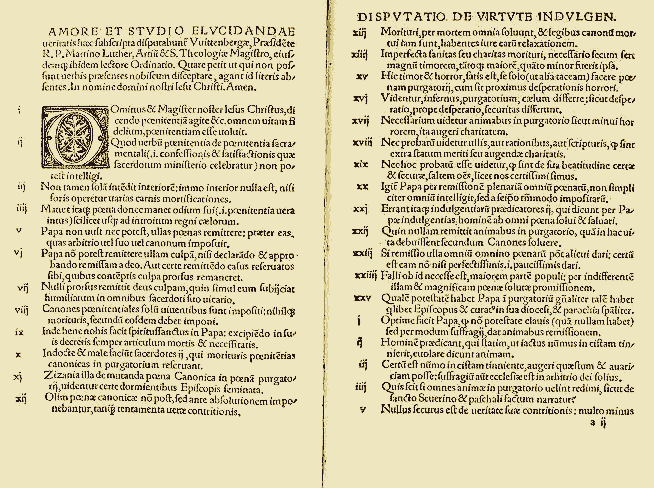
Luther’s Theses, marking the start of the Reformation on October 31 in 1517.

Fear not: I am by no means announcing the end of this blog and am very much looking forward to sharing Bach’s beautiful Advent and Christmas cantatas with you starting on Sunday November 27.

This is just a heads-up about the impending end of my Trinity 1723 Special Series. Bach made his 1723 Trinity Season go out with a bang, and I plan to do the same! Spectacular (and somewhat crazy) cantatas are coming up in the next three weeks, but there’s no cantata from 1723 for today, so this is your chance to catch up on the previous episodes of this special series, which started on Sunday May 29 of this year with this post.  If you don’t have time to read all the episodes, I recommend these two highlights: cantata 147 for the Feast of the Visitation, and cantata 105 for Trinity 9.

Why is there no cantata for today from 1723? It was October 31, also known as Reformation Day, the day on which the Lutheran Church celebrates Martin Luther publishing his 95 Theses against the Catholic Church in 1517. It wasn’t until 1725 that Bach wrote a cantata for that particular day.

Wieneke Gorter, Sunday October 30, 2016.

A pretty soprano aria for Trinity 22

Tags

, ,

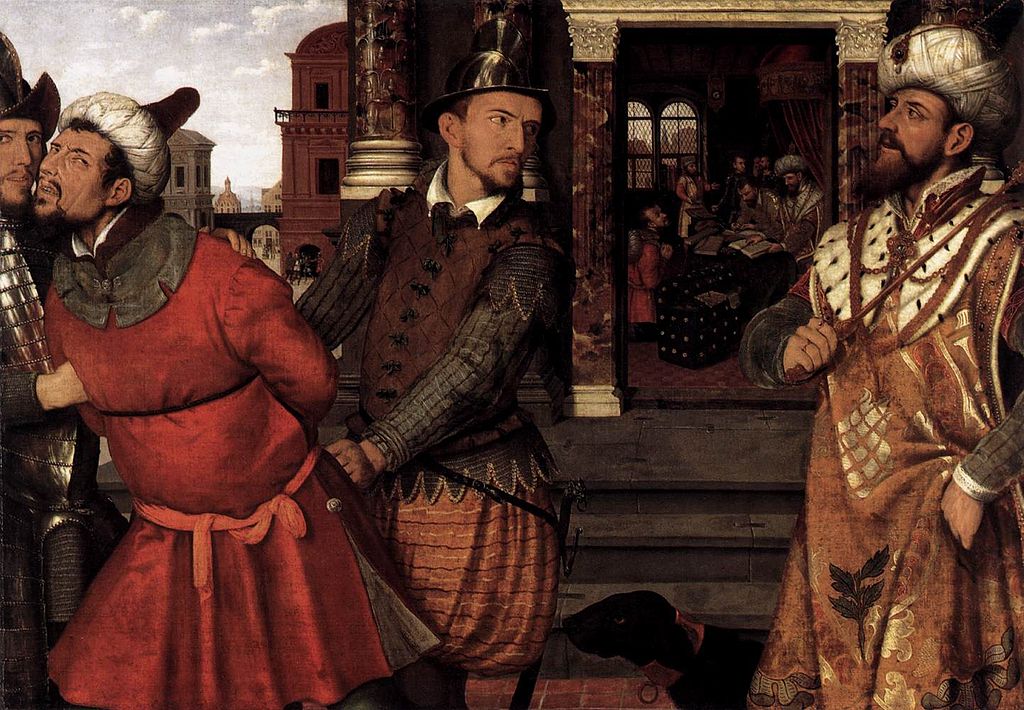
parable_of_the_unfaithful_servant

Parable of the Unmerciful Servant by an unknown master from Northern Germany, ca. 1560. Gemäldegalerie, Berlin.

For this 22nd Sunday after Trinity, October 24 in 1723, Bach wrote cantata 89 Was soll ich aus dir machen, Ephraim?

Apart from providing you with the title of the cantata, the stunning painting, and a pretty YouTube video, you’re on your own this week for reading and listening more about this, as I’ve been busy producing these two fabulous concerts.

To find an overview of the recordings, links to the text & translations, and links to the score of this cantata, please visit this page of the “Bach Cantata Bible” by Aryeh Oron.

For a very beautiful interpretation of the soprano aria (fifth movement) from this cantata, please watch this video of the Bach Stiftung, with soprano Nuria Rial, in Trogen, Switzerland. I first heard the fabulous Nuria Rial sing on the German radio in December 2010 and have been a fan since. Watch her sing Cavalli arias at the Utrecht Early Music Festival in the summer of 2016.  I’ll talk about her again on the first Sunday of Advent, in about a month 🙂

Wieneke Gorter, October 23, 2016

Tenor drama

Tags

, , , , , , , , , ,

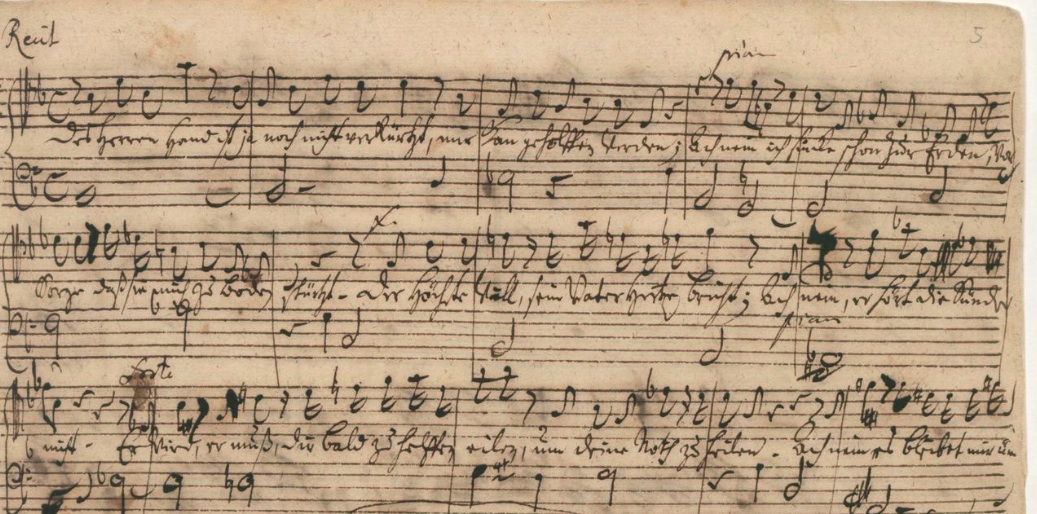
bwv109_tenormanuscript

Excerpt from the start of the tenor recitative from cantata 109, with “piano” and “forte” marked. Staatsbibliothek zu Berlin, Preußischer Kulturbesitz

For this 21st Sunday after Trinity, Bach wrote cantata 109 Ich glaube, lieber Herr, hilf meinem Unglauben! in 1723.

For overall best performance, I recommend Herreweghe’s recording from 2013, with counter-tenor Damien Guillon and tenor Thomas Hobbs.

Listen to this recording on YouTube. To support the artists, please consider purchasing the entire album on Amazon — a good deal if you like this blog, as it also includes three cantatas I discussed here earlier this year: cantata 44, cantata 73, and cantata 48.

Read the German texts with English translations here, and find the score here.

I love Herreweghe’s interpretation of  the opening and closing chorus as well as Damien Guillon’s singing in the alto recitative and aria.

However, there is an extremely dramatic and unusual recitative and aria for tenor in this cantata which I like better on the Gardiner recording. The recitative is unusual because Bach has two voices/persons speak: the uncertain/fearful voice, marked “piano” in his manuscript (see picture above), and the certain/faithful voice, marked “forte” in the manuscript. According to Gardiner, this feature never appears anywhere else in Bach’s recitative writing.

Just as with the “Storm on the lake” aria from cantata 81, only Gardiner and the fabulous Paul Agnew are able to properly convey the drama of the text and context of this tenor recitative and aria. If at first you think this might be a bit over the top, it is most probably exactly what Bach had in mind. A bit of opera to properly bring out the agony of the text.

Listen to these two movements by Gardiner and Agnew on YouTube: the recitative here, and the aria here.

Bach might have been preparing the Leipzig congregations for the St. John Passion he was planning for Good Friday 1724, as this tenor aria is very similar in dramatic intensity and music to the Ach mein Sinn aria from that passion. Those who know the St. John Passion well might hear other resemblances in this cantata 109.


Wieneke Gorter, October 16, 2016