Yesterday evening, Saturday March 5, 2016, conductor and cellist Nikolaus Harnoncourt left this world. He was an important part of the Sunday Bach cantata tradition my mother started in our family, and she was a great admirer of him. Even though my mother passed away more than five years ago, I feel she died a little more for me today, now that I know Harnoncourt is gone.
Sometime in the late 1980s, with my parents and my sister, I attended a performance of Bach’s Passion according to St. John which Harnoncourt directed in the Concertgebouw in Amsterdam. We had seats in the section behind the orchestra and choir, so that we could watch him communicate with the players and singers. I will never forget that. Afterwards, my mother–who was singing in a Bach choir herself at the time–said that it would mean the world to her if she could ever sing in a choir conducted by Harnoncourt. It never happened for her, but the combination of her saying this and me seeing Harnoncourt at work inspired me to join a Bach choir in my first year of college.
Even though Harnoncourt made an incredible amount of recordings (see his timeline for a list of all of them), there is nothing like seeing (an) excellent artist(s) live on stage. To see them work, interact, and to feel their energy is an experience you’ll never forget and which is worth so much more than earthly possessions. So if there is someone you admire but only know from recordings, go hear and see them live while they’re still alive! Make the effort. You will be glad you did.
Watch Harnoncourt conduct Bach’s Passion according to St. John on this video recorded in Graz, Austria, in 1985. It is a terrific example of the world class conductor he was. Don’t be put off by the 30-year-old sound quality, especially noticeable in the oboes in the opening chorus. It is only that bad in the beginning, the rest of the recording is a feast for the ears and eyes, not in the least because of the excellent performance (and singing technique!) by Kurt Equiluz as evangelist.
Listening to the Passion according to St. John is also appropriate in the order of things on this blog, since Bach was working on this passion during Lent in 1724, and revising it in 1725. And this way, come Good Friday (March 25, 2016), I can perhaps talk about the other passion 🙂
My apologies for not posting anything this past weekend. The other aspects of my life need(ed) my attention, time, and energy.
While you wait for my future posts, please watch this video about Bach’s life and work. It’s a BBC documentary, aka the film version of Gardiner’s book about Bach, with Gardiner actually visiting all the villages and cities where Bach lived and worked, and showing lots of historical documents in the Bach Archives in Leipzig.
To come later this month:
Sunday March 20: Palm Sunday: Cantata 182 Himmelskönig, sei willkommen
Sunday March 27: Easter Sunday: Cantata 31 Der Himmel lacht! Die Erde jubilieret
From left to right, the St. Thomas School in Leipzig, where the Bach family lived in a large apartment on the left side (or front, seen like this, with a view over the park), the St. Thomas Church right next to the School (with such a high roof and spire it could be seen from all over the city), and the St. Nicholas Church at walking distance. Bach’s cantatas were performed in both churches.
No discussion of Bach cantatas until Easter, because Bach did not write any cantatas for Lent (the 40 days before Easter). Read more about this in my post from last week.
Johann Sebastian Bach (1685-1750) wrote most of his cantatas, motets, masses, and passions in Leipzig. He moved there on Saturday May 22, 1723.
Christoph Wolff includes this account of the event by a Hamburg newspaper in his The New Bach Reader: “This past Saturday at noon, four wagons loaded with household goods arrived here from Köthen; they belonged to the former Princely Kapellmeister there, now called to Leipzig as Cantor Figuralis. He himself arrived with his family on two carriages at 2 o’clock and moved into the newly renovated apartment in the St. Thomas School.”
By that time, Bach’s family consisted of:
his wife Anna Magdalena (he married her in Köthen in 1721 when she was 20 years old),
four children from his first wife Maria Barbara (she died in 1720).
one child from Anna Magdalena,
and most probably his sister-in-law Friedelena Margaretha Bach (sister of his first wife Maria Barbara, who -according to Wolff- lived in the Bach household from at least 1709 at age 34 to her death in 1729. I will probably write an entire post about all the stories and non-stories about Bach’s wives soon, but let’s just leave it at this for now, here :-)). That her last name is also Bach is because these sisters were Bach’s second cousins.
Until 1742, Anna Magdalena and Johann Sebastian would have 12 more children in Leipzig, of which they would lose six. They would also take some nephews under their wings (a normal thing to do in the extended Bach family—Bach himself had lived with a relative after his parents died) and have a mind-boggling number of private students.
Leipzig was a bustling town, the second largest in the region, with a highly regarded university as well as three annual trade fairs, which brought merchants, artists, and tourists from all over Europe to the city. It happened most probably during one of these fairs that Leipzig instrument maker J.H. Eichentopf came into contact with some eastern instruments on which he based the concept of the oboe da caccia he developed around the time of Bach’s arrival in the city, and which Bach used in many compositions, such as cantata 65. The only thing the city didn’t have was an opera house. The one in Dresden was about 112 kilometers, or 70 miles, or a day’s travel away. The other famous one, in Hamburg, was almost three times as far away.
In addition to teaching the boys of the St. Thomas School in music and many other subjects, Bach was to supply music for all Sundays and church feast days in both the St. Thomas and St. Nicholas churches. No-one had specified that these had to be cantatas. A simpler form of composition would probably have suited the council better, as many of the members opposed the Italian, operatic style of some of the arias, or the French character of many of the opening sinfonias. If Bach would sometimes have programmed music by other composers, that would not have been a problem either.* It was his own choice to write a new cantata for every Sunday, most probably driven by a strong desire, a promise to himself (or “life goal,” as he calls it when moving from Mühlhausen to Weimar) to change the concept of church music, glorifying God but also educating the congregation in Lutheran theology. And as far as we know now, he kept that promise, writing a new cantata every week, for almost three full years.
The churches would be full, with one to three thousand (!) people attending the services. But however large in number, the congregation did not necessarily form a captive audience. Many of them, especially the women, seated in the main, “ground floor” section of pews, would arrive late and make quite an entrance, taking time to greet their neighbors, and making sure to get the attention of the men who were sitting in the balconies. The men would sometimes throw the 18th-century equivalent of paper airplanes to the women to catch their attention. Upper class families had their own boxes, or “chapels” in the church, and were often laughing and talking very loudly in them.
In another part of his Leipzig life, Bach had more attentive audiences in “Zimmermann’s,” one of the six coffee houses in Leipzig, where he lead the Collegium Musicum of the university in performances of instrumental music and secular cantatas. They performed at least once a week on Wednesdays, and twice a week during the three annual trade fairs. At first Bach was principal guest conductor, from 1729 he was the director of this elite ensemble of virtuoso instrumentalists. It is safe to say that even though he owned an entire library of theological books and was committed to teaching his “neighbor” through his church music, he composed and performed as much (and maybe more!) instrumental and secular music in Leipzig as he did sacred music.
Wieneke Gorter, February 21, 2016, updated February 20, 2021
*After a while, Bach did indeed perform music by other composers. Read more about this in a background article I wrote for California Bach Society’s blog, here.
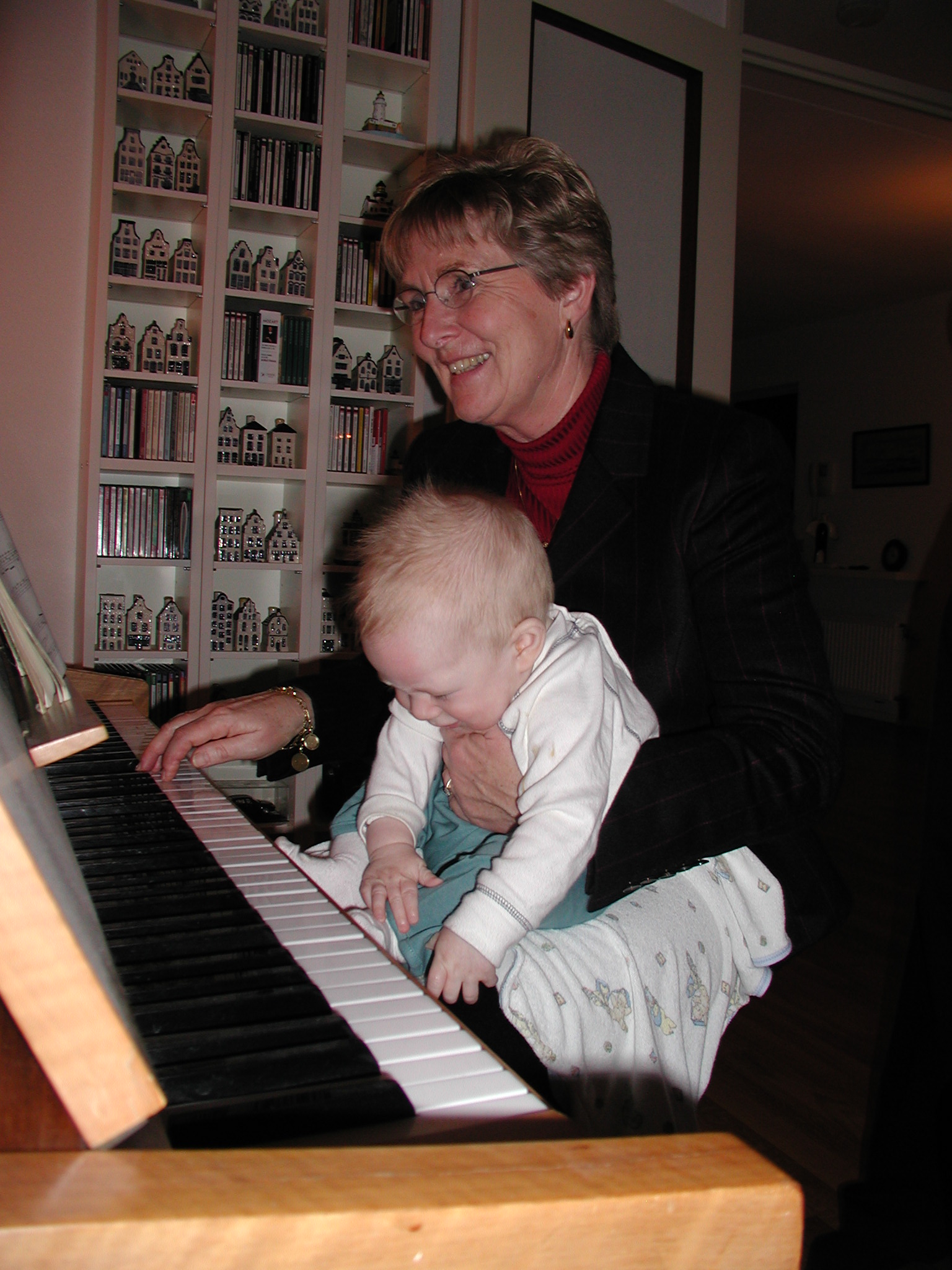
My mother, Weia Gorter-Assink (1946-2010) with my first-born, December 2002
One of the main reasons I started this blog was to honor my late musician/teacher mother, and to continue her legacy of playing the appropriate Bach cantata every Sunday. In the church newsletter she would look up what Sunday it was, and then she would open the little red book by Alfred Dürr (it actually consisted of two Deutsche Taschenbuch Verlag books at the time, nowadays available as one single book in English or in German), and look up which cantatas Bach wrote for that Sunday. Then she would look through her collection of Leonhardt/Harnoncourt LPs (vinyl records), and if she had a recording, she would put it on the turn table, and read along in the score that came with the LP/vinyl record.
My mom’s routine of checking the church newsletter or doing her own calculations *before* she checked the Dürr book is crucial here. Because there are three Sundays before Lent (Septuagesima, Sexagesima, and Quinquagesima/Estomihi), and they override the Sundays after Epiphany. If Easter is late, there can be as many as six Sundays after Epiphany (though we only have surviving Bach cantatas for the first four of those), if Easter is early (as is the case this year) there are only two Sundays after Epiphany.
This means that my post this year about cantata 3 was still correct, my next two posts (about 72 & 73, and about the operatic cantata 81) were irrelevant for this year, I should have posted about cantata 144 on Sunday January 24 instead of last week, and in the two weeks between then and now I should have introduced you to the fantastic portrayal of rain and snow in cantata 18, followed by some of Bach’s most magnificent choral writing in cantata 23.
Parabel of the Laborers in the Vineyard by Jan Luyken, print, 1703
A number of Dutch things converged for me when writing this post. Whenever I think about the parable of the Laborers in the Vineyard, the Bible story for this Septuagesima Sunday, or the third Sunday before Lent, I see the windows of my 3rd or 4th grade classroom.* I also have to think of my late grandfather reading this story from the Bible. Quickly summarized, this story is: A landlord pays all his laborers equally, no matter how many hours they worked. Those that worked all day object.
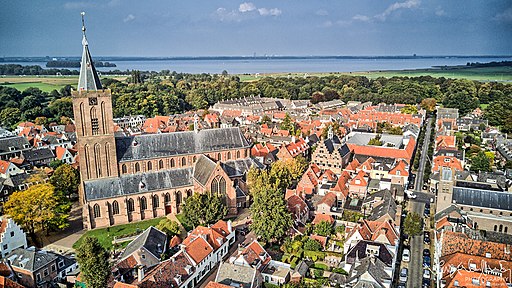
My favorite recording of cantata 144 Nimm, was dein ist, und gehe hin (first performed on Sunday February 6, 1724) turns out to have two connections to my home country: It was recorded in the Grote Kerk in Naarden, during the Bach Pilgrimage tour of Gardiner/English Baroque Soloists, and it features Dutch singer Wilke te Brummelstoete as alto soloist. Counter-tenor fan that I am, I can safely state that I will mention no more than a handful of female altos on this blog each year, so this is pretty special.
Naarden, The Netherlands
The icing on the cake is the illustration I discovered when searching for a good picture to go with this blog post: an etching by Haarlem artist Jan Luyken as published in the Amsterdam Mortierbijbel (Bible published by Pieter Mortier) in 1703, from the collection of the Rijksmuseum in Amsterdam.
Soloists: Miah Persson, soprano; Wilke te Brummelstroete, alto; James Oxley, tenor; Jonathan Brown, bass.
As I’m updating this post on February 8, 2020, the J.S. Bach Foundation has just released their entire live video recording of this cantata, and that one is wonderful too, especially because Nuria Rial sings the soprano aria. Find that video here on YouTube. Soloists are Nuria Rial, soprano; Markus Forster, alto; Raphael Höhn, tenor.
What to listen for in cantata 144 Nimm, was dein ist, und gehe hin:
In the opening chorus: the illustration of the text gehe hin, gehe hin! (off you go!) with ascending figures, each gehe hin “retaken” so that the text really leaps off the page, more on the Gardiner recording than on other ones. Also listen how beautifully the sopranos and violins enhance each other’s sound in this movement. That happens too on the J.S. Bach Foundation recording.
In the alto aria: The illustration of the grumbling workers by the repeated 8th-notes in the strings. The music on the text “Murre nicht” (Don’t grumble) is always low, the music with the text “Lieber Christ” (please note that this means “dear Christian,” not “dear Christ”) always goes up. Very well done in an appropriate style by Wilke te Brummelstoete on the Gardiner recording.
In the soprano aria: the glorification of the “Genügsamkeit” (being satisfied with what you have, a concept that must have been very important to Bach), and the wonderful voice of soprano Miah Persson on the Gardiner recording or the always radiant Nuria Rial on the J.S. Bach Foundation recording. Read more about Miah Persson in my blog post about cantata 179 and those about cantatas 186 and 186a. Read more about Nuria Rial in my posts about Cantata 36 and Cantata 89.
Thank you for reading! Please leave your email address in the “follow this blog” section on the left side of this blog post. You will receive an email by WordPress whenever I have posted a new story. Please note that the choice of words and spelling in their confirmation email is by WordPress, not me. My apologies for that, and many thanks to you for your patience while I work on a more elegant solution!
To support this blog, please consider purchasing Gardiner’s album featuring cantata 144 on Amazon. I receive a small percentage of every sale made through this link. And it would be so fun if someone would actually buy a CD through this link. So far (February 13, 2020), it hasn’t happened 😉 Thank you!
Wieneke Gorter, February 6, 2016, updated January 27, 2024.
*Though a protestant school, it was pretty moderate in its teachings, and I don’t really remember Bible reading in the classroom. However, we learned a hymn every week and the reason I have to think of the classroom when reading this parable probably has to do with the hymn “De eersten zijn de laatsten” (The first will be the last) which is based on this same story.
The Storm on the Sea of Galilee by Rembrandt van Rijn, 1633. Formerly at the Isabella Stuart Gardner Museum, Boston, USA. Stolen in 1990.
Cantata 81 Jesus schläft, was soll ich hoffen? from 1724 closely follows the reading for the 4th Sunday after Epiphany: the story of Jesus calming the storm on the sea of Galilee.
In combining masterful text illustration with his theology, Bach presents a powerful drama rivaling a Handel opera. And I was lucky to find two conductors especially not shy of the opera-element in this cantata: Harnoncourt and Gardiner. The recording from 1978 directed by Harnoncourt has a great sense of drama as well as good singing in all the movements. For me it is the most “overall” satisfying recording of this cantata. It was not an easy decision though this week, and the fact that I grew up with the Harnoncourt recording might of course have influenced my choice. Soloists: Paul Esswood, counter-tenor; Kurt Equiluz, tenor; Ruud van der Meer, bass.
If you have time to listen some more: The absolute best rendition of the spectacular tenor aria in my opinion appears on the Gardiner recording, with very convincing “waves” in the orchestra (at an even higher tempo than Harnoncourt) and truly marvelous singing by Paul Agnew. Listen to this aria on Spotify.
What to keep in mind when listening:
The reading for this 4th Sunday after Epiphany, from Matthew 8:
23. Und er trat in das Schiff, und seine Jünger folgeten ihm.
[23] And when he entered into a ship, his disciples followed him.
24. Und siehe, da erhub sich ein groß Ungestüm im Meer, also daß auch das Schifflein mit Wellen bedeckt ward; und er schlief.
[24] And, behold, there arose a great tempest in the sea, insomuch that the ship was covered with the waves: but he was asleep.
25. Und die Jünger traten zu ihm und weckten ihn auf und sprachen: HERR, hilf uns, wir verderben!
[25] And his disciples came to him, and awoke him, saying, Lord, save us: we perish.
26. Da sagte er zu ihnen: Ihr Kleingläubigen, warum seid ihr so furchtsam? Und stund auf und bedräuete den Wind und das Meer; da ward es ganz stille.
[26] And he saith unto them, Why are ye fearful, O ye of little faith? Then he arose, and rebuked the winds and the sea; and there was a great calm.
27. Die Menschen aber verwunderten sich und sprachen: Was ist das für ein Mann, daß ihm Wind und Meer gehorsam ist?
[27] But the men marvelled, saying, What manner of man is this, that even the winds and the sea obey him!
In Western Europe at Bach’s time, there was probably no insight yet that the “sea” in this bible story was actually a large sweet-water lake. Bach’s Lutheran bible talked of a sea, not a lake, and most paintings from the 16th and 17th centuries depict seagulls, cliffs, or port cities in the distance. Of course a storm can also develop on a large lake, but we have to assume that Bach and his librettist had a full-blown storm at sea in mind when writing this. Bach probably never witnessed one, but Gardiner says that one of the theologian books in Bach’s library featured a vivid commentary on this part of the gospel. That book’s author, Heinrich Müller, lived in Rostock, on the Baltic sea. And who knows what interpretations of a “tempesta di mare” by other composers Bach had heard at the opera in Hamburg or seen on copied music which traveling colleagues and students might have brought with them.
Already in the opening aria Bach combines opera with theology. The recorders illustrate the “sleeping” Jesus, but also the loneliness of a life without Jesus/without faith (Bach uses recorders for this purpose more often, for example in the O Schmerz tenor-aria from the St. Matthew Passion (when for a moment Jesus feels he has lost faith), as well as in the Sanfte soll mein Todeskummer tenor-aria from the Easter Oratorio). There is also some hint in the orchestra of the calm before the storm, underlining the anxiety of the question “Was soll ich hoffen?”
The big storm at sea manifests in the tenor aria, equal to a “rage” aria by Handel, with the orchestra and the singer imitating the rolling waves and wind.
Then enters Jesus in the bass arioso, asking his disciples, but also the believers in general, why they didn’t have faith. Dürr remarks that the music is like an “Invention” and is practically a bass duet, with the other “singer” being the continuo. This is also a pivotal point in the cantata, moving from the part without Jesus/faith (nos 1-3) to the part with Jesus/faith.
Another “storm aria” follows, sung by the bass, but this time the storm is somewhat quieting down, and the oboe lines paint a quieter mood. All this to illustrate that Jesus is calming the storm. The alto recitative states/confirms that Jesus has calmed the storm, and is with us, and the chorale (second verse of the beautiful Jesu meine Freude) is the final affirmation:
Unter deinen Schirmen Beneath your protection Bin ich für den Stürmen I am free from storms Aller Feinde frei. and all enemies. Laß den Satan wittern, Let Satan sniff around, Laß den Feind erbittern, let the enemy be exasperated Mir steht Jesus bei. Jesus stands by me. Ob es itzt gleich kracht und blitzt, Though there is thunder and lightning, Ob gleich Sünd und Hölle schrecken, though sin and hell terrify, Jesus will mich decken. Jesus will protect me.
Thank you for reading! Please leave your email address in the “follow this blog” section on the left side of this blog post. You will receive an email by WordPress whenever I have posted a new story. Please note that the choice of words and spelling in their confirmation email is by WordPress, not me. My apologies for that, and many thanks to you for your patience while I work on a more elegant solution!
Wieneke Gorter, January 31, 2016, links updated February 2, 2020
Christ cleansing a leper, Jean-Marie Melchior Doze, 1864
For this third Sunday after Epiphany, we find no less than four gems in Bach’s treasure trove: cantatas 73, 111, 72, and 156. I decided to highlight 73 and 72, because of the interesting references between the two. As far as we can tell, Bach loved these cantatas too: He performed cantata 73 at least one more time, and transcribed the opening chorus of cantata 72 into the Gloria of his Mass in G minor.
From the chronology of performances in Leipzig, it looks as if Bach wrote cantata 73 in 1724 and cantata 72 two years later. However, some scholars argue that (a large part of) cantata 72 was probably already written around 1715, since most of the poetry is from a collection Bach used when working in Weimar at that time. But whether 72 was first or 73 was first, it doesn’t matter that much for the appreciation of these two beautiful cantatas.
I have a soft spot for cantata 73 because I love the way Herreweghe performs this, have listened to the 1990 recording many times since it came out, and then to the (better!) 2013 recording. The best parts are the opening chorus and the bass aria (sung by Peter Kooy on both recordings) and I’m grateful for Eduard van Hengel’s Bach website (in Dutch) where I learned a lot about the many possible bits of reference in this cantata to other works.
soloists: Rachel Nicholls (one of the most “boy soprano”-like voices of the soprano soloists in that series, I love it), Robin Blaze (counter-tenor), Peter Kooy (bass)
The most important words from the Bible text for this third Sunday after Epiphany (the story of Jesus cleansing a leper, from the gospel of Matthew):
Da er aber vom Berg herabging, folgte ihm viel Volks nach. Und siehe, ein Aussätziger kam und betete ihn an und sprach: Herr, so du willst, kannst du mich wohl reinigen. Und Jesus streckte seine Hand aus, rührte ihn an und sprach: Ich will’s tun; sei gereinigt!
(When He had come down from the mountain, great multitudes followed Him. And behold, a leper came and worshiped Him, saying, Lord, if You are willing, You can make me clean. Then Jesus put out His hand and touched him, saying, I am willing; be cleansed.)
In the opening chorus: The illustration of the word “Alles” (Everything): one can hear all the instruments in the orchestra, and when the voices come in, they first jump an octave over two quarter notes, signifying all the possible notes in the chord, and then run up in 16th notes, singing every single note in the chord.
In the alto aria: nine times the words “Herr, so du willt” – make sure to remember this melody!
In the bass aria: the text is set in the third person, but it is almost as if Jesus himself is speaking here, and this is where the text moves to the “Ich will’s tun” (I will do it / I am willing) words from the gospel.
In the soprano aria*: the happy and sweet elaboration on the “Ich will’s tun” – which here turns into “my Jesus will do it!”
The closing chorale: the same text and tune Bach uses throughout cantata 111 for this same Sunday in 1725, as well as in the St. Matthew Passion (but in that case with different harmonies in the last four lines!)
Please note: these are two different Herreweghe recordings. The newest one, on Herreweghe’s own label, features a different soprano and tenor soloist than on his earlier recording of this same cantata (Virgin Classics, 1990, with soprano Barbara Schlick and tenor Howard Crook). I like this new one better. The entire CD is wonderful, and also features fabulous counter-tenor Damien Guillon in the other cantatas on the disc. If you like this recording, please consider supporting the artists by purchasing it on Amazon.
What to listen for in cantata 73:
In the opening chorus: the first four notes of the original chorale Herr, wie du willt, so schick’s mit mir in Leiden und Sterben, used as a four-note “Leitmotiv,” first appearing staccato in the horn in the orchestra:
and at the very end of the movement, homophonically in the choir, repeated three times, not something Bach normally does in cantata opening choruses:
In the bass aria: now the “Herr, wie du willt” from the chorale text turns in to “Herr, so du willt” from the gospel text. And to accentuate this, Bach again gives this text its own “Leitmotiv”-like melody. However, it might not have been a new melody. It is very similar to “Bist du bei mir” from Anna Magdalena’s music book. She wrote this aria in her book much later, but it was copied from an opera aria by Stölzel from 1717. Perhaps this opera aria was already being hummed in the Bach household in 1724, we will never know. Later in the bass aria in cantata 73, the “Herr, so du willt”-melody from the alto aria of cantata 72 returns!
What I love especially in this bass-aria is the illustration of “Leichenglocken” (death bells) by pizzicato strings and a somewhat “tolling” movement in the vocal part. My mother (a walking Bach encyclopedia who played a cantata on the turntable / CD player every Sunday) would always point features like this out to me. Bach used it in many other cantatas, for example in (cantata number/movement number): 8/1, 95/5, 105/4, 127/3, 161/4, 198/4. [Thanks again to Eduard van Hengel, I didn’t have to look this up myself].
* While overall I like Bach Collegium Japan’s recording of cantata 72 best, and I love how Rachel Nicholls sings the soprano aria, I would like to mention that on Montreal Baroque’s recording of this work, the soprano aria by Monika Mauch is excellent and worth listening to. How she makes everything calm on the words “sanft und still” is very special.
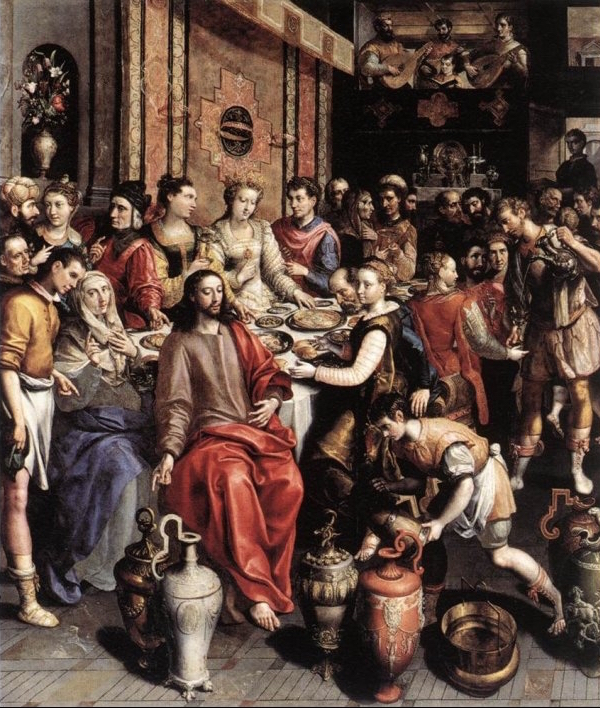
Marriage at Cana by Marten de Vos, 1597. Cathedral of Our Lady, Antwerp, Belgium.
Judging by the text and lamenting style of their opening choruses or opening arias, all cantatas for this Sunday (155, 3, and 13) are very sad at first glance. Which seems strange, since the reading for the day is the miracle of Jesus turning water into wine at the Marriage at Cana. So let’s dig a little deeper in the cantata for this Sunday that I love the most, Cantata 3 Ach Gott, wie manches Herzeleid, from 1725.
My favorite interpretation of this cantata the one by Bach Collegium Japan. The choir sopranos (including Dorothee Mields) sing a truly heavenly “zum Himmel” in the opening chorus, bass soloist Peter Kooy does an excellent job in his on purpose difficult aria and doesn’t hold back in the chorale tune in the opening chorus, and last but not least: fabulous singing by soprano Dorothee Mields and counter-tenor Pascal Bertin in the duet.
If you can’t listen on Spotify or prefer not to, you can find Gardiner’s recording here on YouTube. Soprano: Joanne Lunn; Counter-tenor: Richard Wyn Roberts; Tenor: Julian Podger; Bass: Gerald Finley.
Find the text of Cantata 3 Ach Gott, wie manches Herzeleidhere, and the score here.
Bach was not just a strong believer but also a self-taught theologian, and stated several times that his church music was intended for the glorification of God and to instruct his “neighbor.” On this day of the Marriage at Cana reading, he might have been compelled to illustrate the deeper meaning of the Bible story: earthly troubles can turn into heavenly bliss if you are patient and believe strongly enough that Jesus will lead you. So either he himself or his librettist decided not to mention the Bible story at all in the the text of this cantata.*
It is then not so strange anymore that in the music of this cantata Bach keeps, brilliantly, combining the struggle and the salvation in almost every part of the work.
The achingly beautiful opening chorus at first just sounds like a lament, but has some hidden messages which reveal the salvation. First, in the instrumental introduction, there is an ascending (the way to salvation/heaven) line in the violins at the same time as there is a chromatic descending line (the struggle/affliction) in the oboes, illustrating the last two lines of the text of that chorus:
Der schmale Weg ist trübsalvoll, (The narrow way is full of affliction) Den ich zum Himmel wandern soll. (by which I must travel to heaven.)
Click here to see that visualized by Thomas Braatz on the Bach Cantatas website.
While the Leipzig congregation might have missed this first hidden message, they would have gotten the second: the text communicated through the well-known chorale tune. The same way my Dutch calvinist great-grandmother had all the verses of all the Psalm texts memorized, the Lutherans in Bach’s time knew all their chorales and would immediately think of the text when hearing the tune. For this opening chorus, Bach chose the tune of O Jesu Christ mein’s Lebens Licht, so there was some glorification of Jesus right there amidst the lamentation:
O Jesu Christ mein’s Lebens Licht
Mein Hort, mein Trost, mein Zuversicht
Auf Erden bin ich nur ein Gast
Und drückt mich sehr der Sünden Last.
O Jesus Christ, light of my life,
my refuge, my comfort, my reassurance,
on earth I am only a guest And the burden of sin presses down heavily upon me.
And to make this stand out, Bach uses his “pay attention!” trick again, letting this chorale melody appear in a for him very unusual place: the vocal bass line. To emphasize it, he doubles it with a trombone (which is probably also the reason why this cantata is almost never performed today, because who is going to hire an expensive trombonist just to play along with the choir in one part of the cantata?).
In the other outstanding part of this cantata, the soprano/alto duet, this is all reversed: the music sounds absolutely happy, but if you look at the score, you see a visual illustration of the text in the middle section: Mein Kreuz hilft Jesus tragen (Jesus helps to bear my cross). When the oboe line goes up, the continuo line goes down, and when one vocal line goes up, the other vocal line goes down. On top of that, there are four sharps in the key signature (in Bach’s manuscript this would look like four crosses and a sharp is also called a “cross” in German). We know from other works that hidden messages like this are not a coincidence in Bach’s writing.
Wieneke Gorter, January 16, 2016. Links updated January 10, 2018 and January 31, 2020.
*Seen in the context of the chorale cantata series of 1724/1725, this is not unusual at all. On Several occasions before this Sunday in 1725, Bach had decided to focus more on the text of the chorale he had chosen for the cantata than on the Gospel reading for that day. See for example my post about December 31, 1724 and January 1, 1725.
Paolo Veronese: Jesus Among the Doctors, circa 1560, oil on canvas
Lutherans in the 18th century knew very well that on this Sunday, the first after Epiphany, they should fast-forward twelve years in Jesus’ life, to the story of his parents losing him on a trip to Jerusalem, and then finding him in the temple, conversing with the Doctors. This story often appeared on paintings from the 15th century onward, and the text from Luke was probably as familiar to the Leipzig congregation as the Christmas story :
48. Und da sie ihn sahen, entsetzten sie sich. Und seine Mutter sprach zu ihm: Mein Sohn, warum hast du uns das getan? Siehe, dein Vater und ich haben dich mit Schmerzen gesucht.
[48] And when they saw him, they were astonished. And his mother said to him : ‘My son, why have you done this to us? Your father and I have looked for you with anxiety.’
49. Und er sprach zu ihnen: Was ist’s, daß ihr mich gesucht habt? Wisset ihr nicht, daß ich sein muß in dem, was meines Vaters ist?
[49] And he said to them : ‘How is it that you looked for me?Did you not know that I must be in that which is my father’s?’
In cantata 154 Mein liebster Jesus ist verloren (from 1724, written 3 days after Sie werden aus Saba alle kommen) Bach doesn’t set the scripture literally, except for one of Jesus’ lines of text. He doesn’t let Jesus’ parents talk (as for example Schütz had done 75 years before in his Mein Sohn, warum hast du uns das getan? from Symphoniae Sacrae III) but instead it is “man” in general who thinks he has lost Jesus, and is later happy to have found him again. However, the loss of a child as well as the fear of it happening is something that Bach could relate to, and that drama is palpable in the opening tenor aria.
Find the German text with English translations here, and the score here.
For the rest this cantata feels almost like a little opera, with the very pretty alto aria asking Jesus to please not hide in the clouds, followed by the appearance of Jesus speaking “Wisset ihr nicht, daß ich sein muß in dem, was meines Vaters ist?” and then the exuberant alto/tenor duet rejoicing in the fact that Jesus has been found. Bach uses two special and wonderful orchestrations in this cantata. In the alto aria he uses a “high continuo” with violins and harpsichord to accompany the voice and the oboes, most probably to illustrate purity and innocence. And in the alto/tenor duet Bach brings both the violins of the tenor aria and the oboes from the alto aria together, the first violin and first oboe playing the same part, the second violin and the second oboe also playing the same part, as an additional illustration of the happy reunion and the last two lines of text of the duet:
Ich will dich, mein Jesu, nun nimmermehr lassen, I want never again to abandon you, my Jesus,
Ich will dich im Glauben beständig umfassen. I want to embrace you constantly in faith.
John Eliot Gardiner, in his terrific liner notes with his recording (scroll down to page 6), states that on the text “O Donnerwort in meinen Ohren” (O thunderous word in my ears) in the opening tenor aria, the orchestra should evoke “ear drumming.” (If you would like to listen to this Gardiner interpretation with tenor James Gilchrist, you can find that here on YouTube). Gardiner also points out that this tenor aria is a cousin to Peter’s Ach, mein Sinn! aria from the St. John Passion. That passion would not be performed until Good Friday of that year, 1724, but in his book Bach: Music in the Castle of Heaven Gardiner suggests that Bach was probably working on the passion, and might have been preparing the people in Leipzig for it. This included introducing them to Jesus (even a twelve-year-old one) as a bass voice. This might explain why Bach somewhat unnaturally “interjects” Jesus’ text “Wisset ihr nicht, daß ich sein muß in dem, was meines Vaters ist?” in between the alto aria and the tenor recitative in this cantata.
With cantata 32 Liebster Jesu, mein Verlangen (from 1726), Bach steps even further away from the literal story of this Sunday. It is now not even “man” anymore who has lost Jesus and then finds him again, but the “soul” in the form of a soprano voice, and Jesus. Herreweghe’s first oboist, Marcel Ponseele, recorded a handful cantatas with his own ensemble Il Gardellino and I was excited to find out that they also recorded cantata 32. Beautiful job by soprano Caroline Weynants and of course Marcel Ponseele himself in the pretty opening aria.
In closing, some food for thought: Bach incorporates the text of Psalm 84 Wie lieblich sind deine Wohnungen in the fourth movement of Cantata 32 in the soprano voice. Knowing that Schütz also used that same Psalm text at the end of his Mein Sohn, warum hast du uns das getan?, I wonder if Bach knew that particular Schütz piece and used it as inspiration for this cantata and, who knows, perhaps also for cantata 154, since that one is so operatic, shall we say Schütz-like, in nature and structure …
Wieneke Gorter, January 10, 2016, links updated January 11, 2020.
Some of us love to keep the tree and the lights for a few more days, others are (eagerly or not) looking ahead, facing reality (and finally starting that blog). The same two sentiments can be found in Bach’s music for this time of year. The cantata for January 6 (Epiphany) from 1724 is very Christmas-y, the one from 1725 absolutely not. Both are well worth a listen.
Let’s start with the one that is still in full Christmas swing, from 1724: cantata 65 Sie werden aus Saba alle kommen, with a happy text incorporating the story of the Three Kings visiting the baby Jesus, and featuring 2 horns, 2 recorders, and 2 oboes da caccia in the orchestra. As a child I loved this cantata. It was mainly because of the special instrumentation, the horns prominent in the tenor aria, the oboes in the bass aria. But I also clearly remember it was so cool that the bass aria talks about the New Year!
I grew up with the Harnoncourt recording, and though that interpretation of the tenor aria (sung by Kurt Equiluz) is still one of the best, my “favorite overall” recording of this cantata today is that of Bach Collegium Japan. Tenor James Gilchrist and bass Peter Kooy do a fabulous and compelling job at their arias, and the horns sound beautiful.
The next year, in 1725, Bach wrote cantata 123 Liebster Immanuel, Herzog der Frommen. A gem of a cantata, with little strands of the chorale woven into the opening chorus, extremely beautiful. Both music and text are much more poignant than the Epiphany cantata of the year before. There are even references to the cross. And then there’s the bass aria. When you listen to this cantata for the first time, and you hear the flute start this aria, you will never guess it is going to be a bass aria! It is a very unusual combination of voice and instrument for Bach, and that usually means: pay attention! And yes, there it is in the text, the core of Bach’s 18th century Lutheran faith: even if society casts you out, you don’t belong, you are lonely, then you will still be saved by Jesus.
My favorite recording of this cantata is the one by Montréal Baroque, on which Dutch bass Harry van der Kamp and flutist Grégoire Jeay make something truly special out of that bass aria. I love the liveliness of this interpretation overall, including an opening chorus that immediately grabs my attention and moves me, and fabulous performances by countertenor Matthew White and tenor Charles Daniels in their arias as well.
The only downside for me of the Montréal Baroque recording is that the chorus pieces are all sung one-on-a-part, by the four soloists only. Not only do I have a personal (maybe not historically accurate, but so be it!) preference for 3-5 voices on a part, I also find that soprano Monika Mauch is outbalanced by the men in the opening chorus. I can hardly hear her, which is too bad because I’m sure she’s an equally great singer as the other three.







 Weekly Cantata