Weekly Cantata

Weekly Cantata

Tag Archives: Bach Collegium Japan

No nonsense for Trinity 10, 1724

19 Saturday Aug 2017

Posted by cantatasonmymind in Cantatas, Leipzig, Trinity

≈ Leave a comment

Tags

Bach, Bach Collegium Japan, BWV 101, cantatas, Damien Guillon, flute, Gesualdo Consort Amsterdam, Harry van der Kamp, Leipzig, Luther, Trinity
christ-driving-the-merchants-from-the-temple

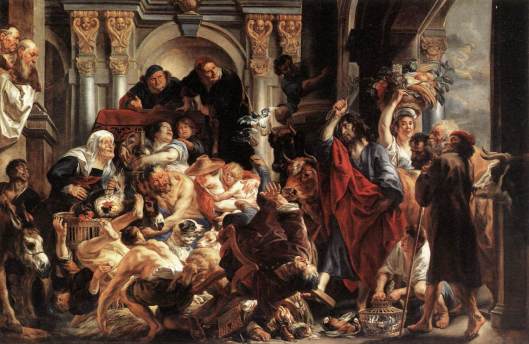
Christ Driving the Merchants from the Temple by Jacob Jordaens, circa 1650. Musée du Louvre, Paris.

After the stunningly beautiful music of cantata 94 from last week, it is a bit hard for me to go back to a “regular” chorale cantata: cantata 101: Nimm von uns Herr, du treuer Gott. But then again, maybe the beauty and lightness of last week’s cantata is the key to understanding this week’s …

I was not familiar with this cantata, because for this Sunday in the liturgical year, the 10th after Trinity, my mother would probably have played the more impressive 46 (written in 1723, its opening chorus later used for the Qui Tollis of the Mass in B minor – see my discussion of it here) or 102 (written in 1726, its opening chorus later used for the Kyrie of the Missa Brevis in g minor – see a short discussion at the end of this post).

There is a nice live recording of cantata 101: Nimm von uns Herr, du treuer Gott on YouTube by the Gesualdo Consort, part of a well-constructed program of Bach works based on the Vater Unser melody (Luther’s German version of the Lord’s Prayer). However, this performance doesn’t include trombones doubling the vocal parts in the opening chorus. If you would like to hear that important feature of this cantata, you can listen to Bach Collegium Japan’s recording of the opening chorus here.

Please find the text and translations here, and the score here.

Why does Bach take a starker approach for this Sunday in 1724 than in those other two years? One reason might be that in 1724, he is more strongly bound to his commitment of using a chorale tune as basis for the cantata than he is to the Gospel text for this Sunday (Jesus predicting the destruction of Jerusalem and him driving the merchants from the Temple). And the chorale for this Sunday is terror-inspiring: written during a time of the plague in 1584, on the melody of Luther’s Vater Unser.

If we go back to last week’s cantata, we should realize how frivolous it was of Bach to compose such a lighthearted cantata, featuring the flute, an ultra-secular, and French instrument! And this only to show off a University student, who didn’t even attend the St. Thomas School! It might very well have upset his employers, and afterwards they might have urged him to write something more appropriate next time, something inspiring devotion in the members of the Leipzig congregations, instead of treating them to the stuff he used to write at the court in Köthen. We will never know, but we can imagine.

So, while not directly quoting the Gospel of Jesus banishing the merchants from the Temple, but perhaps inspired by that story nonetheless, Bach goes back to the basics, the core of the Lutheran faith. And we know that whenever the hymn is based on a melody written by Luther himself, Bach shows the utmost respect for that, and often uses references in his music to remind the congregations of the timeless character of the music and of the dogma.

To reinforce the timeless character, he uses the “old” ensemble of cornetto and trombones to double the vocal parts in the opening chorus — the same way he did this for cantata 2 and cantata 25. Bach pushes the doctrine down everyone’s throat even more, or as Gardiner says, he “subjects his listeners to a twin-barrelled doctrinal salvo” when he not only presents the 1584 chorale melody in all but one movement of the cantata, including in the recitatives, but also quotes Luther’s hymn Dies sind die heil’gen zehn Gebot (These are the holy Ten Commandments) in the instrumental opening of the first movement.*

To further rub in the need for penitence, Bach presents strong dissonances on the words “schwere Straf und grosse Not” (grave punishment and great distress). Also, in the terrific Bass aria**, Bach instills horror in his audience when he makes an abrupt move from E minor to C minor on the word “Warum” of the sentence “Warum willst du so zornig sein” (Why wilt thou be so angry). Gardiner calls this a “Mahlerian swerve” and says “Not even Purcell, with his penchant for a calculated spotlit dissonance, was capable of matching this when setting the same words in his anthem “Lord, how long wilt thou be angry.”

In 1726 Bach wrote cantata 102 Herr, deine Augen sehen nach dem Glauben! for this same Sunday, the 10th Sunday after Trinity. It is a terrific composition. Bach was proud of it too, because he later re-used it in the Missa Brevis in F Major (BWV 233) and the Missa Brevis in g minor (BWV 235). Listen to Il Gardellino’s recording of it here on YouTube, with Damien Guillon, countertenor; Marcus Ullman, tenor; and Lieven Termont, bass. Especially the aria Aria Weh der Seele, die den Schaden (perhaps better known today as the soprano aria Qui Tollis from BWV 233) by countertenor Damien Guillon and oboist Marcel Ponseele is to die for.

Wieneke Gorter, August 18, 2017.

* It is not the first time he quotes this hymn in an opening chorus either, see my post about cantata 77 here.

** This bass aria is the best movement of the piece in my opinion, and probably also the reason why the leader of the Gesualdo Consort, Harry van der Kamp, himself the bass soloist, programmed this cantata in the first place.

A double bill for July 2

01 Saturday Jul 2017

Posted by cantatasonmymind in Cantatas, Chorale cantatas 1724/1725, Leipzig, Trinity

≈ Leave a comment

Tags

Bach Collegium Japan, Deborah York, Gerd Türk, Pascal Bertin, Peter Kooy, Ton Koopman

In my effort to follow Bach’s compositions in the order in which he wrote them in 1724, I sometimes get a bit confused, because in 2017 the Sundays of the church year are exactly one week later than in 1724. Where it gets tricky is around the Feast days of St. John and the Visitation of Mary, which are always on the same date: June 24 and July 2 respectively.

See how the dates of 1724 compare to the dates of 2017 in this table here below, and you’ll understand my dilemma for today: in Bach’s time, if the feast of the Visitation fell on a Sunday, it would cancel out the theme and thus the cantata for that Sunday. That is why there is no cantata for Trinity 4 from 1724, and why Weekly Cantata will be on break next week.

Sunday/Feast day17242017Cantata
Trinity 1June 11June 1820: O Ewigkeit, du Donnerwort
Trinity 2June 18June 252: Ach Gott, vom Himmel sieh darein
St. John (Johannis)June 24June 247: Christ, unser Herr, zum Jordan kam
Trinity 3June 25(July 2)135: Ach Herr, mich armen Sünder
Visitation (Mariä Heimsuchung)July 2July 210: Meine Seele erhebt den Herren
Trinity 4July 2July 9(no cantata from 1724 because same day as Visitation)
Trinity 5July 9July 1693: Wer nur den lieben Gott lässt walten
Trinity 6July 16July 23(no cantata from 1724 because of Bach’s visit to Köthen)
Trinity 7July 23July 30107: Was willst du dich betrüben
Trinity 8July 30Aug 6178 Wo Gott der Herr nicht bei uns hält

So officially, I should present you only with the cantata for the feast of the Visitation today, but since we are listening in order of 1724, I give you some highlights of cantata 135 Ach Herr mich armen Sünder first. An update from 2021: Since I first wrote this post, a beautiful live video recording of this cantata has been released on YouTube by the J.S. Bach Foundation. Find it here.

The cantata is the last of the set of four I described in this post, and thus has the cantus firmus in the bass in the opening chorus. This is nicely done on the J.S. Bach Foundation recording, with a trombone doubling the choral bass part. But the best choral basses are still on the recording by Bach Collegium Japan. Listen to that recording on Spotify.

While the boy sopranos have a bit more work in the opening chorus (as was the case the last two weeks), there is again no soprano aria in this cantata. The Leipzig congregations haven’s heard a soprano solo since Trinity Sunday.

But then, on July 2, 1724, they get to hear the cantata for the feast of the Visitation: cantata 10 Meine Seel erhebt den Herren. With a soprano aria directly after the opening chorus, and a virtuoso one too. It might be that a talented new student had enrolled in the school, or Bach was finally ready training one, or there is a talented boy visiting for the holiday.* There is a very nice live video of Ton Koopman performing this in the St. Thomas Church in Leipzig during the Bach Festival there in 2003, with Deborah York singing the soprano aria.

Wieneke Gorter, July 1, 2017. Updated March 26, 2020, and June 19, 2021.

*Read more about the possibility of musicians visiting for this feast day in my post from last year about the Visitation. Read more about the soprano problem in this post.

The Herreweghe altos (Trinity 2 in 1724)

25 Sunday Jun 2017

Posted by cantatasonmymind in Cantatas, Chorale cantatas 1724/1725, Leipzig, Trinity

≈ Leave a comment

Tags

Alex Potter, alto, Bach Collegium Japan, Collegium Vocale Gent, Eduard van Hengel, Phlippe Herreweghe

BWV2_title
The title page of cantata 2 Ach Gott tom Himmel sieh darein, written by Bach’s lead copyist, J.A. Kuhnau. Staatsbibliothek zu Berlin Preußischer Kulturbesitz

Regular readers of this blog know that I have a soft spot for the Herreweghe choir sopranos*. But the alto section of Collegium Vocale Gent is often equally impressive, and they deserve a special mention for their fabulous sound in the cantus firmus of this cantata’s opening chorus. Listen to Herreweghe’s recording of cantata 2 Ach Gott, vom Himmel sieh darein on YouTube.

Find the text of this cantata here (read along so you can see the brilliant text-illustration in the music), and the score (where you can see which instruments double which vocal parts) here.

Bach wrote this cantata for the 2nd Sunday after Trinity, which fell on June 18 in 1724.  As I explained last week, this is the second in a series of four cantatas at the start of Bach’s 1724/1725 Leipzig cycle, and according to the master’s orderly design for these first four chorale cantatas, the cantus firmus of the hymn tune (always the same as the cantata title) is now in the alto part.

This Herreweghe recording is from before the time that soloists joined the choir sections of Collegium Vocale, which means that alto soloist Ingeborg Danz does not sing in this excellent group of one mezzo (Mieke Wouters), two contraltos (Yvonne Fuchs and Cécile Pilorger), and one countertenor (Alex Potter). Also the blend with the instruments doubling this alto part (two oboes and one trombone) is so marvelous it gives me goose bumps. Then again, there aren’t many things in music that move me more than a Bach opening chorus with trombones.

Whenever Bach uses the archaic form of chorale motet as opening chorus, especially when he combines it with the use of the Renaissance/Early Baroque trombone quartet (1 cornetto and 3 trombones), he wants to stress the timeless importance, the authoritative character of a message. In this case the at that point already two centuries old message is the chorale, one of Luther’s own.  For readers who understand German: Eduard van Hengel’s website (in Dutch) has a very insightful overview of the original German text of Psalm 12, the text of Luther’s chorale, and how Bach’s librettist changed that into the text for the cantata.  You can find it here.

Bach alto and tenor arias are at their prettiest, I find, when they are written as a trio sonata, and there is a wonderful example of that in the alto aria Tilg, o Gott in this cantata. It is a plea for help in fighting the “Rottengeister,” or the sectarians amidst the Lutherans. Alto soloist Ingeborg Danz does a terrific job interpreting the text. When the alto starts singing the word Rottengeistern, we see that it was that word we had already heard many times in the triplets of the violin part. As Eduard van Hengel says, it is the “popular easy talk of the sectarians, and that is also the reason why the other two parts don’t have this motive” [to further illustrate the schism].

In his effort to educate his fellow Lutherans (the Leipzig congregations) with his music, Bach wants to make it clear that he’s still preaching by means of the well-known chorale, and uses longer notes for the direct quotation (in music and text) of the chorale in this aria: der uns will meistern.

The best interpretation of the tenor aria Durchs Feuer wird das Silber rein actually appears on another recording, that of Bach Collegium Japan with tenor Gerd Türk. You can listen to that aria here. Here we have arrived at the solution/salvation part of the cantata, and so this music is more pleasant, easier to listen to. But Bach is still preaching: there are some crossing (!) lines in the music, and in the middle section, which tells the listeners to be patient (sei geduldig) and Bach stresses the words Kreuz und Not.

So one wonders: was Bach’s decision to focus on chorales for this 1724/1725 cantata cycle inspired by his need to make things easier for the boy sopranos, or by a wish to explain the theology to the congregations in a way that was more obvious to them than the more complicated, sometimes perhaps too hidden, messages he had so far delivered by way of his music? Or had the City Council or the church elders told him to to this?

*Read more about that in this post.

Wieneke Gorter, June 25, 2017

On my mother’s birthday, March 24

24 Friday Mar 2017

Posted by cantatasonmymind in Cantatas

≈ 1 Comment

Tags

Amsterdam Baroque Orchestra, Bach, Bach Collegium Japan, bwv 127, bwv 202, bwv 44, cantatatas, Caroline Stam, Collegium Vocale Gent, Dorothee Mields, Masaaki Suzuki, Nancy Argenta, Phlippe Herreweghe, Ton Koopman

OLYMPUS DIGITAL CAMERA

my mother with my daughter, The Hague, summer of 2009

This year, on March 24, my mother would have turned 71. Sadly, she left us on November 19, 2010, after a tragic illness we only understood to be a terminal one on September 5 of that same year. To say that those months were an emotional roller coaster for all involved is an understatement. Normally very liberal and progressive in her Christianity, my mother turned very pious in her last weeks, and during that time she didn’t really let any persons in anymore, only music.

One of the major reasons I started this blog in January 2016 was to continue my mother’s legacy of playing the cantata for the appropriate Sunday every week, but also to remember the joy of going to concerts with my mother and listening to recordings together with her.

So I would like to think of this post as a short radio program with beautiful Bach music, featuring three soprano arias I strongly associate with my mother, sung by singers she and I adore(d).

A fond childhood memory is my mother, my sister, and I taking the bus from the little town where we lived to a town 15 kilometers (9 miles) away, where my mother was going to sing a solo in a wedding service. I remember what she wore: a light blue dress with tiny white and red flowers on it, a narrow red belt, and red sandals with heels. The solo she was singing was the aria “Sehet in Zufriedenheit” from cantata 202. I remember being in awe that she was standing there on the organ loft and singing it so beautifully. A gorgeous example of this aria, in the exact tempo in which my mother liked to perform it, is this recording of Nancy Argenta with Ensemble Sonnerie under the direction of Monica Huggett:

Sehet in Zufriedenheit
See in contentment
Tausend helle Wohlfahrtstage,
a thousand bright and prosperous days,
Dass bald bei der Folgezeit
so that soon as time passes
Eure Liebe Blumen trage!
your love may bear its flower!

Much later, my parents had a subscription to the series of cantata performances by the Amsterdam Baroque Orchestra with Ton Koopman, and there they got to see and hear many different soprano soloists. I remember them being impressed with Caroline Stam. Hear her sing the aria “Es ist und bleibt der Christen Trost” from cantata 44, one of my mother’s favorite Bach cantata arias of all time,  with the Amsterdam Baroque Orchestra under the direction of Ton Koopman.

Es ist und bleibt der Christen Trost,
The consolation of Christians is and remains
Dass Gott vor seine Kirche wacht.
God’s watchful care over his church.
Denn wenn sich gleich die Wetter türmen,
For even though at times the clouds gather,
So hat doch nach den Trübsalstürmen
yet after the storms of affliction
Die Freudensonne bald gelacht.
the sun of joy has soon smiled on us.

We felt extremely blessed that Caroline Stam agreed to sing at my mother’s funeral service. We asked her to sing Purcell’s “Evening Hymn,” since that had been in the top 5 on my mother’s iPod in her last weeks. But for the Bach aria, we let Caroline pick what she would like to sing. I am still very grateful for that decision. Always very conscious of texts, Caroline chose the hauntingly beautiful “Die Seele ruht” from cantata 127. For years, I have not been able to listen to this aria, but now I can again, though it still makes me cry a little. Hear Dorothee Mields sing this aria with Collegium Vocale Ghent under the direction of Philippe Herreweghe:

Die Seele ruht in Jesu Händen,
My soul rests in the hands of Jesus,
Wenn Erde diesen Leib bedeckt.

Though earth covers this body
Ach ruft mich bald, ihr Sterbeglocken,
Ah, call me soon, you funereal bells,
Ich bin zum Sterben unerschrocken,

I am not terrified to die
Weil mich mein Jesus wieder weckt.

Since my Jesus will awaken me again.

If you would like to read more, here are five posts from 2016 in which I talk about my mother a lot or a little bit:

The order of things

Glorious soprano arias and unusual instrumentation

The Crown on Bach’s 1723 Trinity season

Many things to be proud of

Our Christmas Morning

Wieneke Gorter, March 24, 2017

Come out of your hole to hear a violin concerto

03 Friday Feb 2017

Posted by cantatasonmymind in Cantatas, Christmas, Epiphany, Leipzig

≈ Leave a comment

Tags

Bach, Bach Collegium Japan, James Gilchrist, Leipzig, Luther, Masaaki Suzuki, Peter Kooy, Robin Blaze

presentationinthetemple
Presentation in the Temple (1640/1641) by Simon Vouet (1590-1649). Musée du Louvre, Paris.

In many traditions, from pre-Christian European to contemporary American, February 2 marks the end of the dark part of the winter.  Feasts on this day celebrate the daylight, looking ahead to spring, and the start of new things. Growing up in a Calvinist protestant culture in the Netherlands, I wasn’t aware of any of these holidays.

Let’s start with the silly American holiday on February 2: Groundhog Day. If the groundhog (some sort of marmot) comes out of her hole on this day while it is cloudy, spring will be early; if it is sunny and the groundhog will thus see her own shadow when she comes out of her hole, she will be scared and go back inside and spring won’t start for another six weeks. Grown men actually observe the groundhogs on February 2.

People from Celtic cultures celebrate Imbolc or Brigid’s Day on February 2 because it is the midway point between the winter solstice and the spring equinox. The holiday is a celebration of the lengthening days and the early signs of spring. The lighting of candles and fires represented the return of warmth and the increasing power of the Sun over the coming months.

The Catholic feast of Candlemas also originates in pre-Christian times, and originally marked the end of a period of light feasts which started around mid November. After the early Christians established that Jesus was born on December 25, it was easy to declare Saint Martin (Nov 11, 40 days before Christmas) the start of the great Christmas season and February 2 (40 days after Christmas) the end of it. I read that in some countries people leave their Christmas decorations up until Candlemas. I would have loved to have that tradition in the Netherlands too, because I had serious trouble with the bleak, grey, uneventful month of January there. And all procrastinators are now absolved: you didn’t know it, but you were doing the right thing to leave those lights up until February!

The Catholic Church merged Candlemas with the feast of the Purification of Mary and the Presentation of Jesus at the Temple. In the Jewish tradition, a new mother was “unclean” for the first 40 days after giving birth. On the 40th day, she would have to visit the temple for a purification ceremony, and to present her son to the priests. Luther kept this Catholic feast on the calendar, but  focused much more on the Presentation of Jesus at the Temple  than on the Purification of Mary.  What is more, he turned Simeon’s song of praise into a message of “Now I can die in peace.” This is why all five cantatas (BWV 82 (the famous Ich habe genug), 83, 125, 157, and 158) Bach wrote for this holiday are mostly about the joy of dying. But not to worry, the cantata from 1724 is actually very festive.

Listen to/watch cantata 83 Erfreute Zeit im neuen Bunde by the Netherlands Bach Society on YouTube. Shunske Sato, violin and direction; Robin Blaze, alto; Daniel Johannsen, tenor; Stephan MacLeod, bass. I prefer this recording because this cantata is a violin concerto and here we can see one of the best Baroque violinists and Bach interpreters, Shunske Sato, at work.* However for the most magical rendition of the second movement please also listen to the Bach Collegium Japan recording (Natsumi Wakamatsu, violin; Robin Blaze, alto; James Gilchrist, tenor; Peter Kooij, bass)

Find the German text with English translations of Cantata 83 here, and the score here.

The first and third movement  are written like a violin concerto and celebrate the “new” era. According to an excellent study by Dutch musicologist Pieter Dirksen, presented at a Bach Symposium in Germany in 2000, the impressive violin part was most likely written for violin virtuoso Johann Georg Pisendel from Dresden. Dirksen makes a very convincing case that Bach wrote this past Sunday’s operatic cantata 81 and this cantata 83 (both from the same week in 1724) specifically to please musicians and perhaps also dignitary guests from Dresden, giving them the two musical forms the Dresden court favored most: an opera in the form of cantata 81 and a concerto in the form of cantata 83. There are no documents supporting the suggestion that Pisendel was in Leipzig around the time this cantata was played. However, as I have mentioned before in this blog, it seems evident from Bach’s writing around special holidays that there were either guest musicians or colleagues to impress in those weeks. Also, Dirksen gives many plausible examples of links to Dresden in the style and instrumentation of these compositions, and argues that Bach had no other violinist available, including himself, who would have been able to play this and that this is why he didn’t write virtuoso violin solos in any cantatas from the first Leipzig cycle.

The second movement symbolizes the “old” tradition Simon stands for in the Gospel story. In a way he has never done this in any other cantata, Bach sets Luther’s translation of Simeon’s words (“Herr, nun lässest du deinen Diener in Friede fahren …”) to the old Gregorian psalmtone for Nunc Dimittis, which was the Roman version of Simeon’s words. It is likely he wanted to show the Catholic guests from Dresden he was familiar with their tradition too, or perhaps he wanted to honor the Catholic history of this feast day. The very best rendition of this movement is sung by Peter Kooij on the Bach Collegium Japan recording of this cantata. My late mother used to say: “Peter Kooij must have a special line with God.” He definitely has a special line with Bach.

Wieneke Gorter, February 2, 2017, updated February 2, 2020 and February 2, 2023.

*read how Shunske Sato’s playing made me want to write for this blog again in this post

A Discovery for Third Christmas Day

27 Tuesday Dec 2016

Posted by cantatasonmymind in Bach's life, Cantatas, Christmas, Leipzig

≈ Leave a comment

Tags

Bach, Bach Collegium Japan, Christmas, Leipzig, Peter Jelosits, Peter Kooy, Robin Blaze, trombone

bwv64facsimile
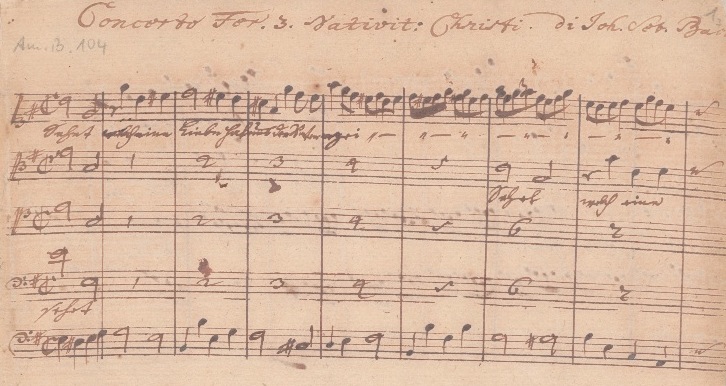
First page of Bach’s original score for cantata 64 Sehet, welch eine Liebe hat uns der Vater erzeiget for the Third Day of Christmas. Staatsbibliothek zu Berlin (Amalienbibliothek), Berlin.

The third cantata of Bach’s Christmas Oratorio was very popular in our house, and it was my sister’s all-time favorite. That is probably why I had never heard the beautiful cantata 64 Sehet, welch eine Liebe hat uns der Vater erzeiget before doing research for this blog, even though it has trombones in the opening chorus and in all three (!) chorales, and Peter Jelosits is singing the soprano aria on the Harnoncourt recording.

Listen to Bach Collegium Japan’s recording of cantata 64 on Spotify. Soloists: Yukari Nonoshita, soprano; Robin Blaze, countertenor; Peter Kooij, bass. With Concerto Palatino: Yoshimichi Hamada, cornetto; Simen van Mechelen, Charles Toet, and Wim Becu, trombones.

Find the text here, and the score here.

Bach wrote this cantata in 1723 and the structure, with the three chorales, is very similar to cantata 40 from yesterday, written that same year.

During his four-week  Advent Break that first year in Leipzig (he repeated a Weimar cantata on the first Sunday of Advent, and was not to perform any music in the churches for the next three Sundays), Bach wrote six new cantatas for the period from December 26, 1723, to January 9, 1724 (cantatas 40, 64, 190, 153, 65, and 154). But that was not all. For Christmas Day 1723, he supplemented cantata 63 from Weimar with a newly written Magnificat. Knowing how hard it is for a choir to sing that Magnificat (on the same level as the Mass in B Minor and the Motets), it is clear that Bach did not have a “break” at all, but was very busy rehearsing his choir in addition to writing all this new music.

Wieneke Gorter, December 27, 2016, Harnoncourt link updated December 26, 2019.

Bach in Vienna / Robin Blaze going wild

06 Sunday Nov 2016

Posted by cantatasonmymind in 1723 Trinity season special series, Cantatas, Leipzig, Trinity

≈ Leave a comment

Tags

24th Sunday after Trinity, Bach Collegium Japan, BWV 105, BWV 60, Eduard van Hengel, Gerd Türk, Jason Victor Serinus, John Eliot Gardiner, Masaaki Suzuki, Peter Kooy, Robin Blaze, San Francisco Classical Voice, St. John Passion, St. Matthew Passion, Trinity 24

kokoschka_pieta

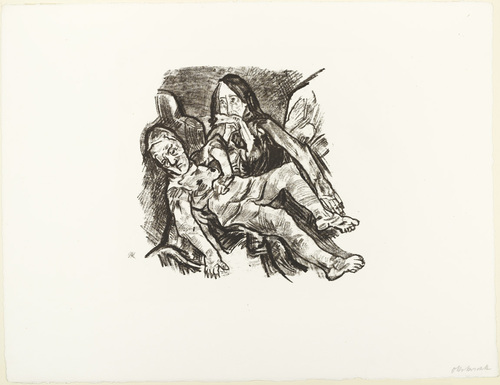
Pietà (It is enough) / Pietà (Es ist genug), plate 11 from a series of 11 lithographs O Ewigkeit, Du Donnerwort by Oskar Kokoschka, 1914/1916. Museum of Modern Art, New York.

In Vienna, they were all talking about Bach’s cantata 60 O Ewigkeit, Du Donnerwort. The astonishing harmonization in the closing chorale as well as the structure of a “dialogue” between Fear (alto) and Hope (tenor) made it one of the most unusual among his cantatas, and apparently something worth discussing. In the first half of the 20th century, that is. In 1935  Alban Berg used the “modern” harmonization from the closing chorale Es ist genug in the final movement of his violin concerto To the Memory of an Angel–an instrumental Requiem for Manon Gropius, daughter of Bauhaus architect Walter Gropius and Mahler’s widow, Alma Schindler.

Several years before, the same Alma Schindler had a short-lived affair with Czech painter Oskar Kokoschka. After they broke up, Kokoschka processed his torment by making a series of 11 lithographs to illustrate the cantata. The dialogue between Fear (the alto) and Hope (the tenor) in the cantata became a dialogue between Alma and himself, in pictures only: click here to see the entire series. Many thanks to Eduard van Hengel for pointing this out.

Listen to Bach Collegium Japan’s recording of this cantata on Spotify, with countertenor Robin Blaze and tenor Gerd Türk. Find the German text with English translations here, and the score here.

Bach wrote this cantata 60 O Ewigkeit, Du Donnerwort for the 24th Sunday after Trinity in 1723, the Sunday normally linked to the Gospel story of the Raising of Jairus’ Daughter. However, in 1723–as now in 2016–this day fell on the first Sunday in November: All Hallows Sunday, All Saints Sunday, however you want to call it, but the Sunday on which the congregation would have commemorated all who had passed away that year. None of the commentaries I have read mention this, but I think it is important, because I feel this cantata is much more about how horrible it might be to die, or the thoughts one has when sitting at a loved one’s deathbed, than it is about the Raising of Jairus’ Daughter.

Of all the recordings I listened to, I like Bach Collegium Japan’s the best, because of Robin Blaze’s interpretation of the alto part. I always love his voice, but he is usually quite understated in his singing. He explains this well in this interview on San Francisco Classical Voice. I sometimes wish he would indeed sing with Kate Bush and “let go” a little, so I was thrilled to hear that in this cantata he actually does go a bit wild, for his standards at least, and that Suzuki lets him do it. His conviction in the opening chorale is already terrific (also note the wonderful blend with the horn doubling his part), but the way he sings the text “Und martert diese Glieder” (and tortures these limbs) in movement 2 is amazing, spot-on, and unrivaled by any others I listened to.

As we have seen before in the course of these 1723 Trinity Season cantatas (read for example my post on cantata 105) there are elements of Bach’s passions already present in this cantata. The agitated singing of the tenor in the stunningly beautiful duet (movement 3) resembles the Ach, mein Sinn! tenor aria from the St. John Passion. The repeated tremolo in the violins in movement 1 is something Bach often uses to illustrate fear, and this will show up again in the tenor arioso O Schmerz! Hier zittert das gequälte Herz in his St. Matthew Passion.

For further reading, including all the amazing harmonies in this piece which impressed the Viennese composers of the early 20th century,  as well as other insights, I can highly recommend Gardiner’s journal entry about this cantata (start reading on page 5).

Wieneke Gorter, November 6, 2016, updated November 21, 2020

A Weimar cantata for Trinity 20

09 Sunday Oct 2016

Posted by cantatasonmymind in 1723 Trinity season special series, Cantatas, Leipzig, Trinity

≈ 2 Comments

Tags

Bach, Bach Collegium Japan, Leipzig, Makoto Sakurada, Peter Kooy, St. Matthew Passion, Trinity 20, Yoshikazu Mera, Yumiko Kurisu

Vornehme Hochzeitsgesellschaft

Vornehme Hochzeitsgesellschaft (Distinguished Wedding party) by Wolfgang Heimbach, 1637. Kunsthalle Bremen, Germany.

I’m in the middle of St. Matthew Passion concert weekend now with California Bach Society. To read more about the connection between this blog and Bach’s Great Passion, please see my post from last week.

This week, while doing dishes, packing dinners, promoting our concerts on Facebook, and making spreadsheets for the youth choir logistics, I listened to several recordings of the 1723 cantata for this Sunday: cantata 162 Ach! ich sehe, itzt, da ich zur Hochzeit gehe, and can safely say I recommend Bach Collegium Japan’s recording of this cantata. It has the most sensitive playing in the instrumental opening and the best interpretation of the bass aria and the soprano aria in my opinion.

Listen to the recording of cantata 162 by Bach Collegium Japan on Spotify. Soloists: Soprano: Yumiko Kurisu, Counter-tenor: Yoshikazu Mera, Tenor: Makoto Sakurada, Bass: Peter Kooy.

Read the text here, and find the score here.

Bach wrote this cantata in Weimar, and performed it there on October 25, 1716. For the performance in Leipzig on October 10, 1723, he added a corno da tirarsi to the instrumentation (the Bach Collegium Japan recording is based on the Weimar version, and thus doesn’t feature the corno da tirarsi).

A very short explanation of the cantata, thanks to Eduard van Hengel: Cantata 162 is based on the Gospel text for this Sunday: Jesus compares the heavenly kingdom with the wedding of a King’s son. Many guests decline the invitation, and several of those who do come are sent away because they are not properly dressed. Since the relationship between Jesus and the soul of the believer is compared to the bond between groom and bride, the believers will be at first concerned that they will not be allowed to join the wedding (cantata movements 1-3), but can then rejoice in their conviction that Jesus, through his suffering, will provide the proper dress for them (cantata movements 4-6).

To read more in Dutch, please go to Eduard van Hengel’s website; to read more in English, find Gardiner’s notes about this cantata here.

Wieneke Gorter, October 9, 2016. Updated October 21, 2023.

A detour to 1725

18 Sunday Sep 2016

Posted by cantatasonmymind in 1723 Trinity season special series, Cantatas, Leipzig, Trinity

≈ Leave a comment

Tags

according to Lutheran Church year, Bach, Bach Collegium Japan, BWV 148, BWV 76, BWV 83, cantatas, Gerd Türk, Gottfried Reiche, John Eliot Gardiner, Mark Padmore, Masaaki Suzuki, Maya Homburger, Natsumi Wakamatsu, Pieter Dirksen, Pisendel, Robin Blaze, Toshio Shimada

sleeping_girl
Sleeping girl in a landscape, after Bernhard Keil, 17th century. Gemäldegalerie Alte Meister, Kassel, Germany.

In the first version of this post, I argued that cantata 148 Bringet dem Herrn Ehre seines Namens for the 17th Sunday after Trinity was written in 1723, dismissing the statements of several scholars it was probably written in 1725. I agreed with them that this cantata is a bit “out of place” between the somber but extremely beautiful and compelling cantatas of Trinity 16 and Trinity 19, and that the text looks very similar to a poem by Picander, the librettist with whom Bach did not collaborate before 1725. However, I was not convinced by their third argument that  Bach’s writing in the  opening chorus would be too “new” for 1723, and at first I didn’t see how Bach could have practically written the cantata in 1725.

I suggested that Bach was too busy in 1725, coming back from a trip to Dresden right before this cantata had to be performed on September 23 of that year. But when I discussed this idea with Eduard van Hengel, he reminded me that Bach would have had plenty of time to compose a cantata well ahead of his trip to Dresden, since–as far as we know–he had not written a new cantata since August 26. So that was argument number 4 for placing this cantata in 1725 instead of 1723.

Argument number 5 presented itself to me while I did my research for cantata 83, reading Pieter Dirksen’s article on Bach’s writing for violin in his first Leipzig cycle of cantatas. Dirksen points out that Bach’s new compositions from 1723 don’t feature virtuoso parts for violin at all. He suggests the reason for this is that Bach’s orchestra in Leipzig (including Bach himself*) was missing a violinist who could play technically challenging music.

Johann Georg Pisendel

After reading Dirksen’s article on Bach’s connection with the Dresden violinist Johann Georg Pisendel,** and knowing that soon after Trinity 17 it would be Michaelmas, I got excited: the cantata 148 story was coming full circle! I was now no longer seeing Bach juggling ink and parchment on the coach back from Dresden to Leipzig on Saturday September 22, 1725, but instead I was imagining a friend in that coach with him: Johann Georg Pisendel.

If it is true that Pisendel visited Leipzig for the Purification of Mary holiday in 1724, as Dirksen suggests, it is not far-fetched to assume he would do so again for the feast of Michaelmas in 1725 (on September 29, so only six days after Trinity 17 in 1725). St. Michael’s Fair was a huge event in Leipzig, drawing visitors from as far as England and Poland, increasing the city’s population to 30,000, and thus also increasing the “audiences” for Bach’s music in the churches.

For this cantata, I prefer the recording by Bach Collegium Japan, with soloists Robin Blaze (countertenor), Gerd Türk (tenor), Toshio Shimada (trumpet), and Natsumi Wakamatsu (violin). Listen to this recording on Spotify or support the artists and purchase the album on Amazon.com, Amazon.de, or Amazon.fr.

Find the German texts with English translations here, and the score here.

The text of cantata 148 Bringet dem Herrn Ehre seines Namens talks about the importance of coming to church on Sunday, and listening to the music in the church (tenor recitative and aria), but it also talks about taking a day of rest (alto aria).

While the opening chorus is exceptional,  it doesn’t sound very polished or “finished.” Gardiner, while otherwise excited about it, is not satisfied with the ending, and suggests that “perhaps Anna Magdalena called from the kitchen that dinner was on the table and the soup was getting cold.” What can I say? Only a male writer would say this!

The virtuoso violin part shows up in the tenor aria. On this recording of Bach Collegium Japan, played by Natsumi Wakamatsu, it moves me to tears. The tenor aria on the Gardiner recording is good too, with tenor Mark Padmore, and violinist Maya Homburger. You can find that one here. Whoever played this violin part in 1725, this person was not resting on Sunday …

©Wieneke Gorter, originally written September 18, 2016; revised February 4, 2017, links updated and picture of Pisendel added October 2, 2020.

*In his article Dirksen explains in detail how Bach went through the trouble of making the violin solo of cantata 76  relatively easy to play for an intermediate violinist, and suggests Bach was a good violinist, but perhaps not such a virtuoso as many believe him to be. Dirksen’s article appears on pages 135-156 of Bachs 1. Leipziger Kantantenjahrgang: Bericht über das 3. Dortmunder Bach-Symposion 2000 — Dortmund: Klangfarben Musikverlag, 2002.

**Pisendel had been friends with Bach since 1709 and several scholars think that it was for this Italian-trained virtuoso that Bach wrote his most complicated violin music. It is assumed that Bach had Pisendel in mind when writing the violin part of the “Laudamus te” of his Mass in B Minor.

A most amazing trumpet part

21 Sunday Aug 2016

Posted by cantatasonmymind in 1723 Trinity season special series, Bach's life, Cantatas, Leipzig, Trinity

≈ Leave a comment

Tags

Anhalt-Zerbst, Anna Magdalena Bach, Bach, Bach Collegium Japan, BWV 635, BWV 678, BWV 679, BWV 75, BWV 76, BWV 77, Gottfried Reiche, John Eliot Gardiner, Köthen, Kirsten Sollek, Luther, Lutheran Church year, Masaaki Suzuki, organ preludes, Peter Kooy, Saxe-Weissenfels, slide trumpet, Toshio Shimada, tromba da tirarsi, trumpet, Wilcke

master_of_the_good_samaritan_001
The Good Samaritan by “the Master of the Good Samaritan,” Dutch, 1537

To fully appreciate today’s cantata, I encourage you to first listen to Luther’s hymn,  Dies sind die heil’gen Zehn Gebot (These are the holy Ten Commandments). I was not familiar with this tune, and had to do some research to understand what the slide trumpet was playing in the opening chorus. It was a very well-known hymn in Bach’s time. The Leipzig congregations sang it many times a year, and also sang it during the church services on Sunday August 22, 1723, the 13th Sunday after Trinity (probably preceded by an organ prelude in the style of BWV 635, see below). It was an important hymn for Bach. You can listen to his own chorale setting of it here.

It is also worthwhile to listen how Bach used this melody in three very different organ works: BWV 635, BWV 678, and BWV 679. He wrote BWV 635 as part of the Orgelbüchlein, in Weimar, the other two in the mid 1730s as part of the Clavier-Übung III.

The cantata for this Sunday, cantata 77 Du sollt Gott, deinen Herren, lieben features this chorale-tune in the opening chorus, but only in the tromba da tirarsi (slide trumpet) part and the continuo part. In the continuo it appears in long notes, and is not as clearly audible as in the trumpet part. There are exactly ten entrances for the trumpet within that opening chorus, the last time featuring the entire chorale tune, of course pointing to the ten commandments.

Bach Collegium Japan’s recording showcases this feature the best of all recordings I listened to, superbly played by Toshio Shimada, on a real tromba da tirarsi. I also like his playing the best in the alto aria. Listen to this recording on Spotify or on YouTube.

Read the text here, and find the score here.

John Eliot Gardiner suggests that Bach made a theological statement by presenting his first two Trinity cantatas in Leipzig,  75 for Trinity 1 (focusing on the love of God/how to be before God) and 76 for Trinity 2 (focusing on brotherly love/how to love one’s neighbor) in close relation to each other, and that all through this 1723 Trinity season he has tried to reinforce the idea that those themes are connected, and how the believers should apply the laws from the Bible to themselves and to their own daily lives. He further argues that with this opening chorus he comes full circle back to that connection, by using a double fugue, by reminding the listeners of the “law” by way of the chorale in  the trumpet part, and by setting the text of the Gospel immediately preceding the parable of the Good Samaritan (Luke 10):

27. Er antwortete und sprach: Du sollst GOtt, deinen HErrn, lieben von ganzem Herzen, von ganzer Seele, von allen Kräften und von ganzem Gemüt und deinen Nächsten als dich selbst.

[27] And he answering said, Thou shalt love the Lord thy God with all thy heart, and with all thy soul, and with all thy strength, and with all thy mind; and thy neighbour as thyself.

After the bass recitative and soprano aria further elaborating on the “Love for God”-theme, and the tenor aria on the “Good Samaritan / Love your neighbor”-theme, we are treated to the most amazing tromba da tirarsi playing of all Bach cantatas written for this instrument, in this very unusual and humble alto aria, beautifully sung by mezzo-soprano Kirsten Sollek, and expertly played on the slide trumpet by Toshio Shimada.

This is an incredibly difficult part for the tromba da tirarsi, and almost impossible to play well on a “regular” Baroque trumpet. Was this Bach’s way of illustrating the “Unvolkommenheit” in the text? Would even Reiche not have been able to play this perfectly, with only a few days rehearsal time? And/or did Bach want people in the church to pay attention, so that this would be a true moment of reflection in the service?

In the region where Bach lived and worked, the trumpeters were very good, and Bach knew them and their world well, especially since he had married into a trumpet family in 1721. All the men in Anna Magdalena Wilcke’s family that we know of (father, brother, and husbands of all three sisters) were well-regarded trumpeters at the Anhalt-Zerbst court, about 17 miles (28 km) directly north of Köthen, and the Saxe-Weissenfels court, about 22 miles (35 km) south-west of Leipzig. The trumpeters in Leipzig were all Stadtpfeifer, employed by the city, and thus not always available to him.

Wieneke Gorter, August 20, 2016, updated August 28, 2023.

← Older posts
Newer posts →

Recent Posts

  • “Missa Miniatura” by CONTINUUM/Elina Albach Even More Moving in 2025
  • Bachfest Leipzig 2025
  • Bach Cantatas for Christmas – 1724 and 1734 editions
  • Fourth Sunday of Advent – more insight into Cantata 62 helped me better understand Bach’s Christmas Oratorio
  • Saint Ambrose and Luther in Milan – Second Sunday of Advent

Archives

  • August 2025
  • July 2025
  • December 2024
  • November 2024
  • June 2024
  • January 2024
  • December 2023
  • October 2023
  • September 2023
  • August 2023
  • April 2022
  • February 2022
  • January 2022
  • December 2021
  • November 2021
  • June 2021
  • May 2021
  • April 2021
  • February 2021
  • January 2021
  • December 2020
  • November 2020
  • October 2020
  • September 2020
  • August 2020
  • July 2020
  • May 2020
  • April 2020
  • March 2020
  • February 2020
  • January 2020
  • December 2019
  • November 2019
  • May 2018
  • April 2018
  • March 2018
  • February 2018
  • January 2018
  • December 2017
  • November 2017
  • October 2017
  • September 2017
  • August 2017
  • July 2017
  • June 2017
  • May 2017
  • April 2017
  • March 2017
  • February 2017
  • January 2017
  • December 2016
  • November 2016
  • October 2016
  • September 2016
  • August 2016
  • July 2016
  • June 2016
  • May 2016
  • April 2016
  • March 2016
  • February 2016
  • January 2016

Enter your email address to follow this blog and receive notifications of new posts by email.

Join 336 other subscribers

Categories

  • 1723 Trinity season special series
  • Advent
  • After Easter
  • Ascension
  • Bach's life
  • Cantatas
  • Chorale cantatas 1724/1725
  • Christmas
  • Easter
  • Epiphany
  • Following Bach in 1725
  • Köthen
  • Leipzig
  • Septuagesima
  • Travel
  • Trinity
  • Weimar

Meta

  • Create account
  • Log in
  • Entries feed
  • Comments feed
  • WordPress.com

Website Built with WordPress.com.

  • Subscribe Subscribed
    • Weekly Cantata
    • Join 156 other subscribers
    • Already have a WordPress.com account? Log in now.
    • Weekly Cantata
    • Subscribe Subscribed
    • Sign up
    • Log in
    • Report this content
    • View site in Reader
    • Manage subscriptions
    • Collapse this bar
 

Loading Comments...