Weekly Cantata

Weekly Cantata

Tag Archives: Christmas

Bach Cantatas for Christmas – 1724 and 1734 editions

23 Monday Dec 2024

Posted by cantatasonmymind in Cantatas, Chorale cantatas 1724/1725, Christmas, Epiphany, Leipzig

≈ 4 Comments

Tags

Alex Potter, Antonia Frey, baroque-music, Bart Aerbeydt, Bernhard Bechtold, Carine Tinney, Charles Daniels, Christmas, Christmas Oratorio, Collegium Vocale Gent, Concerto Copenhagen, Daniel Johannsen, Eric Milnes, Florian Sievers, Harry van der Kamp, J.S. Bach Foundation, J.S. Bach Stiftung, Jan Kobow, Julia Doyle, Lars Ulrik Mortensen, Lucia Giraudo, Margot Oitzinger, Maria Keohane, Mark Padmore, Matthew Brook, Matthew White, Milo Maestri, Monika Mauch, Montreal Baroque, Netherlands Bach Society, Peter Kooij, Philippe Herreweghe, Rodrigo Lopez-Paz, Rudolf Lutz, Sarah Connolly, Stephan MacLeod, Tomáš Král, Vasiljka Jezovsek

Merry Christmas! Below are my recommendations for recordings of Bach’s chorale cantatas for the Christmas season, written in 1724/1725, as well as a link to the video of this year’s wonderful live performance by the Netherlands Bach Society of Bach’s Christmas Oratorio, written in 1734/1735. Before I get to that, I wanted to share a personal story. (If you want to “jump to the recipe,” just scroll down three paragraphs to the next header).

As regular readers of this blog know, Christmas morning for me = “Jauchtzet, frohlocket,” the first entrance of Bach’s Christmas Oratorio*. But ten days ago, during the first-ever Christmas Oratorio concert of my life as a chorus member, I couldn’t sing those words.

I had unwittingly set myself up for it, because I had just done two things to remember my late mother. It was very cold in the church, and I had lent one of my mother’s scarves to a friend who was singing next to me. As we were getting on stage, I told her: “this scarf has been in many a Bach concert, because my mother used to sing in a Bach choir too.” And then I showed her how I had copied my mother’s signature from her old piano reduction to the new one I was using now.

So while I had been completely fine during all the rehearsals, now with the audience there and those memories, the first notes of the timpani made me choke up. Fortunately, that first soprano entrance is low and doubled by many other voices, so nobody noticed. And I was fine for the rest of the concert, and thoroughly enjoyed getting to sing cantatas 1, 2, 5, and 6 of Bach’s Christmas Oratorio with a good orchestra and great soloists.

Do you have special memories associated with Bach’s or other Christmas music? Please let me know in the comments. Here are my recommendations for recordings:

Christmas Cantatas from Bach’s Chorale Cantata cycle, 1724/1725

Christmas Day: Cantata 91 Gelobet seist du, Jesu Christ by the J.S. Bach Foundation/Rudolf Lutz, with Monika Mauch – Soprano; Margot Oitzinger – Alto; Bernhard Berchtold – Tenor; and Peter Kooji – Bass. Find the score here, and English translations here.

Second Christmas Day: Cantata 121 Christum wir sollen loben schon by Concerto Copenhagen/Lars Ulrik Mortensen, with Maria Keohane – Soprano; Alex Potter – Alto; Jan Kobow – Tenor; and Matthew Brook – Bass. Find the score here, and English translations here.

Third Christmas Day: Cantata 133 Ich freue mich in dir by Concerto Copenhagen/Lars Ulrik Mortensen, with Maria Keohane – Soprano; Alex Potter – Alto; Jan Kobow – Tenor; and Matthew Brook – Bass. Find the score here, and the English translations here.

Maria Keohane

Sunday after Christmas: Cantata 122 Das neugeborene Kindelein by Collegium Vocale Gent/Philippe Herreweghe, with Vasiljka Jezovsek – Soprano; Sarah Connolly – Alto; Mark Padmore – Tenor; and Peter Kooij – Bass. Find the score here, and the English translations here.

New Year’s Day: Cantata 41 Jesu nun sei gepreiset by the J.S. Bach Foundation/Rudolf Lutz, with Julia Doyle – Soprano; Antonia Frey – Alto; Florian Sievers – Tenor; and Stephan MacLeod – Bass. Find the score here, and the English translations here.

Jan 6, Epiphany: Cantata 123 Liebster Immanuel, Herzog der Frommen by Montréal Baroque/Eric Milnes, with Matthew White, alto; Charles Daniels, tenor; and Harry van der Kamp, bass. Find the score here, and the English translations here.

From Bach’s Christmas Oratorio, 1734/1735

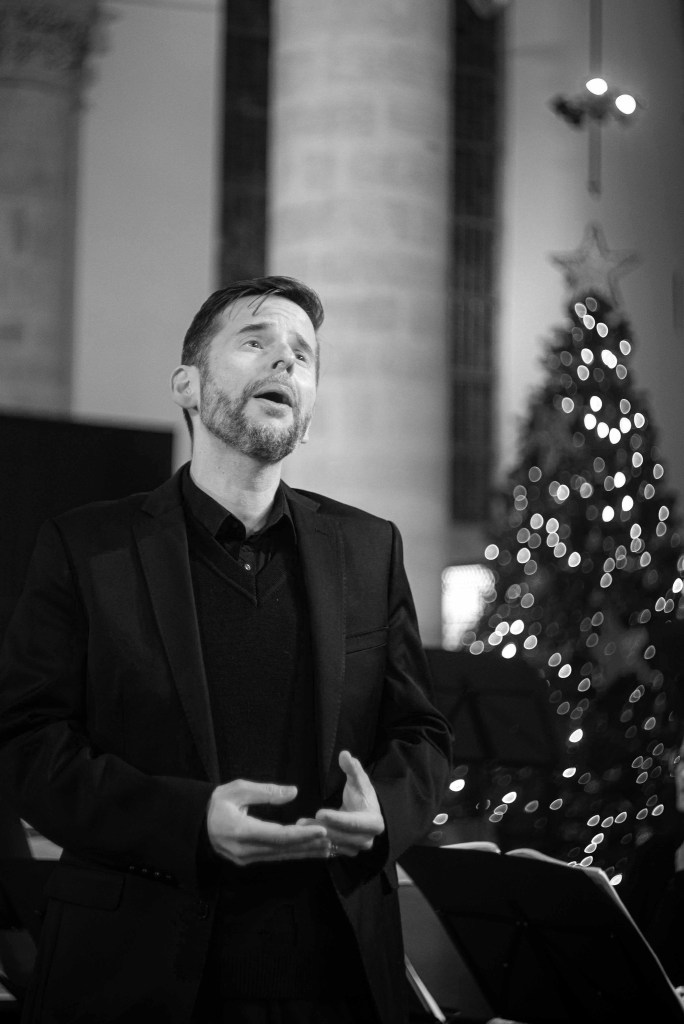
Bart Aerbeydt and Milo Maestri
Lucia Giraudo
Daniel Johannsen

All photos above by Donald Bentvelsen. Find him on Instagram at @bentvel.

I highly recommend the video of the most recent live performance by the Netherlands Bach Society under the direction of Lars Ulrik Mortensen. They performed cantatas 1, 4, 5, and 6 of Bach’s Christmas Oratorio in the Netherlands earlier this month. I attended the concert in Naarden on December 11, the video below is from the performance in Utrecht, two days later. The choir could have been a bit larger for my personal taste, but for the rest I absolutely loved this performance, with text-focused singing by all soloists, and fabulous and sensitive playing by the instrumentalists, allowing for musical dialogues with the singers. I especially enjoyed the contributions by tenor Daniel Johannsen, oboist Rodrigo Lopez-Paz (photo in my previous post), violinist Lucia Giraudo, and horn players Bart Aerbeydt and Milo Maestri. I very much ejoyed reading the program booklet, especially the the interview with director Lars Ulrik Mortensen.

Read the English program book for this performance here. Read a bit more on the fifth cantata from this same performance in my previous post.

Please consider subscribing to this blog (just click on the button below), it really helps me!

Best wishes for the New Year,

Wieneke Gorter, December 23, 2024.

* if you don’t know the story, please find it here.

Fourth Sunday of Advent – more insight into Cantata 62 helped me better understand Bach’s Christmas Oratorio

21 Saturday Dec 2024

Posted by cantatasonmymind in Advent, Cantatas, Chorale cantatas 1724/1725, Leipzig

≈ 1 Comment

Tags

Advent, Alex Potter, Bach, BWV 248/5, Carine Tinney, Cecilia Bernardini, Chorale Cantatas, Christmas, Christmas Oratorio, Daniel Johannsen, Johann Martin Schamel, l500b300, Lydia Vroegindeweij, Netherlands Bach Society, Rodrigo Lopez-Paz, Tomáš Král, Weihnachtsoratorium

Adoration of the Shepherds by Dutch painter Gerard van Honthorst, 1622. Pommersches Landesmuseum (Pomerania State Museum), Germany.

In my post for the first Sunday of Advent about Cantata 62 Nun komm, der Heiden Heiland, I explained how Bach’s chorale cantatas were most likely influenced by Johann Martin Schamel‘s annotations in his publication “Evangelischer Lieder-Commentarius.” Still, in that post, I gave just a few examples of how Bach used Schamel’s explanations.

Only after I wrote that post, I realized that Lydia Vroegindeweij had already created a “Read and Listen” guide for this cantata on her Luther 500 / Bach 300 website, shining a very clear light on the relation between Schamel’s explanations and Bach’s music. However, that article was in Dutch. So over the past few weeks, I translated Lydia’s Dutch text into English, and then Lydia transformed that text into a beautiful web page, with listening examples for every single movement of the cantata. Please find that brand-new English “Read and Listen” guide for Cantata 62 here.

In the process of translating and re-reading, I became more familiar with Luther’s and Schamel’s key themes for Advent and Christmas, especially these three:

  1. The importance of light: the light comes from the manger (as pictured in the painting above), from within, and is a metonym for Christ, always conquering the darkness. It is mentioned again and again.
  2. Jesus is always there, he is living in the hearts of the people, he is always with them as if he were a family friend, a house guest. In other words, he is already here and one doesn’t have to wait for him.
  3. Christ’s divine character and human character exist simultaneously, in one and the same person.

During that same time, I was rehearsing and performing cantatas 1, 2, 5, and 6 of Bach’s Christmas Oratorio as a chorus member, as well as attending an excellent performance by the Netherlands Bach Society of cantatas 1, 4, 5, and 6. Singing these texts and reading them in a program booklet with my newly acquired knowledge, I became much more conscious how strongly Luther’s and Schamel’s way of thinking are also present in the text and music of Bach’s Christmas Oratorio.

The theme of the inner light is especially present in one of my favorite parts of the Christmas Oratorio, the fifth cantata, written for the Sunday after New Year. Please find a live video recording here of the Netherlands Bach Society’s performance of this cantata in Utrecht on December 13, 2024, the same production I attended two days earlier in Naarden.

Following the chorus that talks about the sighting of the star, Bach and his librettist present an alto recitative (performed here by Alex Potter), which at first still refers to the star, but then turns to Jesus / to the core of the faith, and explains that Jesus is the light:

Wohl euch, die ihr dies Licht gesehen,
Happy are you who have seen the light,
Es ist zu eurem Heil geschehen!
It has appeared for your salvation!
Mein Heiland, du, du bist das Licht,
My saviour, you, you are the light
Das auch den Heiden scheinen sollen,
Which shall shine on the Gentiles also
Und sie, sie kennen dich noch nicht,
And they, they do not know you yet,
Als sie dich schon verehren wollen.
Though they would already worship you
Wie hell, wie klar muss nicht dein Schein,
How bright, how clear must your radiance be,
Geliebter Jesu, sein!
Beloved Jesus!

Rodrigo Lopez-Paz. Photo by Eduardus Lee, courtesy of the Netherlands Bach Society.

More illustrations of this special light follow in the bass aria (performed here by baritone Tomáš Král and oboist Rodrigo Lopez-Paz)

Erleucht auch meine finstre Sinnen,
Illuminate also my gloomy thoughts
Erleuchte mein Herze
Illuminate my heart
Durch der Strahlen klaren Schein!
With the rays of your clear light!
Dein Wort soll mir die hellste Kerze
Your word will be the brightest candle for me
In allen meinen Werken sein;
In all my deeds;
Dies lässet die Seele nichts Böses beginnen.
This lets my soul begin nothing evil

In the terzetto (performed here by violinist Cecilia Bernardini, soprano Carine Tinney, alto Alex Potter, and tenor Daniel Johannsen), we also see the theme of “Jesus who dwells in the heart” appear. In this trio, the alto interrupts the tenor and soprano with the very strong statement “er ist schon wirklich hier!” (he really is already here!). The tenor and soprano represent the people who think the Messiah is yet to come, singing:

Ach, wenn wird die Zeit erscheinen?
Ah, When will the time appear ?
Ach, wenn kömmt der Trost der Seinen?
Ah, When will he who is the comfort of his people come ?

While the alto voice represents the Lutheran doctrine that Jesus is always with you, that he dwells in your heart, singing:
Schweigt, er ist schon würklich hier!
Be silent, he is really already here!

The text of the closing chorale combines the theme of Jesus dwelling in the heart with that of the inner light:

Zwar ist solche Herzensstube
Indeed such a room in my heart
Wohl kein schöner Fürstensaal,
Is certainly no fine royal palace
Sondern eine finstre Grube;
But rather a dark pit;
Doch, sobald dein Gnadenstrahl
Yet, as soon as the rays of your mercy
In denselben nur wird blinken,
Only gleam within there
Wird es voller Sonnen dünken.
It will seem filled with sunlight.

Wieneke Gorter, December 21, 2024.

Saint Ambrose and Luther in Milan – Second Sunday of Advent

07 Saturday Dec 2024

Posted by cantatasonmymind in Advent, Cantatas, Chorale cantatas 1724/1725, Leipzig

≈ 3 Comments

Tags

Advent, Ambrose of Milan, Christmas, Hilliard Ensemble, Josquin des Prez, martin-luther, Saint Ambrose, Sant'Ambrogio, Sant'Ambrogio Basilica, Veni redemptor gentium

In the absence of a chorale cantata for this second Sunday of Advent*, I wanted to read more about Ambrose of Milan, whose “Veni redemptor gentium” inspired Luther to write his “Nun komm, der Heiden Heiland.” What would Luther have heard about the 4th-century legend when he visited Milan in 1510 on his way to Rome? Always the travel planner, I also wondered if there are there any traces of Ambrose to see in the Milan of today.

Milan’s patron saint

Ambrose of Milan

I learned that Ambrose has been Milan’s patron saint for centuries and is still celebrated today. What’s more, the Christmas season in Milan doesn’t officially start until his Saint’s Day, which happens to be … today, December 7. It is on December 7 that the Scala opens its season, with broadcasts of the opera performance throughout the city. And it is on December 7 that the largest Christmas Market opens, and that the bishop preaches in the Sant’Ambrogio Basilica. If you are from Northern Italy or have visited Milan around this time of year you will laugh at me, but I truly didn’t know this when I decided to write a post about Ambrose and his hymn earlier this week, I only found out today.

Sarcophagus of Stilicho in the Sant’Abrogio Basilica in Milan. 4th century.

Ambrose was a theologian and statesman who served as Bishop of Milan from 374 to 397, and is considered one of the most influential ecclesiastical figures of the 4th century. He is the founder of the Sant’Ambrogio Basilica in Milan, which still stands today. His literary works have been acclaimed as masterpieces of Latin eloquence, and as Bishop he did fundamental work for later church-state relations. Ambrose is also remembered as the teacher who converted and baptized the Christian theologian St. Augustine of Hippo.

What Luther would have learned more than a thousand years later

While we know Luther as the most important reformer and founder of Protestantism, he started out as an Augustine monk, and studied Theology in Erfurt. We can assume that Luther already knew Ambrose’s hymns, as they were in use in the churches. However, Luther would likely also have studied Ambrose’s and Augustine’s sermons. For example, Ambrose’s sermon “Exposition of the Gospel According to Luke” was widely circulated. In “Luther’s Theology of Music,” Miikka E. Anttila writes: “Ambrose believed that a psalm softens anger, offers a release from anxiety, and alleviates sorrow. He also pointed out that a child who refuses to learn other things takes pleasure in contemplating a psalm.” These ideas we also find in Luther’s writings.

In 1510, Luther was sent to Rome along with another monk to settle a dispute. There are many legends about Luther’s time in Rome, but I’m more intrigued by his stop in Milan on the way to Rome. In that city, Leonardo da Vinci had finished his Last Supper in 1498. Architect Donato Bramante had constructed the Cloisters of Sant’Ambrogio also in 1498 and a year later finished work on the Santa Maria della Grazie. Also it had been as recently as 1489 that Josquin des Prez, Luther’s favorite composer** had worked in Milan.

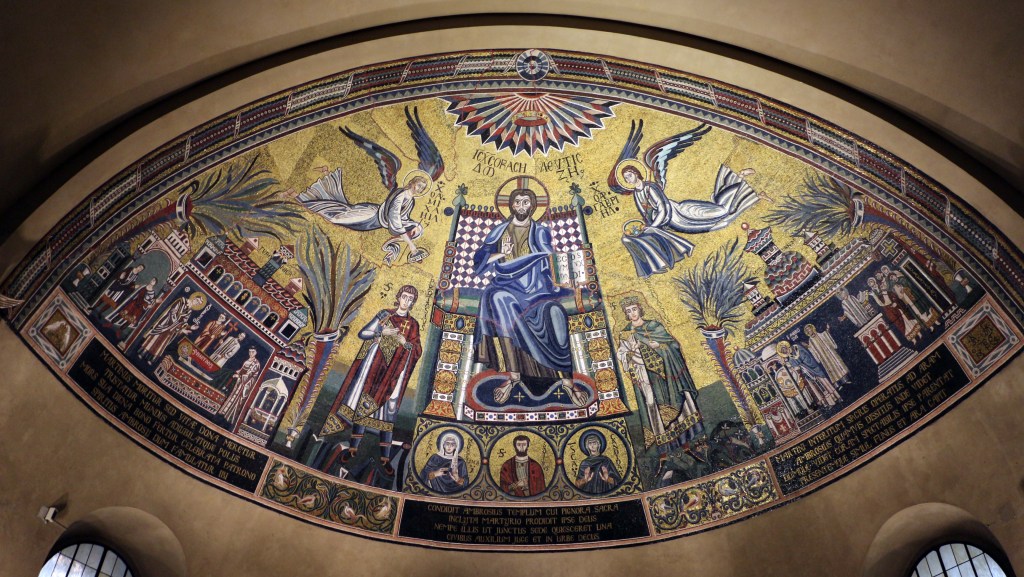
20th-century restoration of a mosaic from the 4th through 13th century in Sant’Ambrogio Basilica in Milan.

Did Luther visit Sant’Ambrogio Basilica? Did he see this mosaic, which was restored in the 13th century? Did he hear the many legends about Ambrose that made him even more of a hero to him? And: did he happen to hear this incredible polyphony of Josquin des Prez (The Hilliard Ensemble, recorded 1983) somewhere in Milan, and was it thus that he fell in love with Josquin’s music? This is Josquin des Prez’ Ave Maria Virgo Serena, one of the few works by Josquin of which scholars nowadays are certain it was written by him, composed around 1485, during Josquin’s service at the court of Milan, and wildly popular in the 16th century.

As I often say, we will probably never know, but it is nice to contemplate these scenarios, and Milan is now definitely on my “want to go” list.

Wieneke Gorter, December 7, 2024.

*Bach didn’t write a cantata for the second, third, or fourth Sunday of Advent in Leipzig, because the time between the first Sunday of Advent and Christmas was a time of introspection, similar to Lent. Regarding music performed during church services, this meant only strict liturgical singing (= the congregation singing chorales and responses), nothing else.

**Luther wrote: “God has preached the gospel through music, too, as may be seen in Josquin’s, all of whose compositions flow freely, gently, and cheerfully, are not forced or cramped by rules, and are like the song of the finch.”

Further Reading

Find Encyclopedia Brittanica’s entry on Saint Ambrose here.

Find more stories on Saint Ambrose here, and architectural and historical information on the Basilica here.

Find tourist information on Saint Ambrose and the festivities in Milan everywhere on the internet. I started here.

Find the full Latin text of Saint Ambrose’s hymn and Luther’s German adaptation on this website (in Dutch).

Find Yakub E. Kartawidjaja’s PhD thesis “Music in Martin Luther’s Theology” here.

Detail from the Agnus Dei, an original mosaic from the 4th century at the Sant’Ambrogio Basilica in Milan.

Historic Churches and a Comforting Duet – Third Day of Christmas 2023

27 Wednesday Dec 2023

Posted by cantatasonmymind in Cantatas, Christmas, Leipzig, Weimar

≈ Leave a comment

Tags

Agnes van Laar, Bach, BWV 248/3, cantatas, Christmas, Christmas 3, Christmas Oratorio, Claron MacFadden, Dietrich Henschel, germany, John Eliot Gardiner, Marc Pantus

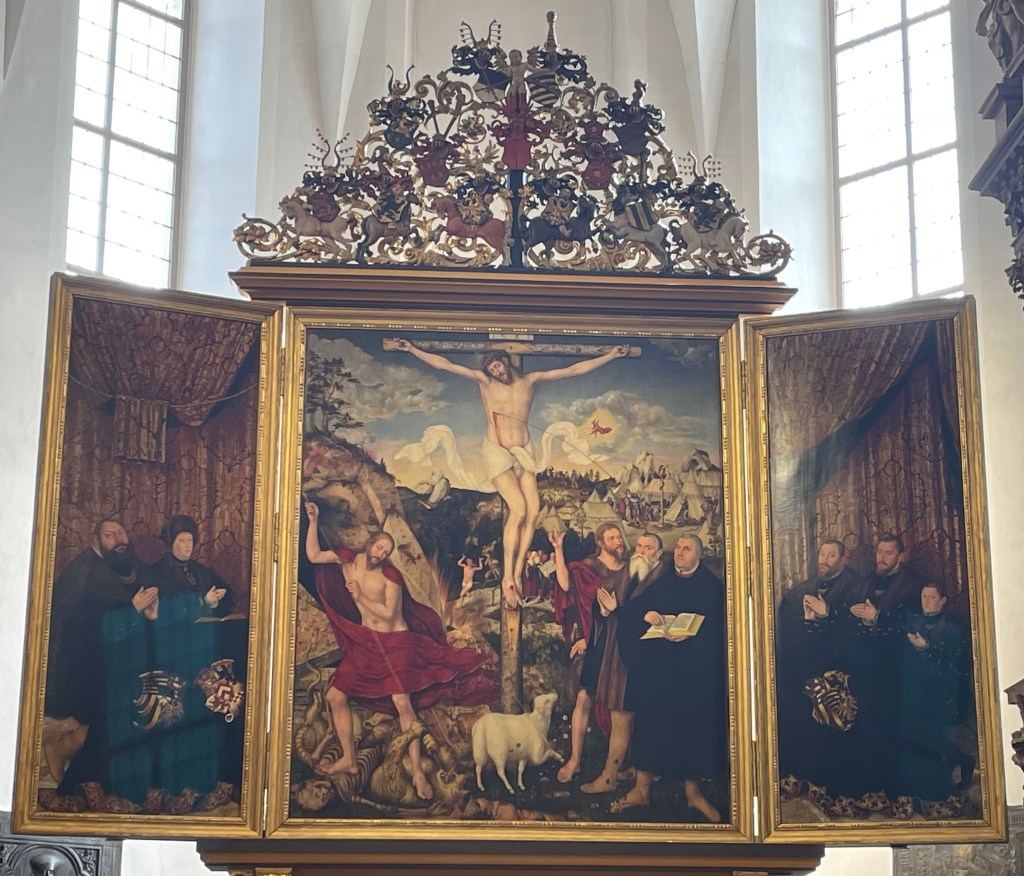
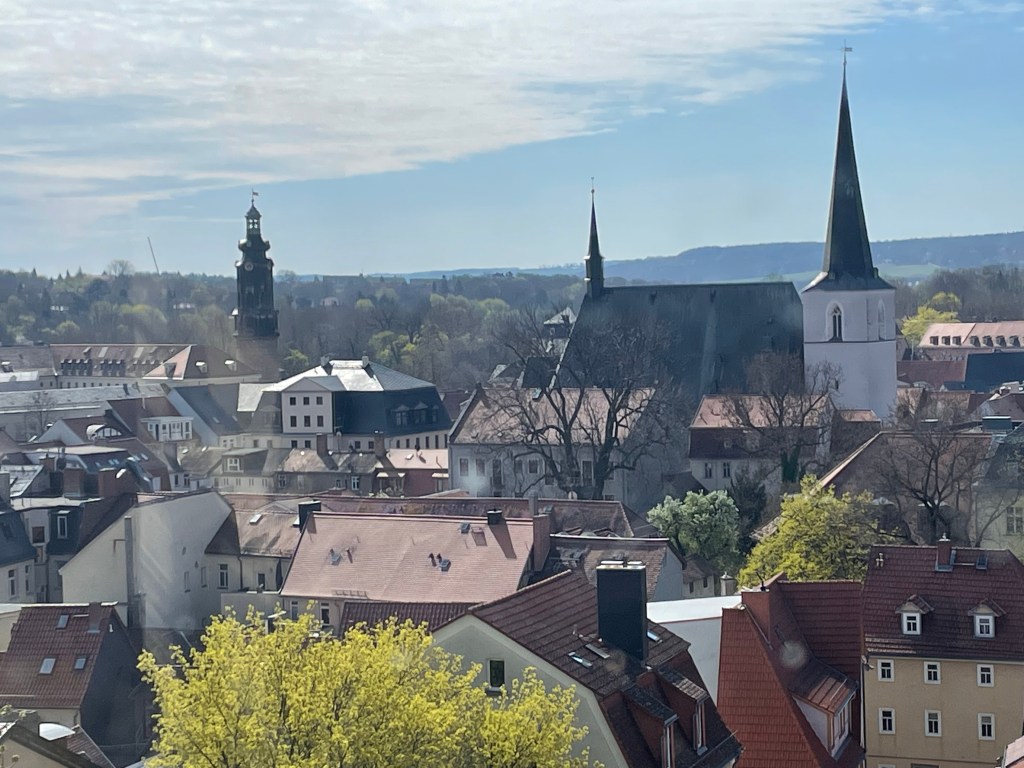
Photos from my visit to Weimar in April 2022: The famous altarpiece by Cranach in the St. Peter and Paul church or Herder church and the view over Weimar from the bell tower of St. James church. In the righmost photo you can see on the left the tower of the Bastille where Bach was held prisoner for a month, and on the right the Herder church. In addition to his job at the Duke’s castle, Bach played the organ at both St. James church and Herder church.

I hope you all had a meaningful Advent season and a merry Christmas. I needed to be with friends and family this month, and craved to hear music in old churches. It all worked out and I had one of the best Christmas seasons ever in recent years. I’m sorry that because of spending my time this way, I did not get to share any thoughts or music on this blog. If you went searching in my archives on your own, please let me know in the comments what you listened to. If you ever find youtube links that no longer work, please comment under the specific post or simply send me an email.

Why the photos of Weimar at the top of this blog post?

It’s because of a video I would like to share here today.

One of the best pieces of music I heard in an old church this month was the duet “Herr, dein Mitleid, dein Erbarmen” (Lord, your compassion, your mercy) from the third cantata of Bach’s Christmas Oratorio, written for today, the Third Day of Christmas. On December 10, I heard this excellently performed by soprano Agnes van Laar and bass Marc Pantus in the stunning Saint Martin’s church in Bolsward, the Netherlands.

This duet doesn’t usually appear among the “greatest hits” of Bach’s Christmas Oratorio but I just love the way the instrumental and vocal parts move together, and I am also moved by the text. I was searching for a good live video performance of this duet to share here today, and liked Gardiner’s the best, with soprano Claron McFadden and bass Dietrich Henschel. Please find that video here. Here is the text:

Herr, dein Mitleid, dein Erbarmen
Tröstet uns und macht uns frei.
Deine holde Gunst und Liebe,
Deine wundersamen Triebe
Machen deine Vatertreu
Wieder neu.

Lord, your compassion, your mercy
console us and make us free.
Your gracious favour and love,
your wondrous desires
make the love you have for us as a father
again new.

While watching this video, I realized that MacFadden and Henschel are singing at the Herder church in Weimar, directly in front of the famous Cranach altarpiece. I cannot really describe in words how thrilling it was for me to finally set foot in that church in April 2022. Watching the video and looking at the photos also inspired me to share more stories about my travels to Thuringia in April 2022 on this blog, and to hopefully visit the region again in the new year.

Further exploring:

Read my post from 2020 about all Bach’s other cantatas for the Third Day of Christmas here.

Find a very nice overview of Bach’s time in Weimar on the website of the Thuringia Bach Festival here.

Wieneke Gorter, December 27, 2023.

First Week of Advent 2023

07 Thursday Dec 2023

Posted by cantatasonmymind in Advent, Cantatas, Leipzig

≈ 3 Comments

Tags

All of Bach, Christmas, Harnoncourt, J.S. Bach Foundation, music, Netherlands Bach Society, Nuria Rial, Seppi Kronwitter, Shuann Chai, Shunske Sato, Zsuzsi Tóth

Photo of Shunske Sato by Elvira Demerdzhy

During this first week of Advent, I often talk about Nuria Rial’s rendition of the soprano aria from Cantata 36 with the J.S. Bach Foundation. However, this year let’s put the spotlight on the violin part of that aria, and watch the incomparable Shunske Sato work his magic in this movement from Cantata 36 Schwingt freudig euch empor on All of Bach, with soprano Zsuzsi Tóth. Never did I enjoy a “da capo” this much. To read more about this cantata, the third one Bach wrote (or adapted) for the first Sunday of Advent, read my blog post from 2017 here.

That I had to think about Sato’s playing this week is no coincidence. Today I witnessed his amazing musicianship, sense of timing, and sense of humor in a terrific concert with equally talented pianist Shuann Chai here in Amsterdam. They played two Beethoven violin sonatas and it was such a treat that I can’t wait for their CD to come out in 2024 with all ten of the sonatas. Another reason I’m excited about their recording project is that Shuann will be playing on two original fortepianos from 1800 and 1820, respectively. Please read more about their endeavor here and please consider donating. They are currently at 64% of their funding so they can use all the help they can get.

Shunske Sato and Shuann Chai, Photo by Marco Borggreve.

If you are on Instagram, please follow my account at @weeklycantata (or click on the instagram icon here below). Please consider subscribing to this blog (type your email in the box below and then click “subscribe”), so you will receive an email each time I publish a story.

Wieneke Gorter, December 7, 2023.

About Weekly Cantata

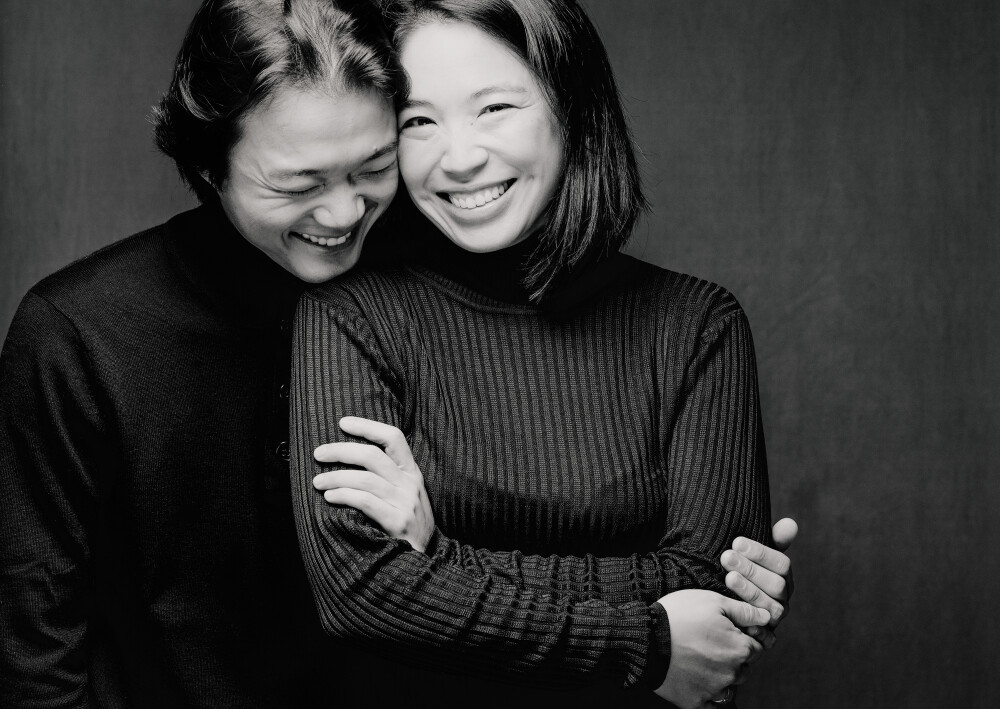
I am a bilingual writer, publicist, choral singer, art and nature lover, foodie, happy wife, and blessed mother of two. I started this blog in 2016, inspired by my late mother’s love for Bach’s cantatas. After 23 years in the San Francisco Bay Area, I’m now back in the Netherlands.

If you are on social media, please follow me:

  • Facebook
  • Instagram

Please subscribe!

Please subscribe to this blog! Simply fill in your email address and you’ll receive an email every time I’ve published a new post. Thank you so much / Vielen Dank / Dankuwel / Merci mille fois / 감사합니다 / 谢谢 / ありがとう / Mille grazie / Muchas gracias / Muito obrigado / Tusen takk / Tack så mycket / Terima kasih / شكراً جزيلاً / תודה רבה

Designed with WordPress.com

Two Weimar cantatas for the fourth Sunday of Advent

21 Saturday Dec 2019

Posted by cantatasonmymind in Advent, Bach's life, Cantatas, Christmas, Leipzig, Weimar

≈ Leave a comment

Tags

Advent, Advent 4, Alfredo Bernardini, All of Bach, Bachvereniging, BWV 132, BWV 147, BWV 147a, Christmas, Dominik Wörner, Hana Blazikova, J.S. Bach Foundation, J.S. Bach Stiftung, Jakob Pilgram, Jan Kobow, Julia Doyle, Margot Oitzinger, Netherlands Bach Society, Rudolf Lutz, Tim Mead, Weimar, Wolf Matthias Friedrich

For the fourth Sunday of Advent, Bach wrote two cantatas in Weimar: Cantata 132 Bereitet die Wege, bereitet die Bahn in 1715, and Cantata 147a Herz und Mund und Tat und Leben in 1716.

Bach rewrote Cantata 147, the same way he did that with cantatas 70 and 186, into a cantata for another time of the year in Leipzig, in this case the feast of the Visitation on July 2, 1723. Read more about that here in my post from 2016. I have now updated that post with a link to the wonderful live performance of Cantata 147 by the J.S. Bach Foundation, with with Hana Blažiková, soprano; Margot Oitzinger, alto; Jakob Pilgram, tenor; and Wolf Matthias Friedrich, bass.

Cantata 132 was not transformed into a cantata for another time in the church year in Leipzig, so today’s performances of this cantata still reflect the Advent cantata from Weimar. Watch a beautiful live performance of this cantata by the Netherlands Bach Society here on YouTube. Soloists are Julia Doyle, soprano; Tim Mead, alto; Jan Kobow, tenor; and Dominik Wörner, bass.

Find the German text with English translations here, and the score here.

As I already pointed out in my Advent Calendar earlier this week, the text of the joyful opening aria refers to the story of John the Baptist, who was believed to have come to prepare the way for Jesus, and includes the Isaiah quote as it appears in the scripture: “Messias kömmt an!” (The Messiah is coming). Bach gives this text to the soprano three times, and to give it extra emphasis, each time omits all instrumental accompaniment on those three words.

The rest of the cantata stays close to the story of John the Baptist. The bass aria refers to the Pharisees interrogating John, but then Bach’s text writer (Salomo Franck, who was also the Weimar court librarian) projects the question “Wer bist du?” (Who are you?) onto the believer: ask your conscience: are you a true person or a false person?

As a child, I was enormously impressed by this bass aria, even more than by the wonderful soprano aria at the beginning of the piece. I loved how Max van Egmond sings the “Wer bist du?” text on the Leonhardt recording from 1983. You can find that recording, and read more about those childhood memories, in this blog post from 2016. I had no idea at the time that in those very cool opening notes Bach is quoting this organ piece by Buxtehude. I only learned that this week, by watching the “extra videos” the Netherlands Bach Society provides along with their live recordings on All of Bach.

If you are not following this blog yet, please consider signing up (on the left of this text if you are on a desktop computer, at the bottom of this post when you are reading on a smartphone). This way you won’t miss any posts about the many cantatas Bach wrote for all three Christmas Days (yes there were three in his time), New Year’s Day, and the Sundays after those feast days.

Wieneke Gorter, December 21, 2019.

Bonus Advent cantata

10 Sunday Dec 2017

Posted by cantatasonmymind in Advent, Cantatas, Leipzig

≈ Leave a comment

Tags

1st Sunday of Advent, Advent, Bach, BWV 36, Christmas, Christoph Pregardien, Collegium Vocale Gent, J.S. Bach Foundation, J.S. Bach Stiftung, Nuria Rial, Peter Kooy, Phlippe Herreweghe, Sarah Connolly, Sybilla Rubens

Nuria Rial, my favorite interpreter of the soprano aria from Cantata 36.

In Leipzig in Bach’s time, the period between the first Sunday of Advent and Christmas was a “tempus clausum,” when no figural music was allowed in the churches. So if I would follow Bach’s cantata writing in 1724 very strictly, I would not have any music for you today.

So let’s take a detour to 1725. Sometime in that year, Bach wrote a congratulatory cantata for a teacher at the St. Thomas School in Leipzig. The cantata, with the title Schwingt freudig euch empor, had nine movements: an opening chorus, four recitatives and three arias. The cantata also featured a closing chorus alternated with recitatives for all the soloists, the way Bach would also use that in the before-last movement of his St. Matthew Passion. For the text of this cantata, please see this entry on Eduard van Hengel’s website. Scroll all the way down to find a table with all the different texts for the different cantatas.

In the fall of 1726, Bach received a request from his previous employer, prince Leopold of Köthen, to write a cantata for this birthday of his second wife, princess Charlotte Friederike Wilhelmine, on November 26 of that year. Scholars think that at the same time Bach was reworking this cantata from 1725 into this Birthday cantata, he was also reworking it into an Advent cantata. However the music of that particular cantata has not survived.

In 1731 Bach again, or finally, was able to make the original of 1725 into an Advent cantata, by replacing all the recitatives with chorales. This is cantata 36 Schwingt freudig euch empor, one of three cantatas for the first Sunday of Advent that have survived. (The other two are Cantata 61 I discussed last year, and Cantata 62 I discussed last week). Again please see Eduard van Hengel’s table of the different texts of all the various cantatas here. Find the English translations of Cantata 36 here, and find the score of Cantata 36 here.

My favorite recording of the entire cantata is the one by Herreweghe from 1997 (from the same album I discussed last week). I like this recording the best because of the most sparkling interpretation of the opening chorus, gorgeous singing by Christoph Prégardien in the tenor solos and by Peter Kooy in the bass aria, and a wonderful soprano/alto duet by Sybilla Rubens and Sarah Connolly. Find this recording here on YouTube. Or follow the links in my post from last week to purchase the entire album of Advent cantatas by Herreweghe. It is a great Christmas gift 🙂 !

If you prefer to watch a live recording, I recommend the one by the J.S. Bach Foundation. They just released the entire video recording of this cantata this week, and this performance contains my absolute favorite interpretation of the soprano aria by Nuria Rial.

Wieneke Gorter, December 9, 2017, links updated and photo added December 3, 2019.

Cantata 62: one of my favorite opening choruses and a magnificent bass aria

02 Saturday Dec 2017

Posted by cantatasonmymind in Advent, Bach's life, Cantatas, Chorale cantatas 1724/1725, Leipzig

≈ Leave a comment

Tags

Advent, Bach, chorale cantata, Christmas, Christophe Pregardien, Damien Guillon, Grace Davidson, Harry van der Kamp, Marcel Ponseele, oboe, Peter Kooy, Thomas Hobbs

Adventskranz 1. Advent

I don’t know if it is because the oboes already announce the chorale melody in the instrumental part of this opening chorus, or because of the overall Advent sparkle, but I have always found the first movement of Cantata 62 Nun komm der Heiden Heiland one of the most beautiful of all Bach’s cantata opening choruses. I especially cherish the Herreweghe recording from 1997. Find that recording here on YouTube. Soloists are Sibylla Rubens, soprano; Sarah Connolly, alto; Christoph Prégardien, tenor; and Peter Kooij, bass. This cantata also features an impressive recitative and aria for bass.

I remember an anecdote from my mom’s time as a member of the Twents Bachkoor, somewhere in the early 1980s. Bass soloist Harry van der Kamp showed up for an Advent concert, thinking he was coming to sing the other cantata with the same Nun komm der Heiden Heiland title, Cantata 61, which includes a beautiful recitative for bass (discussed on this blog here), but nothing really challenging for bass otherwise. He found out during the warm-up rehearsal that it was in fact 62. He did a fabulous job and part of my admiration for him stems from witnessing that as an audience member during that concert.

In the bass recitative, listen for Bach’s musical illustration of the words “laufen” (walking — upwards sequence), “Gefall’ne” (fallen — 7th down), and “heller Glanz” (bright luster — a sparkling highest note).

Find the text of Cantata 62 here, and the score here.

Bach wrote this cantata for the first Sunday in Advent in Leipzig in 1724, as part of his series of chorale cantatas of 1724/1725. For nine and a half months, starting on June 11, 1724, he would write every cantata according to this same template: the opening movement is a chorale fantasia on the first stanza of an existing Lutheran hymn or chorale, with the tune appearing as a cantus firmus. The last movement has the last stanza of the same hymn as text, in a four-part harmonization of the tune. The text of those choral, outer movements was used verbatim, while the text of the solo, inner movements was paraphrased, but still based on the inner stanzas of the same hymn.

I have been following all these chorale cantatas in the order they were written in 1724 on this blog. If you missed it, you can start reading here. If you subscribe to this blog (on the left-hand side of this text when reading on a desktop computer, or at the bottom of this text when reading on a smartphone) you will receive an email every time I have posted a new story.

There is also a wonderful live performance by Herreweghe of this cantata on YouTube, albeit with different soprano, alto, and tenor soloists (Grace Davidson, soprano; Damien Guillon, countertenor; Thomas Hobbs, tenor), but again with Peter Kooij singing bass, and again Marcel Ponseele playing first oboe. It was recorded in the St. Roch Church in Paris in 2015 and you can find it here on Youtube. The camera direction in the beginning is a bit strange: perhaps the TV director didn’t know the piece or didn’t have the score in front of her/him, because the camera is on the altos when the sopranos have an entrance, and on the back of the basses and tenors when the altos have an entrance, but later on it gets better, and it is a wonderful selection of Advent and Christmas cantatas they present there in that concert.

The CD recording from 1997  is part of a very good album, which also includes the two other Advent cantatas: Cantata 36 Schwingt freudig euch empor from 1731 (more about this in the next few weeks) and Cantata 61 Nun komm der Heiden Heiland from 1713 (discussed here on this blog). Please consider supporting the artists by purchasing this album in its reprint from 2014. Or purchase the box from 2010, which also includes two CDs with Christmas cantatas.

Wieneke Gorter, December 2, 2017.

Starlight shining on a Trinity cantata

15 Sunday Oct 2017

Posted by cantatasonmymind in Cantatas, Chorale cantatas 1724/1725, Leipzig, Trinity

≈ Leave a comment

Tags

18th Sunday after Trinity, Bach, Bach Collegium Japan, Bachstiftung, BWV 103, BWV 96, Christmas, cornetto, Deborah York, Epiphany, flauto piccolo, flute, Franziska Gottwald, J.S. Bach Foundation, Jan Börner, Julius Pfeifer, Maurice Steger, Nik Tasarov, Noëmi Sohn-Nad, Paul Agnew, Peter Kooij, Peter Kooy, Rudolf Lutz, sopranino recorder, St. Thomas Church, Thomaskirche, Ton Koopman, Trinity 18, Wolf Matthias Friedrich

threekings
The Adoration of the Kings, circa 1440. From a series of four boards from the former High Altar of the Heilig-Kreuz-Münsters in Rottweil, Germany.

In the summer and fall of 1724, Bach wrote an entire series of chorale cantatas, meaning that each cantata was based on a hymn. If at all possible, it was to be a hymn associated with that particular Sunday in the church year.  For this 18th Sunday after Trinity, he chose Herr Christ, der einige Gottessohn (Lord Christ, the only son of God). Keep reading to learn why.

When I first wrote about this Cantata 96 Herr Christ, der einige Gottessohn, in 2017, I recommended Ton Koopman’s recording. Listen to that recording here on Amazon, or here on Spotify. (It is not available on YouTube). Soloists are: Deborah York, soprano; Franziska Gottwald, alto; Paul Agnew, tenor; Klaus Mertens, bass; Heiko ter Schegget, sopranino recorder; and Wilbert Hazelzet, transverse flute.

However, since then a wonderful live video registration by the J.S. Bach Foundation has come out: you can find that here on YouTube. This is a terrific recording as well, with the added bonus that you can see the sopranino recorder and all the other instruments. Soloists in this performance are: Noëmi Sohn, soprano; Jan Börner, alto; Julius Pfeifer, tenor; Wolf-Matthias Friedrich, bass; and Maurice Steger, sopranino recorder.

Find the German text with English translation here and the score here.

In the Lutheran Church the chorale Herr Christ, der einige Gottessohn, one of the oldest Protestant hymns, was not so much associated with this 18th Sunday after Trinity, but more with Epiphany/Three Kings (January 6), for its reference to the Morning Star. Bach brings the luster of the Christmas season into this cantata in the most beautiful way. He gives the opening chorus a dusting of starlight by writing a part for flauto piccolo, or sopranino recorder*, over the rest of the vocal and instrumental parts. Since this time it is the altos that have the chorale melody in the opening chorus, Bach can create an ethereal link between the chorus and the flauto piccolo by way of the soprano part in the chorus. In the fifth line of the text, Er ist die Morgensterne (he is the Morning Star), he modulates to the brilliant key of E Major on the word “Morgensterne.”

But why did Bach select this chorale for a Sunday in the Trinity season? It becomes a bit more clear in the alto recitative and tenor aria. They refer to the fact that Jesus is God’s son, not David’s son. This is the only direct reference to the Gospel reading for this Sunday: Jesus giving the Jewish elders a hard time after they had claimed that he was only David’s son, not God’s son (Matthew 22: 34-46).  In the tenor aria Bach features his star flute player again.

In the soprano recitative, the focus changes to Jesus as guiding light, referring to the “he is the Morning Star” text from the chorale. The soprano’s statement that it can be hard to stay on the “right path” is illustrated in the bass aria.

We have heard faltering steps in Bach cantatas before (read my post about that here), but this time Bach offers a more theatrical illustration. In the St. Thomas Church in Leipzig a visual and aural effect would have made this even stronger: the violins, playing when the bass sings “zu rechten” (now to the right), would have stood on the right-hand balcony, the oboes, playing when the bass sings “zu linken” (now to the left) would have stood on the left-hand balcony. Also, in Bach’s rhetoric, right meant good and high, left meant bad and low.

The middle part of this cantata, with the text “Gehe doch, mein Heiland, mit” (My saviour please come with me) always moves me, especially when Peter Kooij sings it (listen to that here on Spotify, with Bach Collegium Japan).

Wieneke Gorter, October 15, 2017, updated October 8, 2020.

Follow this blog on Facebook or Instagram

*Since his arrival in Leipzig, Bach had used recorders in cantatas quite often (see this image by Nik Tarasov), but this is the very first time he writes for sopranino recorder, or “flauto piccolo.” The second time was on March 25, 1725, in Cantata 1 Wie schön leuchtet der Morgenstern, and the third time on the third Sunday after Easter in 1725, in Cantata 103 Ihr werdet weinen und heulen.

A Discovery for Third Christmas Day

27 Tuesday Dec 2016

Posted by cantatasonmymind in Bach's life, Cantatas, Christmas, Leipzig

≈ Leave a comment

Tags

Bach, Bach Collegium Japan, Christmas, Leipzig, Peter Jelosits, Peter Kooy, Robin Blaze, trombone

bwv64facsimile
First page of Bach’s original score for cantata 64 Sehet, welch eine Liebe hat uns der Vater erzeiget for the Third Day of Christmas. Staatsbibliothek zu Berlin (Amalienbibliothek), Berlin.

The third cantata of Bach’s Christmas Oratorio was very popular in our house, and it was my sister’s all-time favorite. That is probably why I had never heard the beautiful cantata 64 Sehet, welch eine Liebe hat uns der Vater erzeiget before doing research for this blog, even though it has trombones in the opening chorus and in all three (!) chorales, and Peter Jelosits is singing the soprano aria on the Harnoncourt recording.

Listen to Bach Collegium Japan’s recording of cantata 64 on Spotify. Soloists: Yukari Nonoshita, soprano; Robin Blaze, countertenor; Peter Kooij, bass. With Concerto Palatino: Yoshimichi Hamada, cornetto; Simen van Mechelen, Charles Toet, and Wim Becu, trombones.

Find the text here, and the score here.

Bach wrote this cantata in 1723 and the structure, with the three chorales, is very similar to cantata 40 from yesterday, written that same year.

During his four-week  Advent Break that first year in Leipzig (he repeated a Weimar cantata on the first Sunday of Advent, and was not to perform any music in the churches for the next three Sundays), Bach wrote six new cantatas for the period from December 26, 1723, to January 9, 1724 (cantatas 40, 64, 190, 153, 65, and 154). But that was not all. For Christmas Day 1723, he supplemented cantata 63 from Weimar with a newly written Magnificat. Knowing how hard it is for a choir to sing that Magnificat (on the same level as the Mass in B Minor and the Motets), it is clear that Bach did not have a “break” at all, but was very busy rehearsing his choir in addition to writing all this new music.

Wieneke Gorter, December 27, 2016, Harnoncourt link updated December 26, 2019.

← Older posts

Recent Posts

  • “Missa Miniatura” by CONTINUUM/Elina Albach Even More Moving in 2025
  • Bachfest Leipzig 2025
  • Bach Cantatas for Christmas – 1724 and 1734 editions
  • Fourth Sunday of Advent – more insight into Cantata 62 helped me better understand Bach’s Christmas Oratorio
  • Saint Ambrose and Luther in Milan – Second Sunday of Advent

Archives

  • August 2025
  • July 2025
  • December 2024
  • November 2024
  • June 2024
  • January 2024
  • December 2023
  • October 2023
  • September 2023
  • August 2023
  • April 2022
  • February 2022
  • January 2022
  • December 2021
  • November 2021
  • June 2021
  • May 2021
  • April 2021
  • February 2021
  • January 2021
  • December 2020
  • November 2020
  • October 2020
  • September 2020
  • August 2020
  • July 2020
  • May 2020
  • April 2020
  • March 2020
  • February 2020
  • January 2020
  • December 2019
  • November 2019
  • May 2018
  • April 2018
  • March 2018
  • February 2018
  • January 2018
  • December 2017
  • November 2017
  • October 2017
  • September 2017
  • August 2017
  • July 2017
  • June 2017
  • May 2017
  • April 2017
  • March 2017
  • February 2017
  • January 2017
  • December 2016
  • November 2016
  • October 2016
  • September 2016
  • August 2016
  • July 2016
  • June 2016
  • May 2016
  • April 2016
  • March 2016
  • February 2016
  • January 2016

Enter your email address to follow this blog and receive notifications of new posts by email.

Join 338 other subscribers

Categories

  • 1723 Trinity season special series
  • Advent
  • After Easter
  • Ascension
  • Bach's life
  • Cantatas
  • Chorale cantatas 1724/1725
  • Christmas
  • Easter
  • Epiphany
  • Following Bach in 1725
  • Köthen
  • Leipzig
  • Septuagesima
  • Travel
  • Trinity
  • Weimar

Meta

  • Create account
  • Log in
  • Entries feed
  • Comments feed
  • WordPress.com

Website Built with WordPress.com.

  • Subscribe Subscribed
    • Weekly Cantata
    • Join 158 other subscribers
    • Already have a WordPress.com account? Log in now.
    • Weekly Cantata
    • Subscribe Subscribed
    • Sign up
    • Log in
    • Report this content
    • View site in Reader
    • Manage subscriptions
    • Collapse this bar
 

Loading Comments...