Weekly Cantata

Weekly Cantata

Tag Archives: Johann Martin Schamel

The End of Times and Christmas Combined – Cantata 116 for Trinity 25

21 Saturday Nov 2026

Posted by cantatasonmymind in Advent, Bach's life, Cantatas, Chorale cantatas 1724/1725, Christmas, Leipzig, Trinity

≈ Leave a comment

Tags

Advent, Bach Collegium Japan, Bachakademie Stuttgart, BWV 116, BWV 70, BWV 90, Christmas, evangelischer-lieder-commentarius, Gaechinger Cantorey, Hannes Rux-Brachtendorf, Hans-Christoph Rademann, Jacob Peeters, Jakob Ebert, Johann Martin Schamel, l500b300, Lydia Vroegindeweij, Makoto Sakurada, Marie Henriette Reinhold, Masaaki Suzuki, Masamitsu San'nomiya, Nicolaes Visscher II, Ottoman siege of Vienna 1683, Patrick Grahl, Peter Kooij, Peter Schenk, Robin Blaze, Romeyn de Hooghe, Theatrum Europaeum, Tobias Berndt, Trinity 25, Trinity 26, Yukari Nonoshita
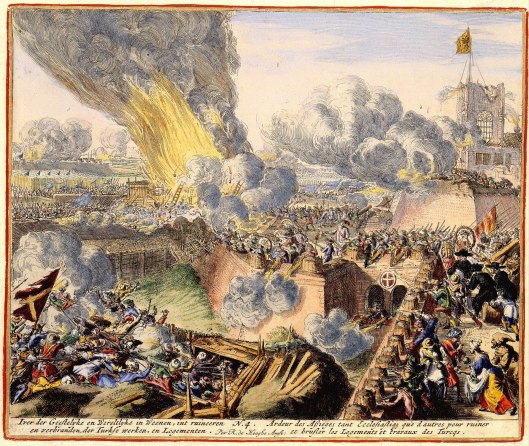
Iver der Geestelyke en Wereltlyke in Weenen, int ruineeren en verbranden der Turkse werken, en Logementen (The clergy’s and laity’s zeal in Vienna in the demolishing and burning of the Turkish fortifications and quarters), copper engraving by Romeyn de Hooghe (1645-1708), 1683. This particular print, from the Atlas Dirk van der Hagen, is hand painted. However, at the time, most prints of this same engraving by De Hooghe would have appeared in black and white, in Dutch and German newspapers as well as in books such as Merian’s Theatrum Europaeum.*

I believe that in 1723 and 1724, writing the last cantata before Advent was of special significance to Bach. At those times, he would consciously combine the horrors of Judgment Day with the hope or even sparkle of Advent and Christmas.

In my humble opinion, this is why Cantata 116 Du Friedefürst, Herr Jesu Christ from 1724 is much less grim than Cantata 90 Es reißet euch ein schrecklich Ende for this same Sunday in 1723. Because, in 1724, the 25th Sunday after Trinity was indeed the last Sunday before Advent, while in 1723, there was one more Sunday to go. And for that next Sunday in 1723, the 26th Sunday after Trinity, Bach adapted a Weimar cantata into cantata 70, Wachet! betet! betet! wachet! which does have that element of hope that Cantata 116 also has but Cantata 90 mostly lacks. In my post from 2016, I wrote about Cantata 70 “there is much more sparkle in the music and hope in the text than last week [i.e. in Cantata 90], because of the link with Advent.”

My favorite recording of Cantata 116 Du Friedefürst, Herr Jesu Christ is the one by Bach Collegium Japan under the direction of Masaaki Suzuki. Because of oboist Masamitsu San’nomiya’s fluid playing in the alto aria, and the very best rendition of the terzetto (movement 4) by Yukari Nonoshita, soprano; Makoto Sakurada, tenor; and Peter Kooij, bass. Robin Blaze also does a beautiful job singing the alto solos on this recording. Find this recording here on Spotify, and here on YouTube.

Find the German texts with English translations of Cantata 116 here, and the score here.

How does Bach combine the End of Times with the Christmas message in Cantata 116 Du Friedefürst, Herr Jesu Christ?

Since this cantata will be part of his 1724/1725 cycle of chorale cantatas, he has to select an appropriate chorale. He picks Du Friedefürst, Herr Jesu Christ from 1601, by Jakob Ebert (1549–1614). According to Dr. Lydia Vroegindeweij’s L500B300 website, Johann Martin Schamel’s Evangelischer Lieder-Commentarius lists this hymn as written during wartime. Schamel also says that it was “actively sung” by the Lutherans in Saxony during the two-month-long Ottoman siege of Vienna in 1683. And thanks to Dr. Lydia Vroegindeweij’s findings, we know that Bach most likely consulted Schamel’s annotations for his entire cycle of chorale cantatas.

1683 was not that long ago in 1724, and Bach’s older relatives must have been telling him about the war with the Ottomans. The liberation of Vienna in 1683 was most likely seen as a proud moment for the citizens of Leipzig, since the father of their ruler Augustus the Strong had personally commanded the Saxon troops during the battle. Black and white versions of the picture above and other illustrations of the war circulated in Leipzig, thanks to newspapers, books such as Merian’s Theatrum Europaeum, and the efforts of Peter Schenk and others.* Thus, the reference to the unspeakable distress (alto aria) and asking for foregiveness (soprano-tenor-bass terzetto) would not have been lost to the Leipzig congregations hearing this cantata on Sunday, November 26, 1724.

But, again thanks to Dr. Lydia Vroegindeweij who mentions this in the sixth episode of her podcast (in Dutch), by choosing this particular chorale, Bach also makes a reference to the Christmas message that Jesus is man and God (read more about this concept in my post from 2019). Because the first lines of this chorale are:

Du Friedefürst, Herr Jesu Christ,
Wahr’ Mensch und wahrer Gott

You prince of peace, Lord Jesus Christ,
true man and true God

My favorite part of this cantata is the soprano-tenor-bass terzetto (movement 4). It is beautiful music, truly heartbreaking on the text “Es brach ja dein erbarmend Herz” (your compassionate heart was broken). The text again refers to that Christmas message of Jesus’ “coming to earth” and “becoming man:”

Ach, wir bekennen unsre Schuld
Und bitten nichts als um Geduld
Und um dein unermesslich Lieben.
Es brach ja dein erbarmend Herz,
Als der Gefallnen Schmerz
Dich zu uns in die Welt getrieben.

Ah, we acknowledge our guilt,
and ask for nothing other than your patience
and your immeasurable love.
Your compassionate heart was broken
when the sorrow of those who had fallen
drove you to us in this world.

Since I last wrote about the other cantata for this Sunday, Cantata 90 Es reißet euch ein schrecklich Ende, in 2016, an even better version of the bass aria with trumpet has come out. It appears on Rademann’s Vision Bach, Volume 5. Soloists are Marie Henriette Reinhold, alto; Patrick Grahl, tenor; Tobias Berndt, bass; and Hannes Rux-Brachtendorf, trumpet. Rux-Brachtendorf is fabulous as always, and the combination with Tobias Berndt makes for a terrific aria. The other singers are great too. Find that recording here on Spotify, and here on YouTube. Texts are here, and the score is here.

I would love it if you would share this article with a friend, with the choir you sing in, or with anyone you think who might appreciate it. Not an email subscriber yet? You can sign up below, and you will receive an email each time I publish a new article. I won’t use your email address for anything else.

© Wieneke Gorter, November 21, 2026.

* In 1683, in Amsterdam, Nicolaes Visscher II (1649-1702) published a series of ten prints about the Ottoman siege of the city of Vienna with the most important pictures of the war. The prints were engraved by Romeyn de Hooghe after eye-witness drawings by the Antwerp artist Jacob Peeters. The picture at the top of this post is the fourth in that series of ten. Visscher sold many of his engraved plates to Peter Schenk, who also reprinted them. Schenk traveled regularly between Amsterdam and Leipzig, sold prints at the Leipzig trade fairs, and had a store in Leipzig.

Fourth Sunday of Advent – more insight into Cantata 62 helped me better understand Bach’s Christmas Oratorio

21 Saturday Dec 2024

Posted by cantatasonmymind in Advent, Cantatas, Chorale cantatas 1724/1725, Leipzig

≈ 1 Comment

Tags

Advent, Alex Potter, Bach, BWV 248/5, Carine Tinney, Cecilia Bernardini, Chorale Cantatas, Christmas, Christmas Oratorio, Daniel Johannsen, Johann Martin Schamel, l500b300, Lydia Vroegindeweij, Netherlands Bach Society, Rodrigo Lopez-Paz, Tomáš Král, Weihnachtsoratorium

Adoration of the Shepherds by Dutch painter Gerard van Honthorst, 1622. Pommersches Landesmuseum (Pomerania State Museum), Germany.

In my post for the first Sunday of Advent about Cantata 62 Nun komm, der Heiden Heiland, I explained how Bach’s chorale cantatas were most likely influenced by Johann Martin Schamel‘s annotations in his publication “Evangelischer Lieder-Commentarius.” Still, in that post, I gave just a few examples of how Bach used Schamel’s explanations.

Only after I wrote that post, I realized that Lydia Vroegindeweij had already created a “Read and Listen” guide for this cantata on her Luther 500 / Bach 300 website, shining a very clear light on the relation between Schamel’s explanations and Bach’s music. However, that article was in Dutch. So over the past few weeks, I translated Lydia’s Dutch text into English, and then Lydia transformed that text into a beautiful web page, with listening examples for every single movement of the cantata. Please find that brand-new English “Read and Listen” guide for Cantata 62 here.

In the process of translating and re-reading, I became more familiar with Luther’s and Schamel’s key themes for Advent and Christmas, especially these three:

  1. The importance of light: the light comes from the manger (as pictured in the painting above), from within, and is a metonym for Christ, always conquering the darkness. It is mentioned again and again.
  2. Jesus is always there, he is living in the hearts of the people, he is always with them as if he were a family friend, a house guest. In other words, he is already here and one doesn’t have to wait for him.
  3. Christ’s divine character and human character exist simultaneously, in one and the same person.

During that same time, I was rehearsing and performing cantatas 1, 2, 5, and 6 of Bach’s Christmas Oratorio as a chorus member, as well as attending an excellent performance by the Netherlands Bach Society of cantatas 1, 4, 5, and 6. Singing these texts and reading them in a program booklet with my newly acquired knowledge, I became much more conscious how strongly Luther’s and Schamel’s way of thinking are also present in the text and music of Bach’s Christmas Oratorio.

The theme of the inner light is especially present in one of my favorite parts of the Christmas Oratorio, the fifth cantata, written for the Sunday after New Year. Please find a live video recording here of the Netherlands Bach Society’s performance of this cantata in Utrecht on December 13, 2024, the same production I attended two days earlier in Naarden.

Following the chorus that talks about the sighting of the star, Bach and his librettist present an alto recitative (performed here by Alex Potter), which at first still refers to the star, but then turns to Jesus / to the core of the faith, and explains that Jesus is the light:

Wohl euch, die ihr dies Licht gesehen,
Happy are you who have seen the light,
Es ist zu eurem Heil geschehen!
It has appeared for your salvation!
Mein Heiland, du, du bist das Licht,
My saviour, you, you are the light
Das auch den Heiden scheinen sollen,
Which shall shine on the Gentiles also
Und sie, sie kennen dich noch nicht,
And they, they do not know you yet,
Als sie dich schon verehren wollen.
Though they would already worship you
Wie hell, wie klar muss nicht dein Schein,
How bright, how clear must your radiance be,
Geliebter Jesu, sein!
Beloved Jesus!

Rodrigo Lopez-Paz. Photo by Eduardus Lee, courtesy of the Netherlands Bach Society.

More illustrations of this special light follow in the bass aria (performed here by baritone Tomáš Král and oboist Rodrigo Lopez-Paz)

Erleucht auch meine finstre Sinnen,
Illuminate also my gloomy thoughts
Erleuchte mein Herze
Illuminate my heart
Durch der Strahlen klaren Schein!
With the rays of your clear light!
Dein Wort soll mir die hellste Kerze
Your word will be the brightest candle for me
In allen meinen Werken sein;
In all my deeds;
Dies lässet die Seele nichts Böses beginnen.
This lets my soul begin nothing evil

In the terzetto (performed here by violinist Cecilia Bernardini, soprano Carine Tinney, alto Alex Potter, and tenor Daniel Johannsen), we also see the theme of “Jesus who dwells in the heart” appear. In this trio, the alto interrupts the tenor and soprano with the very strong statement “er ist schon wirklich hier!” (he really is already here!). The tenor and soprano represent the people who think the Messiah is yet to come, singing:

Ach, wenn wird die Zeit erscheinen?
Ah, When will the time appear ?
Ach, wenn kömmt der Trost der Seinen?
Ah, When will he who is the comfort of his people come ?

While the alto voice represents the Lutheran doctrine that Jesus is always with you, that he dwells in your heart, singing:
Schweigt, er ist schon würklich hier!
Be silent, he is really already here!

The text of the closing chorale combines the theme of Jesus dwelling in the heart with that of the inner light:

Zwar ist solche Herzensstube
Indeed such a room in my heart
Wohl kein schöner Fürstensaal,
Is certainly no fine royal palace
Sondern eine finstre Grube;
But rather a dark pit;
Doch, sobald dein Gnadenstrahl
Yet, as soon as the rays of your mercy
In denselben nur wird blinken,
Only gleam within there
Wird es voller Sonnen dünken.
It will seem filled with sunlight.

Wieneke Gorter, December 21, 2024.

Recent Posts

  • Three Listening Guides – First Sunday of Advent
  • The End of Times and Christmas Combined – Cantata 116 for Trinity 25
  • From the Archives, with a New Recording – Cantatas 60 and 26 for Trinity 24
  • A Controversy and a Coin Collection – Cantata 163 for Trinity 23
  • Giving the Choir a Breather? – Cantata 89 for Trinity 22

Archives

  • November 2026
  • October 2026
  • September 2026
  • August 2026
  • August 2025
  • July 2025
  • December 2024
  • November 2024
  • June 2024
  • January 2024
  • December 2023
  • October 2023
  • September 2023
  • August 2023
  • April 2022
  • February 2022
  • January 2022
  • December 2021
  • November 2021
  • June 2021
  • May 2021
  • April 2021
  • February 2021
  • January 2021
  • December 2020
  • November 2020
  • October 2020
  • September 2020
  • August 2020
  • July 2020
  • May 2020
  • April 2020
  • March 2020
  • February 2020
  • January 2020
  • December 2019
  • November 2019
  • May 2018
  • April 2018
  • March 2018
  • February 2018
  • January 2018
  • December 2017
  • November 2017
  • October 2017
  • September 2017
  • August 2017
  • July 2017
  • June 2017
  • May 2017
  • April 2017
  • March 2017
  • February 2017
  • January 2017
  • December 2016
  • November 2016
  • October 2016
  • September 2016
  • August 2016
  • July 2016
  • June 2016
  • May 2016
  • April 2016
  • March 2016
  • February 2016
  • January 2016

Enter your email address to follow this blog and receive notifications of new posts by email.

Join 338 other subscribers

Categories

  • 1723 Trinity season special series
  • Advent
  • After Easter
  • Ascension
  • Bach's life
  • Cantatas
  • Chorale cantatas 1724/1725
  • Christmas
  • Easter
  • Epiphany
  • Following Bach in 1725
  • Köthen
  • Leipzig
  • Leipzig 1726/1727
  • Septuagesima
  • Travel
  • Trinity
  • Weimar

Meta

  • Create account
  • Log in
  • Entries feed
  • Comments feed
  • WordPress.com

Website Built with WordPress.com.

  • Subscribe Subscribed
    Weekly Cantata
    Join 158 other subscribers

    Have a WordPress.com account? Log in now.

  • Weekly Cantata
    View site in Reader
    Manage subscriptionsSign upLog in
    Report this content
    Collapse this bar
Loading Comments...