
Tags
Advent, Bach Collegium Japan, Bachakademie Stuttgart, BWV 116, BWV 70, BWV 90, Christmas, evangelischer-lieder-commentarius, Gaechinger Cantorey, Hannes Rux-Brachtendorf, Hans-Christoph Rademann, Jacob Peeters, Jakob Ebert, Johann Martin Schamel, l500b300, Lydia Vroegindeweij, Makoto Sakurada, Marie Henriette Reinhold, Masaaki Suzuki, Masamitsu San'nomiya, Nicolaes Visscher II, Ottoman siege of Vienna 1683, Patrick Grahl, Peter Kooij, Peter Schenk, Robin Blaze, Romeyn de Hooghe, Theatrum Europaeum, Tobias Berndt, Trinity 25, Trinity 26, Yukari Nonoshita
I believe that in 1723 and 1724, writing the last cantata before Advent was of special significance to Bach. At those times, he would consciously combine the horrors of Judgment Day with the hope or even sparkle of Advent and Christmas.
In my humble opinion, this is why Cantata 116 Du Friedefürst, Herr Jesu Christ from 1724 is much less grim than Cantata 90 Es reißet euch ein schrecklich Ende for this same Sunday in 1723. Because, in 1724, the 25th Sunday after Trinity was indeed the last Sunday before Advent, while in 1723, there was one more Sunday to go. And for that next Sunday in 1723, the 26th Sunday after Trinity, Bach adapted a Weimar cantata into cantata 70, Wachet! betet! betet! wachet! which does have that element of hope that Cantata 116 also has but Cantata 90 mostly lacks. In my post from 2016, I wrote about Cantata 70 “there is much more sparkle in the music and hope in the text than last week [i.e. in Cantata 90], because of the link with Advent.”
My favorite recording of Cantata 116 Du Friedefürst, Herr Jesu Christ is the one by Bach Collegium Japan under the direction of Masaaki Suzuki. Because of oboist Masamitsu San’nomiya’s fluid playing in the alto aria, and the very best rendition of the terzetto (movement 4) by Yukari Nonoshita, soprano; Makoto Sakurada, tenor; and Peter Kooij, bass. Robin Blaze also does a beautiful job singing the alto solos on this recording. Find this recording here on Spotify, and here on YouTube.
Find the German texts with English translations of Cantata 116 here, and the score here.
How does Bach combine the End of Times with the Christmas message in Cantata 116 Du Friedefürst, Herr Jesu Christ?
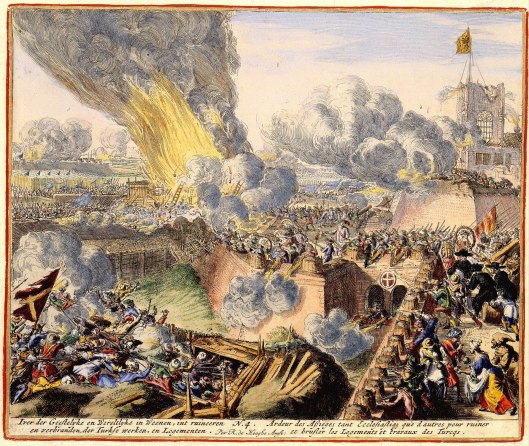
Since this cantata will be part of his 1724/1725 cycle of chorale cantatas, he has to select an appropriate chorale. He picks Du Friedefürst, Herr Jesu Christ from 1601, by Jakob Ebert (1549–1614). According to Dr. Lydia Vroegindeweij’s L500B300 website, Johann Martin Schamel’s Evangelischer Lieder-Commentarius lists this hymn as written during wartime. Schamel also says that it was “actively sung” by the Lutherans in Saxony during the two-month-long Ottoman siege of Vienna in 1683. And thanks to Dr. Lydia Vroegindeweij’s findings, we know that Bach most likely consulted Schamel’s annotations for his entire cycle of chorale cantatas.
1683 was not that long ago in 1724, and Bach’s older relatives must have been telling him about the war with the Ottomans. The liberation of Vienna in 1683 was most likely seen as a proud moment for the citizens of Leipzig, since the father of their ruler Augustus the Strong had personally commanded the Saxon troops during the battle. Black and white versions of the picture above and other illustrations of the war circulated in Leipzig, thanks to newspapers, books such as Merian’s Theatrum Europaeum, and the efforts of Peter Schenk and others.* Thus, the reference to the unspeakable distress (alto aria) and asking for foregiveness (soprano-tenor-bass terzetto) would not have been lost to the Leipzig congregations hearing this cantata on Sunday, November 26, 1724.
But, again thanks to Dr. Lydia Vroegindeweij who mentions this in the sixth episode of her podcast (in Dutch), by choosing this particular chorale, Bach also makes a reference to the Christmas message that Jesus is man and God (read more about this concept in my post from 2019). Because the first lines of this chorale are:
Du Friedefürst, Herr Jesu Christ,
Wahr’ Mensch und wahrer Gott
You prince of peace, Lord Jesus Christ,
true man and true God
My favorite part of this cantata is the soprano-tenor-bass terzetto (movement 4). It is beautiful music, truly heartbreaking on the text “Es brach ja dein erbarmend Herz” (your compassionate heart was broken). The text again refers to that Christmas message of Jesus’ “coming to earth” and “becoming man:”
Ach, wir bekennen unsre Schuld
Und bitten nichts als um Geduld
Und um dein unermesslich Lieben.
Es brach ja dein erbarmend Herz,
Als der Gefallnen Schmerz
Dich zu uns in die Welt getrieben.
Ah, we acknowledge our guilt,
and ask for nothing other than your patience
and your immeasurable love.
Your compassionate heart was broken
when the sorrow of those who had fallen
drove you to us in this world.
Since I last wrote about the other cantata for this Sunday, Cantata 90 Es reißet euch ein schrecklich Ende, in 2016, an even better version of the bass aria with trumpet has come out. It appears on Rademann’s Vision Bach, Volume 5. Soloists are Marie Henriette Reinhold, alto; Patrick Grahl, tenor; Tobias Berndt, bass; and Hannes Rux-Brachtendorf, trumpet. Rux-Brachtendorf is fabulous as always, and the combination with Tobias Berndt makes for a terrific aria. The other singers are great too. Find that recording here on Spotify, and here on YouTube. Texts are here, and the score is here.
I would love it if you would share this article with a friend, with the choir you sing in, or with anyone you think who might appreciate it. Not an email subscriber yet? You can sign up below, and you will receive an email each time I publish a new article. I won’t use your email address for anything else.
© Wieneke Gorter, November 21, 2026.
* In 1683, in Amsterdam, Nicolaes Visscher II (1649-1702) published a series of ten prints about the Ottoman siege of the city of Vienna with the most important pictures of the war. The prints were engraved by Romeyn de Hooghe after eye-witness drawings by the Antwerp artist Jacob Peeters. The picture at the top of this post is the fourth in that series of ten. Visscher sold many of his engraved plates to Peter Schenk, who also reprinted them. Schenk traveled regularly between Amsterdam and Leipzig, sold prints at the Leipzig trade fairs, and had a store in Leipzig.

