Weekly Cantata

Weekly Cantata

Tag Archives: J.S. Bach Stiftung

Bachfest Leipzig 2025

09 Wednesday Jul 2025

Posted by cantatasonmymind in Cantatas, Leipzig, Travel

≈ Leave a comment

Tags

Adina Apartment Hotel Leipzig, Alex Potter, Anna-Sylvia Goldammer, Apartmenthotel Quartier M., Bach, Bach Akademie Stuttgart, Bach-Archiv Leipzig, Bachakademie Stuttgart, Bachfest 2025, Bachfest 2026, Bachfest Leipzig, Bachfest Leipzig 2025, Bachfest Leipzig 2026, Bachfest Malaysia, Bachstiftung, BWV 198, BWV 20, BWV 233, BWV 79, Christiane Mariana von Ziegler, Christiane Mariane von Ziegler, Collegium Vocale Gent, Continuum Berlin, David Chin, David de Winter, Elina Albach, Gardiner, Hans-Christoph Rademann, Heinrich Schütz, Innside Leipzig, J.S. Bach Foundation, J.S. Bach Stiftung, Johann Hermann Schein, johann-sebastian-bach, Koopman, linden trees, Maria Küstner, Merseburg, Merseburger Dom, Michael Maul, Miriam Feuersinger, Motel One Leipzig, Nikolaikirche, Patrick Grahl, Philippe Herreweghe, Rick Fulkner, Romanus-Haus, Rudolf Lutz, Schütz, Schein, Solomon's Knot, Thomaskirche, Tobias Berndt, Tomáš Král, Wir glauben all an einen Gott
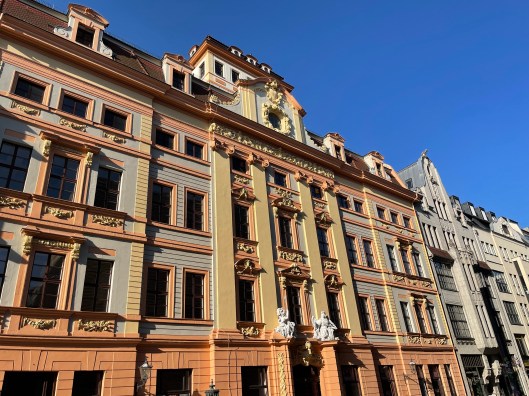
Romanus-Haus in Leipzig, the house where poet Christiane Mariane von Ziegler held salons in the 1720s and 1730s.

I visited Bachfest Leipzig again this year, from Tuesday evening, June 17, through Sunday, June 22, attending eight concerts in six days. Read my highlights below, and please subscribe to this blog so you don’t miss future posts. I joined a festival trip to Merseburg, took walks, caught up with friends from all over the world, and met some new fellow Bach lovers. For me, the camaraderie has almost become a more important reason to return each year than the concerts.

That said, next year’s cantata programming is not to be missed, with Herreweghe AND Lutz AND Rademann, so if you would like to attend you should probably get organized – my tips for that at the end of this post.

Summer in Leipzig

June is the perfect time of year in this city. People are out on café terraces everywhere, and walking in the streets. Then there’s the summer green: entire rose bushes for sale on the street in the middle of the center, and linden trees in bloom wherever you go. The scent of linden delights me, and I learned something new about them this year, thanks to our Bachfest tour guide Anna-Sylvia Goldammer on the organ trip to Merseburg: Leipzig has apparently always been full of linden trees! The latin word for Leipzig, Lipsi, was derived from the Slavic word for linden tree, lipa. Most of downtown, inside the ring, is car-free, with only taxis and necessary vehicles allowed in. This makes it feel safe and, dare I say it, more walkable than Amsterdam.

The free performances can be the most meaningful

Inspired by a seatmate on the trip to Köthen last year, I attended more of the free or almost-free performances this year. You can still fully enjoy the camaraderie with other Bach fans and hear beautiful music without spending a fortune. There are no assigned seats for the church services, so as long as you line up early, you can enjoy the best view for free.

This year I had missed the free performances on the market square, but on Saturday morning, June 21, I was so lucky to attend an unforgettable, absolutely exquisite rendition of the duet from Cantata 79 Gott der Herr ist Sonn und Schild by soprano Miriam Feuersinger and baritone Tobias Berndt during the “Mette” (morning service) in the Nikolaikirche. The Sunday morning service in the Thomaskirche was special too. The service was a reconstruction of what a church service in Bach’s time would have been like (I could write an entire blog post about that!), I got to hear Johannes Lang play the organ, Tomáš Král sing the bass arias in Cantata 20 O Ewigkeit, du Donnerwort, and tenor Patrick Grahl sing not only the tenor aria in that cantata but also the cantor-bits in the service as well as the reading from the New Testament (yes this was sung, beautiful!). But I also happened to sit and sing (in the congregational singing) next to the 80-year-old father of choir director Maria Küstner. With great determination he had climbed all the stairs to the balcony, even though he was walking with a cane. When after the service I thanked him for his clear and confident singing, he told me that decades ago, on frequent car trips between Leipzig and Berlin, he would sing Luther’s “Wir glauben all an einen Gott” (one of the Lutheran chorales we had just sung in the service) to keep himself and the family awake. I forgot to ask him if this was still during GDR time, but it might very well have been.

Catching up with David Chin

This year I also finally had the opportunity to have lunch with David Chin, director of Bachfest Malaysia and creator of the excellent documentary Encountering Bach which I have referenced already a few times on this blog. We started conversations on Facebook during the Covid pandemic after David published his first episodes of the documentary, then met in person at the Thüringer Bachwochen in 2022, but only managed to say a few quick hellos at last year’s Bachfest. So grateful it worked out to talk this year!

Concert highlights: Alex Potter and David de Winter
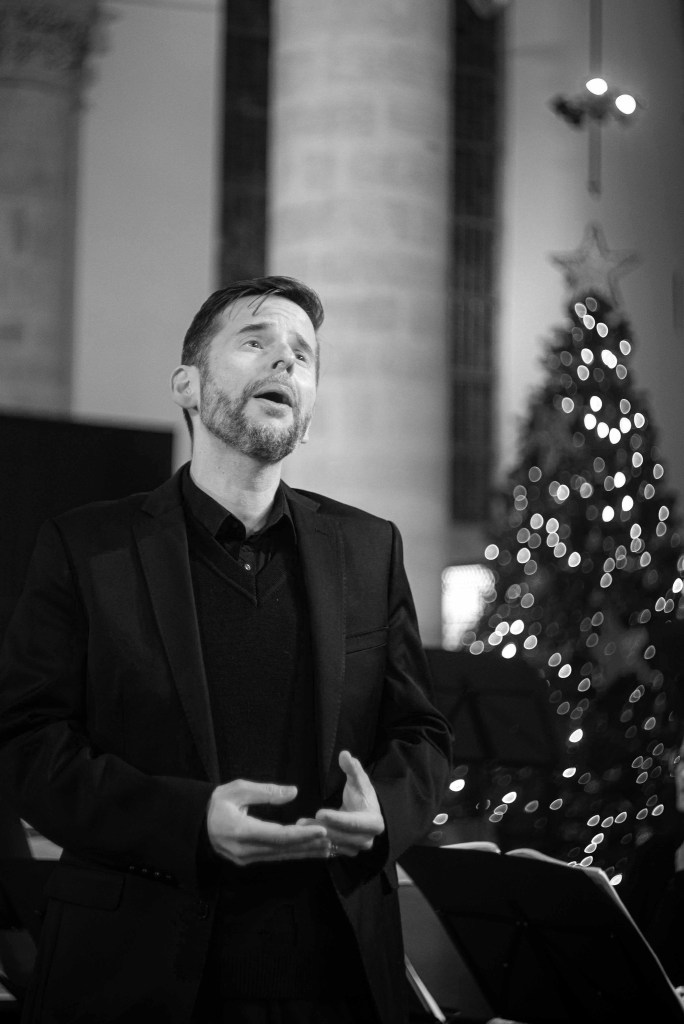
Alex Potter in the Nikolaikirche on June 17. Photo courtesy of Sascha Wolff.

I had only just arrived to Leipzig on Tuesday June 17. I had not even unpacked yet, but I had a chance to hear “Missa Miniatura,” Elina Albach’s adaptation of Bach’s Mass in B Minor again, and I am a big fan of that production. So I ate a quick dinner and made it to the Nikolaikirche just in time. Alex Potter’s stunning rendition of the Agnus Dei at this concert was definitely a highlight of this Bachfest for me. In order to have a bit more acoustic, he had climbed up a few steps so he stood directly under an arch in the Nikolaikirche. Thanks to Sascha Wolff for capturing that moment on photo. After this aria I felt “we can now all die happily.” The other aria that transported me to a similar state of bliss was David de Winter’s “Der Ewigkeit saphirnes Haus” from Cantata 198 Laß, Fürstin, laß noch einen Strahl with Solomon’s Knot on Friday, June 20, in the Evangelisch-Reformierte Kirche. I had never heard this aria sung so beautifully.

Bach’s “50 best cantatas” by Lutz, Herrewege, and Rademann, Vox Luminis, Koopman, and Gardiner in 2026 – how to get organized

Disclaimer: I’m not getting paid to write this. Below is a reflection of my personal opinion and personal interpretation of the information that is available at the time of writing this blog post. I do not accept responsibility if your experience is different. I just thought it might be helpful to curate the information from various websites for you.

Anyone reading this who has visited Bachfest in the last few years: please feel free to add your own advice in the comments. Thank you!

Next year’s cantata programming at the festival is going to be a hit parade of the “50 best cantatas” (chosen by the audience, read more about the how and why in this interview with festival director Michael Maul by blogger Rick Fulkner) with two concerts each by Herreweghe, Lutz, Koopman, Gardiner, Rademann, and Vox Luminis. Here are my tips to get organized:

If you already know you want to attend all 12 cantata concerts (= two concerts per day, six days in a row, of two to three cantatas each, each cantata preceded by a motet by Schütz or Schein), you can purchase your “packet” here. You’ll go through two seat selection screens, one to select your seat for the Thomaskirche (the screen doesn’t specify this, but it is the seatmap that has the stage at the bottom, and “Südempore” on the right), and, once you have clicked the checkout button, another one for the Nikolaikirche (not specified either, but this is the map that has the stage at the top and 1. Empore and 2. Empore).

Please note for Thomaskirche:

  • For concerts with choir and orchestra, the performers are located on the organ loft of the Sauer-organ (the bottom of the seating map).
  • The majority of the pews downstairs, where the sound is likely best, have their backs to the performers. Many people don’t mind this, but it surprised me. Thus, if it is important for you to see the performers, choose a premium seat (yellow on the map) on one of the balconies, where the sound is wonderful too.
  • Some seats on the Empore (balconies) have partially blocked views of the performers due to large pillars, even the premium seats are not all equal, so don’t get your hopes up too much.

Please note for Nikolaikirche:

The sound is good everywhere in the church, but most seats on the balconies have limited leg space, so keep that in mind if you are tall, since these cantata concerts will be pretty long. The Bach Museum shop sells cute portable cushions for making your church pew seat more comfortable, see picture on the left, pillow folded in half. I also saw people who traveled with inflatable pillows.

If you want to pick and choose, only want to go to one concert per day, or don’t want to commit to spending a thousand euros just yet, mark your calendar:

  • November 11, 2025: Advance sales start for Patrons of the Bachfest/Bach-Archiv Leipzig and for members of the Neue Bachgesellschaft.
    • Become a patron of the Bachfest here (access to VIP seating for three concerts or more, depending on level of giving).
    • Become a member of the Neue Bachgesellschaft here (no special seating, just the earlier access to ticket sales).
  • November 25, 2025: Regular ticket sales start.

Where to stay: People I met had good experiences at Innside (hotel directly across the ring from the Thomaskirche, in a nice neighborhood), Motel One (close to the Nikolaikirche), and Adina Apartment Hotel (apartments close to the Nikolaikirche, 24-hour reception, pool, restaurant, bar). I myself stayed in Apartmenthotel Quartier M. which I loved because of the excellent organic supermarket on the ground floor of the same building, the good price, and the short walking distance to the Thomaskirche.

Copyright Wieneke Gorter, July 9, 2025.

Bach Cantatas for Christmas – 1724 and 1734 editions

23 Monday Dec 2024

Posted by cantatasonmymind in Cantatas, Chorale cantatas 1724/1725, Christmas, Epiphany, Leipzig

≈ 4 Comments

Tags

Alex Potter, Antonia Frey, baroque-music, Bart Aerbeydt, Bernhard Bechtold, Carine Tinney, Charles Daniels, Christmas, Christmas Oratorio, Collegium Vocale Gent, Concerto Copenhagen, Daniel Johannsen, Eric Milnes, Florian Sievers, Harry van der Kamp, J.S. Bach Foundation, J.S. Bach Stiftung, Jan Kobow, Julia Doyle, Lars Ulrik Mortensen, Lucia Giraudo, Margot Oitzinger, Maria Keohane, Mark Padmore, Matthew Brook, Matthew White, Milo Maestri, Monika Mauch, Montreal Baroque, Netherlands Bach Society, Peter Kooij, Philippe Herreweghe, Rodrigo Lopez-Paz, Rudolf Lutz, Sarah Connolly, Stephan MacLeod, Tomáš Král, Vasiljka Jezovsek

Merry Christmas! Below are my recommendations for recordings of Bach’s chorale cantatas for the Christmas season, written in 1724/1725, as well as a link to the video of this year’s wonderful live performance by the Netherlands Bach Society of Bach’s Christmas Oratorio, written in 1734/1735. Before I get to that, I wanted to share a personal story. (If you want to “jump to the recipe,” just scroll down three paragraphs to the next header).

As regular readers of this blog know, Christmas morning for me = “Jauchtzet, frohlocket,” the first entrance of Bach’s Christmas Oratorio*. But ten days ago, during the first-ever Christmas Oratorio concert of my life as a chorus member, I couldn’t sing those words.

I had unwittingly set myself up for it, because I had just done two things to remember my late mother. It was very cold in the church, and I had lent one of my mother’s scarves to a friend who was singing next to me. As we were getting on stage, I told her: “this scarf has been in many a Bach concert, because my mother used to sing in a Bach choir too.” And then I showed her how I had copied my mother’s signature from her old piano reduction to the new one I was using now.

So while I had been completely fine during all the rehearsals, now with the audience there and those memories, the first notes of the timpani made me choke up. Fortunately, that first soprano entrance is low and doubled by many other voices, so nobody noticed. And I was fine for the rest of the concert, and thoroughly enjoyed getting to sing cantatas 1, 2, 5, and 6 of Bach’s Christmas Oratorio with a good orchestra and great soloists.

Do you have special memories associated with Bach’s or other Christmas music? Please let me know in the comments. Here are my recommendations for recordings:

Christmas Cantatas from Bach’s Chorale Cantata cycle, 1724/1725

Christmas Day: Cantata 91 Gelobet seist du, Jesu Christ by the J.S. Bach Foundation/Rudolf Lutz, with Monika Mauch – Soprano; Margot Oitzinger – Alto; Bernhard Berchtold – Tenor; and Peter Kooji – Bass. Find the score here, and English translations here.

Second Christmas Day: Cantata 121 Christum wir sollen loben schon by Concerto Copenhagen/Lars Ulrik Mortensen, with Maria Keohane – Soprano; Alex Potter – Alto; Jan Kobow – Tenor; and Matthew Brook – Bass. Find the score here, and English translations here.

Third Christmas Day: Cantata 133 Ich freue mich in dir by Concerto Copenhagen/Lars Ulrik Mortensen, with Maria Keohane – Soprano; Alex Potter – Alto; Jan Kobow – Tenor; and Matthew Brook – Bass. Find the score here, and the English translations here.

Maria Keohane

Sunday after Christmas: Cantata 122 Das neugeborene Kindelein by Collegium Vocale Gent/Philippe Herreweghe, with Vasiljka Jezovsek – Soprano; Sarah Connolly – Alto; Mark Padmore – Tenor; and Peter Kooij – Bass. Find the score here, and the English translations here.

New Year’s Day: Cantata 41 Jesu nun sei gepreiset by the J.S. Bach Foundation/Rudolf Lutz, with Julia Doyle – Soprano; Antonia Frey – Alto; Florian Sievers – Tenor; and Stephan MacLeod – Bass. Find the score here, and the English translations here.

Jan 6, Epiphany: Cantata 123 Liebster Immanuel, Herzog der Frommen by Montréal Baroque/Eric Milnes, with Matthew White, alto; Charles Daniels, tenor; and Harry van der Kamp, bass. Find the score here, and the English translations here.

From Bach’s Christmas Oratorio, 1734/1735

Bart Aerbeydt and Milo Maestri
Lucia Giraudo
Daniel Johannsen

All photos above by Donald Bentvelsen. Find him on Instagram at @bentvel.

I highly recommend the video of the most recent live performance by the Netherlands Bach Society under the direction of Lars Ulrik Mortensen. They performed cantatas 1, 4, 5, and 6 of Bach’s Christmas Oratorio in the Netherlands earlier this month. I attended the concert in Naarden on December 11, the video below is from the performance in Utrecht, two days later. The choir could have been a bit larger for my personal taste, but for the rest I absolutely loved this performance, with text-focused singing by all soloists, and fabulous and sensitive playing by the instrumentalists, allowing for musical dialogues with the singers. I especially enjoyed the contributions by tenor Daniel Johannsen, oboist Rodrigo Lopez-Paz (photo in my previous post), violinist Lucia Giraudo, and horn players Bart Aerbeydt and Milo Maestri. I very much ejoyed reading the program booklet, especially the the interview with director Lars Ulrik Mortensen.

Read the English program book for this performance here. Read a bit more on the fifth cantata from this same performance in my previous post.

Please consider subscribing to this blog (just click on the button below), it really helps me!

Best wishes for the New Year,

Wieneke Gorter, December 23, 2024.

* if you don’t know the story, please find it here.

First Sunday of Advent 1724: Bach helps commemorate and explain a 200-year-old hymn text

30 Saturday Nov 2024

Posted by cantatasonmymind in Advent, Cantatas, Chorale cantatas 1724/1725, Leipzig

≈ Leave a comment

Tags

Advent 1, Antonia Frey, bachhaus-eisenach, Bachstiftung, baroque-music, Benedikt Kristjánsson, BWV 62, choral-music, erfurter-enchiridion, erfurter-handbuchlein, evangelischer-lieder-commentarius, history, J.S. Bach Foundation, J.S. Bach Stiftung, Jan Kobow, johann-martin-schamel, John Eliot Gardiner, l500b300, Lisa Andres, Lydia Vroegindeweij, martin-luther, Rudolf Lutz

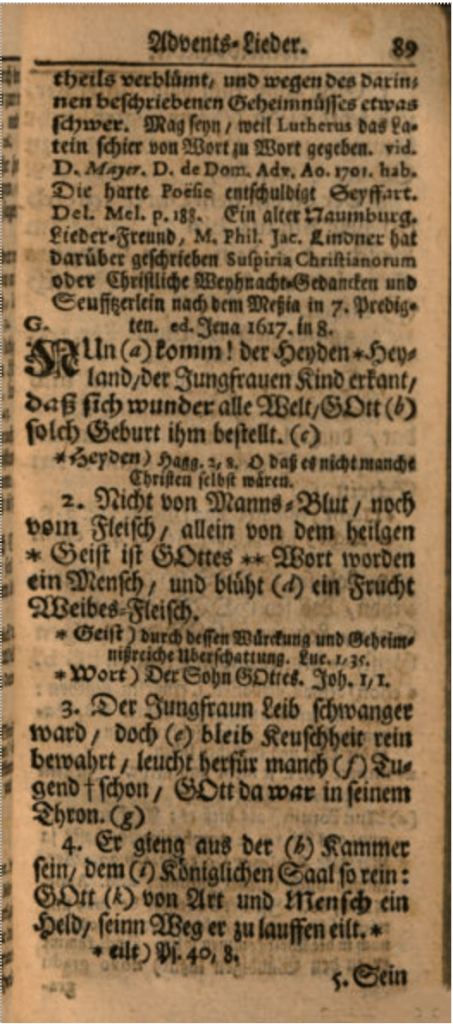
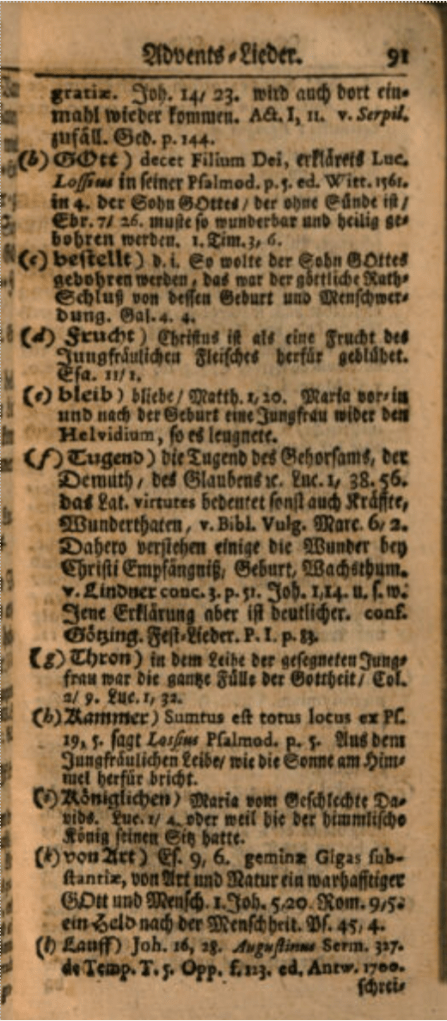
Evangelischer Lieder-Commentarius (Evangelical Hymn Commentary) by Johann Martin Schamel from 1724: an annotated hymnal, published to commemorate the bi-centenary of Luther’s first hymnals. From left to right: the title page; page 89 with the first four verses of Luther’s hymn “Nun komm, der Heiden Heiland,” with lower-case letters and asterisks referring to footnotes; page 91 with the footnotes.

Please open this post in your internet browser (just click on the title at the top) to see the images placed the correct way – thank you!

Today’s cantata – Happy 1st Advent!

Warning: If you don’t feel like reading science journalism, and just came here to listen to a beautiful cantata, I got you: here is Cantata 62 Nun komm, der Heiden Heiland in an excellent new live performance by the J.S. Bach Foundation under the direction of Rudolf Lutz. I especially love the opening chorus as well as the tenor aria, sung from memory by Benedikt Kristjánsson (read more about him in my post about the Bachfest in Leipzig this past summer). Other soloists are Lisa Andres, soprano; Antonia Frey, alto; and Peter Harvey, bass.

Find the German text with English translation here, and the score here.

A special exhibition in Eisenach

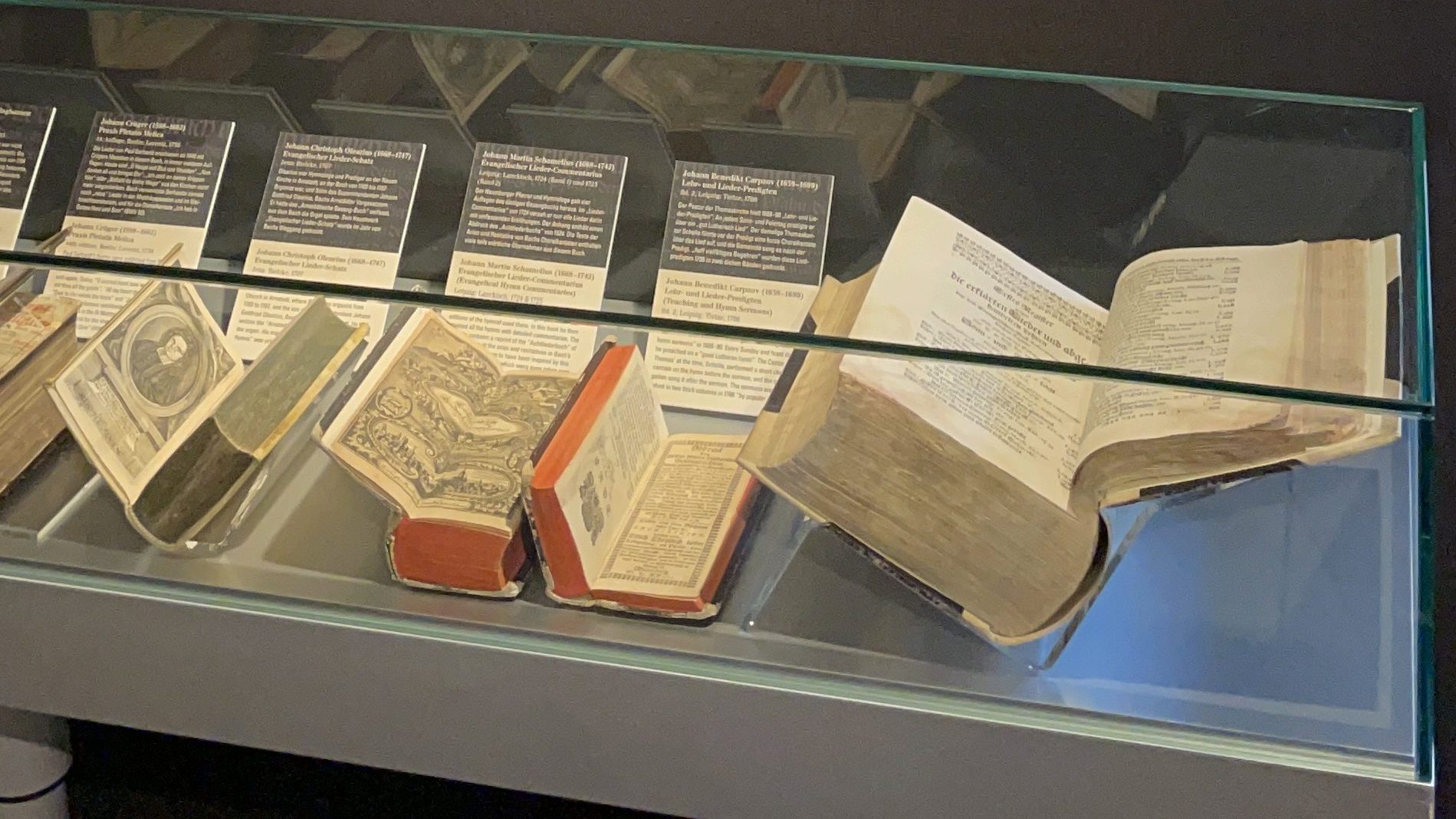
A month ago, I traveled to Eisenach (Bach’s birthplace in Germany) to catch the last days of a special exhibition at the Bachhaus on the double anniversary of Luther’s hymns (500 years) and Bach’s chorale cantatas (300 years) and the connection between the two. I got to see in real life many hymnals that were in use during Bach’s time. What struck me right away was how small and narrow they are! They were truly meant to be held in one hand (so one could leaf through it with the other hand). This is of course exactly what Luther envisioned when he published the very first German-language hymnals in 1524: that churchgoers could read and sing along during the church service, and also easily use the hymnals at home and at school. This photo gives a good idea of their size compared to a larger book:

Luther’s “Nun komm, der Heiden Heiland”

“Nun komm, der Heiden Heiland” in the Erfurter Enchiridion from 1524.

While most of the hymnals were displayed as in the photo above, the two oldest and rarest, on loan from libraries in Regensburg and Strasbourg, were hidden behind thick felt flaps to protect them from the light. One of these, Luther’s Erfurter Enchiridion (Erfurter Handbook) from 1524, lay opened to his Advent hymn “Nun komm, der Heiden Heiland,” the hymn Bach used two hundred years later, for Cantata 62 Nun komm, der Heiden Heiland for the first Sunday of Advent. Luther based this hymn on the then still well-known “Veni redemptor gentium” from the 4th century, closely translating the latin, and only slightly altering the melody.

Publications commemorating the bi-centenary of Luther’s hymnals in 1724 likely influenced Bach

Bach scholars have always wondered why Bach wrote an entire cycle of cantatas based on hymns. Some offer that his first cycle of cantatas (1723/1724) must have been too complicated for his audience (the Leipzig churchgoers) and that Bach, or possibly his employers, thus came up with something extremely familiar (the hymns) as a common thread for the second cycle of cantatas. Others say that the ability of the boy sopranos must have been so bad, judging by letters Bach later wrote to complain about this, that he switched to chorale cantatas so the choir sopranos would only have to sing the well-known chorale melody while the altos, tenors, and basses would sing more complicated parts.

While none, a combination, or part of these hypotheses might be true, recent research by Dutch theologian Dr. Lydia Vroegindeweij provides us with a third theory: Bach was very likely influenced by a strong movement in Lutheran Germany in the first quarter of the 18th century for the preservation and clarification of the original Lutheran hymns. His choice of 1724 as the year to start a cycle of chorale cantatas would thus not have been a coincidence at all, but a way to help commemorate the centenary of Luther’s first hymnals. The most important figures in this movement operated in Bach’s circle of friends and colleagues and of course Bach was a great admirer of Luther, having Luther’s entire oeuvre of writings in his library. So he would have been more than interested to support the efforts to preserve and better explain Luther’s hymns.

Specifically, Lydia makes a strong case that Bach and/or his anonymous librettist must have consulted Johann Martin Schamel’s Evangelischer Lieder-Commentarius (see the caption heading this post) for the recitative and aria texts for several if not all of his chorale cantatas. She has pointed out that many chorale cantata texts correspond to Schamel’s explanations, use the exact same words, or even follow Schamel’s suggestion to combine Luther’s psalm in question with another one (as is the case in Cantata 38, read more here).

As Lydia explains in a podcast she now has on a Dutch radio station, Luther’s hymn “Nun komm, der Heiden Heiland” especially needed clarification, because in an effort to make the text rhyme and stay as close as possible to the original “Veni redemptor gentium,” Luther had made the text so compact that it had puzzled many hymnologists and clergy.

How does Bach illustrate Schamel’s explanations of this particular hymn?

In the first stanza (the literal text of the opening chorus), Schamel puts (a) after the word “Nun” (now) and explains [freely translated]: “As if it meant: Oh come now, you promised! Instead, it is the poetic style, and is not meant as if the Savior had yet to come into the world. But he comes to believers daily, again and again, each time as a new step of grace.” This concept of “again and again” and the “steps” are clearly present in the music of the opening chorus of Cantata 62.

Lydia says: “Schamel substantiates this with a reference to John 14:23. This corresponds with Luther’s own explanation of this verse in the Calov Bible [which Bach was also familiar with, and added to his own library in 1733]. There Luther also talks about daily contact, and about Jesus who would like to live with people in their houses and share a meal with them.”

The emphasis in this cantata is placed more on the sacred miracle of the human birth and less on the “coming”. This “Wunder” (miracle/wonder) is even more celebrated in the tenor aria. Lydia says: “The aria emphasizes that God encompasses the whole world with that kind of miracle and that we can only admire that grace.”

And the prize for the best interpretation of the tenor aria goes to …

When two years ago Lydia and I searched for the best interpretation of the tenor aria, i.e. the one that really emphasizes the “wonder,” our prize went to Jan Kobow on the Gardiner recording from 2000. Listen to it here. Kobow does a beautiful job expressing the wonder, not only in the first phrase, but also in the B-section when he sings “o, Wunder”. He also makes a striking contrast between those wondrous and quiet-making aspects of the miracle and the stronger, more convinced text of “Herrscher.”

However, now that I’ve heard and seen Benedikt Kristjánsson sing on the recording with the J.S. Bach Foundation, his singing strikes me as the perfect illustration of “God encompasses the whole world with that kind of mystery.”

Further reading

If you would like to do your own reading and interpreting of Schamel’s commentary, you can find it here (in German). If you would like to subscribe to Lydia’s newsletter, you can do so here. Also, please don’t forget to subscribe to my blog – just fill in your email address here below, and you will receive an email every time I post a new story. Thank you!

Wieneke Gorter, November 30, 2024.

About Weekly Cantata

I am a bilingual writer, publicist, choral singer, art and nature lover, foodie, happy wife, and blessed mother of two. I started this blog in 2016, inspired by my late mother’s love for Bach’s cantatas. After 23 years in the San Francisco Bay Area, I’m now back in the Netherlands.

If you are on social media, please follow me:

  • Facebook
  • Instagram

Please subscribe!

Please subscribe to this blog! Simply fill in your email address and you’ll receive an email every time I’ve published a new post. Thank you!

Multifunctional trumpets, from 1723 to 1748

27 Sunday Aug 2023

Posted by cantatasonmymind in 1723 Trinity season special series, Bach's life, Cantatas, Leipzig, Trinity

≈ Leave a comment

Tags

Alex Potter, BWV 69, BWV 69a, Christ healing a deaf mute, Dominik Wörner, Eduard van Hengel, J.S. Bach Foundation, J.S. Bach Stiftung, Karl Graf, Michael Maul, Miriam Feuersinger, Mirjam Berli, Peter Kooij, Raphael Höhn, Rudolf Lutz, Thomas Hobbs, Trinity 12, trumpets

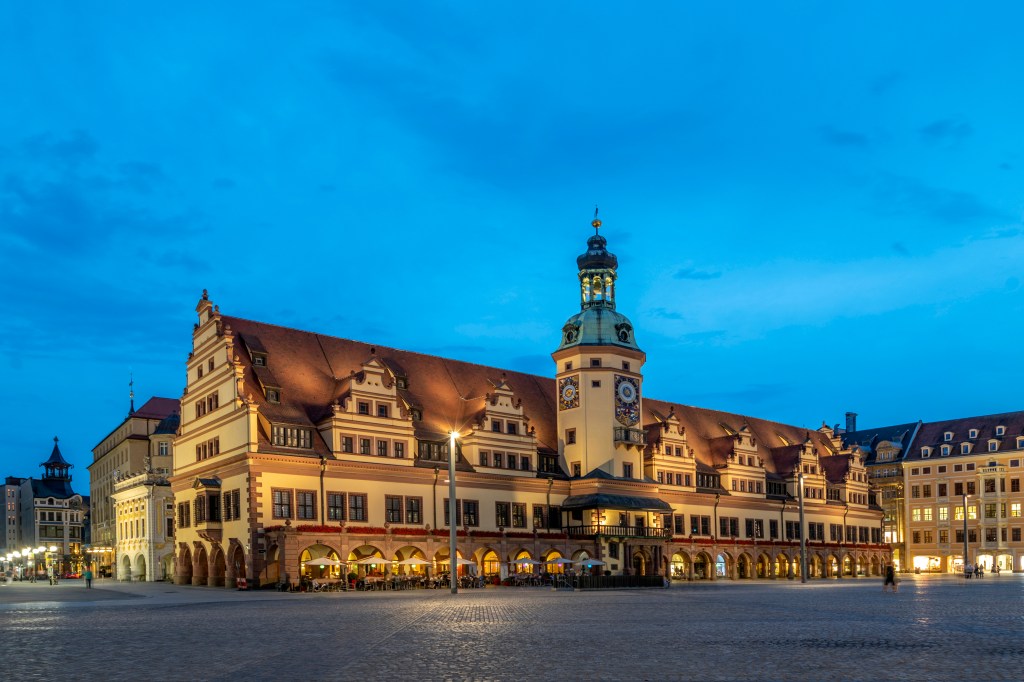
Old Town Hall in Leipzig

For those of you receiving this in email, please click on the post to read in a web browser, as images and table will display much better that way.

For this Sunday in 1723, the 12th after Trinity, Bach wrote Cantata 69a Lobe den Herrn, meine Seele. In my post from 2016 I remarked how unusual it was for Bach to use trumpets on such a “normal” Sunday, and imagined his father-in-law being in town for a visit. But this week I heard two better arguments. 

In his podcast, Bach scholar Michael Maul suggests that after the incredibly serious and sad music of the past three Sundays, Bach might have realized that the Leipzig churchgoers needed to hear something more upbeat. This might sound trivial, but if you look at Bach’s passions, he knew very well when a change in mood was needed and mastered that skill like a great opera composer or playwright. In addition to this good reason, I was also convinced by theologian Karl Graf in the J.S. Bach Foundation’s lecture about Cantata 69a, because he reminded me that the Bible story on which this cantata is based is that of Christ healing a deaf mute. Graf points out that in the time of the Bible, but also still in Bach’s time, a deaf mute would not only have been excluded from society, but would also have been considered a person without faith. Thus, the rejoicing by chorus and trumpets is not only an illustration of the praise the crowd gives after witnessing the miracle, but especially of this person finding faith.

A quarter century later, in 1748, Bach recycled this cantata during the same time of year, but for a completely different occasion: the installation of the new Town Council, or “Ratswahl.” The “Ratswahl” was always on the first Monday after August 24 (the feast of St. Bartholomew); which in 1748 fell on Monday, August 30. Bach must have written about 27 Ratswahl cantatas, but only six have survived.

I have listed Bach’s changes in 1748 here below, expanding on a table created by Eduard van Hengel. I’ve included links for live video recordings of both cantatas (just click on the link at the top of each column).

Cantata 69a for Trinity 12 1723

Live video recording by the J.S. Bach Foundation, Rudolf Lutz, conductor. With
Mirjam Berli, soprano; Alex Potter, alto; Raphael Höhn, tenor; Dominik Wörner, bass.
Cantata 69 for Ratswechsel 1748

Live recording by the Netherlands Bach Society, Peter Dijkstra, conductor. With
Miriam Feuersinger, soprano; Alex Potter, alto; Thomas Hobbs, tenor; Peter Kooij, bass.
Please find the German texts with English translations here, and the score herePlease find the German texts with English translations here, and the score here
Opening ChorusOpening Chorus, unchanged
Soprano recitative, 11 measures

Ach, dass ich tausend Zungen hätte!
Ach wäre doch mein Mund
Von eitlen Worten leer!
Ach, dass ich gar nichts redte,
Als was zu Gottes Lob gerichtet wär!
So machte ich des Höchsten Güte kund;
Denn er hat lebenslang so viel an mir getan,
Dass ich in Ewigkeit ihm nicht verdanken kann.
Soprano recitative, 18 measures

Wie groß ist Gottes Güte doch!
Er bracht uns an das Licht,
Und er erhält uns noch.
Wo findet man nur eine Kreatur,
Der es an Unterhalt gebricht?
Betrachte doch, mein Geist,
Der Allmacht unverdeckte Spur,
Die auch im kleinen sich recht groß erweist.
Ach! möcht es mir, o Höchster, doch gelingen,
Ein würdig Danklied dir zu bringen!
Doch, sollt es mir hierbei an Kräften fehlen,
So will ich doch, Herr, deinen Ruhm erzählen.
Tenor aria in C Major with recorder and oboe da caccia

Meine Seele,
Auf, erzähle,
Was dir Gott erwiesen hat!
Rühmet seine Wundertat,
Laßt ein gottgefällig Singen
Durch die frohen Lippen dringen!
Alto aria in G Major with violin and oboe


Meine Seele,
Auf! erzähle,
Was dir Gott erwiesen hat!
Rühme seine Wundertat,
Laß, dem Höchsten zu gefallen,
Ihm ein frohes Danklied schallen!
Alto recitative with continuo only,
18 measures

Gedenk ich nur zurück,
Was du, mein Gott, von zarter Jugend an
Bis diesen Augenblick
An mir getan,
So kann ich deine Wunder, Herr,
So wenig als die Sterne zählen.
Vor deine Huld, die du an meiner Seelen
Noch alle Stunden tust,
Indem du nur von deiner Liebe ruhst,
Vermag ich nicht vollkommnen Dank zu weihn.
Mein Mund ist schwach, die Zunge stumm
Zu deinem Preis und Ruhm.
Ach! sei mir nah
Und sprich dein kräftig Hephata,
So wird mein Mund voll Dankens sein.
Tenor recitative with strings 
26 measures

Der Herr hat große Ding an uns getan.
Denn er versorget und erhält,
Beschützet und regiert die Welt.
Er tut mehr, als man sagen kann.
Jedoch, nur eines zu gedenken:
Was könnt uns Gott wohl Bessres schenken,
Als dass er unsrer Obrigkeit
Den Geist der Weisheit gibet,
Die denn zu jeder Zeit
Das Böse straft, das Gute liebet?
Ja, die bei Tag und Nacht
Vor unsre Wohlfahrt wacht?
Laßt uns dafür den Höchsten preisen;
Auf! ruft ihn an,
Dass er sich auch noch fernerhin so gnädig woll erweisen
Was unserm Lande schaden kann,
Wirst du, o Höchster, von uns wenden
Und uns erwünschte Hilfe senden.
Ja, ja, du wirst in Kreuz und Nöten
Uns züchtigen, jedoch nicht töten.
Bass ariaBass aria, unchanged
Closing chorale with instruments doubling the vocal lines

Was Gott tut, das ist wohlgetan,
Darbei will ich verbleiben.
Es mag mich auf die rauhe Bahn
Not, Tod und Elend treiben:
So wird Gott mich
Ganz väterlich
In seinen Armen halten.
Drum lass ich ihn nur walten.
Closing chorale with separate parts for trumpets and timpani

Es danke, Gott, und lobe dich
Das Volk in guten Taten.
Das Land bringt Frucht und bessert sich,
Dein Wort ist wohl geraten.
Uns segne Vater und der Sohn,
Uns segne Gott, der Heilge Geist,
Dem alle Welt die Ehre tut,
Für ihm sich fürchten allermeist,
Und sprecht von Herzen: Amen!

Wieneke Gorter, August 27, 2023.

About Weekly Cantata

I am a bilingual writer, publicist, choral singer, art and nature lover, happy wife, and blessed mother of two. I started this blog in 2016, inspired by my late mother’s love for Bach’s cantatas. After 23 years in the San Francisco Bay Area, I’m now back in the Netherlands.

If you are on social media, please follow me:

  • Facebook
  • Instagram

Please subscribe!

Please join my readers from all over the world and subscribe to this blog! Simply fill in your email address and you’ll receive an email every time I’ve published a new post. Thank you so much / Vielen Dank / Merci mille fois / 감사합니다 / 谢谢 / ありがとう / Mille grazie / Muchas gracias / Muito obrigado / Takk / Terima kasih / Dankuwel!

Designed with WordPress.com

Wishing you beauty, love, and contemplation for Advent

28 Sunday Nov 2021

Posted by cantatasonmymind in Advent, Cantatas, Chorale cantatas 1724/1725, Following Bach in 1725, Leipzig, Weimar

≈ Leave a comment

Tags

Advent 1, BWV 36, BWV 61, BWV 62, J.S. Bach Foundation, J.S. Bach Stiftung, Nuria Rial, Rudolf Lutz

In German-speaking countries, people wish each other either a “schönen” (beautiful, pleasant), “lieblichen” (lovely, love-filled), or a “besinnlichen” (thoughtful, contemplative) Advent. I wish you all of that: beauty, love, and contemplation for the next four weeks.

On this first Sunday of Advent, I present to you again the J.S. Bach Foundation (J.S. Bachstiftung) with soprano Núria Rial, this time in Cantata 36 Schwingt freudig euch empor. In 1731, Bach transformed a secular birthday cantata from 1725 into this work for Advent. Enjoy watching these two videos by the J.S. Bach Foundation to get better acquainted with this composition:

Fabulous explanation by Rudolf Lutz of cantata BWV 36 “Schwingt freudig euch empor” (in German with English subtitles)

Video registration of their concert in Trogen, Switzerland, in 2007: J.S. Bach – Cantata BWV 36 “Schwingt freudig euch empor” (J.S. Bach Foundation)

If you would like to read, listen, or watch more, here’s a little overview of my previous posts for the first Sunday of Advent:

In Weimar, in 1714, Bach wrote Cantata 61 Nun komm, der Heiden Heiland. This one I remember the best from my childhood, because my mother loved Seppi Kronwitter’s singing of the soprano aria on the Harnoncourt recording. Read about it here. More about Bach’s prolific Advent cantata writing in Weimar next week.

In Leipzig, in 1724, Bach wrote Cantata 62 Nun komm, der Heiden Heiland. My most recent writing about this cantata is from 2020, not for this blog, but for that of California Bach Society. Find it here. My post from 2017 about this cantata is here.

Read my post about Cantata 36 Schwingt freudig euch empor here. 

Wieneke Gorter, November 28, 2021.

By the way: the video of the J.S. Bach Foundation’s 15th Anniversary concert with Núria Rial is still available here on YouTube. It is a registration of the performance in Trogen, held one day after the one I attended in Basel.

J.S. Bach Foundation with Nuria Rial review and live video

18 Thursday Nov 2021

Posted by cantatasonmymind in Cantatas, Köthen, Leipzig, Weimar

≈ Leave a comment

Tags

Amy Power, Bach, Bachstiftung, BWV 199, bwv 202, BWV 82, cantatas, Daniel Rosin, Eva Borhi, J.S. Bach Foundation, J.S. Bach Stiftung, Manuel Walser, Nuria Rial, Rudolf Lutz, Sonoko Asabuki

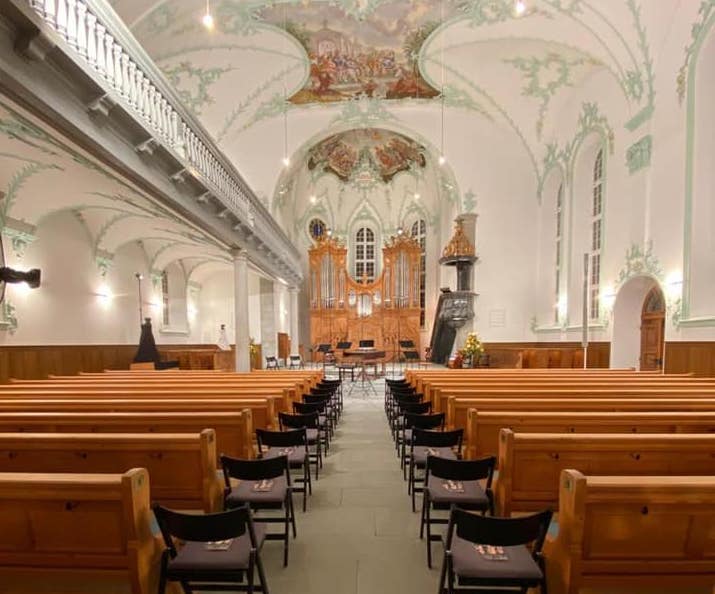
The church in Trogen, Switzerland, where the 15th anniversary concert of the J.S. Bach Foundation was recorded on November 17, 2021. Find it here on YouTube.

Nuria Rial in Basel

This week, the J.S. Bach Foundation celebrated 15 years of recording Bach cantatas with a special anniversary program in three cities in Switzerland: Basel, Trogen, and Zürich. I am still pinching myself that I got to attend the concert in Basel on Tuesday November 16, sitting only 6 feet (2 meters) from the amazing soprano Nuria Rial, who sang Cantata 199 Mein Herze schwimmt im Blut and Cantata 202 Weichet nur, betrübte Schatten.

Her performance was everything I had been hoping for and more. Her voice pulls you in from the start, and the energy and joy she exudes are just extraordinary. And then there’s her playfulness. I will never forget how special it was to experience that from up-close. I also realized what a true ensemble member she is, always in contact with the instrumentalists.

Amy Power in Basel

And those instrumentalists really need to be mentioned! Oboist Amy Power’s playing was lyrical throughout, with beautiful ornamentations in the “da capo” parts of the arias. I especially enjoyed the call-and response between her and Nuria Rial in the first movement of Weichet nur, betrübte Schatten. Her accomplishments were even more impressive knowing that she had been summoned from Graz less than 8 days before the concert, when the J.S. Bach Foundation heard that oboist Andreas Helm had to isolate at home because of contracting Covid-19.

First violinist Eva Borhi’s sensitive playing was especially gorgeous in the “Tief gebückt” aria from Canatata 199 and “Schlummert ein” aria from Cantata 82 with Manuel Walser. But my favorite was her interaction with Nuria Rial in the “Wenn die Frühlingslufte streichen” aria from Cantata 202.

Violist Sonoko Asabuki had an exquisite solo in the Chorale “Ich, dein betrübtes Kind” from Cantata 199, and cellist Daniel Rosin did a great illustration of Phoebus’ speeding horses in the third movement of Cantata 202, which earned a “Bravo” cheer from the audience, as if we were at the opera. (Always better than the audience member who fell asleep during “Schlummert ein,” snoring and all, a few rows behind me).

Last but not least, Rudolf Lutz, who directed the others from the harpsichord, improvised tasteful and effective mini-preludes leading up to the recitatives in Cantata 199, and very sensitively employed the lute register in the da capo of “Schlummert ein,” which formed a beautiful accompaniment to the pianissimo playing strings. He was also his usual witty self, making audience and performers laugh with his short speeches. My sister mentioned that even though we were here together at the concert because of our mother, she was actually strongly reminded of our grandfather. Also a man who always appeared very proper and Calvinist, but would then surprise you with his terrific sense of humor.

Watch this same performance, recorded live in Trogen, a day later than the one I attended in Basel here on YouTube.

Wieneke Gorter, November 19, 2021.

Nuria Rial singing Cantata 202: why this is special to me

15 Monday Nov 2021

Posted by cantatasonmymind in Cantatas

≈ Leave a comment

Tags

Bachstiftung, Basel, J.S. Bach Foundation, J.S. Bach Stiftung, Manuel Walser, Nuria Rial, Rudolf Lutz, Schola Cantorum Basiliensis

Nuria Rial

Today is an exciting day for me, because I get to see and hear Nuria Rial sing live for the first time in my life, performing a piece I have very fond childhood memories of. I also get to hug my sister for the first time in more than two years, and I get to explore the gorgeous city of Basel. It is a special week for my sister and me, since this coming Friday is the 11th anniversary of our mother’s death.

To remember our late mother and her love of music, every year my sister and I have tried to go to a concert together. Because I used to live in California and my sister lives in France, and we both have kids, it would not work out every year, but we’ve had some memorable experiences. In March 2013 we attended Bach’s St. Matthew Passion by Herreweghe in Cuenca, Spain, during Holy Week, which in Spain comes with processions in the streets. In November 2015 we went to Monteverdi’s 1610 Vespers by Savall in the then brand-new Philharmonie de Paris, only a few days after the terrorist attacks. The last time we went to a concert together was in January 2018.

When the J.S. Bach Foundation announced their 15th anniversary concerts with Nuria Rial in Cantata 202, my choice for this year was made. I’m so grateful this is all working out and I am so excited I already woke up at 5 am this morning, as if I’m an elementary school kid, going on a field trip.

About that elementary school kid. One of my strongest childhood memories is of the time my sister and I accompanied my mother when she had to go sing at a wedding. It must have been late 1970s/early 1980s. The couple were both elementary school teachers, so they got married on a Wednesday afternoon, to make it possible for their students to attend their wedding as well. I remember absolutely nothing about all the other kids that must have been there that day. I only remember waiting for the bus, sitting on the floor of the organ loft, and hearing the music. Read more in this in this post, where you can also hear an example of the piece my mother sang that afternoon: the “Gavotte” from Cantata 202.

I have always wanted to visit Basel. It’s the place of the Schola Cantorum Basiliensis, where so many of the Baroque musicians I admire received their training. But I also heard many stories about all the great art museums, the historic city, and how beautifully it is situated on the Rhine. When we returned from our trip to Italy in 2018, we had a wonderful stop-over with a dear friend near Basel, but all we got to see of the city were the two railway stations.

I first heard Nuria Rial sing on the German radio station WDR3, exactly one month after my mother passed away in 2010. I was staying at my parents’ house in the Netherlands with my kids. My mother had always preferred the German classical music station over the Dutch one, especially for their Early music programming, so WDR3 was pre-programmed into my parents’ fancy equipment. I heard Nuria Rial sing and she literally took my breath away. After it was over I went on Facebook and told all my singer friends (that’s why I still know what day it was). To get an idea, watch her live recording of the soprano aria from Cantata 36 with the J.S. Bach Foundation. I know I already said it, but tonight is the first time I’m going to hear and see her live.

It will also be the first time I’m going to see the J.S. Bach Foundation (Bachstiftung) perform live, after having been a fan of theirs for several years now, and having shared many of their videos on my blog. Read my last post about them (and another favorite soprano) here. I feel honored I get to celebrate their 15th Anniversary with them tonight.

There really is nothing like a live performance. But if you can’t make it to Switzerland this week, you can still watch this same concert 🙂 Tomorrow, Wednesday November 17, this same program will be live-streamed from Trogen, Switzerland, at 7 pm Central European Time, which is 10 am Pacific Time, 1 pm Eastern Time, or 6 pm in the UK. For more information on the live-stream, and to download the program booklet, click here. Direct links to the live stream are here, or on the YouTube channel of the J.S. Bach Foundation.

Wieneke Gorter, November 16, 2021.

Dorothee Mields in the spotlight – Third Sunday after Trinity

20 Sunday Jun 2021

Posted by cantatasonmymind in 1723 Trinity season special series, Cantatas, Chorale cantatas 1724/1725, Köthen, Leipzig, Trinity, Weimar

≈ Leave a comment

Tags

Alex Potter, Bach Akademie Stuttgart, Bachstiftung, BWV 135, BWV 172, BWV 21, Dorothee Mields, Gaechinger Cantorey, Hans-Christoph Rademann, J.S. Bach Foundation, J.S. Bach Stiftung, Peter Kooij, Rudolf Lutz, Trinity 3

As far as we know, Bach wrote two cantatas for this Sunday, the third after Trinity: Cantata 21 Ich hatte viel Bekümmernis and Cantata 135 Ach Herr, mich armen Sünder.

Read my post from 2017 about Cantata 135 here. Since I wrote that post, a beautiful live video recording by the J.S. Bach Foundation has been released on YouTube. Find it here.

But now about Cantata 21. It is one of Bach’s most well-known cantatas and it gets programmed often because it features several exciting choruses. The version most of us know is with three soloists: a soprano, a tenor, and a bass. Bach first wrote it like that in Weimar and later performed a similar version in Leipzig in 1723, as part of his first year there. However, in 1720, he created a different version, which he performed in Köthen as well as in Hamburg. It is likely that this version was created for a special soprano soloist (possibly Anna Magdalena?), because in this version, Bach assigns all three tenor solos to the soprano as well, thus featuring the soprano in every solo movement. The bass joins her for two duets.

Dorothee Mields

It turns out that the J.S. Bach Foundation decided to perform this 1720 version for their live video series, with soprano Dorothee Mields and bass Peter Kooij. If I had been at that concert in person, I would have joined the whooping and clapping at the end, because it is an outstanding performance by both soloists but also by the chorus. I only discovered this video recording by accident tonight. I had completely missed it when it was released earlier this month. I meant to write a very short blog post today, quickly giving you some links to previous posts and then go to sleep, but I was completely mesmerized by Dorothee Mields’ singing and was unable to close my computer.

In my post from 2016 about Cantata 21, I show how similar the duet from this cantata is to the duet from Cantata 172 (also written in Weimar). When I watched the J.S. Bach Foundation video of Cantata 21 and witnessed Mields’ art of being in sync with her duet partner, I remembered there’s another wonderful video I have wanted to share. It is Dorothee Mields and Alex Potter singing the duet from Cantata 172 in this video by the Bach Akademie Stuttgart that came out at the end of May. I enjoy very much how sensitive Mields and Potter both are to the music and the text, and how beautifully and naturally their voices move together.

Wieneke Gorter, June 19, 2021.

Second Sunday after Trinity

12 Saturday Jun 2021

Posted by cantatasonmymind in 1723 Trinity season special series, Cantatas, Chorale cantatas 1724/1725, Leipzig, Trinity

≈ Leave a comment

Tags

BWV 2, BWV 76, cantatas, J.S. Bach Foundation, J.S. Bach Stiftung, John Eliot Gardiner, Rudolf Lutz, Trinity 2

For this Sunday, the second after Trinity, Bach wrote Cantata 76 in 1723 and Cantata 2 in 1724.

Read my blog post about Cantata 76, featuring a recording by Gardiner, here.

Read my listening guide for Cantata 2, featuring a fabulous live performance by the J.S. Bach Foundation, here.

Wieneke Gorter, June 12, 2021.

Third Christmas Day

27 Sunday Dec 2020

Posted by cantatasonmymind in Cantatas, Chorale cantatas 1724/1725, Christmas, Leipzig

≈ Leave a comment

Tags

Alex Potter, Bachstiftung, BWV 133, Christmas 3, Concerto Copenhagen, J.S. Bach Foundation, J.S. Bach Stiftung, Maria Keohane, Miriam Feuersinger, Rudolf Lutz

Winter on the Holterberg, the “local hill” in the region where I lived from age 6 to 16.

For me, December 27 is always the Third Christmas Day , whether it falls on that other cantata day, the Sunday after Christmas, or not. In the Netherlands, where I grew up, there are two days on which people celebrate Christmas: December 25 and 26. Special meals are eaten on both days. And because the country is so small, you can visit one part of your family on the 25th and then see the other part on the 26th. Most relatives expect you to do this. So, when I was a child, Third Christmas Day was always our first “free” day during the Christmas break, without church visits, meal prep, having to dress up (even though I liked that), or commitments to family.

We had a standing arrangement with friends for this day: if there was enough snow on the ground, and if we were in town, we would go cross-country skiing together on the only hill in our region. It was a half-joke, because the Netherlands isn’t very snowy, and it would take an extraordinary winter for there to be enough snow on the ground for cross-country skiing. When I was 16 we moved away from that region, so it maybe happened only once that we actually did this together with the other family, but just the idea was fun, and it didn’t feel like something we “had” to do to any of us.

This was a long introduction to justify why I am sharing a cantata for Third Christmas Day on this blog today, when I should be sharing cantatas for the Sunday after Christmas instead, as that day officially overrides the other.

Ever since I found out this video of Cantata 133 Ich freue mich in dir (I rejoice in you) existed, on November 1st of this year, I had been planning to share it today. It features two absolutely gorgeous tender arias by some of my favorite soloists and the wonderful ambiance Concerto Copenhagen always manages to convey in their Christmas videos. So here your are: Cantata 133 Ich freue mich in dir, written in 1724, by Concerto Copenhagen, from their 2011 Christmas concert, starring Alex Potter in the alto aria and Maria Keohane and her beautiful berry-red dress in the soprano aria. Find the video here, the text and translations here, and the score here.

Cantatas for Third Christmas Day have all been discoveries for me since I started writing this blog. None of these were cantatas my mother played on the turn table at home, probably for two reasons: 1. It was the day for the third cantata from the Christmas Oratorio (and this one was my sister’s favorite); 2. After playing the one cantata, we were usually off doing other things afterwards (see above), and my mother must have felt the “freedom” of this day too.

I will take a break for the next two weeks, and not post again until Sunday, January 17. Our first-born is flying the nest exactly two weeks from today, to go live on a college campus on the other side of the country, and we won’t see him in person again until May. So I would like to spend my time these next two weeks cooking, hiking, and laughing with the family, and helping my son get ready.

Here are some links for further reading and listening during those two weeks:

More cantatas for today:

Cantata 151 Süsser Trost, mein Jesus kömmt, written for Third Christmas Day in 1725. I recommended the performance by Maria Keohane (wearing a white and gold Christmas dress) with the Netherlands Bach Society in my post from 2019. Find it here.

Cantata Cantata 122 Das neugeborne Kindelein, written for the Sunday after Christmas in 1724. In addition to recommending the Herreweghe recording, in my blog post from 2017 I share my research as to why the word “Jubeljahr” (Jubilee) appears in this cantata.

Cantata 64 Sehet, welch eine Liebe hat uns der Vater erzeiget, written for Third Christmas Day in 1723. I recommended the recording by Harnoncourt and Bach Collegium Japan in my post from 2016. Find that here.

Or watch the cantata for the Third Christmas Day from Bach’s Christmas Oratorio following my links in this post.

Cantatas for New Year’s Day:

Watch the fourth cantata of Bach’s Christmas Oratorio by the J.S. Bach Foundation. You can find it here. The fourth cantata is my favorite part of the Christmas Oratorio, and soprano Miriam Feuersinger is absolutely fabulous in this performance.

Read my blog post from 2017 about Cantata 41 Jesu, nun sei gepreiset. Or explore on your own: Bach wrote several other cantatas for this day which I haven’t discussed on this blog yet: BWV 190 in 1724, BWV 16 in 1726, and BWV 171 in 1729.

Cantatas for Epiphany:

Read my very first post on this blog, from 2016 (apologies if some of the links don’t work anymore), my post from 2018, Or watch the last (6th) cantata from Bach’s Christmas Oratorio following my links in this post.

Thank you for following this blog! “See” you in three weeks.

Wieneke Gorter, December 27, 2020.

← Older posts

Recent Posts

  • “Missa Miniatura” by CONTINUUM/Elina Albach Even More Moving in 2025
  • Bachfest Leipzig 2025
  • Bach Cantatas for Christmas – 1724 and 1734 editions
  • Fourth Sunday of Advent – more insight into Cantata 62 helped me better understand Bach’s Christmas Oratorio
  • Saint Ambrose and Luther in Milan – Second Sunday of Advent

Archives

  • August 2025
  • July 2025
  • December 2024
  • November 2024
  • June 2024
  • January 2024
  • December 2023
  • October 2023
  • September 2023
  • August 2023
  • April 2022
  • February 2022
  • January 2022
  • December 2021
  • November 2021
  • June 2021
  • May 2021
  • April 2021
  • February 2021
  • January 2021
  • December 2020
  • November 2020
  • October 2020
  • September 2020
  • August 2020
  • July 2020
  • May 2020
  • April 2020
  • March 2020
  • February 2020
  • January 2020
  • December 2019
  • November 2019
  • May 2018
  • April 2018
  • March 2018
  • February 2018
  • January 2018
  • December 2017
  • November 2017
  • October 2017
  • September 2017
  • August 2017
  • July 2017
  • June 2017
  • May 2017
  • April 2017
  • March 2017
  • February 2017
  • January 2017
  • December 2016
  • November 2016
  • October 2016
  • September 2016
  • August 2016
  • July 2016
  • June 2016
  • May 2016
  • April 2016
  • March 2016
  • February 2016
  • January 2016

Enter your email address to follow this blog and receive notifications of new posts by email.

Join 338 other subscribers

Categories

  • 1723 Trinity season special series
  • Advent
  • After Easter
  • Ascension
  • Bach's life
  • Cantatas
  • Chorale cantatas 1724/1725
  • Christmas
  • Easter
  • Epiphany
  • Following Bach in 1725
  • Köthen
  • Leipzig
  • Septuagesima
  • Travel
  • Trinity
  • Weimar

Meta

  • Create account
  • Log in
  • Entries feed
  • Comments feed
  • WordPress.com

Website Built with WordPress.com.

  • Subscribe Subscribed
    • Weekly Cantata
    • Join 158 other subscribers
    • Already have a WordPress.com account? Log in now.
    • Weekly Cantata
    • Subscribe Subscribed
    • Sign up
    • Log in
    • Report this content
    • View site in Reader
    • Manage subscriptions
    • Collapse this bar
 

Loading Comments...