
Tags
Berlin, BWV 179, BWV 872, Charlottenburg Castle, Christine Schornsheim, Eduard van Hengel, fugue, harpsichord, Köthen, Leipzig, Michael Mietke, Netherlands Bach Society, Richard Atkinson, Trinity 11, Well Tempered Clavier

This past Sunday was the 11th Sunday after Trinity, for which Bach wrote Cantata 179 Siehe zu, daß deine Gottesfurcht nicht Heuchelei sei (See that your fear of God is not hypocrisy) in 1723 in Leipzig.
Much has been written about the stunning fugue in the opening chorus of this cantata, and I happily refer you to my posts from 2016 and 2020 for more information and a link to my favorite recording. But last week I learned something completely new about this opening chorus, thanks to yet another fabulous video series that saw the light during the pandemic: Richard Atkinson’s Bach Analyses. Since I’m a visual learner, I truly love watching videos like these. At first I merely started watching Richard’s video on the opening chorus of Cantata 179 to see if it would perhaps make the complex structure of the composition a bit easier to understand than Eduard van Hengel’s written explanation I had discussed in 2016.
And indeed it really helped me understand the music better! But what’s more, in that video Richard points out that the fugue from Cantata 179 shares some unusual composition techniques as well as themes with another mind boggling fugue by Bach, namely that of his Prelude and fugue no. 3 in C-sharp major (BWV 872) from the Well Tempered Clavier, Book II. As far as I know, no other Bach scholar or commentator ever mentioned this. Listen to that fugue here, played by Christine Schornsheim. We don’t know when exactly Bach wrote the keyboard piece, because we only have the publication date of the collection in which it appeared (Well Tempered Clavier Book II, 1740). It is possible that the cantata came first, but it is just as likely that Bach would have written the keyboard work before the cantata, while still employed at Köthen.
Thinking of Bach playing with fugues on the harpsichord in Köthen brings me to another bit about Bach’s life I learned last week, while watching the interview with Christine Schornsheim by the Netherlands Bach Society: that we actually know what kind of harpsichord Bach played in Köthen, from 1719 to 1723. To be clear: most harpsichord players and all harpsichord builders already know this, but I didn’t, and I thought it worth mentioning here.
Historical records show that the Prince of Köthen allowed Bach to order a harpsichord from the famous builder Michael Mietke in Berlin sometime in 1718, and got to pick it up in March 1719.
On March 1, 1719, the accounts read: “To the Capellmeister Bach for the Berlin-made harpsichord and travel expenses 130 Thaler”. On March 14, Gottschalk, the chamber servant, also received eight thalers in “wages for transporting the Berlin harpsichord.”
The instrument remained in the princely music chamber; Bach did not get to take it with him when he moved to Leipzig in May 1723. In 1784, the instrument is still mentioned: “The large harpsichord or grand piano with 2 manuals, by Michael Mietke in Berlin, 1719, defect.”
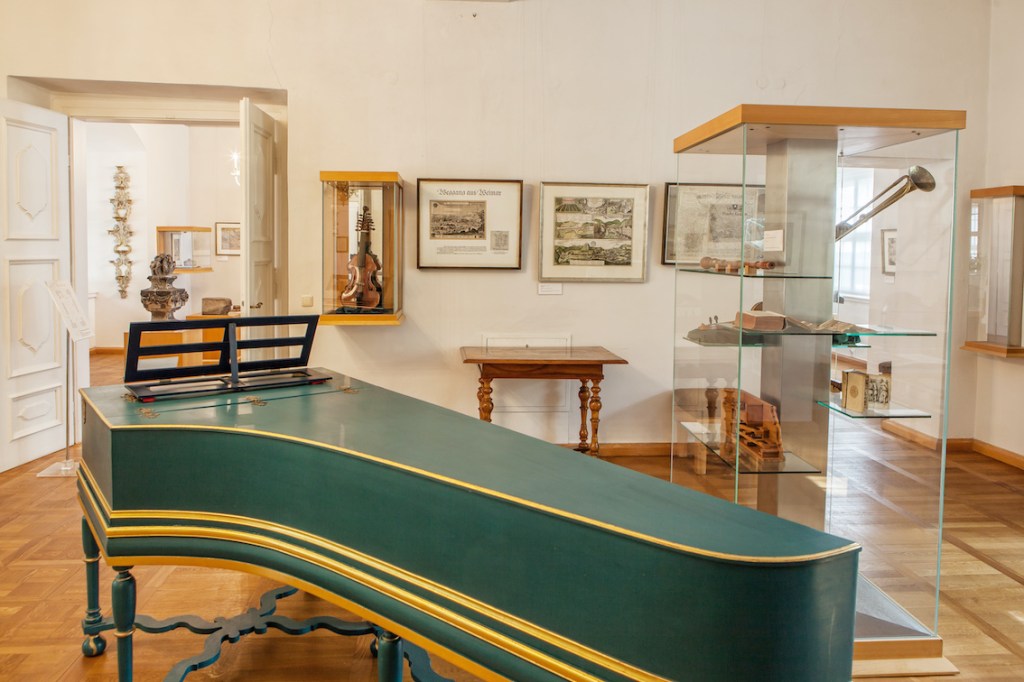
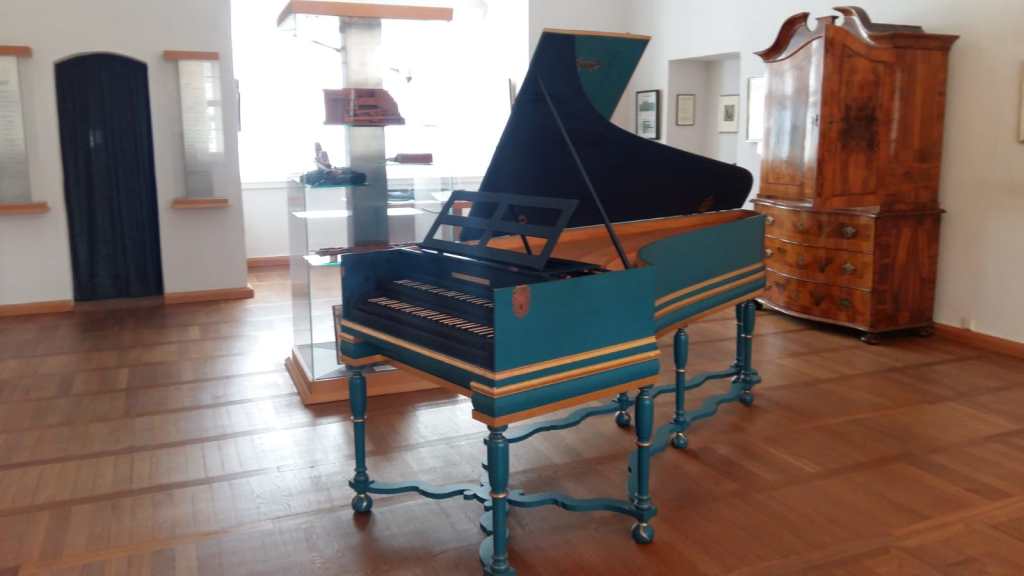
Many harpsichord builders have created copies of Bach’s “Mietke harpsichord.” In the video registration of the Prelude and fugue no. 3 in C-sharp major (BWV 872), Christine Schornsheim plays a terrific copy by Bruce Kennedy. The Köthen Castle had a copy made in 1992 by Martin-Christian Schmidt, pictured here:
For the picture at the top of this blog post I chose one of the very few original Mietke harpsichords that have survived to this day, the “White Mietke” at the Charlottenburg Castle in Berlin. It was built almost two decades earlier than Bach’s harpsichord, it only has one single keyboard, and it was decorated by the court painter at Charlottenburg.
Wieneke Gorter, August 23, 2023.
*manual = keyboard
About Weekly Cantata
I am a bilingual writer, publicist, choral singer, art and nature lover, happy wife, and blessed mother of two. I started this blog in 2016, inspired by my late mother’s love for Bach’s cantatas. After 23 years in the San Francisco Bay Area, I’m now back in the Netherlands.
If you are on social media, please follow me:
Please subscribe!
Please join my readers from all over the world and subscribe to this blog! Simply fill in your email address and you’ll receive an email every time I’ve published a new post. Thank you so much / Vielen Dank / Merci mille fois / 감사합니다 / 谢谢 / ありがとう / Mille grazie / Muchas gracias / Muito obrigado / Takk / Terima kasih / Dankuwel!
Designed with WordPress.com





 Weekly Cantata