Weekly Cantata

Weekly Cantata

Tag Archives: Peter Kooy

Many things to be proud of

26 Saturday Nov 2016

Posted by cantatasonmymind in Advent, Cantatas, Leipzig, Weimar

≈ 2 Comments

Tags

Advent, Bach, BWV 61, Christophe Pregardien, Eduard van Hengel, First Sunday of Advent, French ouverture, Harnoncourt, Leipzig, Luther, Nuria Rial, Peter Kooy, Seppi Kronwitter, Sybilla Rubens, Weimar

giotto-entry-into-jerusalem

The Entry into Jerusalem by Giotto, ca. 1305. Fresco in the Scrovengni Chapel, Padua, Italy.

Bach performed this cantata 61 Nun komm der Heiden Heiland in Leipzig on November 28, 1723, as a “rerun” of the first performance in Weimar in 1714. Why did he not write a new cantata? The prevailing scholarly answer is that Bach was giving himself a break from composing in between the three-week frenzy of cantatas 60, 90, and 70 and the new works (including a Magnificat) he was planning for the Christmas days.  I think Bach was proud of his Weimar cantatas, and I believe he wanted to show off the special features in this cantata to his colleagues and to the thousands of Lutherans that he knew would flock to the Leipzig churches on holidays.

I myself am proud of having followed Bach’s cantata writing of 1723 every week for the entire Trinity season. After all this listening and reading, I see a pattern in Bach reviving some of his Weimar cantatas on Leipzig feast days*, and I now look at cantata 61 Nun komm der Heiden Heiland in a new way.

This cantata had already been in my top five because of the moving interpretation of the soprano aria by Seppi Kronwitter (soprano) and Nikolaus Harnoncourt (cello) on the Harnoncourt recording from 1976. My mother loved this aria and played this recording many times, and I have fond memories of listening to it with her.

Harnoncourt-cello

I had always found the bass recitative that precedes it very charming, with the musical illustration of the knocking on the door, but not more than that.  I had seen this recitative in the context of all the Bach cantatas and passions that I knew, and had compared it with other typical Bach “Vox Christi” writing for bass. But those were all written after November 28, 1723.  So now, after having tried to place myself in the shoes of the Leipzig congregations for the entire 1723 Trinity season, I am fully aware that they had not heard a “Vox Christi” at all in any of the cantatas leading up to this one.** And thus I finally realize how it must not have been charming, but truly moving to them to hear this announcement presented in this way, on the first Sunday they started looking forward to the birth of Christ.

In the text of the recitative, Jesus says: “See, I am in front of your door! I’m knocking!” The librettist means the door of the believer’s heart, in which he’s planning to live. The pizzicato in the strings, as well as the staccato and the intervals in the voice part illustrate the knocking, and the dissonances at the beginning only resolve until the final “klopfe an.” The form of this recitative is highly unusual, and perhaps also something Bach wanted to show off in Leipzig.

However Bach’s greatest source of pride was probably the opening chorus of this cantata. To understand this, we need to do a mini music history class. First, in the 4th century, Ambrosius created the hymn Veni Redemptor Gentium, beautifully sung here on this video by Giovanni Vianini, director of the Schola Gregoriana Mediolanensis in Milan, Italy. Then, in 1524, Luther turned that hymn into Nun komm der Heiden Heiland, which sounds like this and which all Lutherans in Bach’s time knew very well.

In Weimar Bach had come into contact with French and Italian court music, and had adopted the habit of writing almost every opening chorus or opening sinfonia of his cantatas as a royal “entrada,” to show off his skills in French ouverture writing as well as to please the Duke.

So now Bach needed/wanted to merge the timeless hymn with a fashionable French ouverture. And the result is stunning. Or, as Eduard van Hengel says: Bach wrote “brilliant fusion” at the age of 29. Listen to this in the recording by Philippe Herreweghe on YouTube (Sybilla Rubens, soprano; Christoph Prégardien, tenor; Peter Kooij, bass).

Find the German text with English translations here and the score here.

The first line of the hymn is sung one voice part at a time, an illustration of the Bible reading for this Sunday: the people greeting the messiah who is riding into Jerusalem. The second line is then sung as a simple four-part hymn, while the instrumental parts keep playing the first part of the ouverture. The third line becomes a mini motet in the fast and happy (“Gai”) middle part of the ouverture, in 3/4. 

The fourth line of text is then again a simple four-part setting on the third part of the ouverture.

For the closing chorale, Bach chose the last two lines of Wie schön leuchtet der Morgenstern as melody. And again he marries the chorale tune beautifully with the instrumental writing.

Wieneke Gorter, November 26, 2016, updated December 1, 2019.

*Read more about this in my post about the feast of St. John the Baptist on June 24, The Visitation on July 2, and last week’s post about cantata 70. Read how proud Bach was of his Weimar cantatas in this post about cantata 12.

** unless they had a really good memory, and were present at Bach’s “audition” in February 1723. There is a Vox Christi in Cantata 22 which he presented at that time, but didn’t repeat in Leipzig until that same time in the church year in 1724.
Bach in Vienna / Robin Blaze going wild

06 Sunday Nov 2016

Posted by cantatasonmymind in 1723 Trinity season special series, Cantatas, Leipzig, Trinity

≈ Leave a comment

Tags

24th Sunday after Trinity, Bach Collegium Japan, BWV 105, BWV 60, Eduard van Hengel, Gerd Türk, Jason Victor Serinus, John Eliot Gardiner, Masaaki Suzuki, Peter Kooy, Robin Blaze, San Francisco Classical Voice, St. John Passion, St. Matthew Passion, Trinity 24

kokoschka_pieta

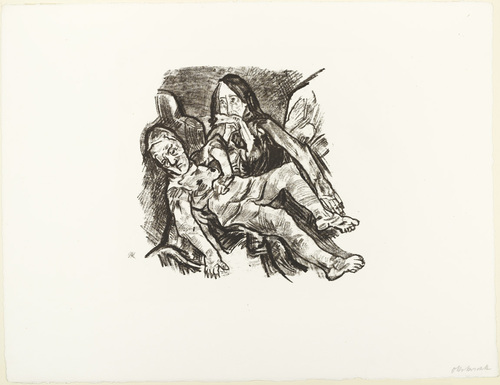
Pietà (It is enough) / Pietà (Es ist genug), plate 11 from a series of 11 lithographs O Ewigkeit, Du Donnerwort by Oskar Kokoschka, 1914/1916. Museum of Modern Art, New York.

In Vienna, they were all talking about Bach’s cantata 60 O Ewigkeit, Du Donnerwort. The astonishing harmonization in the closing chorale as well as the structure of a “dialogue” between Fear (alto) and Hope (tenor) made it one of the most unusual among his cantatas, and apparently something worth discussing. In the first half of the 20th century, that is. In 1935  Alban Berg used the “modern” harmonization from the closing chorale Es ist genug in the final movement of his violin concerto To the Memory of an Angel–an instrumental Requiem for Manon Gropius, daughter of Bauhaus architect Walter Gropius and Mahler’s widow, Alma Schindler.

Several years before, the same Alma Schindler had a short-lived affair with Czech painter Oskar Kokoschka. After they broke up, Kokoschka processed his torment by making a series of 11 lithographs to illustrate the cantata. The dialogue between Fear (the alto) and Hope (the tenor) in the cantata became a dialogue between Alma and himself, in pictures only: click here to see the entire series. Many thanks to Eduard van Hengel for pointing this out.

Listen to Bach Collegium Japan’s recording of this cantata on Spotify, with countertenor Robin Blaze and tenor Gerd Türk. Find the German text with English translations here, and the score here.

Bach wrote this cantata 60 O Ewigkeit, Du Donnerwort for the 24th Sunday after Trinity in 1723, the Sunday normally linked to the Gospel story of the Raising of Jairus’ Daughter. However, in 1723–as now in 2016–this day fell on the first Sunday in November: All Hallows Sunday, All Saints Sunday, however you want to call it, but the Sunday on which the congregation would have commemorated all who had passed away that year. None of the commentaries I have read mention this, but I think it is important, because I feel this cantata is much more about how horrible it might be to die, or the thoughts one has when sitting at a loved one’s deathbed, than it is about the Raising of Jairus’ Daughter.

Of all the recordings I listened to, I like Bach Collegium Japan’s the best, because of Robin Blaze’s interpretation of the alto part. I always love his voice, but he is usually quite understated in his singing. He explains this well in this interview on San Francisco Classical Voice. I sometimes wish he would indeed sing with Kate Bush and “let go” a little, so I was thrilled to hear that in this cantata he actually does go a bit wild, for his standards at least, and that Suzuki lets him do it. His conviction in the opening chorale is already terrific (also note the wonderful blend with the horn doubling his part), but the way he sings the text “Und martert diese Glieder” (and tortures these limbs) in movement 2 is amazing, spot-on, and unrivaled by any others I listened to.

As we have seen before in the course of these 1723 Trinity Season cantatas (read for example my post on cantata 105) there are elements of Bach’s passions already present in this cantata. The agitated singing of the tenor in the stunningly beautiful duet (movement 3) resembles the Ach, mein Sinn! tenor aria from the St. John Passion. The repeated tremolo in the violins in movement 1 is something Bach often uses to illustrate fear, and this will show up again in the tenor arioso O Schmerz! Hier zittert das gequälte Herz in his St. Matthew Passion.

For further reading, including all the amazing harmonies in this piece which impressed the Viennese composers of the early 20th century,  as well as other insights, I can highly recommend Gardiner’s journal entry about this cantata (start reading on page 5).

Wieneke Gorter, November 6, 2016, updated November 21, 2020

Tenor drama

16 Sunday Oct 2016

Posted by cantatasonmymind in 1723 Trinity season special series, Cantatas, Leipzig, Trinity

≈ Leave a comment

Tags

Bach, Damien Guillon, Dorothee Mields, John Eliot Gardiner, La Petite Bande, Leipzig, Paul Agnew, Peter Kooy, Phlippe Herreweghe, St. John Passion, Thomas Hobbs

bwv109_tenormanuscript

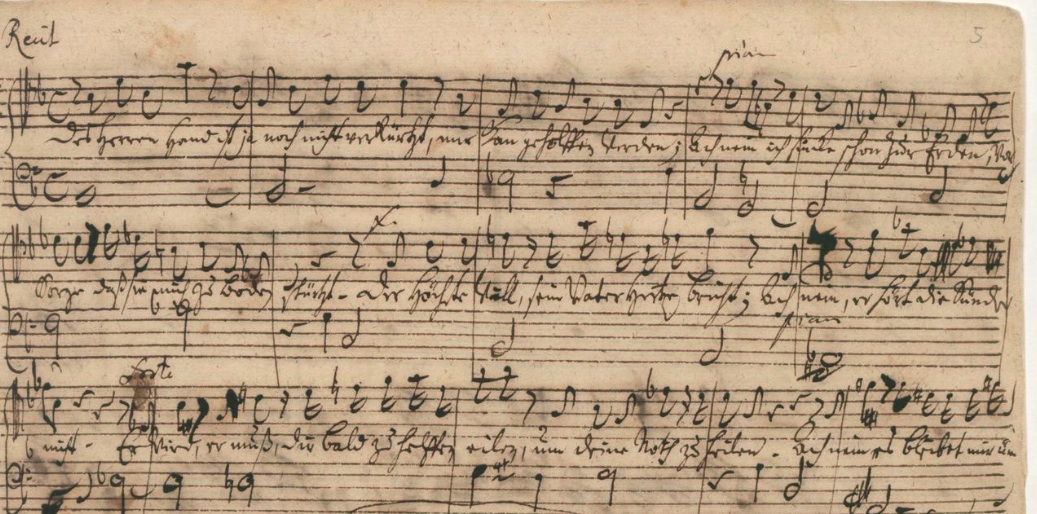
Excerpt from the start of the tenor recitative from cantata 109, with “piano” and “forte” marked. Staatsbibliothek zu Berlin, Preußischer Kulturbesitz

For this 21st Sunday after Trinity, Bach wrote cantata 109 Ich glaube, lieber Herr, hilf meinem Unglauben! in 1723.

For overall best performance, I recommend Herreweghe’s recording from 2013, with counter-tenor Damien Guillon and tenor Thomas Hobbs.

Listen to this recording on YouTube. To support the artists, please consider purchasing the entire album on Amazon — a good deal if you like this blog, as it also includes three cantatas I discussed here earlier this year: cantata 44, cantata 73, and cantata 48.

Read the German texts with English translations here, and find the score here.

I love Herreweghe’s interpretation of  the opening and closing chorus as well as Damien Guillon’s singing in the alto recitative and aria.

However, there is an extremely dramatic and unusual recitative and aria for tenor in this cantata which I like better on the Gardiner recording. The recitative is unusual because Bach has two voices/persons speak: the uncertain/fearful voice, marked “piano” in his manuscript (see picture above), and the certain/faithful voice, marked “forte” in the manuscript. According to Gardiner, this feature never appears anywhere else in Bach’s recitative writing.

Just as with the “Storm on the lake” aria from cantata 81, only Gardiner and the fabulous Paul Agnew are able to properly convey the drama of the text and context of this tenor recitative and aria. If at first you think this might be a bit over the top, it is most probably exactly what Bach had in mind. A bit of opera to properly bring out the agony of the text.

Listen to these two movements by Gardiner and Agnew on YouTube: the recitative here, and the aria here.

Bach might have been preparing the Leipzig congregations for the St. John Passion he was planning for Good Friday 1724, as this tenor aria is very similar in dramatic intensity and music to the Ach mein Sinn aria from that passion. Those who know the St. John Passion well might hear other resemblances in this cantata 109.


Wieneke Gorter, October 16, 2016

A Weimar cantata for Trinity 20

09 Sunday Oct 2016

Posted by cantatasonmymind in 1723 Trinity season special series, Cantatas, Leipzig, Trinity

≈ 2 Comments

Tags

Bach, Bach Collegium Japan, Leipzig, Makoto Sakurada, Peter Kooy, St. Matthew Passion, Trinity 20, Yoshikazu Mera, Yumiko Kurisu

Vornehme Hochzeitsgesellschaft

Vornehme Hochzeitsgesellschaft (Distinguished Wedding party) by Wolfgang Heimbach, 1637. Kunsthalle Bremen, Germany.

I’m in the middle of St. Matthew Passion concert weekend now with California Bach Society. To read more about the connection between this blog and Bach’s Great Passion, please see my post from last week.

This week, while doing dishes, packing dinners, promoting our concerts on Facebook, and making spreadsheets for the youth choir logistics, I listened to several recordings of the 1723 cantata for this Sunday: cantata 162 Ach! ich sehe, itzt, da ich zur Hochzeit gehe, and can safely say I recommend Bach Collegium Japan’s recording of this cantata. It has the most sensitive playing in the instrumental opening and the best interpretation of the bass aria and the soprano aria in my opinion.

Listen to the recording of cantata 162 by Bach Collegium Japan on Spotify. Soloists: Soprano: Yumiko Kurisu, Counter-tenor: Yoshikazu Mera, Tenor: Makoto Sakurada, Bass: Peter Kooy.

Read the text here, and find the score here.

Bach wrote this cantata in Weimar, and performed it there on October 25, 1716. For the performance in Leipzig on October 10, 1723, he added a corno da tirarsi to the instrumentation (the Bach Collegium Japan recording is based on the Weimar version, and thus doesn’t feature the corno da tirarsi).

A very short explanation of the cantata, thanks to Eduard van Hengel: Cantata 162 is based on the Gospel text for this Sunday: Jesus compares the heavenly kingdom with the wedding of a King’s son. Many guests decline the invitation, and several of those who do come are sent away because they are not properly dressed. Since the relationship between Jesus and the soul of the believer is compared to the bond between groom and bride, the believers will be at first concerned that they will not be allowed to join the wedding (cantata movements 1-3), but can then rejoice in their conviction that Jesus, through his suffering, will provide the proper dress for them (cantata movements 4-6).

To read more in Dutch, please go to Eduard van Hengel’s website; to read more in English, find Gardiner’s notes about this cantata here.

Wieneke Gorter, October 9, 2016. Updated October 21, 2023.

The Herreweghe sopranos

11 Sunday Sep 2016

Posted by cantatasonmymind in 1723 Trinity season special series, Cantatas, Leipzig, Trinity

≈ Leave a comment

Tags

Bach, cantatas, Collegium Vocale Gent, Dominique Verkinderen, Dorothee Mields, Hana Blazikova, John Eliot Gardiner, Mark Padmore, Peter Kooy, Phlippe Herreweghe, Trinity 16

bwv95_sopraan

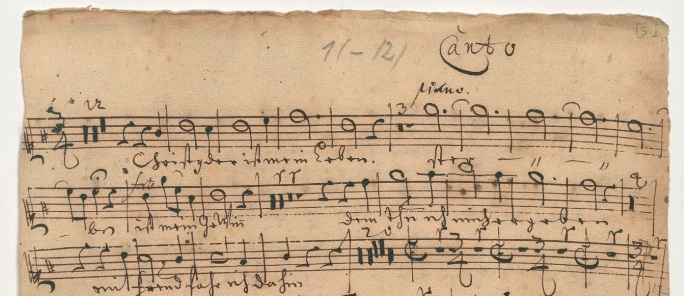
The soprano part of cantata 95 Christus, der ist mein Leben. Staatsbibliothek zu Berlin – Preußischer Kulturbesitz

After all his experimenting with the form of the cantata last week, Bach keeps exploring how he can build a cantata based on chorale melodies and chorale texts. As a result, this week’s cantata 95 Christus, der ist mein Leben again takes a unique place in Bach’s cantata collection: it features no less than four different chorales, all part of the Sterbe-lieder (Deathbed songs) that were very popular in Leipzig at the time: Christus, der ist mein Leben; Mit Fried und Freud, ich fahr dahin; Valet will ich dir geben; and Weil du vom Tod erstanden bist.

I recommend Herreweghe’s recording of this cantata. Listen to this recording on YouTube, or on Spotify. Support the artists and purchase this recording on Amazon. (Or find them in the Amazon stores  for  Germany and France)

Soloists: soprano Dorothee Mields, counter-tenor Matthew White, tenor Hans Jörg Mammel, bass Thomas E. Bauer. Choir sopranos: Dorothee Mields, Hana Blazikova, Dominique Verkinderen.

In the manuscript of the soprano part pictured above, it is interesting to note the dynamic markings for the text “Sterben ist mein Gewinn.” Dynamics are not very common in Bach manuscripts, but, as Alfred Dürr points out, Leipzig had a strong tradition of singing softly and slowly on the word “Sterben,” and singing loudly on “ist mein Gewinn,” going back at least to 1629. In that year, then Thomaskantor Johann Hermann Schein wrote this note for his singers:

“da singen sie adagio mit einem sehr langsamen Tactu, weiln in solchen versiculis verba emphatica enthalten” (here you should sing adagio in a very slow tempo, because verses like these contain emphatic words)

How Herreweghe’s sopranos sing this Sterben ist mein Gewinn in the first chorale takes my breath away, and this is the most important reason why I prefer this recording. Having grown accustomed to the boy choirs of the Leonhardt and Harnoncourt recordings in the 1970s, my parents, sister, and I were blown away by Herreweghe’s Collegium Vocale Gent when their first CDs started coming out in the late 1980s and early 1990s.

My mother was especially taken by the sound and blend of the sopranos, and “Herreweghe sopranos” became a household term in our family. After attending a performance by a different group, we would often say to each other: “it was nice, but they are not Herreweghe sopranos….,” and sigh a little.

This cantata is all about longing for life after death, and over the course of the cantata these statements are made: I will be happy to die (opening movement), because life on earth is worthless (soprano recitative). Saying goodbye to that will be freeing (soprano chorale), so please can I die as soon as possible (tenor recitative and aria), because death is only a sleep (bass recitative) from which I will wake up to join Jesus, who has gone before me (closing chorale).

The outstanding tenor aria features Bach’s signature “death bells” in the pizzicato strings. Bach uses these “Leichenglocken”  also in cantatas 73, 8, 105, 127, 161, and 198. For an alternative recording of this movement, with gorgeous singing by Mark Padmore, listen to the Gardiner recording on Spotify.

The concept of death being only a short period of sleep after which the dying person wakes up to meet Jesus in the afterlife was an extremely important part of 18th-century Lutheran faith. When dealing with death on a daily basis, it was comforting to believe that death would ultimately lead to paradise. And by stressing this concept, Bach also refers to the Gospel for this 16th Sunday after Trinity. It is the story of the miracle at Nain: a young man who has died  is carried out of the city and then woken up by Jesus.

Wieneke Gorter, September 11, 2016, updated October 7, 2025

Children’s stories

03 Saturday Sep 2016

Posted by cantatasonmymind in 1723 Trinity season special series, Bach's life, Cantatas, Leipzig, Trinity

≈ 1 Comment

Tags

according to Lutheran Church year, Bach, Bach-Archiv Leipzig, BWV 138, cantatas, Collegium Vocale Gent, Damien Guillon, Deborah York, Dorothee Mields, Eduard van Hengel, Hana Blazikova, Ingeborg Danz, Leipzig Bach Festival, Lutheran Church year, Mark Padmore, Peter Kooy, Phlippe Herreweghe, Thomas Hobbs, Trinity 15

Bergrede_Brueghel

The Sermon on the Mount, oil on copper painting by Jan Brueghel the Elder, 1598

In 1723 Bach wrote cantata 138 Warum betrübst du dich, mein Herz.  Again I prefer Herreweghe’s interpretation, but it’s not so easy to choose between his recording from 1998 (with soloists Deborah York, Ingeborg Danz, Mark Padmore, and Peter Kooij) and the one from 2013 (with soloists Hana Blazikova, Damien Guillon, Thomas Hobbs, and Peter Kooij). Update from 2021: there now is an extremely inspired Herreweghe recording with all my favorite soloists (Dorothee Mields, Alex Potter, Guy Cutting, Peter Kooij), recorded live at De Singel in Antwerp on Sunday January 31, 2021 (during the Covid19 pandemic, so without audience). Find it here.

Listen to the entire 1998 recording on Youtube or listen to one long track of the 2013 recording with Hana Blazikova and Damien Guillon on YouTube. Please consider supporting the artists by purchasing the 1998 version (used copies available only) or the 2013 version  on Amazon.

Find the text, based on the Sermon on the Mount, of this cantata here, and the score here.

It is often not immediately clear what a Bach cantata is about, what the text means, or what Bach wanted to convey with it. In an absolutely wonderful interview (with excellent English subtitles) for the Leipzig Bach Festival, soprano Dorothee Mields says that even she, as a native German speaker, often feels the need to look at English translations, go back to the Bible texts, and read more about the subject, because she didn’t necessarily recognize the text from her children’s bible.

The image of the children’s bible stuck with me since first watching the interview seven months ago. And when listening to the cantata for this Sunday, I had to think of it again, because the choice of words in this cantata is very moving, but at the same time so simple, that it is almost as if the librettist is speaking to children. Listen, for example, to the text the soprano sings in the third movement:

Nur ich, ich weiss nicht, auf was Weise ich armes Kind mein bisschen Brot soll haben; Wo ist jemand, der sich zu meiner Rettung findt?

(It is just that I, poor child, don’t know how I should receive a bit of bread; Where is the person who will save me?)

Eduard van Hengel hilariously remarks that it reminds him a bit of Calimero (a popular children’s cartoon about a little chick, which aired in The Netherlands, Belgium, France, and Italy in the early 1970s. Watch this first episode to get an idea).

I wonder who the librettist for this cantata was. I imagine a different person than who wrote texts for the last few cantatas. Last week, the Bachs possibly had their house full with the families of Anna Magdalena’s brother and sisters, visiting because the men, all trumpet players, were needed for two cantatas. Perhaps one of the visitors had talent for entertaining the children with stories and making up poems on the spot? Did Bach ask this person to write the libretto for this cantata? Or was his own head still filled with children’s stories and did he write the text himself?

These are all just assumptions and we don’t know for sure if last week’s extra players were the relatives of Bach’s wife, but my potential movie script is getting better and better …

There’s of course more to this cantata than the charming texts. Musically, as far as the form and structure is concerned, this cantata is unique within this first cycle of Leipzig cantatas. Bach takes a chorale as the base for the cantata, yet it is not at all the same as his series of chorale cantatas from the 1724/1725 cycle. In those later chorale cantatas, he always uses all the verses and keeps a strict structure of one soloist per movement. In this cantata 138, he only uses three verses of the chorale, and gives the cantata a very free form, with a different number of soloists for each movement. He is obviously experimenting. And I wonder again: might he have been influenced by his visitors from last week? Did he have discussions about his compositions with his colleagues? And how is this playing around with the form of the cantata related to using a different librettist or no librettist? Did he not want to bother a professional writer with his experimenting?

There is one more–for me at least–exciting aspect to this cantata: when I first started listening to it, I discovered that I already knew the bass aria. Same singer (Peter Kooij) and same music, but a different text, because I had until then only heard this as the Gratias from Bach’s Mass in G Major, BWV 236 from the mid 1730s. Listen to both, and marvel at Bach’s talent for subtle recycling.

Wieneke Gorter, September 3, 2016, updated September 19, 2020 and February 13, 2021.

Christmas in August

27 Saturday Aug 2016

Posted by cantatasonmymind in 1723 Trinity season special series, Bach's life, Cantatas, Leipzig, Trinity

≈ Leave a comment

Tags

according to Lutheran Church year, Anhalt-Zerbst, Anna Magdalena Bach, Bach, Bruce Dickey, cantatas, City Council, Collegium Vocale Gent, concerto palatino, cornetto, Deborah York, Eduard van Hengel, Hana Blazikova, Ingeborg Danz, Köthen, Leipzig, Lutheran Church year, Mark Padmore, Peter Kooy, Phlippe Herreweghe, Ratswechsel, recorder, Saxe-Weissenfels, Thomas Hobbs, Trinity 14, trombone, trumpet, Wilcke

gesu_lebbrosi
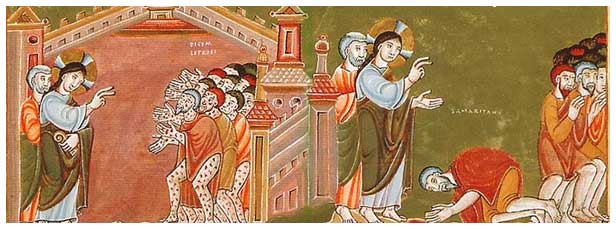
Jesus heals ten lepers, from the Codex Aureus of Echternach, c. 1035-1040

Only a handful of Bach cantatas ask for the Renaissance/Early Baroque ensemble of one cornetto and three trombones in the opening and closing chorus. This instrumentation was considered somewhat “old fashioned” in Bach’s time, while at the same time it was still very normal in cities to hear Stadtpfeifers (city pipers) play chorales from the towers during the day, to remind the citizens of their Christian duties. In this Cantata 25 Es ist nichts Gesundes an meinem Leibe, for the 14th Sunday after Trinity (August 29 in 1723), the playing of the chorale tune by this ensemble in the opening chorus stands for the way it has always been, the way it has been true for centuries.

palatino
Concerto Palatino, the leading cornetto/trombone ensemble for the past 25 years. Photo by Sabrina Flauger. Learn more about them here.

My preferred recording of Cantata 25 is the one by Herreweghe, on the same album as cantata 105 for Trinity 9 and cantata 46 for Trinity 10, as well as cantata 138 for next week. Soloists in cantata 25: soprano Hana Blažíková, tenor Thomas Hobbs, and bass Peter Kooij. Cornetto: Bruce Dickey  (pictured above, front row, on left); trombones: Claire McIntyre, Simen van Mechelen (pictured above, top row, on left), and Joost Swinkels.

Listen to this recording on Spotify or on YouTube. Please consider supporting the artists by purchasing this album (containing four cantatas for this 1723 Trinity season) on Amazon.

Read the text of this cantata here, and find the score here.

I could write an entire blog post about the opening chorus alone, the way I did last week for cantata 77 and two weeks earlier for cantata 179. But in the interest of variety, I’m going to keep this section short, and I will just say that the opening chorus  is an incredible, unrivaled complex composition for ten voices, again completely different than any opening chorus the Leipzig congregations had heard before during this Trinity season of 1723. By having the “ancient” brass quartet play the chorale melody of Herzlich tut mich verlangen nach einem selgen End (With my whole heart I long for my blessed End / my Salvation)** Bach shows that the promise of salvation after death will always provide a silver lining to the sorrow of the daily, sinful human condition. He also illustrates this “salvation” with the recorders in the uplifting and soothing soprano aria (Hana Blažíková in top shape!), and the brass and recorders in the closing chorale, and intensifies the “sickness” of the human sins by setting these texts to “dry” recitatives  (though listen to that bass arioso, beautifully sung by Peter Kooij) in between. Again, it was completely normal in his day and age to think this way, and Bach saw it as his mission in life to teach this theology to his fellow Lutherans by way of his church music.

But, listen to the festive, large orchestra for this cantata! No less than four brass players (one cornetto and three trombones) and five wind players (two oboists and three recorder players) were required at the same time in the opening chorus and closing chorale. For a cantata about the healing of ten lepers? Well, it turns out that this weekend it was Christmas in August for Bach, and the extra players were probably in town for the much more important and incredibly festive Cantata 119 Preise, Jerusalem, den Herrn that was on the calendar for the next day, Monday August 30, the day of the inauguration of the new City Council (Ratswechsel). *** As I already suggested in my post about cantata 147, Bach might have sometimes used guest musicians in his orchestra who were in town for other reasons, and judging from the level of playing required for the Brandenburg concerto-like Cantata 119, the extra brass (all playing trumpet in 119) and wind (playing oboe and recorder in 119) players might have been needed to be of the level of court chamber musician, not just Stadtpfeifer (usually a lower rank, and not necessarily used to playing the complicated court music). So in my probably not so unlikely movie script fantasy, Bach hired musicians from the not too far away courts where he had worked before or where his in-laws worked (Köthen, Weissenfels, Zerbst) to play in the orchestra on Monday August 30, and he had asked them to also play in the service on Sunday August 29.

Listen to the Ratswechsel cantata 119 Preise, Jerusalem, den Herrn by Herreweghe on YouTube. (Soloists: soprano Deborah York; alto Ingeborg Danz; tenor Mark Padmore, bass Peter Kooij.)

Wieneke Gorter, August 24, 2016, updated September 8, 2023.

** Several writers have suggested the chorale best known to the congregation at the time (on the melody we have later come to know as O Haupt voll Blut und Wunden) would have been instead Ach Herr, mich armen Sünder, but I agree with Eduard van Hengel that because of Bach’s use of the angel-like recorders and the heavenly brass it makes more sense to go with Herzlich tut mich verlangen nach einem selgen End.

*** The new city council was always chosen on August 24, and then inaugurated on the first Monday following August 24, which was Monday August 30 in 1723.

About Weekly Cantata

I am a bilingual writer, publicist, choral singer, art and nature lover, happy wife, and blessed mother of two. I started this blog in 2016, inspired by my late mother’s love for Bach’s cantatas. After 23 years in the San Francisco Bay Area, I’m now back in the Netherlands.

If you are on social media, please follow me:

  • Facebook
  • Instagram

Please subscribe!

Please join my readers from all over the world and subscribe to this blog! Simply fill in your email address and you’ll receive an email every time I’ve published a new post. Thank you so much / Vielen Dank / Merci mille fois / 감사합니다 / 谢谢 / ありがとう / Mille grazie / Muchas gracias / Muito obrigado / Takk / Terima kasih / Dankuwel!

Designed with WordPress.com

A most amazing trumpet part

21 Sunday Aug 2016

Posted by cantatasonmymind in 1723 Trinity season special series, Bach's life, Cantatas, Leipzig, Trinity

≈ Leave a comment

Tags

Anhalt-Zerbst, Anna Magdalena Bach, Bach, Bach Collegium Japan, BWV 635, BWV 678, BWV 679, BWV 75, BWV 76, BWV 77, Gottfried Reiche, John Eliot Gardiner, Köthen, Kirsten Sollek, Luther, Lutheran Church year, Masaaki Suzuki, organ preludes, Peter Kooy, Saxe-Weissenfels, slide trumpet, Toshio Shimada, tromba da tirarsi, trumpet, Wilcke

master_of_the_good_samaritan_001
The Good Samaritan by “the Master of the Good Samaritan,” Dutch, 1537

To fully appreciate today’s cantata, I encourage you to first listen to Luther’s hymn,  Dies sind die heil’gen Zehn Gebot (These are the holy Ten Commandments). I was not familiar with this tune, and had to do some research to understand what the slide trumpet was playing in the opening chorus. It was a very well-known hymn in Bach’s time. The Leipzig congregations sang it many times a year, and also sang it during the church services on Sunday August 22, 1723, the 13th Sunday after Trinity (probably preceded by an organ prelude in the style of BWV 635, see below). It was an important hymn for Bach. You can listen to his own chorale setting of it here.

It is also worthwhile to listen how Bach used this melody in three very different organ works: BWV 635, BWV 678, and BWV 679. He wrote BWV 635 as part of the Orgelbüchlein, in Weimar, the other two in the mid 1730s as part of the Clavier-Übung III.

The cantata for this Sunday, cantata 77 Du sollt Gott, deinen Herren, lieben features this chorale-tune in the opening chorus, but only in the tromba da tirarsi (slide trumpet) part and the continuo part. In the continuo it appears in long notes, and is not as clearly audible as in the trumpet part. There are exactly ten entrances for the trumpet within that opening chorus, the last time featuring the entire chorale tune, of course pointing to the ten commandments.

Bach Collegium Japan’s recording showcases this feature the best of all recordings I listened to, superbly played by Toshio Shimada, on a real tromba da tirarsi. I also like his playing the best in the alto aria. Listen to this recording on Spotify or on YouTube.

Read the text here, and find the score here.

John Eliot Gardiner suggests that Bach made a theological statement by presenting his first two Trinity cantatas in Leipzig,  75 for Trinity 1 (focusing on the love of God/how to be before God) and 76 for Trinity 2 (focusing on brotherly love/how to love one’s neighbor) in close relation to each other, and that all through this 1723 Trinity season he has tried to reinforce the idea that those themes are connected, and how the believers should apply the laws from the Bible to themselves and to their own daily lives. He further argues that with this opening chorus he comes full circle back to that connection, by using a double fugue, by reminding the listeners of the “law” by way of the chorale in  the trumpet part, and by setting the text of the Gospel immediately preceding the parable of the Good Samaritan (Luke 10):

27. Er antwortete und sprach: Du sollst GOtt, deinen HErrn, lieben von ganzem Herzen, von ganzer Seele, von allen Kräften und von ganzem Gemüt und deinen Nächsten als dich selbst.

[27] And he answering said, Thou shalt love the Lord thy God with all thy heart, and with all thy soul, and with all thy strength, and with all thy mind; and thy neighbour as thyself.

After the bass recitative and soprano aria further elaborating on the “Love for God”-theme, and the tenor aria on the “Good Samaritan / Love your neighbor”-theme, we are treated to the most amazing tromba da tirarsi playing of all Bach cantatas written for this instrument, in this very unusual and humble alto aria, beautifully sung by mezzo-soprano Kirsten Sollek, and expertly played on the slide trumpet by Toshio Shimada.

This is an incredibly difficult part for the tromba da tirarsi, and almost impossible to play well on a “regular” Baroque trumpet. Was this Bach’s way of illustrating the “Unvolkommenheit” in the text? Would even Reiche not have been able to play this perfectly, with only a few days rehearsal time? And/or did Bach want people in the church to pay attention, so that this would be a true moment of reflection in the service?

In the region where Bach lived and worked, the trumpeters were very good, and Bach knew them and their world well, especially since he had married into a trumpet family in 1721. All the men in Anna Magdalena Wilcke’s family that we know of (father, brother, and husbands of all three sisters) were well-regarded trumpeters at the Anhalt-Zerbst court, about 17 miles (28 km) directly north of Köthen, and the Saxe-Weissenfels court, about 22 miles (35 km) south-west of Leipzig. The trumpeters in Leipzig were all Stadtpfeifer, employed by the city, and thus not always available to him.

Wieneke Gorter, August 20, 2016, updated August 28, 2023.

Trumpets and timpani on a regular Sunday

14 Sunday Aug 2016

Posted by cantatasonmymind in 1723 Trinity season special series, Bach's life, Cantatas, Leipzig, Trinity

≈ Leave a comment

Tags

according to Lutheran Church year, Bach, Bach Collegium Japan, cantatas, John Eliot Gardiner, Lutheran Church year, Masaaki Suzuki, Peter Kooy, Toshio Shimada, Which cantata which Sunday

healingdeafmuteDecapolis

Jesus healing a deaf and mute man at Decapolis, by Bartholomeus Breenbergh, 1635

Last week, Bach gave his principal trumpet and horn player Gottfried Reiche a little break, but this week he needs him back: after the “old style” church motet opening chorus for Trinity 11, this week’s cantata for Trinity 12 opens with festive trumpets and timpani.

Listen to this cantata 69a Lobe den Herrn, meine Seele in the recording by Bach Collegium Japan on Spotify, with Toshio Shimada on trumpet.

Find the text here, and the score here.

Even though the text of the Gospel for this Sunday, the story of Jesus healing a deaf and mute man, is a jubilant one, it is still unusual that for a “regular” Sunday Bach would use three trumpets and timpani in the orchestra. Had the council complained about him teaching too much of his stern theology, being too somber, in the past cantatas? Was perhaps Anna Magdalena’s father (the principal trumpeter at the court of Saxe-Weissenfels, and most probably a friend of Reiche, who was from that same region) in Leipzig to see his daughter and grandkids, and wanted to play in the orchestra with his friend? Again, all good material for a movie script …

In his journal of their cantata pilgrimage in 2000, John Eliot Gardiner writes that the trumpet part in the opening chorus makes him think of the last seven bars of the Cum Sancto Spiritu from the Mass in B minor. I agree, but the start of this opening chorus also really makes me think back to cantata 147 for the feast of the Visitation of Mary on July 2.

Just like last week’s cantata, and many other cantatas from this period, today’s composition ended up in Bach’s top 15, in the sense that he re-used it many times afterwards, and reworked it into important other works. In this case he changed the tenor aria with oboe da caccia and recorder into an alto aria for oboe and violin for a performance in 1727, and reworked the entire cantata into a celebratory cantata for the re-election of the council in 1749 (BWV 69).

Wieneke Gorter, August 14, 2016.

Trinity 10: my favorite counter-tenor in the spotlight

30 Saturday Jul 2016

Posted by cantatasonmymind in 1723 Trinity season special series, Cantatas, Leipzig, Trinity

≈ Leave a comment

Tags

according to Lutheran Church year, Bach, BWV 105, BWV 244, BWV 46, cantatas, Collegium Vocale Gent, Damien Guillon, Hana Blazikova, Kooy, Lutheran Church year, Mass in B Minor, Peter Kooy, Philippe Herreweghe, St. Matthew Passion, Thomas Hobbs, Which cantata which Sunday, Which cantata which week

For this Sunday, Trinity 10, August 1, 1723 Bach wrote cantata 46 Schauet doch und sehet, ob irgend ein Schmerz sei.

This is another exquisite cantata, worth listening to (or worth watching for a bit, see link below for a wonderful video of the opening chorus by Herreweghe live at the Saintes Festival).

I recommend Herreweghe’s recording from 2012, on the same album already discussed in my previous post for cantata 105.

Purchase this recording on Amazon (the album also includes last week’s cantata 105, and two more cantatas from the 1723 Trinity season).

Listen to this Herreweghe recording from 2012 on Spotify.

Or, listen to this same recording on YouTube, via playlist I created (if this shows up as a visual on your screen,  and clicking on the main “play button” results in a “this video cannot be played” message, click on the icon on the top left where it says 1/6, and it should work):

Or watch these same performers in a live video of the opening chorus only from the Festival de Saintes.

Please find the text here, and the score here.

I especially enjoy this cantata because of the beautiful opening chorus, the dramatic bass aria (with terrific tromba da tirarsi playing by Alain de Rudder), and the alto aria.

You’ll recognize the first part of the opening chorus. Bach must have liked this enough to re-use it later as the Qui Tollis in his Mass in B minor. The illustration of the “Schmerz” with two recorders and two oboi da caccia in the orchestra is beautiful.

Last week, with cantata 105, Bach started using features that preluded his passions. In the alto aria in this cantata 46, there is again a reference to the St. Matthew Passion. The pastoral character of the music, as well as the text reference to Küchlein (chicks) make me think of the Sehet Jesus hat die Hand alto aria. I am a huge fan of counter-tenor Damien Guillon. In 2011, I heard him sing for the first time in a live performance of the St. Matthew Passion by Herreweghe in Europe, and have been collecting his recordings since then. He appears on recordings with his own ensemble Le Banquet Celeste, cantata recordings by Herreweghe from 2011 and later, and on several recordings of Marcel Ponseele’s ensemble Il Gardellino. Watch an interview with him (with English subtitles) on YouTube:

Wieneke Gorter, July 30, 2016, links updated August 10, 2023.

← Older posts
Newer posts →

Recent Posts

  • “Missa Miniatura” by CONTINUUM/Elina Albach Even More Moving in 2025
  • Bachfest Leipzig 2025
  • Bach Cantatas for Christmas – 1724 and 1734 editions
  • Fourth Sunday of Advent – more insight into Cantata 62 helped me better understand Bach’s Christmas Oratorio
  • Saint Ambrose and Luther in Milan – Second Sunday of Advent

Archives

  • August 2025
  • July 2025
  • December 2024
  • November 2024
  • June 2024
  • January 2024
  • December 2023
  • October 2023
  • September 2023
  • August 2023
  • April 2022
  • February 2022
  • January 2022
  • December 2021
  • November 2021
  • June 2021
  • May 2021
  • April 2021
  • February 2021
  • January 2021
  • December 2020
  • November 2020
  • October 2020
  • September 2020
  • August 2020
  • July 2020
  • May 2020
  • April 2020
  • March 2020
  • February 2020
  • January 2020
  • December 2019
  • November 2019
  • May 2018
  • April 2018
  • March 2018
  • February 2018
  • January 2018
  • December 2017
  • November 2017
  • October 2017
  • September 2017
  • August 2017
  • July 2017
  • June 2017
  • May 2017
  • April 2017
  • March 2017
  • February 2017
  • January 2017
  • December 2016
  • November 2016
  • October 2016
  • September 2016
  • August 2016
  • July 2016
  • June 2016
  • May 2016
  • April 2016
  • March 2016
  • February 2016
  • January 2016

Enter your email address to follow this blog and receive notifications of new posts by email.

Join 338 other subscribers

Categories

  • 1723 Trinity season special series
  • Advent
  • After Easter
  • Ascension
  • Bach's life
  • Cantatas
  • Chorale cantatas 1724/1725
  • Christmas
  • Easter
  • Epiphany
  • Following Bach in 1725
  • Köthen
  • Leipzig
  • Septuagesima
  • Travel
  • Trinity
  • Weimar

Meta

  • Create account
  • Log in
  • Entries feed
  • Comments feed
  • WordPress.com

Website Built with WordPress.com.

  • Subscribe Subscribed
    • Weekly Cantata
    • Join 158 other subscribers
    • Already have a WordPress.com account? Log in now.
    • Weekly Cantata
    • Subscribe Subscribed
    • Sign up
    • Log in
    • Report this content
    • View site in Reader
    • Manage subscriptions
    • Collapse this bar
 

Loading Comments...